Coo-ee article in Journal of the Ashfield & District Historical Society Inc.

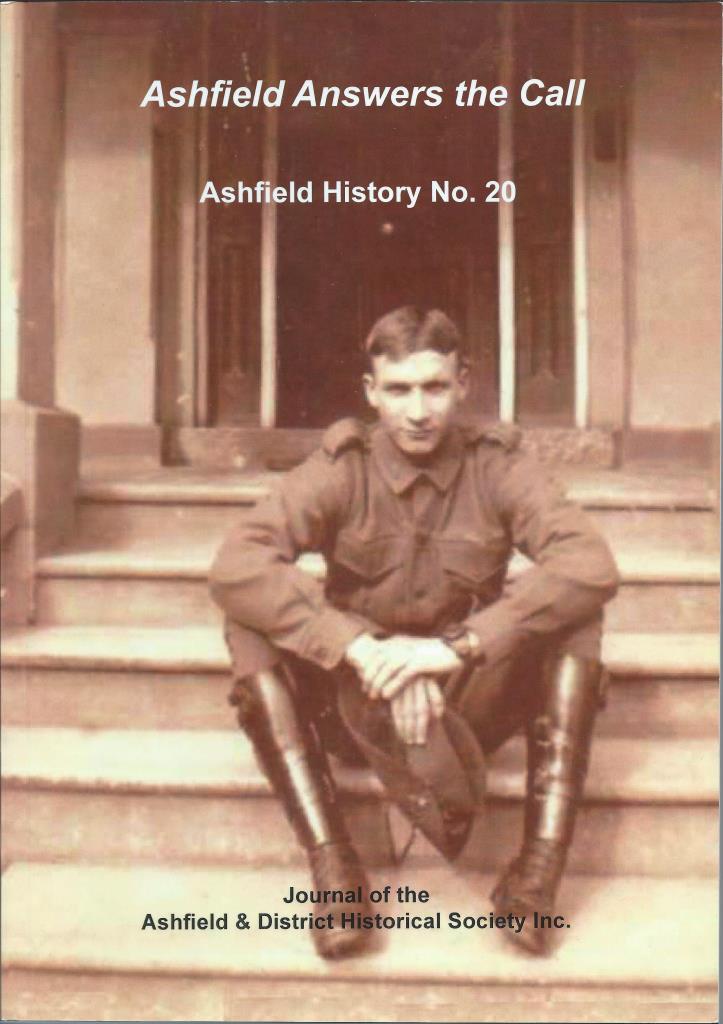
‘Coo-ee!’ article in Ashfield History No. 20, Journal of the Ashfield & District Historical Society Inc.

Ashfield History No 20, published by Ashfield & District Historical Society Inc., November 2015.

Ashfield History No 20, published by Ashfield & District Historical Society Inc., November 2015.

A very interesting 31 page article titled ‘Coo-ee’, written by Ann O’Connell, has been published in ‘Ashfield Answers the Call’, Ashfield History No. 20, Journal of the Ashfield and District Historical Society Inc.

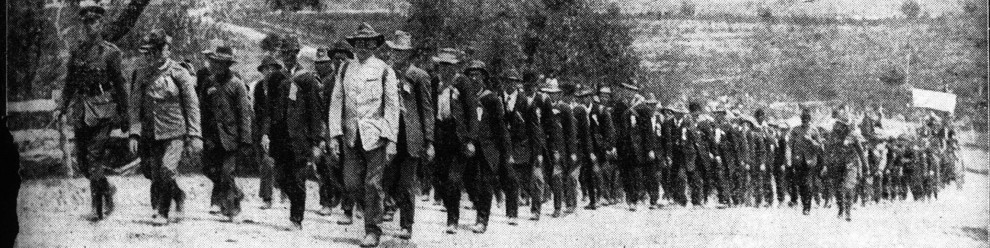
Written from an Ashfield perspective, this provides a very informative overview of the 1915 Coo-ee March,  with information about the march from its beginning in Gilgandra to its end in Sydney, and the 22 recruits who joined the Coo-ee March at Ashfield.  The article also includes lots of very interesting illustrations, including some photographs which have not been published before being printed in this article.

These include photographs from the personal family albums of Lieutenant Frank Middenway’s daughters, now held by his granddaughters, Dorothy Clampett and Margaret Murden.  One of these photographs is of the Coo-ees marching in a procession in front of the Bathurst Court House, in Russell Street, Bathurst, and one of the ‘Coo-ees near Wang’, showing local people with pushbikes, horses and sulkies, greeting the Coo-ees on a country road near Wallerawang (both on page 42).

Lieutenant Middenway, from Lithgow Army Camp, accompanied Captain Eade and Staff Sergeant Major Scott from Lithgow to Sydney, to assist with recruitment on the Coo-ee March.[1] His signature as Attesting Officer is on many of the Coo-ees’ Attestation Papers in their service records.

This article also includes photographs of the Ashfield Drill Hall, where the Coo-ees stayed overnight on 11th November 1915.

There is also a photograph of one of the purple Coo-ee “badge” ribbons that has been kept in Lieutenant Middenway’s family album.

This journal issue is available from sale for $20.00 plus $10.00 postage and handling from the Ashfield & District Historical Society, PO Box 20, Ashfield, NSW 1800. See their publications page for further information:   http://users.tpg.com.au/adhsashfield1/ADHS-publications.htm

[1] ‘General’, Lithgow Mercury, 3 November 1915, p. 2, http://nla.gov.au/nla.news-article218452406


TIMELINE April 1916

TIMELINE April 1916

Saturday, 1 April 1916

Joseph ARMSTRONG, Percy George BROWN, Charles William Gordon CONROYEdwin Joseph FULLER, John MARTIN, Donald Singleton STEWART, John TARLINGTON,  John William THOMPSON,  William Charles WALKER, Joseph Patrick WALLIS, and Colin David WREN, the Coo-ees who on 16th February 1916 had embarked for Egypt on the HMAT Ballarat A70 as 14th reinforcement for the 13th Battalion, were all transferred to the 54th Battalion at Ferry Post, Egypt.

Sunday, 9 April 1916

Lewis LEOVILLE and five other Coo-ees embarked from Sydney on the HMAT A71 Nestor.

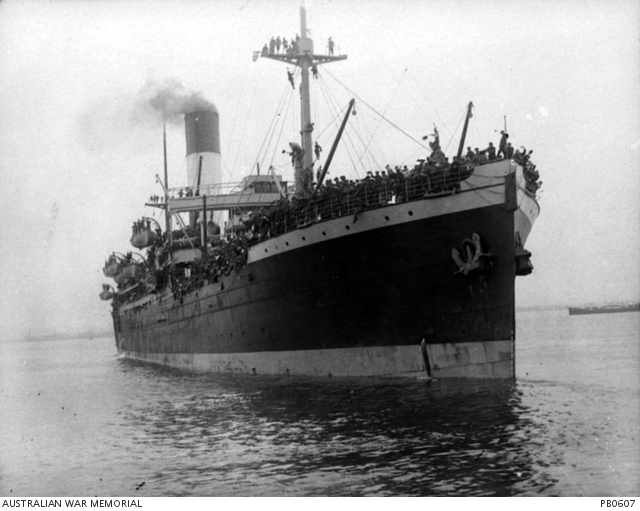
Photograph of HMAT A71 Nestor loaded with troops on an earlier voyage, taken 11 October 1915. Part of the Australian War Memorial Collection. PB0607.

Photograph of HMAT A71 Nestor loaded with troops on an earlier voyage, taken 11 October 1915. Part of the Australian War Memorial Collection. PB0607.

Tuesday, 11 April 1916  

The bulk of the Coo-ees arrive at Alexandra in Egypt on the HMAT A15 Star of England.

Friday, 14 April 1916

William Thomas HITCHEN embarked from Sydney on the HMAT A14 Ceramic.

Sunday, 16 April 1916    

Joseph PARRISH , Karl Alex Frederick NIELSON and John QUINN transferred to the 4th Pioneer Battalion in Egypt.

Tuesday, 18 April 1916  

William Henry NICHOLLS and two other Coo-ees embarked from Sydney on the HMAT A56 Palermo.

Wednesday, 19 April 1916          

Harold BAXTER,  Harold Brooks DAVIS and Alan Chesher JOHNSON (Alan Cheshyre JANION) transferred to the 45th Battalion in Egypt.

Sunday, 25 April 1916

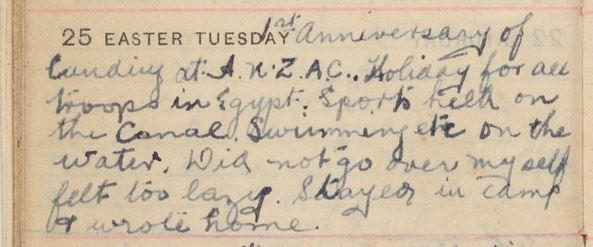
First anniversary of the landing of Australian troops at Gallipoli.  William Hilton SAUNDERS had wrote in his diary about his experience on the first Anzac Day held on 25th April 1916, where a sports day was held in the Australian camp in Egypt where he and the other Coo-ees were in training. He wrote the following words:

W. H. Saunders diary entry 25/4/1916 (Image part of the State Library of NSW collection)

W. H. Saunders diary entry 25/4/1916 (Image part of the State Library of NSW collection)

April 1916: 25 Easter Tuesday. “1st anniversary of landing at A.N.Z.A.C. Holiday for all troops in Egypt. Sports held on the Canal. Swimming etc. on the water. Did not go over myself felt too lazy. Stayed in camp & wrote home.”

Wednesday, 26 April 1916          

Ronald Hector PERKINS and another Katoomba Coo-ee embarked from Sydney on the HMAT A39 Port Macquarie.

Ronald Hector PERKINS

Ronald Hector PERKINS

Per his military service record (regimental no. 2472), Ronald Hector Perkins was born at Katoomba, N.S.W. He gave his age as 21 years and 4 months, his marital status as single, and his occupation as carrier’s employee. His description on his medical was height 5 feet 7 inches tall, weight approximately 180 lbs., with a fresh complexion, blue eyes, and brown hair. His religious denomination was Congregational. He claimed that he had no previous military service ‘excepting compulsory training’. He completed his medical on the 5th November 1915 at Katoomba, and was attested at Katoomba by Lieutenant F. Middenway on the same day.

He was named in The Blue Mountain Echo as one of the recruits who joined the Coo-ees at Katoomba.[1]

After completing the march he went to Menangle Park Camp as reinforcement for the 6th Light Horse Regiment.

On his embarkation roll his address at time of enrolment was Bent Street, Katoomba, N.S.W., and his next of kin is listed as his mother, Mrs Fanny Perkins, at the same address.

On 26th April 1916 Trooper Perkins departed Sydney on the HMAT Port Macquarie A39.

After arriving at Suez in Egypt, on 21st June 1916 Trooper Perkins was taken on strength with the 2nd Light Horse Training Regiment at Te-el-Kebir.

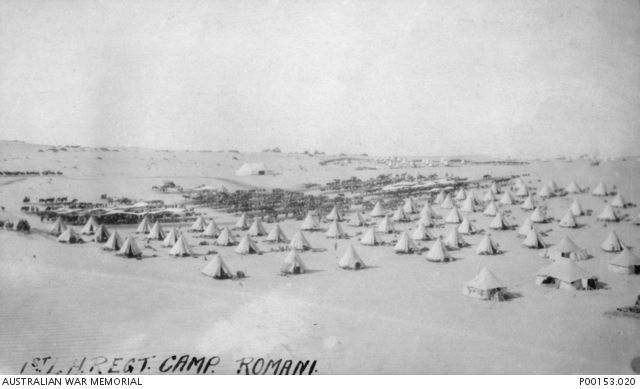
On 5th July 1916 Trooper Perkins transferred to the 1st Light Horse Regiment at Romani in Palestine.

Photograph of ‘Horse and tent lines of the 1st Australian Light Horse Regiment’, Romani Area, ca. August 1916. Part of the Australian War Memorial Collection. P00153.020

Photograph of ‘Horse and tent lines of the 1st Australian Light Horse Regiment’, Romani Area, ca. August 1916. Part of the Australian War Memorial Collection. P00153.020

The 1st Light Horse Regiment participated in the Battle of Romani 3-5th August 1916.[2]

On 6th August 1916 Trooper Perkins was admitted to the 1st Australian Stationary Hospital at Ismallia, Egypt, with an injury to his left shoulder. On 9th August 1916 he was transferred to the 3rd Australian General Hospital at Abbassia, Egypt. On 5th of September 1916 he was transferred to the British Red Cross Convalescent Hospital at Montazah, Egypt. He was discharged to duty on 18th September 1916.

He was taken on strength with the 1st Light Horse Regiment from the 1st Light Horse Training Regiment at Moascar, Egypt, on 13th October 1916.

On 2nd August 1917 Trooper Perkins was appointed as a temporary Driver.

On 6th September 1917 Driver Perkins was sent to a rest camp at Port Said, Egypt. He rejoined the 1st Light Horse Regiment on 16th September 1917.

On 16th March 1918 Driver Perkins’ rank status was formally changed to Driver.

On 15th May 1918 Driver Perkins was charged with when on active service on 3rd May 1918 being out of bounds in Jerusalem without a pass. He was fined one days pay.

On 16th June 1918 Driver Perkins was charged with on the 14th of June 1918 polluting drink ration by washing a horse within two yards of a stream, refusing to give his name and number to a member of the Military Police, and failing to produce an identity disc. He was fined two days pay.

On 27th September 1918 Driver Perkins was sent to hospital sick with malaria. On 30th September 1918 he was moved to the 66th Casualty Clearing Station. On 3rd October 1918 he was sent to the 26th Casualty Clearing Station, then admitted to the 47th Stationary Hospital at Gaza, Palestine later that day.

On 5th October 1918 he was transferred to the 44th Stationary Hospital. On 13th October 1918 he was transferred to the 14th Australian General Hospital at Port Said, Egypt.

He was discharged on 8th November 1918 and sent to a Rest Camp at Port Said, Egypt.

On 10th November 1918 Driver Perkins was granted 14 days leave in Cairo, Egypt. He returned from leave on 24th November 1918, and rejoined the 1st Light Horse Regiment at Moascar, Egypt, on 29th November 1918.

On 13th March 1919 Driver Perkins embarked from Kantara, Egypt, and commenced his return to Australia aboard the H.T. Ulimaroa. He arrived in Australia on 24th April 1919.

His parents invited about 100 guests to a function held at the Masonic Hall in Katoomba on Wednesday evening 30th April 1919 to welcome home their sons ‘Harold and Ron Perkins back from the front’, and a ‘pleasant evening was spend with music and dancing’.[3]

He was discharged from the A.I.F. medically unfit on 23rd June 1919.

[1] ‘March o’er the Mountains’, The Blue Mountain Echo, 12 November 1915, pp. 2-3, http://nla.gov.au/nla.news-article108042142

[2] AWM4 Australian Imperial Force unit war diaries, 1914-18 War, Item no. 10/6/16, 1st Australian Light Horse Regiment, August 1916, accessed 3 April 2016, https://www.awm.gov.au/collection/RCDIG1011913/

 [3] ‘Welcome back’, The Blue Mountain Echo, 2 May 1919 , p. 4, http://nla.gov.au/nla.news-article108252021


TIMELINE March 1916

Tuesday, 7th March 1916

The bulk of the Coo-ees undertook their final parade and inspection in Sydney as 15th Reinforcements for the 13th Battalion. To read further click here: Final Parade and Inspection

The State Commandant inspecting the "Coo-ees" in Sydney (Sydney Mail 15/3/1916)

The State Commandant inspecting the “Coo-ees” in Sydney (Sydney Mail 15/3/1916)

Wednesday, 8th March 1916

About 119 Coo-ees embarked from Sydney on the HMAT A15 Star of England, and made up just over half of the 15th Reinforcements for the 13th Battalion on this troopship.  These included: Harold BAXTER, Sidney BENNETT, James Gerald CAMERON, Allan COLQUHOUNBernard COYTEJames CRAWFORDHarold Brooks DAVIS, Alan John Burnett EASTERBROOK, William FARTHINGMaurice Bertram FREE, Walter James GOODLET, Denis Roy GREEN, Leslie Webster GREENLEAF, Charles Alfred HAMPSON, Lightfoot Lamonby HAMPSON, Oliver James HARMON, William John Luther HOWARD, Charles Henry HUNT, Jack Henry HUNT, William Laurence HUNT, William Emerton HUNTER, Thomas JACKSON, Alan Chesher JOHNSON (Alan Cheshyre JANION), Darcy KEATING, Alfred Rupert Clyde LINGSTROM, Samuel LUKE, Laurence Leslie MAGUIRE, James MAHER, Charles Edmond MARCHANT, Ernest Charles Norman MAY, Wilfred Ernest MCDONALD, Edward Joseph MCGARRY, Andrew James MCGREGOR, Joseph Raymond McGUIRE, James MCKEOWN, Jack MORRIS, Karl Alex Frederick NIELSON, Joseph PARRISH, John QUINN, Victor QUINTON, Arthur Charles REID, William Hilton SAUNDERS, John Thomas SMITH, Ernest Stephen TAYLOUR, John William THOMPSON, Thomas THORNE, David James WAGNER, William WEBBER, and Rowland John WILSON

AWM_H17014_HMAT_A15_Star_of_England

Photograph of HMAT A15 Star of England. Part of the Australian War Memorial collection. H17104.

Saturday, 11th March 1916

Joe BILLING and three other Coo-ees embarked from Sydney on the HMAT A67 Orsova.

Tuesday 21st March 1916

Charles Arthur FINN and Percy Walter HOLPEN and Clement Patrick KANE and Henry MOSS and  John Herbert WATTS and another Coo-ee embarked from Sydney on the HMAT A26 Armadale.

Wednesday, 22nd March 1916

The Coo-ees on the HMAT A70 Ballarat arrived in Egypt.

Leslie SULLIVAN and four other Coo-ees (all Light Horse) embarked from Sydney on the HMAT A4 Pera.

Friday, 31st March 1916

William Henry GRIFFITHS and two other Coo-ees embarked from Sydney on the HMAT A16 Star of Victoria.


William Henry GRIFFITHS

Per his military service record (regimental no. 5089), William Henry Griffiths was born at Waterloo Flat, Victoria. He gave his age as 33 years and 2 months, his marital status as single, and his occupation as engine driver. His description on his medical was height 5 feet 7 inches tall, weight 9 stone 10 lbs., with a fair complexion, hazel eyes, and auburn (dark) hair. His religious denomination was Roman Catholic. He claimed that he had no previous military service.

William Griffiths was named in an article titled ‘Blayney recruits’ in the Leader as one of six men who have joined ‘as a result of the visit of the Coo-ees to Blayney’.[1] The Coo-ees had held a recruiting meeting and stayed overnight at Blayney on 26th October 1915.

He completed his medical examination at Orange on 1st November 1915, and was attested at at Orange on the same day.

After the Coo-ee March he went to Liverpool Camp as reinforcement for the 13th Battalion.

On 18th February 1916 he was charged with being absent without leave for two days, and he was fined ten shillings. On 21st February 1916 he was charged with being absent from parade, and he was fined five shillings.

On his embarkation roll his address at time of enrolment was 2 Hambleton Street, Albert Park, Melbourne, Victoria, and his next of kin was listed as his father, E. R. Griffiths, at the same address.

An initial Regimental No. 4784 is crossed out on his Attestation Paper, and replaced with 5089. Private Griffiths departed Sydney on the HMAT A16 Star of Victoria A16 on 31st March 1916 with two other Coo-ees, as 16th reinforcements for the 13th Battalion. He arrived in Egypt on the 8th May 1916.

On 7th June 1916 Private Griffiths left Alexandria aboard a transport ship bound for France, and he arrived at Marseilles on 14th June 1916.

He was sent to the 4th Division Base Depot at Etaples, France. He marched in and was taken on strength of the 13th Battalion on 21st July 1916, when it was training at Naours, France.

On 21st August 1916 Private Griffiths was sent to the 3rd Canadian General Hospital at Boulogne, France, suffering Nephrites.

On 25th August 1916 he was evacuated to England aboard the Hospital Ship Brighton. Later that day he was admitted to the Guildford War Hospital at Guildford, England.

On 20th November 1916 he was transferred to the 1st Australian Auxiliary Hospital at Harefield, England. On 2nd December 1916 he was discharged from Hospital, and sent to the Number 2 Command Depot at Weymouth, England.

On 2nd January 1917 Private Griffiths was sent to the Infantry Drafting Depot at Pernham Downs, England. On 22nd July 1917 he departed Southampton, bound for France. He arrived at the 4th Australian Division Base Depot on 24th July 1917. He departed the 4th Australian Division Base Depot on the 9th of August 1917, and rejoined the 13th Battalion on 11th August 1917, when it was conducting working parties in the vicinity of Neuve Eglise, Belgium.

On 25th September 1917 the 13th Battalion was manning the front line trenches in the vicinity of Westhoek, Belgium, when Private Griffiths was wounded in action, receiving a shrapnel wound to his chest. He was moved back to the 3rd Australian Field Ambulance. On 27th September 1917 he was moved to the 3rd Casualty Clearing Station, where he was placed aboard the 24th Ambulance Train, and moved to the 7th Canadian General Hospital at Etaples, France.

On 10th October 1917 he was placed aboard the hospital Ship Lille De Liege and evacuated to England. He was admitted to the Royal Surrey War Hospital at Guildford in England later that day.

Private Griffiths was discharged from hospital on 29th November 1917, and granted leave to report to the Number 1 Command Depot at Sutton Veny on the 13th of December 1917.

On 18th January 1918 Private Griffiths was admitted to the Sutton Veny Military Hospital, suffering Bronchitis. He was discharged and sent back to the Number 1 Command Depot on 12th February 1918.

On 16th March 1918 Private Griffiths was transferred to the Australian Motor Transport Service as a cleaner.

His service record includes a certified extract of a marriage certificate for a marriage on 21st August 1918 between William Henry Griffiths (soldier) and Kathleen Spires at Christ Church, Chelsea, England.

On 31st January 1919 Private Griffiths marched into the Number 2 Command Depot at Weymouth, England, to commence his return to Australia. On 5th February 1919 he was transferred to the Number 1 Command Depot at Sutton Veny, England.

Private Griffiths departed England on 2nd April 1919 for return to Australia with his wife, aboard the H.T. Benalla. He arrived in Australia on 5th May 1919.

He was discharged medically unfit on 15th November 1919.

[1] ‘Blayney recruits’, Leader, 29 October 1915, p. 8, http://nla.gov.au/nla.news-article117842821

Leslie SULLIVAN

Leslie SULLIVAN

Per his military service record (regimental no. 2230), Leslie Sullivan was born at Orange, N.S.W. He gave his age as 18 years, his marital status as single, and his occupation as general labourer. His description on his certificate of medical examination was height 5 feet 8 inches tall, weight 9 stone 13 lbs., with a fair complexion, blue eyes, and fair hair. His religious denomination was Roman Catholic. He claimed that he had no previous military service.

The Wellington Times named Leslie J. Sullivan as one of six recruits who ‘handed in their names’ after an address given at Bodangora by Private W. J. Johnson (who was also the Mayor of Auburn), who was accompanying the Coo-ees from Wellington to Orange to assist with the recruiting speeches.[1]

Leslie Sullivan completed his medical examination at Wellington on 16th October 1915 (when the Coo-ees were at Wellington). His father James Sullivan gave his signature for consent to the enlistment of his son on the Application to Enlist in the Australian Imperial Force paper which was addressed to the Recruiting Officer at Dripstone, and dated 19th October 1915. He was attested at Dripstone by Captain Nicholas on the 19th October 1915.

The Wellington Times reported that Leslie Sullivan in a note home described the Coo-ee March ‘trip as splendid, and says it is worth walking over the mountains to see the wonderful sights, and that he also ‘speaks very highly of the O.C., and says there is not a man among them who would not follow him to the hottest fighting place in the Dardanelles’.[2]

After completing the Coo-ee March he went to Liverpool Camp as reinforcement for the 6th Light Horse Regiment.

The Wellington Times reported that Leslie Sullivan was given a send-off by the people of Bodangora in the Convent School Hall on Monday 7th February 2016, with singing, dancing and recitations during the evening’s festivities, where he was presented with a wristlet watch, a pocket wallet, a safety shaving set in a silver case, and a set of military hair brushes in a leather case. He was also given a fountain pen in a silver case to give to Trooper Jimmy [James] Taylor at Liverpool Camp, who had left with him from Bodangora to join the Coo-ees. In returning thanks, Trooper Sullivan said ‘he could not speak well, but he thanked them and would do his best’.[3]

On his embarkation roll his address at time of enrolment was Bodangora, Wellington, N.S.W., and his next of kin is listed as his mother, Mrs Alice Elizabeth Sullivan, at the same address.

On 22nd March 1916 Trooper Sullivan departed Sydney on the HMAT A4 Pera, as 15th reinforcement for the 6th Light Horse Regiment.

After arriving at Suez in Egypt, on the 21st April 1916 Trooper Sullivan was admitted to the Government Hospital sick. On 22nd April 1916 Trooper Sullivan was taken on strength of the 2nd Light Horse Training Battalion, whilst in hospital.

On 25th April 1916 he was transferred to the 1st Australian Dermatological Hospital at Abbassia, Egypt. He was discharged on 2nd June 1916 and marched into the 2nd Light Horse Training Regiment at Tel-el-Kebir, Egypt on 5th June 1916.

On 6th July 1916 Trooper Sullivan was transferred to the 2nd Double Squadron at Serapeum, Egypt.

On 2nd November 1916 he was transferred to the 4th Australian Camel Regiment at Abbassia, Egypt.

On 13th January 1917 Trooper Sullivan was charged with being absent without leave from 1800 till 2030 on 11th January 1917. He was awarded 7 days confined to barracks.

On 24th January 1917 Trooper Sullivan was charged with being absent without leave from 1700 till 2120 on the 23rd January 1917. He was awarded 14 days confined to barracks.

On 7th February 1917 Trooper Sullivan was transferred to the 17th Company of the Imperial Camel Corps.

On 10th March 1918 Trooper Sullivan was sent to the Port Said Rest Camp. He rejoined his unit on 8th April 1918.

On 28th May 1918 Trooper Sullivan was promoted to Lance Corporal.

On 29th June 1918 Lance Corporal Sullivan was admitted to the Isolation Camp sick. On 10th July 1918 he was transferred to the 26th Stationary Hospital at Ismailia, Egypt. On 1st August 1918 he was sent to the Port Said Rest Camp. He was discharged on 15th August 1918.

On 23rd August 1918 Lance Corporal Sullivan was transferred to the 14th Light Horse Regiment at Ismailia, Egypt.

On 25th October 1918 Lance Corporal Sullivan was sent to hospital sick. On 5th November 1918 he was transferred to the 31st General Hospital at Ismailia, Egypt, suffering from Influenza. He was discharged on 16th November 1918. On 20th November 1918 he was sent to the Port Said Rest Camp.

He rejoined his unit on 12th December 1918.

On 5th February 1919 Lance Corporal Sullivan was admitted to hospital suffering from Malaria. He was transferred to a Convalescent Depot on 6th March 1919.

He rejoined his unit at Moascar on 13th March 1919.

On 14th June 1919 he was charged with being absent without leave from 0630 till 0915 on 8th June 1919, and was deprived of one day’s pay.

Lance Corporal Sullivan commenced his return to Australia on H.T. Dongola from Kantara in Egypt on 24th July 1919. He disembarked at Sydney on 28th August 1919.

He was discharged on 21st October 1919.

[1] ‘District news. Bodangora’, Wellington Times, 21 October 1915, p. 5, http://nla.gov.au/nla.news-article143396661

[2] ‘District news. Bodangora’, Wellington Times, 11 November 1915 , p. 5, http://nla.gov.au/nla.news-article143396376

[3] ‘Send off to Trooper Leslie Sullivan’, Wellington Times, 10 February 1916 , p. 7, http://nla.gov.au/nla.news-article143392079


Clement Patrick KANE

Clement Patrick KANE

Per his military service record (regimental no. 2208), Clement Patrick Kane was born at Cunamulla, Queensland. He gave his age as 21 years and 1 month, his marital status as single, and his occupation as labourer. His description on his certificate of medical examination was height 5 feet 7 ½ inches tall, weight 160 lbs., with a medium complexion, blue eyes, and brown hair. His religious denomination was Roman Catholic. He claimed that he had no previous military service.

C. P. Cane was one of the thirteen men who ‘stepped forward and gave their names, either to march under Captain Nicholas, or to come after harvest’ after the recruiting meeting held to raise recruits for the Coo-ee March at Wongarbon on Thursday evening 14th October 1915.[1]

His Application to Enlist in the Australian Imperial Force paper was addressed to the Recruiting Officer at Wellington, and dated 16th October 1915, when the Coo-ees were in Wellington. He gave his postal address as Coolah, N.S.W. He completed his medical examination at Wellington on 16th October 1915, and was attested at Dripstone by Captain Nicholas on the 19th October 1915.

After completing the march he went to Liverpool Camp and trained for the 15th reinforcements for the 1st Light Horse Regiment.

On his embarkation roll his address at time of enrolment was P.O., Wellington, N.S.W. and his next of kin is listed as his sister, Mrs G. Guilford, at the same address.

On 21st March 1916 Trooper Kane departed Sydney on the HMAT A26 Armadale. After arriving in Egypt, he was taken on strength of the 1st Light Horse Training Regiment on 24th April 1916 at Tel-el-Kebir. On the 15th of May 1916 he was transferred to the Artillery details.

On 28th May 1916 Gunner Kane left Alexandria bound for England, on the HMT Corsican, arriving at Plymouth on 12th June 1916.

On 9th August 1916 Gunner Kane was appointed a Driver.

On 12th August he departed England, and on 13th August 1916 he was attached to the 4th Division Artillery details at Etaples, France.

On 17th August 1916 Driver Kane was transferred to the 5th Division Ammunition Column, and he was taken on strength of this unit in the field on 21st August 1916, when it was in the vicinity of Erquinghem, France.

On 30th December 1917 Driver Kane went on leave for two weeks to the United Kingdom. He rejoined his unit in France on 14th January 1918.

On 17th June 1918 he reverted to Gunner at his own request.

On 4th November 1918 He was transferred to the 14th Field Artillery Brigade.

On 16th November 1918 he was re-appointed Driver.

On 8th January 1919 Driver Kane went on leave to the United Kingdom until 22nd January 1919. He then rejoined his unit in France on 25th January 1919.

On 9th April 1919 he returned to England to await return to Australia

Driver Kane commenced his return to Australia on 22nd May 1919, departing from Liverpool aboard the H.T. Durham.

He was discharged at Sydney on 13th September 1919.

[1] ‘The route march’, The Farmer and Settler, 19 October 1915 , p. 3, http://nla.gov.au/nla.news-article116648940 ; ‘On the track’, Wellington Times (NSW : 1899 – 1954), 18 October 1915, p. 3, http://nla.gov.au/nla.news-article143388423


TIMELINE February 1916

Wednesday, 16th February 1916

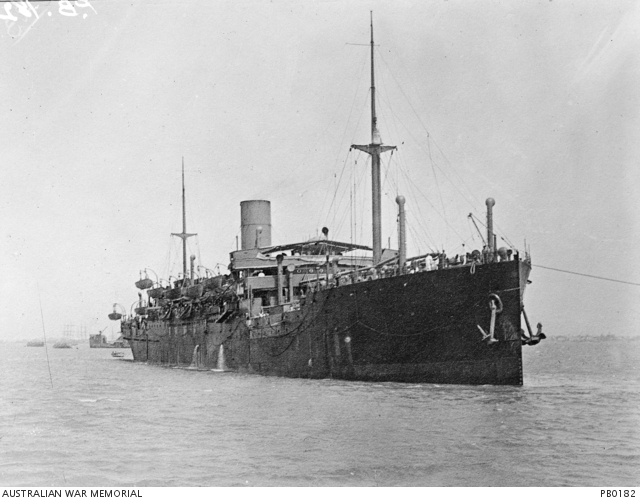
The first group of Coo-ees embarked from Sydney for overseas active service, on the HMAT Ballarat A70.

HMAT Ballarat A70, 18/2/1916. Photograph from the AWM Collection PB0182.

HMAT Ballarat A70, 18/2/1916. Photograph from the AWM Collection PB0182.

These included: Joseph ARMSTRONG, Percy George BROWN, Charles William Gordon CONROYEdwin Joseph FULLER, John MARTIN, Donald Singleton STEWART, John TARLINGTON,  John William THOMPSON,  William Charles WALKER, Joseph Patrick WALLIS, and Colin David WREN.

It was reported in the Dubbo Liberal and Macquarie Advocate that Percy George Brown had written “The first batch of the Gilgandra “Coo-ees” to leave for the front will sail at the end of the present week. About 15 men, including four who enlisted at Dubbo, have been transferred into an earlier reinforcement of the same battalion, which the rest of the “Coo-ees” are in”.[1]

[1] ‘Our Soldiers’, The Dubbo Liberal and Macquarie Advocate, 4 February 1916, p. 4, http://nla.gov.au/nla.news-article77604424

Colin David WREN

Colin David WREN

Colin David Wren. Photograph courtesy of P. Kahler.

Colin David Wren. Photograph courtesy of P. Kahler.

Per his military service record (regimental no. 4623), Colin David Wren was born at Calcutta, India. He gave his age as 40 years and 5 months, his marital status as married, and his occupation as laborer. His description on his medical was height 5 feet 10 inches tall, weight 142 lbs., with a medium complexion, green eyes, and dark hair. His religious denomination was Church of England. He claimed that he had six years previous military experience in India. He completed his medical on 19th October 1915 at Lithgow, and was attested by Lieutenant F. Middenway at Lithgow on 2nd November 1915 (when the Coo-ees were in Lithgow).

He was reported as having joined the Coo-ees in the Cowra Free Press.[1]

After completing the Coo-ee March he went to Liverpool Camp as reinforcement for the 13th Battalion.

Private Wren was given a send-off at Tallarook woolshed [near Broula] in January 1916, where he was presented with a gold wristlet watch, and he ‘in responding, made a vigorous appeal to the manhood of Broula to enlist, and was successful in securing five recruits’.[2]

On his embarkation roll his address at time of enrolment was Grenfield [i.e. Grenfell] Road, Broula, via Cowra, N.S.W., and his next of kin is listed as his wife, Mrs. M. [Margaret] Wren, at the same address.

On 16th February 1916 Private Wren was one of the first group of Coo-ees to embark overseas on active service, and departed Sydney on the HMAT Ballarat A70 as 14th reinforcement for the 13th Battalion.

HMAT Ballarat A70, 18/2/1916. Photograph from the AWM Collection PB0182.

HMAT Ballarat A70, 18/2/1916. Photograph from the AWM Collection PB0182.

The HMAT Ballarat A70 arrived in Egypt on 22nd March 1916.

On 1st April 1916 Private Wren, (along with the other Coo-ees he had travelled to Egypt with), was transferred to the 54th Battalion at Ferry Post.

On 12th April 1916 Private Wren was transferred to the 1st Australian Stationary Hospital at Ismailia, Egypt, with Stricture. On 27th April 1916 he was transferred to the British Red Cross Convalescent Home in Montazah. On 8th May 1916 he was discharged for duty to Tel-el-Kebir.

On 25th May 1916 he was transferred to the 4th Pioneer Battalion.

On 5th June 1916 he proceeded to join the British Expeditionary Force in France from Alexandria aboard the Transport Ionian. He disembarked at Marseilles on 15th June 1916.

On 25th October 1916, he was detached for duty at the 1st Anzac Headquarters, from the 4th Australian Divisional Base Depot.

On 8th January 1917 he was taken on strength of the 4th Pioneer Battalion in the field.

Three months later he was admitted to the 1st Field Ambulance sick, on 4th April 1917. He was transferred to the 10th General Hospital in Rouen on 9th April 1917. On 1st May 1917 he was transferred to England on the Hospital Ship Western Australia. He was admitted to the 2nd Southern General Hospital in Bristol with old stricture, on 2nd May 1917.

During the time he was convalescing in hospital in Bristol , Private Wren wrote in a letter dated 16th June 1916, that was reported on in the Cowra Free Press, of ‘his praise of the people of that town in regard to their treatment of wounded Australians’, and he described being taken for a drive around the city by the local people, and he said ‘he and hundreds of other wounded Australians thanked God for the hospitable and kind way in which they had been treated by the people of England’.[3]

On 27th July 1917 he was transferred to the 3rd Auxiliary Hospital from the 2nd Southern General Hospital, with Cystitis.

On 30th July 1917 Private Wren was discharged from hospital, and granted two weeks leave until 13th August 1917, when he reported to No. C. Depot in Weymouth, England.

On 27th September 1917 Private Wren left England for return to Australia on the transport Suevic.

On 3rd January 1918 he was discharged at Sydney as medically unfit.

[1] Another “Cooee!”, Cowra Free Press, 13 November 1915, p. 2, http://nla.gov.au/nla.news-article99695508

[2] A Soldier Farewelled’, Cowra Free Press, 22 January 1916, p. 2, http://nla.gov.au/nla.news-article99696556

[3] ‘Soldier’s letters’, Cowra Free Press, 8 September 1917, p. 2, http://nla.gov.au/nla.news-article99711897


John William THOMPSON

John William THOMPSON

Per his military service record (regimental no. 4609), John William Thompson was born at Camperdown, Sydney, N.S.W. He gave his age as 25 years and 4 months, his marital status as single and his occupation as laborer. His description on his medical was height 5 feet 2 5/8 inches tall, weight 8 stone 11 lbs., with a dark complexion, brown eyes, and dark brown hair. His religious denomination was Roman Catholic. He claimed that he had no previous military experience. He completed his medical on the 24th October 1915 at Orange, and was attested at Orange by Captain Nicholas on the 24th October 1915.

He was named as one of the recruits who joined the Coo-ees at Orange in the Leader.[1]

After completing the Coo-ee March he went to Liverpool Camp as reinforcement for the 13th Battalion.

On his embarkation roll his address at time of enrolment was 4 Raglan Street, Darlington, Sydney, N.S.W., and his next of kin is listed as his father, J. W. Thompson, Botany, Sydney, N.S.W..

On 16th February 1916 Private Thompson was one of the first group of Coo-ees to embark overseas, and departed Sydney on the HMAT Ballarat A70 as 14th reinforcement for the 13th Battalion.
HMAT Ballarat A70, 18/2/1916. Photograph from the AWM Collection PB0182.

HMAT Ballarat A70, 18/2/1916. Photograph from the AWM Collection PB0182.

During the voyage, Private Thompson (along with several other Coo-ees on the ship) was charged with being absent without leave from on 8th March 1916 whilst at Colombo, Ceylon. He was fined 1 pound.

The HMAT Ballarat A70 arrived in Egypt on 22nd March 1916.

On 1st April 1916 John William Thompson was transferred to the 54th Battalion at Ferry Post.

On 3rd April 1916 Private Thompson was sent to the 15th Australian Field Ambulance sick. He was moved back to the 2nd Casualty Clearing Station later that day. He was placed aboard the 4th Hospital Train and moved to the 1st Australian Stationary Hospital at Ismalia in Egypt. He was transferred to the 1st Australian Dermatological Hospital at Abbassia in Egypt on 4th April 1916. He was discharged from hospital for duty on 6th June 1916.

On 6th August 1916 Private Thompson left Alexandria bound for England. He arrived later that month.

On 31st August 1916 Private Thompson was sent to the Fargo Military Hospital ill with an unstated condition. He was discharged and marched into the 4th Training Battalion at Rollerstone in England on 5th September 1916.

On 2nd November 1916 Private Thompson departed Folkestone, England, aboard the Transport Golden Eagle bound for France. He then marched into the 5th Australian Division Base Depot at Etaples, France the next day. He was taken on strength of the 54th Battalion on 22nd November 1916.

On 8th May 1917 Private Thompson was sent to the 5th Australian Field Ambulance suffering from the effects of an inoculation. He was moved back to the 5th Division Rest Station and rejoined the Battalion on 12th May 1917.

On 1st June 1917 Private Thompson was sent to the 6th Field Ambulance ill with “soft sore”. He was moved back to the 5th Division Rest Station later that day. On 6th June 1917 he was transferred to the 39th General Hospital. He was discharged on 22nd June 1917 and sent to the 5th Australian Division Base Depot at Le Harve, France. He rejoined the 54th Battalion on 26th August 1917.

On 2nd October 1917 Private Thompson went on leave to England. Whilst in England he was charged with being absent without leave from 8th October 1917 till 15th October 1917. He was fined 22 days pay.

Private Thompson returned from leave and rejoined his unit on 26th October 1917.

On 30th November 1917 Private Thompson was charged with being absent without leave from 11th November 1917 till 25th November 1917. He was awarded 28 days field punishment number 2.

On 5th January 1918 Private Thompson was charged with being absent without leave from 0900 on 3rd January 1917 till 2150 on 3rd January 1918. He was awarded 7 days field punishment number 2.

On 11th January 1918 Private Thompson was sent to the 14th Field Ambulance sick and he was transferred to the 39th General Hospital. He was discharged on 26th January 1918 and sent to the 5th Australian Division Base Depot at Le Harve, France. He rejoined the Battalion on 20th February 1918.

On 11th April 1918 Private Thompson was wounded in action, receiving a shrapnel wound to his left hand. He was sent to a Field Ambulance then moved back to a casualty clearing station, then on 12th April 1918 he was admitted to the 12th General Hospital at Rouen, France. He was discharged on 13th April 1918 and sent to the 5th Australian Division Base Depot at Le Harve, France. He rejoined the 54th Battalion on 10th June 1918.

On 25th June 1918 Private Thompson was sent to the 5th Army School of Cookery. On 11th July 1918 he was sent to the Australian Division Base Depot, then on 31st July 1918 he rejoined his unit.

On 21st August 1918 he was received by Assistant Provost Marshal Havre from Paris. On 23rd August 1918 he was placed in custody pending disposal. On 26th August 1918 Private Thompson was charged with being absent without leave from the 0730 on 18th August 1918 till 2240 on 20th August 1918. He was awarded 14 days field punishment number 2.

On 29th September 1918 Private Thompson was wounded in action for the second time, receiving a gunshot wound to his left hand. He was sent to a Field Ambulance then moved back to the 30th Casualty Clearing Station. On 1st October 1918 he was admitted to the 4th General Hospital.

On 12th October 1918 he was placed aboard a Hospital Ship for evacuation to England. He was admitted to the Ontario Military Hospital at Orplington, England later that day.

Whilst in hospital Private Thompson was charged with being absent without leave from 2100 on 21st October 1918 till 1900 on 22nd October 1918. He was fined 1 days pay.

He was discharged from hospital on 29th October 1918 and granted leave to report to the Number 4 Command Depot at Hurdcott in England on 12th November 1918.

On 16th November 1918 Private Thompson was charged with being absent without leave from 1030 on 13th November 1918 till 1000 on 16th November 1918. He was fined 3 days pay.

On 18th November he marched into No. 4 Command Depot at Hurdcott from Army Headquarters in London ex furlough.

On 2nd December 1918 Private Thompson marched into the Australian Army Medical Corps Training Depot.

Private Thompson departed England on 5th January 1919 for return to Australia aboard the Transport Kanowna. He disembarked in Sydney on 14th March 1919. He was discharged at Sydney medically unfit with amputated forefinger left hand, gunshot wound, on 5th May 1919.

[1] ‘The Recruits’, Leader, 25 October 1915, p. 4, http://nla.gov.au/nla.news-article117842599