Tag Archives: HMAT A15 Star of England

Louis Henry ATTENBOROUGH

Louis Henry ATTENBOROUGH

Per his military service record (regimental no. 4728), Louis Henry Attenborough was born at Stratton Audley, Oxford, [England]. He gave his age as 44 years and 6 months, his marital status as single, and his occupation as mechanic. His description on his certificate of medical examination was height 5 feet 8 inches tall, weight 10 stone 10 lbs., with a fresh complexion, grey eyes, and hair  ‘going grey’. His religious denomination was ‘Free Thinker’. He claimed that he had no previous military service. His  ‘Joined on’ date was recorded as 27th October 1915.

Louis Attenborough was named in an article titled ‘Blayney recruits’ in The Leader as one of six men who have joined ‘as a result of the visit of the Coo-ees to Blayney’.[1] The Coo-ees had held a recruiting meeting and stayed overnight at Blayney on 26th October 1915.

He was attested by Captain Eade at Bathampton on 27th October 1915, where the Coo-ees stayed that evening, after leaving Blayney that morning.

After the Coo-ee March he went to Liverpool Camp as reinforcement for the 13th Battalion.

He did not complete his medical examination until 13th November 1915, at Liverpool Camp.

On his embarkation roll his name was recorded as ‘Lewis Henry Attenborough’, and his address at time of enrolment was Blayney, N.S.W. His next of kin was listed as his brother, A. W. [Arthur] Attenborough, Alagallah, Bowral Street, Kensington, N.S.W. His religion was recorded on this document as Church of England.

On 8th March 1916 Private Attenborough, along with many of the other Coo-ees, departed Sydney on the HMAT A15 Star of England, and arrived in Egypt on the 11th April 1916.

On 16th April 1916 Private Attenborough, along with some of the other Coo-ees, was transferred to the 4th Pioneer Battalion at Tel-el-Kebir.

On 4th June 1916 Private Attenborough left Alexandria aboard the Transport Scotian, bound for France. He arrived at Marseilles on 11th June 1916.

Private Attenborough served with the 4th Pioneer Battalion in France for the next six months, until on 9th December 1916, when he was sent to the 5th Australian Field Ambulance sick with Influenza. On 10th December 1916 he was moved back to the 38th Casualty Clearing Station.  On 11th December 1916 he was placed aboard the 5th Ambulance Train, for transfer to the 9th General Hospital at Rouen, France.

On 24th December 1916 he was placed aboard the Hospital Ship Dunluce Castle at Le Harve, France, for evacuation to England, with Debility. Later that day he was admitted to the Cambridge Hospital at Aldershot, England.

On 18th January 1917 Private Attenborough was granted leave, to report to the No. 1 Command Depot at Pernham Downs, England, on the 2nd of February 1917.

On 7th February 1917 Private Attenborough went before a Medical Board, where he was found to have Deafness, Senility and Rheumatism, and to be overage – he was recorded as being “58” years of age at his ‘last birthday’ on a Medical Report on an Invalid form in his service record. [If this stated age was actually correct, this may have made him the oldest Coo-ee to go overseas on active service]. Stated on the Medical Report on an Invalid dated 7th February 1917 in his service record was: ‘Has been somewhat deaf for years but in August while passing one of our own guns was deafened by its firing’.

On 12th February 1917 he was transferred to the No. 2 Command Depot at Weymouth, England.

On 6th April he marched out from No. 2 Command Depot at Weymouth for return to Australia.

On 4th May 1917 Private Attenborough departed England from Plymouth aboard the H.T. Themistocles for discharge. (Also being sent home on the same ship were Coo-ees James Birrell Dawson, Walter James Goodlet, and James McKeown).

Private Attenborough arrived in Sydney on 5th July 1917.

He was discharged medically unfit on 23rd August 1917.


Note: A letter in his service record dated 8th April 1921 shows that Louis Henry Attenborough had returned to England by this date, as it reported he was at that time residing at Fern Cottage, 90 Bath Road, Heston-Hounslow, Middlesex.

[1] ‘Blayney Recruits’, Leader , 29 October, 1915, p. 8. Retrieved December 17, 2016, from http://nla.gov.au/nla.news-article117842821


Leslie Reginald ANLEZARK

Leslie Reginald ANLEZARK

Per his military service record (regimental no. 4726), Leslie Reginald Anlezark was born at Orange, N.S.W. He gave his age as 26 years and 8 months, his marital status as single, and his occupation as brick-setter. His description on his certificate of medical examination was height 5 feet 7 ½ inches tall, weight 9 stone 6 lbs., with a fair complexion, grey eyes, and brown hair.  He had a heart pierced by a dagger tattooed on his right upper arm. His religious denomination was Church of England. He claimed that he had three years previous military service, and had been rejected as unfit by the A.I.F. in August 1914 due to his eyesight.

He completed his medical on 24th October 1915 at Orange, and was attested by Captain Nicholas at Orange on 24th October 1915.  He was given the rank of Acting Sergeant on 24th October 1915, when he joined the Coo-ees at Orange.

After completing the Coo-ee March he went to Liverpool Camp as reinforcement for the 13th Battalion, retaining his rank as Acting Sergeant.

On 21st November 1915 Acting Sergeant Anlezark was charged with being absent without leave from the Liverpool Camp. He received a warning.

A letter Acting Sergeant Anlezark wrote to Mr E. T. McNeilly, the Mayor of Orange, while he was in Liverpool Camp, was published in The Leader on 14th February 1916, in which he wrote:

“…Now for some statistics: The Coo-ees marched into camp 273 strong and seven me were added from other units, because of technical knowledge or for other reasons. Of this number unfortunately, twenty one failed to pass the severe Liverpool medical test, and sixteen, for medical or disciplinary reasons, have since been transferred to the home defence forces, or have been discharged – not a large proportion to lose in comparison with the camp experience of other units. And, although thirty men, at their own request, have been transferred to the Light Horse, it will be seen that the Coo-ees column is still substantially intact, an assertion that is further supported by the fact that every non-com but one in the present E. Company marched with the column from the west. The company sergeant major is S. E. Stephens, who, since his service with the first expeditionary force in New Guinea, has been on the ‘Farmer and Settler’ editorial staff. He went to Gilgandra to report the route march for this journal, re-enlisted there, and marched into camp with the column. The platoon sergeants are H. Davenport, of Wongarbon; L. R. Anlezark, of Orange; T. W. Dowd, of Wongarbon; and E. S. Taylor, of Wentworthville. Corporals: C. H. Maidens, of Molong; W. W. Smith, of Geurie; J. E. L. Hourigan, of Parramatta; J. G. Cameron, of Gilgandra; J. McKeown, of Gilgandra; and Pay Corporal, J. C. Gilmour, of Coonamble. Others of the men gathered in on that first route march are qualifying for the non com class; but, unfortunately, as the Coo-ees are reinforcements for a battalion already at the front, and not part of a new battalion, these ranks may only be temporary.

How well, on the whole, the Coo-ees are behaving, and how quickly they are assimilating the lessons to be learned at Liverpool, is evidenced by the fact that, although they only marched into camp on November 14, a fairly big draft has already been made upon E company to make up the 14th reinforcements for the battalion at the front…”.[1]

On his embarkation roll his address at time of enrolment was C/o Mrs R. Benfield, Railway Estate, Hurstville, N.S.W., and his next of kin was listed as a friend, Mrs L. Benfield, at the same address.

On 8th March 1916 Acting Sergeant Anlezark, along with many of the other Coo-ees, departed Sydney on the HMAT A15 Star of England, as 15th reinforcements for the 13th Battalion, and arrived in Egypt on the 11th April 1916.

He was transferred to the 45th Battalion on 19th April 1916.

On 2nd June 1916 Private Anlezark left Alexandria aboard the transport Kinfauns Castle, bound for France.  He arrived at Marseilles on 8th June 1916.

Private Anlezark served with the 45th Battalion through its first action at Fleurbaix, France in July 1916, then as through the battles around Pozieres and Mouquet Farm in August, September and October 1916.

On 24th November 1916 the 45th Battalion was holding the front line trenches in the vicinity of Guedecourt in France, when Private Anlezark was evacuated to the 36th Casualty Clearing Station suffering from Influenza. He was placed aboard the 24th Ambulance Train and sent to the 12th General Hospital at Rouen, France, where he was admitted on 25th November 1916.

On 8th December 1916 he was also diagnosed to be suffering from trench fever, and was evacuated to England by the Hospital Ship Aberdonian.  He was admitted  to the War Hospital at Reading, England, on 9th December 1916.

On 17th January 1917 Private Anlezark was discharged from hospital, and granted leave till 1st February 1917, to report to the No. 1 Command Depot at Pernham Downs, England.

On 23rd March 1917 Private Anlezark was transferred to the 61st Battalion at Wareham, England.

On 29th April 1917 he was transferred back to the 45th Battalion, and departed Folkestone, England, for return to France.

On 30th April 1917 he marched into the 4th Australian Division Base Depot at Etaples, France.

On 4th May 1917 he rejoined the 45th Battalion when it was preparing to move at Bouzincourt, France.

Just over one month later, on 7th June 1917 the 45th Battalion was engaged in action around the Messines Ridge, Belgium, attacking German trenches.  During the attack Private Anlezark was wounded in action, receiving a bullet wound to his right arm. He was evacuated to the 9th Casualty Clearing Station on 8th June 1917.  He was then admitted to the 9th General Hospital at Rouen, France, on 9th June 1917.

On 14th June 1917 he was evacuated to England on the Hospital Ship St George, with a gun shot wound to his right arm.

He was admitted to the 3rd London General Hospital at Wandsworth in England on 15th June 1917.

On 25th June 1917 he was transferred to the Grove Military Hospital at Tooting, England.

On 23rd August 1917 he was moved to the 1st Australian Auxiliary Hospital at Harefield, England.

On 1st September 1917 Private Anlezark was discharged from hospital, and granted leave till 15th  September 1917, to report to the No. 2 Command Depot at Weymouth, England.

On 20th September 1917 Private Anlezark was transferred to the No. 3 Command Depot at Hurdcott, England.

On 19th October 1917 he was moved to the Overseas Training Brigade.

On 10th November 1917 Private Anlezark departed Southampton England bound for France. On 11th November 1917 he arrived at the 4th Australian Division Base Depot at Le Harve, France.

On 27th November 1917 he rejoined the 45th Battalion when it was training at St Quentin, France.

Less than a month later, on 24th December 1917 the 45th Battalion was training near Peronne, France, when Private Anlezark was admitted to the 11th Australian Field Ambulance suffering from Influenza.  On 31st December he was transferred to the 1st Casualty Clearing Station.  He was discharged to duty on 4th January 1918.

Private Anlezark rejoined the 45th Battalion on 22nd January 1918, when it was training at La Clyette, Belgium.

On 28th July 1918 Private Anlezark was granted leave to Paris, France.

He returned from leave in Paris to the 45th Battalion on 7th August 1918, when the Battalion was near Hamel, France, preparing for a major offensive against German positions, which began the next day.

Private Anlezark served with the 45th Battalion for the remainder of the war.

On 27th January 1919 Private Anlezark departed Le Harve bound for England, arriving at Weymouth on 28th January 1919, where he marched into the Overseas Training Brigade.

On 19th February 1919 Private Anlezark was charged with being absent without leave from 2359 on 17th February 1919 till 1200 on 18th February 1919. He was fined two days pay.

On 22nd February 1919 he was transferred to the No. 1 Command Depot at Sutton Veny, England.

On 4th March 1919 Private Anlezark was admitted to the 1st Australian General Hospital at Sutton Veny with cellulitis of face.

Private Anlezark departed Southampton, England, on 6th May 1919, aboard the H.M.A.H.S.  Karoola, bound for Australia.

He arrived in Sydney on 28th June 1919.  He was discharged termination of period of enlistment on 18th October 1919.


[1] ‘The Coo-ees’, The Leader, 14 February 1916, p. 6. Retrieved December 17, 2016, from http://nla.gov.au/nla.news-article117790684
 

Sidney James De Courcy HEUSTON

Sidney James De Courcy HEUSTON

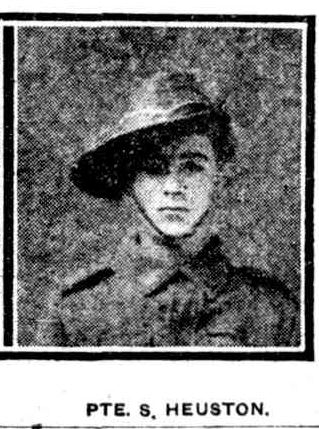
Pte. S. Heuston (The Globe and Sunday Times War Pictorial, 14/10/1916)

Pte. S. Heuston (The Globe and Sunday Times War Pictorial, 14/10/1916)

Per his military service record (regimental no. 4796), Sidney James De Courcy Heuston was born at Coonamble, N.S.W.  He gave his age as 18 years and 1 month, his marital status as single, and his occupation as plumber.  His description on his medical was height 5 feet 7 ¾ inches tall, weight 8 stone 3 lbs., with a dark complexion, grey eyes, and dark brown hair.  His religious denomination was Methodist.  He claimed that he had four years previous military service with the Senior Cadets.

Written on the top of his Attestation Paper is that he ‘Presented at Orange 24/10/15’.  He completed his medical examination on the 24th October 1915 at Orange, and was attested by Captain Nicholas at Orange on 24th October 1915.  “S. J. Deloury Hewston”was named as one of the men who were recruited to join the Coo-ees at Orange in the Leader. [1]

His initial Application to Enlist in the Australian Imperial Force form dated 24th October 1915 was addressed to the Recruiting Officer at Orange, and his postal address was Parkes Street, Wellington.  His parents George Heuston and Louise Heuston both signed this form, giving consent for their son to join, as he was under 21 years of age.  However, it was noted that he had joined the Coo-ee March at Wellington in an article in the Sunday Times a year after he had joined.[2]  His place of enlistment is listed as ‘Wellington’ on the Medical Report on an Invalid form dated 25th September 1916 in his service record.  So it appears he may first have presented to join the Coo-ees when they recruited at Wellington on 16th and 17th October 1915, then caught up with them and joined them at Orange where the Coo-ees stayed overnight on 24th October 1915, after his parents had signed his consent form.

After completing the Coo-ee March he went to Liverpool Camp as reinforcement for the 13th Battalion.

On 7th February 1916 Private Heuston was charged at Liverpool Camp with being absent from special picquet on 5th February 1916.  He was fined 5 shillings.

On his embarkation roll his address at time of enrolment was Park[es] Street, Wellington, N.S.W., and his next of kin is listed as his father, G. W. DeC. Heuston, at the same address.

On 8th March 1916 Private Heuston, along with many of the other Coo-ees, departed Sydney on the HMAT A15 Star of England, and arrived in Egypt on 11th April 1916.

On 19th April 1916, he was transferred to the 45th Battalion in Egypt, along with some of the other Coo-ees.

On 2nd June 1916 Private Hueston left Alexandria with several other Coo-ees in  45th Battalion aboard the transport Kinfauns Castle, bound for France, arriving at Marseilles on 8th June 1916.

Private Heuston served with the 45th Battalion through its first action at Fleurbaix, France, in July 1916 then as it moved to Pozieres in early August 1916.

On the night of the 5th/6th of August 1916 the 45th Battalion was in the front line trenches between Pozieres and Martinpuich, France.  Private Heuston was wounded in action on 6th August 1916, suffering a gunshot wound to his right leg, and was evacuated to the 3rd Casualty Clearing Station.

He was then admitted to the 13th General Hospital at Boulogne, France, on 7th August 1916.

On 11th August 1916 Private Hueston was sent by the Hospital Ship Jan Breydel to England, and admitted to the 1st Birmingham War Hospital, with a gunshot wound to the right thigh.

On 6th September 1916 Private Heuston was transferred to the 1st Australian Auxiliary Hospital at Harefield, England (3 days after Captain Bill Hitchen had died in the same hospital).

On 28th September 1916 he was discharged from hospital and sent to Weymouth, England.

On 12th November 1916 Private Heuston departed England aboard the H.T. Wiltshire, bound for Australia.

He arrived in Sydney on 31st December 1916, and was discharged medically unfit on 28th February 1917.

[1] ‘The Recruits’, Leader, 25 October 1915,  p. 4, http://nla.gov.au/nla.news-article117842599

[2] ‘The Coo-ees’, Sunday Times, 8 October 1916, p. 9, http://nla.gov.au/nla.news-article121335018


John Edward Leslie HOURIGAN

John Edward Leslie HOURIGAN

Corporal J. E. L. Hourigan (Cumberland Argus and Fruitgrowers Advocate 12/8/1916)

Corporal J. E. L. Hourigan (Cumberland Argus and Fruitgrowers Advocate 12/8/1916)

Per his military service record (regimental no. 4787), John Edward Leslie Hourigan was born at Parramatta, N.S.W. He gave his age as 21 years and 1 month, his marital status as single, and his occupation as carter. His description on his medical was height 5 feet 7 inches tall, weight 166 lbs., with a fair complexion, blue eyes, and fair hair. His religious denomination was Roman Catholic. He claimed to have 4 years U. T. [universal training] experience and was still serving.

“Jack” Hourigan was reported in The Cumberland Argus and Fruitgrowers Advocate as enlisting with the Coo-ees at Parramatta.[1] He completed his medical on the 11th November 1915 at Parramatta, and was attested by Lieutenant R. Howe at Parramatta on the 11th November 1915.

After completing the Coo-ee March he went to Liverpool Camp as reinforcement for the 13th Battalion. His service record shows he was made Acting Corporal from 11th November 1915.

He was reported in The Farmer and Settler on 5th January 1916 as being one of the Corporals in E company from the “Coo-ees” column, and it was noted that ‘as the “Coo-ees” are reinforcements for a battalion already at the front, and not part of a new battalion, these ranks may be only temporary’.[2]

On his embarkation roll his address at time of enrolment was 415 Church Street, Parramatta, N.S.W., and his next of kin is listed as his father, J. Hourigan, at the same address.

On 8th March 1916 Acting Corporal Hourigan departed Sydney on the HMAT A15 Star of England, along with many of the other Coo-ees, as part of the 15th reinforcements for the 13th Battalion. He arrived in Egypt on 11th April 1916.

On 19th April 1916, he was transferred to the 45th Battalion in Egypt,  along with some of the other Coo-ees.

On 29th May 1915 his promotion to Corporal was confirmed.

On 2nd June 1916 Corporal Hourigan left Alexandria aboard the transport Kinfauns Castle bound for France with other members of the 45th Battalion, arriving at Marseilles on 8th June 1916.

On 8th July 1916 the 45th Battalion was in the front line for the first time in the vicinity of Fleurbaix, France, when Corporal Hourigan was wounded in action, receiving a severe gunshot wound to his scalp. He was evacuated to the 4th Australian Field Ambulance then moved back to the 8th Casualty Clearing Station on 9th July 1916.

On 21st July 1916 he was sent to the 30th General Hospital at Calais in France. On 22nd July he was placed aboard the Hospital Ship Brighton for evacuation to England. He was admitted to the Wharncliffe War Hospital at Sheffield in England on 23rd July 1916.

On 21st September 1916 Corporal Hourigan was transferred to the 1st Australian Auxiliary Hospital at Harefield, England.

On 23rd September 1916 he was discharged from hospital, and marched into the Number 2 Command Depot at Weymouth, England.

On 14th October 1916 he was charge with overstaying leave from 3 p.m. on 11th October until 8 p.m. on 13th October 1916. He was reprimanded by the Colonel, and forfeited 3 days pay.

Corporal Hourigan was transferred to the Infantry Draft Depot at Pernham Downs in England on 24th January 1917.

On 13th March 1917 Corporal Hourigan departed Folkestone bound for France. He arrived at the 4th Australian Division Base Depot at Etaples in France on 14th March 1917. Corporal Hourigan rejoined the 45th Battalion on 29th March 1917 when it was training in the vicinity of Bapaume, France.

In October 1917 Corporal Hourigan was sent to the Lieutenants Training School at the 4th Australian Division Base Depot at Le Harve in France, however on 15th October 1917 he was charged with absenting himself from 10 p.m. on 13th October until 9.20 p.m. on 14th October 1917. He was reprimanded by the Commanding Officer, fined 2 days pay, and sent back to the 45th Battalion on 22nd October 1917.

On 21st January 1918 Corporal Hourigan went on 14 days leave to England.

He rejoined the Battalion on 9th February 1918 when it was being relieved from the front line in the vicinity of Hollebeke in Belgium.

On 25th March 1918 the 45th Battalion was moving by motor buses from Belgium to the Somme battlefield in France, when Corporal Hourigan sprained his left ankle.[3] He was evacuated to the 12th Australian Field Ambulance, then moved back to the 1st Australian Casualty Clearing Station, then placed aboard the 20th Ambulance Train, where he was conveyed to the 9th Canadian Stationary Hospital, being admitted on 26th March 1918.

On 29th March 1918 he was sent to the 7th Convalescent Depot at Boulogne, France.

On 10th April 1918 he was moved to the 10th Convalescent Depot.

On 18th April 1918 he marched into the 4th Australian Division Base Depot at Le Harve, France.

Corporal Hourigan rejoined the 45th Battalion on 13th May 1918 when it was in action in the vicinity of Villers Brettoneux, France.

On 6th November 1918 Corporal Hourigan was promoted to Sergeant.

Following the Armistice, on 19th November 1918 Sergeant Hourigan went on leave to England. He rejoined the 45th Battalion on 6th December 1918.

On 21st April 1919 Sergeant Hourigan marched into the Australian Base Depot at Le Harve to commence his return to Australia. He left for England the next day, on 22nd April 1919.

On 11th May 1919 Sergeant Hourigan departed England aboard the Transport Borda bound for Australia.

He arrived in Australia on 28th June 1919, and was discharged Termination of period of Enlistment on 12th August 1919.

[1] ‘Of the Boys’, The Cumberland Argus and Fruitgrowers Advocate, 7 June 1919, p. 8, http://nla.gov.au/nla.news-article86115560

[2] ‘Route Marches. Gathering of the Clans. The “Cooees”winning praise in camp’, The Farmer and Settler, 5 January 1916, p. 3, http://nla.gov.au/nla.news-article116676486

[3] Lee, J. E., The chronicle of the 45th Battalion A.I.F., East Sussex : The Naval & Military Press Ltd, [2009], p. 58.

TIMELINE March 1916

Tuesday, 7th March 1916

The bulk of the Coo-ees undertook their final parade and inspection in Sydney as 15th Reinforcements for the 13th Battalion. To read further click here: Final Parade and Inspection

The State Commandant inspecting the "Coo-ees" in Sydney (Sydney Mail 15/3/1916)

The State Commandant inspecting the “Coo-ees” in Sydney (Sydney Mail 15/3/1916)

Wednesday, 8th March 1916

About 119 Coo-ees embarked from Sydney on the HMAT A15 Star of England, and made up just over half of the 15th Reinforcements for the 13th Battalion on this troopship.  These included: Harold BAXTER, Sidney BENNETT, James Gerald CAMERON, Allan COLQUHOUNBernard COYTEJames CRAWFORDHarold Brooks DAVIS, Alan John Burnett EASTERBROOK, William FARTHINGMaurice Bertram FREE, Walter James GOODLET, Denis Roy GREEN, Leslie Webster GREENLEAF, Charles Alfred HAMPSON, Lightfoot Lamonby HAMPSON, Oliver James HARMON, William John Luther HOWARD, Charles Henry HUNT, Jack Henry HUNT, William Laurence HUNT, William Emerton HUNTER, Thomas JACKSON, Alan Chesher JOHNSON (Alan Cheshyre JANION), Darcy KEATING, Alfred Rupert Clyde LINGSTROM, Samuel LUKE, Laurence Leslie MAGUIRE, James MAHER, Charles Edmond MARCHANT, Ernest Charles Norman MAY, Wilfred Ernest MCDONALD, Edward Joseph MCGARRY, Andrew James MCGREGOR, Joseph Raymond McGUIRE, James MCKEOWN, Jack MORRIS, Karl Alex Frederick NIELSON, Joseph PARRISH, John QUINN, Victor QUINTON, Arthur Charles REID, William Hilton SAUNDERS, John Thomas SMITH, Ernest Stephen TAYLOUR, John William THOMPSON, Thomas THORNE, David James WAGNER, William WEBBER, and Rowland John WILSON

AWM_H17014_HMAT_A15_Star_of_England

Photograph of HMAT A15 Star of England. Part of the Australian War Memorial collection. H17104.

Saturday, 11th March 1916

Joe BILLING and three other Coo-ees embarked from Sydney on the HMAT A67 Orsova.

Tuesday 21st March 1916

Charles Arthur FINN and Percy Walter HOLPEN and Clement Patrick KANE and Henry MOSS and  John Herbert WATTS and another Coo-ee embarked from Sydney on the HMAT A26 Armadale.

Wednesday, 22nd March 1916

The Coo-ees on the HMAT A70 Ballarat arrived in Egypt.

Leslie SULLIVAN and four other Coo-ees (all Light Horse) embarked from Sydney on the HMAT A4 Pera.

Friday, 31st March 1916

William Henry GRIFFITHS and two other Coo-ees embarked from Sydney on the HMAT A16 Star of Victoria.


Walter James GOODLET

Walter James GOODLET

Coo-ees Walter Goodlet (left) and James Birrell Dawson (right), both amputees. Photograph courtesy of James Dawson's great grandson Jamie Stacey.

Coo-ees Walter Goodlet (left) and James Birrell Dawson (right), both amputees. Photograph courtesy of James Dawson’s great grandson Jamie Stacey.

Per his military service record (regimental no. 4780), Walter James Goodlet was born at Sofala, N.S.W. He gave his age as 21 years, his marital status as single, and his occupation as miner. His description on his medical was height 5feet 9 inches tall, weight 123 lbs., with a medium complexion, grey eyes, and brown hair. His religious denomination was Presbyterian. He claimed that he had 6 months previous military service with the 41st Infantry (Militia).

He was one of three men who stepped forward at the recruiting meeting in Yetholme around a bonfire in the school ground, and ‘arranged to join the “Coo-ees” at Lithgow’.[1]

He caught the train to Lithgow where he joined the Coo-ees.[2]

He completed his medical on the 2nd November 1915 at Lithgow, and was attested by Captain Eade at Lithgow on 2nd November 1915.

After completing the march he went to Liverpool Camp as reinforcement for the 13th Battalion.

On his embarkation roll his address at time of enrolment was Glanmire, via Bathurst, N.S.W., and his next of kin is listed as his father, J. Goodlet, Glanmire, via Bathurst, N.S.W.

He was given a send off at Glanmire shortly before leaving Australia, where there was dancing, and he was presented with a wristlet watch, a pocket wallet, a £1 note from friends, ten shillings from the Walang school children, and two pairs of socks. The Bathurst Times reported that he ‘briefly thanked those present for their handsome presents, and hoped that some day he would have the pleasure of meeting them all again’.[3]

On 8th March 1916 Private Goodlet departed Sydney on the HMAT A15 Star of England, along with many of the other Coo-ees, arriving in Egypt on 11th April 1916.

On 27th May 1916 he was transferred to the 4th Pioneer Battalion at Tel El Kebir, Egypt.

On 4th June 1916 Private Goodlet left Alexandria aboard the Scotian bound for France, arriving at Marseilles on 11th of June 1916.

Two months later, on 3rd August 1916, the 4th Pioneer Battalion was constructing communication trenches in Becourt Wood, France, when Private Goodlet was wounded in action, being struck by a the blast of a high explosive shell that shattered his the left arm. He was evacuated to the 4th Field Ambulance. On 6th August 1916 he was moved to the 1st General Hospital at Rouen, France. On 28th August 1916 he was transferred to England by the Hospital Ship Mahons, where he was admitted to the 3rd London General Hospital at Wandsworth, and his arm was amputated.

On 24th November 1916 Private Goodlet was transferred to the 2nd Australian Auxiliary Hospital at Southall, England.

On 21st December 1916 Private Goodlet was granted leave. He reported back on 5th April 1917.

On 4th May 1917 Private Goodlet departed England bound for Australia aboard the Transport Themistocles (along with fellow Coo-ee Private James Dawson, who had also lost an arm).

H.T. Thermistocles arrived at Sydney on 5th July 1917.

He was discharged medically unfit, with a disability of an amputated left arm, on 4th January 1918.

[1] ‘The Coo-ees along the route at Glanmire and Yetholme’, The Bathurst Times, 1 November 1915, p. 3, http://nla.gov.au/nla.news-article111237023

[2] ‘Personal’, The Bathurst Times, 8 March 1916, p. 3, http://nla.gov.au/nla.news-article109949686

[3] ‘Personal’, The Bathurst Times, 8 March 1916, p. 3, http://nla.gov.au/nla.news-article109949686


Rowland John WILSON

 Rowland John WILSON

Per his military service record (regimental no. 4910), Rowland John Wilson was born at Tallawang, N.S.W.[1]  He gave his age as 24 years and 1 month, his marital status as single, and his occupation as labourer. His description on his medical was height 5 feet 6 inches tall, weight 10 stone 6 lbs., with a fair complexion, grey eyes, and brown hair. His religious denomination was Roman Catholic. He claimed that he had 3 months experience with the Lawson Rifle Club. The “Joined on” date on his Attestation Paper was 7th November 1915.  He was attested at Lawson on 7th November 1915.

After completing the march he went to Liverpool Camp as reinforcement for the 13th Battalion. He completed his medical examination at Liverpool on 15th November 1915.

On his embarkation roll he is listed under the name Ronald John Wilson, and his address at time of enrolment was Queens Road, Lawson, N.S.W.  His next of kin is listed as his brother [i.e. uncle], P. J. Wilson, Queens Road, Lawson, N.S.W.

On 8th March 1916 Private Wilson along with many of the other Coo-ees departed Sydney on the HMAT A15 Star of England, and arrived in Egypt on the 11th April 1916. On the 19th April 1916 Private Wilson was transferred to the 45th Battalion at Tel-el-Kebir.

On the 2nd June 1916 Private Wilson left Alexandria aboard the transport Kinfauns Castle bound for France, arriving at Marseilles on the 8th June 1916.

Private Wilson served with the 45th Battalion during its first action at Fleurbaix, France in July 1916. Private Wilson then moved with the 45th Battalion to Pozieres, France, in early August 1916.

Private Wilson was killed on the night of the 7th/8th August 1916 when the 45th Battalion was under heavy enemy artillery fire between Pozieres and Martinpuich in the Battle of Pozieres – the same night that fellow Coo-ee William Emerton Hunter was killed, who was also in the 45th Battalion.

Private Wilson’s date of death is recorded as 8th August 1916. He has no known grave.

Private Wilson is remembered on the Australian National Memorial at Villers-Bretonneux in France.

Private Wilson's name on the Villers-Bretonneux Memorial, France (Photograph: S. & H. Thompson 7/9/2014)

Private Wilson’s name on the Villers-Bretonneux Memorial, France (Photograph: S. & H. Thompson 7/9/2014)

Private Wilson’s name is commemorated on panel 141 on the Australian War Memorial First World War Roll of Honour.

His name is also remembered on the Lawson War Memorial.

[1] NAA: B2455, WILSON R J

Harold Brooks DAVIS

Harold Brooks DAVIS

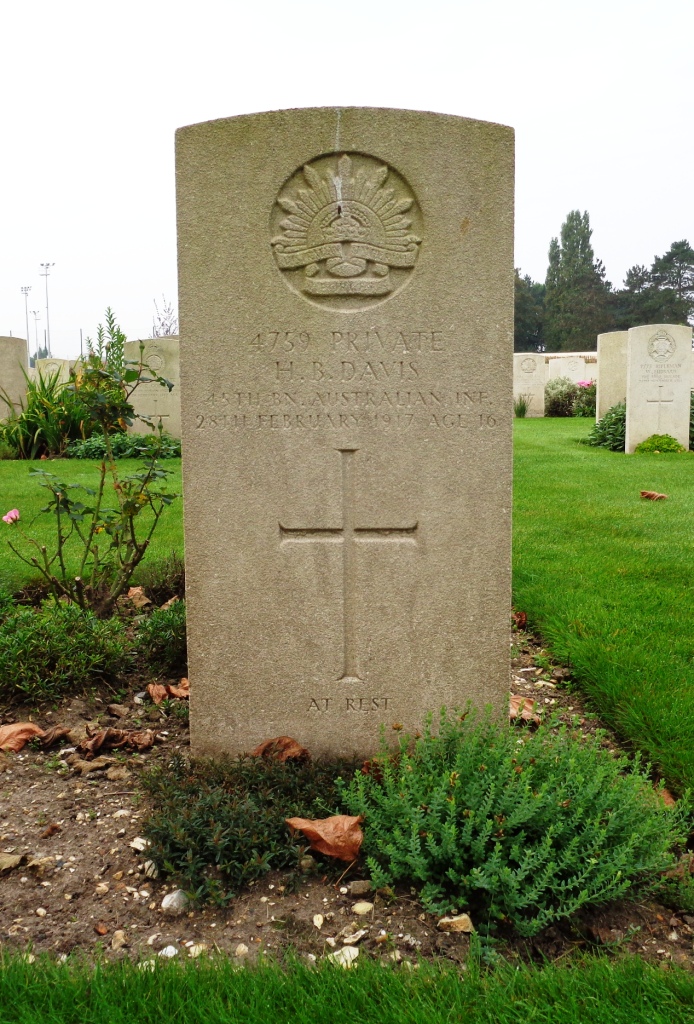
Per his military service record (regimental no. 4759), Harold Brooks Davis was born at Parramatta, N.S.W.[1] He gave his age as 18 years [though he was much younger than this], his marital status as single, and his occupation as plumber. His description on his medical was height 5 feet 7 inches tall, weight 100 lbs., with a dark complexion, grey eyes, and dark brown hair. His religious denomination was Methodist. He claimed that he had no previous military service.

It is not certain where Harold Brooks Davis joined the Coo-ee March.  His “Joined on” date on his attestation paper was the 8th November 1915, the day the Coo-ees travelled from Lawson to Springwood. The Blue Mountain Echo reported that ‘he joined the “Coo-ees” in their memorable march o’er the Mountains’.[2] The Farmer and Settler reported that ‘a halt of only fifteen minutes was made at Leura, but two recruits joined’ following a recruiting address on 6th November 1915.[3]  The names of the two recruits who stepped forward at his home town of Leura were not reported in local newspapers at the time.

However he did not complete his medical until three days later, on the 11th November 1915 at Ashfield, and he was attested at Ashfield on the 11th November 1915. The Coo-ees had a recruitment meeting and stayed in Ashfield at the Drill Hall on the night of 11th November 1915 – the last night of the march.

After completing the Coo-ee March he went to Liverpool Camp as reinforcement for the 13th Battalion.

On his embarkation roll his address at time of enrolment was Northcote Street, Leura, N.S.W., and his next of kin is listed as his father, J. [James] Davis, Northcote Street, Leura, N.S.W.

Private Davis departed Sydney on the HMAT Star of England along with many of the Coo-ees on the 8th March 1916. He arrived in Egypt on the 11th April 1916.

On the 19th April 1916 he transferred to the 45th Battalion in Egypt.

On the 2nd June 1916 Private Davis left Alexandria aboard the transport Kinfauns Castle bound for France, arriving at Marseilles on the 8th June 1916.

Private Davis served with the 45th Battalion through its first action at Fleurbaix, France in July 1916, then the Battle of the Somme around Poziers, Mouquet Farm, and Flers.

On 5th January 1917 the 45th Battalion was at Dernacourt, France, preparing to move forward into the front lines, when Private Davis was evacuated to the Anzac Rest Station with a Septic Foot. He remained at the Rest Station until 31st January 1917, when he rejoined the Battalion when it was at Mametz, France, resting and providing working parties behind the lines.

Just three weeks later, on 21st February 1917 Private Davis received multiple gunshot wounds when the 45th Battalion was engaged in action at Gueudecourt, France. He was evacuated to the 45th Casualty Clearing Station.

On 27th February 1917 he was evacuated by the 21st Hospital Train to the 6th General Hospital at Rouen, France, where he died of his wounds the next day, on 28th February 1917.

Private Davis is buried in the St. Sever Cemetery Extension at Rouen, France.

Harold Brooks Davis' headstone at St. Sever Cemetery Extension, Rouen, France (Photograph: S. & H. Thompson 7/9/2014)

Harold Brooks Davis’ headstone at St. Sever Cemetery Extension, Rouen, France (Photograph: S. & H. Thompson 7/9/2014)

Private Davis’ name is commemorated on panel 139 on the Australian War Memorial First World War Roll of Honour. His age at time of death is recorded on the Australian War Memorial Roll of Honour database, and on his headstone, as being 16 years of age.

His birth certificate shows that he was born on 1st March 1901, the son of James Davis and Elizabeth Davis (nee Brooks).[4]  This means that he had been only 14 years, 8 months, and 7 days old, when he joined the Coo-ee March. He was the youngest of the Coo-ees.

Sadly, when he died of his wounds on 28th February 1917, he was still only 15 years old – this was the day before his 16th birthday.

Private Davis’ name is also remembered on the Leura Lone Pine Park Memorial Gates.

[1] NAA: B2455, DAVIS H B

[2] ‘Leura’, The Blue Mountain Echo, 9 March 1917, p. 3, http://nla.gov.au/nla.news-article108247441

[3] ‘The route march’, The Farmer and Settler, 9 November 1915, p. 3, http://nla.gov.au/nla.news-article116669569

[4] NSW Birth Certificate Parramatta 15787/1901 Harold B. Davis

Lightfoot Lamonby HAMPSON

Lightfoot Lamonby HAMPSON

Per his military service record (regimental no. 4790), Lightfoot Lamonby Hampson was born at Wigton, Cumberland, England. He gave his age as 37 years, his marital status as married, and his occupation as painter.  He had worked at the ironworks in Lithgow prior to enlisting. His description on his medical was height 5 feet 5 inches tall, with a medium dark, grey eyes, and brown hair. His religious denomination was Baptist. He claimed that he had 3 years experience in the Militia. He completed his medical on the 6th November at Lawson (on the day the Coo-ees arrived at Lawson), but was not attested until the 13th November 1915 at Liverpool (after the end of the march). His date of joining on the nominal roll was the 9th November 1915 (the day the Coo-ees arrived at Penrith).

After the end of the Coo-ee March he went to Liverpool Camp with his son Charles Alfred Hampson (who had joined the Coo-ees at Lithgow) as reinforcement for the 13th Battalion.

On his embarkation roll Lightfoot Hampson’s address at time of enrolment was Redgalein, Hussans [sic]Walls Road, Lithgow, N.S.W. (the same as his son Charles’s address), and his next of kin is listed as sister-in-law, guardian of his children, Mrs. L. Hampson, Wanderee, Ferry Street, Drummoyne, N.S.W. (Lightfoot Hampson had four children – the eldest Charles Alfred Hampson who he had decided to enlist with on the Coo-ee March, and three younger sons, and one daughter).

On 8th March 1916 Private Hampson departed Sydney on the HMAT A15 Star of England, accompanied by his son Charles, and many of the other Coo-ees. He arrived in Egypt on 11th April 1916.

On 16th April 1916 Gunner Hampson was transferred to the 4th Division Artillery at Tel-el-Kebir (along with his son Charles).

On 21st April 1916 he was taken on the strength of the 10th Field Artillery Brigade and posted to the 10th Brigade Ammunition Column at Serapeum (along with his son Charles). On the 27th May they were both taken on strength of the 4th Division Ammunition Column.

On 6th June 1916 Gunner Hampson left Alexandria aboard the HMT Oriana (along with his son Charles) bound for France, arriving at Marseilles on 13th June 1916.

On 29th June 1916 Gunner Hampson’s designation was changed to Driver. (His son Charles was also mustered as Driver on the same day).

On 23rd August 1916 the 4th Division Ammunition Column was at Acquin, France when Driver Hampson was evacuated with Influenza. On 30th August 1916 he was admitted to the 4th Stationary Hospital at St Omer, France. He was returned to his unit on the 10th September 1916.

On 18th September 1916 he attended the Trench Mortar School at Berthen (along with his son Charles). On 30th September 1916 they both rejoined the 4th Division Ammunition Column when it was at Vlamertinghe near Ypres, Belgium.

On 5th November 1916 Driver Hampson reverted back to Gunner at his own request. (His son Charles also reverted to Gunner at his own request on the same day).

On 22nd December 1916 he and his son Charles were both transferred to the 10th Field Artillery Brigade which was in the Somme Sector near Flers, France, and were posted to the 110th Howitzer Battery.

According to the 10th Australian Field Artillery Brigade unit war diary, on 28th April 1917 the 110th Howitzer Battery was carrying out a gas shell bombardment on the village of Riencourt-les-Cagnicourt during the 1st Battle of Bullecourt. His son Gunner Charles Hampson was killed in action on this day. The loss of the son who he had enlisted with, embarked overseas with, trained in Egypt with, and fought alongside in France with, must have been devastating for Lightfoot Hampson.

On 6th May 1917 the 10th Field Artillery Brigade was in action during the Battle of Bullecourt when Gunner Hampson was wounded in action by German counter battery fire. He received wounds to his back and face. Gunner Hampson was evacuated to the 23rd Field Ambulance. On 7th May 1917 he was moved to the 45th Casualty Clearing Station. On 8th May he was placed aboard the 4th Ambulance Train and conveyed to the 6th General Hospital at Rouen, France. On 13th May 1917 he was transferred to a Convalescent Depot. On 12th June 1917 Gunner Hampson was discharged and sent to the Base Depot at Le Harve, France.

On 29th June 1917 Gunner Hampson rejoined the 10th Field Artillery Brigade.

On 8th December 1917 Gunner Hampson was detached to attend a course at the 2nd Army School. He rejoined the Brigade on 7th January 1918 when it was in the vicinity of Hollebeke, Belgium.

On 1st September 1918 Gunner Hampson was granted leave in England. He returned to the 10th Field Artillery Brigade on 20th September 1918 when it was in action in the vicinity of Villeret, France.

On 4th March 1919 Gunner Hampson left his unit bound for the Base Depot at Le Havre to commence his return to Australia. On 13th March 1919 he departed Le Havre bound for England. He arrived at Weymouth, England, on 14th March 1919, marching into the Number 4 Command Depot.

On 1st May 1919 Gunner Hampson departed England aboard the China to return to Australia. He arrived in Australia on 11th June 1919, and was discharged on 26th July 1919.

Charles Alfred HAMPSON

Charles Alfred HAMPSON

Per his military service record (regimental no. 4789), Charles Alfred Hampson was born at Petersham, N.S.W.[1] He gave his age as 17 years and 8 months, his marital status as single, and his occupation as machinist. He had worked at the Small Arms Factory in Lithgow prior to enlisting. His description on his medical was height 5 feet 2 inches tall, weight 108 lbs., with a medium complexion, grey eyes, and blue grey [sic] hair. His religious denomination was Baptist. He claimed that he had no previous military service. He completed his medical on the 31st October 1915 at Lithgow, and was attested at Lithgow on the 1st November 1915. His father’s signature giving his consent for his son to enlist is on Charles Hampson’s initial Application to enlist form.

His father Lightfoot Lamonby Hampson, with address Redgalein, Hassans Walls Road, Lithgow, N.S.W., was first listed as his next of kin on his Attestation paper, but this was changed to his grandmother, Mrs Dorothy Hampson, at the same address, after his father enlisted with the Coo-ees as well, catching up with them by the time they reached Lawson.

Although Charles Alfred Hampson gave his age as 17 years and 8 months on his Attestation paper, his birth certificate shows that he was born on 11 February 1899, so Charles had upped his age by one year, and was only actually 16 years and 8 months when he enlisted, which made him one of the youngest of the Coo-ees.[2]

After completing the march he went to Liverpool Camp as reinforcement for the 13th Battalion (along with his father).

On his embarkation roll his address at time of enrolment was Redgalein, Hussans [sic] Walls Road, Lithgow, N.S.W. His father Lightfoot Hampson was issued with regimental no. 4790, the next number after his.

On 8th March 1916 Private Hampson departed Sydney on the HMAT A15 Star of England, accompanied by his father Lightfoot Hampson, and many of the other Coo-ees. He arrived in Egypt on 11th April 1916.

On 16th April 1916 Gunner Hampson was transferred to the 4th Division Artillery at Tel-el-Kebir (along with his father Lightfoot).

On 21st April 1916 he was taken on the strength of the 10th Field Artillery Brigade and posted to the 10th Brigade Ammunition Column at Serapeum (along with his father). On the 27th May they were both taken on strength of the 4th Division Ammunition Column.

On the 6th June 1916 both Gunner Hampsons left Alexandria aboard the HMT Oriana bound for France, arriving at Marseilles on the 13th June 1916.

On the 29th June 1916 he was mustered as Driver. (His father was also mustered as Driver on the same day).

On the 2nd August 1916 Driver Hampson was charged with using insolent language to his superior officer, and not immediately obeying an order given by his superior officer. On 3rd August 1916 he was awarded 14 days Field Punishment no. 2 by the Commanding officer of the 4th Division Ammunition Column.

On 16th September 1916 he attended the Trench Mortar School at Berthen (along with his father). They both returned to their unit on 30th September 1916, when it was at Vlamertinghe near Ypres, Belgium.

On 5th November 1916 he reverted to Gunner at his own request. (His father also reverted to Gunner at his own request on the same day). On 2nd December 1916 he was admitted to the 5th Field Ambulance with chilled feet. On 17th December 1916 he returned to his unit from the Field Ambulance.

On 22nd December 1916 he was transferred to the 10th Australian Field Artillery Brigade which was in the Somme Sector near Flers, France, and was posted to the 110th Howitzer Battery (along with his father).

According to the 10th Australian Field Artillery Brigade unit war diary, on 28th April 1917 the 110th Howitzer Battery were carrying out a gas shell bombardment on the village of Riencourt-les-Cagnicourt during the 1st Battle of Bullecourt. Gunner Charles Hampson was killed in action on this day. The loss of the son who he had enlisted with, embarked overseas with, trained in Egypt with, and fought alongside in France with, must have been devastating for his father Lightfoot Hampson.

Gunner Hampson is buried in the H.A.C. Cemetery, Ecoust-St. Mein, Arras, Nord Pas de Calais, France.

Charles Alfred Hampson's headstone at H.A.C. Cemetery, France (Photograph: S. & H. Thompson, 6/9/2014)

Charles Alfred Hampson’s headstone at H.A.C. Cemetery, France (Photograph: S. & H. Thompson, 6/9/2014)

Gunner Hampson’s name is commemorated on panel 16 on the Australian War Memorial First World War Roll of Honour.

Gunner Hampson’s name is also listed on the Lithgow War Memorial.

[1] NAA: B2455, HAMPSON C A

[2] NSW Birth Certificate 6276/1899 HAMPSON  CHARLES A  LIGHTFOOT L  ROSE H  PETERSHAM