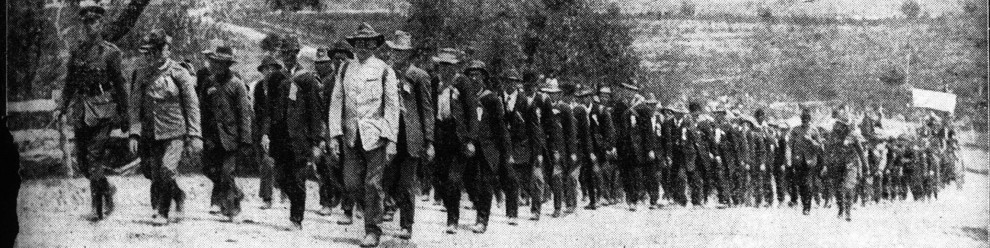
1987 and 2015 Coo-ee March Re-enactments Reunion and unveiling of Coo-ee March Roll of Honour Plaque

1987 and 2015 Coo-ee March Re-enactments Reunion and unveiling of Coo-ee March Roll of Honour Plaque

Marchers from the 1987 and 2015 Coo-ee March Re-enactments met in Gilgandra for a special reunion over the October Long Weekend, in memory of the 1915 Coo-ees, and to mark the 30th Anniversary of the 1987 Coo-ee March Re-enactment.

Around 40 former marchers and support people gathered at the Tattersalls Hotel in Gilgandra on Friday evening, 29th September 2017, to begin the weekend’s activities.

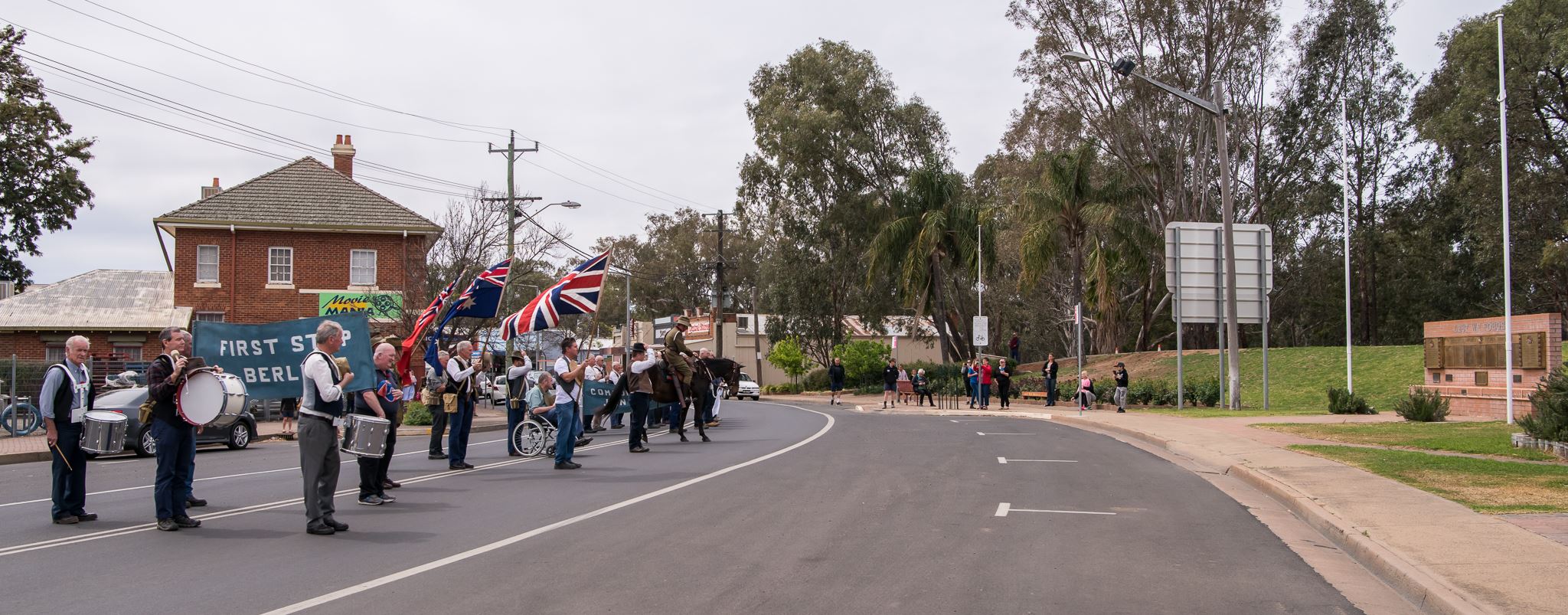
The main event was a street parade by the marchers on Saturday morning 30th September 2017 from Bridge Street along Miller Street (the main street), then, after a short stop for reflection at the Gilgandra War Memorial wall, the marchers marched along the Windmill Walk along the Castlereagh River to the Coo-ee March Memorial Gateway at the Coo-ee Heritage Centre, for a commemorative service.

Marchers formed up at Cairn in Bridge Street, Gilgandra, 30/9/2017 (Photograph courtesy John Tibben)

The marchers formed up to begin the parade at the commemorative Cairn in Bridge Street at 10.45 am for a welcome by Gilgandra Shire Council Acting Mayor Ashley Walker.

This Cairn marks the spot where the Gilgandra to Sydney Coo-ee Recruitment March started 102 years ago, on 10th October 1915.

50 years later, in 1965 seven of the original Coo-ees reunited in Gilgandra, to unveil this commemorative Cairn.

The 1987 Coo-ee March Re-enactment and the 2015 Coo-ee March Re-enactment both started at this commemorative Cairn.

Parade along Miller Street, Gilgandra 30/9/2017 (Photograph courtesy of John Tibben)
Marchers stopped at Gilgandra War Memorial 30/9/2017 (Photograph courtesy of John Tibben)
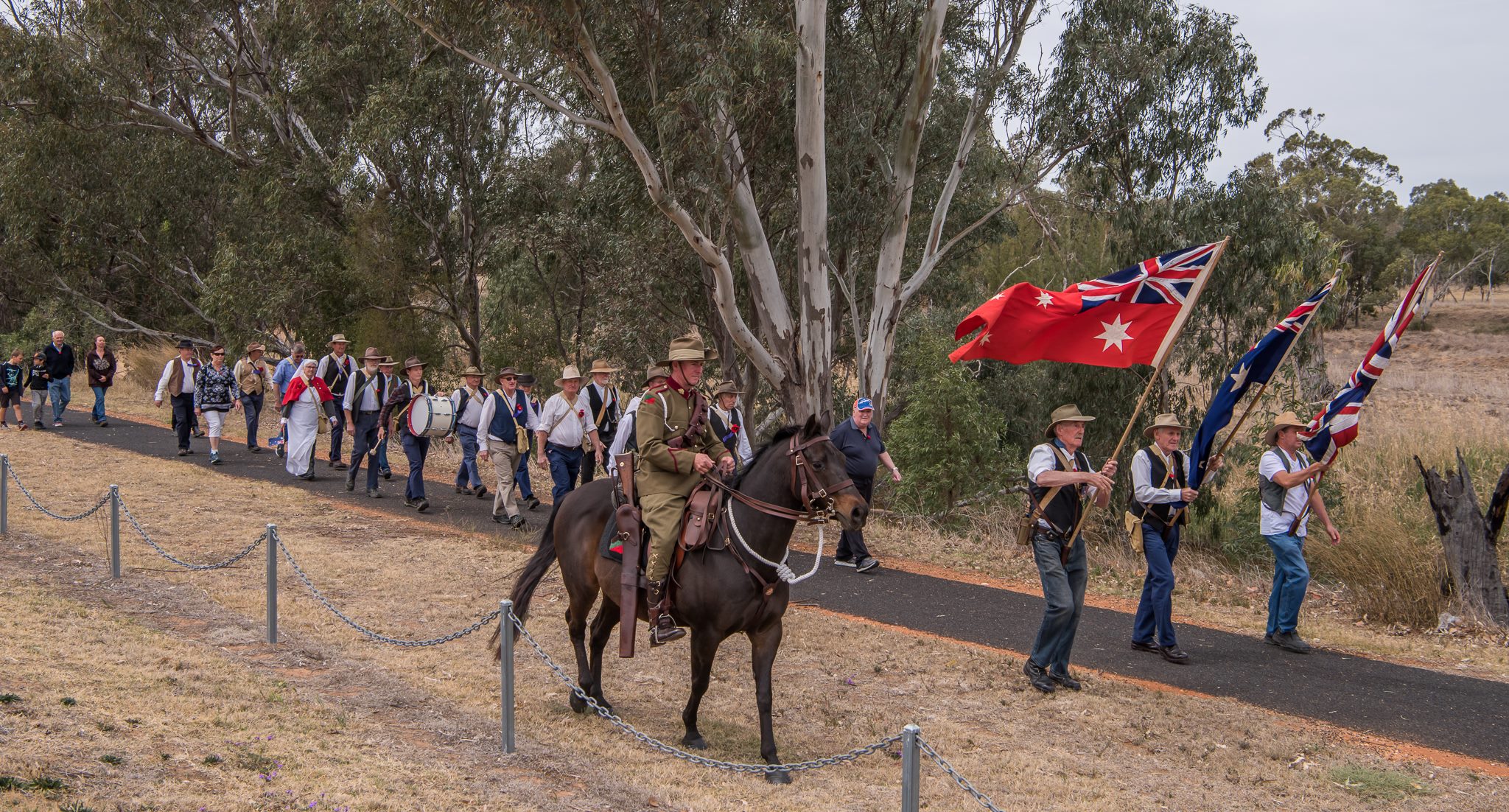
Marchers on Windmill Walk next to the Castlereagh River Gilgandra 30/9/2017 (Photograph courtesy of John Tibben)

At the commemorative service held at the Coo-ee March Memorial Gateway, the names of the 35 Gilgandra Coo-ees were read out by Coo-ee descendant  and 2015 Coo-ee March Re-enactment marcher Deborah Hitchen, and 2015 marchers Eric McCutcheon and Paul Mann.

A Coo-ee March Roll of Honour plaque, listing the name of the 41 Coo-ees who died while on active service overseas during the First World War, was then unveiled.
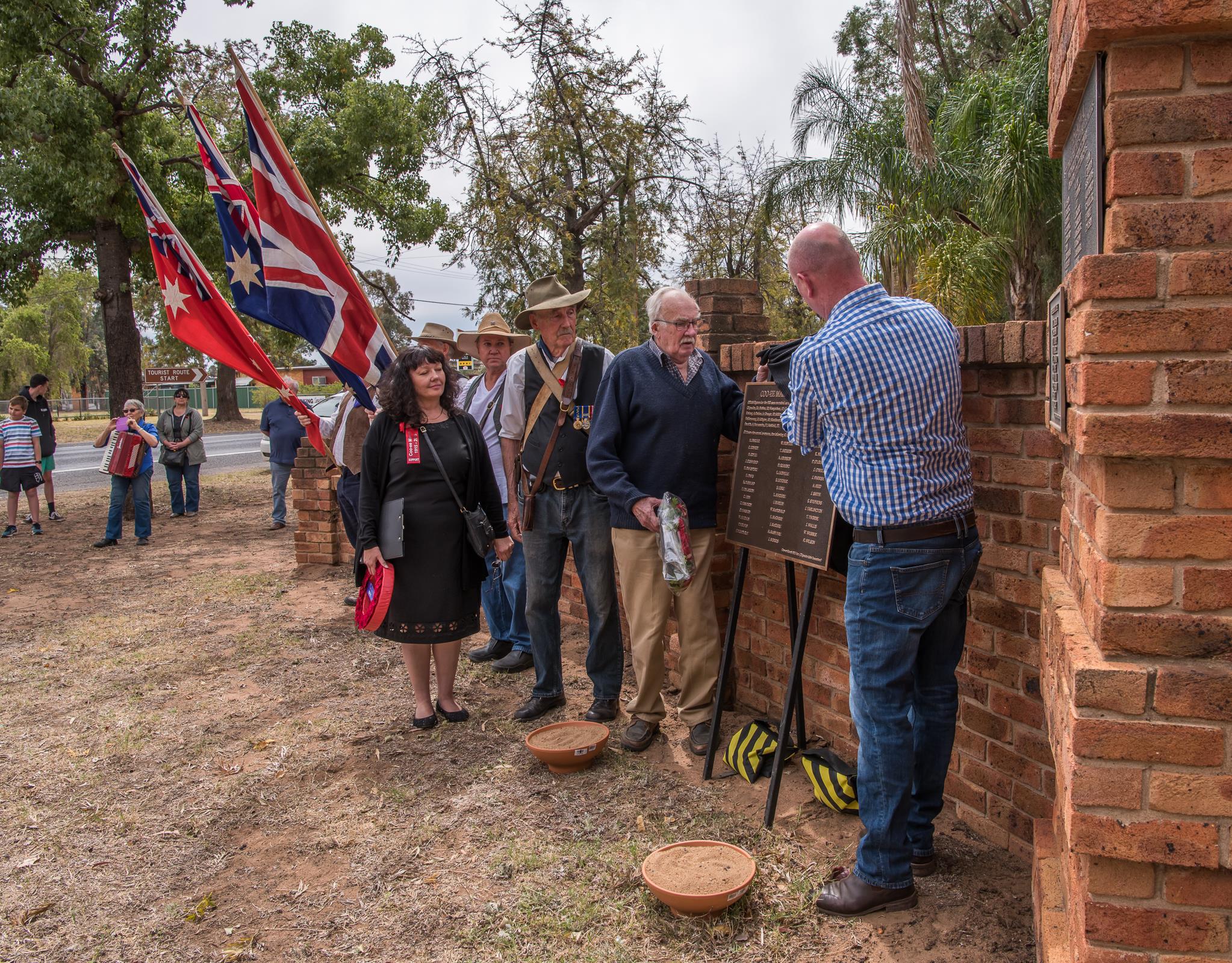
Unveiling of the Coo-ee March Roll of Honour plaque at Gilgandra 30/9/2017 (Photograph courtesy of John Tibben)

The plaque was prepared by Coo-ee March 2015 Inc. (Gilgandra Sub-Committee) in memory of the 41 fallen Coo-ees.  It was unveiled by Gilgandra Shire Council Acting Mayor Ashley Walker, Gilgandra Historical Society President Graeme Purvis, Brian Bywater OAM, one of the organisers of both the 1987 and 2015 Coo-ee March Re-enactments, and President of Coo-ee March 2015 Inc., and myself (Helen Thompson, Researcher for Coo-ee March 2015 Inc. (Gilgandra Sub-Committee).
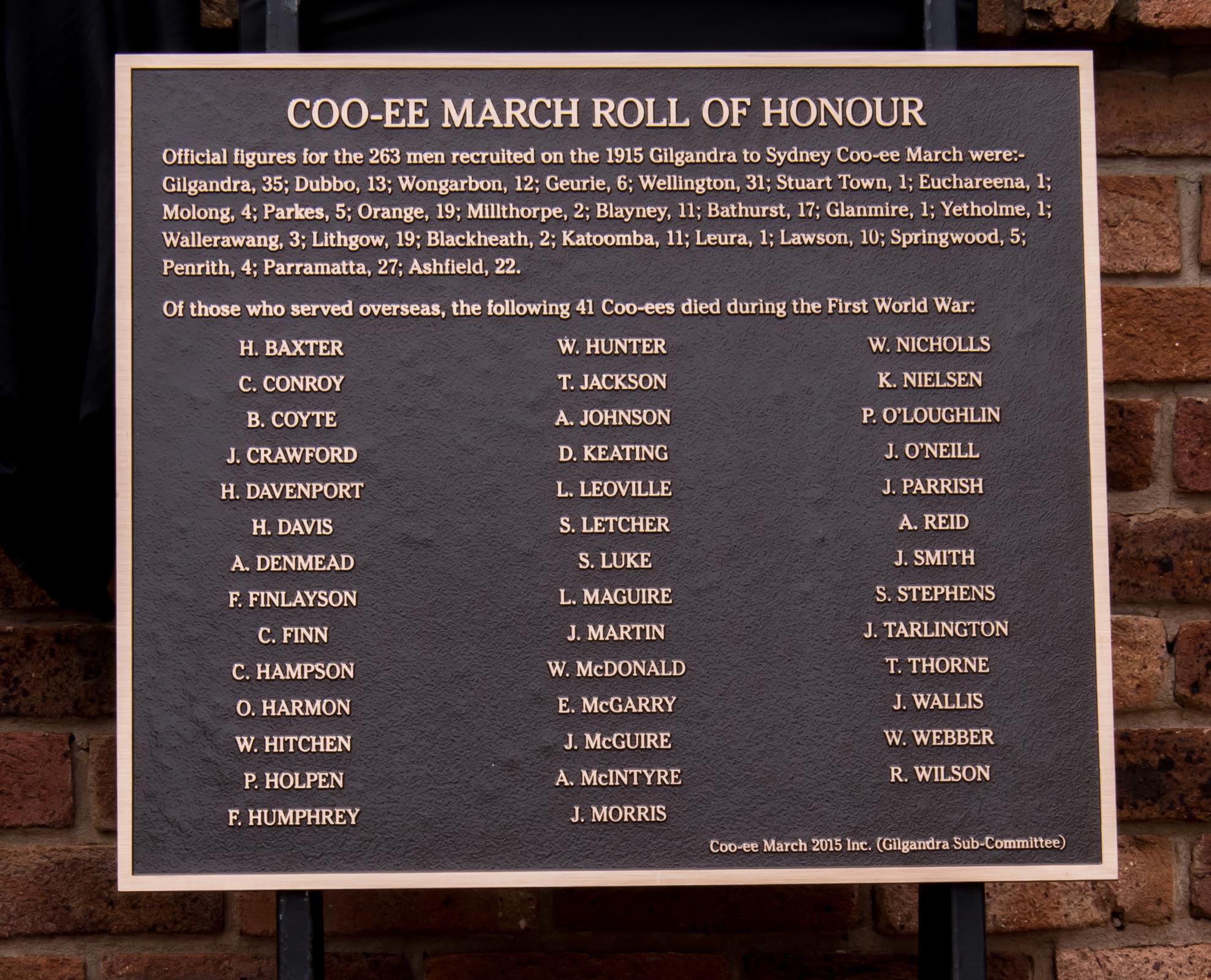
Coo-ee March Roll of Honour plaque (Photograph courtesy of John Tibben)

The plaque was blessed by 2015 marcher and local Anglican minister, Father Grahame Yager.

It was very moving when the MC Richard Salcole read out the names of the 41 fallen Coo-ees, and each marcher present from the 1987 and 2015 Re-enactments moved forward to lay a poppy in bowls of sand that were placed with the wreaths in remembrance of these men, as each name was read.
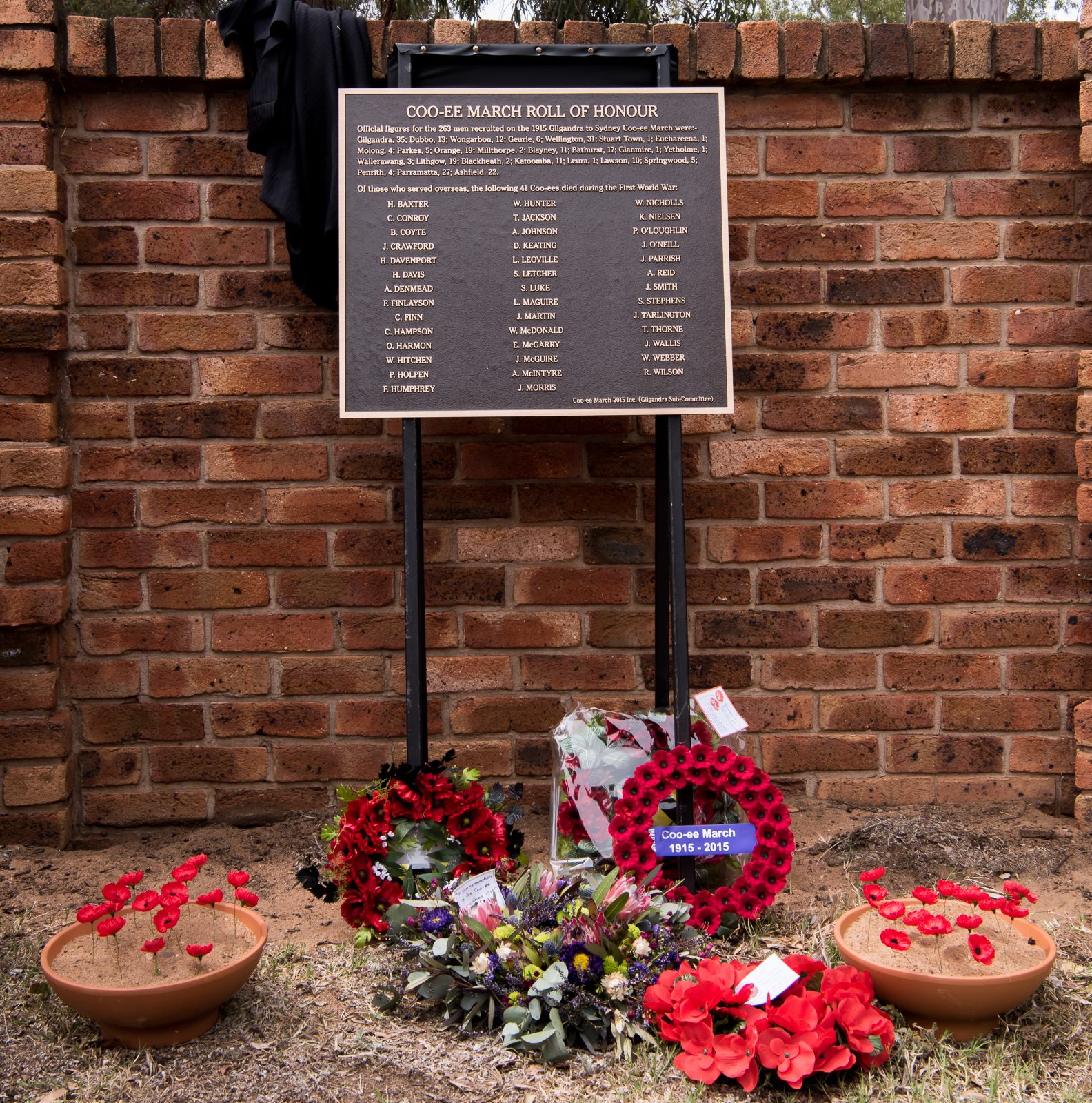
Plaque, wreaths, and poppies at Gilgandra 30/9/2017 (Photograph courtesy of John Tibben)

The red poppy wreath with the purple Coo-ee March 1915-2015 ribbon on it travelled with Stephen and me when we visited the graves of the fallen Coo-ees, or the memorials where their names are remembered, in France, Belgium and England last year.
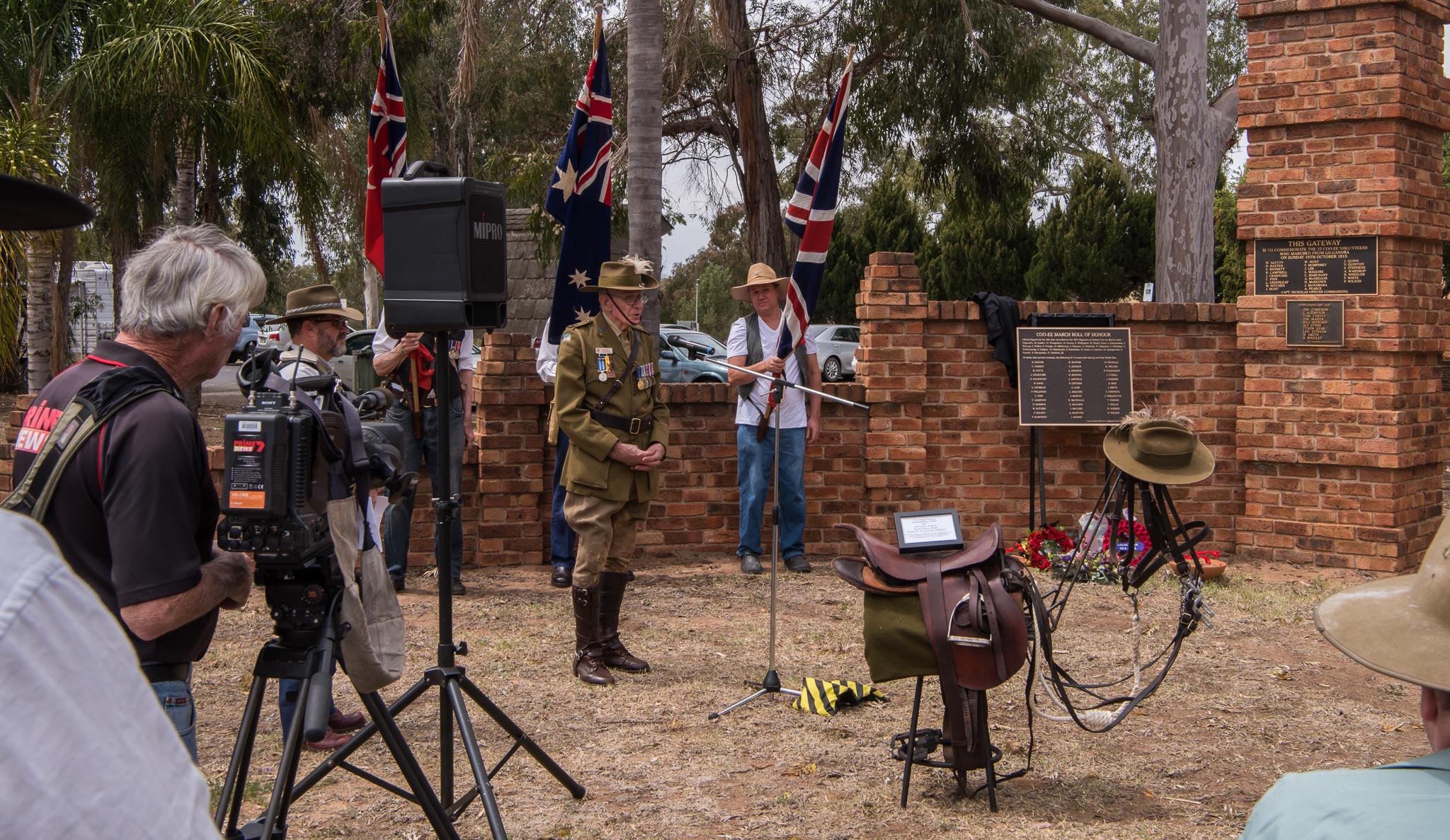
1902 British Military Saddle donated by Major Stewart Thompson to Giglandra Museum and Historical Society (Photograph courtesy of John Tibben)

This 1902 British Military Saddle, accompanied by an 1898 replica pattern bridle, on display at the service, was the type of saddle used by the Australian Light Horse during the First World War.  It was donated to the Gilgandra Museum and Historical Society during the service. This saddle was used by Major Stewart Thompson (retired) OAM when he accompanied the marchers on his horse as an Australian Light Horse re-enactor on the 1987 Coo-ee March Re-enactment.

After the commemorative service, the marchers adjourned to the Gilgandra Bowling Club for a BBQ lunch. It was a great day to remember the 1915 Coo-ees, and catch up with the 1987 and 2015 marchers.

A special service was held at St Ambrose Church in Gilgandra, in memory of the Coo-ees, on Sunday morning 1st October, 2017.

The names of the 41 Coo-ees who died while on active service overseas during the First World War. Information about the 41 Coo-ees who died while on active service overseas during the First World War can be found on this website on the Honour Roll page https://cooeemarch1915.com/honour-roll/
Walter CAVILL

Walter CAVILL

Per his military service record (regimental no. 25628), Walter Cavill was born at Bulli, N.S.W.[1] He gave his age as 22 years and 4 months, his marital status as single, and his occupation as electric crane driver. He claimed to have no previous military experience.

His description on his Certificate of Medical Examination was height 5 feet 8 inches tall, weight 146 lbs., with a ruddy complexion, grey eyes, and dark brown hair. His religious denomination was Church of England. He was attested by Captain Eade at Lithgow on 3rd November 1915 (the day the Coo-ees marched from Lithgow to Hartley).  He completed his medical at Lawson on 6th November 1915 (the day the Coo-ees marched from Katoomba to Lawson).

After completing the Coo-ee March he went to Liverpool Camp as reinforcement for the 13th Battalion.

On 5th January 1916 he was transferred to the reinforcements for the Field Artillery Brigade.

On his embarkation roll his address at time of enrolment was Main Street, Lithgow, N.S.W.[2] His next of kin was listed as his father, J. [John] Cavill, P.O. Clifton, N.S.W.

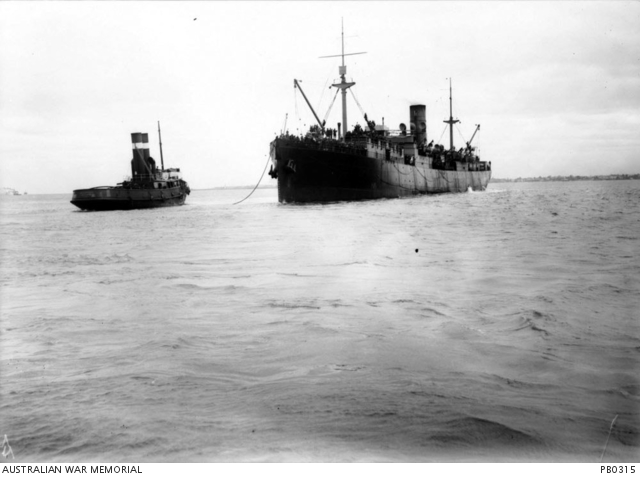
On 29th July 1916 Driver Cavill departed Sydney on the H.M.A.T. Orsova  A67 with the 4th Reinforcements for the 4th Divisional Ammunition Column.

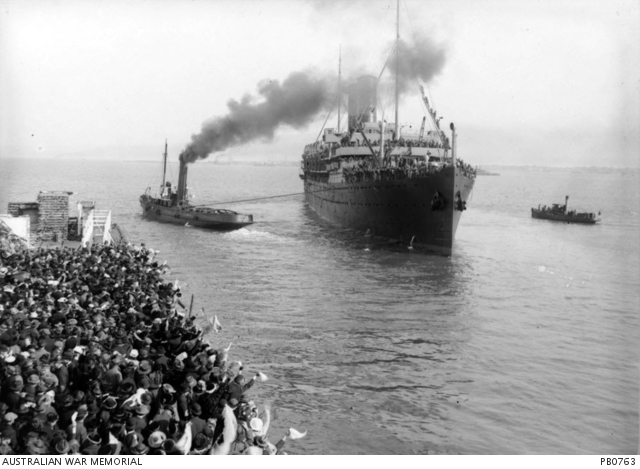
HMAT Orsova A67 leaving Melbourne 1 August 1916. Part of the Australian War Memorial collection. PB0663.

He arrived at Plymouth in England on 14th September 1916. 

On 9th October 1916 Driver Cavill was charged with overstaying his leave from midnight on 8th October 1916 till 0930 on 9th October 1916 from No. 1 Camp at Parkhouse. He was fined one day pay.

On 24th October 1916 Driver Cavill transferred to the 55th Battalion at Hurdcott, England.

On  4th December 1916 Private Cavill was charged with being absent without leave from 0630 on 22nd November 1916 till 0630 on 1st December 1916. He was awarded 21 days Field Punishment No. 2 and fined 33 days pay.

On 11th December 1916 Driver Cavill was admitted to the 1st Australian Dermatological Hospital at Bulford, England, sick. He was discharged on 12th January 1917.

On 24th January 1917 Driver Cavill departed Folkestone, England, aboard the S.S.  Princess Clementine, bound for France.

He arrived at the 5th Division Base Depot at Etaples, France, on 25th January 1917.

On 8th February 1917 Driver Cavill was taken on strength of the 55th Battalion when it was resting at Trones Wood Camp, France.[3]

On 10th September 1917 Driver Cavill was charged with being absent without leave from 1400 parade on 5th September 1917, and being absent without leave from all parades on 6th September 1917. He was awarded 2 days Field Punishment No. 2.

On 22nd October 1917 the 55th Battalion was resting at Dickebusch Camp in Belgium, after moving back from frontline support east of Westhoek, Belgium, the day before.  On this day Driver Cavill was sent to the 8th Australian Field Ambulance sick.[4] He was moved back to the 5th Division Rest Camp.

On 28th October 1917 he was placed aboard an Ambulance Train and transferred to the 8th Stationary Hospital at Wimereux, France, where he was admitted with Myalgia.

On 16th November 1917 Driver Cavill was placed aboard the Hospital Ship St Andrew for evacuation to England. He was admitted to the 1st Western General Hospital at Liverpool, England, on 17th November 1917, suffering from Trench Fever (serious).

On 2nd January 1918 Driver Cavill was discharged from hospital and granted leave, to report to the No. 3 Command Depot at Hurdcott, England on 18th January 1918.

On 27th March 1918 he was transferred to the No. 3 Command Depot at Weymouth, England.

Driver Cavill departed  England on 21st April 1918 aboard the H.M.A.T. Suevic for return to Australia, suffering Trench Fever .

He arrived in Australia on 7th June 1918.

He was discharged Medically Unfit on 7th December 1918.


[1] NAA: B2455, CAVILL W

[2] First World War Embarkation Roll Walter Cavill, https://www.awm.gov.au/collection/R1989523

[3] Australian Imperial Force unit war diaries, 1914-18 War – AWM4 Subclass 23/72 – 55th Infantry Battalion, February 1917.

[4] Australian Imperial Force unit war diaries, 1914-18 War – AWM4 Subclass 23/72 – 55th Infantry Battalion, October 1917.

TIMELINE October 1917

Timeline October 1917

Thursday, 4 October 1917

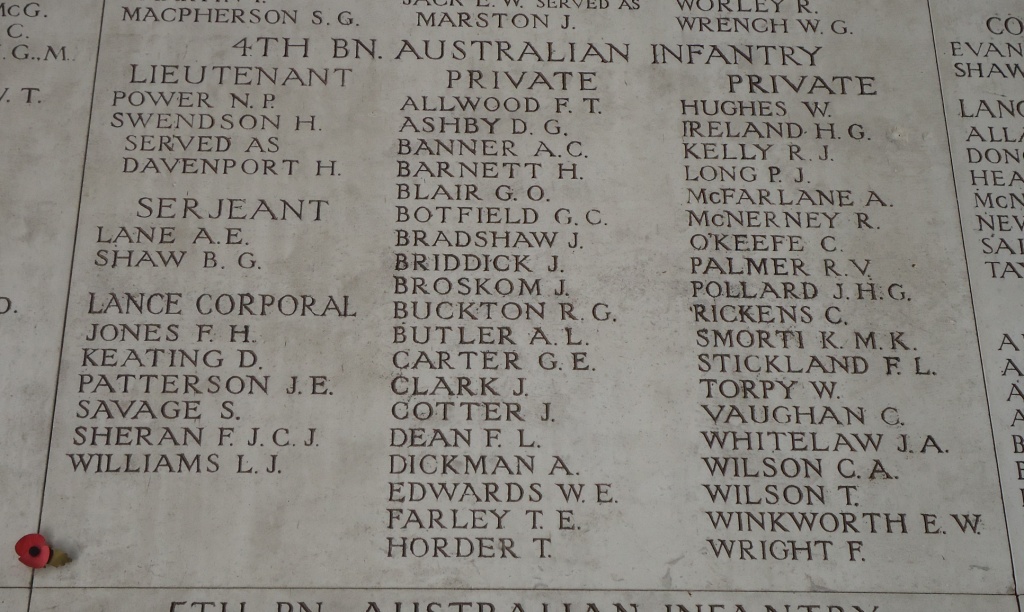
Lance Corporal Darcy KEATING (4th Battalion) was killed in action (first reported as missing in action) when the 4th Battalion was engaged in an attack at Broodseinde Ridge in Belgium.

KEATING D. on on 4th Battalion panel [near bottom of left row in Lance Corporal section] at the Menin Gate Memorial, Ieper (Ypres), Belgium (Photograph: H. Thompson 11/9/2012)

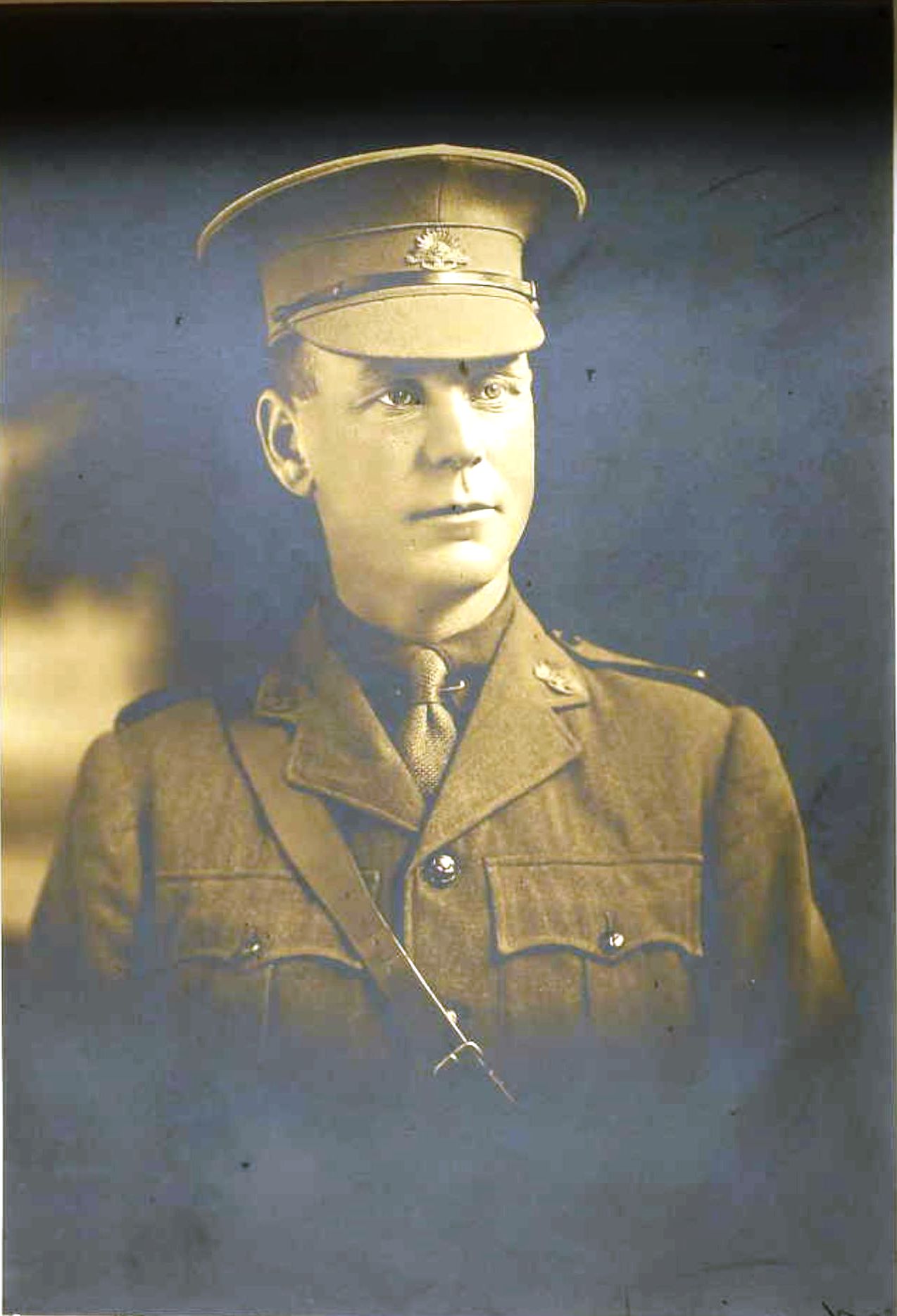
Lieutenant Harry DAVENPORT (aka Harry SWENDSON) (4th Battalion) was wounded in action, being shot in the chest when the 4th Battalion was engaged in an attack at Broodseinde Ridge. He was evacuated to an Aid Post, but died of his wounds prior to arrival that same day.

Harry Davenport (Photograph courtesy of Dave Murray)

Swendson H. (served as Davenport H.) name in Lieutenant section on 4th Bn. Australian Infantry Battalion panel at the Menin Gate Memorial, Ieper (Ypres), Belgium (Photograph: H. Thompson 11/9/2012)

Friday, 12 October 1917

Private William Henry PEPPERNELL (36th Battalion) was wounded in action with a gunshot wound to his right knee when the thigh, when the 36th Battalion was involved in an unsuccessful attack to capture Passchendaele Ridge near the village of Passchendaele. He was admitted to the 3rd Australian Casualty Clearing Station.

Monday, 15 October 1917

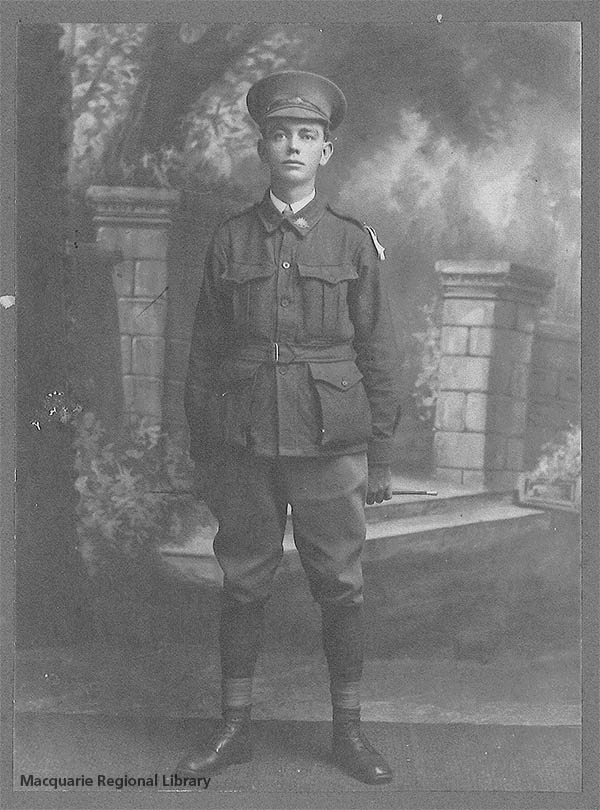
Driver William Hilton SAUNDERS (4th Division Ammunition Column) was wounded in action with a gunshot wound to his right foot in France.

William Hilton Saunders (Photograph courtesy of Macquarie Regional Library)

Wednesday, 17 October 1917

Private William Stirling MASON (13th Battalion) was wounded in action for a second time, being gassed, in the vicinity of Zonnebeke, Belgium.

Thursday, 18 October 1917

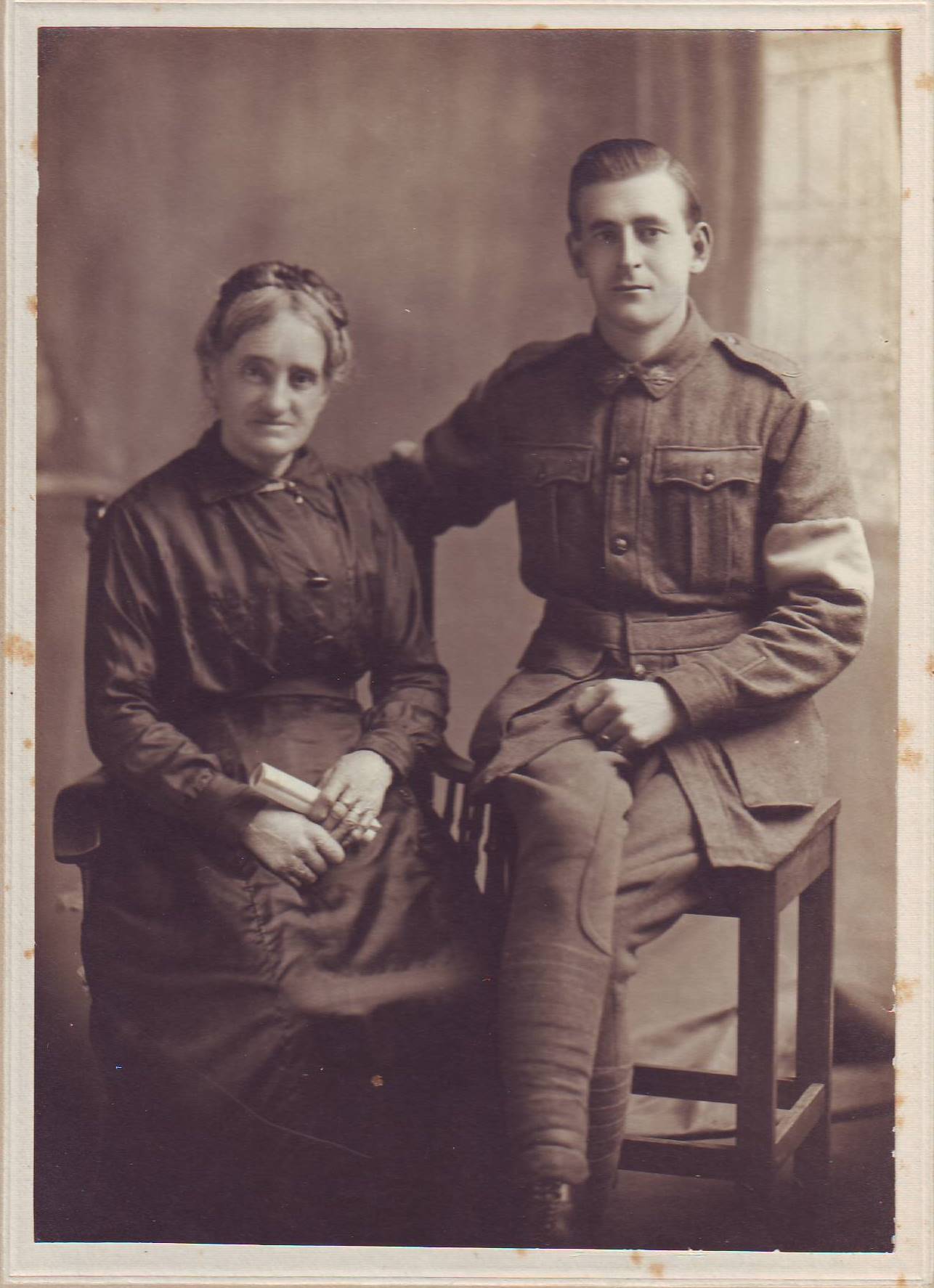
Private Joseph Jacob John HERRINGE (13th Battalion) was wounded by mustard gas poisoning in the vicinity of Zonnebeke, Belgium.

Joseph Herringe and his mother Bridget Herringe (Photograph courtesy Marie Cribbin)

Friday, 19 October 1917

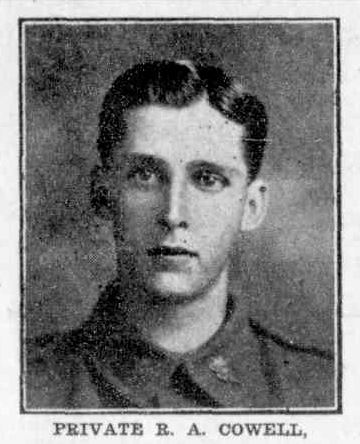
Private Reginald Arthur COWELL (4th Division Light Trench Mortar Battery) was wounded in action for a second time, with a shrapnel wound to his eye, in the vicinity of Passchendaele, Belgium.

Private R. A. Cowell (Cumberland Argus and Fruitgrowers Advocate 19/1/1918)

Saturday, 20 October 1917

Private William Henry PEPPERNELL (36th Battalion) was evacuated to England on the Hospital Ship Carisbrooke Castle.

Sunday, 21 October 1917

Private William Henry PEPPERNELL (36th Battalion) was admitted to the Voluntary Aid Detachment Hospital Cheltenham Area with a gun shot wound to right thigh slight.

Tuesday, 23 October 1917

Lance Corporal Edwin Joseph FULLER (54th Battalion) was wounded in action, being gassed, in Belgium.

Wednesday, 24 October 1917

Lance Corporal  John Graham WATSON (13th Battalion) was wounded in action for the second time with gas poisoning, in Belgium. He was moved back to the 17th Casualty Clearing Station.

Friday, 26 October 1917

Lance Corporal  John Graham WATSON (13th Battalion) was admitted to the 9th General Hospital at Roen, France.


Wednesday, 31 October 1917

Private Edward Montgomery SHEPPARD (1st Pioneer Battalion) embarked from Sydney on the HMAT A14 Euripedes, bound for England.

Trooper David James O’ROURKE was with the 12th Light Horse Regiment when it participated in the Charge of the Light Horse at Beersheba.

David James O’Rourke. Photograph courtesy of Warren O’Rourke.

Joseph Jacob John HERRINGE

Joseph Jacob John HERRINGE

Joseph Herringe and his mother Mrs Bridget Herringe (Photograph courtesy of Marie Cribbin)

Per his military service record (regimental no. 5700), Joseph Jacob John Herringe was born at Cowra, N.S.W.[1]  He gave his age as 21 years and 7 months, his marital status as single, and his occupation as fitter.  He stated he has been apprenticed as a gasfitter for 3 years to A. Wright at Cowra. He claimed that he had 2 years previous military service with the 41st Infantry at Cowra.

His description on his Certificate of Medical Examination form was height 5 feet 10 inches tall, weight 147 lbs., with a ruddy complexion, brown eyes, and brown hair. His religious denomination was Roman Catholic.

He completed his medical examination on 11th November 1915 at Ashfield, and was attested by Lieutenant Frank Middenway at Ashfield on 11th November 1915. His date of joining was recorded as 11th November 1915, the day the Coo-ees marched from Parramatta to Ashfield.

It appears that Joseph Herringe may have first presented to join the Co-ees at Katoomba, as a ‘J. Herringe’ was listed in The Blue Mountain Echo on 12th November 1915 as ‘one of the lads who answered the call, and marched out [of Katoomba] with the “Coo-ees” on their triumphant march to the sea’.[2]  (Several of the Coo-ees listed in this article did not undertake their attestation and medical examination until further along the march, or until they reached Liverpool Camp).

After completing the Coo-ee March he went to Liverpool Camp as reinforcement for the 13th Battalion.

Private Herringe, along with Private Colin Wren, ‘of the Coo-ees’, were ‘among the lads in khaki’ reported to be in Cowra on leave in the Cowra Free Press on 27th November 1915.[3]

They were both reported being on leave again ‘spending the festive season with their relatives and friends’ in the Cowra Free Press on 30th December 1915.[4]

On his embarkation roll Private Herringe’s address at time of enrolment was Grenfell Road, Cowra, N.S.W. His next of kin was recorded as his mother, Mrs B. [Bridget] M. Herringe, at the same address.[5]

On 3rd May 1916 Private Herringe departed Sydney on the HMAT A46 Clan McGillivray, along with fellow Coo-ees Private Saunders and Private Keating, as part of the 18th reinforcements for the 13th Battalion.

HMAT Clan MacGillivray A46

He arrived in Egypt in June 1916.

On 6th August 1916 Private Herringe departed Egypt bound for England aboard the Transport Megantic.

He was sent to the 4th Training Battalion at Rollerstone, England.

On 23rd September 1916 Private Herringe departed England bound for France.

He marched into the 4th Australian Division Base Depot at Etaples, France on 24th September 1916.

He was taken on strength of the 13th Battalion on the 4th of October 1916 whilst it was training and reorganising in the vicinity of Reninghelst, Belgium.

On 18th October 1916 the 13th Battalion was relieving the 15th Battalion in the front line in the vicinity of Zonnebeke, Belgium, when Private Herringe was wounded by mustard gas poisoning.  He was moved back to the 11th Australian Field Ambulance, then to the 3rd Australian Field Ambulance.

On 20th October 1917 Private Herringe was sent to the 2nd Canadian Casualty Clearing Station. On 22nd October 1917 he was admitted to the 16th General Hospital at Le Treport, France.

On 5th November 1917 Private Herringe was placed aboard the Hospital Ship Panama for evacuation to England. On 6th November 1917 he was admitted to the 1st Southern General Hospital at Birmingham, England, with status ‘gassed severe’.

He was discharged on 15th November 1917, and marched into the No. 3 Command Depot at Hurdcott, England.

On 12th February 1918 Private Herringe was transferred to the Overseas Training Brigade at Longbridge Deverill, England.

On 23rd February 1918 Private Herringe was charged with being absent without leave from midnight on 21st February 1918 until 8.30 a.m. on 23rd February 1918. He was awarded 4 days field punishment no. 2, and fined 5 days pay.

On 4th March 1918 Private Herringe departed Southampton, England bound for France.  He marched into the 4th Australian Division Base Depot at Le Harve on 5th March 1918.

He re-joined the 13th Battalion on 9th March 1918 whilst it was training in the vicinity of Neuve Eglise, France.

On 28th April 1918 Private Herringe was sent to the 14th Australian Field Ambulance then moved to the 20th Casualty Clearance Station with a condition not yet diagnosed. He was discharged and returned to the 13th Battalion on 30th April 1918 when it was at Glisy, France.

On 25th May 1918 the 13th Battalion was conducting training at Allonville, France, when Private Herringe was sent to the 4th Australian Field Ambulance suffering pyrexia.  He was moved back to the 61st Casualty Clearing Station. On 26th May 1918 he was placed aboard the 20th Ambulance Train and evacuated to the 56th General Hospital at Etaples, France, where he was admitted on 27th May 1918.

On 1st June 1918 Private Herringe was placed aboard the Hospital Ship Princess Elizabeth for evacuation to England with severe trench fever. He was admitted to the Reading War Hospital in England later that day.

Private Herringe was discharged from hospital on 5th July 1918, and given leave until 19th July 1918.  He marched in to the No. 1 Command Depot at Sutton Veny, England, on 19th July 1918.

On the 10th of August 1918 Private Herringe was transferred to the Overseas Training Brigade at Longbridge Deverill, England.

On 19th August 1918 Private Herringe was transferred to the 12th Training Brigade at Codford, England.

On 19th November 1918 Private Herringe was admitted to the 1st Australian Dermatological Hospital at Bulford, England, suffering warts.  He was discharged on 6th December 1918 and returned to the 12th Training Battalion.

On 15th January 1919 private Herringe marched into the Concentration Depot at Codford to await his return to Australia.

Private Herringe departed Liverpool, England on 19th February 1919 for return to Australia aboard the H.T. Orca.

He arrived in Australia on 9th April 1919.

A letter in his file dated 1st February 1921, addressed to the O.C., Base Records, reported that he was ‘still on Hospital strength’.

H was discharged medically unfit on 14th May 1921.


[1] NAA B2455, HERRINGE J J J 5700

[2] ‘March O’er the Mountains’, (1915, November 12). The Blue Mountain Echo (NSW : 1909 – 1928), pp. 2-3. Retrieved September 21, 2015, from http://nla.gov.au/nla.news-article108042142

[3] ‘Soldiers on Leave’, (1915, November 27). Cowra Free Press (NSW : 1911 – 1921), p. 2. Retrieved October 3, 2017, from http://nla.gov.au/nla.news-article99695725

[4] ‘On Leave’, (1915, December 30). Cowra Free Press (NSW : 1911 – 1921), p. 2. Retrieved October 8, 2017, from http://nla.gov.au/nla.news-article99696209

[5]  First World War Embarkation Roll Joseph Jacob John Herringe, https://www.awm.gov.au/collection/R1830996


TIMELINE September 1917

Timeline September 2017

Tuesday, 11 September 1917

Private Herbert William SPICER  (2nd ANZAC Cyclist Battalion) was wounded in action being gassed during a gas attack in the vicinity of La Clytte, Belgium.

Wednesday, 12 September 1917

Private Herbert William SPICER  (2nd ANZAC Cyclist Battalion) was placed aboard the 21st Ambulance Train and admitted to the 53rd General Hospital at Boulogne, France.

Sunday, 16 September 1917

Private Edwin Joseph FULLER (54th Battalion) was promoted to Lance Corporal.

Tuesday, 18 September 1917

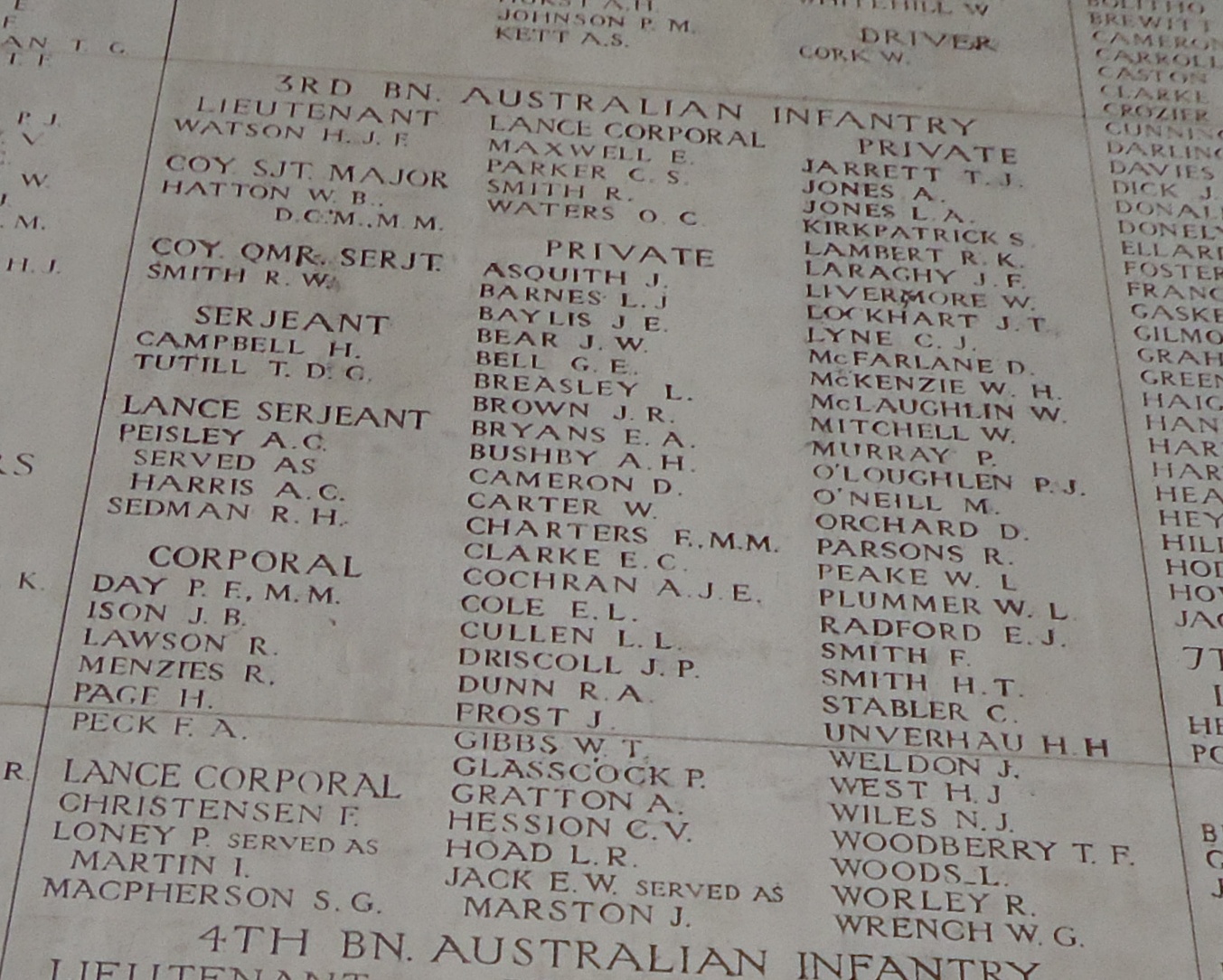
Private Patrick Joseph O’LOUGHLIN (O’LOUGHLEN) (3rd Infantry Battalion) was killed in action at Dickebush, Belgium, preparing for an attack in the vicinity of Polygon Wood.

O’Loughen J P on 3rd Battalion Australian Infantry panel [third row in centre on right] at the Menin Gate Memorial, Ieper, Belgium (Photograph: H. Thompson 11/9/2012)

Private Joseph Francis HEALEY  (13th Battalion) arrived in Australia aboard the transport Euripedes for medical discharge [GSW left knee].

Wednesday, 19 September 1917

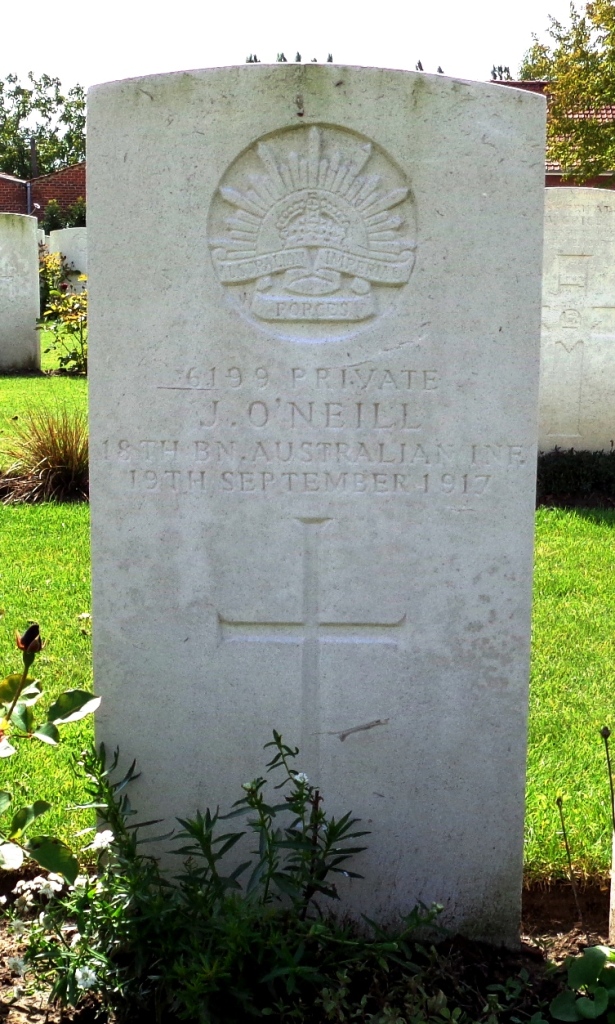
Private James O’NEILL (18th Battalion) was wounded in action near Bellewaarde Ridge, Belgium. He was evacuated to the 3rd Australian Field Ambulance, where he died later that same day of his wounds – it was his first time in action.

James O’Neill’s headstone at the Menin Road South Military Cemetery, Belgium (Photograph: H. Thompson 29/8/2014)

Sunday, 23 September 1917

Private Herbert William SPICER  (2nd ANZAC Cyclist Battalion) was transferred to the 1st Convalescent Depot at Boulogne, France.

Tuesday, 25 September 1917

Private George SEAMAN  (45th Battalion) arrived in Australia aboard the Transport Nestor for medical discharge [debility after shell shock  inguinal hernia].

Private Herbert William SPICER  (2nd ANZAC Cyclist Battalion) was transferred to the 10th Convalescent Depot.

Private Ernest TATTERSALL  (4th Pioneer Battalion) arrived at Sydney aboard the transport Nestor for medical discharge [leg ulcer}.

Private William Henry GRIFFITHS  (13th Battalion) was wounded in action in the vicinity of Westhoek, Belgium – he received a shrapnel wound to his chest.

Wednesday, 26 September

Private Leo Ambrose STINSON  (20th Battalion) left England aboard the transport Borda bound for Australia for medical discharge [ GSW back and right arm at Bullecourt).

Private George DAVIDSON  (4th Pioneer Battalion) departed England bound for Australia aboard the transport Borda for medical discharge [deformity to left elbow as a result of a high explosive shell near Mouquet Farm during the Battle of the Somme].

L/Corporal Henry MOSS  (45th Battalion) departed England on 26th September 1917 on the HMAT Borda to return to Australia for medical discharge [ GSW left arm and jaw during an attack on Messines Ridge, Belgium]

Thursday, 27 September 1917

Private William Henry GRIFFITHS  (13th Battalion) was placed aboard the 24th Ambulance Train, and admitthe 7th Canadian General Hospital at Etaples, France.

Gunner Walter James MITCHELL  (10th Field Artiller Brigade) departed Englandaboard the transport Suvic bound for Australia for medical discharge [suffering myalgia].

Private Colin David WREN  (4th Pioneer Battalion) departed England aboard the transport Suvic bound for Australia for medical discharge [incontinence of urine and overage]

Saturday, 29 September 1917

Private Joseph Raymond McGUIRE  (45th Battalion) was wounded in action in the vicinity of Westhoek Ridge, Belgium.  He received a bomb wound to his right leg, and was evacuated to the 10th Casualty Clearing Station, where he died of his wound.

Private Charles CREASE  (13th Battalion) was wounded in action for a second time with multiple shrapnel wounds to his arms, legs and chest, near Zonnebeke, Belgium.

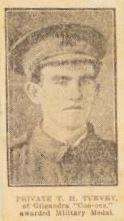
Private Thomas Henry TURVEY MM arrived in Australia on the transport Demostheues [GSW to abdomen at Messines Ridge in Belgium].

Private T. H. Turvey, of Gilgandra “Coo-ees”, awarded Military Medal (Newspaper unknown, 1917)

Private Joseph John WILLIAMS  (13th Battalion) departed England aboard the transport Suvic bound for Australia [trench fever].

Walter James WATTS

Walter James WATTS

Per his military service record (Depot), Walter James Watts was born at Hay, N.S.W.[1]  He gave his age as 38 years, his marital status as married, and his occupation as labourer. His description on his Certificate of Medical Examination form was height 5 feet 6 inches tall, weight 10 stone, with a dark complexion, blue eyes, and dark hair. His religious denomination was recorded as being Anglican.  He claimed that he had no previous military service.

His next of kin was recorded on his Australian Imperial Force Attestation Paper of Persons Enlisted for Service Abroad form as Mrs E. M. Watts, C/o J. Dumbrell, Walla Walla N.S.W.

He completed his medical examination at Gilgandra on 14th October 1915 (4 days after the Coo-ees left Gilgandra).  He travelled to Dubbo Army Camp – the nearest place he could enlist, and was attested at Dubbo on 17th October 1915.

The Gilgandra Weekly reported on 3rd December 1915 that prior to enlisting Watts had been ‘employed by Mr Utley, a district sawmiller’, and that ‘he left Gilgandra for the Dubbo Depot Camp, where he enlisted on October 16. The next day he entrained to Wellington and joined the Coo-ees’.[2]

The Coo-ees had a rest day in Wellington on 17th October 1915.

After completing the Co-ee March he went to Liverpool Camp as reinforcement for the 13th Battalion.

On 17th November 1915 Private Watts of the “Coo-ees” went before a Medical Board at Liverpool Camp, where he was found to be unfit for active service due to varicose veins.

Private Watts was discharged medically unfit on 29th November 1915.


[1] NAA: B2455, WATTS WALTER JAMES

[2] ‘An aftermath’, Gilgandra Weekly, 3 December 1915, p. 10. Retrieved August 11, 2017, from http://nla.gov.au/nla.news-article119922362


Robert John SLOEY

Robert John SLOEY

Per his military service record (Depot), Robert John Sloey was born in Wellington, N.S.W.[1]  He gave his age as 21 years and 8 months, his marital status as single, and his occupation as book-keeper.  His description on his Certificate of Medical Examination was height 5 feet 7 3/8 inches tall, weight 10 stone 7 lbs., with a dark complexion, blue eyes, and dark brown hair.  His religious denomination was Roman Catholic.  He claimed he had previous service in the Byrock Rifle Club, and that he had been rejected as unfit for military service once before due to eyesight.

His next of kin was recorded on his Australian Imperial Force Attestation Paper of Persons Enlisted for Service Abroad form as Mr and Mrs R. J. Sloey, Maxwell Street, Wellington N.S.W.

He appears to have joined the Coo-ee March somewhere between Wellington and Molong. ‘R. J. Sloey’ was reported in the Molong Express and Western District Advertiser on 23rd October 1915 as being one of six recruits that joined the Coo-ee March ‘on the road from Wellington’.[2]

He completed his medical examination at Orange on 24th October 1915.  He was attested at by Captain T. A. Nicholas at Orange on 24th October 1915 (the day the Coo-ees rested at Orange).

After completing the Coo-ee March he went to Liverpool Camp as reinforcement for the 13th Battalion.

His Statement of Service records that on 9th January 1916 Private Sloey deserted from Liverpool Camp. A warrant was issued for his arrest on 16th February 1916. The warrant was withdrawn on 30th January 1919.


[1]NAA: B2455, SLOEY ROBERT JOHN

[2] The “Coo-ees” Come. (1915, October 23). Molong Express and Western District Advertiser (NSW : 1887 – 1954), p. 10. Retrieved August 11, 2017, from http://nla.gov.au/nla.news-article101050484


Tyson RYAN

Tyson RYAN

Per his military service record (regimental no. N21449), Tyson Ryan was born in Gilgandra, N.S.W.[1] He gave his age as 18 years and 6 months, his marital status as single, and his occupation as horse trainer. His description on his Certificate of Medical Examination form was 5 feet 8 inches tall, weight 9 stone 3 lbs., with a dark complexion, blue eyes, and black hair. His religious denomination was recorded as being Roman Catholic. He claimed that he had no previous military experience.

His next of kin was recorded on his Australian Imperial Force Attestation Paper of Persons Enlisted for Service Abroad form as his father, Michael Ryan, Dubbo Road, Gilgandra.  Both his parents (Michael and Mary Ann Ryan) signed their names giving their consent for their son to enlist on his initial Application to Enlist in the Australian Imperial Force form.

He completed his medical examination at Gilgandra on 29th October 1915 (19 days after the start of the Coo-ee March).

He caught up with the Coo-ees, and was attested by Captain A. C. Eade at Lawson on 7th November 1915 (the day the Coo-ees rested at Lawson).

After completing the Coo-ee March he went to Liverpool Camp as reinforcement for the 6th Australian Light Horse Regiment.

Trooper Ryan forfeited 10 days pay for being absent without leave on 10th and  11th January 1916.

On 14th January 1916 Trooper Ryan was fined £10 for assaulting police during a riot.

He was fined 1 shilling, and confined to barracks for 7 days, for being absent without leave on 13th March 1916.

He was fined 1 shilling for neglect of duty and being late on 6 am parade on 6th May 1916.

On 15th May 1916 Trooper Ryan was fined £1 at Menangle Park for using threatening language to an N.C.O.

On the 19th of May 1916 Trooper Ryan was discharged unlikely to become an efficient soldier.

He attempted to re-enlist in 1917, however he was rejected as medically unfit.


[1] NAA: B2455, RYAN TYSON

Hector Andrew George LEE

Hector Andrew George LEE

Per his military service record (Depot), Hector Andrew George Lee was born at Redfern, N.S.W. [1]  He gave his age as 25 years and 10 months, his marital status as widower, and his occupation as labourer.  His description on his Certificate of Medical Examination form was height 5 feet 10 inches tall, weight 199 lbs., with a dark complexion, brown eyes, and brown hair. His religious denomination was left blank.  He claimed that he had no previous military service.

His next of kin was recorded on his Attestation Paper of Persons Enlisted for Service Abroad as his mother, Lucy Lee, Marquet Street, Rhodes N.S.W.

He completed his medical examination, and was attested by Lieutenant Frank Middenway, when the Coo-ees were at Ashfield, on 11th November 1915.

After completing the Coo-ee March he went to Liverpool Camp as reinforcement for the 13th Battalion.

On 16th  December 1915 Private Lee was charged at Liverpool Camp with being absent without leave for 10 days from 7th to 16th December, and also with being drunk on parade.

He was discharged on 20th December 1915 unlikely to become an efficient soldier.


[1] NAA: B2455, LEE HECTOR ANDREW GEORGE

Charles Thomas KING

Charles Thomas KING

Per his military service record (Depot), Charles Thomas King was born at Tuena, N.S.W.[1]  He gave his age as 35 years and 7 months, his marital status as married, and his occupation as labourer, on his Australian Imperial Force Attestation Paper of Persons Enlisted for Service Abroad form.

He claimed that he had no previous military service.  He also stated that he had been previously rejected as unfit for service for varicocele.

His next of kin was recorded as wife, Mary Isabel King, with address Bent Street, Katoomba.

Charles Thomas King joined the Coo-ee March at Springwood.[2]

He undertook a Preliminary Medical Examination at Springwood on 8th November 1915.   His height was recorded as 5 feet 9 inches on his ‘Preliminary Medical Examination’ section on his initial Application to Enlist in the Australian Imperial Force form.

He was attested at Springwood by Lieutenant F. Middenway on 8th November 1915, the day the Coo-ees marched from Lawson to Springwood.  His Description, and Certificate of Medical Examination sections, were not completed on his Attestation Paper.

After completing the Co-ee March he went to Liverpool Camp as reinforcement for the 13th Battalion.

On 17th November 1915 Private King went before a Medical Board at Liverpool Camp, where he was found to be unfit for active service due to varicocele.

Private King was discharged medically unfit on the 29th of November 1915.


[1] NAA: B2455, KING C T

[2] ‘Rejected Coo-ee starving’, Sunday Times, 2 April 1916, p. 9. Retrieved June 20, 2015, from http://nla.gov.au/nla.news-article121342361