Thomas William HASKETT

Thomas William HASKETT

Per his military service record (regimental no. 4793), Thomas William Haskett was born at Manuhull, Dorsetshire, [England].[1]  He gave his age as 43 years and 5 months, his marital status as married, and his occupation as labourer.  His description on his Certificate of Medical Examination form was height 5 feet 8 inches tall, weight 140 lbs., with a fair complexion, blue eyes, and brown hair.  His religious denomination was Church of England.  He claimed that he had 1 years previous military service in the 3rd Battalion of the Dorset Regiment.

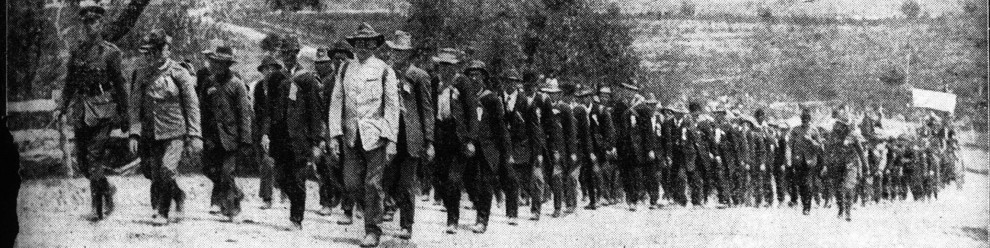
He was attested by Lieutenant F. Middenway at Springwood, but there is an anomaly with the date of his attestation on his Attestation Paper of Persons Listed for Service Abroad.  The date on the Certificate of Attesting Officer section of his Attestation Paper was originally recorded as 9th November 1915 (the day the Coo-ees marched from Springwood to Penrith), but this date has been changed on the form to 5th November 1915 (the day the Coo-ees marched from Mount Victoria to Katoomba).  The Oath to be taken by person being enlisted section is dated from 5th November 1915.

His “Joined on” date on his Attestation Paper was recorded as 5th November 1915, so it appears he may possibly have joined the Coo-ee March somewhere in the Blue Mountains before they arrived at Springwood.  He lived at Wentworth Falls, and was employed by Blue Mountains Shire Council on one of the shire gangs at the time he joined the Coo-ee March.[2]

He completed his medical examination at Ashfield on 11th November 1915.

After completing the Co-ee March he went to Liverpool Camp as reinforcement for the 13th Battalion.

On his embarkation roll his address at time of enrolment was Bathurst Road, Wentworth Falls, N.S.W., and his next of kin is listed as his wife, Mrs A. [Annie] Haskett, at the same address.

On 8th March 1916 Private Haskett, along with many of the other Coo-ees, departed Sydney on the HMAT A15 Star of England.  He arrived in Egypt on 11th April 1916.

On 19th April 1916 he was transferred to the 45th Battalion in Egypt.

On 2nd June 1916 Private Haskett left Alexandria aboard the transport Kinfauns Castle bound for France.  He arrived at Marseilles on 8th June 1916.

Private Haskett served with the 45th Battalion in France until 31st August 1916, when he was sent to the 3rd Casualty Clearing Station suffering from ‘Oedema of penus’.  He was placed aboard the 28th Ambulance Train and admitted to the 3rd Canadian Stationary Hospital at Boulogne, France, later that day.

He was later placed aboard the Hospital Ship St Dennis in Boulogne Harbour for evacuation to England.

After arrival in England, on 31st January 1917 he was admitted to the 3rd Australian Auxiliary Hospital at Dartford, England, with odema nephritis.

On 23rd March 1917 Private Haskett was discharged from hospital, and granted leave to report back on 7th April 1917.  He then marched into the No. 2 Command Depot at Weymouth, England, on 9th April 1917.

On 4th May 1917 Private Haskett departed Devonport, England, bound for Australia aboard the H.T. Miltiades for medical discharge (chronic nephritis).

He arrived in Australia on 5th July 1917.

The Lithgow Mercury reported that a concert and dance was held at Wentworth Falls to welcome home Private T. W. Haskett (and send off several other soldiers) in August 1917.[3]

Private Haskett was discharged Medically Unfit on 4th October 1917.


[1] NAA: B2455, HASKETT T W

[2] ‘Wentworth Falls’, Lithgow Mercury, 7 February 1916, p. 3. Retrieved April 16, 2017, from http://nla.gov.au/nla.news-article218728295

[3] ‘Wentworth Falls’, Lithgow Mercury, 31 August 1917, p. 3. Retrieved April 16, 2017, from http://nla.gov.au/nla.news-article218767520


Robert William PETTIGREW

Robert William PETTIGREW

Per his military service record (regimental no. 4876), Robert William Pettigrew was born at Stanley, Victoria.[1]  He gave his age as 30 years and 7 months, his marital status as widower, and his occupation as teamster.  His description on his Certificate of Medical Examination form was height 5 feet 5 ¾ inches tall, with a fair complexion, blue eyes, and fair hair.  His religious denomination was Church of England.  He claimed that he had no previous military service.

He completed his medical examination at Katoomba on 5th November 1915 (the day the Coo-ees stayed overnight at Katoomba), and was attested by Lieutenant Edward Shaw at Katoomba on the same day.

‘R. W. Pettigrew’ was named in The Blue Mountain Echo as one of ‘the lads who answered the call, and marched out with the Coo-ees’ at Katoomba.[2]

After completing the Co-ee March he went to Liverpool Camp as reinforcement for the 13th Battalion.

On his embarkation roll his address at time of enrolment was C/o Mrs P. Birtles, Wattlegrove Station, Wooragee, Victoria, and his next of kin is listed as his step-sister, Mrs P. Birtles, as the same address.

On 8th March 1916 Private Pettigrew, along with many of the other Coo-ees, departed Sydney on the HMAT A15 Star of England.  He arrived in Egypt on 11th April 1916.

On 13th April 1916 he was admitted to the No. 2 Australian Stationary Hospital at Tel-el-Kebir, Egypt, with asthma.

On 20th May 1916 he was transferred to the 45th Battalion in Egypt.

On 7th June 1916 Private Pettigrew left Alexandria aboard the transport Huntspill bound for France.  He arrived at Marseilles on 14th June 1916.

On 1st July 1916 Private Pettigrew was charged with being absent from entrainment parade at Marseilles on 15th June 1916 . He was fined 8 days pay.

On 9th August 1916 Private Pettigrew was taken on strength of the 45th Battalion when it was manning the support line in the vicinity of Pozieres, France.

Private Pettigrew was with the 45th Battalion in the field in France for the next 12 days, where it was in support from 9th to 11th August 1916 supplying fatigue and working parties, then engaged in the reserve and front lines from 12th to 15th August 1916.  The 45th Battalion then undertook several days marching as the Battalion moved from the front line to Albert, Warloy, and Herissart, then marched to Berteaucourt ‘in heavy rain’ on 19th August 1916, to be reorganised and refitted.[3]

On 21st August 1916 Private Pettigrew was taken by ambulance train from the 4th Casualty Clearing Station and admitted to the 13th General Hospital at Boulogne, France, suffering from bronchial asthma. On 22nd August 1916 he was placed aboard the Hospital Ship St Dennis in Boulogne Harbour from evacuation to England with bronchitis. On 21st August 1916 Private Pettigrew was taken by ambulance train from the 4th Casualty Clearing Station and admitted to the 13th General Hospital at Boulogne, France, suffering from bronchial asthma. On 22nd August 1916 he was placed aboard the Hospital Ship St Dennis in Boulogne Harbour from evacuation to England with bronchitis.

On 23rd August 1916 he was admitted to the Chatham Military Hospital in England. On 12th October 1916 he was transferred to the 3rd Australian Auxiliary Hospital in England.

He was discharged on the 21st of October 1916 and granted leave to report to the No. 1 Command Depot at Perham Downs on 6th November 1916.

On 8th November 1916 Private Pettigrew was charged with being absent without leave from 3.30 pm on 6th November 1916 till 8.45 pm on 7th November 1916. He was awarded 7 days confined to camp and fined 2 days pay.

On 13th November 1916 Private Pettigrew was transferred to the No. 4 Command Depot at Wareham, England.

On the 3rd of March 1917 Private Pettigrew was transferred to the No. 2 Command Depot at Weymouth, England.

On 4th May 1917 he was admitted to Verne Citadel holding station at Portland, England, with asthma.

On 23rd May 1917 Private Pettigrew departed England aboard the HMAT A33 Ayrshire bound for Australia for medical discharge with asthma.

After arriving in Australia he was discharged Medically Unfit on 21st January 1918.

[1] NAA: B2455, PETTIGREW ROBERT WILLIAM

[2] March o’er the Mountains’, The Blue Mountain Echo, 12 November 1915, p. 3. Retrieved March 7, 2017, from http://nla.gov.au/nla.news-article108042142

[3] AWM4 23/62/6 – August 1916, Australian Imperial Force unit war diaries, 1914-18 War, 45th Infantry Battalion


Robert Michael HICKEY

Robert Michael HICKEY

Per his military service record (regimental no. 5099), Robert Michael Hickey was born at Carcoar, N.S.W.[1]  He gave his age as 43 years and 2 months, his marital status as single, and his occupation as engine driver.  His description on his Certificate of Medical Examination was height 5 feet 10 inches tall, weight 156 lbs., with a medium complexion, brown eyes, and brown hair. His religious denomination was Roman Catholic.  He claimed that he had no previous military service.

He was attested by Lieutenant Frank Middenway at Ashfield on 11th November 1915. The Coo-ees held a recruitment meeting and stayed in Ashfield at the Drill Hall on the night of 11th November 1915 – the last night of the march.  The Certificate of Medical Examination in his service record shows that he first completed his medical on 11th November 1915 at Ashfield, however this date is crossed out, and replaced with the later date of 28th January 1916, at Liverpool Camp.

After completing the Coo-ee March he went to Liverpool Camp as reinforcement for the 13th Battalion.

On 4th February 1916 Private Hickey was charged with being Absent Without Leave from 16th  January to 24th January 1916.  He was recommended to be discharged, however he was fined and reinstated.

On his embarkation roll his address at time of enrolment was 29 Rocket Street, Bathurst, N.S.W, and his next of kin is listed as his mother, Mrs E. Hickey, at the same address.

Private Hickey departed Sydney on the HMAT A16 Star of Victoria on 31st March 1916, as 16th reinforcements for the 13th Battalion.[2]  He arrived in Egypt on the 8th May 1916.

On the 7th June 1916 Private Hickey left Alexandria aboard a transport ship bound for France, arriving at Marseilles on the 14th June 1916.

On 21st July he was taken on strength of the 13th Battalion in France from the 4th Division Base Depot at Etaples.

On 2nd August 1916 the 13th Battalion was training at Warloy, France, when Private Hickey was charged with being absent from Tattoo roll call on 31st July 1916. He was awarded 7 days Field Punishment No. 2.

On 11th August 1916, Private Hickey was wounded in action in the vicinity of Pozieres, when the 13th Battalion was in the front line during the Battle of Pozieres.  (His wound is not described in his service record).  He was evacuated to the 1st Canadian General Hospital at Etaples, France, where he was admitted sick on 23rd August 1916.

On 30th August 1916 he was placed aboard the Hospital Ship Stad Antwerpen at Calais for evacuation to England. Later that day he was admitted to the 4th Northern General Hospital at Lincoln, England.

On 25th September 1916 Private Hickey was transferred to the 2nd Australian Auxiliary Hospital at Southall, England. He was discharged on 31st October 1916 and marched into the No. 2 Command Depot at Weymouth, England.

On 9th November 1916 Private Hickey was transferred to the 4th Training Battalion at Codford, England for “home service”.

On13th April 1917 Private Hickey was transferred back to the No. 2 Command Depot at Weymouth, England.

On 4th May 1917 Private Hickey departed England from Devonport aboard the H.M.A.T. Runic bound for Australia.

He arrived in Sydney on 6th July 1917.  He was discharged Medically Unfit (Mitral Incompetence) on 11th August 1917.

Note: A page in his service record lists that he embarked from Sydney on the HMAT A15 Star of England with regimental no. 4798.  However, his name (and this regimental number) are not included on the nominal roll for the HMAT A15 Star of England. This initial regimental no. 4798 is crossed out on his Attestation Paper, and replaced with 5099.


[1] NAA: B2455, HICKEY R M 5099

[2] Australian War Memorial First World War Embarkation Rolls, ‘Robert Michael Hickey’, HMAT Star of Victoria A16, https://www.awm.gov.au/people/rolls/R1830731/

TIMELINE April 1917

TIMELINE April 1917

Wednesday, 4 April 1917

Lance Corporal James Gerald CAMERON (45th Battalion) was admitted to the 3rd General Canadian Hospital at Bologne with a laceration to his right hand (accidental injury in March).

Friday, 6 April 1917

Sergeant Sydney Raymond CARVER (45th Battalion) was wounded in action with a gunshot wound to his left leg.

Lance Corporal James Gerald CAMERON (45th Battalion) was promoted to full Corporal.

Saturday, 7 April 1917

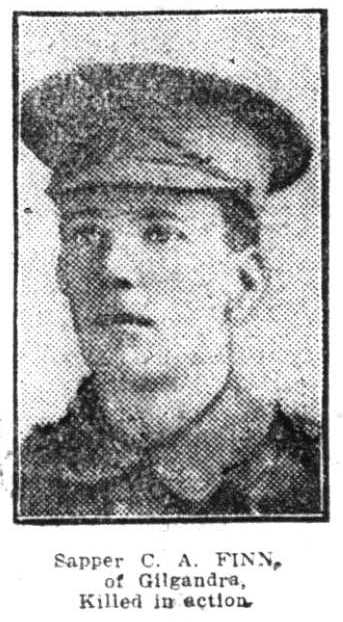
Sapper Charles Arthur FINN (13th Field Company Engineers) was killed in action by a high explosive shell while conducting road maintenance and repairs in the vicinity of Baupame France. Sapper Finn was buried at the H.A.C. Cemetery, Ecoust-St. Mein, Arras, Nord Pas de Calais, France.

Sapper C. A. Finn, of Gilgandra killed in action (Newspaper unknown, ca. 1917)

Charles Alfred Finn’s headstone at H.A.C. Cemetery, France (Photograph: S. & H. Thompson, 6/9/2014)

Corporal James Gerald CAMERON (45th Battalion) was placed aboard the HS Princess Elizabeth for evacuation to England, and was admitted to Kitchener Military Hospital at Brighton the same day.

Monday, 9 April 1917

Trooper Francis Noel WHITE (6th Light Horse Regiment) arrived in Australia aboard the NZ Transport Willochra.

Wednesday, 11 April 1917

Private Thomas ANDERSON (13th Battalion) was wounded in action with a gunshot wound to his right hand in the Battle of Bullecourt in France.

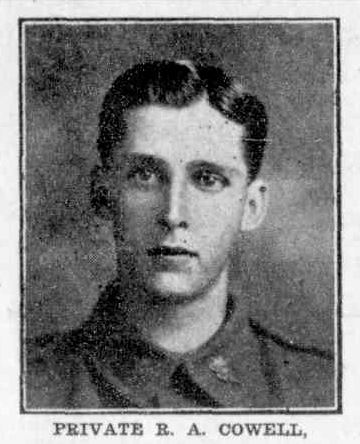
Private Reginald Arthur COWELL (4th Division Light Trench Mortar Battery) was wounded in action with a shrapnel wound to his face in the Battle of Bullecourt in the vicinity of Bullecourt.

Private R. A. Cowell (Cumberland Argus and Fruitgrowers Advocate 19/1/1918)

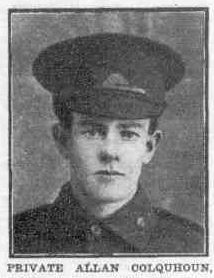
Private Allan COLQUHOUN (13th Battalion) was reported missing in action during the Battle of Bullecourt (he was captured and later reported to be a prisoner of war).

Allan Colquhoun (Cumberland Argus and Fruitgrowers Advocate, 16/11/1918)

Private Stanley Everard STEPHENS (13th Battalion) was killed in action during the Battle of Bullecourt. He was initially one of 367 reported missing on this day – a court of enquiry later officially reported him killed in action.  He has no known grave. His name is remembered on the Australian National Memorial at Villers-Bretonneux, France.

Stanley Everard Stephens (Photograph courtesy of M. Stephens)

Private Stephen’s name on the Villers-Bretonneux Memorial, France (Photograph: S. & H. Thompson 7/9/2014)

Private Thomas JACKSON (13th Battalion) was wounded in action near Bullecourt, France, in the Battle of Bullecourt, receiving shrapnel wounds to his face and neck.

Private Robert Clyde CAMPBELL (13th Battalion) was wounded in action in the vicinity of Reincourt during the Battle of Bullecourt on the Hindenburg Line, receiving a gunshot wound to his left arm.

Private John Hole SAUNDERS (13th Battalion) was sent to the 4th Australian Field Ambulance suffering Asthma.

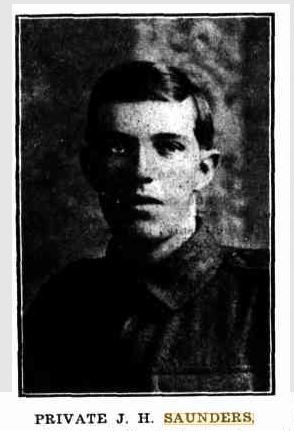
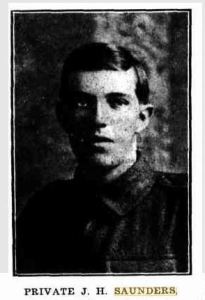
Private J. H. Saunders (Cumberland Argus and Fruitgrowers Advocate 27/5/1916)

Sergeant Sydney Raymond CARVER (45th Battalion) was wounded in action receiving a shrapnel wound to his left leg in the vicinity of Noreuil in the Battle of Bullecourt.

Thursday, 12 April 1917

Private Robert Clyde CAMPBELL (13th Battalion) was admitted to the 6th General Hospital at Rouen.

Friday, 13 April 1917

Private Thomas JACKSON (13th Battalion) was admitted to the 11th Stationary Hospital at Rouen.

Private Sidney BENNETT (45th Battalion) was admitted to the 16th Field Ambulance with Scabies.

Sidney Bennett (Photograph courtesy of his grand-daughters D. Ayers and J. Pemberton)

Private Thomas ANDERSON (13th Battalion) was admitted to the 1st General Hospital (GSW right hand).

Private Reginald Arthur COWELL (4th Division Light Trench Mortar Battery)  was admitted to the 1st General Hospital in France [shrapnel wound to his face, and he was discharged on 28th April, and sent to the 4th Australian Division Base Depot at Le Havre).

Sergeant Sydney Raymond CARVER (45th Battalion) was admitted to the 1st General Hospital at Rouen.

Saturday, 14 April 1917

Private Thomas JACKSON (13th Battalion) was admitted to the  2nd Convalescent Depot at Rouen.

Sunday, 15 April 1917

Private Robert Clyde CAMPBELL (13th Battalion) was moved to the 2nd Convalescent Depot at Rouen.

Monday, 16 April 1917

Private Leo Ambrose STINSON (20th Battalion) was wounded in action in the front line near Lagnicourt in France, receiving a gunshot wound to his back and right arm.

Tuesday, 17 April 1917

Private Leo Ambrose STINSON (20th Battalion) was admitted to the 10th General Hospital in Rouen.

Thursday, 19 April 1917

Trooper William ALSTON (1st Anzac Battalion of the Imperial Camel Brigade) was wounded in action, with a gunshot wound to his left arm and foot, outside Gaza in Palestine, during an attack.

William Alston on the occasion of his marriage to Miss. I. Quinton, sister of Coo-ee Victor Quinton, at Gilgandra, 1923 (Photograph courtesy of Dell Tschanter)

Private Thomas ANDERSON (13th Battalion) placed aboard the HS Londonderry for evacuation to England (gunshot wound right hand).

Friday, 20 April 1917

Private Percy George BROWN (54th Battalion) was admitted to the 11th Stationary Hospital at Rouen, France, with Influezna.

Trooper William ALSTON (1st Anzac Battalion of the Imperial Camel Brigade)  was admited to the 54th Casualty Clearing Station at El Arish in Egypt.

Private Thomas ANDERSON (13th Battalion) admitted to 1st Southern General Hospital at Birmingham, England (gunshot wound right hand).

Saturday, 21 April 1917

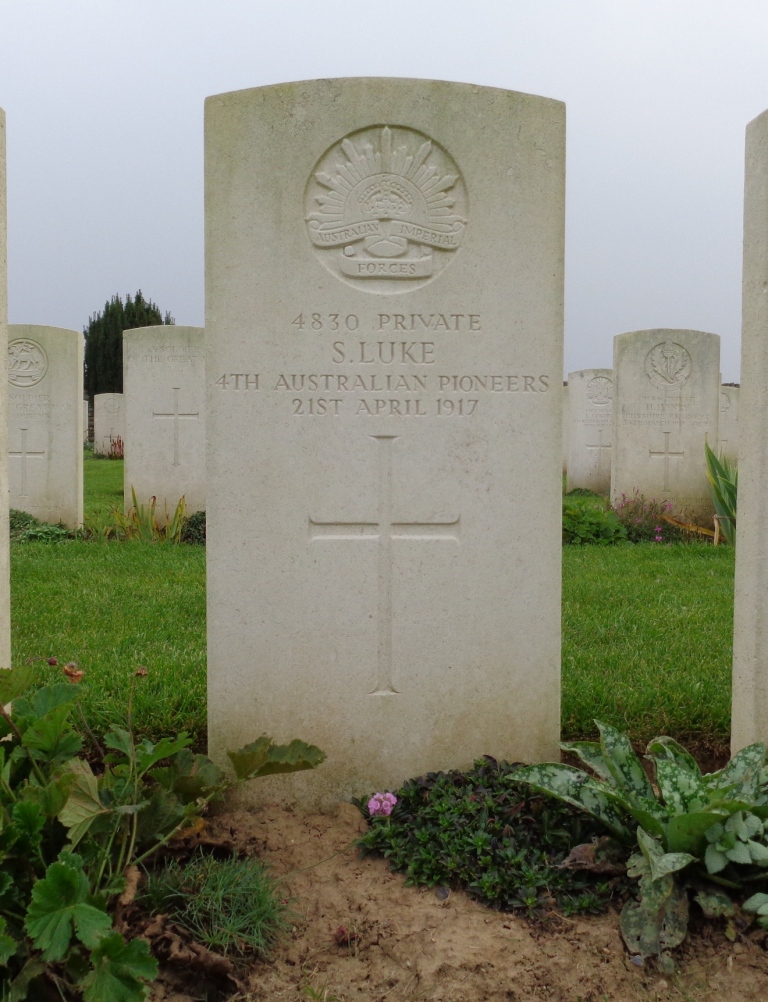
Private Samuel LUKE (4th Pioneer Battalion) was killed in action by a high explosive shell during the Battle of Bullecourt in the vicinity of Vaulx-Vraucourt, France. He was buried in the Vaulx Hill Cemetery, France.

Samuel Luke’s headstone at Vaulx Hill Cemetery, France (Photograph: S & H Thompson, 6/9/2014)

Private Bernard COYTE (13th Battalion) was placed aboard the Hospital Ship St George for evacuation to England suffering a slight debility.

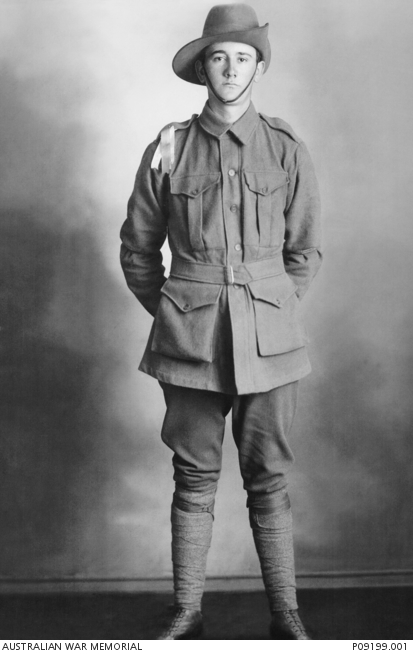
Bernard Coyte, ca. 1915 (Photograph: Australian War Memorial P09199.001)

Private Thomas JACKSON (13th Battalion) was discharged and sent to the 4th Australian Division Depot at Le Havre.

Corporal James Gerald CAMERON (45th Battalion) was discharged from hospital in England and granted leave.

Private John Hole SAUNDERS (13th Battalion) was sent to the 56th Casualty Clearing Station in France (Asthma).

Sunday, 22 April 1917

Trooper William ALSTON (1st Anzac Battalion of the Imperial Camel Brigade) was admitted to the 36th Stationery Hospital at Mahendia in Egypt.

Private Robert Clyde CAMPBELL (13th Battalion) was moved to the 11th Convalescent Depot at Buchy in France.

Monday, 23 April 1917

Private Bernard COYTE (13th Battalion) was admitted to the Lewisham Military Hospital in England.

Private John Hole SAUNDERS (13th Battalion) was sent to the 11th Stationary Hospital at Rouen (Asthma).

Tuesday, 24 April 1917

Private Percy George BROWN (54th Battalion) was moved to the 11th Convalescent Depot in France.

Wednesday, 25 April 1917

Sergeant Sydney Raymond CARVER (45th Battalion) was placed aboard a hospital ship for evacuation to England (shrapnel wound to his left leg).

Thursday, 26 April 1917

Private John Hole SAUNDERS (13th Battalion) was discharged from hospital and sent to the 4th Australian Divison Base Depot at Le Havre.

Sergeant Sydney Raymond CARVER (45th Battalion) was admitted to the 2nd Southern General Hospital at Bristol in England.

Friday, 27 April 1917

Private Thomas Walter DOWD (19th Battalion) was promoted to Lance Corporal.

Saturday, 28 April 1917

Gunner Charles Alfred HAMPSON (10th Field Artillery Brigade) was killed in action during the Battle of Bullecourt. Gunner Hampson was buried in the H.A.C. Cemetery, Ecoust-St. Mein, Arras, Nord Pas de Calais, France.

Charles Alfred Hampson’s headstone at H.A.C. Cemetery, France (Photograph: S. & H. Thompson, 6/9/2014)

Sunday, 29 April 1917

Private Leo Ambrose STINSON (20th Battalion) was evacuated by the hospital ship Warilda to England.

Monday, 30 April 1917

Private Leo Ambrose STINSON (20th Battalion) was admitted to the 5th Southern General Hospital at Portsmouth, England with gun shot wound to the right arm and back.

Private Bernard COYTE (13th Battalion) was transferred to the Bermondsey Ladywell Hospital in England.

Private Thomas JACKSON (13th Battalion) returned from hospital to his Battalion.

Sydney Raymond CARVER

Sydney Raymond CARVER

Per his military service record (regimental no. 4745), Sydney Raymond Carver was born at Hill End, N.S.W.[1]  He gave his age as 30 years and 6 months, his marital status as single, and his occupation as fettler.  His description on his Certificate of Medical Examination form was height 5 feet 6 inches tall, with a dark complexion, brown eyes, and black hair.  His religious denomination was Methodist.  He claimed that he had served for 5 years in the Hill End Rifle Club.

He was attested by Captain A. C. Eade at Katoomba on 5th November 1915 (the day the Coo-ees marched from Mount Victoria to Katoomba).  He did not complete his medical examination until 13th November 1915 at Liverpool.

After completing the Co-ee March he went to Liverpool Camp as reinforcement for the 13th Battalion.

Sydney Raymond Carver was also known as “Tom” Carver.[2]  He was referred to as ‘Private Tom Carver, of the Coo-ees … home on final leave’, in the Lithgow Mercury on 29th December 1915.[3]

The National Advocate reported that Private S. Carver was given a send-off on Thursday night 30th December 1915 in the Royal Hall at Hill End, where he was presented with a wristlet watch.[4]

On his embarkation roll his address at time of enrolment was Hill End, N.S.W., and his next of kin is listed as his father, B. [Benjamin] Carver, Hill End, N.S.W.

On 8th March 1916 Private Carver, along with many of the other Coo-ees, departed Sydney on the HMAT A15 Star of England.  He arrived in Egypt on 11th April 1916.

On 19th April 1916 he was transferred to the 45th Battalion in Egypt.

On 2nd June 1916 Private Carver left Alexandria aboard the transport Kinfauns Castle bound for France arriving at Marseilles on 8th June 1916.

On 4th July 1916 Private Carver was sent to the 4th Australian Field Ambulance suffering from Influenza.  On 7th July 1916 he was sent to the 4th Division Rest Station.  He rejoined the 45th Battalion on 9th July 1916.

On 30th July 1916 Private Carver was promoted to Lance Corporal.

On 24th August 1916 he was promoted to Corporal.

On 6th April 1917 he was promoted to Sergeant.

On 11th April 1917 the 45th Battalion was moving into the front line in the vicinity of Noreuil, France when Sergeant Carver was wounded in action, receiving a shrapnel wound to his left leg.  He was sent to the 4th Australian Field Ambulance, then moved back to the 9th Casualty Clearing Station, then the 56th Casualty Clearing Station.  On 12th April 1917 he was placed aboard the 11th Ambulance Train.  On 13th April 1917 he was admitted to the 1st General Hospital at Entretat, France.

On 25th April 1917 Sergeant Carver was placed aboard a hospital ship for evacuation to England.  On 26th April 1917 he was admitted to the 2nd Southern General Hospital at Bristol, England.

He was discharged from hospital on 21st May 1917, and granted leave to report to the No. 1 Command Depot at Perham Downs on 5th June 1917.

On 26th June 1917 he was transferred to the Overseas Training Brigade.

On 9th December 1917 Sergeant Carver departed Southampton bound for France.  He arrived at the 4th Australian Division Base Depot at Le Harve, France, on 10th December 1917.

He rejoined the 45th Battalion when it was training at Haut Allaines, France, on 16th December 1917.

On 5th April 1918 the 45th Battalion was in action around Dernacourt, France, when Sergeant Carver was wounded in action for the second time, receiving a gunshot wound to his abdomen.  He was sent to the 13th Australian Field Ambulance, then back to the 29th Casualty Clearing Station.  On 6th April 1918 he was placed aboard the 27th Ambulance Train being admitted to the 7th Canadian General Hospital on the 7th of April 1918 at Etaples, France.

On 25th April 1918 he was placed aboard the Hospital Ship Princess Elizabeth for evacuation to England.  On 26th April 1918 he was admitted to the County of Middlesex War Hospital at Napsbury  in England.

On 3rd June 1918 he was transferred to the 1st Australian Auxiliary Hospital at Harefield, England.  He was discharged on 18th June 1918 and sent to the No. 3 Command Depot at Hurdcott, England.

On 3rd July 1918 Sergeant Carver was admitted to the Fovant Military Hospital sick.  He was discharged on 31st July 1918.

On 11th September 1918 Sergeant Carver was transferred to the No. 1 Command Depot at Sutton Veny, England.

On 21st October 1918 Sergeant Carver was sent to the Overseas Training Brigade.

He departed Southampton on 21st November 1918 bound for France.  He arrived at the 4th Australian Division Base Depot at Le Harve, France, on 22nd November 1918.

He rejoined the 45th Battalion in France on 1st December 1918.

On 19th March 1919 Sergeant Carver was sent to the 12th Australian Field Ambulance sick with old abdomen wound.  He was discharged, and rejoined the 45th Battalion, on 25th March 1919.

On 6th April 1919 Sergeant Carver was sent to the Australian Base Depot at Le Harve.

On 11th April 1919 Sergeant Carver was admitted to the 39th General Hospital sick at Le Havre.

On 18th April 1918 he was placed aboard a hospital ship for evacuation to England.  He was admitted to the 1st Australian Dermatological Hospital at Bulford, England, on 19th April 1919.

He was discharged on 4th July 1919 and sent to the No. 2 Depot at Sutton Veny, England.

On 23rd July 1919 Sergeant Carver departed England aboard the H.T. Suevic bound for Australia.

He arrived in Australia 10th September 1919, and was discharged medically unfit on 10th November 1919.

The Mudgee Guardian and North-Western Representative reported that Sergeant Carver was one of the soldiers who were given a welcome home at a large gathering held at the Royal Hall in Hill End on Friday 3rd October 1919.  Each soldier was given an inscribed gold medal, and a ‘useful bundle of clothing from the ladies’ knitting circle’.[5]

Research note: Sydney Raymond ‘Tom’ Carver was not named in The Blue Mountain Echo as one of ‘the lads who answered the call, and marched out with the Coo-ees’ at Katoomba.[6]  His “Joined on” date on his Attestation Paper is 5th November 1915, so it appears possible that he may have joined the Coo-ees somewhere on that day before they reached Katoomba. The Coo-ees picked up two recruits in Blackheath on route from Mount Victoria to Katoomba.[7]  One of these men was Thomas Walsh.  ‘T. Carver’ and ‘T. Walsh’ are listed together on the Blackheath Roll of Honor published in The Blue Mountain Echo on 13th April 1917.[8]  It appears a possibility that ‘Tom’ Carver may have been the other recruit who joined the Coo-ees at Blackheath.  

[1] NAA: B2455, CARVER S R

[2] ‘CARVER, Sydney Raymond (Tom) : Service Number – 4745’’, Hill End War Memorial, http://www.heatgg.org.au/resources/databases/hill-end-war-memorial/

[3] ‘Hill End’, Lithgow Mercury, 29 December 1915, p. 4. Retrieved March 27, 2017, from http://nla.gov.au/nla.news-article218453720

[4] ‘’Hill End Recruits’, National Advocate, 6 January 1916, p. 3. Retrieved March 27, 2017, from http://nla.gov.au/nla.news-article158046862

[5] ‘Soldiers’ Welcome Home’, Mudgee Guardian and North-Western Representative, 9 October 1919, p. 12. Retrieved March 27, 2017, from http://nla.gov.au/nla.news-article157039404

[6] ‘March o’er the Mountains’, The Blue Mountain Echo, 12 November 1915, p. 2. Retrieved September 21, 2015, from http://nla.gov.au/nla.news-article108042142  [on page 3]

[7] ‘The Route March’, The Farmer and Settler,  9 November 1915, p. 3. Retrieved March 27, 2017, from http://nla.gov.au/nla.news-article116669569

[8] ‘Eastertide at Blackheath’, The Blue Mountain Echo, 13 April 1917, p. 3. Retrieved March 29, 2017, from http://nla.gov.au/nla.news-article108244227

Thomas WALSH

Thomas WALSH

Per his military service record (Depot), Thomas Walsh was born in Melbourne, Victoria.[1]  He gave his age as 43 years and 4 months, his marital status as single, and his occupation as labourer.  His description on his Certificate of Medical Examination was height 5 feet 6 inches tall, weight 9 stone 7 lbs., with a dark complexion, grey eyes, and brown hair.  His religious denomination was Church of England.  He claimed he had no previous military experience. Marked against his next of kin on his Attestation Paper was “No Relatives”.

He was attested at Katoomba by Captain A. C. Eade on 5th November 1915 (the day the Coo-ees marched from Mount Victoria to Katoomba).  He did not complete his medical examination until 13th November 1915 at Liverpool.

He appears to have been one of the two recruits that joined the Coo-ees at Blackheath during their march from Mount Victoria to Katoomba on 5th November 1915.  His initial Application to enlist in the Australian Imperial Force form dated 5th November 1915 was addressed to the Recruiting officer at Blackheath, and his postal address was left blank.  The Preliminary Medical Examination section was signed by a medical officer at Blackheath on 5th November 1915.  The Certificate of Recruiting Officer section at the bottom of this form was signed by Captain Eade at Lawson on 7th November 1915.

After completing the Coo-ee March he went to Liverpool Camp as reinforcement for the 13th Battalion.

However, it appears that his service in the Australian Imperial Force was short.

On 15th January 1916 Private Walsh was posted as a deserter. A warrant for his arrest was issued the on 19th February 1916. The warrant was withdrawn on the 13th of January 1920.

Research note: It may just be a coincidence, but the signature of this Thomas Walsh is very similar to that of another Thomas Walsh aged 43 years and 5 months, who was attested at Liverpool on 20th January 1916, who was also born at Melbourne, and was assigned to the same company that the Coo-ees were initially assigned to in the 13th Battalion.  The “Joined on” date of this Thomas Walsh was 4th November 1915, but there is nothing in his service record to indicate where this occurred.  This Thomas Walsh was sent overseas in May 1916, served on the Western Front, and returned to Australia in 1917.  However his next of kin was listed as his mother, who had a different surname, and there were some small differences with his appearance, and a different occupation was listed.

[1] NAA: B2455, WALSH THOMAS

John Hole SAUNDERS

John Hole SAUNDERS

Private J. H. Saunders (Cumberland Argus and Fruitgrowers Advocate 27/5/1916)

Per his military service record (regimental no. 5766), John Hole Saunders was born at Parramatta, N.S.W.[1]  He gave his age as 18 years and 10 months, his marital status as single, and his occupation as shop assistant.  His description on his Certificate of Medical Examination form was height 5 feet 7 ½ inches tall, weight 123 lbs., with a fair complexion, blue eyes, and brown hair. His religious denomination was Methodist.  He claimed to have 4 years universal military training and was still serving.

He completed his medical examination on 10th November 1915 at Parramatta, and was attested by Lieutenant R. Howe at Parramatta on 11th November 1915, when the Coo-ees were recruiting at Parramatta.  He claimed that he had 4 years military service in the Cadets.

After completing the Coo-ee March he went to Liverpool Camp as reinforcement for the 13th Battalion.

The Cumberland Argus and Fruitgrowers Advocate reported that Private ‘Jack’ Saunders’ was presented with a silver-mounted pipe, fountain pen, and other articles, at a send-off held for him and fellow Parramatta recruit Private Roy McMillan, at Parramatta on Monday 14th February 1916. [2]

On his embarkation roll his address at time of enrolment was Dersmore, Crimea Street, Parramatta, N.S.W., and his next of kin is listed as his father, J. H. [John Hole] Saunders, at the same address.

On 3rd May 1916 Private Saunders departed Sydney on the HMAT A46 Clan McGillivray, as part of the 18th reinforcements for the 13th Battalion.

He arrived in Egypt in June 1916.

On Te-el-Kebir on 25th July 1916 Private Saunders was charged with conduct to the prejudice of good order and military discipline in that whilst on a route march disobeyed an order directly given by his superior officer.  He was awarded 2 days confined to barracks.

On 8th August 1916 Private Saunders departed Egypt bound for England aboard the Transport Megantic.

On 12th December 1916 Private Saunders departed Folkestone, England, aboard the SS Arundle bound for France.  He marched into the 4th Australian Division Base Depot at Etaples, France on 13th December 1916.

On 19th December 1916 Private Saunders marched into the 13th Battalion when it was training at Coisy, France.

On 13th January 1917 the 13th Battalion was conducting fatigue duties at Mametz, France, when Private Saunders was evacuated the 5th Australian Field Ambulance sick with Influenza.  On 15th January 1917 he was sent to the 38th Casualty Clearing Station, then placed aboard the 25th Ambulance Train for journey to No. 10 General Hospital at Rouen, France.

On 26th January 1917 he was released from hospital and sent to the 4th Australian Division Base Depot at Etaples, France.

He rejoined the 13th Battalion on 16th February 1917 whilst it was training and performing fatigue duties at Mametz, France.

On 11th April 1917 the 13th Battalion was involved in the attack on the Hindenburg line in the 1st Battle of Bullecourt, France, when Private Saunders was evacuated to the 8th Australian Field Ambulance suffering Asthma.  He was moved to the 4th Australian Field Ambulance, then sent to the 56th Casualty Clearing Station on the 20th April 1917.  On 23rd April 1917 he was transferred to the 11th Stationary Hospital at Rouen, France.

He was discharged from hospital on 26th April 1017 and sent to the 4th Australian Division Base Depot at Etaples, France.  Whilst at the 4th Australian Division Base Depot Private Saunders was classified as “PB” [Permanent Base duties].

On 29th May 1919 he departed France bound for England with the status “P.B.”

Private Saunders arrived in Weymouth on 30th May 1917 and marched into the No. 2 Command Depot.

On the 4th of June 1917 he was transferred to the No. 1 Command Depot at Perham Downs, England.

On 9th June 1917 Private Saunders was classified as “B1A4” [fit for overseas training camp when passed dentally fit].[3]

On 13th September 1917 Private Saunders was reclassified as “A3” [fit for overseas training camp, to which transferred for hardening, prior to rejoining unit overseas].[4]

On 14th September 1917 Private Saunders was sent to the Headquarters Depots at Tidworth, England, to perform guard duties.

On 25th October 1917 Private Saunders was temporarily detached for duty at the Administrative Headquarters in London.

On 4th December 1917 Private Saunders was sent to the No. 3 Command Depot at Hurdcott, England.  On 5th December 1917 he was reclassified as “B1A3” [fit for overseas training camp in two to three weeks].[5]

On 15th December 1917 Private Saunders was reclassified “A3” [fit for overseas training camp, to which transferred for hardening, prior to rejoining unit overseas].[6]

On 19th December 1917 Private Saunders was transferred to the Overseas Training Brigade at Longbridge Deverill, England.

On 10th January 1918 he departed Southampton, England, bound for France.  He marched into the 4th Australian Division Base Depot at Le Harve, France, on 11th January 1918.

On 18th January 1918 Private Saunders rejoined the 13th Battalion on 18th January 1918 when it was training at Locre, Belgium.

On 27th January 1918 the 13th Battalion was at White Chateau was manning the front line near Hollebeke in Belgium when Private Saunders was evacuated to the 13th Australian Field Ambulance suffering Balantitis.  He was moved back to the 2nd Australian Casualty Clearing Station.  On 29th January 1918 he was placed aboard the 39th Ambulance Train and transported to the 39th General Hospital at Le Havre France, where he was admitted on 1st February 1918. He was discharged on 3rd February 1918, and sent to the 4th Australian Division Base depot at Le Harve.

He rejoined the 13th Battalion on 12th of February 1918 when it was training at Locre, Belgium.

On 9th May 1918 the 13th Battalion was manning support lines near Villers Bretonneux, France, when Private Saunders was evacuated to the 13th Australian Field Ambulance sick.  He was moved back to the 61st Casualty Clearing Station then on 10th May 1918 he was placed aboard the 28th Ambulance Train for journey to the 39th General Hospital at Le Harve, France, where he was admitted on13th May 1918.

Private Saunders was discharged from hospital on 16th July 1918 and marched into the 4th Australian Division Base Depot at Le Harve that same day.

He rejoined the 13th Battalion on 3rd August 1918 when it was manning the front line south of Villers Bretonneux, France.

On 7th August 1918 the 13th Battalion was preparing to move forward to participate in an attack on the German lines  around Amiens when Private Saunders went absent without leave at 9.30 p.m.  He returned at 9.15 a.m. on 12th August 1918. On 22nd August 1918 he was charged with being absent without leave, and was awarded 28 days field punishment No. 2 and fined 33 days pay.

On 15th September 1918 the 13th Battalion was preparing to move forward to the front line when Private Saunders went absent without leave again.

He was located on 18th September 1918 and charged with desertion.  On 7th October 1918 a Field General Courts Martial was held where Private Saunders was charged with Desertion.  He pleaded Not Guilty.  He was found Guilty, and he was sentenced to serve 10 years Penal Servitude.

On 8th November 1918 Private Saunders marched into the No. 1 Military Prison at Rouen, France.

On 17th February 1919 he was transferred to England on SS Nirvana to serve the remainder of his sentence.  On 19th February 1919 Private Saunders marched into His Majesty’s Prison at Portland in England.

On 25th April 1919 Private Saunders’ prison sentence was suspended, and he was released and marched into the No. 4 Group at Hurdcott, England, on 26th April 1919.

On 2nd June 1919 Private Saunders departed Devonport, England, aboard the HT Beltana bound for Australia.

He arrived in Sydney on 20th July 1919, and was discharged Termination of Period of Enlistment on 4th September 1919.


[1] NAA B2455, SAUNDERS JOHN HOB

[2] ‘The Sheepskin Fund’, The Cumberland Argus and Fruitgrowers Advocate, 19 February 1916, p. 11. Retrieved March 12, 2017, from http://nla.gov.au/nla.news-article86072411

[3] Department of Veterans Affairs, ‘Army Medical Classifications – World War 1’ in Chapter 5 Abbreviations and Medical Classifications’, http://www.dva.gov.au/consultation-and-grants/advocacy-training/repatriation-handbooks

[4] Ibid.

[5] Ibid.

[6] Ibid.
Reginald Arthur COWELL

Reginald Arthur COWELL

Private R. A. Cowell (Cumberland Argus and Fruitgrowers Advocate 19/1/1918)

Per his military service record (regimental no. 4751), Reginald Arthur Cowell was born at Ermington, N.S.W.[1]  He gave his age as 19 years 5 months, his marital status as single, and his occupation as nurseryman.  His description on his Certificate of Medical Examination form was height 5 feet 8 inches tall, weight 132 lbs., with a sallow complexion, brown eyes, and dark brown hair.  His religious denomination was Church of England.  He claimed that he had no previous military service.

Reginald Arthur Cowell joined the Coo-ees at Parramatta.[2]  The Coo-ees had held a recruiting meeting in the Park at Parramatta on the evening of the 10th November, where it was reported that 41 men had offered themselves as recruits.[3]

He completed his medical examination at Parramatta on 10th November 1915, and was attested by Lieutenant R. Howe at Parramatta on 11th November 1915.

After completing the Co-ee March he went to Liverpool Camp as reinforcement for the 13th Battalion.

The Cumberland Argus and Fruitgrowers Advocate reported on 11th March 1916 that a send-off had been given for Private Reginald Cowell the previous Friday ‘who is leaving with the Coo-ees this week for the front’, and that he was presented ‘with a silver-mounted pipe, tobacco pouch and silver pencil’.[4]

On his embarkation roll his address at time of enrolment was Excelsior Avenue, Castle Hill, N.S.W., and his next of kin is listed as his father, W. A. [William Arthur] Cowell, at the same address.

On 8th March 1916 Private Cowell, along with many of the other Coo-ees, departed Sydney on the HMAT A15 Star of England, and arrived in Egypt on 11th April 1916.

On 7th June 1916 Private Cowell left Alexandria aboard the Transport Ionian bound for France, and he arrived at Marseilles on 14th June 1916.

Private Cowell, (along with several other Coo-ees, including Privates Watson, Easterbrook, Healey, and Mason), marched into the 13th Battalion on 19th August 1916 when it was resting and reorganising at Pernois, France.

On 23rd September 1916 the 13th Battalion was manning the front line in the vicinity of Voormezeele, Belgium when Private Cowell was transferred to the 4th Division Light Trench Mortar Battery.

On 25th September he was taken on strength of the 4th Division Light Trench Mortar Battery in the vicinity of Voormezeele, Belgium.

On 11th April 1917 the 4th Division Light Trench Mortar Battery was involved in the attack on the Hindenburg Line in the vicinity of Bullecourt, France, when Private Cowell was wounded in action, receiving at shrapnel wound to his face.  He was evacuated to the 4th Australian Field Ambulance.  He was then moved back to the 9th Casualty Clearing Station.  On 12th April he was placed aboard the 11th Ambulance Train. He was admitted to the 1st General Hospital at Rouen on 13th April 1917.

On 28th April 1917 Private Cowell was discharged to Base details and sent to the 4th Australian Division Base Depot at Le Harve, France.

On 22nd June 1917 Private Cowell was charged with being absent without leave from Sick Parade.  He was awarded forfeiture of two days pay.

On 1st July 1917 Private Cowell departed the 4th Australian Division Base Depot to return to his unit.  He joined the 4th Division Light Trench Mortar Battery on 5th July 1917 when it was manning the front line in the vicinity of Ypres, Belgium.

On 19th October 1917 Private Cowell was with the 4th Division Light Trench Mortar Battery manning the front line in the vicinity of Passchendaele, Belgium, when he was wounded in action for the second time, receiving a shrapnel wound to his right eye.  He was evacuated to the 4th Australian Field Ambulance.  On 26th October 1917 he was discharged and returned to his unit in Belgium.

On 5th September 1918 Private Cowell was sent to England on leave.  He returned to his unit in France from leave on 23rd September 1918.

On 30th January 1919 Private Cowell was sent to the Australian Base Depot at Le Harve to begin his return to Australia.  He left Le Harve on 10th February 1919, and arrived at Weymouth in England on 11th February 1919.

On 15th February 1919 Private Cowell was admitted to the Fovant Military Hospital seriously ill with Broncho Pneumonia.  On 27th February 1919 he was transferred to the 1st Australian General Hospital at Sutton Veny, England.  He was discharged from hospital to the 3rd Training Brigade on 15th March 1919.

Private Cowell departed England aboard the H.T. Commonwealth bound for Australia on 13th April 1919.

He arrived in Australia on 12th June 1919, and was discharged on 17th October 1919.


[1] NAA: B2455, COWELL R A

[2] ‘Our Brave Boys on the Battle Fields’, The Cumberland Argus and Fruitgrowers Advocate, 19 January 1918, p. 4. Retrieved April 1, 2017, from http://nla.gov.au/nla.news-article86205203

[3] ‘The procession’, The Cumberland Argus and Fruitgrowers Advocate, 13 November 1915, p. 11, http://nla.gov.au/nla.news-article86101767

[4] ‘A Send-off’, The Cumberland Argus and Fruitgrowers Advocate, 11 March 1916, p. 11. Retrieved March 27, 2017, from http://nla.gov.au/nla.news-article86070741


TIMELINE March 1917

TIMELINE March 1917

Friday, 2 March 1917

Private Jack Henry HUNT (45th Battalion) was evacuated to England aboard the Hospital Ship Aberdonian from Boulogne, France, with Trench Feet.

Private Joseph John WILLIAMS (13th Battalion) was sent to the 8th Australian Field Ambulance in France suffering from Scabies, and he was moved to the 5th Rest Station later that day with Influenza. He was later moved to the 5th General Hospital at Rouen with Trench Fever.

Saturday, 3 March 1917

Private Jack Henry HUNT (45th Battalion) was admitted to the Voluntary Aid Hospital at Cheltenham, England, with Trench Feet (severe).  (He was later transferred to the 2nd Southern General Hospital where the third toe of his right foot was amputated).

Monday, 5 March 1917

Private Lewis Reginald DUFF (45th Battalion) was promoted to Lance Corporal.

Wednesday, 7 March 1917

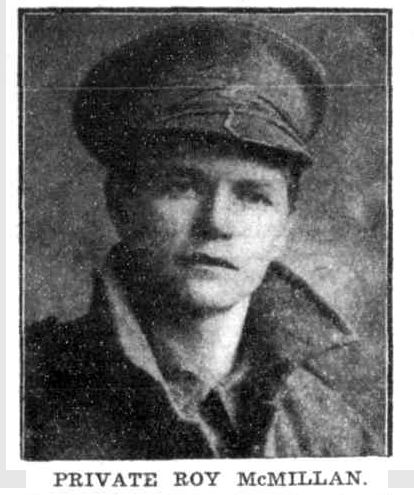
Private Cyril Roy MCMILLAN (45th Battalion) went to the 12th Australian Field Ambulance in France suffering from Trench Feet. He was moved to 3rd Australian Field Ambulance the same day.

Private Roy McMillan (Cumberland Argus and Fruitgrowers Advocate, 11/5/1918)

Private Joseph John WILLIAMS (13th Battalion) was sent to a Casualty Clearing Station with Trench Feet.

Thursday, 8 March 1917

On 8th March Private Cyril Roy MCMILLAN (45th Battalion) was admitted to the 45th Casualty Clearing Station with Trench Feet.

Trooper Francis Noel WHITE (6th Light Horse Regiment) departed Port Suez about the NZ transport Willochra for return to Australia.

Friday, 9 March 1917

Private Bert KILDUFF (4th Pioneer Battalion) was admitted to the 8th Australian Field Ambulance in France for dental treatment.

Sunday, 11 March 1917

Private Cyril Roy MCMILLAN (45th Battalion) was placed aboard the 9th Ambulance Train and moved to the 3rd Stationery Hospital at Rouen, France, with Trench Feet.

Private Thomas SHAW (4th Pioneer Battalion) arrived back in Australia at Sydney aboard the Kanowna.

Monday, 12 March 1917

Private Alfred WARDROP (45th Battalion) had his left foot amputated 3 inches above his ankle at the St John’s Ambulance Brigade Hospital at Etaples, France.

Private Joseph John WILLIAMS (13th Battalion) was placed aboard the Hospital Ship Grantully Castle at Le Havre for evacuation to England (Trench Fever).

Tuesday, 13 March 1917

Private Cyril Roy MCMILLAN (45th Battalion) was placed aboard the Hospital Ship Warilda for evacuation to England with Trench Feet.

Private Alfred WARDROP (45th Battalion) was evacuated to England on the HS Gloucester Castle sailing from Le Havre, following the amputation of his left foot.

Private Joseph John WILLIAMS (13th Battalion) was admitted to the 2nd Southern General Hospital at Bristol in England (Trench Fever).

Private William CAIRNS (13th Battalion) was sent to the 13th Australian Field Ambulance suffering from Influenza.

Wednesday, 14 March 1917

On 14th March 1917 Cyril Roy MCMILLAN (45th Battalion) was admitted to the Kitchener Military Hospital at Brighton, England, with Trench Feet.

Private Andrew James MCGREGOR (2nd Australian Field Bakery) was admitted to the 30th General Hospital at Calais France suffering from Myalgia.

Andrew James McGregor (Daily Telegraph 22/9/1916)

Private Alfred WARDROP (45th Battalion) was admitted to the 3rd London General Hospital (recovering from amputated left foot).

Friday, 16 March 1917

Private William Charles WALKER (54th Battalion) was admitted to the Wareham Isolation Hospital in England suffering Mumps.

Saturday, 17 March 1917

Private Charles Henry HUNT (45th Battalion) departed England about the H.T. Beltana bound for Australia, suffering from Pleurisy and Rheumatism.

Private Daniel LYNCH (13th Battalion) departed England aboard the H.T. Beltana bound for Australia, for discharge for being over age and debility.

Private Bert KILDUFF (4th Pioneer Battalion) was discharged from the 8th Australian Field Ambulance following his dental treatment earlier in the month, but was readmitted on the same day suffering Urethral Stricture.

Sunday 18th March 1917

On 18th March Private Bert KILDUFF (4th Pioneer Battalion) was transferred to the 3rd Casualty Clearing Station with Urethral Stricture.

Wednesday, 21 March 1917

Private Bernard COYTE (13th Battalion) was sent to the 13th Australian Field Ambulance in France with Influenza.

Bernard Coyte, ca. 1915 (Photograph: Australian War Memorial P09199.001)

Private Bert KILDUFF (4th Pioneer Battalion) was transferred by ambulance train to the 1st Australian General Hospital with Urethral Stricture.

Private Andrew James MCGREGOR (2nd Australian Field Bakery)  was discharged and returned to his unit.

Thursday, 22 March 1917

Private Archibald MCINTYRE (56th Battalion) was evacuated to the 5th Divisional Rest Station in France sick.

Friday, 23 March 1917

Private Archibald MCINTYRE (56th Battalion) was admitted to a Casualty Clearing Station.

Saturday, 24 March 1917

Private Archibald MCINTYRE (56th Battalion) was diagnosed with Bronchitis.

Sunday, 25 March 1917

Private Archibald MCINTYRE (56th Battalion) was diagnosed at the 2/1st South Midland Casualty Clearing Station in France with Cerebro Spinal Meningitis.

Monday, 26 March 1917

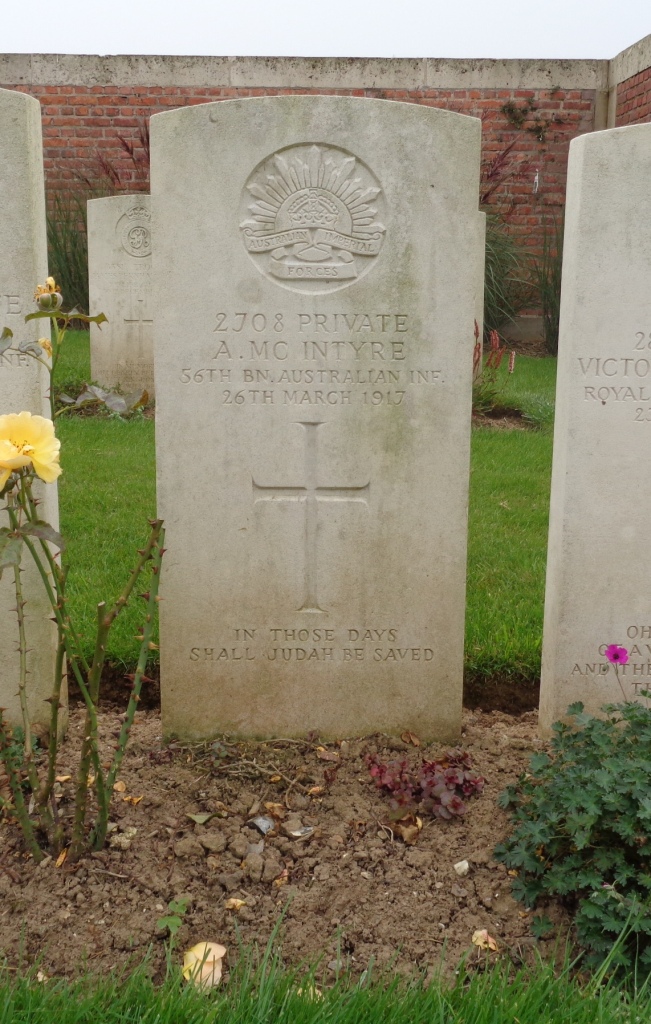
Private Archibald MCINTYRE (56th Battalion) died of his illness, and was buried in the Puchevillers British Cemetery, France.

Archibald McIntyre’s headstone at Puchervillers British Cemetery, France (Photograph: S & H Thompson 5/9/2014)

Tuesday, 27 March 1917

Private Jacob Isak PALMGREN (34th Battalion) arrived at Devonport in England from Australia aboard the Anchises, and marched into the 12th Training Battalion at Codford, England, the same day.

Thursday, 29 March 1917

Private Bernard COYTE (13th Battalion) was admitted to the 3rd Australian Casualty Clearing Station in France with Brocho Pneumonia.

Friday, 30 March 1917

Private Bert KILDUFF (4th Pioneer Battalion) was placed on the HS Gloucester Castle at Le Havre, France, for evacuation to England with Urethral Stricture.

Private William CAIRNS (13th Battalion) was admitted to the 5th General Hospital at Rouen, France,  suffering  from Cystitis.

Saturday, 31 March 1917

Private Bert KILDUFF (4th Pioneer Battalion) was admitted to the 5th Southern General Hospital at Portsmouth, England, with Urethral Stricture.

Lewis Reginald DUFF

Lewis Reginald DUFF

Per his military service record (regimental no. 4766), Lewis Reginald Duff was born at Katoomba, N.S.W. [1]  He gave his age as 18 years and 6 months, his marital status as single, and his occupation as labourer.  His description on his Certificate of Medical Examination form was height 5 feet 5 ¾ inches tall, with a dark complexion, brown eyes, and brown hair.  His religious denomination was Presbyterian.  He claimed that he had no previous military service.

His father Lewis J. Duff gave his consent on his son’s Application to Enlist in the Australian Imperial Force form.  Lewis Reginald Duff completed his medical examination at Katoomba on 5th November 1915, and was attested by Lieutenant F. Middenway at Katoomba on the same day.

‘Lewis Duff’ was named in The Blue Mountain Echo as one of ‘the lads who answered the call, and marched out with the Coo-ees’ at Katoomba.[2]

After completing the Co-ee March he went to Liverpool Camp as reinforcement for the 13th Battalion.

On his embarkation roll his address at time of enrolment was Alma Cottage, Lurline Street, Katoomba, N.S.W., and his next of kin is listed as his father, L. Duff, at the same address.

On 8th March 1916 Private Duff, along with many of the other Coo-ees, departed Sydney on the HMAT A15 Star of England.  He arrived in Egypt on 11th April 1916.

On 19th April 1916 he was transferred to the 45th Battalion in Egypt.

On 2nd June 1916 Private Duff left Alexandria aboard the transport Kinfauns Castle bound for France.  He arrived at Marseilles on 8th June 1916.

Private Duff served with the 45th Battalion in France and Belgium for most of the remainder of the First World War.

Letters sent home to his parents which were published in The Blue Mountain Echo, in which he is usually referred to by his middle name, “Reg. Duff” (as both his father and grandfather were called Lewis Duff), tell us something of his experiences during the war.

A letter dated 15th September 1916 that Private Duff wrote to his parents at Katoomba was printed in The Blue Mountain Echo: “I have just come from the trenches, after a solid seven days without a spell. This is my third stretch out, and, so far, I’m altogether. Scratched in several places, but nothing serious. Our last experience was the worst, so far. It rained nearly all the time, and, in some places, we were up to our knees in mud and water. It was deadly, but we bogged through. We were relieved by the Canadians – fine fellows, fine fighters. I doubt if we will go back to the old lines. We are being re-fitted, and it is rumoured we are to the entrained and sent to another part of the front. All our old cloth go to the wash. It is commencing to get very cold here, and we are getting the misty rains, just like the Mountains… I forgot to mention our company received ‘special mention’ in army orders for the work done. Our officers are very proud- so that’s something”.[3]

His brother Cecil Duff wrote home to his parents from England in late 1916 that “I met an officer of the platoon young Reg. is in last Monday, and he gives a good account of him’’ and he said “Reg. was a game little fighter, very hardy, and was well liked…”.[4]

The next entry in Private Duff’s service record is not for nine months after he arrived in France, when it was recorded that on 5th March 1917 he was promoted to Lance Corporal.

Three months later, on 14th June 1917 he was promoted to Temporary Corporal.

His rank was made Corporal on 15th July 1917.

In a letter to his parents [not dated] that was published in The Blue Mountain Echo on 28th September 1917, Corporal Duff wrote: “Orders are out for another push on the Flanders front, and long ere you receive this we will be back and up to our neck in it again.  We are getting quite used to it now, as, although I have not mentioned much about it, I have been right in the thick of it all along. I have been in very push from the beginning of last year’s offensive at Pozieres. Our Battalion went through that. We were then recalled and sent up to Ypres, in Belgium, and then back down on the Somme again, landing there for the big start in November. We hung on there till April of this year, through all the fighting at Gueudecourt. We were instrumental in forcing Fritz to retreat from Bapaume, and we followed close on his wake right up to the Hindenburg line, at Bullecourt. We didn’t go over here, but, later, when our other Battalions broke through, we returned and aided in holding our gains for a couple of days. When we were relieved, the Huns drove out successors out again, but we doubled back and took them again. After that we were sent to Messines, where there was more rough work. On the completion of that stunt (“stunt,” by the way, is a soldierism for engagement or contract), we went further along the line, where they were hard at it when my squad got furlough. You will see by the foregoing that our boys have done their bit. There are not many left of the old Battalion – that is, of the boys who came with me from Egypt. One by one they drop out, and now men take their places, but so far I’ve been lucky, very lucky. I’ve had enough escapes to account for half a dozen good men, but I’m still all together, so that’s the main thing. Hope I pull through as well on my return, as there’s lots of work ahead”.[5]

On 27th February 1918 Corporal Duff was granted leave to England.  He rejoined the 45th Battalion on 15th March 1918.

On 15th July 1918 Corporal Duff was promoted to Sergeant.

On 31st August 1918 Sergeant Duff was detached for duty to the Permanent Cadre of the 3rd Training Brigade in England.

On 2nd September 1918 Sergeant Duff arrived at Folkstone, England from France.  On 3rd September 1918 Sergeant Duff marched in to the 3rd Training Brigade and to the Permanent Cadre at the Musketry School in Tidworth, England.

On 23rd September 1918 Sergeant Duff was detached to the Drill School at Chelsea, England.

On 20th October 1918 Sergeant Duff was taken on strength of the 12th Training Battalion at Hurdcott, England.

On 11th November 1918 Sergeant Duff was transferred to the No. 2 Camp at Park House, England.

On 14th December 1918 he returned to the 12th Training Battalion.

The Blue Mountains Echo on 28th March 1919 printed an extract from a letter sent by Sergeant Reg. Duff to his mother from Hurdcott, England, in which he stated that he “received three parcels last night (23.1.19)” and that” One was from home, with Xmas cake and sox…”, and that “I was expecting to be going home shortly ; but I had a disappointment yesterday, when they told me I would be going back to France on January 28… I am just back from my Xmas leave. I had a few days in Scotland, but spent most of my time in London, as I know some nice people there. I had only been back from my leave a few days when they gave me the Xmas leave. Well, I don’t want any more leave now ; I’ll wait until I get home”.[6]

On 29th January 1919 Sergeant Duff departed Southampton bound for France.  He arrived at the Australian Base Depot at Le Harve, France, on 30th January 1919.  He rejoined the 45th Battalion on 5th February 1919.

On 6th April 1919 Sergeant Duff arrived at the Australian Base Depot at Le Harve to commence his return to Australia.

On 15th April 1919 Sergeant Duff departed France bound for England.  On 16th April he marched into the No. 4 Group at Hurdcott, England.

On 2nd June 1919 Sergeant Duff departed Devonport, England, aboard the H.T. Beltana bound for Australia.

He arrived in Australia on 19th July 1919.  He was discharged Termination of Period of Enlistment on 12th September 1919.


[1] NAA: B2455, DUFF L R

[2] ‘March o’er the Mountains’, The Blue Mountain Echo, 12 November 1915, p. 3. Retrieved March 7, 2017, from http://nla.gov.au/nla.news-article108042142

[3] ‘The Soldiers’ Mailbag’, The Blue Mountain Echo (NSW : 1909 – 1928), 10 November 1916, p. 1. Retrieved March 7, 2017, from http://nla.gov.au/nla.news-article108042760

[4] ‘Fragments from France, The Blue Mountain Echo, 2 February 1917, p. 3. Retrieved March 7, 2017, from http://nla.gov.au/nla.news-article108248522

[5] ‘Right in the Thick of It’, The Blue Mountain Echo, 28 September 1917, p. 1. Retrieved March 7, 2017, from http://nla.gov.au/nla.news-article108249657

[6] ‘News of Our Boys’, The Blue Mountain Echo,  28 March 1919, p. 6. Retrieved March 7, 2017, from http://nla.gov.au/nla.news-article108246428