Category Archives: Research notes

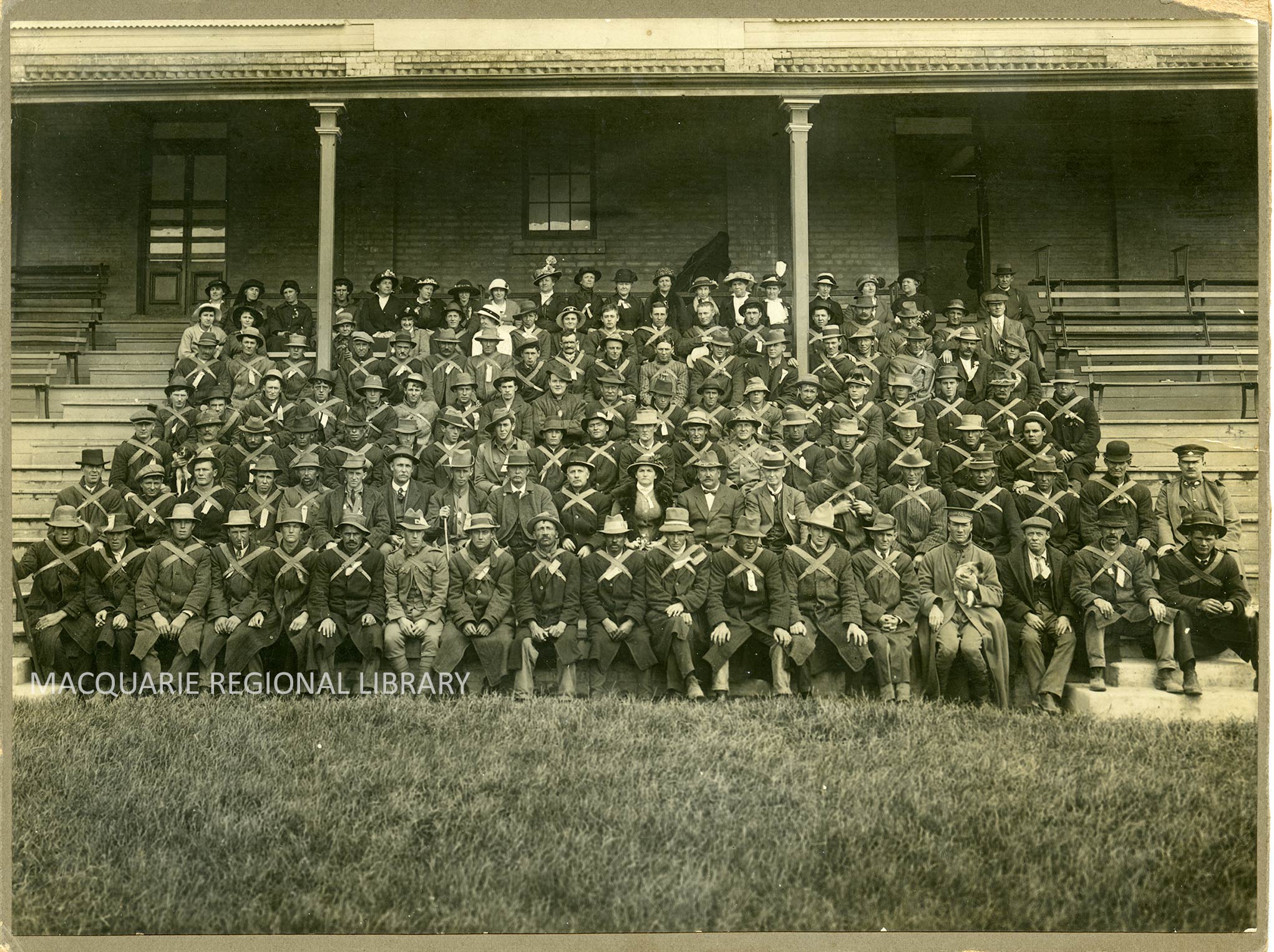
Updated photo of the Coo-ees at Orange

Macquarie Regional Library has kindly supplied me with a higher resolution view copy of the photograph of the Coo-ees at Orange for this website.  I have replaced the photo on the https://cooeemarch1915.com/2015/07/26/photo-of-the-coo-ees-at-orange/ page with this better image.

For those who follow my blog posts by email you might like to revisit this page and click twice on the photo to increase its size. They quality of the photograph is quite remarkable.

See if you can find the two little dogs in the photograph.  Harder to spot is a little black kitten!

Included in this photograph are the men who enlisted in the Coo-ee Recruitment March as they marched from Gilgandra to Dubbo, Wongarbon, Geurie, Wellington, Stuart Town, Euchareena, Molong, through to Orange, where the photograph was taken. (Some may be missing, including the 5 in Orange Hospital sick at the time).

If you have a photograph of a Coo-ee in your family photo collection that joined  the Coo-ee March between Gilgandra to Orange, please take a moment and see if you can find him in this group photograph.

Please send an email to me at cooeemarch1915@gmail.com if anyone can identify any of the people in this photograph.

Photo of the Coo-ees at Orange

PHOTO OF THE COO-EES AT ORANGE

The Coo-ees at Wade Park, Orange, October 1915. Photograph courtesy of Macquarie Regional Library

The Coo-ees at Wade Park, Orange, October 1915. Photograph courtesy of Macquarie Regional Library

This is a photograph of the Coo-ees who were in the Gilgandra to Sydney Cooee-Recruitment March, taken while they were in Orange in October 1915.  Inscribed on the back of the photograph is “The Coo-ees at Orange”.

Except for Captain Bill Hitchen from Gilgandra (sitting in the middle of the second row from the bottom), the people in it are not identified.

This original photograph is part of the Local Studies Collection at Macquarie Regional Library.  A high resolution digital copy can be purchased from Macquarie Regional Library for the purpose of private research and study, and the quality of the image allows you to zoom in on each face and see each individual Coo-ee quite clearly.  Further information about the photograph can be found on the Macquarie Regional Library website at http://catalogue.mrl.nsw.gov.au/cgi-bin/spydus.exe/ENQ/OPAC/BIBENQ?BRN=170437

Included in this photograph are the men who enlisted as they marched from Gilgandra to Dubbo, Wongarbon, Geurie, Wellington, Stuart Town, Euchareena, Molong, to Orange, where the photograph was taken. (Some may be missing, including the 5 in Orange Hospital sick at the time).

There are approximately 104 men, and 23 women seated on a grandstand, which was situated at Wade Park in Orange. Most of the women are seated at the back.

Names of the dignitaries and local Orange people included in the photograph were reported in a 1915 newspaper article, and these people too need to be identified in this photograph. Per The Leader (17 November 1915, p. 8): ‘Seated in the group are the Mayor and Mayoress (Ald. and Mrs E. T. Neilly) Mr H. J. Leary, secretary of the Orange Recruiting Association. Mr. A. J. McCoy, headmaster of the Orange Public School, Mr. V. H. Millard, and the ladies who gave their services towards looking after “Hitchen’s Own” what time they were in Orange.’

A project I am working on is to identify as many Coo-ees as possible in this photograph. Please send an email to cooeemarch1915@gmail.com if anyone can identify any of the people in this photograph.

Blue dungarees and white hats

BLUE DUNGAREES AND WHITE HATS

The blue dungaree suits and white hats issued to the Coo-ee recruits at Lithgow were not unique to the 1915 Coo-ee March.

Following Australian Imperial Force (AIF) Order No. 2 on 26 August 1914, which ‘prescribed the uniform, kit, and necessaries to be issued to each member of the AIF’, enrolling recruits in the AIF were to be issued with a dungaree jacket, a pair of dungaree trousers, and a white hat. [1] This hat was described as a ‘white linen hat’ in The Sydney Morning Herald.[2]

“Marmalades” – the new raw recruits in the military camps – were issued with the blue dungaree suits and white hats as their initial uniform, which, according to an article in the National Advocate, if not washed before being worn for the first time, gave a ‘blue tint’ to the mens’ skins, ‘a tinge which gradually deepens upon further acquaintance’ with the unwashed suits.[3]

The Minister for Defence had instructed that dungarees were to be issued to the recruits on the Coo-ee March at Lithgow or Wallerawang, ‘so that the men may finish their march in some approach to uniform’.[4]

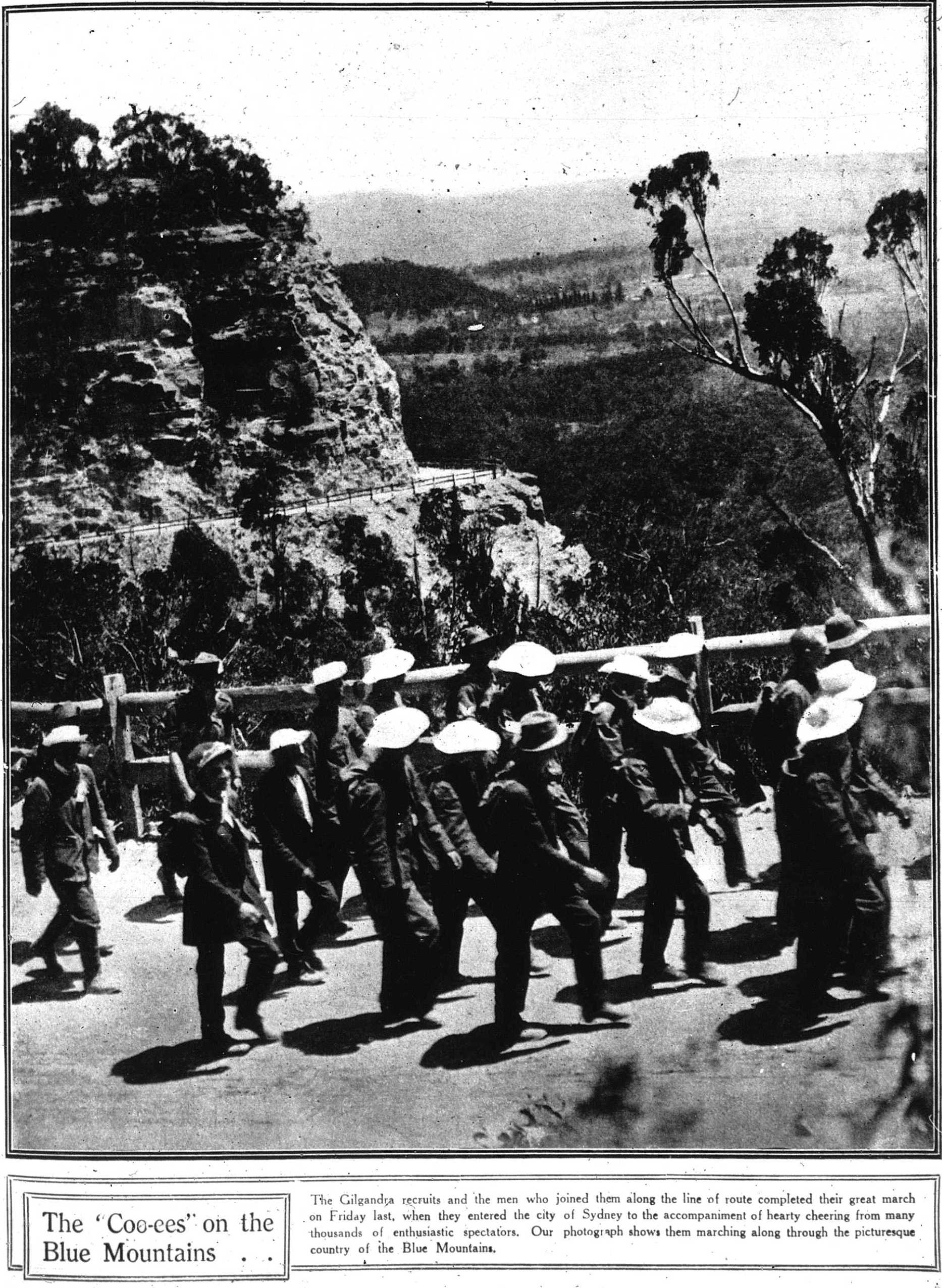
Coo-ees on Victoria Pass (Sydney Mail 17/11/1915)

Coo-ees in their crisp new dungaree suits and white hats climbing Berghofers Pass on their way to Mt. Victoria (Sydney Mail 17/11/1915)

Following the issue of the blue dungarees and white hats to the Coo-ees at Lithgow, The Farmer and Settler noted that when the Coo-ees were welcomed at Mount Victoria the men looked ‘more soldierly than they had done, with their new uniform, dungarees and white hats – the recruits’ dress of the training camps’.[5]

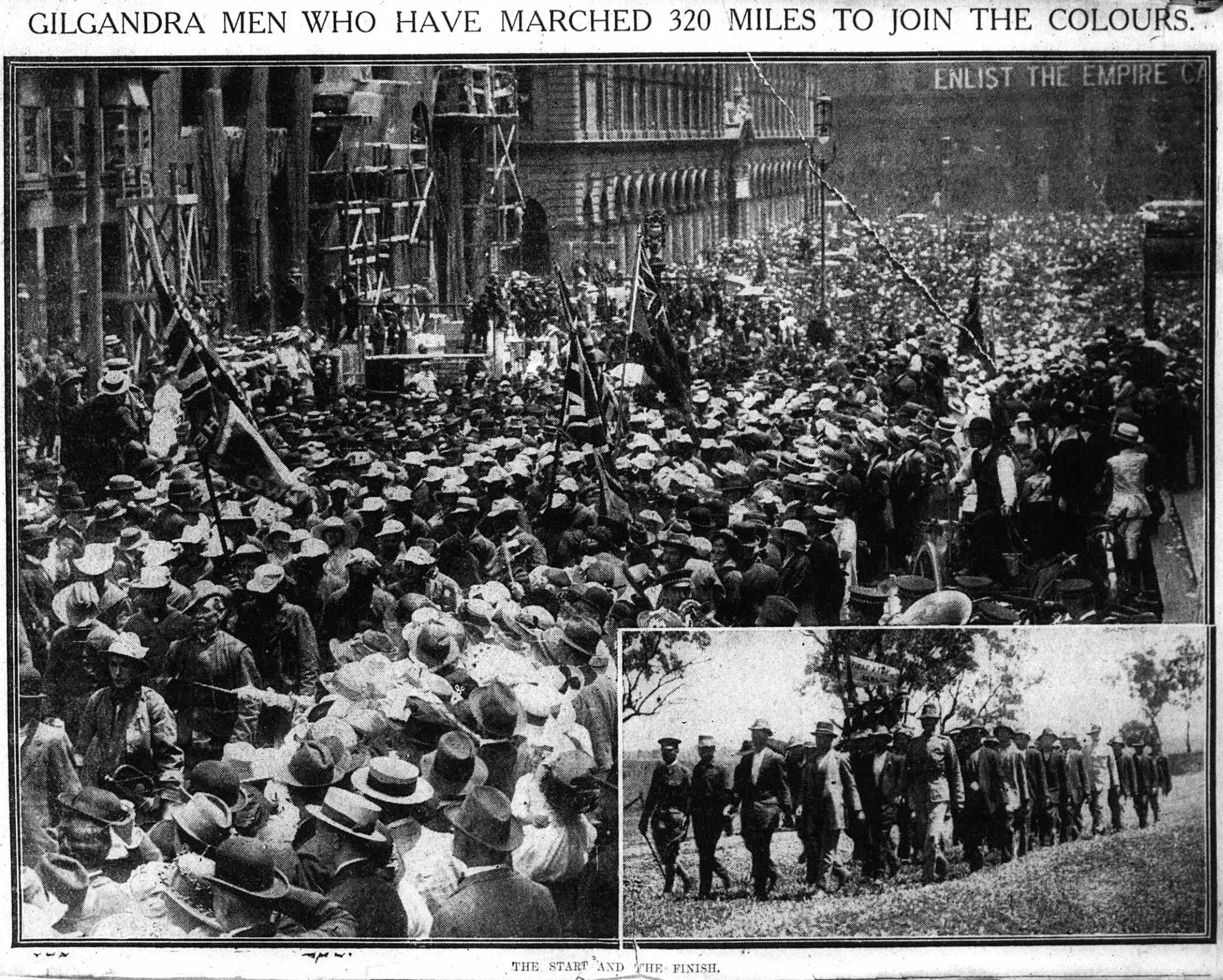
The Sydney Morning Herald reported on their arrival and triumphant procession into the city of Sydney that they ‘wore blue dungarees which didn’t always fit them, and they were somewhat travel-stained and weary after five weeks’ march – somewhat slouchy, in fact; but the city never gave a more enthusiastic welcome to any body of men that it gave to these 263 men from the country.’[6]

The start and the finish (Sydney Morning Herald 13/11/1915)

The start and the finish (Sydney Morning Herald 13/11/1915)

[1]Australian War Memorial, ‘Soldier’s kit, First World War (1914), https://www.awm.gov.au/encyclopedia/soldiers_kit/

[2] ‘Our troops. Enrolling recruits. The equipment’, The Sydney Morning Herald, 28 September 1914, p. 8, http://nla.gov.au/nla.news-article15544205

[3] ‘Liverpool Camp’, National Advocate, 2 October 1915, p. 7, http://nla.gov.au/nla.news-article158151954

[4] Great Route March. Gilgandra to the coast : the “snowball” growing as it rolls’, The Farmer and Settler, 29 October 1915, p. 3. Retrieved June 27, 2015, from http://nla.gov.au/nla.news-article116671286

[5] ‘The Route March through the mountains. The column reviewed by the Governor-General’, The Farmer and Settler, 9 November 1915, p. 3, http://nla.gov.au/nla.news-article116669569

[6] ‘The Coo-ees. Gilgandra men in Sydney. A Great Welcome. Stirring scenes’, The Sydney Morning Herald, 13 November 1915, p. 19, http://nla.gov.au/nla.news-article15624720


William Hilton Saunders war diaries available online

William Hilton Saunders war diaries

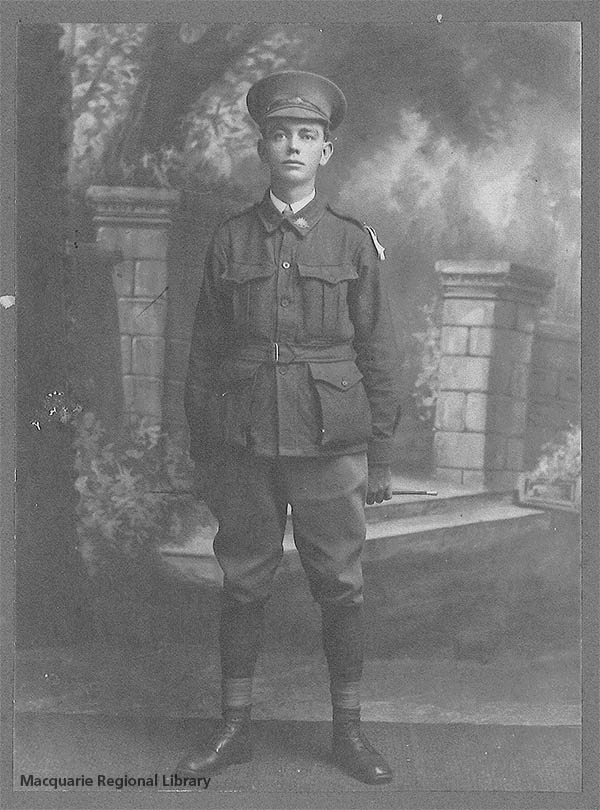
William Hilton Saunders (Photograph courtesy of Macquarie Regional Library)

William Hilton Saunders (Photograph courtesy of Macquarie Regional Library)

William Hilton Saunders joined the Coo-ee March at Wongarbon. Several of the many letters he wrote home were published in local newspapers. He also kept diaries from 1915 to 1919, which are now part of the UNSW Canberra Academy Library’s manuscripts collection.

Stephen and I visited the Academy Library at the Australian Defence Force Academy in Canberra on 22nd August 2013 to view W. Hilton Saunders’ war diaries. There were 5 small fragile diaries, sealed in bags, which we were able to look at under supervision, wearing white gloves. There were many diary entries of interest in these diaries that I would have liked more time to read, but the time we had available to visit was limited, and it was difficult to write many notes in pencil, wearing gloves.

I was advised by the State Library of New South Wales last week that William Hilton Saunders’ war diaries (1916-1919) are now available online on this library’s website at http://www.acmssearch.sl.nsw.gov.au/search/itemDetailPaged.cgi?itemID=1323843. To access the digitised diaries, click on the Collection Hierarchy tab, then the title for each year’s diary, then click on ‘view images’.

This online access to W. Hilton Saunders’ diaries provides a wonderful opportunity to read through the wartime diary entries of one of the Coo-ees, following his experiences in the First World War, from his training at Liverpool Camp, to his voyage from Sydney to Egypt on the HMAT A15 Star of England, his experiences in the training camp at Egypt, and then on the Western Front, and on hearing of the Armistice that ended the war.

Unfortunately the 1915 diary has not been digitised, probably due to its limited number of entries, with none until the end of the year. The 1915 diary had an inscription inside it from a family member dated 8th October 1915 (the day W. Hilton Saunders did his medical and original attestation at Gilgandra before the march commenced). Unfortunately he did not make any entries for the period of the march, only a mention of arriving in Liverpool camp.   There were however lots of female names and addresses written in the back of this 1915 diary with addresses from many the towns and villages along the march, from Stuart Town onwards (where he re-signed his attestation form on 19th October 1915).

W. Hilton Saunders was one of the main contingent of Coo-ees that embarked from Sydney on HMAT A15 Star of England on 8th March 1916, which arrived in Egypt on 11th April 1916. He recorded daily entries in his diary for this period.

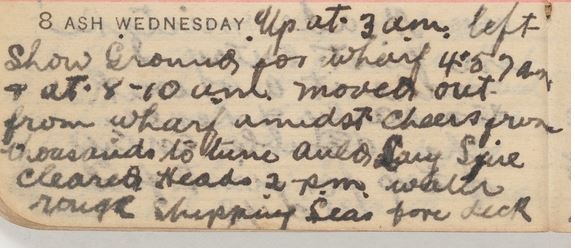
W. Hilton Saunders recorded the following details in his diary for the day the Coo-ees loaded onto the HMAT A15 Star of England, and left Sydney Harbour through the Heads:

W. H. Saunders diary entry 8/3/1916 (Image part of the State Library of NSW collection)

W. H. Saunders diary entry 8/3/1916 (Image from the State Library of NSW collection)

March 1916: 8 Ash Wednesday. “Up at 3 a.m. left Show Ground for wharf 4.57 a.m. & at 8.10 a.m. moved out from wharf amidst cheers from thousands to tune Auld Lang Syne Cleared Heads 2 p.m. water rough chopping seas fore deck”.

The Coo-ees when they joined the Coo-ee March and enlisted in the AIF had expected to be going as reinforcements to support the ANZAC troops on Gallipoli. That campaign finished while they were still in training in Liverpool Camp.

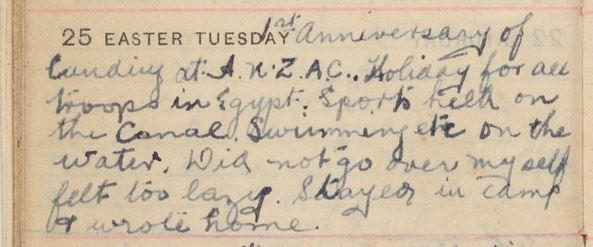
Yesterday as I attended the dawn service at the Dubbo War Memorial commemorating 100 years since the ANZAC troops had landed at Gallipoli, I had wondered what W. Hilton Saunders had wrote in his diares about his experience on the first Anzac Day held on 25th April 1916, where a sports day was held in the Australian camp in Egypt, where he and the other Coo-ees were in training. He wrote the following words:

W. H. Saunders diary entry 25/4/1916 (Image part of the State Library of NSW collection)

W. H. Saunders diary entry 25/4/1916 (Image from the State Library of NSW collection)

April 1916: 25 Easter Tuesday. “1st anniversary of landing at A.N.Z.A.C. Holiday for all troops in Egypt. Sports held on the Canal. Swimming etc. on the water. Did not go over myself felt too lazy. Stayed in camp & wrote home.”

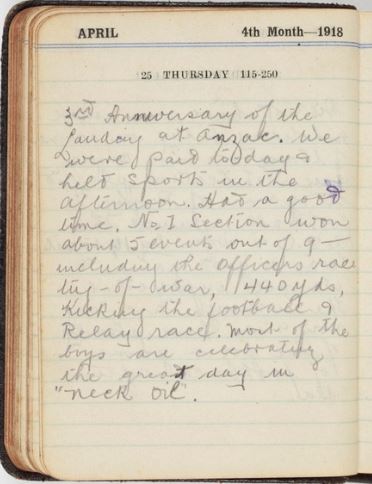
He wrote no entry in his diary for Anzac Day in 1917, but in 1918 he wrote the following entry about his Anzac Day experience for that year:

W. H. Saunders diary entry 25/4/1918 (Image part of the State Library of NSW collection)

W. H. Saunders diary entry 25/4/1918 (Image from the State Library of NSW collection)

April 1918: 25 Thursday. “3rd Anniversary of the landing at Anzac. We were paid today & held sports in the afternoon. Had a good time. No. 1 Section won about 5 events out of 9 – including the officers race … 440 yds, kicking the football & Relay race. Most of the boys are celebrating the great day in “neck oil”. [aka beer].


Coo-ee March plinth at Dubbo War Memorial

Coo-ee March plinth at Dubbo War Memorial

After attending the dawn service at Dubbo War Memorial this morning along with a record size crowd, I took the opportunity to view the new Coo-ee March plinth on the Anzac Memorial Walk at Victoria Park, just near the cenotaph.

'The Coo-ee March' plinth near Dubbo War Memorial (Photograph: H. Thompson 25/4/2015)

‘The Coo-ee March’ plinth near Dubbo War Memorial (Photograph: H. Thompson 25/4/2015)

It is one of ten plinths recently erected by Dubbo City Council to commemorate different aspects of Dubbo’s involvement in the First World War, which was officially unveiled last Thursday, 23rd April 2015.

The Coo-ees had held a recruiting meeting in Dubbo, and stayed overnight at Dubbo Military Camp at Dubbo Showground on 13th October 1915.

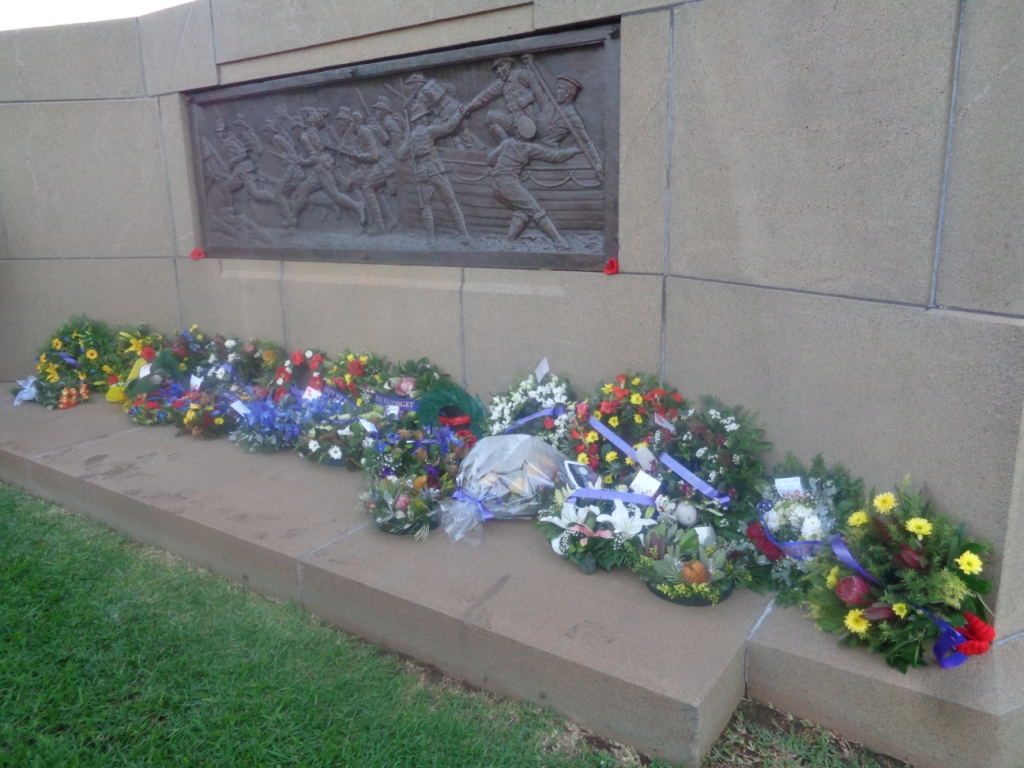
Looking at the wreaths laid on the cenotaph I remembered reading a 1925 newspaper article in the Dubbo Liberal about the unveiling of this cenotaph and laying of the wreaths ceremony held 90 years ago today, on Anzac Day in 1925.

The wreaths included a ‘beautiful wreath nearly three foot in diameter, to the memory of the unknown soldier’, and ‘individual wreaths and those to battalions’ which ‘covered the whole of the base on one side of the monument’, and ‘above the wreaths was placed the historic flag which had been carried by “The Coo-ees” in their march from Gilgandra to Sydney’.[1]

Wreaths at Dubbo War Memorial in the same area where a flag from the Coo-ee March was displayed during the 1925 unveiling of the cenotaph (Photograph: H. Thompson, 25/4/2015)

Wreaths at Dubbo War Memorial in the same area where a flag from the Coo-ee March was displayed during the 1925 unveiling of the cenotaph (Photograph: H. Thompson, 25/4/2015)

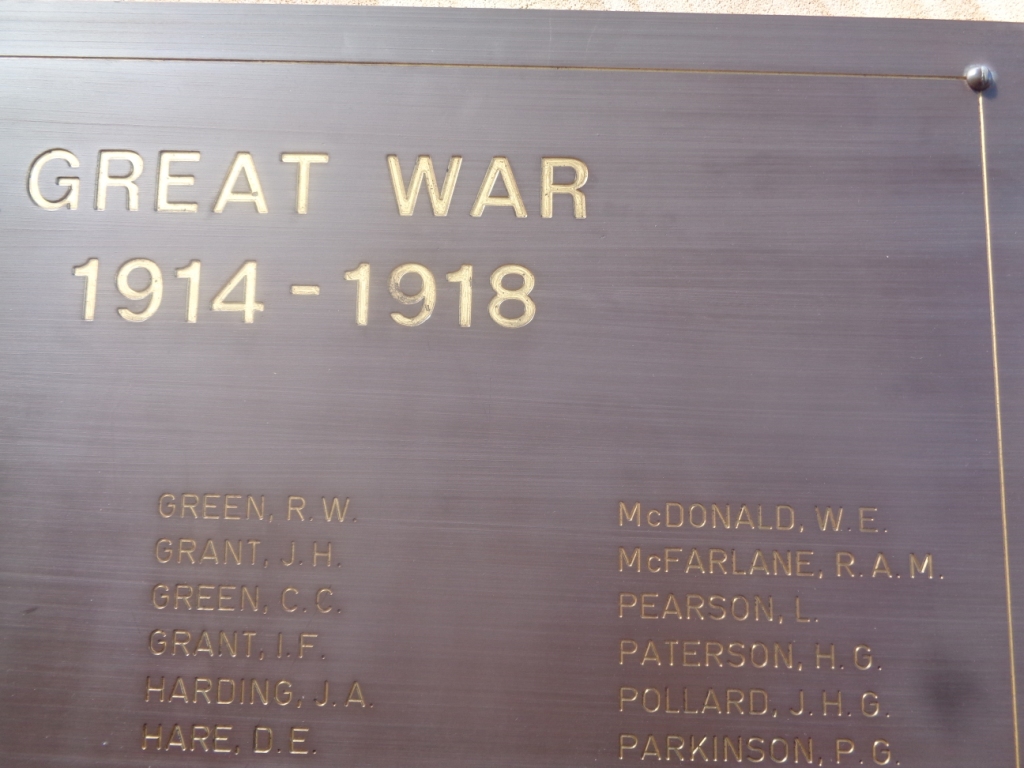
Wilfred Ernest McDonald’s name is listed on the Dubbo War Memorial Roll of Honour, who was born in Dubbo, and had joined the Coo-ees at Wongarbon.  He was killed in action in France on 3rd May 1917 and has no known grave.

'MCDONALD W E' name on Dubbo War Memorial Roll of Honour (Photograph: H. Thompson, 25/4/2015)

‘McDONALD W E’ name on Dubbo War Memorial Roll of Honour (Photograph: H. Thompson, 25/4/2015)

[1] “Laying wreaths,” The Dubbo Liberal and Macquarie Advocate, 28 Apr 1925, p. 4, http://nla.gov.au/nla.news-article76099146.


The 22 Ashfield recruits

Who were the 22 Ashfield recruits?

The Coo-ees held a recruiting meeting, and stayed the night at the Drill Hall at Ashfield on Thursday, 11th November, 1915 – their last night of the Coo-ee March on their long route from Gilgandra to Sydney.

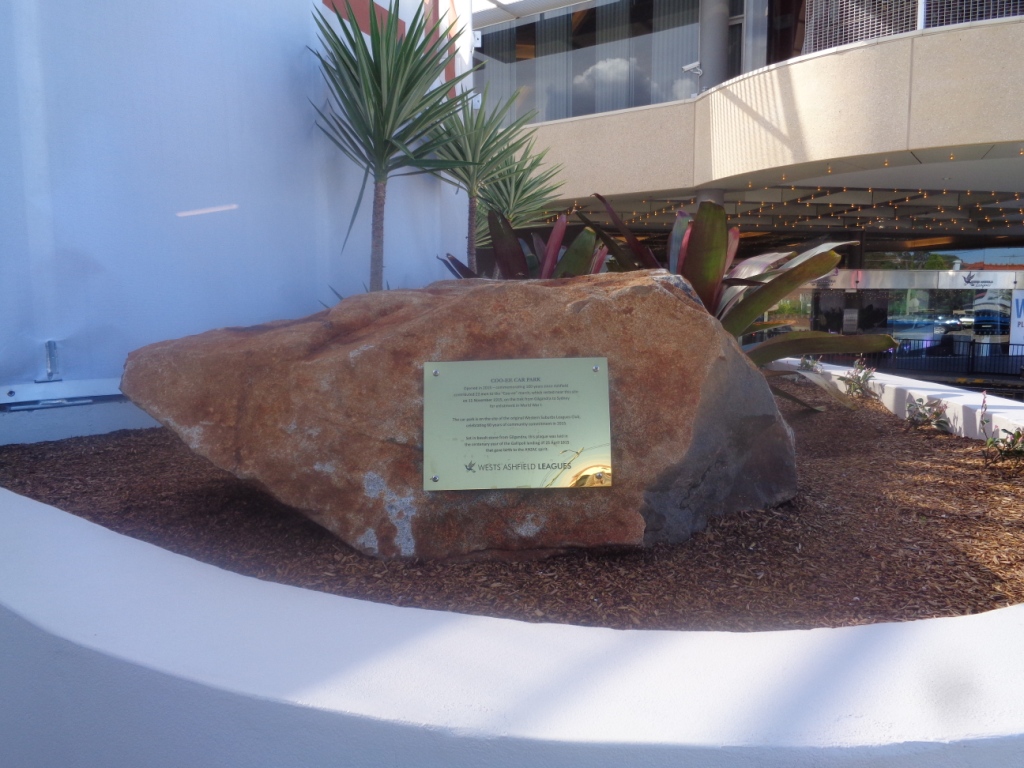
This is now the site of the Ashfield Boys High School gymnasium, and a new car park named Coo-ee Car Park in memory of the 1915 Coo-ee March built recently by the Wests Ashfield Leagues Club.  A plaque about the Coo-ees at Ashfield was unveiled at the Coo-ee Car Park on 21st April 2015.
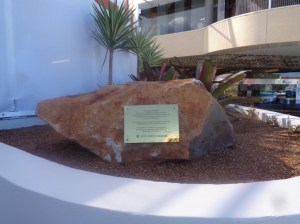
Plaque at Coo-ee Car Park, Ashfield (Photograph: S. & H. Thompson, 23/4/2015)

Plaque at Coo-ee Car Park, Ashfield (Photograph: S. & H. Thompson, 23/4/2015)

A plaque on an obelisk is situated in the grounds of the Ashfield Boys High School. It has been there for some time. On it are the words: “Celebrating Gilgandra Coo-ee Marchers 11 November 1915 22 Ashfield men joined with the Coo-ee marches here on this day”.
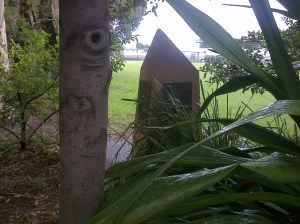
Coo-ee March obelisk at Ashfield Boys High School (Photograph: S. & H. Thompson 3/3/2014)

Coo-ee March obelisk at Ashfield Boys High School (Photograph: S. & H. Thompson 3/3/2014)

Although the “official” count for the total number of Coo-ees recruited on the 1915 Gilgandra to Sydney Coo-ee March per newspaper articles of the time was 263, with Ashfield having a total of 22 recruits, the Sydney Morning Herald reported on 13th November 1915 (p. 19) that ‘the contingent left the western suburb’ of Ashfield ‘about 263 strong, but there are others now to be sworn in – men who joined the little army yesterday.’ The Farmer and Settler reported about Coo-ees numbers on 21st December 1915 (p. 3) that ‘there were no fewer than 277 men on their last pay sheet in camp’.

We have found the following names of 23 men who were attested at Ashfield at the time the Coo-ees were recruiting at Ashfield. We note that one (Bert Kilduff) had paperwork dating only from 12th November 1915 in his service record, so perhaps the ”official” count of 22 recruits was taken the night before at Ashfield, and he was not included.  Although two others also completed their medical examination and signed their attestation paper at Ashfield on the 12th November 1915 (Thomas Edward Bow and Charles Seal), they had both signed the bottom of the first page in their ‘Attestation paper of persons enlisted for service abroad’ on the 11th November 1915.

Attested 11th November 1915 at Ashfield

Robert AYRES (service no. 4729)

Richard John CROCKER (no service no.)

Edward Lewis CUDDEFORD (service no. 5352)

Harold Brooks DAVIS (service no. 4759)

Edgar DAWSON (no service no.)

Thomas DELANEY (service no. 4764)

William ELLERY (service no. 4769)

Richard EVANS (service no. 5368)

Joseph Jacob John HERRINGE (service no. 5700)

Robert Michael HICKEY (service no. 5099)

Albert HULBERT (no service no.)

Hector LEE (service no. Depot)

Thomas LIPSCOMBE (service no. 4826)

Sam LUKE (service no. 4830)

Joseph Raymond MCGUIRE (service no. 4857)

Selby George MEGARRITY (service no. 4841)

William Allen Luther PHILPOT/PHILPOTT (service no. 5164)

William WEBBER (service no. 4917)

Jack Graham WIGGINS (service no. 4918)

Joseph John WILLIAMS (service no. 4912)

Attested 12th November 1915 at Ashfield the (the day the Coo-ees left Ashfield and the last day of the Coo-ee March)

Charles Edward BOW (service no. 4735)

Bert KILDUFF (service no. 4818)

Thomas SEAL (service no. 4895)

Not all of these men were local to the Ashfield area. Some were men who had joined the Coo-ees earlier in the march, or caught up with them at Ashfield, who signed their attestation paper to enlist in the Australian Imperial Force at Ashfield.

William Ellery was reported to be a long term resident of the Dunedoo area before he left to join the Coo-ees.  Edgar Dawson started filling out his paperwork in his service record in Bathurst.  Jack Wiggins was known as a Springwood recruit. Sam Luke joined the Coo-ees at St Marys. Selby Megarrity undertook his medical at Penrith, the day before the Coo-ees arrived at Ashfield.

Fourteen of the Ashfield recruits embarked overseas with the majority of the Coo-ees on the transport  HMAT A15 Star of England on the 8th March 1916.  Five more embarked on other ships soon after.

An individual blog entry will be added to this website for each of the above named Coo-ees.
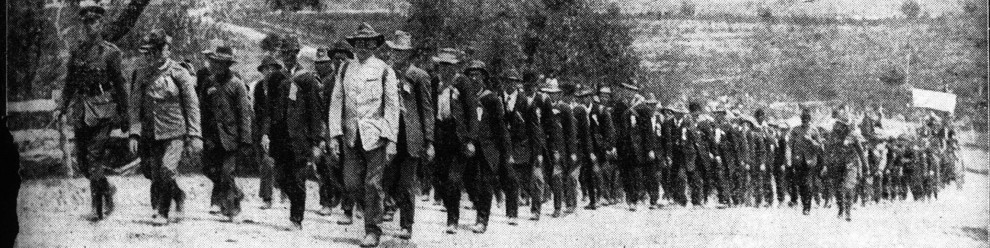
New tab titled The Men

I have added a new tab titled “The Men” to the cooeemarch1915.com website, which provides an alphabetical list of those Coo-ees for which I have written an individual blog entry to date.

I am writing a blog entry for each of the 263  individual Coo-ees.  However, it takes time to research each one’s service record and to find any newspaper articles, photographs, etc. relating to each person.  This is an ongoing project, so please go to the website from time to time to see what new names have been added to the list.

Please click on the name  of the Coo-ee to be linked to their blog entry.  Please also click on the tags for their names at the bottom of their record to go to other entries on this website containing a reference to their names.

Coo-ees in the Battle of Fromelles, and the first Coo-ee to die on active service

Coo-ees in the Battle of Fromelles, and the first Coo-ee to die on active service

On the 16th February 1916 15 Coo-ees departed Sydney as 14th Reinforcement for the 13th Battalion aboard the HMAT A70 Ballarat. These men left Sydney before the bulk of the Coo-ees embarked from Sydney on the HMAT Star of England on the 8th March 1916.

Upon the arrival of the HMAT A70 Ballarat in Egypt on the 22nd March 1916, these 15 Coo-ees were transferred to the 54th Battalion. Two of them (Percy George Brown and John William Thompson) fell ill and was hospitalised, but the other 13 departed for France on 19th June 1916 aboard the HT Caledonian, arriving at Marseilles on 29th June 1916.

After their arrival in France another Coo-ee fell ill (John Martin) and was hospitalised in England. Two others (John Tarlington and Colin David Wren) transferred to the 4th Pioneer Battalion, and another (Eugene Norris) to the 57th Battalion, with nine Coo-ees remaining with the 54th Battalion.

The 54th Battalion was one of the four battalions that comprised the 14th Brigade, and the 57th Battalion was one of the four Battalions of the 15th Brigade. Both Brigades were part of the 5th Australian Division that fought in the Battle of Fromelles. The Battle of Fromelles on the 19th July 1916 was the first major battle to be fought by Australian troops on the Western Front, and the 54th Battalion suffered heavy casualties. The 57th Battalion was in reserve during that initial assault, and the Coo-ee in that Battalion was not injured.

According to the Australian War Memorial (https://www.awm.gov.au/wartime/36/article.asp), the Battle of Fromelles was a disaster, and  the ‘worst 24 hours in Australian history’, with 5,533 Australian casualties in one night, which was  ‘equivalent to the total Australian casualties in the Boer War, Korean War and Vietnam War put together’.   The attack commenced at 6 pm on 19th July 1916, and was over by 8 am on the 20th July.

Of the nine Coo-ees in the 54th Battalion at Fromelles, 42 year old Charles William Gordon Conroy (who joined the Coo-ees at Orange), and 19 year old Joseph Patrick Wallis (Wailes) (who joined the Coo-es at Dubbo) were both killed in action during the Battle of Fromelles, on 19th/20th July 1916.  They were both listed with no known grave, and their names were commemorated at the V.C. Corner Australian Cemetery and Memorial at Fromelles, France.   The body of Joseph Wallis was identified in 2010, and he was reinterred in the Fromelles (Pheasant Wood) Military Cemetery in France.

Henry Blakeman (Lithgow), James Dawson (Lithgow), John Fox (Bathurst) and William Walker (Molong) were wounded at the Battle of Fromelles. Joseph Armstrong (who joined the Coo-ees at Dubbo) and Donald Stewart, one of the youngest of the Coo-ees, (who joined at Wellington), were captured, and spent the rest of the First World War as prisoners of war. Only one of the nine Coo-ees in the 54th Battalion (Edwin Fuller from Orange) survived the Battle of Fromelles unscathed.

However, Thomas Thorne, (who joined the Coo-ees at Lawson), was the first of the Coo-ees to die while on active service overseas. He embarked from Sydney on the HMAT Star of England on 8th March 1916, and had arrived in Egypt on the 11th April 1916. Acting Sergeant Thomas Thorne became ill while on a transport ship taking him from Egypt to England, and he was admitted to Devonport Military Hospital on 16th June 1916. He died of illness two days later of Pneumonia on 18th June 1916 (aged 23), having not seen any active service.

Note: I wish to acknowledge the research assistance of Stephen Thompson in writing this article.


A year on…

OUR RESEARCH A YEAR ON

It has now been a year since I started writing this blog to be a record of the 1915 Coo-ee March, and a memorial to the 263 recruited men who answered the call of “Coo-ee! Come and join us!”, and fell into line in towns and villages along the way of the recruitment march from Gilgandra to Sydney.

I would like to thank those people who have assisted me in this process, who include family members who have sent me photographs and information to include on their Coo-ee’s individual record, and Shirley Marks and Margo Piggott from Gilgandra Historical Society, Brian Bywater from Hitchen House Military Museum, and also Gilgandra Shire Library, and Macquarie Regional Library, who have provided me copies of photographs, newspaper articles and documents, and other information to assist me with my research.

I would also like to thank my husband Stephen, who assists me in my research by summarising service records (and helps me to decipher the abbreviations in them), and delving into AIF unit war diaries, and other resources, and whose GPS plotting skills, route planning, and ability to drive on the right (wrong) side of the road allowed us to visit the graves and memorials of the fallen Coo-ees in France, Belgium, and England last year.

I would also like to thank those who follow my blog by email, and for your comments. It is nice to know that others too are interested in the history of the Coo-ees.

Our research continues on the Coo-ees, and some blog entries I have already written will be updated with photographs and additional information. If you are following this blog by email, please note that these updated blog entries will not be re-posted, so please check this website from time to time to see what changes have been made to the records.

Visit to Australian War Memorial : Roll of Honour, name projections, and a photograph of the Coo-ees

Visit to Australian War Memorial 3rd-5th January 2015

Last weekend (3rd-5th January 2015) Stephen and I visited the Australian War Memorial. We attended the Last Post Ceremony on the Saturday evening, and listened to the story presented on a local WWI soldier from Wongarbon.

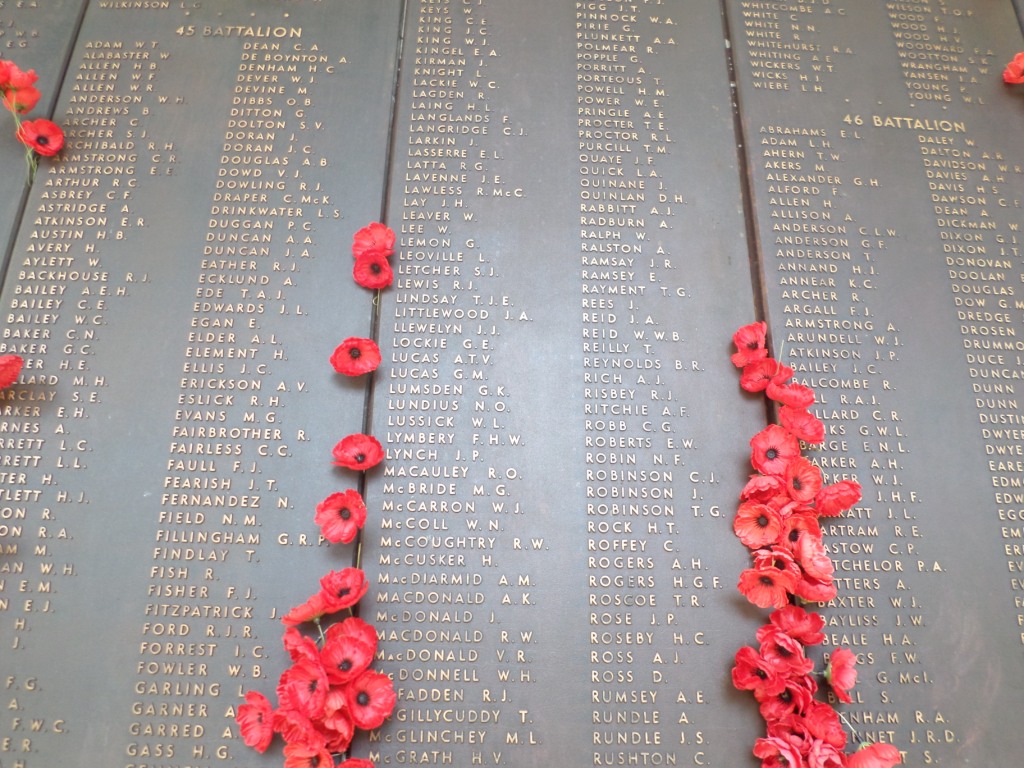
On Sunday morning we located and photographed the names of the fallen Coo-ees on the Roll of Honour bronze panels.

Leoville L. and Letcher S. J. names on the 45th Battalion AWM Roll of Honour (Photograph: H. Thompson 4/1/2015)

LEOVILLE L. and LETCHER S. J. names on the 45th Battalion Australian War Memorial Roll of Honour (Photograph: H. Thompson 4/1/2015)

I noted the names of Coo-ees Louis Leoville (who joined the Coo-ee March at Lithgow) and Spencer John Letcher (who joined at Bathurst) are next to each other on the Roll of Honour in the 45th Battalion section. We placed poppies next to their names in remembrance of them.

Researching their stories this week I was saddened to learn that they both died within three days of each other, while fighting in the front lines at Pozieres in France – Spencer  John Letcher being killed in action on the 6th August 1916, and Louis Leoville dying of wounds on the 8th August 1916.

Three more Coo-ees on the 45th Battalion Roll of Honour who also died while the Battalion was at Pozieres in this three day period are William Emerton Hunter (who joined at Geurie), Jack Morris (who joined at Parramatta), and Rowland John Wilson (who joined at Lawson). Jack Morris was killed on the 6th August 1916, William Emerton Hunter on the 7th August 1916, and Rowland John Wilson on the 8th August 1916.

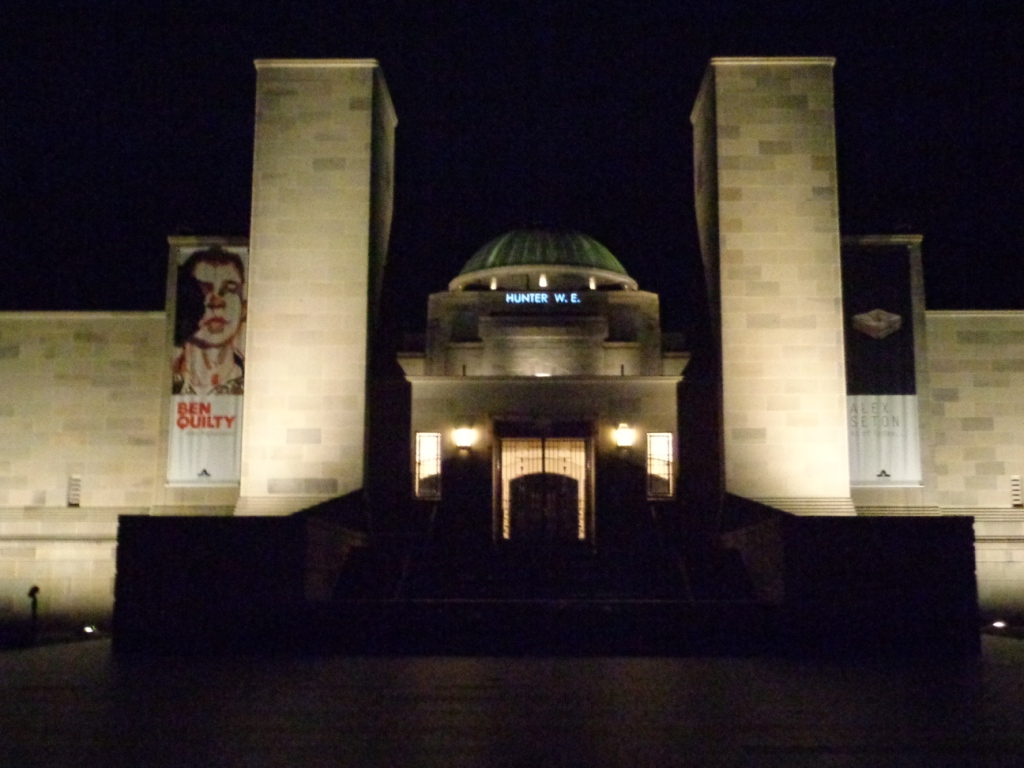
The Australian War Memorial during the 2014-2018 centenary period is at night projecting the names of each of the 62,000 Australians who gave their lives during the Great War on the wall of the Hall of Memory, about 30 times over these four years. The names are visible for 30 seconds, and people can search the Roll of Honour database on the Australian War Memorial website to see when a particular name is planned to be projected.

In the early hours of Monday morning we visited the Australian War Memorial to view the Roll of Honour name projections for two of the fallen Coo-ees – Rowland John Wilson at 1.52 a.m., and William Emerton Hunter at 2.44 a.m. We saw only a mob of kangaroos near the entrance gate, a rabbit on the lawns, a friendly black cat who came up to us as we walked back to the car, and a lone security guard wandering around with a torch during our night time visit.

Hunter W E name projected on the the Hall of Memory wall at the AWM (Photograph: H. Thompson 5/1/2015)

HUNTER W E name projected on the the Hall of Memory wall at the Australian War Memorial (Photograph: H. Thompson 5/1/2015)

On Monday morning we met with a curator in the Research Centre to view a photograph of the Coo-ees entering Dubbo in October 1915 that is listed on the Australian War Memorial catalogue (with no image of the photograph). It has apparently only quite recently been donated to the Australian War Memorial collection. I have not seen this particular photograph before so was very excited to see it.

I have placed an order for a print copy of the photograph so I can have a closer look at it, and hopefully a digital image of the photograph will then be placed on the AWM catalogue.