Category Archives: Recruits

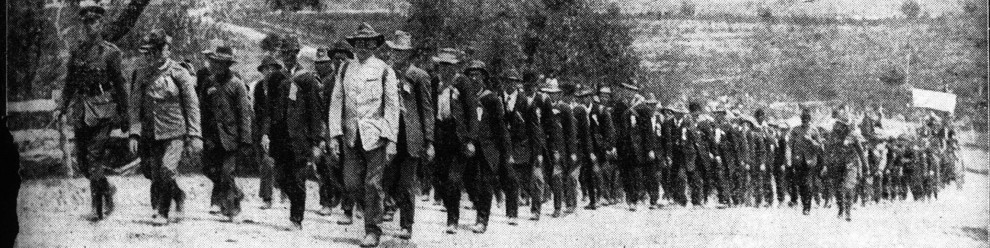
The veteran of the Coo-ees : John McNamara

Transcript of an article titled “The Veteran of the “Coo-ees” from The Dubbo Liberal and Macquarie Advocate, November 16, 1915, p. 2.

THE VETERAN OF THE “COO-EES.”

As long as ever he can remember, John McNamara, the grizzled old veteran, who marched in the front rank of the “Coo-ees” all the way down to the coast, has had a hankering after a military life. He first enlisted during the early eighties in the New South Wales Artillery, which was then under the control of the State Government. On the outbreak of the Soudan campaign he volunteered, for service, and secured a place in the field battery. At the conclusion of the campaign he was awarded the Soudan medal and clasp and the Khedive’s bronze star. His next experience of active service was under Major Forbes in the Matabele campaign, for which he holds the medal.

On the outbreak of hostilities in South Africa McNamara joined Brabant’s Horse, and went right through the war, gaining the Queen’s Medal and four clasps, the Kings Medal and two clasps, and also the Distinguished Conduct Medal. During the same campaign he also served in the Imperial Light Horse under Colonel Duncan McKenzie, and in the Western Province Mounted Rifles. At the conclusion of hostilities he enlisted in the Transvaal Mounted Police as a trooper, and during the Cape Colony rebellion a mounted patrol in which he was had a brush with the famous rebel leader Maritz at Toutlebosch Kop. Later as he resigned from the mounted police, and secured employment on the Cape-Cairo railway, being stationed at Wankas, a town 60 miles north of Buluwayo. Here he contracted black-water fever, and on his recovery he went to New Zealand. He remained there for some years, but the call of the bush was too strong, and six years ago he came over to New South Wales. He attempted to enlist at the beginning of the present war, but was rejected owing to the fact that he was over 35. Now things are changed. He is going to the front, and his heart’s desire being satisfied, there is no happier man in the “Coo-ees” than John McNamara.

Click here to view the article on Trove: http://nla.gov.au/nla.news-article77602239

William Hilton SAUNDERS

William Hilton SAUNDERS

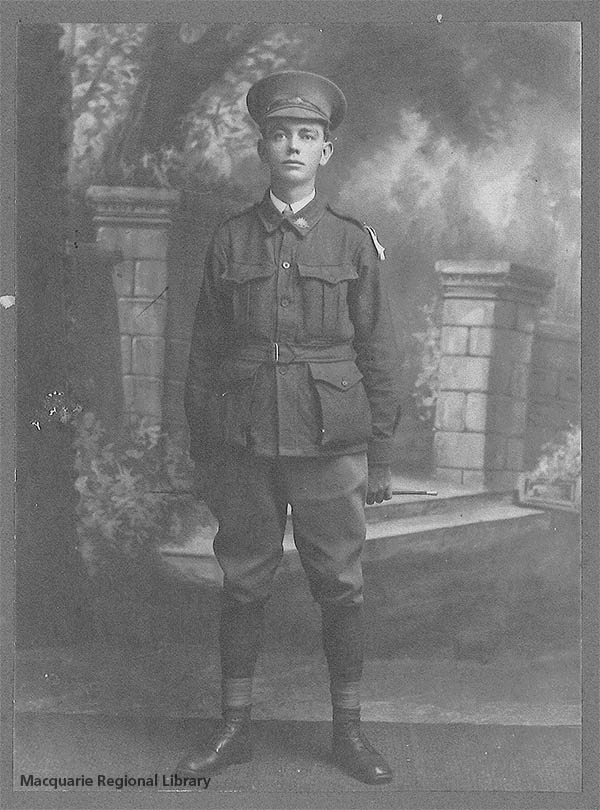
William Hilton Saunders (Photograph courtesy of Macquarie Regional Library)

William Hilton Saunders (Photograph courtesy of Macquarie Regional Library)

Per his military service record (regimental no. 4901), William Hilton Saunders was born at Goodooga, N.S.W. He gave his age as 21 years and 2 months, his marital status as single, and his occupation as Grocer. His description on his medical was height 5 feet 7 ½ inches tall, weight 9 stone 10 lbs., with a fair complexion, greenish grey eyes, and fair hair. His religious denomination was Anglican. He completed his medical on the 8th October 1915 at Gilgandra before the march began. He was attested at Stuart Town on the 19th October 1915. He claimed that he had no previous military service.

He was one of the thirteen men who stepped forward and gave his name, ‘either to march under Captain Nicholas, or to come after harvest’, when the Coo-ees recruited in Wongarbon on 14th October 1915.[1]

After completing the remainder of the march he went to Liverpool Camp as reinforcement for the 13th Battalion.

On his embarkation roll his address at time of enrolment was Wongarbon, N.S.W., and his next of kin is listed as his father, E. J. Saunders, Wongarbon, N.S.W.

Private Saunders departed Sydney on the HMAT Star of England on the 8th of March 1916. He arrived in Egypt on the 11th of April 1916. On the 16th of April 1916 he transferred to the 4th Division Artillery at Telelkebir, and was taken on strength of the 10th Field Artillery Brigade. He was appointed Driver on 18th May 1916. On the 23rd of May 1916 he was taken on strength of the 4th Division Ammunition Column.

On the 6th June 1916 Driver Saunders left Alexandria aboard HMT Oriana, bound for France, arriving at Marseille on the 13th June 1916.

On the 17th August 1917 Driver Saunders was charged with, when on active service, being drunk in Calais about 9.15 pm. He was awarded 21 days Field Punishment Number Two.

On the 15th October 1917 Driver Saunders was wounded in action suffering a gunshot wound to his right foot. He was evacuated to the 3rd Field Ambulance. On the 16th October 1917 he was sent to the 35th General Hospital, and on the 19th October 1917 he boarded a ship for England. On 20th October 1917 he was admitted to the East Suffolk Hospital.

Driver Saunders was granted leave from Hospital on the 20th November 1917. On the 9th January 1918 Driver Saunders departed Southampton to return to France. He rejoined his unit on the 15th January 1918.

On the 2nd September 1918 Driver Saunders was admitted to the 13th Field Ambulance sick. On the 5th September 1918 he was transferred to the 41st Stationary Hospital. On the 6th September 1918 he was sent to the 9th General Hospital at Rouen. On the 12th September 1918 he went to the 11th Convalescent Depot. Driver Saunders rejoined his unit on the 28th September 1918.

On the 26th October 1918 Driver Saunders went on leave to the United Kingdom. On the 18th November 1918 Driver Saunders was charged with being Absent Without Leave from 6.00 am on the 12th November 1918 to 10.10 pm on the 16th November 1918.

Per his 1918 war diary, this period of absence was while he was celebrating the Armistice in London. His entry for the 16th November 1918 was: “Had a great day … Here I am pinched by the MPs & in Warwick Square quite forgot that my pass is overdue & I should have gone back. Oh yes days ago. Who cares”.[2]

He was awarded forfeiture 5 days pay on 18th November 1918, which was increased to a total forfeiture of 10 days pay on 2nd January 1919.

On the 12th May 1919 Driver Saunders departed England for return to Australia aboard the HT Port Napier. He arrived in Sydney on the 5th July 1919, and was discharged on the 19th August 1919.

[1] ‘The Route March’, The Farmer and Settler, 19 October 1915, p. 3.

[2] Saunders, William Hilton, personal diary, 1918.

Wilfred Ernest MCDONALD

Wilfred Ernest MCDONALD

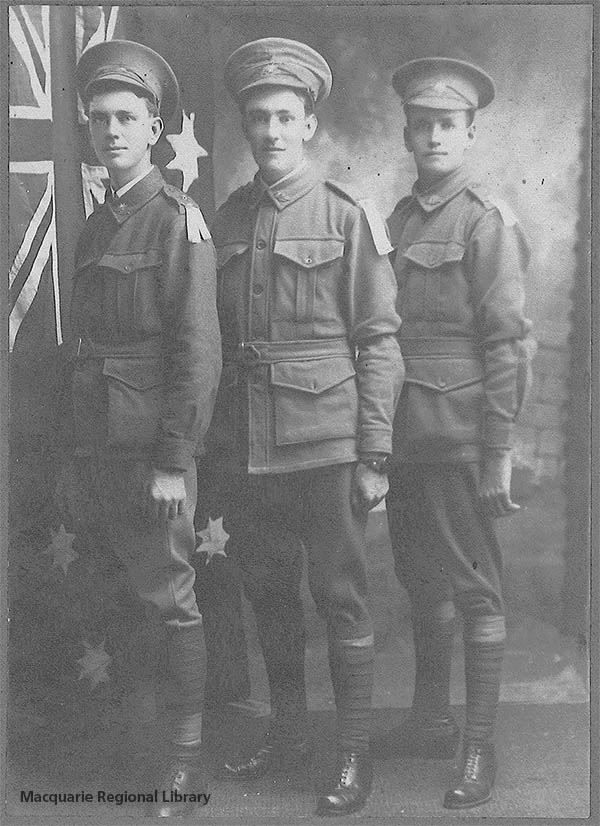
W. Hilton Saunders, Ernest May, and Wilfred McDonald, at Dubbo, ca. Dec. 1915 (Photograph courtesy of Macquarie Regional Library)

W. Hilton Saunders, Ernest May, and Wilfred McDonald, at Dubbo, ca. Dec. 1915 (Photograph courtesy of Macquarie Regional Library)

Per his military service record (regimental no. 4858), Wilfred Ernest McDonald was born at Dubbo, N.S.W. He gave his age as 21 years and 1 month, his marital status as single, and his occupation as laborer. He claimed that he had no previous military service. His description on his medical was height 5 feet 6 ½ inches tall, weight 9 stone 2 lbs., with a fair complexion, greenish grey eyes, and fair hair. His religious denomination was Anglican. He completed his medical on the 8th October at Gilgandra before the beginning of the march.

He was one of the thirteen men who stepped forward and gave his name, ‘either to march under Captain Nicholas, or to come after harvest’, when the Coo-ees recruited in Wongarbon on 14th October 1915.[1] He was attested at Stuart Town on 19th October 1915.

After completing the march he went to Liverpool Camp as reinforcement for the 13th Battalion.

On his embarkation roll his address at time of enrolment was Wongarbon, N.S.W., and his next of kin is listed as his father, H. G. McDonald, Wongarbon, N.S.W.

Private McDonald departed Sydney on the HMAT Star of England on the 8th of March 1916. He arrived in Egypt on the 11th of April 1916. On the 16th of April 1916 he transferred to the 4th Division Artillery at Telelkebir. On the 27th May 1916 he was taken on strength of the 4th Division Ammunition Column.

On the 6th June 1916 Gunner McDonald left Alexandria aboard HMT Oriana, bound for France, arriving at Marseille on the 13th June 1916.

On the 25th June 1916 Gunner McDonald was transferred to the V4 Heavy Trench Mortar Battery.

On the 10th October 1916 Gunner McDonald was admitted to the 4th Australian Field Ambulance with conjunctivitis to his right eye. He was sent back to the 3rd Casualty Clearance station on the 11th October 1916 then to the 15th Casualty Clearance Station at Hazebrouck on the 12th October 1916. On the 20th October 1916 he was sent back to the 13th Stationary Hospital at Boulogne. On the 26th October 1916 Gunner McDonald was admitted to the 26th General Hospital at Etaples suffering a corneal ulcer. On the 10th November 1916 he was transferred to the 6th Convalescent Depot also at Etaples then on the 23rd November 1916 he was readmitted to the 26th General Hospital with Influenza. On the 27th November 1916 he was sent back to the 6th Convalescent Depot then on the 1st December 1916 he was transferred to the 5th Convalescent Depot at Cayeux. On the 22nd December 1916 Gunner McDonald rejoined his Unit.

On the 2nd of February 1917 Gunner McDonald was charged with ‘’Disobeying in such a manner as to show a wilful defiance of authority a lawful command given personally by his superior officer in the execution of his office’’. A Field General Court Martial was held on the 17th February 1917 where Gunner McDonald was found guilty. He was sentenced to Five years Penal Servitude. On the 25th February 1917 the sentence was suspended.

On the 3rd of May 1917 Gunner McDonald was with his unit occupying a position between Ecoust and Bullecourt in France, preparing to support an attack, when they came under heavy German artillery fire. The store of mortar bombs was struck during this bombardment and exploded, destroying all the battery weapons and equipment. A total of 9 men were killed, 14 were wounded, 8 suffered shell shock and 16 were reported Missing In Action. Gunner McDonald was amongst the missing. This status was later amended to Killed In Action. His name is listed on the Villers-Bretonneux Memorial.

His name is also listed on the Dubbo War Memorial, and the Wongarbon Soldiers Memorial.

[1] ‘The Route March’, The Farmer and Settler, 19 October 1915, p. 3.

Ernest Charles Norman MAY

Ernest Charles Norman MAY

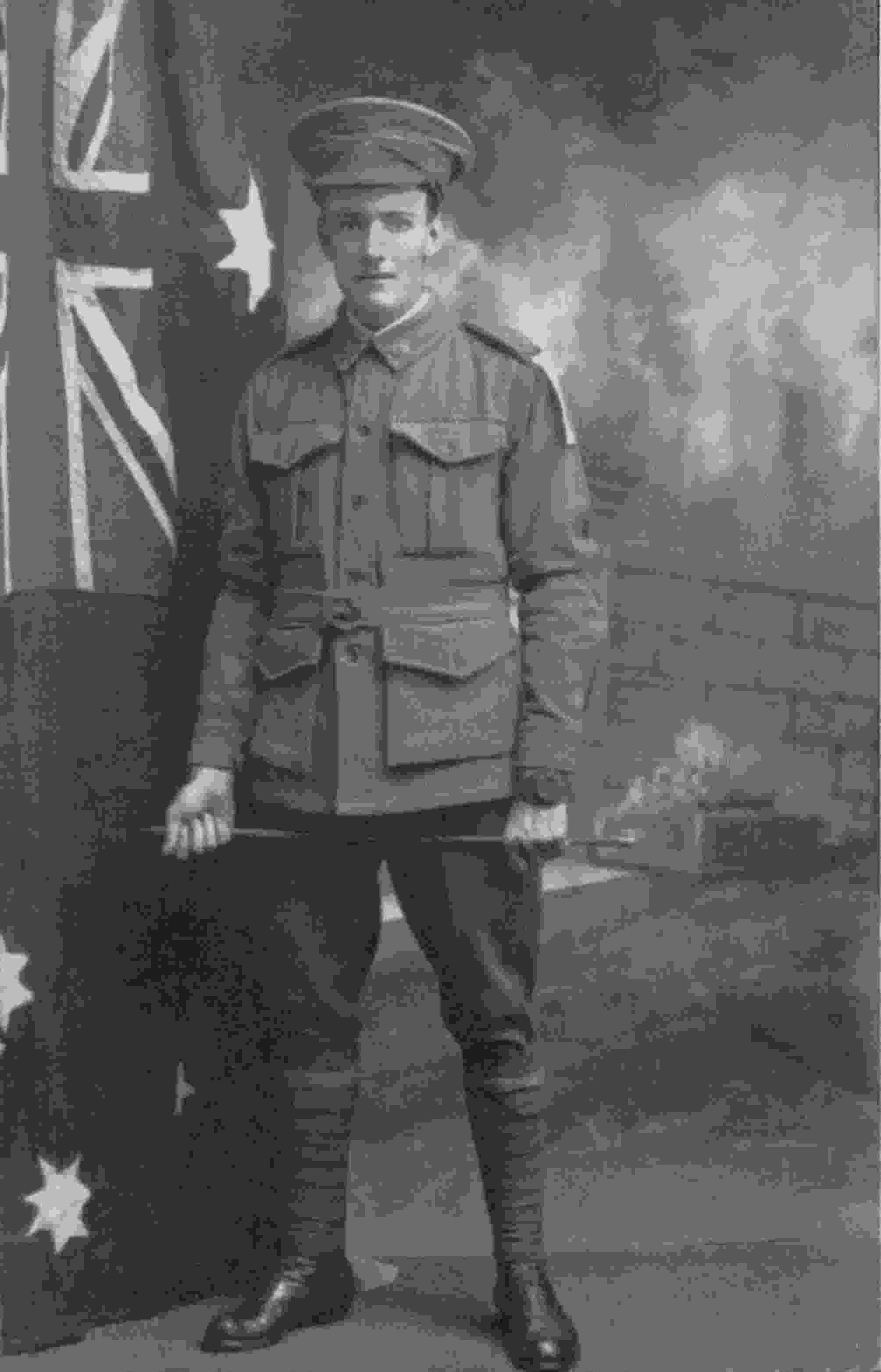
Ernest May (Photograph courtesy of  M. Baxter)

Ernest May (Photograph courtesy of Mrs M. Baxter)

Per his military service record (regimental no. 4851), Ernest Charles Norman May was born at Wongarbon, N.S.W. He gave his age as 23 years, his marital status as single, and his occupation as laborer. His description on his medical was height 5 feet 8 inches tall, weight 145 lbs., with a fair complexion, brown eyes, and brown hair. His religious denomination was Church of England. He was one of the thirteen men who stepped forward and gave his name, ‘either to march under Captain Nicholas, or to come after harvest’, when the Coo-ees recruited in Wongarbon on 14th October 1915.[1] However, he did not undertake his medical until 24th of October 1915 at Orange, where he also was attested. A note on the top of his service record said he ‘presented at Orange 24/10/15’. He claimed previous military service as a member of the Wongarbon Rifle Club.

After completing the remainder of the march he went to Liverpool Camp as reinforcement for the 13th Battalion.

On his embarkation roll his address at time of enrolment was Wongarbon, N.S.W., and his next of kin is listed as his father, C. May, Wongarbon, N.S.W.

Private May departed Sydney on the HMAT Star of England on the 8th of March 1916. He arrived in Egypt on the 11th of April 1916. On the 16th of April 1916 he transferred to the 4th Division Artillery at Telelkebir, and was taken on strength of the 10th Field Artillery Brigade. On the 23rd of May 1916 he was taken on strength of the 4th Division Ammunition Column. On the 27th of May 1916 he was promoted to Bombardier.

On the 6th of June 1916 Bombardier May left Alexandria aboard HMT Oriana, bound for France, arriving at Marseille on the 13th June 1916.

On the 21st February 1917 Bombardier May transferred to the 1st Ammunition Sub Park and was reclassified a Private. On the 27th September 1917 he was reclassified a Driver Motor Transport.

On the 25th February 1918 Driver May was granted leave to the United Kingdom. He re-joined his unit in France on the 11th March 1918.

On the 12th March 1918 Driver May was taken on strength of the 1st Australian Division Motor Transport Company.

On the 7th March 1919 he was promoted to Lance Corporal. On the 23rd March 1919 he was promoted to Corporal. On the 9th April 1919. Corporal May was granted leave to the United Kingdom. He returned to his unit on the 21st April 1919. On the 20th May 1919 Corporal May was transferred to the 2nd Division Motor Transport Company.

On the 8th June 1919 Corporal May was admitted to the 20th Casualty Clearance Station sick with herpes zoster (shingles). On the 15th June 1919 he was transferred to the 3rd Australian Auxiliary Hospital. On the 18th June 1919 Corporal May was granted leave. On the 2nd July 1919 Corporal May reported to Headquarters Number 2 Group Sutton Veny.

Corporal May returned to Australia aboard the transport Takada, leaving England on the 18th July 1919, and disembarking at Sydney on the 7th September 1919. He was discharged on the 25th November 1919.

[1] ‘The Route March’, The Farmer and Settler, 19 October 1915, p. 3.

John Herbert WATTS

John Herbert WATTS

Per his military service record (regimental no. 2260), John Herbert Watts was born at Dunedoo, N.S.W. He gave his age as 18 years, his marital status as single, and his occupation as Casual linesman. His description on his medical was height 5 feet 7 ½ inches tall, weight 137lbs., with a medium complexion, brown eyes, and light brown hair. His religious denomination was Methodist. He joined the Coo-ee March at Dubbo. He completed his medical on the 4th October 1915 at Dubbo, and was attested on the 14th October 1915 at Dubbo. He claimed to have no previous military service.

After completing the march he went to Liverpool Camp. He was appointed as 15th reinforcement for the 1st Light Horse Regiment at Liverpool on 7th February 1916.

On his embarkation roll his address at time of enrolment was Lewis Street, Mudgee, N.S.W., and his next of kin is listed as his father, Nathaniel Watts, Lewis Street, Mudgee, N.S.W.

Trooper Watts departed Sydney on the HMAT A25 Armadale on the 21st March 1916. He arrived in Egypt on the 24th April 1916.

On the 1st May 1916 he was transferred to the 4th Pioneer Battalion at Serapeum.

On the 4th June 1916 he embarked on the transport Scotian at Alexandria to join the British Expeditionary Force in France. He disembarked in Marseilles on 11th June 1916.

Private Watts was appointed Driver on 2nd December 1916.

Per his service record, Driver Watts name was mentioned in Sir D. Haig’s despatch on the 7th April 1918, as deserving of special mention for conspicuous services rendered, which was promulgated in the Commonwealth of Australia Gazette, No. 165, 24th October 1918. The recommendation was ‘for continuous good service from 23rd September, 1917 to 25th February, 1918’.

Following being admitted to hospital sick with pyrexia on the 4th April 1918, Driver Watts was evacuated to England with Trench Fever on 16th April 1918, where he was admitted to Duston War Hospital in Northampton. On 30th April 1918 he was transferred to 1st Australian Auxiliary Hospital at Harefield. He was granted leave from 2nd May 1918 to 16th May 1918. Driver Watts returned from furlough on 17th May 1918 and marched into No. 4 Command Depot, Hurdcott. From the 8th to the 13th August he was admitted to the Camp Isolation Hospital at Hurdcott with Scabies.

Driver Watts returned to France on 22nd September 1918. He was admitted to hospital on 21st November 1918, and transferred to England on 9th January 1919, and admitted to the 1st Australian Dermatological Hospital at Bulford on 10th January 1919.

Driver Watts departed England on 31st March 1919 on the HT Khyber to return to Australia, and disembarked in Sydney on 14th May 1919.

He was discharged on 16th May 1919.

Henry MOSS

Henry MOSS

Per his military service record (regimental no. 2221), Henry Moss was born at Mossgiel, N.S.W. He gave his age as 24 years, his marital status as single, and his occupation as shearer. His description on his medical was height 5 feet 5 ½ inches tall, weight 152 lbs., with a medium complexion, grey eyes, and dark brown hair. His religious denomination was Church of England.  He joined the Coo-ee March at Dubbo. He undertook a preliminary medical at Cobar on 11th October 1915, giving his postal address on this document as “Cobar”. He completed his medical on the 13th October 1915 at Dubbo, and was attested on the 13th October 1915 at Dubbo. He claimed to have no previous military service.

After completing the remainder of the march he went to Liverpool Camp. He was appointed as 15th reinforcement for the 1st Light Horse Regiment at Liverpool on 7th February 1916.

On his embarkation roll his address at time of enrolment was Bulli, South Coast, N.S.W., and his next of kin is listed as his mother, Mrs. Elizabeth Moss, Bulli, South Coast, N.S.W.

Private Moss departed Sydney on the HMAT A25 Armadale on the 21st March 1916. He arrived in Egypt on the 24th April 1916.

On the 18th May 1916 he was transferred to the 4th Pioneer Battalion at Serapeum.

On the 4th June 1916 he embarked on the transport Scotian at Alexandria to join the British Expeditionary Force in France. He disembarked in Marseilles on 11th June 1916.

Private Moss was appointed Lance Corporal in the field on 17th November 1916.

On the 4th June 1916 L/Corporal Moss was transferred to the 45th Battalion.

L/Corporal Moss was wounded in action on 7th June 1917, when he received gunshot wounds to his left arm compound fracture to his humerus, and was taken to the 53rd Casualty Clearing Station. On the 8th June he was moved to the 7th General Hospital at St Omer. On the 14th August he was admitted to the 3rd Australian Auxiliary Hospital in Dartmouth in England.

On 29th August 1917 L/Corporal Moss was discharged from hospital and sent to No. 2 Command Depot at Weymouth.

L/Corporal Moss departed England on 26th September 1917 on the HMAT Borda to return to Australia, and disembarked in Sydney on 25th November 1917.

He was discharged medically unfit on 2nd March 1918.

Denis Roy GREEN

Denis Roy GREEN

Per his military service record (regimental no. 4782), Denis Roy Green was born at Bathurst, N.S.W. He gave his age as 18 years, his marital status as single, and his occupation as Flour mill hand. His description on his medical was height 5 feet 8 ½ inches tall, weight 135 lbs., with a fair complexion, blue eyes, and fair hair. His religious denomination was Church of England.  He joined the Coo-ee March at Dubbo. He completed his medical on the 14th October 1915 at Dubbo, and was attested on the 14th October 1915 at Dubbo. He claimed to have had 10 months previous military service in Cadets B Coy.

After completing the remainder of the march he went to Liverpool Camp as reinforcement for the 13th Battalion.

On his embarkation roll his address at time of enrolment was 49 Carlingford Street, Bathurst, N.S.W., and his next of kin is listed as his mother [recorded incorrectly as his wife], Mrs. A. Robinson, 49 Carlingford Street, Bathurst, N.S.W.

Private Green departed Sydney on the HMAT A15 Star of England on the 8th March 1916. He arrived in Egypt on the 11th April 1916.

On the 16th April 1916 he was transferred to the 4th Division Artillery at Telelkebir.

He proceeded to join the British Expeditionary Force in France, embarking at Alexandria on 6th June 1916 on the HT Ionian, and disembarking at Marseilles on 15th June 1916. On 21st July 1916 he marched out to join the unit.

On the 22nd July 1916 he joined the 4th Pioneer Battalion in the field from the 2nd reinforcement of the 4th Pioneer Battalion.

On 2nd June 1917 he was detached for duty with Divisional Mule Transport. On 13th June 1917 he rejoined 4th Pioneer Battalion from detachment.

On 30th July 1917 he was appointed Driver.

On 21st September 1918 he went on leave in England.

Driver Green returned to Australia on 22nd July 1919 on the HT Ulysses, disembarking in Sydney on 5th September, 1919.

He was discharged on 20th February 1921 as medically unfit.

Anniversary of their start

Transcript of an article from The Sunday Times, October 8, 1916, p. 9.

THE COO-EES
EN ROUTE FOR BERLIN
ANNIVERSARY OF THEIR START
It’s 12 months all but two days since the Coo-ees started on their long march from Gilgandra to Berlin, and thought they’re not there yet, most of them are still on the way. One is well beyond the borders of Germany – he is a prisoner of war, and is reported to be in a prison camp in Westphalia – several have been wounded, and two, including their famous leader, “Captain Bill” Hitchen, are dead.
The Coo-ees started on the first stage of their march, the 330 miles trip from Gilgandra to Sydney, on Tuesday, Oct 10. There were 25 of them then ; but before they had covered half the distance the home town had sent another ten hotfoot to join them. These 35 Gilgandra men were good recruiting agents, for before they reached Sydney they had gathered in seven more men for every one of the original troop. They arrived just about 270 strong. Their example was followed all over the country, and recruiting marches were conducted from several points. None of them, however, captured such interest as that of the Coo-ees , and although public memory is always short, it is probable that Captain Bill Hitchen and his men will always be remembered when Australia’s part in the war is talked of. Certainly they will never be forgotten in Gilgandra and the other country towns they passed through.

SACRIFICES THEY MADE
Every town and township on the line turned out to meet them as they approached, and they were feted and fed until their leaders began to fear they would be killed by kindness. The enthusiasm of the volunteers, too, was infectious. All along the road men dropped their work and joined the ranks. From Gilgandra alone there were three men with families. There was Captain Hitchen (officially he was only a Corporal ; but he will always be remembered as Captain Bill), who had a family of three sons and two daughters ; there was Signaller A. J. McGregor, who left behind him a wife and five young children ; and there was Corporal J. McKeown, who left a wife and four small McKeowns. Wee McGregor, as he was known all along the march, sold out a flourishing bakery business in Gilgandra to join the Coo-ees. He had three brothers at the front, and he wanted to follow them. On the way to Sydney another brother jumped into the ranks – five from one family. McKeown had fought in the South African war, and had soldiering in his blood. At Coonamble two young brothers named Hunt joined the ranks. Their father saw them start ; but the thought of the parting was too much for him. A few days later he hurried after the boys, and at Bathurst he, too, joint the march.

MEN OF ALL AGES
The Coo-ees were men of all ages. Captain Bill himself was 52, and though the rest all said they were under 45 the authorities in many cases had their suspicions about them. On the other hand there were three lads under the age of 18.
When they reached Sydney on March 8 [sic] a number of them were rejected as medically unfit ; but 220 eventually sailed for Europe. They didn’t all go together. Some were taken into the Light Horse and others into the Engineers and Artillery ; but about 180 went away as the 15th Reinforcements of the 13th Battalion. In Egypt they were again split up ; but the majority went into the 45th Battalion. Those who stayed in Egypt were under fire three weeks after their landing, and the men who went to France were in the trenches in June. It used to be a military axiom that it took three years to train a soldier. In the case of the Coo-ees, the time spent in training was a little over three months.
A record of their doings is being kept by Mr. A. H. Miller, of Gilgandra, who took part a leading part in organising the march. He is still collecting details, keeping a list of those who have fallen, and the experiences the men have met with. He also communicates with their relatives, whenever news of any of the men arrives.
The people of Gilgandra are keeping up the anniversary of the start of the march on Tuesday by a social. They originally intended to devote the proceeds to purchasing Christmas hampers for the men ; but the State War Council refused permission for this, and the money will now be devoted to the Repatriation Fund. Numbers of private parcels are being made up, however, for Christmas gifts, for the men. So far there have been but nine casualties among the Coo-ees.

COO-EES WHO HAVE FALLEN
Corporal Hitchen died of diabetes in Harefield Hospital, in England, a few weeks ago. He was ill when he arrived in England and went straight into hospital. He died two months later. When news of his death was received in Gilgandra, all the business houses closed their doors for two hours.
Private Victor Quinton, of Gilgandra, is wounded, though he was at first reported missing. He is a son of Mrs. A. Lumsey, of Gilgandra.
Private Sid Heuston, wounded, is a son of Mr. and Mrs. Geo. Heuston, of Wellington. He joined the Coo-ees there when he was only 17 years and three months of age.
Private Dave Wagner, wounded, is a son of Mr. and Mrs. J. Wagner, of Valley Heights. He was only 16 years and 10 months old when he enlisted.
Private J. Wiggins, wounded, is a son of Mr. E. Wiggins, of Springwood. He and his mate, Dave Wagner, both enlisted from Springwood, the only recruits in the march from the township.
Private C. Crease, wounded, joined the Coo-ees in the mountains. He is a brother of Mrs. P. Letham, of Simmons-street, Enmore.
Sgt. T. Thorne, who died of illness in England, was 23 years of age. He was the only son of Mrs. and the late Mr. G. Thorne, of Thorneycroft, Lawson. His father died suddenly from heart failure a month after the boy left for the front.
Private D. S. Stewart was at first reported missing, but has since been traced to a prison camp in Westphalia, where he is a prisoner of war. He is the second son of Mr. and Mrs. A Stewart, of Parkes-street, East Wellington, and was only 16 years and 9 months old when he enlisted. He was the youngest recruit with the Coo-ees. Another brother, who enlisted at 18, is in the trenches.
Private Oliver James Harmon, of Granville, killed in action, was a son of Mr. and Mrs. W. H. Harmon, of Alfred-street, Granville. He joined the Coo-ees, many of whom he had known out West, at Parramatta. His younger brother, Percy, is on H.M.S. Phantom, and another is in camp at Liverpool.
Private C. Marchant, accidentally wounded in Egypt and invalided home, is a son of Mr. and Mrs. E. Marchant, of Gilgandra, at which township he joined the Coo-ees. He was prominent in boxing circles in the West, and also a member of the Gilgandra Waratah Football Club and the League of Wheelmen.
Private Albert Nelson, wounded (second occasion), is the son of Mr. and Mrs. R. Nelson, of Gilgandra. He joined the Coo-ees at Liverpool Camp, and sailed for the front with them on March 8. When he was wounded on the first occasion he remained on duty. This time he was wounded in three places – knee, back and foot.
Private Borton, Lawson (wounded).
Private R. Uhr (invalided home).
Private J. Morris, Parramatta (killed in action).
Private G. Seaman, Bathurst (wounded).
Private W. E. Hunter, Redfern (wounded), enlisted at Geurie, and when the Coo-ees were in Orange he received a letter from his mother stating that his two brothers had been killed at the Dardanelles.
Cpl. W. Smith, who enlisted with the Coo-ees at Geurie, where he was employed as Shire Clerk, was taken from France to England to undergo an operation. From advices received by the last mail he was improving fast. He was a widower with a number of young children, whom he placed in boarding-school before going to the front.’


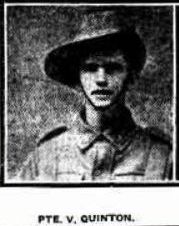
Victor QUINTON

Victor QUINTON

Private Victor Quinton (Sunday Times, 8/10/1916)

Private Victor Quinton (Sunday Times, 8/10/1916)

Per his military service record (regimental no. 4880), Victor Quinton was born at Gilgandra, N.S.W. He gave his age as 19 years and 6 months, his marital status as single, and his occupation as labourer. His description on his medical was height 5 feet 4 ½ inches tall, weight 8 stone 9 lbs., with a dark complexion, bluish green eyes, and dark hair. His religious denomination was Anglican. He completed his medical on the 9th October 1915 at Gilgandra, and was attested by Captain Nicholas on the 9th October 1915 at Gilgandra. He claimed to have had no previous military service.

After completing the march he went to Liverpool Camp as reinforcement for the 13th Battalion.

On his embarkation roll his address at time of enrolment was Miller Street, Gilgandra, N.S.W., and his next of kin is listed as mother, Mrs E. Lumley, Melrose Bidden, Gilgandra N.S.W.

Private Quinton departed Sydney on the HMAT Star of England on the 8th of March 1916. He arrived in Egypt on the 11th April 1916. On the 17th May 1916 he was transferred to the 4th Division Pioneer Training Battalion.

On the 6th June 1916 Private Quinton left Alexandria aboard the Transport Ionian bound for France, arriving at Marseille on the 15th June 1916. On the 22nd July 1916 Private Quinton was taken on strength in the field in the 4th Pioneer Battalion.

On the 5th August 1916 the Battalion was constructing communication trenches near Pozieres when Private Quinton was evacuated with shell shock. He returned to his unit on the 11th August 1916.

Private Quinton was evacuated with Influenza to the 5th Australian Field Ambulance, then the 36th Casualty Clearing Station, on 25th November 1916.  He was sent to hospital in Rouen on 29th November 1916.

On 14th December 1916, Private Quinton was evacuated to the 1st Southern General Hospital in England two weeks later.

He marched into Pernham Downs in England on 13th January 1917.

On the 24th January 1917 Private Quinton was transferred to the Australian Army Ordnance Corps. He served in England until the end of the war.

On the 22nd March 1919 Private Quinton left England on the Transport Nevasa bound for Australia. He arrived on the 26th April 1919, and was discharged on the 12th of June 1919.

Reginald Henry CHAMBERLAIN

Reginald Henry CHAMBERLAIN

Reginald Henry Chamberlain enlisted four times during the First World War.

Per his military service record (regimental no. 3021), Reginald Henry Chamberlain was born at Sydney, N.S.W. He gave his age as 24 years and 5 months (at the time of his 1917 application), his marital status as single, and his occupation as motor mechanic.

He first joined on 5th November 1914, completing his medical at Liverpool on 6th November 1914, and his attestation at Liverpool on 9th November 1914. He stated he had no previous military experience on this application form. However, he was discharged as “unlikely to become an efficient soldier” on 20th November 1914.

He joined again on 7th December 1914, completing his medical and attestation at Liverpool on 9th December 1914. He was discharged on 29th December 1914 with varicocele.

Reginald Henry Chamberlain joined again on 29th July 1915, completing his medical at Sydney on 29th July 1915, and his attestation at Liverpool on 5th August 1915. The date of discharge is not shown for this enlistment period in his service record.

However, he joined again at Parkes, undertaking his medical and attestation at Parkes on 11th October 1915. His description on his medical was height 5 feet 5 ¾ inches tall, weight 123 lbs., with a medium complexion, blue/grey eyes, and brown hair. His religious denomination was Church of England.  He gave his age on this application to enlist form as 22 years and 11 months. Private Chamberlain was one of two recruits (along with Joseph Armstrong who joined at Parkes on the 11th October 1915), who travelled to Dubbo on the morning on Wednesday 13th October 1915, along with three others who entered Dubbo Military Camp (Western Champion, 14/10/1915, p. 18).

It was reported in The Western Champion (21/10/1915, p. 17) that the Parkes Recruiting Association had held a recruiting meeting ‘for the purpose of enrolling recruits who were willing to join the volunteers now on the way, by road, from Gilgandra to Sydney’, and that ‘five men had mounted the lorry in response to the appeal’, and that ‘one of them went on to Dubbo’, with the remaining four planning to proceed to Molong to join the continent.

However, the recruit who was sent to Dubbo by Parkes Recruiting Association to join the Coo-ees is not named anywhere in newspaper reports or in the official correspondence of the march held in the Mitchell Library. It appears one of them (Chamberlain or Armstrong) had a change of heart and decided to join the Coo-ees on their march to Sydney, instead of entering Dubbo Military Camp.

After completing the Coo-ee March Private Armstrong went to Liverpool Camp as reinforcement for the 13th Battalion. However, he was discharged again as being medically unfit on 29th November 1915 before a medical board at Liverpool with varicocele.

On his fourth attempt at enlistment, he successfully completed his medical and attestation on 22nd January 1917 in Sydney. On his embarkation roll his address at time of enrolment was Sydney, N.S.W., and his next of kin is listed (as on his earlier applications to enlist) as his brother William Thomas Chamberlain, 19 Clevedon Road, Parnell, Auckland, N.Z.

Private Chamberlain departed Sydney on the HMAT A24 Benalla on 10th May 1917 as 7th Reinforcement for the 36th Battalion. He disembarked at Plymouth, England on the 19th July 1917. On 20th July he marched into 9th Training Battalion in England.

He proceeded to France on the 27th December 1917 from Southampton.

He marched out to the Front on 30th December 1917. On the 3rd January 1918 he was taken on strength in the 36th Battalion, and re-allocated regimental number 3021A.

He was appointed Lance Corporal on 20th February 1918.

On 30th April 1918 L/Corporal Chamberlain was transferred to the 35th Battalion. He was also wounded in action, being gassed, on the same day, and admitted to the 9th Australian Field Ambulance. He was transferred to the 12th Casualty Clearing Station on 2nd May, then to the 3rd Australian General Hospital in Abbeville on the 6th May 1918.

He embarked for England on 1lth May 1918, and was admitted to Whipps Cross Military Hospital in Leytonstone for shell gas.

He was transferred to the 1st Auxiliary Hospital, Harefield, on 27th May 1918.

He was discharged from hospital on 29th May 1918, then after being granted furlough, marched into No. 4 Command Depot, Hurdcott on 12th June 1918.

On 16th January 1919 he reverted to the rank of Private on being taken on strength of A.M.T.S. (Australian Motor Transport Section) and was mustered as Driver M.T.

He was discharged from the A.I.F. in London on being demobilized on 5th October 1919, but following his request for reinstatement, was then reinstated in the A.I.F. on 27th October 1919.

Private Reginald Henry Chamberlain returned to Australia on 18th December 1919 on the HT Konigin Luise, disembarking in Sydney on 7th February 1919.

He was discharged on 21st March 1920.