Category Archives: Recruits

Alan Chesher JOHNSON (Alan Cheshyre JANION)

Alan Chesher JOHNSON (Alan Cheshyre JANION)

Per his military service record (regimental no. 4817), Alan Chesher (or Chester) Johnson was born at Liverpool, England. He gave his age as 33 years, his marital status as single, and his occupation as laborer. His description on his medical was height 5 feet 6 ¾ inches tall, weight 151 lbs., with a fair complexion, grey eyes, and dark hair. His religious denomination was Church of England. He claimed that he had no previous military service. He completed his medical on the 16th October 1915 at Wellington (while the Coo-ees were in Wellington), and was attested at Dripstone on the 19th October 1915 by Captain Nicholas.

After completing the Coo-ee March he went to Liverpool Camp as reinforcement for the 13th Battalion.

On his embarkation roll his address at time of enrolment was 50A Young Street, Redfern, Sydney, N.S.W., and his next of kin is listed as friend, A. Hunter, 50A Young Street, Redfern, Sydney, N.S.W. (Miss A. Hunter was the sister and NOK of William Emmerton Hunter, who also joined the Coo-ees at Wellington, and embarked on the same ship).

Private Johnson departed Sydney on the HMAT Star of England along with many of the Coo-ees on the 8th March 1916. He arrived in Egypt on the 11th April 1916. On the 19th April 1916 he transferred to the 45th Battalion in Egypt.

On the 2nd June 1916 Private Johnson left Alexandria aboard the transport Kinfauns Castle bound for France, arriving at Marseille on the 8th June 1916.

On the 23rd July 1916 the Battalion was training in the vicinity of Berteacourt, France. Private Johnson was charged with being Absent From Parade at 9.00 am and 1.00 pm on the 22nd July and Being Absent from Church Parade on the 23rd July 1916. He was awarded 7 days Field Punishment number two.

On the 14th October 1916 the Battalion was resting at La Clyette, France, after being relieved from the front line. On this day Private Johnson was charged with being Absent Without Leave from 9.15 pm on the 10th October to 4.00 pm on the 11th October and of being Drunk and Urinating in Troop Quarters. He was awarded 7 days Field Punishment number two and forfeiture of eight days pay.

On the 30th December 1916 when the Battalion was training at Flesselles, France, Private Johnson was evacuated to the 8th Australian Field Ambulance with sore feet, possibly mild trench foot. He returned to the Battalion on the 18th January 1917 whilst it was at Mametz (near Pozieres), France.

On the 7th June 1917 the 45th Battalion was involved in an attack in the vicinity of the Messines Ridge, Belgium. Private Johnson was killed in action on the first day of the Battle of Messines.

Private Johnson has no known grave and is remembered on the Menin Gate at Ypres, Belgium.
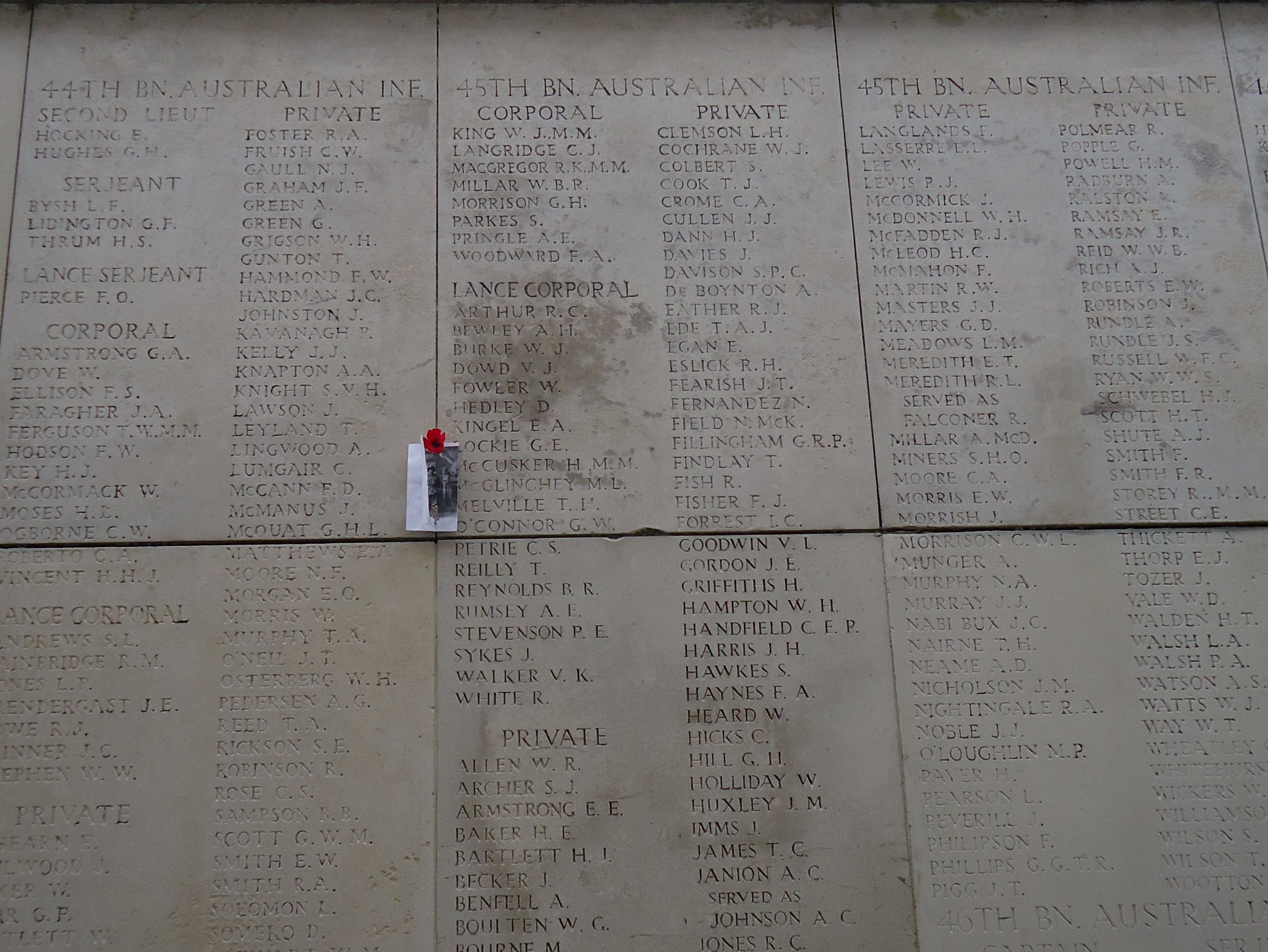
A. C. Janion served as A. C. Johnson on 45th Battalion panel at the Menin Gate Memorial, Belgium (Photograph: H. Thompson 11/9/2012)

Janion A. C. served as A. C. Johnson on 45th Battalion panel [bottom right row in centre] at the Menin Gate Memorial, Belgium (Photograph: H. Thompson 11/9/2012)
A letter in his service record dated 3rd December 1920 addressed to his mother Mrs. A. I. Janion, James Bay Hotel, Government Street, Victoria, B.C. in Canada acknowledges receipt of her statutory declaration (also in the file) advising his last name of Johnson which he enlisted under to be an assumed name, and states that the ‘records have been amended to read – “Stated to be JANION Alan Cheshyre.”

Arthur Charles REID

Arthur Charles REID (READ)

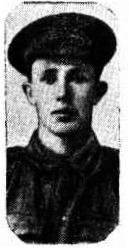
  ‘Gunner A. C. Reed’, (Forbes Advocate 8/12/1916)


‘Gunner A. C. Reed’, (Forbes Advocate 8/12/1916)

Per his military service record (regimental no. 4886), Arthur Charles Reid [or Arthur Charles Reed per his signature or Arthur Charles Read per his 1890 N.S.W. BDM Index birth registration] was born at Forbes, N.S.W. He gave his age as 25 years, his marital status as single, and his occupation as Shearing Machine Expert. His description on his medical was height 5 feet 10 inches tall, weight 13 stone 1 lbs., with a medium complexion, blue eyes, and brown hair. His religious denomination was Church of England. He claimed to have no previous military experience. He was attested on the 5th November at Katoomba, and completed his medical on the 6th November 1915 at Lawson, on the same days that the Coo-ees were in these towns.

He went to Liverpool Camp as reinforcement for the 13th Battalion.

On his embarkation roll his address at time of enrolment was Waitohe Condobolin, N.S.W., and his next of kin is listed as his father, F. H. Reid [Reed or Read], Coerrie [written elsewhere as Colarie or Calarie] Forbes, N.S.W.

Along with many of the Coo-ees, Private Reid departed Sydney on the HMAT Star of England on the 8th March 1916. He arrived in Egypt on the 11th April 1916.

On the 16th April 1916 Private Reid transferred to the 4th Division Artillery and his rank designation changed to Gunner. He was taken of strength of the 10th Field Artillery Brigade in Egypt. On the 27th May 1916 he was taken on strength of the 4th Division Ammunition Column.

On the 6th June 1916 Gunner Reid left Alexandria aboard the Oriana bound for France, arriving at Marseille on the 13th June 1916. On the 25th June 1916 he was taken on strength of the 4th Division Medium Trench Mortar Battery.

On the 8th September 1916 after seeing action on the Somme Gunner Reid had just arrived at the front in the vicinity of Vierssraat, Belgium, when he received a gunshot wound to his head. Private Reid was evacuated to the 11th Canadian Field Ambulance where he died of his wounds the next day.

Gunner Reid is buried at the La Clytte Military Cemetery, De Klijte, Flanders, Belgium.

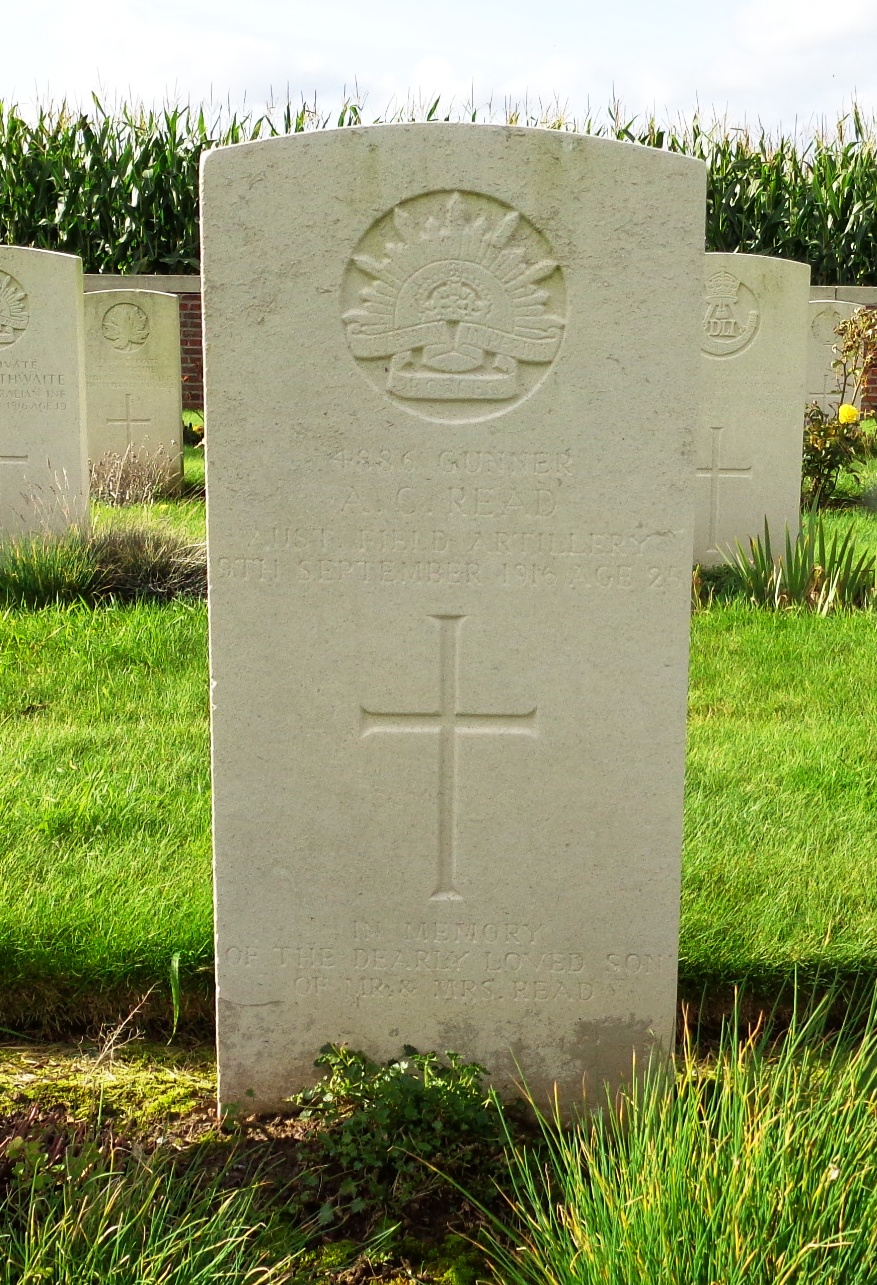
Arthur Charles Reid’s headstone at La Clytte Military Cemetery, Belgium (Photograph: H. Thompson 28/8/2014)


Arthur Charles Reid’s surname is spelt as READ on the headstone. The writing on the headstone is very worn. It reads:

4886 Gunner
A. C. Read
Aust. Field Artillery
9th September 1916 Age 25
In memory
of the dearly loved son
of Mr. & Mrs. Read

David James WAGNER

David James WAGNER

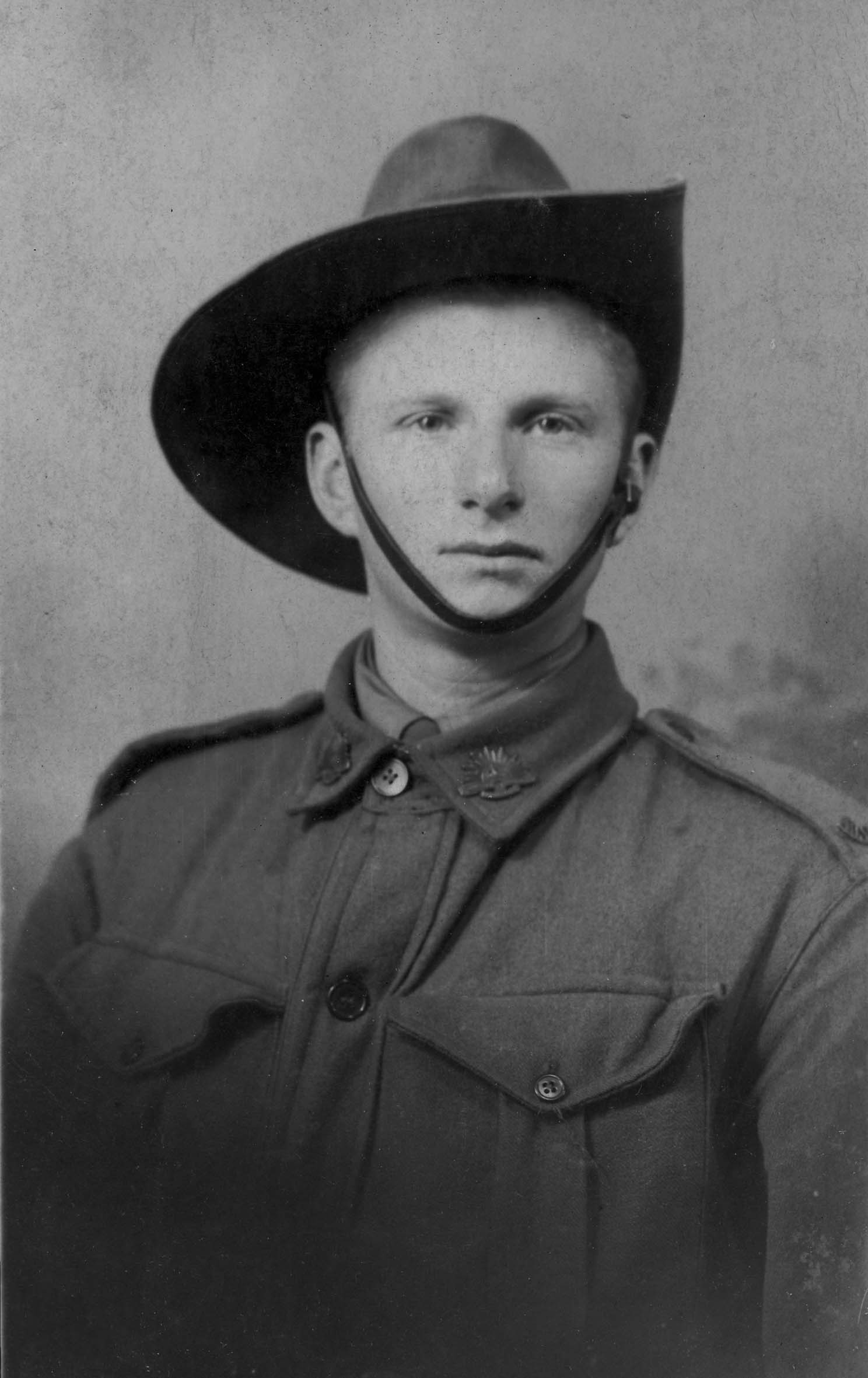
David James Wagner (Photograph courtesy of his grand-daughter Anne Dollin)

David James Wagner (Photograph courtesy of his grand-daughter Anne Dollin)

Per his military service record (regimental no. 4911), David James Wagner was born at Marrickville, Sydney, N.S.W. He gave his age as 18 years, his marital status as single, and his occupation as Bread Carter. His description on his medical was height 5 feet 4 ½ inches tall, weight 8 stone 1 lbs., with a fair complexion, grey eyes, and fair hair. His religious denomination was Church of England.  He claimed to have no previous military experience. It was noted on his enlistment form that he had been rejected previously by the Australian Imperial Force due to a deficient chest measurement. He completed his medical, and was attested on the same day, at Springwood on the 8th November 1915. He was one of two local recruits who joined the Coo-ees at Springwood.

Although Dave Wagner’s age was recorded as 18 years of age on his enlistment papers, he was actually only 16 years and 10 months old at the time, and was one of the youngest of the Coo-ees to enlist.[1] His service record contains a consent form signed by his father Arthur Wagner.

After completing the march he went to Liverpool Camp as reinforcement for the 13th Battalion.

On his embarkation roll his address at time of enrolment was Nancy [sic] Heights, Blue Mountains, N.S.W., and his next of kin is listed as his father, W. [sic] Wagner, Nancy Heights, Blue Mountains, N.S.W. [Nancy Heights should have been recorded as Valley Heights, Blue Mountains, N.S.W.]

Along with many of the Coo-ees, Private Wagner departed Sydney on the HMAT Star of England on the 8th March 1916. He arrived in Egypt on the 11th April 1916. On the 19th April 1916 he transferred to the 45th Battalion in Egypt.

On the 2nd June 1916 Private Wagner left Alexandria aboard the Kinfauns Castle bound for France, arriving at Marseille on the 8th June 1916.

On the 6th July 1916 Private Wagner was shot in the chest while he was with the 45th Battalion when it was manning the front line in the vicinity of Sailly Sur La Lys, France. He was evacuated to the 4th Australian Field Ambulance at Fort Rompu near Erquinghem, then on the 7th July 1916 to the 2nd Australian Casualty Clearance Station at Trois Arbres. On the 13th August 1916 he was transferred to the 32nd Stationary Hospital at Wimereux. On the 15th August 1916 he was moved to the 4th Australian Division Base Depot at Etaples.

On the 11th September 1916 Private Wagner rejoined the 45th Battalion when they were training and refitting at Victoria Camp near Renninghelst, Belgium.

On the 7th June 1917 Private Wagner was admitted to Hospital sick. He rejoined the Battalion on the 13th June 1917.

On the 14th August 1917 Private Wagner was admitted to the 13th Australian Field Ambulance with diarrhoea. He rejoined the Battalion on the 22nd of August 1917.

On the 31st May 1918 Private Wagner was detached to the Headquarters of the 12th Infantry Brigade. On the 29th January 1919 Private Wagner returned to the 45th Battalion.

On the 4th February 1919 he was sent to the 39th Stationary Hospital at Le Harve, France. On the 7th February 1919 Private Wagner was admitted to the 1st Australian Dermatological Hospital at Bulford, England sick. He was discharged from Hospital on the 15th March 1919. Then on the 20th March 1919 Private Wagner was readmitted to the 1st Australian Dermatological Hospital sick. He was discharged on the 21st April 1919.

Private Wagner commenced his return to Australia on the 12th May 1919 aboard the Port Napier, arriving in Australia on the 5th July 1919. He was discharged on the 19th August 1919.

The Blue Mountains Echo reported on 5th September 1919 that at a recent welcome home event held for four returned soldiers at Springood Hall that the chairman called Private Wagner ‘Springwood’s “Coo-ee’’’ whom ‘everybody knew as “Our Davy”’’, and that Private Wagner when he spoke ‘paid tribute to the Women’s Sewing Circle, “Let me tell you,” he said, “that the things they sent to the fighters were greatly appreciated. I am glad to be home; but when I was away I can tell you I looked for the letters which helped me to keep in touch with the home folk”’.[2]

[1] ‘The talk of the town’, The Mirror of Australia, 2 September 1916, p. 2, http://trove.nla.gov.au/ndp/del/article/105136203

[2] ‘Springwood’s soldier sons’, The Blue Mountain Echo, 5 September 1919, p. 2, http://nla.gov.au/nla.news-article108245547

James O’NEILL

James O’NEILL

Per his military service record (regimental no. 6199), James O’Neill was born at Hay, N.S.W. He gave his age as 35 years, his marital status as single, and his occupation as labourer. His description on his medical was height 5 feet 6 ½ inches tall, weight 11 stone 2 lbs., with a dark complexion, blue eyes, and dark hair. His religious denomination was Roman Catholic.  He completed his medical on the 17th October 1915 at Wellington, and was attested on the 19th October 1915 by Captain Nicholas at Stuart Town (signing his name on this document as James Andrew McNeill). He claimed to have had no previous military service.

After completing the Coo-ee March he went to Liverpool Military Camp for training. His service record does not record details of his service for the next few months. There is separate enlistment documentation dated the 14th of March 1916 where he completed a medical and attestation at Liverpool, where he was ‘re-examined and found medically and dentally fit’. However, there is no paperwork indicating that he was discharged prior to this, and his official enlistment date according to the Embarkation Roll is the 19th October 1915.

On his embarkation roll his address at time of enrolment was ‘No fixed abode’, and his next of kin is listed as his sister, Miss Kathleen O’Neill, Hay, N.S.W.

On the 25th October 1916 Private O’Neill departed Sydney on the HMAT Ascanius. He arrived at Devonport, England, on the 28th December 1916. He marched into the 5th Training Battalion at Rollerstone on the 29th December 1916.

On the 11th January 1917 Private O’Neill was charged with being absent without leave from 2400 on the 8th January 1917 till 2100 on the 10th January 1917. He was fined a total forfeiture of 8 days pay.

On the 8th May 1917 Private O’Neill marched out of the 5th Training Battalion and travelled to Folkestone where on the 9th May 1917 he departed for France. On the 13th May 1917 he was taken on strength of the 18th Battalion when it was reorganising and reequipping at Fricourt, France.

On the 23rd June 1917 whilst the Battalion was conducting training near Bapaume, France, Private O’Neill was admitted to the 5th Australian Field Ambulance with Scabies. On the 5th July 1917 he was transferred to the 6th Australian Field Ambulance. He rejoined the Battalion on the 9th July 1917 whilst it was still conducting training near Bapaume, France

On the 19th September 1917 Private O’Neill was wounded in his first action near Bellewaarde Ridge, Belgium. He was evacuated to the 3rd Australian Field Ambulance where he died later that day.

Private O’Neill is buried at the Menin Road South Military Cemetery at Ypres in Belgium.

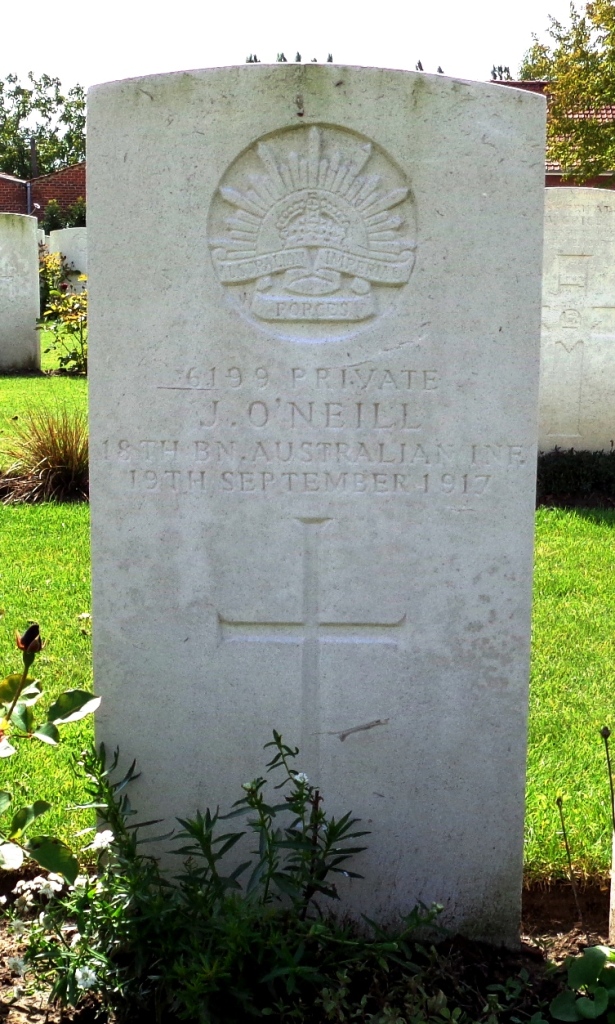
James O'Neill's headstone at the Menin Road South Military Cemetery, Belgium (Photograph: H. Thompson 29/8/2014)

James O’Neill’s headstone at the Menin Road South Military Cemetery, Belgium (Photograph: H. Thompson 29/8/2014)

Joseph Raymond McGUIRE

Joseph Raymond MCGUIRE

Per his military service record (regimental no. 4857), Joseph Ramond McGuire was born at Redfern, N.S.W. He gave his age as 33 years and 10 months, his marital status as single, and his occupation as tinworker labourer. His description on his medical was height 5 feet 2 ½ inches tall, weight 126 lbs., with a dark complexion, brown eyes, and dark hair. His religious denomination was Roman Catholic.  He claimed to have two months previous service with the AIF from 3rd of May 1915 to 8th of July 1915, being discharged for bad conduct. He completed his medical on the 11th of November 1915 at Ashfield and was attested on the 11th of November 1915 at Ashfield.

He went to Liverpool Camp as reinforcement for the 13th Battalion.

On his embarkation roll his address at time of enrolment was 60 Hanover Street, Waterloo, N.S.W., and his next of kin is listed as his father, B. J. McGuire, 60 Hanover Street, Waterloo, N.S.W.

Along with many of the Coo-ees, Private McGuire departed Sydney on the HMAT Star of England on the 8th March 1916. He arrived in Egypt on the 11th April 1916. On the 19th April 1916 he transferred to the 45th Battalion in Egypt.

On the 2nd June 1916 Private McGuire left Alexandria aboard the Kinfauns Castle bound for France, arriving at Marseille on the 8th June 1916.

On the 20th July 1916 whilst the Battalion was conducting training at Berteacourt Les Dames Private McGuire was charged with drunkenness in billet and being absent from 2 p.m. Parade. He was awarded 2 days forfeiture of pay.

On the 12th August 1916 during the Battle of the Somme, Private McGuire was wounded in action, receiving a shrapnel wound to his wrist whilst the 45th Battalion was in action in the vicinity of Pozieres, France. He was evacuated to the 25th General Hospital where he remained till the 17th August. He was then sent to the 4th Division Base Depot. On the 30th September he was sent back to the 45th Battalion, arriving on the 1st October 1916, whilst the Battalion was manning the front line in the vicinity of Pozieres.

On the 27th November 1916 the 45th Battalion came out of the front line after being in action in the vicinity of Guedecourt. During this time the weather had been miserable with constant rain. Private McGuire was one of the casualties evacuated to the 36th Casualty Clearing Station with trench feet. On the 29th November 1916 he was sent to the 3rd Stationary Hospital at Rouen, France. On the 4th December 1916 he boarded the hospital ship Carisbrook Castle at Le Harve for evacuation to England. On the 5th December 1916 he was admitted to the 3rd London General Hospital at Wandsworth.

Private McGuire marched out of the 3rd London General Hospital on the 20th January 1917 and went on leave till the 5th February 1917 when he reported to the 1st Command Depot at Pernham Downs. On 8th February 1917 he was transferred to the 4th Command Depot at Wareham. On the 27th March 1917 whilst still at the 4th Command Depot Private McGuire was charged with neglecting to obey orders re bounds, and he was awarded forfeiture of 4 days pay and 7 days confined to barracks.

On the 15th May 1917 Private McGuire was transferred to and taken on strength of the 61st Infantry Battalion that had just been formed. Later that year the 61st Battalion was disbanded. On the 12th September 1917 Private McGuire departed Southampton, arriving at Le Harve on the 13th September 1917 where he marched into the 4th Australian Division Base Depot. On the 16th September 1917 Private McGuire was charged with being absent from 9.30 p.m. till 10.50 p.m. He was awarded forfeiture of 2 days pay.

On the 21st September 1917 Private McGuire left the 4th Australian Division Base Depot to rejoin the 45th Battalion. He was taken on strength on the 22nd September whilst the Battalion was waiting in the vicinity of Steenvoorde, Belgium, to go into action.

From the 25th September 1917 till the 1st October 1917 the Battalion was involved in offensive operations in the vicinity of Westhoek Ridge, Belgium. On the 29th September Private McGuire received a bomb wound to his right leg. Private McGuire was being evacuated to the 10th Casualty Clearing Station when he succumbed to his wounds on the same day.

Private McGuire is buried at the Lijssenthoek Military Cemetery, Belgium.

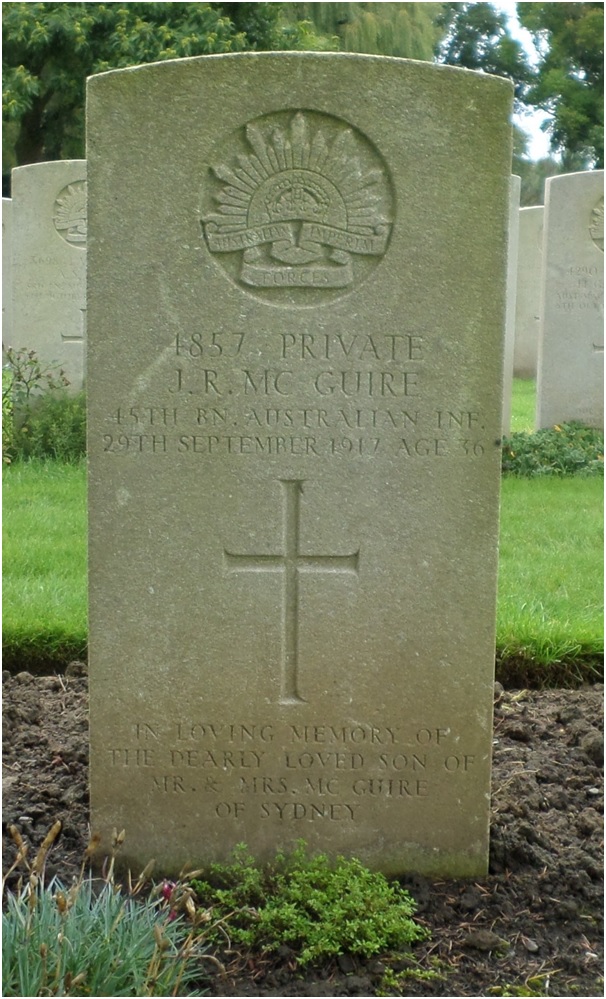
Joseph Raymond McGuire's headstone at Lijssenthoek Cemetery, Belgium (Photograph: H. Thompson 28/8/2014)

Joseph Raymond McGuire’s headstone at Lijssenthoek Military Cemetery, Belgium (Photograph: H. Thompson 28/8/2014)

William Thomas HITCHEN

William “Bill” Thomas HITCHEN

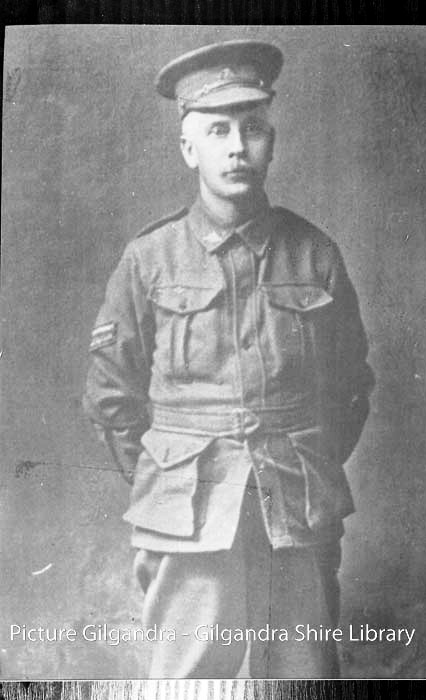
Bill Hitchen (Photograph courtesy of Gilgandra Shire Library)

Bill Hitchen (Photograph courtesy of Gilgandra Shire Library)

Per his military service record (regimental no. 1677), William “Bill” Thomas Hitchen was born at Mudgee, N.S.W. Lowering his actual age of 51 years by several years, he gave his age as 44 years and 2 months, and his address as Bridge Street, Gilgandra, N.S.W. He gave his occupation as plumber. His description on his medical was height 5 feet 7 ½ inches tall, weight 180 lbs., with a medium complexion, light brown eyes, and fair hair. His religious denomination was Roman Catholic.  He claimed to have no previous military experience.

He was known as Captain Bill Hitchen on the Coo-ee March as he was the Captain of the Gilgandra Rifle Club before enlisting.

Bill Hitchen was one of the main organisers of the Coo-ee March (along with his brother Richard G. Hitchen), and he joined the Coo-ees at Gilgandra at the beginning of the march. His official enlistment date is the 10th October 1915. However, per his service record he did not complete his medical and attestation until the 24th February 1916 at Bathurst, after he assisted in organising the Kookaburra March from Tooraweenah to Bathurst in early 1916.

After the Kookaburra March he was allocated to the 2nd reinforcements to the 45th Battalion as a Corporal.

Corporal Hitchen departed Sydney on the HMAT A40 Ceramic on the 14th April 1916. He embarked from Alexandria on 6th June 1916, and disembarked at Plymouth, England, on the 16th June 1916.

He was admitted to the 1st Australian Auxiliary Hospital at Harefield Park on 21st June 1916 sick with Melanotic Sarcoma.  He also had Diabetes.

Corporal Hitchen died of his illness on the 3rd September 1916, and was buried at the nearby Saint Mary’s Churchyard at Harefield, England.

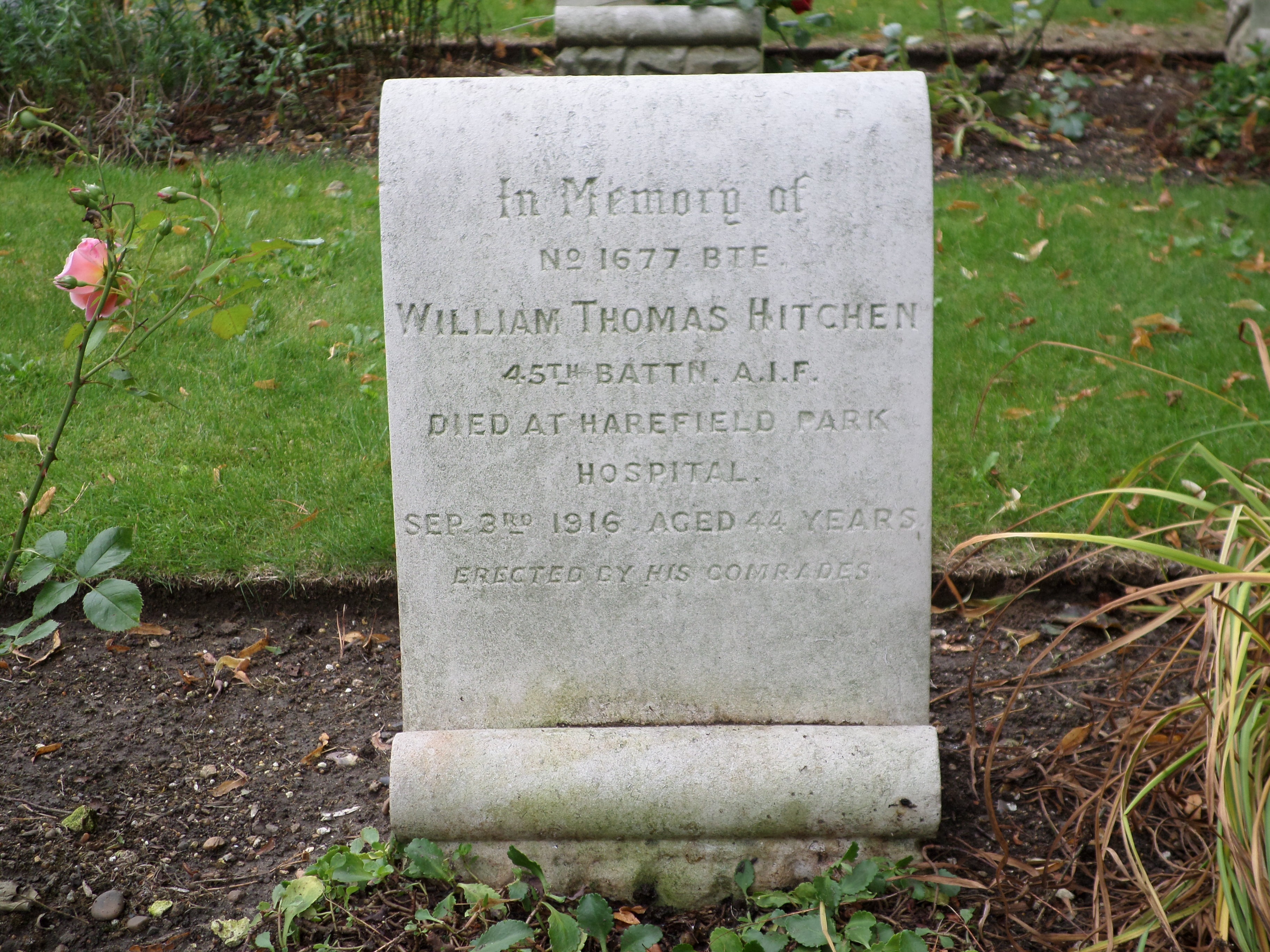
Bill Hitchen's headstone, Harefield (St. Mary) Churchyard (Photograph: S & H Thompson, 17/8/2014)

Bill Hitchen’s headstone, Harefield (St. Mary) Churchyard (Photograph: S & H Thompson, 17/8/2014)

His name is also listed on the Gilgandra War Memorial, Cooee March Memorial Park Gateway (Gilgandra), and the Gulargambone War Memorial.


Donald Singleton STEWART

Donald Singleton STEWART

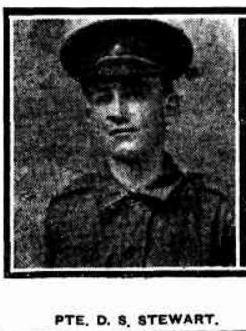
Donald Stewart (Sunday Times, 8/10/1916)

Donald Stewart (Sunday Times, 8/10/1916)

Per his military service record (regimental no. 4600), Donald Singleton Stewart was born at Wellington, N.S.W. He gave his age as 18 years (instead of his actual age of 16 years and 9 months), his marital status as single, and his occupation as grocer. His description on his medical was height 5 feet 8 inches tall, weight 9 stone 5 lbs., with a fair complexion, blue eyes, and fair hair. His religious denomination was Methodist.  He was known as one of the Wellington recruits, and joined the Coo-ees on the road after the Coo-ees had passed through Wellington. He was attested by Captain Nicholas “eight miles east” of Molong [at Boomey] on the 22nd October 1915, and completed his medical at Molong on 22nd October 1915. He claimed that he had previous military service with the Militia.

After completing the Coo-ee March he went to Liverpool Camp as reinforcement for the 13th Battalion.

On his embarkation roll his address at time of enrolment was Park Street, Wellington, N.S.W., and his next of kin is listed as his father, E. Stewart, Park Street, Wellington, N.S.W.

Private Stewart departed Sydney on the HMAT A70 Ballarat on the 16th February 1916 as 14th Reinforcement for the 13th Battalion. He arrived in Egypt on the 22nd March 1916. On the 1st April 1916 he was transferred to the 54th Battalion.

On the 19th June 1916 Private Stewart left Alexandria aboard HT Caledonian bound for France, arriving at Marseille on the 29th June 1916.

On the 20th July 1916 Private Stewart was reported missing in action after taking part in the Battle of Fromelles. On the 12th August 1916 Private Stewart was reported to be a prisoner of war in Germany. He was interned at Dulmen, Germany (a prison camp in Westphalia), then later detained at Schneidemuhl, Germany.

One of the youngest of the Coo-ees, he had his 17th birthday in Liverpool Camp, and his 18th and 19th birthdays as a prisoner of war in Germany (Wellington Times, 19/9/1918, p. 3).

After the end of the war, Private Stewart was repatriated to England on the 18th December 1918.

Private Stewart departed England on the 3rd May 1919 for return to Australia aboard the steamer Leicestershire, disembarking at Sydney on the 22nd June 1919. He was discharged on the 14th August 1919.

William John Luther HOWARD

William John Luther HOWARD

Per his military service record (regimental no. 4802), William John Luther Howard was born at Crookwell, N.S.W. He gave his age as 24 years and 10 months, and his address as Mountain View, Biddon, Gilgandra, N.S.W. He gave his occupation as Farmer. His description on his medical was height 5 feet 9 ¾ inches tall, weight 11 stone 2 lbs., with a dark complexion, light blue eyes, and brown hair. His religious denomination was Methodist. He completed his medical on the 27th October 1915 at Gilgandra, (after the Coo-ee March had started), and was not attested until after the March had finished, at Liverpool on the 13th November 1915. He claimed to have had no previous military service.

Private Howard joined the Coo-ees at Bathurst. A telegram in the official correspondence of the March from A.H. Miller in Gilgandra to Major Wynne on the Coo-ee March dated 28th October 1915 advised that Howard had been sent to Bathurst the night before to meet them (presumably by train). His name was listed as one of the Bathurst recruits in The Bathurst Times (29/10/1915, p. 2).

After completing the march he went to Liverpool Camp as reinforcement for the 13th Battalion.

Private Howard departed Sydney on the HMAT Star of England on the 8th March 1916. He arrived in Egypt on the 11th of April 1916.

On the 7th June 1916 Private Howard left Alexandria aboard the Transport Huntspill bound for France, arriving at Marseille on the 14th June 1916.

After arriving in France Private Howard was sent to a Machine Gun Training School on 30th June 1916. After completing training he was posted to the 12th Machine Gun Company on the 12th August 1916, when it was engaged in heavy fighting around Pozieres.

Private Howard was admitted to hospital with influenza on 1st January 1917, returning to duty on 26th January 1917.

He was appointed Lance Corporal on the 9th October 1917 when his unit was resting out of the line at Ypres, Belgium.

On the 1st April 1918 his unit was redesignated the 4th Machine Gun Battalion.

He went on leave to the United Kingdom on 7th September 1918. He returned from leave on the 26th September 1918.

Lance Corporal Howard began his return to Australia aboard the Transport HMAT Commonwealth on the 17th April 1919. He arrived in Australia on the 19th May 1919.

He was discharged on the 12th June 1919.

Thomas Walter DOWD

Thomas Walter DOWD

Per his military service record (regimental no. 6244), Thomas Walter Dowd was born at Wellington, N.S.W. He gave his age as 31 years and 11 months, his marital status as single, and his occupation as farmer. His description on his medical was height 5 feet 8 3/8 inches tall, weight 150 lbs., with a fair complexion, blue eyes, and brown hair. His religious denomination was Roman Catholic. He claimed that he had no previous military service.

He was one of the thirteen men who stepped forward and gave his name, ‘either to march under Captain Nicholas, or to come after harvest’, when the Coo-ees recruited in Wongarbon on 14th October 1915.[1]  It is not clear where he joined the Coo-ee March, but written on the top of the first page in his service record is that he ‘Presented at Orange 24/10/15’. He completed his medical on the 24th October 1915 at Orange, and was attested at Orange on 24th October 1915.

There is a docket in the official correspondence of the march dated 24th November 1915, for “T. Dowd, barbering for Coo-ees 21 days @5/- £5-0-0”. This was the profession he was to undertake later in his life after the end of the First World War.

After completing the remainder of the march he went to Liverpool Camp as reinforcement for the 13th Battalion, where he was Acting Sergeant.

On his embarkation roll his address at time of enrolment was Wongarbon, N.S.W., and his next of kin is listed as his father, T. Dowd, Maryvale, N.S.W.

Acting Sergeant Dowd departed Sydney on the HMAT Euripides A14 on the 9th September 1916, and arrived at Plymouth, England, on the 26th October 1916.   On the 4th November 1916 he marched into the 4th Training Battalion.

On the 28th December 1916 Acting Sergeant Dowd departed Folkestone aboard the Princess Clementine bound for France. On the 29th December 1916 he marched into the 4th Australian Division Base Depot at Etaples where he reverted to the rank of Private.

On the 5th February 1917 Private Dowd was taken on strength of the 19th Battalion. On the 27th April 1917 he was promoted to Lance Corporal. On the 20th May 1917 Lance Corporal Dowd was detached for duty with the 20th Battalion, then on the 16th June 1917 he was detached for duty with the 5th Australian Machine Gun Company.

On the 24th October 1917 Lance Corporal Dowd attended the 6th Officer Cadet Training Battalion at Oxford.

A Confidential Report in his service record dated 27th March 1918 (while he still had the rank of Lance Corporal) had the following remarks: “A very fine character, with any amount of common-sense, grit and determination, also a certain amount of originality. Will lead men anywhere, and win affection and confidence”.

He qualified for a commission on the 30th April 1918. He then attended a Machine Gun course.

On the 1st June 1918 he was appointed a Second Lieutenant and on the 31st July 1918 was taken on strength of the 2nd Australian Machine Gun Battalion.

On the 3rd September 1918 Second Lieutenant Dowd was wounded in action, and admitted to the 5th Field Ambulance suffering shrapnel wounds to the face and hand. He was moved back to the 53rd Casualty Clearing Station, then to the 20th General Hospital, where he remained until the 20th September 1918.

Second Lieutenant Dowd rejoined his unit on 2nd November 1918. He was promoted to Lieutenant on the 8th November 1918

On the 2nd January 1919 Lieutenant Dowd went to the United Kingdom on leave. He returned to his unit on the 18th January 1919.

Lieutenant Dowd departed England on the 19th April 1919 aboard the H.T. Sardinia for return to Australia. He arrived at Sydney on the 8th June 1919. He was discharged on the 21st July 1919.

[1] ‘The Route March’, The Farmer and Settler, 19 October 1915, p. 3.


John MCNAMARA

John MCNAMARA

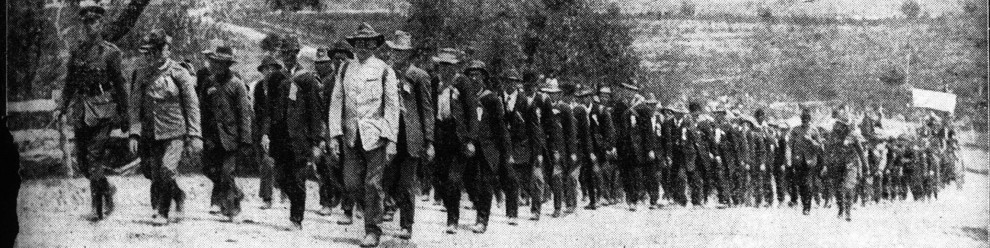
Coo-ees on the road to Balladoran (Sydney Mail 20/10/1915)

Coo-ees on the road to Balladoran – John McNamara is in the front row second from the right, next to Captain Nicholas on far right (Sydney Mail 20/10/1915)

Per his military service record, John McNamara was born at Sydney, N.S.W. His WWI service record shows that he initially tried to enlist on 14th December 1914 at Traralgon in Victoria, where he gave his age as 47 years. (Based on his age given in his entry in the Sudan Nominal Roll on the Australian War Memorial website, it is likely he was even older). On his enlistment papers when he joined the Coo-ees at Gilgandra, he miraculously lost two years, giving his age as 45 years and 2 months. He listed his marital status as single, and his occupation as a butcher. His description on his medical was height 5 feet 11 inches tall, weight 160 ½ lbs., with a medium complexion, grey eyes, and light brown hair. His religious denomination was Roman Catholic. He completed his medical on the 9th October 1915 at Gilgandra, and was attested by Captain Nicholas on the 9th October 1915 at Gilgandra. He claimed to have 5 years in the Regular Forces of New South Wales throughout the Boer War, and a total of 15 years’ previous military service. He gave his address as c/- H. Burns, Exhibition Dairy, Botany Road, Sydney. He listed his next of kin as his nephew, Valentine McNamara, Exhibition Dairy, Botany Road, Sydney.

After completing the march he went to Liverpool Camp as reinforcement for the 13th Battalion.

After two periods of being absent without leave (17th to 24th January 1916, and 3rd to 11th February 1916), on the 16th February 1916 Private McNamara was discharged with his services no longer being required.