Category Archives: Recruits

Joseph ARMSTRONG

Joseph ARMSTRONG

Per his military service record (regimental no. 4430), Joseph Armstrong was born at Bally-Bofey, Ireland. He gave his age as 43 years and 5 months, his marital status as single, and his occupation as labourer. He did a preliminary medical examination at Condobolin on 8th October 1915, then completed his medical, and attestation, at Parkes on 12th October, 1915. His description on his medical was height 5 feet 7 ½ inches tall, weight 162 lbs., with a fresh complexion, blue grey eyes, and light brown hair. His religious denomination was Church of England. He claimed to have served in the 3rd N.S.W. Imperial Bushmen for 2 ½ years in the Boer War.

Private Armstrong was one of two recruits (along with Reginald Henry Chamberlain who joined at Parkes on the 11th October 1915), who travelled to Dubbo on the morning on Wednesday 13th October 1915, along with three others who entered Dubbo Military Camp (Western Champion, 14/10/1915, p. 18).

It was reported in The Western Champion (21/10/1915, p. 17) that the Parkes Recruiting Association had held a recruiting meeting ‘for the purpose of enrolling recruits who were willing to join the volunteers now on the way, by road, from Gilgandra to Sydney’, and that ‘five men had mounted the lorry in response to the appeal’, and that ‘one of them went on to Dubbo’, with the remaining four planning to proceed to Molong to join the contingent.

However, the recruit who was sent to Dubbo by Parkes Recruiting Association to join the Coo-ees is not named anywhere in newspaper reports or in the official correspondence of the march held in the Mitchell Library. It appears one of them (Armstrong or Chamberlain) had a change of heart and decided to join the Coo-ees on their march to Sydney, instead of entering Dubbo Military Camp.

After completing the Coo-ee March Private Armstrong went to Liverpool Camp as reinforcement for the 13th Battalion.

On his embarkation roll his address at time of enrolment was 125 Flinders Street, Sydney, N.S.W., and his next of kin is listed as his cousin, Mrs E. Phillips, 125 Flinders Street, Sydney, N.S.W.

Private Armstrong departed Sydney on the HMAT A70 Ballarat on 16th February 1916 as 14th Reinforcement for the 13th Battalion. He arrived in Egypt on the 22nd March 1916. On the 1st April 1916 he was transferred to the 54th Battalion.

He embarked on the HT Caledonian at Alexandria on 19th June 1916, and disembarked at Marseilles, France, on 29th June 1916.

He was initially reported killed in action on 19th July 1916 at the Battle of Fromelles in France.  However he had been wounded with a bullet wound to the buttock and thigh during this battle, and taken a prisoner by the Germans. On 19th October 1916  he was officially reported as a Prisoner of War, at Wurzburg, Germany.

After the end of the war he was repatriated, arriving in England on 30th December 1918. He then returned to Australia leaving Weymouth on the transport Karoa on 28th March 1919, arriving in Australia on 10th May 1919.  He was medically discharged on 24th June 1919.

Joseph Patrick WALLIS

 Joseph Patrick WALLIS (aka Joseph Patrick WAILES)

Per his military service record (regimental no. 4617), Joseph Patrick Wallis was born at Darlinghurst, N.S.W.[1]  He gave his age as 18 years and 4 months (though he was younger), his marital status as single, and his occupation as seaman. He undertook a preliminary medical examination at Trangie on 6th October 1915 (where he gave his occupation as stableboy, and address as 9 George Street, Burwood). His description on his medical was height 5 feet 6 ¼ inches tall, weight 112 lbs., with a fair complexion, grey eyes, and light brown hair. His religious denomination was Roman Catholic.

He joined the Coo-ee March at Dubbo. He completed his medical on the 13th October 1915 at Dubbo, and was attested on 13th October 1915 at Dubbo. He claimed to have had no previous military service.

After completing the Coo-ee March he went to Liverpool Camp as reinforcement for the 13th Battalion.

On his embarkation roll his address at time of enrolment was Wollara Wollar, via Mudgee, N.S.W., and his next of kin is listed as his aunt, Mrs Sarah Doyle, Wollara Wollar, via Mudgee, N.S.W. (This was later changed in his service record to his mother Mrs Jane Wailes at various Sydney addresses).

Private Wallis departed Sydney on the HMAT A70 Ballarat on the 16th February 1916 as 14th Reinforcement for the 13th Battalion. He arrived in Egypt on the 22nd March 1916. On the 1st April 1916 he was transferred to the 54th Battalion.

He embarked on the HT Caledonian at Alexandria on 19th June 1916, and disembarked at Marseilles, France, on 29th June 1916.

He was killed during the Battle of Fromelles in France on 19/20th July 1916. He was originally listed with “No known grave”, and commemorated at V. C. Corner Australian Cemetery and Memorial at Fromelles.

His body was identified in 2010, and was buried in the Fromelles (Pheasant Wood) Military Cemetery, France.

Joseph Patrick Wallis headstone at Fromelles (Pheseant Wood) Military Cemetery, France (Photograph S & H Thompson 2012)

Joseph Patrick Wallis headstone at Fromelles (Pheseant Wood) Military Cemetery, France (Photograph S & H Thompson 2012)

Private Wailes’ name is also commemorated on panel 160 on the Australian War Memorial First World War Roll of Honour.

Research note: The NSW Birth Certificate for Joseph Wailes shows he was born on 28th August 1898, so he was actually only 17 years and 1 month when he enlisted with the Coo-ees, and 17 years and 10 months when he died.


[1] NAA: B2455, WALLIS JOSEPH PATRICK

[2] NSW Birth Certificate WAILES JOSEPH  27421/1898 FREDERICK C  JANE SYDNEY

Alfred Rupert Clyde LINGSTROM

Alfred Rupert Clyde LINGSTROM (aka Alf LYNNE)

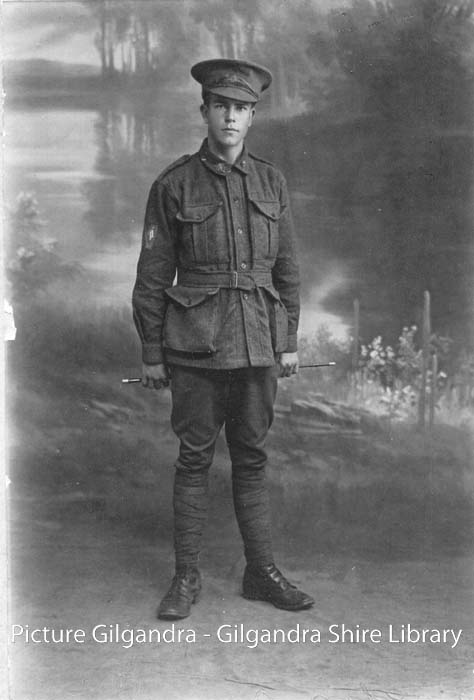
Alfred Rupert Lynne "Pug" (Photograph courtesy of Gilgandra Shire Library)

Alfred Rupert Lynne “Pug”, 1915 (Photograph courtesy of Gilgandra Shire Library)

Per his military service record (regimental no. 4834), Alfred Rupert Clyde Lingstrom was born at Dubbo, N.S.W.[1]  He gave his age as 21 years, his marital status as single, and his occupation as Postal Assistant.  His description on his Certificate of Medical Examination was height 5 feet 6 ½ inches, weight 112 lbs., with a fair complexion, grey eyes, and light brown hair.  His religious denomination was Methodist.  He completed his medical examination on 13th October 1915 at Dubbo (the day the Coo-ees arrived in Dubbo), but was not attested until 26th October 1915 at Bathampton (after he had caught up with the Coo-ees).  He claimed to have had no previous military service. He stated that he was a member of the Geurie Rifle Club.

An article in the Wellington Times dated 28th October 1915 reported that ‘Mr. [W. W.] Smith and Mr. Lynne responded to the call for recruits when the Coo-ees from Gilgandra spent a night in Geurie’ [on Friday 15th October 1915], ‘but neither could join immediately, as the former had a big task in handing over all the shire books to his successor, and Mr. Lynne had to remain in his position at the local [Geurie] post-office till a relief man could be sent along’, and that ‘Mr. Lynne himself hails from the home of the Coo-ees (Gilgandra) so should find himself among friends when he joins them’.[2]

Alfred Lingstrom, reported as “A. Lynne” in The Dubbo Liberal and Macquarie Advocate, following a send off provided by the Geurie community, travelled by train from Geurie with fellow Geurie Coo-ee William Smith on Tuesday 26th October 1915, to catch up with the Coo-ees at Blayney.[3]

He was known as one of the Gilgandra Coo-ees.

After completing the remainder of the Coo-ee March, he went to Liverpool Camp as reinforcement for the 13th Battalion.

Private Lingstrom attended a Signal School at Liverpool from 25th December 1915 to 2nd February 1916.[4]

On his embarkation roll his address at time of enrolment was Warren Street, Gilgandra, N.S.W., and his next of kin is listed as his mother, Mrs. E. [Emily] Lingstrom, at the same address.

Private Lingstrom, along with many of the Coo-ees, departed Sydney on the HMAT A15 Star of England on 8th March 1916, as 15th reinforcement for the 13th Battalion.  He arrived in Egypt on 11th April 1916.

On the 16th May 1916 he was transferred to the Signal Section of the Engineers Training Depot at Tel-el Kebir.

On the 15th October 1916 Private Lingstrom was taken on strength of the ANZAC Mounted Division Signal Squadron at Romani.

On 1st February 1917 Private Lingstrom was sent to hospital sick. On 12th February 1917 he was admitted to the 14th Australian General Hospital at Abbassia, Egypt, suffering from Bronchitis.  He was transferred to a Convalescent Depot on 20th February 1917.

On 9th March 1917 Private Lingstrom was charged with (1) breaking out of barracks about 6 p.m. and remaining absent until apprehended by the Military Police about 7.30 p.m. on 8th March 1917, (2) being out of bounds by being in Wagh el Burka Street, and (3) neglecting to obey Garrison orders by not wearing identity discs.  He was awarded 3 days confined to barracks and fined 4 days pay.

On 12th March 1917 Private Lingstrom was sent to the 1st Light Horse Training Regiment at Moascar, Egypt.  On 20th March 1917 he was moved to the Base Signal Depot at Alexandria, Egypt.  On 27th of April 1917 he rejoined the ANZAC Mounted Division Signal Squadron.

On 9th May 1917 Private Lingstrom went to hospital sick. He was admitted to Citadel Military Hospital in Cairo, Egypt, on 12th May 1917, suffering from Debility.  He was discharged to a Convalescent Depot at Abbassia, Egypt, on 19th May 1917.

On 30th May 1917 Private Lingstrom was charged with overstaying his pass from 8 p.m. until apprehended by the Military Police about 9.40 p.m., and being out of bounds, on 28th May 1917.  He was fined 2 days pay.

On 2nd June 1917 Private Lingstrom was transferred to the British Red Cross Convalescent Depot at Montagah, Egypt.

On 14th June 1917 Private Lingstrom was discharged to the Base Signal Depot at Alexandria, Egypt.

On 28th July 1917 he rejoined the ANZAC Mounted Division Signal Squadron.

On 28th January 1918 Private Lingstrom was charged with whilst being on active service for failed to salute an officer on 25th January 1918.  He was awarded 5 days confined to camp.

On 2nd March 1918 Private Lingstrom was sent to the Base Signal Depot at Alexandria, Egypt.  On 28th March 1918 he rejoined the ANZAC Mounted Division Signal Squadron.

On 11th August 1918 Private Lingstrom was sent to a Rest Camp at Port Said, Egypt.

On 1st September 1918 he was sent to the Signals Training Unit at Moascar, Egypt.

On 12th February 1919 he rejoined the ANZAC Mounted Division Signal Squadron.

On 6th March 1919 Private Lingstrom was promoted to Temporary 2nd Corporal.  He was promoted to 2nd Corporal on 24th June 1919.

2nd Corporal Lingstrom began his return to Australia aboard the H.T. Malta at Kantara, Egypt, on 3rd July 1919.

He arrived in Australia on 10th August 1919, and was discharged on 3rd October 1919.


[1] NAA: B2455, LINGSTROM ALFRED RUPERT CLYDE

[2] ‘Round the Wellington District’, Wellington Times, 28 October 1915, p. 7. Retrieved February 27, 2017, from http://nla.gov.au/nla.news-article143392877

[3] ‘Geurie’, The Dubbo Liberal and Macquarie Advocate , 29 October 1915, p. 2. Retrieved February 27, 2017, from http://nla.gov.au/nla.news-article77601626

[4] ‘Gilgandra’, Dubbo Dispatch and Wellington Independent, 15 February 1916, p. 3. Retrieved February 27, 2017, from http://nla.gov.au/nla.news-article228635701


Oral recording by Leslie Greenleaf about the Coo-ee March

Oral recording of Leslie Webster Greenleaf’s recollection of the Coo-ee March

An oral recording is held in the Australian War Memorial sound collection (ID number S00329), which has the title: : ‘Leslie Webster Greenleaf, MM, as a private, 13th Battalion, discusses his part in the Gilgandra “Cooee March” in October 1915 in an interview with Kaye Mallison’.

This recording covers Leslie Webster Greenleaf’s recollection of joining at Gilgandra, the march to Sydney, training in Liverpool, the trip on the troopship ‘Star of England’, final parade in Egypt, and subsequent break-up of the Coo-ees, which he described as “that was the end of the era for the Coo-ees”, and his subsequent troopship journey to France.

This oral recording can be listened to online at http://www.awm.gov.au/collection/S00329/

To listen to this recording, click on the “Sound” link next to the file name.

Leslie Webster GREENLEAF

Leslie Webster GREENLEAF (MM)

Per his military service record (regimental no. 4783), Leslie Webster Greenleaf was born in London, England.[1] He gave his age as 18 years, his marital status as single, and his occupation as butcher. His description on his medical was height 5 feet 7 inches tall, weight 126 lbs., with a fair complexion, grey eyes, and brown hair. His religious denomination was Church of England.  He completed his medical on the 9th October 1915 at Gilgandra and was attested by Captain Nicholas on the 9th October 1915 at Gilgandra. He claimed to have had no previous military service.

After completing the Coo-ee March he went to Liverpool Camp as reinforcement for the 13th Battalion.

On his embarkation roll his address at time of enrolment was Eumungerie Post Office, N.S.W., and his next of kin was his sister, Miss P. Greenleaf, 2 Woodside Road, Surrey, England.

Private Greenleaf departed Sydney on the HMAT A15 Star of England on the 8th March 1916 with the 15th reinforcements to the 13th Battalion. He arrived in Egypt on the 11th April 1916.

On the 7th June 1916 Private Greenleaf left Alexandria aboard the Transport Ionian bound for France, arriving at Marseille on the 14th June 1916.

On the 29th August 1916, during the Battle of the Somme, when the 13th Battalion was attacking Mouquet Farm, he received a gunshot wound to his right hand. Private Greenleaf was hospitalised then evacuated to England.

Private Greenleaf returned to France on the 29th December 1917.

On the 2nd May 1918 Private Greenleaf was with his Battalion defending Villers-Bretonneux when he undertook an action for which he was recommended for (and subsequently awarded with) the Military Medal.

The citation read: ‘East of Villers-Bretonneux on the morning of the 2nd May, 1918, when an officer was severely wounded by M.G. fire and lay within full view of the enemy, Privates Greenleaf and Smith went to his assistance and carried him in at great personal risk. With the assistance of two other men they improvised a stretcher squad, and, as the case was a serious one, carried through with it to the Regimental Aid Post. This was done in broad day light, and practically the whole route was under observation of enemy snipers who were very active.’

On the 20th May 1918, when the 13th Battalion was still defending Villers-Bretonneux, three members of the Battalion were wounded. Private Greenleaf received a bomb wound to his left arm, being wounded in action for the second time. He was admitted to the 13th Australian Field Ambulance, the taken to the 47th Casualty Clearing Station. On 23rd May 1918 Private Greenleaf admitted to the 47th General Hospital at Le Treport, France.

On 3rd  June 1918 Private Greenleaf was evacuated to England by Hospital Ship Panama (gun shot wound left arm). On 4th June 1918 Private Greenleaf was admitted to the Kitchener Military Hospital at Brighton, England. On 11th June 1918 Private Greenleaf was transferred to the 1st Australian Auxiliary Hospital at Harefield, England.

Private Greenleaf was discharged from hospital on leave from 13th June 1918, to report to No. 1 Command Depot at Sutton Veny on 27th June 1918.

Private Greenleaf began his return to Australia aboard the H.T.  City of Exeter on 15th January 1919.

He arrived in Australia on 2nd March 1919.

He was discharged on 11th May 1919.

[1] NAA: B2455, GREENLEAF L W

Charles Arthur FINN

Charles Arthur FINN

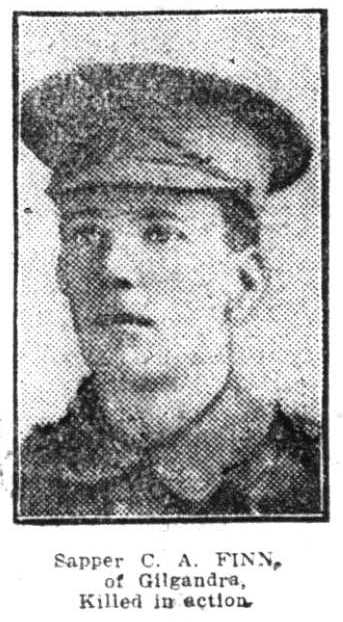
Sapper C. A. Finn, of Gilgandra killed in action (Newspaper unknown, ca. 1917)

Sapper C. A. Finn, of Gilgandra killed in action (Newspaper unknown, ca. 1917)

Per his military service record (regimental no. 6289), Charles Arthur Finn was born at Mt McDonald, N.S.W.[1] He gave his age as 27 years and 3 months, his marital status as single, and his occupation as Blacksmith. He completed his medical on 7th October 1915 at Gilgandra and was attested by Captain Nicholas on 9th October 1915 at Gilgandra. He claimed to have had no previous military service.

After completing the Coo-ee March he went to Liverpool Camp as reinforcement for the Engineers.

On his embarkation roll his address at time of enrolment was Gilgandra, N.S.W., and his next of kin is listed as mother, Mrs Eliza Finn, ‘Rosevale’, Everdon, Gilgandra N.S.W.

Sapper Finn departed Sydney on the HMAT A26 Armidale on 21st March 1916 with the 15th reinforcements for the 1st Field Company Engineers. He arrived in Egypt on 24th April 1916.

On the 28th May 1916 Sapper Finn left Alexandria aboard the SS Briton bound for England where he trained before being sent to France on 18th August 1916.

He marched into the 4th Division Base Depot at Etaples on 18th August 1916.

Sapper Finn was transferred to the 13th Field Company Engineers, and was one of 15 reinforcements who marched into the 13th Field Company Engineers on  27th August 1916, whilst it was resting at Pernois, France.

On the 29th November 1916 he was evacuated sick whilst the Company was conducting works in the forward area in the vicinity of Delville Wood, France

On the 1st December 1916 he was admitted to the 14th General Hospital at Boulogne, France, with Influenza. On the 9th of December 1916 he was transferred to the 1st Convalescent Depot at Boulogne. On the 16th of December 1916 he was sent to the 25th General Hospital suffering from piles. On the 3rd of January 1917 he was transferred to the 7th Convalescent Depot.

On the 14th February 1917 Sapper Finn was sent to the No.3 Large Rest Camp. On the 18th February 1917 whilst at the Number 3 Large Rest Camp Sapper Finn was charged with Whilst Being On Active Service Being in Bed One Hour after Reveille. He was awarded Five Days Confined to Barracks.

On the 26th February 1917 Sapper Finn marched into the Australian Engineers Base Depot at Etaples. On the 15th March 1917 he rejoined the 13th Field Company whilst it was in Reserve at Baizieux, France.

On the 7th April 1917 the 13th Field Company was conducting road maintenance, and locating and repairing wells and looking for mines, in the vicinity of Bapaume, France when he and another member of the Company were killed by a high explosive shell. According to his Red Cross Wounded and Missing report, Sapper Finn and another soldier ‘were taking detonators out of a German unexploded mine when a shell came over and killed them both’, and they were ‘both buried at Noreuil, where they were at the time’. [2]

His body was exhumed from this grave after the war, and he was then buried at the H.A.C. Cemetery, Ecoust-St. Mein, Arras, Nord Pas de Calais, France.


Charles Alfred Finn's headstone at H.A.C. Cemetery, France (Photograph: S. & H. Thompson, 6/9/2014)

Charles Arthur Finn’s headstone at H.A.C. Cemetery, France (Photograph: S. & H. Thompson, 6/9/2014)

Sapper Finn’s name is commemorated on panel 23 on the Australian War Memorial First World War Roll of Honour.

His name is also listed on the Gilgandra War Memorial, and the Cooee March Memorial Park Gateway at Gilgandra.


[1] NAA: B2455, FINN C A

[2] ‘6289 Sapper Charles Arthur Finn, 13th Field Company Engineers’, Red Cross Wounded and Missing Enquiry Bureau Files, 1914-1918 War 1DRL/0428, https://www.awm.gov.au/people/rolls/R1486776/

James CRAWFORD

James CRAWFORD

Per his military service record (regimental no. 4753), James Crawford was born in Glasgow, Scotland. He gave his age as 38 years, his marital status as single, and his occupation as farmer. His description on his medical was height 5 feet 5 ½ inches tall, weight 11 stone 7 lbs., with a fair complexion, bluish grey eyes, and fair hair. His religious denomination was Anglican. He completed his medical on the 8th October 1915 at Gilgandra and was attested by Captain Nicholas on the 9th October 1915 at Gilgandra. He claimed to have had no previous military service. His surname looks like “Crowford” in his signature.

After completing the march he went to Liverpool Camp as reinforcement for the 13th Battalion.

On his embarkation roll his address at time of enrolment was Gilgandra, N.S.W., and his next of kin is listed as mother, Mrs E. Crawford, Hull Head, Castle Fern, Donegal, Ireland.

Private Crawford departed Sydney on the HMAT Star of England on the 8th March 1916. He arrived in Egypt on the 11th of April 1916.

On the 7th of June 1916 Private Crawford left Alexandria aboard the Transport Ionian bound for France, arriving at Marseille on the 14th of June 1916.

On the 31st August 1916 during the Battle of the Somme the 13th Battalion was being relieved from the vicinity of Mouquet Farm, France when he received a gunshot wound to his back. Private Crawford was evacuated to the 49th Casualty Clearing Station, where he died of his wounds on the 3rd September 1916.

He is buried in the Contay British Cemetery, France.

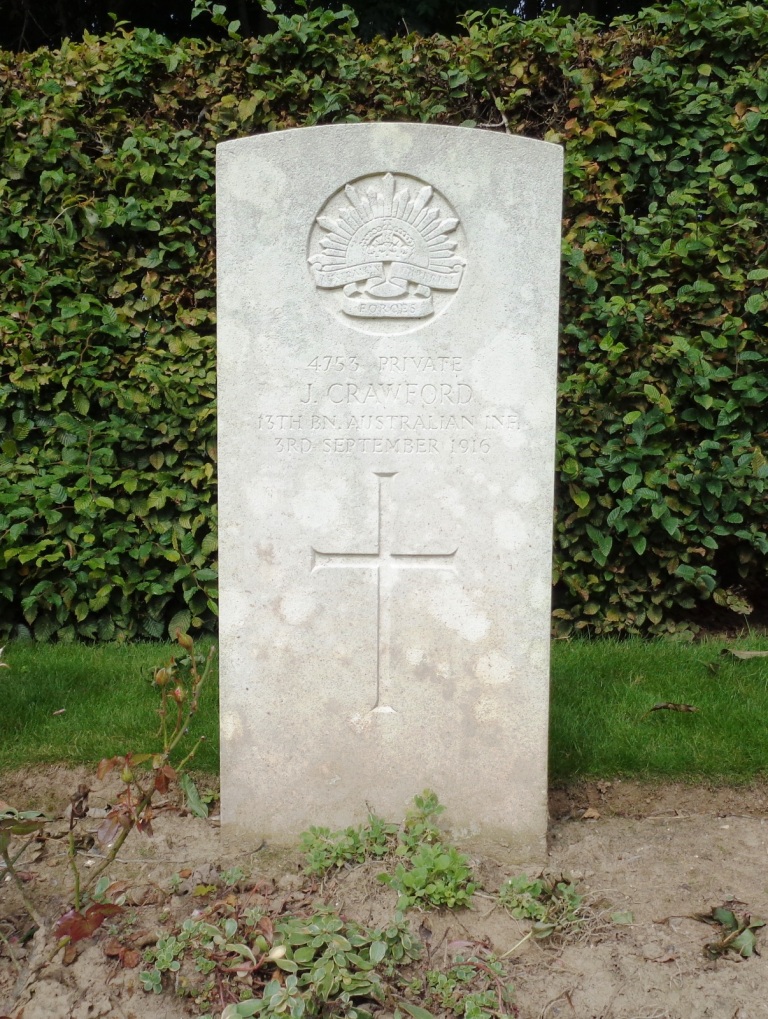
James Crawford's headstone, Contay British Cemetery, France (Photograph: H. Thompson 4/9/2014)

James Crawford’s headstone, Contay British Cemetery, France (Photograph: H. Thompson 4/9/2014)

Private Crawford’s name is commemorated on panel 68 on the Australian War Memorial First World War Roll of Honour.

His name is also listed on the Cooee March Memorial Park Gateway (Gilgandra).

Ernest SIMPSON (aka C. A. SIMPSON)

Ernest Simpson (aka C. A. Simpson)

One of the men who lined up to join the Coo-ee March at Gilgandra has been listed as “C. A. Simpson” on the Cooee March Memorial Park gateway in Gilgandra, and in the book The Coo-ee March by John Meredith (1981).

Simpson was incorrectly named as “C. Simpson” in a photo published in the Daily Telegraph (pictured on left below), which possibly lead to the incorrect initials being assigned to him.

C_Simpson_C_Finn_C_Marchant_JR_Lee_DailyTelegraph_11Oct1915_p9

Paraded for medical inspection … (left to right): Messrs. C. Simpson, C. Finn, C. Marchant, and J. R. Lee (Daily Telegraph, 11/10/1915)

An article in The Farmer and Settler (19 October 1915, p. 3) reported that ‘In addition to the men sworn in at Gilgandra and at towns en route, the great march column numbers: … Simpson, temporarily unfit, but hoping to pass the doctor in Sydney’.[1]  Further down the same page is reported: ‘One of the men marching to Sydney has failed to pass the doctor. He waited for three weeks in Gilgandra, paying his own hotel expenses, and then when he stripped off for the medical inspection he was “turned down” for hernia. He is physically the strongest man that has offered, and, is otherwise “as sound as a bell”. He intends to march to Sydney, undergo an operation upon arrival, and submit himself again’.[2]

A chance review last week of a document held in the official correspondence from the march held in the Mitchell Library, which lists an “E. Simpson” with a period of enlistment from “9/10 to 11/11/15” with other Coo-ees still waiting for payment for their period of service who had been rejected as medically unfit on arrival at Liverpool Camp,  has enabled his identity to be established.[3]

Knowing the correct initial for his first name, and that he had actually enlisted,  allowed for his service record to be located on the National Archives of Australia website. He is listed under the name Ernest Simpson, joining on 9th October 1915, at Gilgandra. He was born in Horsham, Victoria, and gave his age as 33 years, and his occupation as labourer. There are no details entered for his description on his medical certificate form in his service record papers.  His next of kin is listed as his father, Duncan Simpson, Renmark, South Australia.

On the ‘Detailed medical history of an invalid’ form in his service record dated 17th November 1915 at Liverpool, he was found by the medical board to have a double inguinal hernia, and to be unfit for military service.  He was medically discharged on 29th November 1915.

[1] ‘Route March notes’, The Farmer and Settler, 19 October, 1915, p. 3, http://nla.gov.au/nla.news-article116648915

[2] ‘Failed to pass the doctor’, The Farmer and Settler, 19 October, 1915, p. 3, http://nla.gov.au/nla.news-article116648912

[3] The Alex Halden (Joe) Miller papers mainly relating to the Gilgandra Coo-ee Recruitment March, New South Wales, 1912-1921, 1939, MLMSS 5081


Robert Clyde CAMPBELL

Robert Clyde CAMPBELL

Per his military service record (regimental no. 5996), Robert Clyde Campbell was born in Sydney, N.S.W. He gave his age as 25 years, his marital status as single, and his occupation as farmer. His date of joining on the attestation paper at the front of his service record is listed as 9th October 1915, however further pages record that he completed his medical on the 13th July 1916 at Kiama N.S.W., and also signed his service oath at Kiama on the 13th July 1916. His description on his medical was height 5 feet 7 inches tall, weight 11 stone 6 lbs., with a fair complexion, blue eyes, and fair hair. His religious denomination was Church of England. He claimed to have had no previous military service.

“R. C. Campbell” was named in several newspaper articles published at the time as one of the original 25 recruits who signed up for the march in Gilgandra on Saturday 9th October 1915.

Further investigation has found that he did not complete the Coo-ee March. Per a telegram sent to A. H. Miller dated 17th November 1915 in the official correspondence from the march which is held at the State Library of New South Wales, R. C. Campbell was admitted to Lithgow Hospital with Typhoid Fever when the Coo-ees were in Lithgow, where he remained until after the march was completed. He then went to Liverpool Camp as reinforcement for the 13th Battalion.

On his embarkation roll his address at time of enrolment was 286 Harris Street, Sydney, N.S.W., and his next of kin is listed as mother, Mrs C. Campbell, 286 Harris Street, Sydney, N.S.W.

Private Campbell departed Sydney on the HMAT Wiltshire A18 on the 22nd August 1916, arriving at Plymouth on the 13th October 1916. He marched into the 13th Battalion on the 6th March 1917 when it was out of the line at Ribemont, France.

On the 11th April 1917 Private Campbell was with the Battalion when it launched an attack on the Hindenberg Line in the vicinity of Reincourt. During this attack he was wounded receiving a gun shot wound to his left arm. He was one of 118 members of the Battalion wounded. Another 25 were killed and 367 were missing.

Private Campbell was hospitalised and evacuated to England on the 18th July 1917. He developed oedema to his left leg, and on the 31st October 1917 he commenced his return to Australia on the HMAT Berrima, arriving in Australia on the 3oth December 1917. He was discharged as medically unfit on the 30th January 1918.

James Gerald CAMERON

James Gerald CAMERON (DCM)
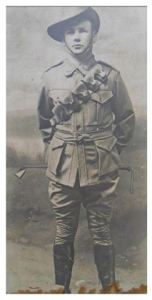
James Gerald Cameron (Photograph courtesy of his grandson Dennis Richards)

Per his military service record (regimental no. 4747), James Gerald Cameron was born at Mundooran, N.S.W.[1]  [Mundooran was later renamed Mendooran]. He gave his age as 23 years and 9 months, his marital status as single, and his occupation as farmer.  His description on his medical was height 5 feet 8 inches tall, weight 12 stone 11 lbs., with a fair complexion, blue eyes, and fair hair. His religious denomination was Presbyterian.  He completed his medical on the 9th October 1915 at Gilgandra, but was not attested by Captain Nicholas until the 12th October 1915 at Mogriguy. He claimed to have had no previous military service.

On his embarkation roll his address as time of enrolment was Mundooran, N.S.W., and his next of kin is listed as father, J. A. Cameron, Mundooran, N.S.W.

James Cameron’s experience in joining the march at Gilgandra was reported in The Farmer and Settler :

‘One of the men in the big march – Cameron – happened to attend the meeting at Gilgandra on the Friday night before starting day. Moved by Private Lee’s eloquence, he handed in his name. He then rode home forty miles to tell his people of the step he had taken, and, after riding forty miles back, was ready to take his place with his new comrades on the Sunday morning’.[2]

After completing the march he went to Liverpool Camp as reinforcement for the 13th Battalion.

Private Cameron departed Sydney on the HMAT A15 Star of England on the 8th March 1916 bound for Egypt.

On 12th April 1916 he was admitted to the 2nd Australian Stationary Hospital at Tel El Kebir, Egypt suffering from Mumps.

On  18th May 1916 he transferred to the 4th Division Cyclist Training Corps.

Private Cameron left Alexandria on the Huntspill on 8th June 1916, arriving in Marseilles on the 14th June 1916.

On the 9th July 1916 he transferred to the 1st ANZAC Cyclist Battalion, then on the 26th August 1916 he was transferred to the 45th Battalion, missing the battles on the Somme, and joining the Battalion at the time they were moving to Belgium. On the 5th September 1916 he was appointed Lance Corporal.

On 10th October 1916 Lance Corporal Cameron was accidentally injured suffering a dislodged cartilage to his right knee. He was sent to the 12th Australian Field Ambulance, then on 11th October 1916 he was transferred to the 10th Casualty Clearing Station, then to the 3rd Casualty Clearing Station. On 12th October 1916 he was placed aboard the 1st Ambulance Train and sent to the 8th Stationary Hospital at Wimereux, France. He was discharged and rejoined the Battalion on 19th October 1916.

He was promoted to Temporary Corporal on 11th December 1916.

On 27th March 1917 Temporary Corporal Cameron was again accidentally injured suffering a laceration to his right hand. He was sent to the 12th Australian Casualty Clearing Station, then on 31st March he was transferred to the 1st/1st Casualty Clearing Station.  He reverted to the rank of Lance Corporal while he was in hospital.

On 4th April 1917 he was admitted to the 3rd Canadian General Hospital at Boulogne, France.

On 6th April 1917 he was promoted to Corporal.

On 7th April 1917 he was placed aboard the Hospital Ship Princess Elizabeth for evacuation to England. He was admitted to the Kitchener Military Hospital at Brighton in England later that day.

He was discharged from hospital on 21st April 1917 and granted leave to report to the No. 1 Command Depot at Perham Downs in England on 7th May 1917.

On 25th June 1917 Corporal Cameron departed Southampton, England, bound for France. He marched into the 4th Australian Division Base Depot at Le Harve on 26th June 1917.

He rejoined the 45th Battalion on 14th July 1917 when it was resting and reorganising at Kortepyp Camp, Belgium after being in action around Messines.

On the 25th August 1917 he was promoted to Sergeant.

On 21st March 1918 he was granted leave to England. He rejoined the 45th Battalion in France on 6th April 1918.

On 2nd May 1918 Sergeant Cameron received a gunshot wound to his left shoulder during fighting around Villers Bretonneux. He was sent to the 12th Australian Field Ambulance. On 3rd of May 1918 he was evacuated to the 61st Casualty Clearing Station. On 4th May 1918 he was admitted to the 1st Canadian General Hospital. On 6th May 1918 he was placed aboard the hospital Ship Ville De Liege and evacuated to England. He was admitted to the High Barnet Military Hospital in London later that day.

On 21st May 1918 he was transferred to the 1st Australian Auxiliary Hospital at Harefield, England.

On 23rd May 1918 he was granted leave to report to the No. 1 Command Depot at Perham Downs, England, on 6th June 1918.

On  5th June 1918 Sergeant Cameron  was admitted to the 1st Australian Dermatological Hospital at Bulford, England sick. He was discharged on 13th July 1918.

On 6th September 1918 Sergeant Cameron departed Folkestone, England, bound for France. He marched into the 4th Australian Division Base Depot at Le Harve, France on  9th September 1918.

He rejoined his Battalion on 13th September 1918 when it was Poeuilly, France.

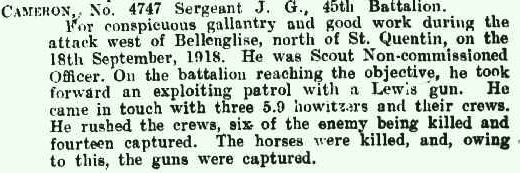
For his actions on the 18th September 1918 during an attack near Bellenglise, France, Sergeant Cameron recommended for, and subsequently awarded, a Distinguished Conduct Medal. The recommendation dated 25th September 1918 in his military service record reads: ‘For conspicuous bravery and devotion to duty during the attack west of Bellenglise on the 18th September 1918. He was scout N.C.O. On the Battalion reaching the objective he took forward an exploiting patrol with a Lewis gun. He came in touch with three 5.9. Howitzers and their crew. He rushed the crews, six of the enemy being killed and 14 captured. The horses were killed and owing to this the guns were captured.

Notification of his award was announced in Supplement No. 31225 to The London Gazette, 12th March 1919 (page 3392), and was also promulgated in the Commonwealth of Australia Gazette, 17th June 1919 (page 1012).

The citation below for his Distinguished Conduct Medal was published in Supplement No. 31668 to The London Gazette, 2nd December 1919 (page 14907), and also in The Commonwealth of Australia Gazette No. 20, 19th February 1920 (page 191).
‘Awarded the Distinguished Conduct Medal … Cameron, No. 4747 Sergeant J. G., 45th Battalion’ (The Commonwealth of Australia Gazette, 19th February 1920, p 191)

On 23th October 1918 he was appointed Temporary Company Sergeant Major. He was promoted to Company Sergeant Major (Warrant Officer Class 2) on 8th November 1918.

On 3rd February 1919 Company Sergeant Major Cameron was granted leave to England.  He rejoined the 45th Battalion on 25th March 1919.

On 10th April 1919 Company Sergeant Major Cameron departed Le Harve bound for England, to commence his return to Australia. He landed at Southampton on 11th April 1919 and marched into the No. 6 Camp at Sutton Veny, England.

Company Sergeant Major Cameron departed England aboard the HT Devanha on 8th May 1919 bound for Australia.

He arrived at Sydney on 26th June 1919. He was discharged Termination of Period of Enlistment on  10th August 1919.


[1] NAA: B2455, CAMERON J G

[2] ‘Eighty miles to enlist’, The Farmer and Settler, 19 October, 1915, p. 3, http://nla.gov.au/nla.news-article116648908