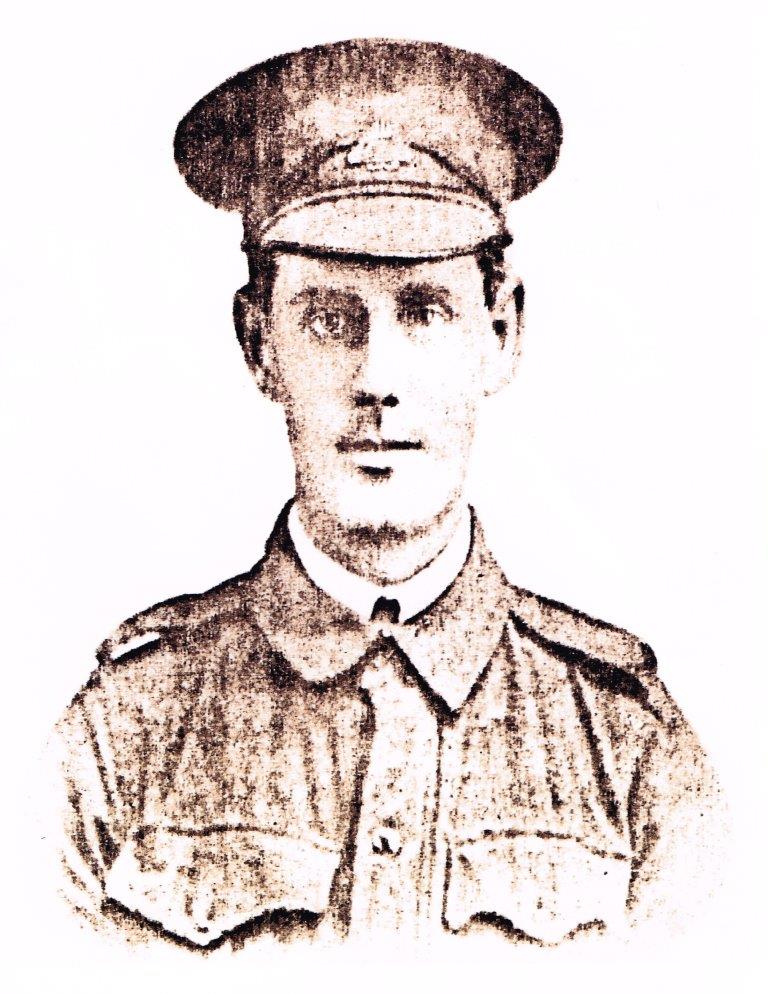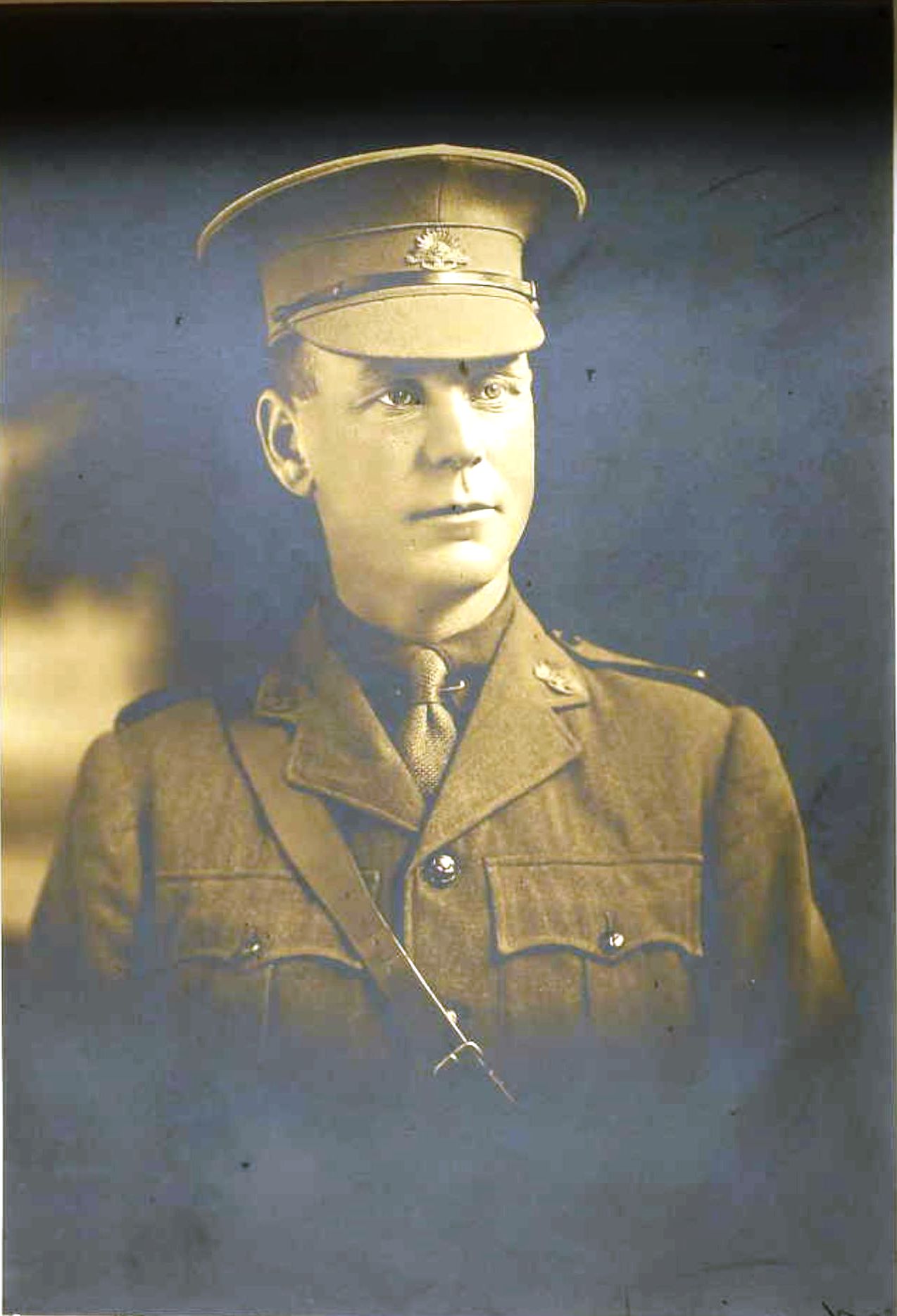
William Stirling MASON

William Stirling MASON

Per his military service record (regimental no. 4839), William Stirling Mason was born at ‘Eketahana’ [i.e. Eketahuna], New Zealand.[1]  His middle name of “Stirling” is spelt “Sterling”on some sections of his service record, but it is spelt as “Stirling” in his signature.  He gave his age as 21 years and 8 months, his marital status as single, and his occupation as labourer.  His description on his medical was height 5 feet 6 inches tall, weight 8 stone 12 lbs., with a fair complexion, blue eyes, and light brown hair. His religious denomination was Church of England.  He claimed that he had 12 months service in the Senior Cadets in New Zealand and he had been rejected for the AIF in the past for chest measurement.

The Blue Mountain Echo named ‘W. Mason’ as one of ‘the lads who answered the call, and marched out with the Coo-ees’ at Katoomba.[2]

He was attested at Springwood on 9th November 1915, and completed his medical examination on 9th November 1915 at Penrith, N.S.W.  (The Coo-ees had travelled from Springwood to Penrith on 9th November 1915).

After completing the Co-ee March he went to Liverpool Camp as reinforcement for the 13th Battalion.

On his embarkation roll his address at time of enrolment was Waratah Street, Katoomba, N.S.W., and his next of kin is listed as his father, W. [Walter] Mason, at the same address.

On 8th March 1916 Private Mason, along with many of the other Coo-ee,s departed Sydney on the HMAT A15 Star of England, and arrived in Egypt on 11th April 1916.

It is not recorded when Private Mason departed Egypt, but he ended up in the 4th Training battalion in England.

On 30th July 1916 Private Mason departed Rollerstone in England bound for France.  He marched into the 4th Australian Division Base Depot at Etaples on 1st August 1916.

He joined the 13th Battalion on 19th August 1916 when it was resting and reorganising at Pernois, France.

On 4th February 1917 the 13th Battalion successfully attacked the German Front Line trenches near the village of Guedecourt, France.  During this attack Private Mason was wounded in action. receiving multiple shrapnel wounds to his right arm.  He was evacuated and admitted to the 3rd Canadian Stationary Hospital at Boulogne, France on 7th February 1917.

On 9th of February 1917 Private Mason was placed aboard the Hospital Ship Princess Elizabeth in Boulogne Harbour for evacuation to England.

On 10th February 1917 he was admitted to the Norfolk War Hospital.

Private Mason was discharged on 5th March 1917, and granted leave to report to the Number 4 Command Depot at Wareham, England, on 21st March 1917.

On 3rd April 1917 Private Mason was admitted to the Military Hospital at Wareham with measles.

On 12th April 1917 he was moved to the 16th Field Ambulance at Woolwich, then was admitted to the Woolwich Military Hospital later that day.  He was discharged and sent back to the Number 4 Command Depot on 21st April 1917.

On 27th April 1917 Private Mason was transferred to the newly formed 63rd Battalion at Pernham Downs (which was later disbanded on 19th October 1917).

On 12th September 1917 Private Mason departed Southampton bound for France, to reinforce the 13th Battalion.  He arrived at the 4th Australian Division Base Depot at Le Harve on 13th September 1917.

On 21st September 1917 he departed the 4th Australian Division Base depot to rejoin the 13th Battalion.  On 30th September 1917 he marched into the 13th Battalion, when it was in the Steenvoorde area in northern France.

Two weeks later, on 16th October 1917, Private Mason was with the 13th Battalion manning the support line in the vicinity of Zonnebeke, Belgium, when he was wounded in action by Mustard Gas.  He was sent to the 11th Australian Field Ambulance with a blistered head, then moved back to the 3rd Australian Clearing Station.  He was placed aboard the 26th Ambulance Train and on 19th October 1917 he was admitted to the 3rd Stationary Hospital at Rouen, France.

On 22nd October 1917 he was placed aboard Hospital Ship Grantully Castle for evacuation to England.  On 24th October 1917 he was admitted to the Queen Mary Military Hospital at Whalley in Lancashire.

On 16th November 1917 Private Mason was discharged from hospital, and granted leave to report to the Number 1 Command Depot at Sutton Veny on 30th November 1917.

On 2nd January 1918 Private Mason marched into the Overseas Training Brigade at Longbridge, England from Number 1 Command Depot.

On 23rd January 1918 Private Mason departed Southampton bound for France.  He arrived at the 4th Australian Division Base Depot at Le Harve on  24th January 1918.

On 26th January 1918 Private Mason departed the 4th Australian Division Base depot to rejoin the 13th Battalion.  On 30th January 1918 he marched into the Battalion when it was manning the front line in the vicinity of Hollebeke, Belgium.

On the 1st of March 1918 Private Mason was with the 13th Battalion being relieved by the 10th Battalion from the support lines when the enemy launched a trench raid. Private Mason’s company was caught in the enemy barrage and 5 men were killed, and 5 wounded, including Private Mason, who sustained a shrapnel wound to his forehead and another to his right hand.  Both were minor. He was sent to the 1st Australian Field Ambulance.  He was treated and rejoined the Battalion the next day.

On 13th of November 1918 Private Mason was granted leave from France to England until 28th November 1918.

While on leave in England, on 17th November 1918 was admitted to the 1st Australian Auxiliary Hospital at Harefield, England, suffering Bronchitis.  This was reported as ‘Influenza seriously ill’ on 20th November 1918.

Private Mason was discharged on 6th of December 1918 and granted leave to report back to the Hospital at Harefield on  11th December 1918.  He was discharged on 14th December 1918, and sent to the Number 2 Command Depot at Weymouth, England.

On 18th January 1919 Private Mason departed England aboard the H.M.A.T. Ulysses bound for Australia.  He arrived in Australia on 15th March 1919.

The Blue Mountain Echo reported that Private ‘Will Mason’, along with other returning local soldiers, was presented with a smoker’s outfit at a welcome home function held at the Katoomba Town Hall on 31st March 1919.[3]

Private Mason was discharged Medically Unfit on 1st May 1919.

[1] NAA: B2455, MASON WILLIAM STIRLING

[2] ‘March over the Mountains’, The Blue Mountain Echo, 12 November 1915, p. 2. Retrieved September 21, 2015, from http://nla.gov.au/nla.news-article108042142  [on page 3]

[3] ‘A Royal Welcome. Katoomba’s Heroes Received. A Memorable Evening’, The Blue Mountain Echo, 4 April 1919, p. 1. Retrieved February 19, 2017, from http://nla.gov.au/nla.news-article108245995
 

Joseph Francis HEALEY

Joseph Francis HEALEY

Per his military service record (regimental no. 5385), Joseph Francis Healey was born at Leeds, England.[1]  His surname is spelt as “Healy” in some places in his service record.  He gave his age as 41 years and 3 months [although he appears to have been several years older than this], his marital status as single, and his occupation as cook.  He claimed that he had no previous military service.

There is some irregularity in his service record. No details apart from his age, and recording his religious denomination as Roman Catholic, are given on his Certificate of Medical Examination, and it was not signed by an Examining Medical Officer.  His period of service in his service record is dated as having commenced on 26th October 1915 (when the Coo-ees were at Blayney).  He was attested by Lieutenant Edward J. Shaw on 13th November 1915, with the oath dated from 26th October 1915, and recorded as ‘taken and subscribed at Blayney’ on 26th October 1915.

The Leader named Joseph Healey as one of six men who joined the Coo-ees at Blayney.[2]

After completing the Coo-ee March he went to Liverpool Camp as 15th reinforcement for the 13th Battalion.

On 21st November 1915 Private Healey was charged with being absent without leave, and fined 1 day’s pay.

Private Healey was transferred to 17th Reinforcement for the 13th Battalion on 11th March 1916.

On his embarkation roll his address at time of enrolment was 91 Rope Street, Leichhardt, Sydney, N.S.W., and his next of kin is listed as friend, M. Riches, at the same address.

On 9th April 1916 Private Healey departed Sydney on the HMAT Nestor A71 (along with several other Coo-ees), bound for Egypt.

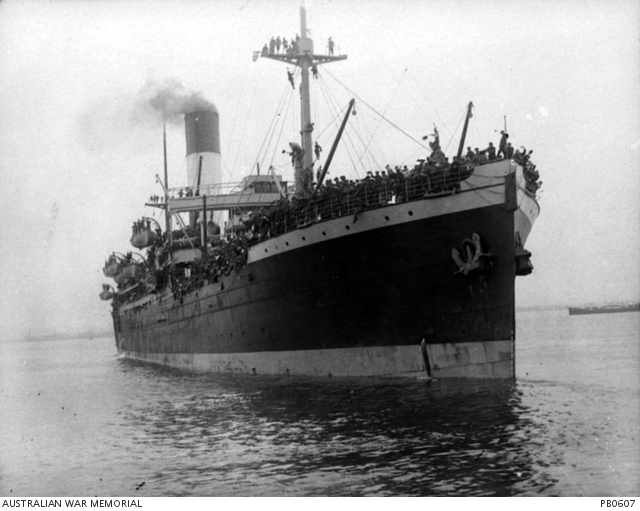
Photograph of HMAT A71 Nestor loaded with troops on an earlier voyage, taken 11 October 1915.  Part of the Australian War Memorial Collection. PB0607.

Photograph of HMAT A71 Nestor loaded with troops on an earlier voyage, taken 11 October 1915. Part of the Australian War Memorial Collection. PB0607.

On 7th June 1916 Private Healey departed Alexandria aboard His Majesty’s Transport Ionian bound for France, and arrived at Marseilles on 14th June 1916.  He marched into the 4th Australian Divisional Base Depot at Etaples.

On 19th August 1916 Private Healey joined the 13th Battalion when it was in action around Pozieres, France.  Private Healey served through the fighting around Pozieres until 30th August 1916, when he was evacuated with Shell Shock.  He rejoined the Battalion the next day.

On 11th October 1916 the 13th Battalion was training at Quebec Camp at Rhenninghelst, Belgium. Private Healey was charged with being absent without leave from Camp from 10 pm on 8th October 1916 till 5 pm on 10th of October 1916.  He was awarded 3 days Field Punishment Number Two and fined 6 days pay.

On 4th February 1917 the 13th Battalion launched an attack on the German Trenches in front of the village of Guedecourt, France.  During this attack Private Healey was wounded in action when he received a gun shot wound to his left knee.  He was evacuated to the 12th Australian Field Ambulance on 5th February 1917.

On 9th February 1917 Private Healey was admitted to the 8th General Hospital at Rouen, France.  He was sent to Le Harve later that day, and boarded the Hospital Ship Formosa, bound for England.

He was admitted to the 2nd Birmingham War Hospital on 10th February 1917.

On 26th March 1917 Private Healey was evacuated to the 3rd Australian Auxiliary Hospital at Dartford, England.

On 9th April 1917 Private Healey was discharged from hospital, and transferred to the Number 2 Command Depot at Weymouth, England.

A Medical Report on an Invalid form in his service record dated 14th May 1917 stated that he was ‘over age – 47 years’.

On 21st July 1917 Private Healey departed England aboard the H.M.A.T. Euripides bound for Australia.

Private Healey arrived in Australia on 18th of September 1917.

He was discharged medically unfit at Sydney on 29th December 1917, with disability gun shot wound to the left leg, and over age.

[1] NAA: B2455, HEALY J F 5385

[2] ‘Blayney Recruits’, Leader, 29 October 1915, p. 8. Retrieved April 1, 2016, from http://nla.gov.au/nla.news-article117842821


David James O’ROURKE

David James O’ROURKE

David James O'Rourke. Photograph courtesy of Warren O'Rourke.

David James O’Rourke (Photograph courtesy of Warren O’Rourke)

Per his military service record (regimental no. 2043), David James O’Rourke was born at Mudgee, N.S.W.[1]  He gave his age as 18 years and 4 months [though he was much younger], his marital status as single, and his occupation as labourer.  His mother Mrs Harriet Ann Lonergan signed the consent of parents or guardians section on his initial Application to enlist in the Australian Imperial Force form.  His description on his Certificate of medical examination was height 5 feet 8 inches tall, weight 155 lbs., with a fair complexion, brown eyes, and auburn hair.  His religious denomination was Roman Catholic.

He completed his medical examination at Wellington on 18th October 1915 (when the Coo-ees were at Wellington), and was attested by Captain Nicholas at Stuart Town on 19th October 1915.  He claimed he had no previous military service.

After completing the march he went to Menangle Park Camp as reinforcement for the 1st Light Horse Regiment.

On 1st June 1916 he was reallocated as a reinforcement for the 12th Light Horse Regiment.

On his embarkation roll his address as time of enrolment was Arthur Street, Wellington, N.S.W., and his next of kin is listed as his mother, Mrs Harriet Ann Lonergan, at the same address.

Trooper O’Rourke departed Melbourne on the HMAT A6 Clan Maccorquodale on 19th September 1916, with the 13th Reinforcements for the 12th Light Horse Regiment.

He arrived at Suez, Egypt, on 19th October 1916.  The next day, Trooper O’Rourke was sent to the Isolation Camp at Moascar.

On 12th November 1916 he marched into the 2nd Light Horse Training Regiment at Moascar.

On 24th February 1917 he was transferred to the 4th Light Horse Training Regiment.

On 15th March 1917 he was taken on strength of the 12th Light Horse Regiment whilst it was conducting training at Ferry Post, Egypt.

The following month, he was with the 12th Light Horse Regiment when it was involved in the Second Battle of Gaza 17th-19th April 1917.

On 26th August 1917 Trooper O’Rourke was detached to conduct guard duties at Khan Yunis.

On 29th August 1917 he was sent to the 65th Casualty Clearing Station with a septic throat.

On 6th of September 1917 he was transferred to the 24th Stationary Hospital with tonsillitis.

On 10th September 1917 he was admitted to the 14th Australian General Hospital at Abbassia, Egypt, with tonsillitis.

Trooper O’Rourke was discharged from hospital on 1st October 1917, and marched into the 2nd Light Horse Training Regiment on 2nd October 1917.

He rejoined the 12th Light Horse Regiment on 25th October 1917 when it was at Fara, preparing for the Battle of Beersheba.  Trooper O’Rourke was with the 12th Light Horse Regiment when it participated in the Charge of Beersheba on 31st October 1917.  Casualties for the 12th Light Horse Regiment were reported in the Regiment’s War Diary the next day as as 20 men killed, 19 men wounded, 44 horses killed, and 60 horses wounded.[2]

The Wellington Times reported that his mother Mrs H. A. Lonergan was ‘in receipt of a cable from her son, Trooper David O’Rourke, stating that he had gone safely through the recent big battle in Palestine, and was quite well’, and that Trooper O’Rourke was ‘only 18’.[3]

On 2nd April 1918 the 12th Light Horse Regiment was at Jaffa where Trooper O’Rourke was part of a watering party, leading three horses, when a horse in front of him kicked him in the left knee, which caused a contusion of the femur & tibia with much swelling.  Trooper O’Rourke was sent to 4th Light Horse Field Ambulance, then on 3rd April 1918 to the 43rd Stationary Hospital.

On 5th April 1918 he was moved to the 44th Stationary Hospital at Kantara.  On 6th April 1918 he was transferred to the 14th Australian General Hospital at Port Said.

On 12th June 1918 Trooper O’Rourke was discharged from hospital, with a Medical Board classification of B3, due to his injured knee.  On 19th June 1918 he was assigned to duties at the Depot Stores at Gezira.

On 16th September 1918 Trooper O’Rourke was admitted to the 31st General Hospital at Cairo sick. He was transferred to a Convalescent Hospital at Helouan on 12th December 1918.

He rejoined the Depot Stores on 25th January 1919.

On 2nd August 1919 Trooper O’Rourke departed Kantara, to commence his return to Australia aboard the H.T. Delta.  He arrived in Australia on 3rd September 1919.

The Freeman’s Journal reported on 11th September 1919 that his mother Mrs T. Lonergan ‘has received word that her son, Trooper D. J. O’Rourke, was expected to arrive at Melbourne this week. Trooper O’Rourke was one of the youngest members who left with the Coo-ees, being only sixteen years and four months when he enlisted.  He went over with 12th Light Horse and saw 4 years service with them in Egypt and Palestine.  He came through all the engagements safe and sound, though he had some narrow escapes, his horse being shot from beneath him on one occasion’.[4]

He was discharged Termination of Period of Enlistment on 19th October 1919.

[1] NAA: B2455, O’ROURKE DAVID JAMES

[2] AWM4 10/17/9 – October 1917, Australian Imperial Force unit war diaries, 1914-18 War, 12th Australian Light Horse Regiment.

[3] ‘Personal Pars’, Wellington Times, 26 November 1917, p. 2. Retrieved September 13, 2015, from http://nla.gov.au/nla.news-article137413032

[4] ‘The gossip of the week : round about Australia’, Freeman’s Journal, 11 September 1919, p. 23. Retrieved April 28, 2015, from http://nla.gov.au/nla.news-page13246397


Alfred WARDROP

Alfred WARDROP

Alfred Wardrop (Courtesy of Gary Wardrop)

Alfred Wardrop (Courtesy of Gary Wardrop)

Per his military service record (regimental no. 4908), Alfred Wardrop was born at Pyramul, N.S.W.[1]  He gave his age as 28 years and 6 months, his marital status as single, and his occupation as ‘no particular trade’. His description on his medical was height 5 feet 9 inches tall, weight 11 stone, with a fair complexion, blue eyes, and fair hair. His religious denomination was Anglican. He claimed that he had no previous military service. He completed his medical on 7th October 1915 at Gilgandra, and was attested by Captain Nicholas at Gilgandra on 9th October 1915.

After completing the Co-ee March he went to Liverpool Camp as reinforcement for the 13th Battalion.

The people of his home town of Pyramul gave him a farewell social and presentation when he was home on leave in February 1916.[2]

Along with fellow Coo-ees Privates W. Howard, J. Maher, C. Marchant, V. Quinton, L. L. Maguire, L. Greenleaf, T. Turvey, H. Baxter, and Signallers A. Lynne and J. Quinn, Private Wardrop was ‘entertained at a monster send-off’ in the Australian Hall on Friday, 3rd March 1916, when in Gilgandra on final leave.[3]

On his embarkation roll his address at time of enrolment was ‘Pyramel’ [sic], via Mudgee, N.S.W., and his next of kin is listed as his father, R. Wardrup, at the same address.  His trade or calling was recorded as labourer.

On 8th March 1916 Private Maguire along with many of the other Coo-ees departed Sydney on the HMAT A15 Star of England, and arrived in Egypt on the 11th April 1916.

After arriving in Egypt he was transferred to the 45th Battalion on the 19th April 1916.

On 2nd June 1916 Private Wardrop left Alexandria aboard the Transport Kinafauns Castle bound for France, and arrived at Marseilles on 8th June 1916.

Private Wardrop served with the 45th Battalion through its first action at Fleurbaix, France in July 1916, then as it moved to Pozieres in early August 1916.

On 16th August 1916 the 45th Battalion had just been relieved from the front line trenches between Pozieres and Martinpuich, France. Private Wardrop had suffered a gun shot wound to his right hand, and was evacuated to the 44th Casualty Clearing Station.  He was then moved by Ambulance Train, and admitted to the 9th General Hospital at Rouen, France on 17th August 1916.

On 21st August 1916 he was sent by the Hospital Ship Asturias to England. On 22nd August 1916 he was admitted to the 3rd London General Hospital at Wandsworth, London, England.

On 8th September 1916 Private Wardrop was discharged from Hospital, and granted leave.  On 27th  September 1916 he reported back from leave to the No. 1 Command Depot at Pernham Downs, England.

On 11th November 1916 Private Wardrop departed England for return to France.

On 13th November 1916 he marched into the 4th Australian Division Base Depot at Etaples, France.

On 4th of December 1916 Private Wardrop rejoined the 45th Battalion when it was resting at Dernacourt, France.

On 23rd February 1917 Private Wardrop was with the 45th Battalion when it was engaged in action in the vicinity of Stormy Trench, north east of Guedecourt, France, when he was wounded in action, receiving gunshot wounds to his left foot and left leg, and right thigh.  He was evacuated to the 14th Australian Field Ambulance, then back to the 45th Casualty Clearing Station.

On 26th February 1917 Private Wardrop was placed aboard the 31st Ambulance Train, and moved to the St Johns Ambulance Brigade Hospital at Etaples, France.

On 12th March 1917 his left foot was amputated three inches above the ankle.

On 13th March 1917 he was evacuated to hospital in England from Le Havre aboard the Hospital Ship Gloucester Castle.

On 14th March 1917 Private Wardrop was admitted to the 3rd London General Hospital at Wandsworth, England.

While he was recovering in this hospital, he wrote a letter home to his mother in Pyramul, which was published in the Mudgee Guardian and North-Western Representative, in which he wrote: “[Sending] a line to let you know that I am getting along well now. … I am in the same hospital now as I was when I was wounded before, but I cannot get [around] like I could before. I am wounded pretty badly this time, but am over the worst of it now  … I have no pain at all. I [had] my left foot off above the [ankle], a wound in the thigh on the … leg, and one under the knee on the right leg … I … go back to Australia after a few months. You have no need to worry about me in any way, as I am getting along fine, and am as happy as I ever I was. I will be able to get up in a chair in a few weeks. The same shell got [five] others, killing three – and wounding three of us. I was one of the lucky ones again, as I was between two of my mates who were killed”.[4]

On 15th September 1917 Private Wardrop was transferred to the 2nd Australian Auxiliary Hospital at Southall, England.

On 4th October 1917 Private Wardrop was granted leave to report back to the 2nd Australian Auxiliary Hospital on 18th October 1917.

He was granted leave again from 3rd January 1918 to 6th January 1918.

Private Wardrop commenced his return to Australia on 10th January 1918 aboard the H.T. Corinthic.

He arrived in Sydney on 7th March 1918.

He was discharged medically unfit on 6th September 1918.

[1] NAA: B2455, WARDROP ALFRED

[2] ‘Pyramul’, Mudgee Guardian and North-Western Representative, 21 February 1916, p. 2. Retrieved February 7, 2017, from http://nla.gov.au/nla.news-article156945383

[3] ‘District News’, Mudgee Guardian and North-Western Representative, 9 March 1916, p. 30. Retrieved February 7, 2017, from http://nla.gov.au/nla.news-article156951725

[4] ‘Wounded in France’, Mudgee Guardian and North-Western Representative, 28 May 1917, p. 4. Retrieved February 7, 2017, from http://nla.gov.au/nla.news-article157120908


William COLLYER

William COLLYER

Per his military service record (regimental no. 4752), William Collyer was born at Wongarbon, N.S.W.[1] He gave his age as 19 years and 3 months, his marital status as single, and his occupation as butcher. (He was the son of Thomas William Collyer and Flora Collyer). [2] His description on his medical was height 5 feet 8 ½ inches tall, weight 10 stone 10 lbs., with a fair complexion, blue eyes, and fair hair. His religious denomination was Church of England. He completed his certificate of medical examination on the 17th October 1915 at Wellington (while the Coo-ees were at Wellington). However he was not attested until 24th October 1915 by Captain Nicholas at Orange. A note at the top of his Attestation Paper reads ‘Presented himself 24/10/1915 with form signed by Metcalfe [the doctor at Wellington]. Sworn in 24/10/15’.

His Application to Enlist in the Australian Imperial Force form, addressed to the Recruiting Officer at Wellington, was signed by both his father Thomas Collyer and stepmother Ellen Collyer, so perhaps he had travelled back to Wongarbon to get the consent of his parents, before he caught up with the Coo-ees at Orange. He claimed that he had no previous military service.

‘William Colyer’ [sic] was listed in The Leader as one of the men who were recruited at Orange to join the Coo-ees.[3]

‘W. Collyer’ was listed as one of the ‘Wongarbon boys’ with the Coo-ees in The Dubbo Liberal and Macquarie Advocate.[4]

After completing the remainder of the march he went to Liverpool Camp as reinforcement for the 13th Battalion.

The Wellington Times reported that Privates W. Collyer and H. Saunders  were presented with wristlet watches by the residents of Wongarbon at a farewell social while they  were home on final leave on 3rd March 1916.[5]

On his embarkation roll his address at time of enrolment was Wongarbon, N.S.W., and his next of kin is listed as his father, T. Collyer, Wongarbon, N.S.W.

On 8th March 1916 Private Collyer, along with many of the other Coo-ees, departed Sydney on the HMAT A15 Star of England.  He arrived in Egypt on 11th April 1916.

On 16th April 1916 he transferred to the 4th Division Artillery at Tel-el-Kebir, and was taken on strength of the 10th Field Artillery Brigade.  He was also mustered as a Driver.

On 25th May 1916 he was transferred to the Artillery Training Depot at Tel-el-Kebir.

On 28th May 1916 Gunner Collyer left Alexandria on the HMT Corsican, bound for England.  He disembarked at Plymouth on 12th June 1916, for further training.

On 30th July 1916 Gunner Collyer departed England bound for France.

On 9th August 1916 Gunner Collyer was taken on strength of the 4th Division Ammunition Column in France, while it was training in the vicinity of the village of Acquin, 9 miles from St. Omer.

On 14th October 1916 his rank was changed to Driver.

On 7th March 1917 Driver Collyer’s rank was changed back to Gunner.

On 29th November 1917 Gunner Collyer was granted leave to England.

On 13th December 1917 whilst on leave in England, he was admitted to the 1st Australian Dermatological Hospital at Bulford, England, sick.  He was discharged from Hospital on 1st April 1918.

On 2nd April 1918 he marched into to No. 1 Command Depot at Sutton Veny in England.

On 24th May 1918 he marched out to the Overseas Training Brigade.

On 3rd July 1918 Gunner Collyer departed Southampton for return to Le Havre, France.

Gunner Collyer rejoined his unit on 14th July 1918, when the 4th Division Ammunition Column was at Frenchencourt, France.

On 9th March 1919 Gunner Collyer left his unit, and marched into the Base Depot at Le Harve to commence his return to Australia. He departed France on 31st March 1919.

He arrived at Weymouth, England, on 1st April 1919, where he marched into the No. 4 Command Depot.

On 12th May 1919 Gunner Collyer departed England for return to Australia aboard the HT Port Napier (along with Wongarbon Coo-ee Driver Saunders).

Gunner Collyer arrived in Sydney on 5th July 1919, and was discharged on the 19th of August 1919.


[1] NAA: B2455, COLLYER W

[2] NSW Birth Registration 35916/1896 William A Collyer.

[3] ‘The Recruits’, Leader, 25 October 1915, p. 4. Retrieved November 26, 2016, from http://nla.gov.au/nla.news-article117842599

[4] ‘Our Soldiers’, The Dubbo Liberal and Macquarie Advocate,  29 October 1915, p. 4. Retrieved January 26, 2017, from http://nla.gov.au/nla.news-article77601711

[5] ‘At Wongarbon’, Wellington Times,  9 March 1916, p. 6. Retrieved November 29, 2016, from http://nla.gov.au/nla.news-article143398796


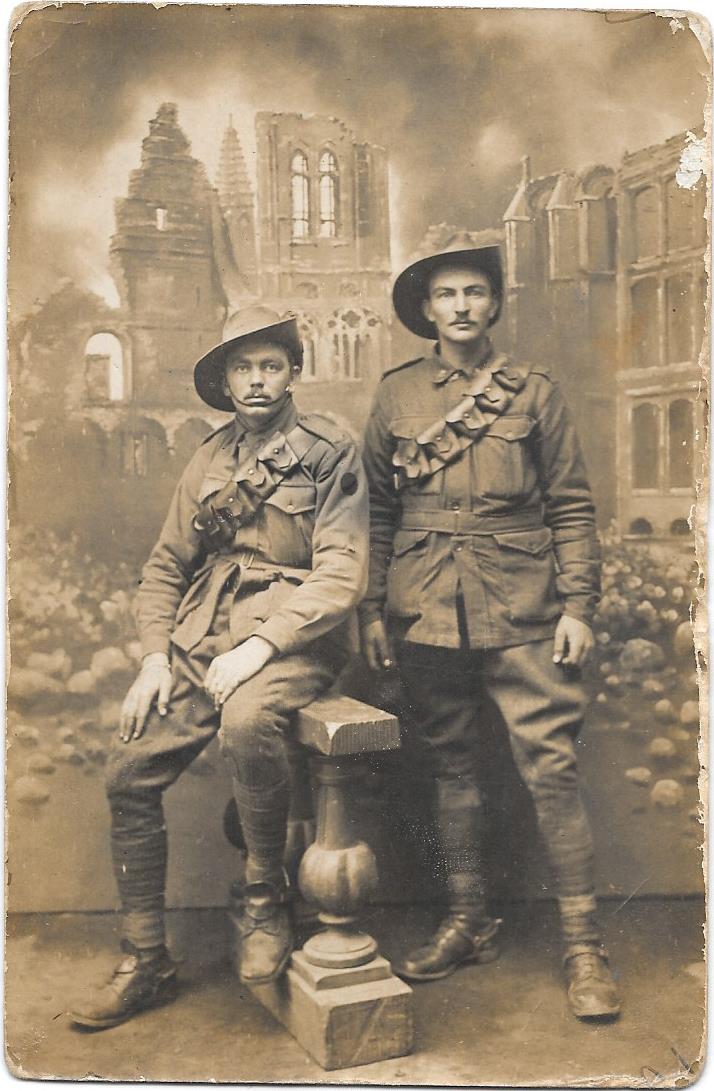
Photograph of William Hilton Saunders and William Collyer

Photograph of Wongarbon Coo-ees William Hilton Saunders and William Collyer

William Hilton Saunders and WIlliam Collyer, 1916 (Photograph courtesy of Mrs K. Edmonds)

William Hilton Saunders and William Collyer, 1916 (Photograph courtesy of Mrs K. Edmonds)

Mrs K. Edmonds has sent me this studio portrait photograph of her grandfather William Hilton Saunders with another soldier, who she thinks is his friend and fellow Coo-ee from Wongarbon, William Collyer.

Driver William Hilton Saunders is seated on the left in the photograph.

William Hilton Saunders mentioned that both he and William Collyer had grown moustaches in the first letter he sent home to his parents at Wongarbon, after arriving in Egypt:

You would not know Will and I now, we both have moustaches, and I weigh 70 kilogrammes, which is equivalent to about 11 stone, so you see I have put on a considerable amount of flesh already since leaving Australia”.[1]

The backdrop behind the two soldiers in the photograph appears to depict the ruins of St Martin’s Cathedral at Ypres in Belgium.  William Hilton Saunders would have been familiar with this scene.  He noted in his diary on Friday, 29th September, 1916:

‘’I went out with G S W [General Service Wagon] & team to Ypres (about 6 miles) for bricks. Cruel yet interesting sight to witness. A fair town in peace time, but was utterly devoid of life except for soldiers who have to live in old cellars etc. Everything is one mass of ruins & where buildings are not blown right down enormous gaping shell holes mark the billet of some of Fritz’s death messengers.  We got a couple of loads of bricks from the Ypres church & arrived back early this morning, out all night”.[2]

On reading William Hilton Saunder’s 1916 to 1918 diaries, I only found one entry in which he refers to having had his photo taken during this period.

On Sunday, 22nd October 1916, he wrote: “Will Collyer & I went to Poperinghe on leave. Rode our mules & had a good look around. Both had our photos taken. Poperinghe about the size of Dubbo …”.[3]

Driver William Hilton Saunders and Driver William Collyer were both in the 4th Division Ammunition Column, which was stationed in the vicinity of the village of Vlamertinghe at that time, about half way along the road from Ypres to Poperinghe in Belgium. It was about 12.5 km (8 miles) from Ypres to Poperinghe. [4]

It seems likely therefore that this is the photograph of William Hilton Saunders and William Collyer that William Hilton Saunders referred to in his diary.

[1] ‘Australians in Action. Letters from the Front’, Wellington Times, 29 June 1916, p. 3. Retrieved January 23, 2017, from http://nla.gov.au/nla.news-article137412087

[2] Saunders, William Hilton, personal diary, 1916. Original diary held by UNSW Canberra, Academy Library Special Collection.

[3] Saunders, William Hilton, personal diary, 1916.

[4] The Great War 1914-1918, ‘Poperinge (Poperinghe), http://www.greatwar.co.uk/ypres-salient/town-poperinge.htm

Loring ASHHURST

Loring ASHHURST

Per his military service record (Depot), Loring Ashhurst stated on his Attestation Paper that he was born at Montreal, Canada.[1] (He stated on his naturalization application papers dated August 1916 that he was born in Charleston, South Carolina, in the United States of America).[2] He gave his age as 39 years and 9 months, his marital status as single (although it appears he was married), and his occupation as miner. His description on his certificate of medical examination was height 5 feet 7 inches tall, weight 160 lbs., with a dark complexion, brown eyes, and dark hair. His religious denomination was recorded as Church of England. He claimed that he had no previous military service.

He listed Alice Ashhurst, Linsley Street, Cobar, N.S.W., as his next of kin on his Attestation Paper. He listed his postal address as ‘Cobar, N.S.W.’ on his initial Application to Enlist in the Australian Imperial Force form.

The Wellington Times reported  ‘Askhurst’ as one of the 8 named men who offered themselves at the recruiting meeting held at Wongarbon.[3]  His surname is spelt differently in several newspaper articles.

He completed his medical examination on the 16th October 1915 at Wellington (the day the Coo-ees arrived at Wellington), and was attested by Captain Nicholas at Dripstone on the 18th October 1915.

A Medical History form in his service record shows he was admitted to Orange District Hospital during his time in the Coo-ee March from 23rd October 1915 to 25th October 1915 (while the Coo-ees were at Orange), with ‘congestion base right lung’, induced by ‘exposure to wet’.

Loring Asshurst appears to have been one of the 5 men reported in The Bathurst Times to have been admitted to Orange Hospital ‘suffering from influenza’ following a ‘drenching ‘.[4]  It had poured rain on the Coo-ees the morning they left Molong, on their way to Orange, on 23rd October 1915.[5]

He rejoined the Coo-ees after being in hospital at Orange.  A letter in the official correspondence of the march from W. T. Hitchen, Wallerawang, 31/10/15, addressed to Mrs Ashhurst, Cobar, reads:

Dear Mrs Ashhurst, your husband is still with the Coo-ees and is in good health. You will no doubt have heard from him before this.  Under the conditions of the march it is rather difficult at times to attend to correspondence …’[6]

After completing the Coo-ee March he went to Liverpool Camp to the Infantry Depot.

‘Askhurst’ was included in a list of ‘Wellingtonians at the front’ in the Wellington Times on 9th December 1915.[7]

The Statement of Service for Private Ashhurst in his service record shows his period of service was from 18th October 1915 until 9th January 1916.  He is listed as ‘Deserter’ in the Remarks column.

On 9th January 1916 Private Ashhurst of the Cooees Regiment or Corps was charged with desertion.  A warrant was put out for his arrest on 16th February 1916.

On 14th March 1916 Private Ashhurst was arrested at Cobar by the Civil Police. He was escorted back to the Liverpool Camp by the Military Police.

The Western Age reported that ‘A Cobar resident named Loring Ashurst, who enlisted with the Coo-ees, was arrested by police on Tuesday as a military deserter, notwithstanding the fact that he holds his discharge from Liverpool camp, dated 9th December last, stating that he was medically unfit’, and that ‘The military authorities claim that the discharge is irregular’.[8]

Loring Ashhurst sent a letter to the Editor of the Western Age, in which he stated ‘Upon arriving at Liverpool camp and being brought before the proper officers it only required a little explanation on my part to prove to them that it was through no fault of mine that the discharge, which I possessed, was irregular, but the fault of a military acting Adjutant-General’, and that ‘I consider that I have been treated very shabbily, after having done my best’.[9]

Private Ashhurst was discharged services no longer required on 17th March 1916.

[1] NAA: B2455, ASHHURST L.

[2] NAA: A1, 1916/22239  Loring Centennial Ashhurst, Naturalization application, August 1916.

[3] ‘On the Track’, Wellington Times, 18 October 1915, p. 3. Retrieved January 15, 2017, from http://nla.gov.au/nla.news-article143388423

[4] ‘The “Coo-ees”’, The Bathurst Times, 26 October 1915, p. 2. Retrieved January 15, 2017, from http://nla.gov.au/nla.news-article111234699

[5] ‘The Route March’, The Farmer and Settler, 26 October 1915, p. 3. Retrieved January 15, 2017, from http://nla.gov.au/nla.news-article116655979

[6] Alex Halden (Joe) Miller,  Gilgandra Coo-ee Recruitment March correspondence and papers, 1915-1939, letter from W. T. Hitchen to Mrs Asshurst, Cobar, 31 October 1915.

[7] ‘Serving the Empire’, Wellington Times, 9 December 1915, p. 8. Retrieved January 15, 2017, from http://nla.gov.au/nla.news-article143397726

[8] ‘Summary’, Western Age, 17 March 1916, p. 2. Retrieved January 15, 2017, from http://nla.gov.au/nla.news-article136725191

[9] To the Editor’, Western Age, 21 March 1916, p. 2. Retrieved January 15, 2017, from http://nla.gov.au/nla.news-article136724511


TIMELINE January 1917

TIMELINE January 1917

Monday, 1 January 1917

Private James MCKEOWN (45th Battalion) was evacuated to England sick with bronchitis.

Sunday, 2 January 1916

Private James MCKEOWN (45th Battalion) was admitted to the Lewisham Military Hospital in England with bronchitis after evacuation from France.

Thursday, 4 January 1917

James MAHER (13th Battalion) was promoted to Lance Corporal.

James Maher, 1915 (Photograph courtesy of L. Leo)

James Maher, 1915 (Photograph courtesy of L. Leo)

Saturday, 6 January 1917

Private George Arthur FAWBERT was discharged due to defective vision at Liverpool Camp.

Tuesday, 9 January 1917

Privates Percy Edward BLACKWOOD  and  Patrick Joseph O’LOUGHLIN (O’LOUGHLEN) (both  reinforcements for the 3rd Battalion )arrived at Devonport in England on the HMAT A24 Benalla.

Private Richard John CROCKER  (reinforcement for the 60th Battalion) arrived on the HMAT Afric at Plymouth in England.

Wednesday, 10 January 1917

Private John Thomas SMITH (4th Pioneer Battalion) was wounded in action with a gunshot wound to the stomach, while working on a railway line near Longueval in France.

2nd Lieutenant Harry DAVENPORT (aka Harry SWENDSON) (reinforcement for the 4th Infantry Battalion) arrived at Devonport on the SS Port Nicholson.

Harry Davenport (Photograph courtesy of Dave Murray)

Harry Davenport (Photograph courtesy of Dave Murray)

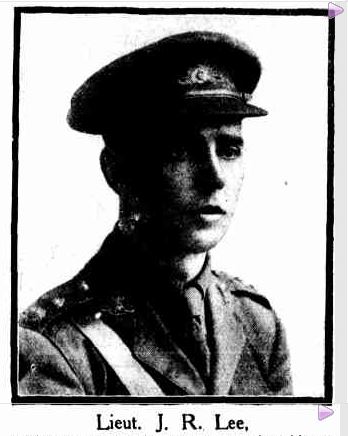
2nd Lieutenant John Robert LEE (reinforcement for the 24th Battalion) arrived in England on the HMAT A8 Argyllshire.

Lieutenant J. R. Lee (Sydney Mail, 3/3/1920)

Lieutenant J. R. Lee (Sydney Mail, 3/3/1920)

Private Joseph William EDWARDS (reinforcement for the 3rd Battalion) and Private Henry NEIRHOFF (reinforcement for the 13th Battalion) arrived in Devonport aboard the SS Port Nicholson.

Friday, 12 January 1917

Private John Thomas SMITH (4th Pioneer Battalion) was admitted to the 12th General Hospital at Rouen in France.

Saturday, 13 January 1917

Private Harold Roy Devlin UHR was discharged medically unfit in Australia (2nd enlistment, he did not leave Australia).

Sunday, 14 January 1917

Private Thomas SHAW (4th Pioneer Battalion) boarded the hospital ship Kanowna at Southampton for return to Australia (he had been wounded at Pozieres on 7th August 1916 with gunshot wounds to the left leg and neck).

Tuesday, 16 January 1917

Private Francis Charles FINLAYSON (reinforcement for the 13th Battalion) embarked for France from England.

Thursday, 18 January 1917

Private Percy Walter HOLPEN (46th Battalion) received a gunshot wound to his chest in the trenches in front of Fricaurt in France. He was evacuated to a Casualty Clearing Station.

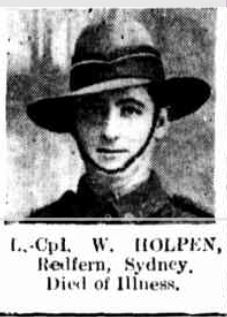
L. Cpl. W. Holpen, Redfern, Sydney. Died of Illness (Sydney Mail, 8/1/1919)

L. Cpl. W. Holpen, Redfern, Sydney. Died of Illness (Sydney Mail, 8/1/1919)

Saturday, 20 January 1917

Private Francis Albury HOLLAND  (45th Battalion) was discharged in Australia medically unfit (he had arrived back in Australia in December 1916 with epilepsy).

Monday, 22 January 1917

Reginald Henry CHAMBERLAIN re-enlisted at Victoria Barracks in Sydney.

Wednesday, 24 January 1917

Jacob Isak PALMGREN (reinforcement for the 45th Battalion) embarked from Sydney on the HMAT A68 Anchises, bound for England.

Private Percy Walter HOLPEN (46th Battalion) was admitted to the 3rd Stationery Hospital at Rouen in France wounded with a gunshot wound to his chest.

Sunday, 28 January 1917

Private Percy Walter HOLPEN (46th Battalion) was placed on a hospital ship at Le Havre for evacuation to England.

Monday, 29 January 1917

Private William SMITH (4602 Gilgandra) (reinforcements for the 30th Battalion) arrived in Devonport in England on the HMAT Beltana A72.

Private Percy Walter HOLPEN (46th Battalion) was admitted to the 1st London General Hospital.

Private James MCKEOWN (45th Battalion) was transferred from the Lewisham Military Hospital to the 3rd Australian Auxiliary Hospital at Dartford [bronchitis].

Wednesday, 31 January 1917

Private George Arthur FAWBERT re-enlisted for home service with the Headquarters Band at Liverpool Camp.

Richard John CROCKER

Richard John CROCKER

Per his military service record (Depot), Richard John Crocker was born at Croydon, N.S.W.[1]  He gave his age as 18 years and 4 months, his marital status as single, and his occupation as brickmaker.  His description on his Certificate of medical examination was height 5 feet 8 inches tall, weight 128 lbs, with a fair complexion, blue eyes, and brown hair.  His religious denomination was Church of England.  His next of kin on his Attestation paper was listed as his mother, Mrs Alice W. Crocker, Brighton Avenue, Croydon, N.S.W.  He completed his medical examination and was attested by Lieutenant Edward  J. Shaw at Ashfield, on 11th November 1915.  He claimed to have four years previous military experience with the 39th Regiment.

After joining the Coo-ee March at Ashfield, he went to Liverpool Camp.  However, his time with the Coo-ees would be short, as he was underage.

A letter from Lieutenant Stanley Stilling from the Ashfield Drill Hall dated 16th November 1915 in his file states that ‘Mrs Crocker … called at this Office this evening, and states that she will not consent to her son Richard Crocker, 16 ½ years old, and who is a Trainee of the Area – going with the A.I.F. and asks for his discharge. Crocker volunteered here, and was duly Medically examined, etc., in connection with the Gilgandra Recruits’.[2]

A letter from his mother Alice Crocker dated 18th November 1915 is also in his file, in which she states ‘My son Richard Crocker enlisted with the Gilgandra Coo-ees last Thursday night against my wish as he is only 16 last May and I think far too young, I want you to send him home at once, please’.[3]

He was discharged parents request, being underage, on 25th November 1915.

Less than a year later, Richard John Crocker re-enlisted in the A.I.F.  He completed his Certificate of medical examination at Victoria Barracks on 20th September 1916, and was attested at the Show Ground Camp at Sydney on 25th September 1916.

A letter dated 19th September 1916 in his file signed by both his parents gave consent for their son to enlist. However he was still underage.  He had stated that he was 18 years and 3 months of age in this application to enlist, but this was later changed to 17 years and 4 months on his Certificate of medical examination. A copy of his Birth Certificate in his service record dated 20th March 1917 shows that his date of birth was 13th May 1899.

Private Crocker was allocated to the 7th reinforcements for the 60th Battalion.

On his embarkation roll his address at time of enrolment was Ashfield, N.S.W.  His next of kin was listed as his father, Edwin Crocker, 53 Arthur Street, Ashfield, N.S.W.

Private Crocker (regimental no. 2873) embarked from Sydney on the HMAT Afriq A19 on 3rd November 1916.  He disembarked at Plymouth on 9th January 1917.

He marched into the 15th Training Battalion at Hurdcott, England on 10th January 1917.

On 10th May 1917 Private Crocker was transferred to the Australian Army Medical Corps, and he marched into the Medical Corps Training Depot at Parkhouse, England.

He later wrote in a letter to the O.C., Victoria Barracks: ‘I went away in 1916 but was under age so I was transferred from the 7/60th to the A.M.C. I was constantly in Hospital work and I volunteered 3 times to go up to the line but I was in the operating theatre & did not get shifted’.[4]

On 4th September 1917 he went to Parkhouse Hospital with a headache.  He returned to the A.M.C. Training Depot on 10th September 1917.

On 29th September 1917 Private Crocker was taken on the staff of the 1st Australian Auxiliary Hospital at Harefield, England.

On 13th June 1918 Private Crocker was admitted to the Hospital suffering Influenza. He was discharged on 16th June 1918.

On 27th January 1919 Private Crocker was detached for duty at the 1st Australian General Hospital at Sutton Veny, England.

On 23rd March 1919 he was admitted to the Hospital suffering Influenza. He was discharged on 4th April 1919, and sent to the Training Depot.

On 13th of May 1919 [his 20th birthday], Private Crocker was granted leave, to report back on 25th  May 1919.

Private Crocker commenced his return to Australia on  2nd July 1919, aboard the H.T.  Karmala.  He disembarked at Sydney on 17th August 1919.

He was discharged Termination of Period of Enlistment on 6th October 1919.

[1] NAA: B2455, CROCKER R J

[2] NAA: B2455, CROCKER R J, letter to Headquarters, A.I.F.Camp, Liverpool, from Lieut. Stanley Stilling, Area Officer, 39th Infantry, 16 November 1915

[3] NAA: B2455, CROCKER R J, letter from Alice Crocker, 18 November 1915

[4] NAA: B2455, CROCKER R J, letter to O.C., Victoria Barracks, from Richard John Crocker, [1936].

Thomas SHAW

Thomas SHAW

Per his military service record (regimental no. 4896), Thomas Shaw was born at Draycott in the Clay, Staffordshire, England.[1] He gave his age as 36 years and 8 months, his marital status as single, and his occupation as farmer labourer. His description on his certificate of medical examination was height 5 feet 5 ½ inches tall, weight 11 stone 2 lbs., with a fair complexion, blue eyes, and fair hair. His religious denomination was Church of England. He claimed that he had no previous military service.

He completed his medical examination on the 16th October 1915 at Wellington (the day the Coo-ees arrived at Wellington), and was attested by Captain Nicholas at Stuart Town on the 19th October 1915. His “Joined on” date on his Attestation Paper was 18th October 1915, the day the Coo-ees left Wellington, and marched to Dripstone.

After completing the Coo-ee March he went to Liverpool Camp as reinforcement for the 13th Battalion.

On his embarkation roll his address at time of enrolment was not recorded, and his next of kin was listed as his sister, Mrs P. White, Bruce Bridge, Heath, Lincoln, England.

On 8th March 1916 Private Shaw along with many of the other Coo-ees departed Sydney on the HMAT A15 Star of England, and arrived in Egypt on the 11th April 1916.

On the 16th April 1916 Private Shaw was transferred to the 4th Pioneer Battalion at Tel-el-Kebir.

On 4th June 1916 Private Shaw left Alexandria aboard the Transport Scotian, bound for France.  He arrived at Marseilles on 11th June 1916.

Just two months later, on 7th August 1916 the 4th Pioneer Battalion was constructing communication trenches in Becourt Wood, France, when Private Shaw was wounded in action, receiving gunshot wounds to his left leg and neck. He was evacuated to the 4th General Hospital at Camiers, France, the next day.

On 20th August 1916 he was moved to Calais, France, and transferred to England aboard the Hospital Ship Newhaven.  He was admitted to the Carrington Military Hospital at Nottingham, England on 21st August 1916.

On 2nd September 1916 Private Shaw was transferred to the 1st Australian Auxiliary Hospital at Harefield, England.

On the 23rd of October 1916 Private Shaw was moved to the 3rd Auxiliary Hospital at Dartford with Myalgia.

On 14th January 1917 Private Shaw departed Southampton, England, on the Hospital Ship Kanowna, bound for Australia.

He arrived in Sydney on 11th March 1917, and was discharged Medically Unfit on 29th August 1917.

[1] NAA: B2455, SHAW THOMAS