Yearly Archives: 2014

Melcombe Regis Cemetery

MELCOMBE REGIS CEMETERY

On Monday 25th August 2014 we visited the Melcombe Regis Cemetery in Weymouth, Dorset, England.

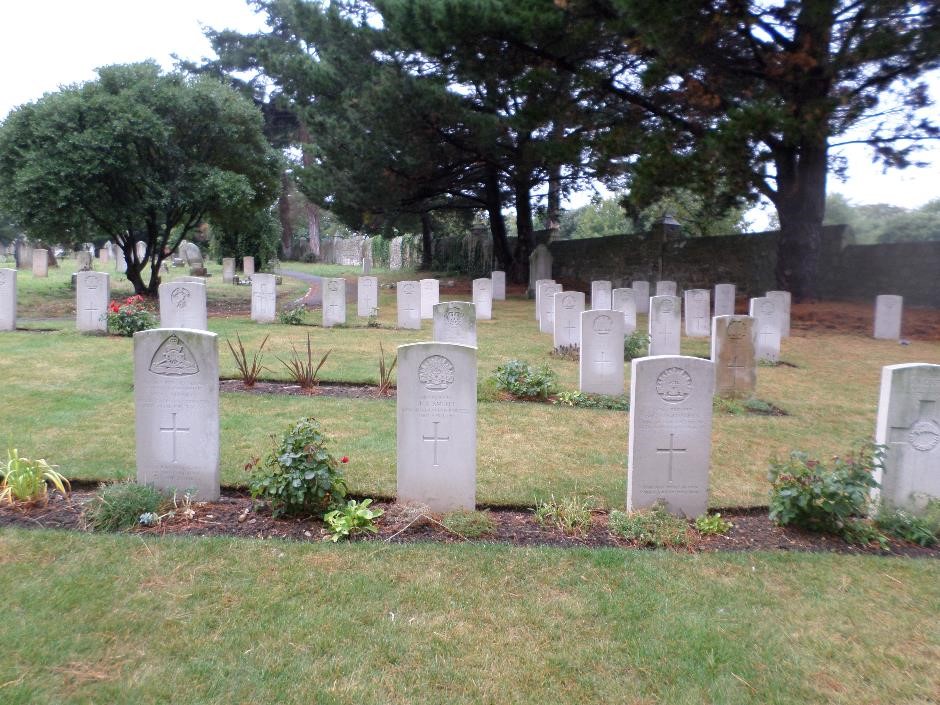
According to the Commonwealth War Graves Commission website http://www.cwgc.org/, Melcombe Regis Cemetery contains 142 graves from the First World War, scattered in the general cemetery. 83 of these are for Australian servicemen. John Thomas Smith, from Wellington, who died of wounds, is the only Coo-ee buried in this cemetery (in the south west corner).

The photograph below shows John Thomas Smith’s headstsone (2nd from left in centre) at Melcombe Regis Cemetery.

Melcombe Regis Cemetery (Photograph: S & H Thompson 25/8/2014)

Melcombe Regis Cemetery (Photograph: S & H Thompson 25/8/2014)

A photograph of the headstone on John Thomas Smith’s grave will be added to his individual blog entry, and form part of a Roll of Honour for the fallen Coo-ees on this blog, after our return to Australia.

Plymouth (Efford) Cemetery

PLYMOUTH (EFFORD) CEMETERY

On Sunday 24th August 2014 we visited the Plymouth (Efford) Cemetery in Plymouth, Devon, England.

According to the Commonwealth War Graves Commission website http://www.cwgc.org/, Plymouth (Efford) Cemetery contains 338 graves from the First World War, scattered in the general cemetery. Thomas Thorne (from Lawson), who died from illness, is the only Coo-ee buried in this cemetery.

As this is a large cemetery, it is difficult to locate his grave. However, we remembered where Thomas Thorne’s grave was located (on the northern side of the cemetery near the crematorium) from our previous visit to the cemetery two years ago.

Plymouth (Efford) Cemetery (Photograph: S & H Thompson 24/8/2014)

Plymouth (Efford) Cemetery (Photograph: S & H Thompson 24/8/2014)

A photograph of the headstone on Thomas Thorne’s grave will be added to his individual blog entry, and form part of a Roll of Honour for the fallen Coo-ees on this blog, after our return to Australia.


Harefield (St. Mary) Churchyard

HAREFIELD (ST. MARY) CHURCHYARD

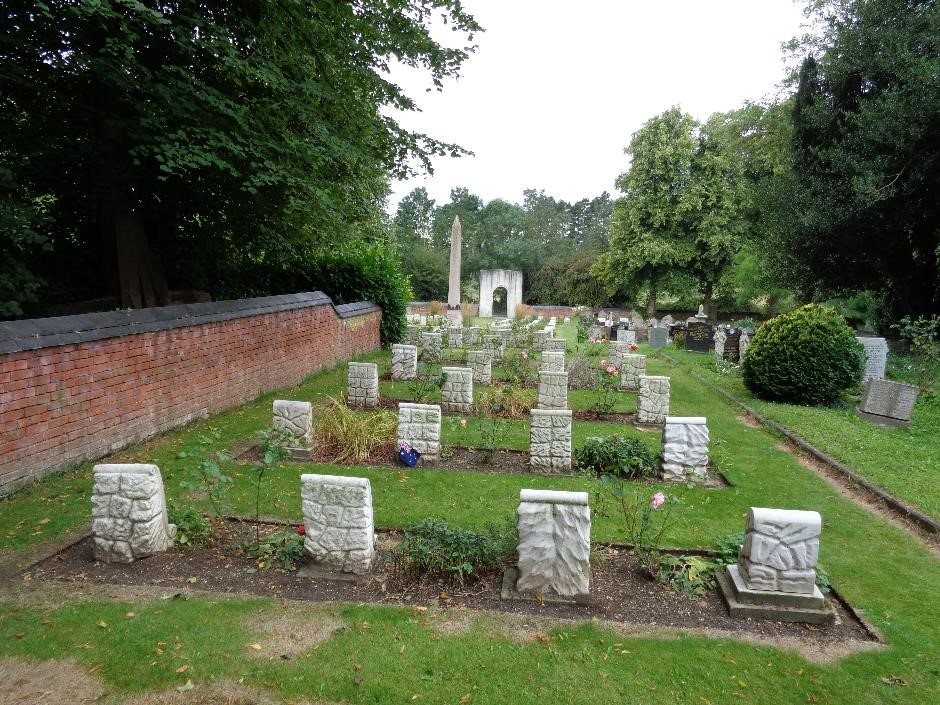
After our arrival in London on Sunday 17th August 2014 we picked up our hire car, and drove the short distance to Harefield (St. Mary) Churchyard, at Harefield, Middlesex, England, where Bill Hitchen from Gilgandra is buried.

An Australian flag marks Bill Hitchen’s grave 2nd from the left in the second row in the photograph below.

An Australian flag marks Bill Hitchen’s grave at Harefield (St. Mary) Churchyard. (Photograph: S & H Thompson 17/8/2014)

An Australian flag marks Bill Hitchen’s grave at Harefield (St. Mary) Churchyard. (Photograph: S & H Thompson 17/8/2014)

The photograph below of the Commonwealth War Graves section at Harefield (St. Mary) Churchyard from the Australian War Memorial website http://www.awm.gov.au/collection/P02293.001 showing the same scene was taken about 1917 (based on the latest date of death that can be seen on  the headstones).

The Anzac Cemetery Harefield, Lawrence, photo [ca. 1917] (Photograph public domain from the AWM website: http://www.awm.gov.au/collection/P02293.001)

The Anzac Cemetery Harefield, Lawrence, photo [ca. 1917] (Photograph public domain from the AWM website: http://www.awm.gov.au/collection/P02293.001)

Bill Hitchen’s grave at the time this photograph was taken did not have a headstone, only a wooden cross. Note the position of the headstones on these graves. The headstones have been reversed at a later date, and part of the wall removed, following the expansion of the cemetery.

According to the Commonwealth War Graves Commission website http://www.cwgc.org/ Harefield (St. Mary) Churchyard contains 120 graves from the First World War and 6 graves from the Second World War. The First World War graves are mostly of Australian soldiers who died at Harefield Park in No. 1 Australian Auxiliary Hospital. Bill Hitchen is the only Coo-ee buried in this churchyard.

A photograph of the headstone on Bill Hitchen’s grave will be added to his individual blog entry, and form part of a Roll of Honour for the fallen Coo-ees on this blog, after our return to Australia.


Visiting the graves and memorials of the Coo-ees in England, France and Belgium

Visiting the graves and memorials of the Coo-ees

I am currently on holidays overseas with my husband Stephen. Included in our busy itinerary over the next few weeks is visiting the graves of the Coo-ees who died while on active service in England, France and Belgium during the First World War, and/or the memorials where their names are commemorated, if they have no known grave. This will include visiting approximately 27 cemeteries and memorials, including the Menin Gate at Iepers (Ypres) in Belgium, and the Australian National Memorial at Villers-Bretonneux in France.

I plan to include a brief blog entry about each of these cemeteries and memorials, and the names of the Coo-ees who are buried or named there.

We are taking photographs of each grave, or name on the memorial, to include on each individual Coo-ee’s blog entry after we return to Australia, which will form a Roll of Honour for the Coo-ees on this blog.

William Thomas HITCHEN

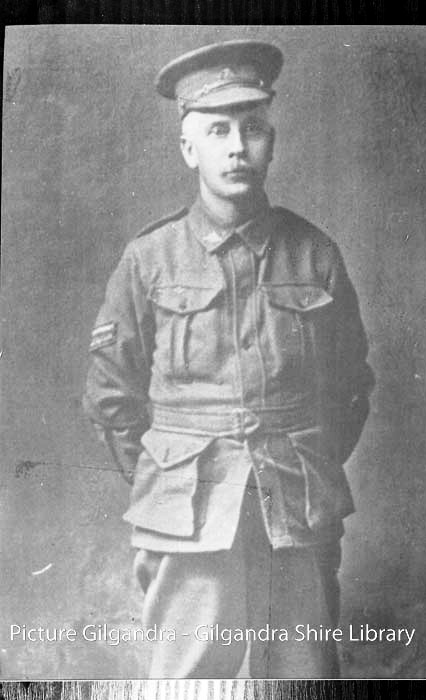
William “Bill” Thomas HITCHEN

Bill Hitchen (Photograph courtesy of Gilgandra Shire Library)

Bill Hitchen (Photograph courtesy of Gilgandra Shire Library)

Per his military service record (regimental no. 1677), William “Bill” Thomas Hitchen was born at Mudgee, N.S.W. Lowering his actual age of 51 years by several years, he gave his age as 44 years and 2 months, and his address as Bridge Street, Gilgandra, N.S.W. He gave his occupation as plumber. His description on his medical was height 5 feet 7 ½ inches tall, weight 180 lbs., with a medium complexion, light brown eyes, and fair hair. His religious denomination was Roman Catholic.  He claimed to have no previous military experience.

He was known as Captain Bill Hitchen on the Coo-ee March as he was the Captain of the Gilgandra Rifle Club before enlisting.

Bill Hitchen was one of the main organisers of the Coo-ee March (along with his brother Richard G. Hitchen), and he joined the Coo-ees at Gilgandra at the beginning of the march. His official enlistment date is the 10th October 1915. However, per his service record he did not complete his medical and attestation until the 24th February 1916 at Bathurst, after he assisted in organising the Kookaburra March from Tooraweenah to Bathurst in early 1916.

After the Kookaburra March he was allocated to the 2nd reinforcements to the 45th Battalion as a Corporal.

Corporal Hitchen departed Sydney on the HMAT A40 Ceramic on the 14th April 1916. He embarked from Alexandria on 6th June 1916, and disembarked at Plymouth, England, on the 16th June 1916.

He was admitted to the 1st Australian Auxiliary Hospital at Harefield Park on 21st June 1916 sick with Melanotic Sarcoma.  He also had Diabetes.

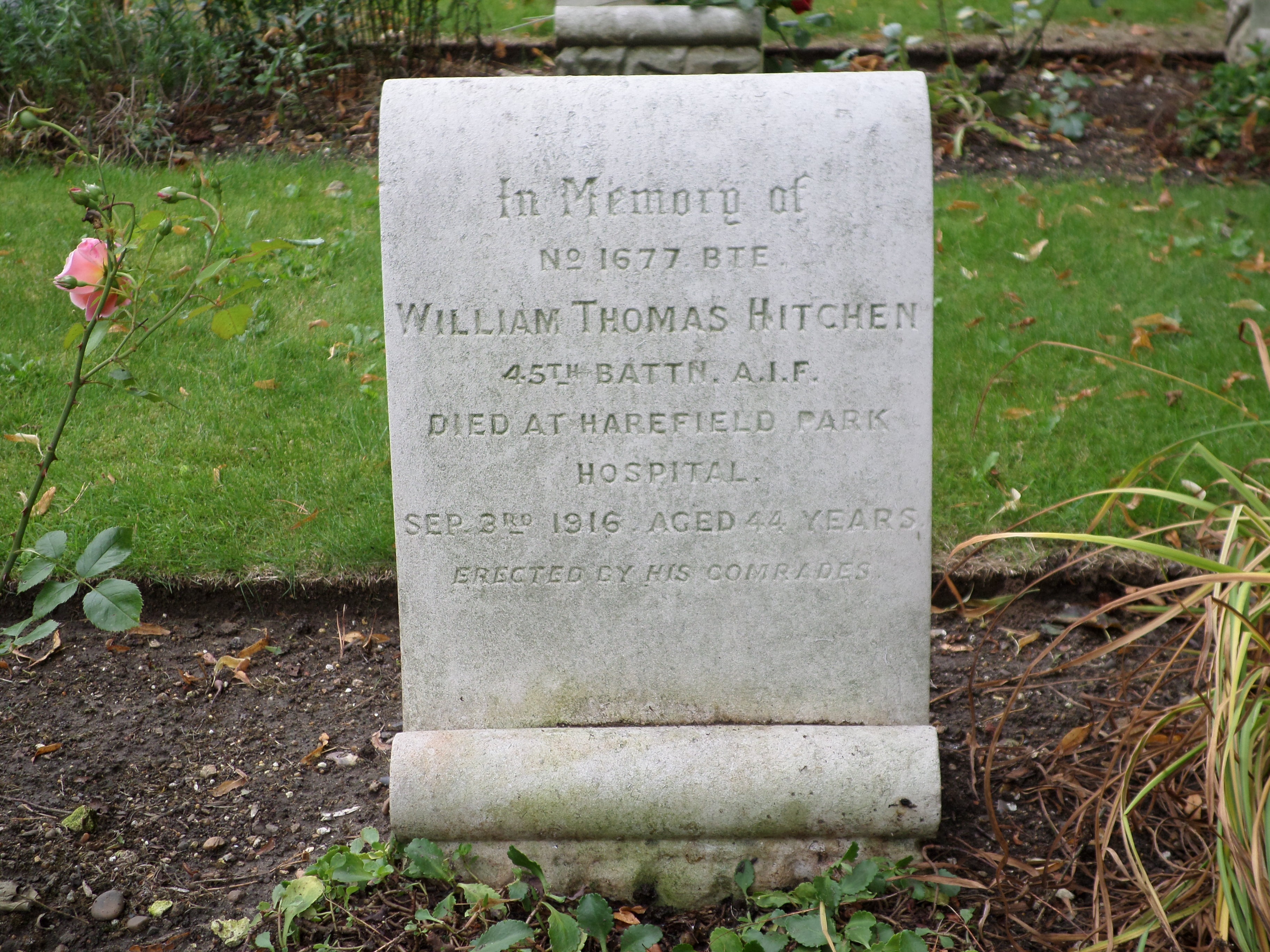
Corporal Hitchen died of his illness on the 3rd September 1916, and was buried at the nearby Saint Mary’s Churchyard at Harefield, England.

Bill Hitchen's headstone, Harefield (St. Mary) Churchyard (Photograph: S & H Thompson, 17/8/2014)

Bill Hitchen’s headstone, Harefield (St. Mary) Churchyard (Photograph: S & H Thompson, 17/8/2014)

His name is also listed on the Gilgandra War Memorial, Cooee March Memorial Park Gateway (Gilgandra), and the Gulargambone War Memorial.


Letter from Donald Stewart in a German prisoner of war camp

Transcription of an article titled ‘Private Don. Stewart’ published in the Wellington Times, 9 November, 1916, p. 7.

‘PRIVATE DON. STEWART.
Mr. E. Stewart has received the following letter from his son, Private Don. Stewart, who is a prisoner in Germany, written on 12th August:— Just a few lines hoping you are all well as this leaves me at present. I was captured on the 20th July. We went into the trenches a couple of days before I was caught. We had a big charge on the 19th, and had very heavy losses. Out of about six of my section who tried to get out of a tight hole two of us got out alive, and God only knows how I got out of it. We are being treated as well as can be expected in the camp we are in. We get the same food as a German soldier. I saw Ted Hubbard before the charge, but I don’t know how he got on. He was a corporal. Morton Austin was captured also. He lives over the Macquarie bridge. I saw some of the Coo-ees in France, and they were in action before we were. The Fifth Division were the first Australians to charge. You can send any news of Les, when yon write. I heard of his battalion when in France, but I never saw him. If you think it worth while you can send me some cigarettes and eatables — the smokes if anything at all. I have written to England for parcels, and they ought to be here next week, so we will not be so badly off. I received the paper that was sent from home, and saw in it that auntie had received the letter I threw overboard. I sent a couple addressed to home, but don’t know whether you received them or not. We live here in houses, and they are very clean and warm. We have a bed made of matting with two blankets. We have a warm bath every week and our clothes are steamed. We don’t do any work, and I bet I will be lazier than ever when I get back. That means I will be pretty lazy. I suppose it is pretty cold at home now; I wouldn’t mind having a fox hunt now. I suppose you have still got Prince. I hope he can catch a fox when I get back. I have told you all I can, and think I will have a job to fill in the next page, but I will try. I have still got the pocket books you gave me, and the best way I can find to fill in time is copying out music. We often play cards all day long. Smokes are hard to get, so we have to wait until some parcels come. We are allowed to write four postcards and two letters a month, and I will write them home with one to Blayney now and again, so I will leave it to you to tell all you know.’

Click here to view the article on Trove: http://nla.gov.au/nla.news-article137411974

Donald Singleton STEWART

Donald Singleton STEWART

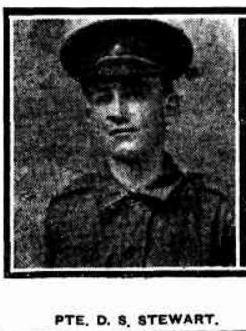
Donald Stewart (Sunday Times, 8/10/1916)

Donald Stewart (Sunday Times, 8/10/1916)

Per his military service record (regimental no. 4600), Donald Singleton Stewart was born at Wellington, N.S.W. He gave his age as 18 years (instead of his actual age of 16 years and 9 months), his marital status as single, and his occupation as grocer. His description on his medical was height 5 feet 8 inches tall, weight 9 stone 5 lbs., with a fair complexion, blue eyes, and fair hair. His religious denomination was Methodist.  He was known as one of the Wellington recruits, and joined the Coo-ees on the road after the Coo-ees had passed through Wellington. He was attested by Captain Nicholas “eight miles east” of Molong [at Boomey] on the 22nd October 1915, and completed his medical at Molong on 22nd October 1915. He claimed that he had previous military service with the Militia.

After completing the Coo-ee March he went to Liverpool Camp as reinforcement for the 13th Battalion.

On his embarkation roll his address at time of enrolment was Park Street, Wellington, N.S.W., and his next of kin is listed as his father, E. Stewart, Park Street, Wellington, N.S.W.

Private Stewart departed Sydney on the HMAT A70 Ballarat on the 16th February 1916 as 14th Reinforcement for the 13th Battalion. He arrived in Egypt on the 22nd March 1916. On the 1st April 1916 he was transferred to the 54th Battalion.

On the 19th June 1916 Private Stewart left Alexandria aboard HT Caledonian bound for France, arriving at Marseille on the 29th June 1916.

On the 20th July 1916 Private Stewart was reported missing in action after taking part in the Battle of Fromelles. On the 12th August 1916 Private Stewart was reported to be a prisoner of war in Germany. He was interned at Dulmen, Germany (a prison camp in Westphalia), then later detained at Schneidemuhl, Germany.

One of the youngest of the Coo-ees, he had his 17th birthday in Liverpool Camp, and his 18th and 19th birthdays as a prisoner of war in Germany (Wellington Times, 19/9/1918, p. 3).

After the end of the war, Private Stewart was repatriated to England on the 18th December 1918.

Private Stewart departed England on the 3rd May 1919 for return to Australia aboard the steamer Leicestershire, disembarking at Sydney on the 22nd June 1919. He was discharged on the 14th August 1919.

William John Luther HOWARD

William John Luther HOWARD

Per his military service record (regimental no. 4802), William John Luther Howard was born at Crookwell, N.S.W. He gave his age as 24 years and 10 months, and his address as Mountain View, Biddon, Gilgandra, N.S.W. He gave his occupation as Farmer. His description on his medical was height 5 feet 9 ¾ inches tall, weight 11 stone 2 lbs., with a dark complexion, light blue eyes, and brown hair. His religious denomination was Methodist. He completed his medical on the 27th October 1915 at Gilgandra, (after the Coo-ee March had started), and was not attested until after the March had finished, at Liverpool on the 13th November 1915. He claimed to have had no previous military service.

Private Howard joined the Coo-ees at Bathurst. A telegram in the official correspondence of the March from A.H. Miller in Gilgandra to Major Wynne on the Coo-ee March dated 28th October 1915 advised that Howard had been sent to Bathurst the night before to meet them (presumably by train). His name was listed as one of the Bathurst recruits in The Bathurst Times (29/10/1915, p. 2).

After completing the march he went to Liverpool Camp as reinforcement for the 13th Battalion.

Private Howard departed Sydney on the HMAT Star of England on the 8th March 1916. He arrived in Egypt on the 11th of April 1916.

On the 7th June 1916 Private Howard left Alexandria aboard the Transport Huntspill bound for France, arriving at Marseille on the 14th June 1916.

After arriving in France Private Howard was sent to a Machine Gun Training School on 30th June 1916. After completing training he was posted to the 12th Machine Gun Company on the 12th August 1916, when it was engaged in heavy fighting around Pozieres.

Private Howard was admitted to hospital with influenza on 1st January 1917, returning to duty on 26th January 1917.

He was appointed Lance Corporal on the 9th October 1917 when his unit was resting out of the line at Ypres, Belgium.

On the 1st April 1918 his unit was redesignated the 4th Machine Gun Battalion.

He went on leave to the United Kingdom on 7th September 1918. He returned from leave on the 26th September 1918.

Lance Corporal Howard began his return to Australia aboard the Transport HMAT Commonwealth on the 17th April 1919. He arrived in Australia on the 19th May 1919.

He was discharged on the 12th June 1919.

The “Gilgandra barber” and the Coo-ees welcomed in Lithgow

Article titled “Coo-ees Welcomed” from the Democrat, 6th November 1915, p. 2.

‘“Coo-ees” Welcomed.

The Gilgandra braves — the “Coo-ees” — were accorded an enthusiastic reception on Monday last. They left Wallerawang at 9.30 a.m., and marched to Middle River, where they halted. They were met there by the men of the Lithgow camp and a right royal time was spent. It is an offence to have long hair, and as the laws of the Medes and Persians altereth not, neither do the laws according to the Gilgandra recruits alter. At least six of the Lithgow boys needed tonsorial attention and the “Gilgandra barber,” who sat as judge, declared them guilty and sentenced them to be shorn of their curly locks. Despite protests, the chief executioner carried out his duties to the satisfaction of all but the six. These latter have now cool heads — it will prevent them from becoming hot-headed.

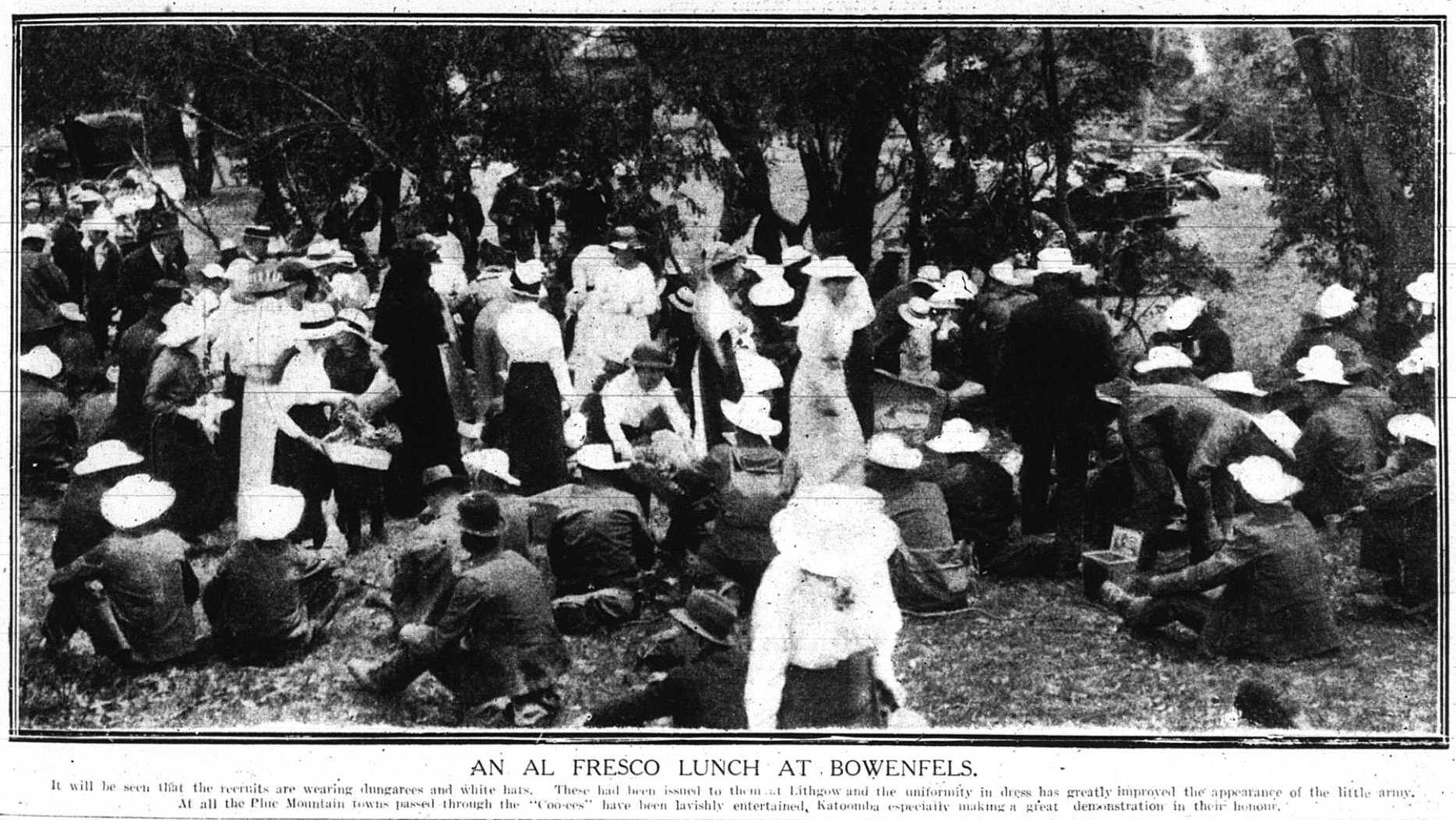
“’Fall in” was then sounded, and the two squads of soldiers marched to Bowenfels, where they halted to await the welcome ceremonies.

An Al Fresco lunch at Bowenfels (Sydney Mail 10/11/1915)

An Al Fresco lunch at Bowenfels (Sydney Mail, 10/11/1915)

The visitors looked in the pink of condition and were as hard as nails. They had increased their number by five at Wallerawang.  

The welcome arrangements were admirably carried out by the chief marshals (Messrs. A. E. Roper and Saunderson). There was not a hitch anywhere. This is as it should be and the gentlemen concerned are to be congratulated.


The Cooerwull school children sang “Advance Australia Fair” capitally, while the Lithgow children also did well.     


The Town Band played at the meeting place, and played beautifully.

The Mayor (Ald. Pillans) then welcomed the “Coo-ees” to Lithgow in a speech admirably suited to the occasion — being short, concise, and good. Major Wynne responded on behalf of the visitors. 

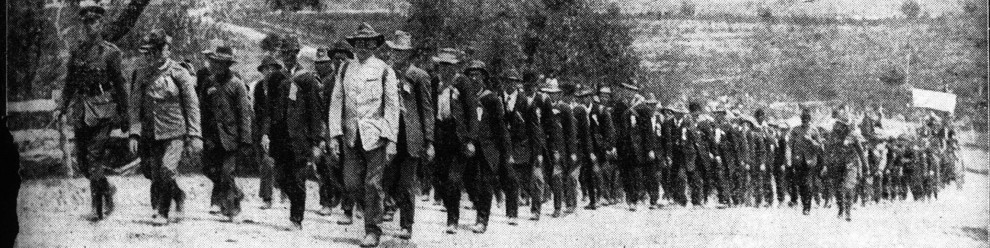
The procession was then formed, the mounted police in front, then the aldermen, the Progress Association and prominent townspeople, then came the Lithgow recruits, followed the Town Band, and then came the “Coo-ees,”‘ each town being represented by their respective units — a flag with the name or the town being the line of demarkation. Then we had our own cadets, with trumpeters playing smartly and briskly. Patrols of Boy Scouts, under Scout-master Lamb, were also in evidence and added considerably to the success of the procession. The civilians also joined in as well as scores of motor cars, buggies, ‘busses, etc. The procession wended its way along Main-street, across Eskbank bridge, up Railway Parade, and into the Trades Hall, which had been kindly loaned for the occasion.


At six o’clock the braves were entertained at luncheon at the Town Hall. This over, it had been intended to have a smoke social, but as the Oddfellows Hall proprietary had kindly granted a free pass for their picture show to the men, they all preferred that, and a splendid programme was screened to the enjoyment of the vast audience present.


On Tuesday advantage was taken of having squad drill, after which general leave was granted. The men were also given white hats and dungarees and they looked more like soldiers than they did in civilian costume.


The squad has two mascots — a young cattle dog and a fox. The young recruit who had charge of them said, “Now I’ve got them over the worst of their trouble, all the others want to collar them, but they won’t get them. They’re mine.”’

Click here to access the article on Trove:http://nla.gov.au/nla.news-article103569195

The Coo-ee mascots [cropped photograph] (Daily Telegraph, 30/10/1915)

The Coo-ee mascots [cropped photograph] (Daily Telegraph, 30/10/1915)

Note: According to a docket in the official correspondence of the march, Thomas Dowd, a recruit from Wongarbon, was paid for 21 days barbering services on the march, so he appears to have been the “Gilgandra barber” in the above article.
Hair-cuts at Blayney

When the Coo-ees were at Blayney, the Blayney Recruiting Association paid two local barbers to cut the hair of about 80 of the men at the showground, where the Coo-ees were camped.[1]

This event is described in an extract of an article titled ‘Western News’, from The Bathurst Times, 29th October, 1915, p. 3.

‘WESTERN NEWS
(By Our Travelling Representative.)
BLAYNEY, Thursday.
A DAY OF HAIR-CUTS.

On Wednesday tho hairdressers of Blayney had a busy time in exercising the tonsorial art on tho Gilgandra “Coo-ees.” Curly locks and straight growths were trimmed and cut, and marching recruits emerged from the chairs feeling fresh and fit. One of the men, however, expressed his disapproval of a close crop. He gave the reason. “Some time ago,” he explained, “I got a knock on the head and since then I have always kept my hair pretty long so as to protect the scar, but now I’ve had a close crop and it shows out. Not only that my hat is now several sizes too large for my head. I stuffed a daily paper in so as to make it a closer fit, but that didn’t do any good. It’s still too big.” He was quite distressed about it. It appeared to worry him more than all tho thoughts of going off to fight for his country.’

Click here to access the article on Trove: http://nla.gov.au/nla.news-article111246715

[1] ‘Gilgandra to the Coast’, The Farmer and Settler, 29 October 1915, p. 3.