Category Archives: Towns

Day 20, Friday, 29 October, 1915, Bathurst to Yetholme

Transcription of an article titled ‘The Great Route March : the tremendous Bathurst welcome’ from The Farmer and Settler, 2 November, 1915, p. 3, [part 2 of 3].
… [Continued]

Bathurst to Yetholme.
The district band played the column  out of town on Friday, leading the way from the showground along the beautiful willow avenue, over the bridge and out along the long, white road that leads Sydney-wards, over the mountains. The first portion of the day’s fifteen-mile journey to Yetholme was fairly good going, until Glanmire was reached at dinner time. Residents of Raglan co-operated with the Glanmire folk to provide lunch under the trees in Mr. Ivatt’s property at Glanmire. After being welcomed by Mr. J. Godfrey, the men “fell to” and soon evidenced their full appreciation of the good things provided by the ladies. The Rev. Crighton then addressed a few words of straight, manly advice to the men, and after the “Coo-ees” had cheered the ladies and others that had entertained them, they were themselves cheered along the road by the admiring throng.

Hilly ceased to be a suitable adjective with which to describe the road then entered upon, but the boys swung along the  mountain roads with a style about them that was a compliment to Captain Eade, and the non-commissioned officer that had joined forces at Bathurst for purposes of instruction and discipline.

A little after five in the evening Yetholme was discovered by the boys to be one or two tourist accommodation houses and a post office, nestling in the mountains, and one of the prettiest spots yet encountered. Small as was the population, arrangements had been made by the recruiting association for the proprietor of “Brooklands Park” to provide sustenance for the two full platoons of soldiers that had marched in that afternoon. Mr. W. H. Berry, president of the Turon Shire Council extended a warm welcome to the boys, and after quarters had been taken up in the school grounds, tea was served in the large dining hall. Two sittings is the order of the day now that a hundred and fifty men have to be provided for, only the larger towns boasting a structure capable of seating the whole army at once.

After tea it was proposed to hold a smoke concert in the dining room, but following a suggestion thrown out by the officers of the column, a camp fire concert was organised in the school grounds. A fair crowd assembled, and a very pleasant evening was spent, no fewer than three men coming forward to join, in response to the speeches of Messrs. C. W. Chiplin, Williams, Clark, Blackett, Lee, and Wynne. This addition to the ranks was all the more welcome because unexpected, nobody regarding such a small place as Yetholme in the light of a recruiting ground. One more man caught up on horseback from Glanmire. Mr. W. L. Garrad was a most energetic worker, as secretary of the local recruiting association; Mr. William represented Meadow Flat, and Mr. Chiplin spoke for Sunny Corner.

A shower of rain caused a little inconvenience to the open air sleepers during the night, hut all hands were cheery and ready for the march next morning after breakfast.’

Click here to access the article on Trove: http://nla.gov.au/nla.news-article116674770
Day 19, Thursday, 28 October, 1915, Bathampton to Bathurst

Transcription of an article titled ‘The Great Route March : the tremendous Bathurst welcome’ from The Farmer and Settler, 2 November, 1915, p. 3, [part 1 of 3].

‘The Great Route March
THE TREMENDOUS BATHURST WELCOME.

The recruiting march from Gilgandra to the sea has now reached the Blue Mountains, and is entering upon its fourth week. Captain Eade, of Lithgow, who has lately had disciplinary charge of the men, has done much towards making an army out of a mob, and by the time the column marches into Sydney it will be of a strength and of a character that the defence authorities will gladly approve.

After leaving Bathampton on Thursday morning dinner was provided for the marching column at Evans’ Plains, and the march then continued to Bathurst.

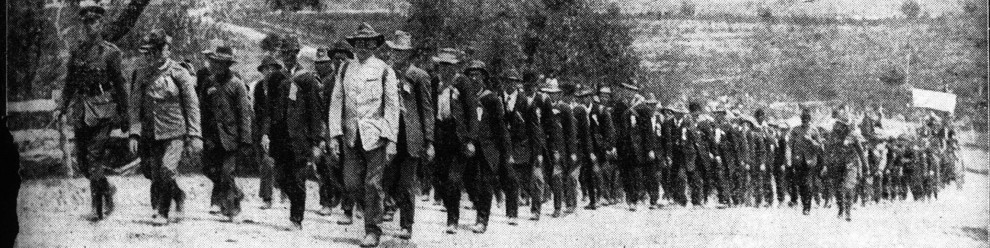
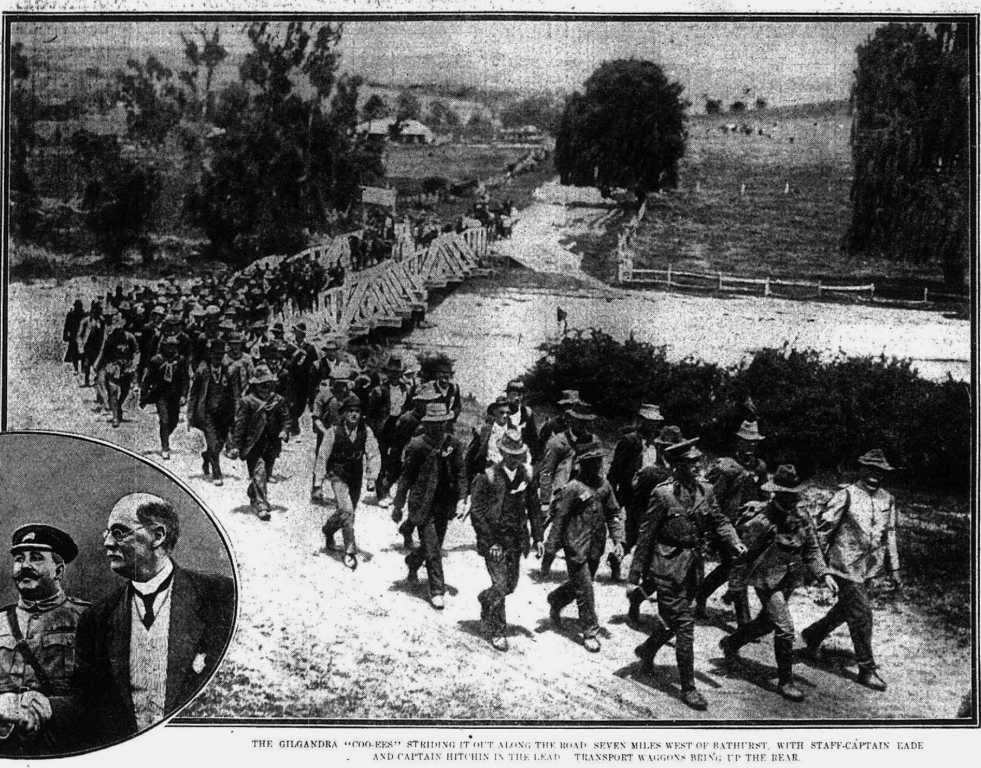
Coo-ees seven miles west of Bathurst (Daily Telegraph 30/10/1915)

Coo-ees seven miles west of Bathurst (Daily Telegraph 30/10/1915)

The pre-arranged time of arrival at the outskirts of the town was four o’clock, so, as good time had been made on the journey, an hour or more was put in at squad drill. The preparations of the Bathurst Recruiting Committee were elaborate and complete in every particular. All Bathurst was out to do honor to the men from the Castlereagh, and the children of all schools made a remarkable display, dressed in the costumes of the Allied nations. The cadets, under Col. Paul, and the school children lined the road, and then a procession was formed. Mounted police led, followed by the mayor and aldermen, and the Salvation Army and City Bands; a party of returned wounded soldiers, enjoying a holiday as guests of the Bathurst Red Cross Society, headed the “Coo-ees,” and the Bathurst unit fell in behind with their banner.

Hundreds of people lined the route, and the mile-long procession wound its way along the gaily decorated streets amid the cheers of the onlookers, and the ringing of church bells to King’s Parade, where an enclosure had been made in front of tho Soldiers’ Monument.

The wind had been rising all day, and at half-past four, just as the procession was turning into King’s Parade a “southerly buster” swirled the dust in clouds around the marching men. Alderman Beavis, Mayor of Bathurst, briefly welcomed Captain Hitchen and his coo-ees, for whom rousing cheers were given; then, as rain seemed imminent, the ladies dispensed afternoon tea and cigarettes in All Saints’ school-room, instead of outside as had been previously arranged.

The camp for the night was at the show ground, where also the ladies, marshalled by the Mayoress, served dinner to the hungry “Coo-ees.” Fortunately   the weather cleared, so that no more alterations to the programme were necessary. At 7.30 a continental was opened in Machattie Park, the selections by the District and City Bands being interspersed with recruiting speeches. A more beautiful setting could not have been found anywhere than in this park, with its well ordered paths, trim greenery, and the lights from the band rotunda glistening on the water playing from the fountain, about which the great crowd had assembled. Sweets and tobacco stalls were dotted about, at which purchases might be made by all except “Coo-ees,” who had been provided with badges that franked them to everything inside the park gates. Supper was served by another staff of ladies in a large tent specially erected for the occasion.

The Mayor, as chairman, introduced Dr. Machattie, Captain Eade, Sergeant Lee, and Private Fern, M.L.A., the member for Cobar, who was going to Cobar that night on final leave, and also to bring down a hundred men from the farthest west to join the column at Penrith.

These gentlemen addressed heart-to-heart, straight-from-the-shoulder recruiting arguments to the young men of Bathurst, not forgetting to point out to the women of Bathurst—Indeed, of all Australia—their duty in this awful war. Ten men had fallen into line with the recruits in tho procession as the Bathurst unit; eleven more men now came for- ward, so that the hundred and thirty odd that marched into the Queen City of the West formed a longer line by the addition of twenty-one “Bathurst Boomerangs.” Every recruit was presented with a trinket in the form of a boomerang, with Bathurst engraved on it, and the lo-cal unit was called “Bathurst Boomerangs” because “they go out to return.” While the heartiness of the welcome accorded the men of the column at Bathurst could not be any more sincere, or better demonstrated by the responsible citizens, than that of the other towns en- countered en route from Gilgandra, there can be no doubt that this was the big reception to date. Every man of the “Coo-ees” agrees that he had everything that could be desired at the hands of the   citizens of Bathurst.’

Click here to access the article on Trove: http://nla.gov.au/nla.news-article116674771

Day 18, Wednesday, 27 October, 1915, Blayney to Bathampton

Transcription of extract from an article titled ‘Gilgandra to the Coast : the “Snowball” growing as it rolls’ from The Farmer and Settler, 29 October, 1915, p. 3, [part 3 of 3 parts]:
… [Continued]

‘Blayney to Bathampton.
Blayney was bidden farewell on Wednesday morning, and a hilly journey entered upon to Bathampton. Six miles on this stage were traversed to King’s Plains, which name appeared on the face of is a misnomer, as the little cluster of houses was set on the top of a hill in the midst of hills. The local school teacher, Mr. Gardiner, was in charge of operations here, and the children marched out to meet the Coo-ees, each with a flag, together with the total population, about fifty persons. Luncheon was served in the school grounds, and the boys were welcomed by Mr. Gardiner, speaking on behalf of the residents.

Six more hilly miles were covered over a spur of the Blue Mountains to the home of Mr. Gilmour, who kindly offered the hospitality of the Bathampton estate to the recruits.

Bathampton lies in a pretty valley through which winds the Fitzgerald Valley Creek, and is one of the oldest Crown grants. The original homestead is nearly demolished, but some of the farm buildings remain.’

Click here to access the article on Trove: http://nla.gov.au/nla.news-article116671286

Day 17, Tuesday, 26 October, 1915, Millthorpe to Blayney

Transcription of extract from an article titled ‘Gilgandra to the Coast : the “Snowball” growing as it rolls’ from The Farmer and Settler, 29 October, 1915, p. 3, [part 2 of 3 parts]:
… [Continued]

‘Blayney Demonstration.
An early start was made on Tuesday, cloudy conditions, with cold winds, still prevailing. Blayney was entered at 12.45, the column being met at the town boundary by the Cowra town band, which had kindly come to the assistance of band-less Blayney. The Mayor (Alderman E. R. Clark). Mr. C. S. Fern (member for Cobar), shire councillors and aldermen were also present, and the procession was headed by a squad of thirty horsemen and horsewomen, and followed by a large number of cars and vehicles.

The show ground had been selected by the Recruiting Association for the recruits’ accommodation, and there the boys found a fine dinner prepared by the ladies of the local Red Cross Committee. To prevent any possible risk of the recruits succumbing to the misguided generosity of townspeople and others, all hotels were declared out of bounds, and the publicans warned by the police not to serve the recruits. It is a great pity that some of the persons that make a nuisance of themselves by insisting on “shouting” could not be made to go to the war themselves. They will not fight themselves, and they insist upon trying to make the real fighters unfit for their work.

The Cowra band gave selections during tho afternoon, and the public were present in force, chatting with the “Coo- ees.” After tea, also provided by the ladies, a continental was held in the pavilion, two thousand persons being present. Local artists contributed to a fine programme of vocal and instrumental tunes, interspersed with recruiting addresses by Mr. E. S. Carr (the local Federal member), Mr. E. R. Clark (the Mayor), Mr. C. S. Fern (the member for Cobar) and Q.M.S. Lee. Five local men answered the call, together with five other men from the district. Carcoar district also sent one man, and in addition presented the sum of £20, that had boon collected at the Carcoar show to tho marching fund of the column. Five more men arrived by the late train from Geurie and one from Gilgandra. The evening concluded with supper under the pavilion.

The Blayney Recruiting Association, the energetic secretary of which is Mr. K. F. Creaghe, was in charge of all arrangements. They supplied any and everything required from the stores, and also arranged for about eighty men to have their hair cut by two local barbers, who attended at the camp for that purpose. As cold weather is being experienced, six horse rugs were supplied at Blayney, and a vehicle will also be given, as the present transport facilities are proving inadequate.

The Blayney Freezing Works donated a supply of petrol for the motor, and as a large number of men have the “Coo-ee bark” (Syn. Liverpool cough), Mr. Matthews, the chemist, donated a quantity of cough tablets. A staff-sergeant-major from Lithgow will also shortly join the contingent to give instruction and for disciplinary purposes.’

Click here to access the article on Trove: http://nla.gov.au/nla.news-article116671286

Day 16, Monday, 25 October, 1915, Orange to Millthorpe

Transcription of extract from an article titled ‘The Route March : Section Leaders Appointed’ from The Farmer and Settler, 15 October, 1915, p. 3, [part 5 of 5 parts]:
…[Continued]

Leaving Orange (Sydney Mail 3/11/1915)

Leaving Orange (Sydney Mail 3/11/1915)

‘On Monday (yesterday) morning the “Coo-ees” formed in procession, and marched to the soldiers’ monument in Summer-street, where, at ten o’clock, the Mayor, Alderman McNeilly, presented a flag to the Orange unit of about twenty men. Corporal McLean received the flag on their behalf. The Mayor, in the course of an eloquent speech, said he trusted that McLean would lead the men by his own example of uprightness and loyalty straight to Berlin. Corporal McLean briefly thanked the Mayor, cheers were given, and the Mayor then bade farewell to the contingent and wished the men God speed. A light cart was presented also to carry the Orange kits, and all men were issued one kit-bag, of military pattern. The haversack kit is now limited to kit-bag capacity, and other superfluous gear is forwarded wherever desired by the men free of cost on the railways. The men looked well with the uniform appearance of the haversacks containing over- coat and such small things as toilet necessaries. The kit-bags and haversacks were purchased from Walder’s, of Sydney, and 200 blankets and 100 overcoats arrived from the military headquarters. The weather was cloudy as the column set forth, and more rain was expected. They arrived at Millthorpe last night for dinner at six, and a social evening followed. The route taken was via Lucknow and Spring Hill, where the “Coo-ees” were entertained at lunch and afternoon tea respectively.

The column will arrive at Bathurst on Thursday, and there they expect to add a number of recruits.’

Click here to view the article on Trove: http://nla.gov.au/nla.news-article116655979

DAY 16 continued:

Transcription of extract from an article titled ‘Gilgandra to the Coast : the “Snowball” growing as it rolls’ from The Farmer and Settler, 29 October, 1915, p. 3, [part 1 of 3 parts]:

‘Gilgandra to the Coast
THE “SNOWBALL” GROWING AS IT ROLLS.

The Great Western “snowball” continually rolls eastward, increasing in size as it rolls. The men are generally in good health and in the best of spirits, the latter condition not entirely unconnected with the fact that the Minister for Defence has agreed to their being paid from the date of enlistment, whereas they had been under the impression that there would be no pay until they went into camp at Sydney. Mr. Pigott, M.H.R., was the medium through whom Captain Hitchen received this welcome information. The Minister has also instructed that dungarees are to be issued at Lithgow or Wallerawang, so that the men may finish their march in some approach to uniform.

At Blayney, Captain Eade took over the duties of enrolling officer from Captain Nicholas, and it is understood that at Lithgow, Captain Eade will be similarly relieved by an officer sent from Sydney to take the column in charge.

Orange to Millthorpe.
After leaving Orange, “Hitchen’s Coo-ees” took the road for Millthorpe. Three miles out, however, at Hinchenbrook, the lads found that a light repast consisting of tea, cakes, etc., had been prepared, and they had to storm this trench before they could advance any further. Mrs. Maddrell sang, “God be with you till we meet again,” the “Coo-ees” joining in the chorus. The girls then pinned bouquets in the dusty coats and marched along a mile or two with the column, carrying bannerettes. The rain held off, and cold winds made ideal marching weather.

Lucknow’s Welcome.
It was only three miles further to Lucknow, where, on arrival, the first thing that met the marching men’s eyes was the Union Jack that came from Lucknow, in India, to the school children, in exchange for a similar piece of bunting.

Mr. C. Blunt, and the Rev. R. H. Kelly extended a hearty welcome, and an invitation to dinner, and to the dinner that was set before them they did more than justice. Lucknow did as well in catering for the “Coo-ees” as they have in every other patriotic movement; £250 has been given locally for patriotic purposes, and there are seven young men to represent the little hamlet at the front. One more has decided to march with the column.

Arrival at Spring Hill.
Monday, the 25th, was destined to be a day of feeds, for after leaving Lucknow, with the best wishes of the inhabitants, warmly voiced, still ringing in their ears, the boys had only stepped out a mile or two when they found that Spring Hill had made arrangements for “after- noon tea.” The meal was worthy of a better name.

Millthorpe en Fete.
Winding along the road through the valleys of the Canobolas, between the famous May hedges, all in bloom, Millthorpe at last was reached about five o’clock. The wind was now piercing, and Millthorpe residents declared it the coldest day of the year. The town band met the column at the town boundary, and following Molong’s example, the shops wore closed, and all Millthorpe and the surrounding district assembled along the line of route to do honor to the boys from the west.

There was not room in Frape’s Hall to accommodate the number of persons that wanted to dine with the “Coo-ees.” However, meals were taken in relays, and the “Coo-ees,” fast becoming experts in the matter of eatables, declared that they had not had a better dinner than was placed before them by the ladies of Millthorpc. Mr. Hector was in the chair, and after the loyal toast and that of “Our Allies,” the Rev. Hugh Kelly proposed the health of Capt. Hitchen and his “Coo-ees,” to which the captain and Q.M. Sgt. Lee responded.

After the tables had been cleared away, an excellent concert was provided by local artists, and one or two of the recruits. This was followed by a recruiting appeal with two “converts,’ and the evening concluded with dancing until 3 a.m. Needless to say, most of the “Coo- ees” were in bed long before that hour.

Undulating to hilly is the kind of country being traversed now, all looking beautifully green after the recent rains.’

Click here to access the article on Trove: http://nla.gov.au/nla.news-article116671286

Day 15, Sunday, 24 October, 1915, Orange

Transcription of extract from an article titled ‘The Route March : Section Leaders Appointed’ from The Farmer and Settler, 15 October, 1915, p. 3, [part 4 of 5 parts]:
…[Continued]

‘Except for a march through the town in the afternoon to Cook Park where a recruiting meeting was held, Sunday was spent as a day of rest, church parades in the morning and evening being optional. Breakfast was prepared by the “Coo-ee” cooks, but dinner and tea were provided by the ladies.’

Click here to view the article on Trove: http://nla.gov.au/nla.news-article116655979

Day 14, Saturday, 23 October, 1915, Molong to Orange

Transcription of extract from an article titled ‘The Route March : Section Leaders Appointed’ from The Farmer and Settler, 15 October, 1915, p. 3, [part 3 of 5 parts]:
…[Continued]

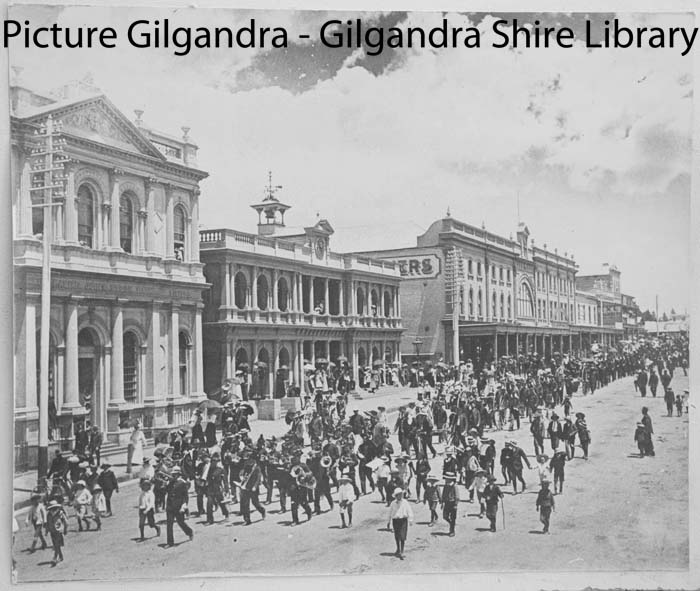
Arriving in Orange (Photograph courtesy of Gilgandra Shire Library)

Coo-ees marching past the post office in Summer Street, Orange (Photograph courtesy of Gilgandra Shire Library)

Orange.
The two miles between the night camp and the cook’s advanced party were covered before breakfast on Saturday morning, and then a move was made toward Orange.

It was recognised that the thundery appearance of the sky made it imperative that no time should be lost, but before a start could be made the rain began to come down. The programme arranged by the Orange people was that the column should enter the town at three o’clock, but the rain rendered it imperative to get the men under cover at the earliest possible moment, as a number were without overcoats, and were to receive them at Orange. The town was entered, therefore, about noon, and the Mayor, Alderman E. T. McNeilly, led the way by back streets to Wade Park, where clothes were dried and dry socks issued. One hundred and thirty pairs of socks had just been received from Misses Grant and Moyan, Kirrlbilli, Sydney, for the use of the “Coo-ees,” and they could not have arrived at a more opportune time. Tho Mayoress, Mrs, McNeilly, was found hard at work with a staff of ladies preparing a substantial meal, which was much appreciated by the men, as was also the 2-oz. of “medicine” per man prescribed by the Mayor; the “Follow the King” ideal is being lived up to all through the march, but the circumstances were held to warrant something “medicinal” after the wetting.

After dinner and a spell the “fall in” was sounded and the “Coo-ees”‘ were taken back to the town boundary where a procession was marshalled, and the formal entry made. Rain continued to fall at intervals; notwithstanding this, however, there was a great crowd along the route to the town hall. The Orange town band, the Light Horse, Citizen Forces, and Scouts were in the procession, and the guard of honor was a detachment of soldiers under Sergeant Crook, who had come front Liverpool, Holdsworthy, and Warwick Farm training camps, paying their own expenses, all for the purpose of doing honor to Hitchen’s “Coo-ees.” The Citizen Forces kept a clear space in front of the town hall, and the mayor and aldermen, the shire president, representative clergy, and Messrs. Fitzpatrick, M.L.A. (none the worse for his march and his wetting), H. R. M. Pigott, M.H.R., and many others, welcomed Captain Hitchen and his corps. Captain Hitchen was taken up to the balcony and introduced to the crowd, numbering about four thousand persons, and brief speeches were made by leading men. Captain Hitchen returned thanks, and in apologising for lack of words said that his thanks were none the loss heartfelt, so he would call on Q.M.-Sergeant Lee to speak for him and the “Coo-ees.” Lee got that part of the business over quickly, and, seeing so large a crowd assembled, he seized the opportunity of making a recruiting appeal. Nine men stepped forward to fill the blank files, and word was received that more would come later, so the “snow- ball” should be the bigger by fifteen men if they all pass the doctor.

The sun peeped out for a moment as the National Anthem was being played, but as the sky was again becoming overcast, the proceedings broke up with cheers for everybody, not the least hearty of which were for “Captain Bill Hitchen and his “Coo-ees'” as the great welcome banner put it.

A sumptuous banquet had been prepared under the pavilion at Wade Park, to which over a hundred hungry recruits sat down at 6 p.m. The Mayor presided, and later proposed the health of Captain Hitchen and his men, together with the health of the men that had volunteered that afternoon, and the men that were already soldiers, and had come from the training camps to honor the “Coo-ees.” Mr. J. L. C. Fitzpatrick, in supporting the toast, had a dig at the military authorities for their red-tape and cold-water methods in making these Orange recruits pay their own fares and expenses in welcoming the Gilgandra contingent, Q.M.-Sergeant Lee and Mayor Wynn spoke for the men.

A continental had been arranged to be held in Wade Park after tea, but as the weather still refused to behave, it was called off.’

Click here to view the article on Trove: http://nla.gov.au/nla.news-article116655979

Day 13, Friday, 22 October, 1915, Boomey to Molong

Transcription of extract from an article titled ‘The Route March : Section Leaders Appointed’ from The Farmer and Settler, 15 October, 1915, p. 3, [part 2 of 5 parts]:
…[Continued]

Molong.
Boomey was bidden farewell at 8 a.m. on Friday, 22nd, and several miles covered to The Shades, where the men of the column were treated to a poultry breakfast. Mr. It. E. Johnson, the local school teacher, a most enthusiastic worker, had his thirty or forty school children paraded to meet the marching army, and showed them a point in marching. The children also sang patriotic songs during the brief meal, and in this respect also reflected credit on their teacher. Sergeant Sam Ball, of the Light Horse, which body met the “Coo-ees” a mile or so along the road, was also an energetic organiser of the little reception, and the ladies cannot be praised enough for the trouble they took to do honor to the marching recruits. Headed by the Light Horse, the remainder of the sixteen miles to Molong was left behind with the memories of the generous treatment en route. Arriving at the outskirts of the town at 11.30, a procession was formed, and the principal streets were traversed to the martial airs of the Molong town band. At the saluting base at the recreation ground, the mayor, Alderman J. S. Taylor, inspected the column and expressed himself well pleased with the men’s appearance. After the order to dismiss, cordials were served out, and the river availed of, the opportunity for a wash. Luncheon was the next item on the programme. One of the staff had a stock of “Coo-ees” ribbons for sale at a shilling each, and we have reason to believe that at the conclusion of his   speech, he sold over a pounds’ worth.

At the recruiting meeting after lunch, Messrs. J. C. L. Fitztpatrick, M.L.A., W. Johnson, ex-M.L.A., Major Wynne, and Q.M.-Sergeant Lee were the chief speakers. Two men volunteered, and were duly sworn in, and four men turned up from Parkes, sent on by the Recruiting Association. Two other men caught up from Coonamble.

It is a significant fact that many men come along after the column has passed. There can be no doubt that the effect is greater than would appear from the actual number of men enrolled at the time. If Captain Hitchen has the opportunity of coming along again in January, as he at present intends, he will gather up an ever so much larger army, both because the harvest labor will be released, and because (this Recruiting March will have stirred up the apathetic and opened their eyes to their responsibility in this present crisis.

At three o’clock sharp the procession was re-formed, and the road to Orange taken. Tea was partaken of at Mr. Hebden’s station, about five miles out, and then the recruits pushed on at a leisurely marching pace, for the night camp. The idea of the moonlight walk was to cut as much as possible off the following day’s march, so that Orange could be entered with the men in fresh a condition as possible. The cook and No. 1 transport pushed on further, to Armstrong’s property.

The local member, Mr. Fitzpatrick, marched out of Molong with the “Coo-ees,” after seeing that they wanted for nothing in the way of blankets, sox, etc. He camped with the men. The en- rolling officer, Captain Nicholas, was sitting up by the camp fire until half- past eleven that night swearing in the latest batch of recruits.’

Click here to view the article on Trove: http://nla.gov.au/nla.news-article116655979

Day 12, Thursday, 21 October, 1915, Euchareena to Boomey

Transcription of extract from an article titled ‘The Route March : Section Leaders Appointed’ from The Farmer and Settler, 15 October, 1915, p. 3, [part 1 of 5 parts]:

‘THE ROUTE MARCH
Section Leaders Appointed
THE SNOWBALL GROWING AS IT ROLLS.

As there was no formal public entertainment on Wednesday evening at Euchareena, and as the men had arrived fairly fresh, a good night’s rest put them into good fettle, and they were ready to make an early start on the ten-mile walk to Boomey. Lunch was taken three miles out under the willows at Nembriggan [i.e. Newbriggan] Creek, a charming, little spot on the road to Molong. The food was that which had been left over at the Euchareena tea, so the cook’s work was light. On the way a shearing shed in full operation was inspected, and one of the shearers signified his intention of enlisting, promising to join the “Coo-ees” at Orange. The proprietors, Messrs. Brazier Bros., gave a sheep to assist the commissiariat.

Advantage was taken of the long luncheon halt at Newbriggang [sic] Creek to divide the column into sections, so that the best possible appearance may be made when marching, and also, more important still, to enable the organising staff and N.C.O’s to handle the men more efficiently. One complete platoon of sixty-nine men was formed as follows :-
No. 1 (Gilgandra) Section.-Sergeant in charge and sixteen Gilgandra men.
No. 2 (Gilgandra) Section.-Corporal in charge; the section completed by incorporating nine Dubbo men.
No. 3 (Wellington) Section.- Corporal   in charge, and sixteen Wellington men.
No. 4 (Wellington) Section.-Sergeant in charge, and the section completed by including eight Wongarbon men.
The remainder of the strength will form the nucleus of a new section, and a number of men have been told off to special duties.

After lunch the men were marched off in sections, each acting independently of the others, and under the control 0f its own section leader. The arrangement was highly satisfactory, both N.C.O’s, and men feeling much better pleased with themselves than under the previous system where all marched in one body. The effect, too, of the four separate sections marching into Boomey at a few paces interval with the transports following, was much more attractive from a spectacular point of view.

Boomey.
Four o’clock was the schedule time of arrival at Boomey, and the recruits arrived “on the tick,” to find the ladies hard at work preparing tea.

It is a never-ceasing wonder to the “Coo-ees” how such feasts can possibly be prepared out in the open bush, with apparently only a dozen houses within miles. The presence of a large collection of vehicles might possibly furnish a clue if one were only curious enough to ask how far the good people had come. Mr. A. A. Rodgers, President of the Amaroo Shire Council, addressed a few words of welcome, and expressed, on behalf of the residents, their appreciation of the spirit that moved the “Coo-ees” to take up their burden for the Empire. “Spruiker” Lee acknowledged the reception on behalf of the recruits, switching into a little recruiting appeal to try to snare one or two likely birds that were fluttering round the edge of the net; but without avail.

After tea an impromptu camp fire concert was held, and some “Coo-ee” talent was unearthed, so assisted by local volunteers, a very pleasant evening spent.

A pair of blankets and an overcoat were given to one of the men by the ladies present, who saw that he was needing them. As recruits had come in rather heavily, the stock of blankets had run out. However, more were even then waiting at Orange.’

Click here to view the article on Trove: http://nla.gov.au/nla.news-article116655979

Day 11, Wednesday, 20 October, 1915, Stuart Town to Euchareena

Transcription of extract from an article titled ‘The Route March : Growth of the “Snowball”’ in The Farmer and Settler, 22 October, 1915, p. 3 [part 3 of 3]
… [Continued]

‘Breakfast over, the transports were loaded for Euchareena. The lunching place was Store Creek, where the few inhabitants and the school children gave every assistance in preparing the lunch, besides providing milk, eggs, butter etc. The school children ran races for “Hitchen’s Coo-ee” badges, and also adorned the boys with roses. The first time that flowers were offered to the recruits was at Wellington, where an old French lady threw rose petals over the marching men. Since then, at Dripstone, Stuart Town, and now at Euchareena, the roses have been forthcoming. Here they were positively garlanded with roses.

Euchareena’s Welcome.
It must have been an impressive sight to the little knot of ladies that stood waiting by the Salvation Army hall at Euchareena to see across the valley that little band of one hundred men coming marching down the long, white road to the valley head where nestles the town-ship, then curve and come again over the rise, marching like veterans. The prettiest part of the picture was the children, dressed in their best, and waving the good old Union Jack. Camp was pitched in the school grounds, and then, after a brief welcome speech had been made by Mr. O’Reilly, the school teacher, and songs had been rendered by the little tots, the tea provided by the local folk was partaken of. The usual recruiting meeting was held after tea, the speeches being made from the platform of a railway shed. One young man was enrolled, and there are hopes of one or two more being persuaded to come. Three men caught up by the mail train, and one went on to Orange.’

Click here to view the article on Trove: http://nla.gov.au/nla.news-article116649160