Category Archives: Roll of honour

John MARTIN

John MARTIN

Per his military service record (regimental no. 4541), John Martin was born at Melbourne, Victoria. He gave his age as 34 years 10 months, his marital status as single, and his occupation as labourer. His description on his medical was height 5 feet 4 ½ inches tall, weight 10 stone 2 lbs., with a florid complexion, grey eyes, and brown hair. His religious denomination was Roman Catholic. He claimed that he had no previous military service. He completed his medical on the 22nd October 1915 at Molong, and was attested by Captain Nicholas at Molong (8 miles from Molong East) on the 22nd October 1915.

After joining the Coo-ees at Molong, he completed the Coo-ee March, and went to Liverpool Camp as reinforcement for the 13th Battalion.

The address he gave on his initial application to enlist form at Molong on the 22nd October 1915 was Bowral, Southern Line, N.S.W. On his embarkation roll his address at time of enrolment was C/o E. J. Arnold, St. John’s Road, Forest Lodge, Sydney, N.S.W., and his next of kin is listed as sister, Mrs. M. Martin, St. John’s Road, Forest Lodge, Sydney, N.S.W.

On 16th February, 1916 Private Martin departed Sydney on the HMAT Ballarat A70. On the voyage to Egypt the HMAT Ballarat A70 stopped at Ceylon where on 3rd of March 1916 Private Martin was charged with Being Absent Without Leave from 1700 on 7th March 1916 till 1900 on 7th March 1916, and also charged with Breaking Ranks. He was fined 1 pound.

The HMAT Ballarat A70 arrived in Egypt on 22nd March 1916.

On 1st April 1916 Private Martin was transferred to the 54th Battalion at Ferry Post, Egypt.

On 19th June 1916 Private Martin left Alexandria aboard the Transport HT Caledonian bound for France, arriving at Marseilles on the 29th June 1916.

Private Martin joined the 54th Battalion early in July 1916 when it was conducting training at Thiennes, France. On 7th July 1916 Private Martin was evacuated to the 12th Casualty Clearing Station suffering from Haemorrhoids. On 10th July he was placed aboard the 18th Ambulance Train bound for Calais, France. On 13th July 1916 he was placed aboard the Hospital Ship Newhaven that departed for England and arrived at Dover later that day. Private Martin was then admitted to the General Military Hospital at Colchester, England.

As a result of being hospitalised with his ailment Private Martin was not present with the 54th Battalion when it was involved in the Battle of Fromelles later that month.

On 20th September 1916 Private Martin marched into the 14th Training Battalion at Larkhill, England. On 14th October 1916 Private Martin departed England bound for France, marching into the 5th Australian Division Base Depot at Etaples on 16th October 1916. On 30th October 1916 Private Martin departed the 5th Australian Division Base Depot to rejoin his unit.

On 2nd November 1916 Private Martin arrived at the 54th Battalion when it was in the trenches in the vicinity of Longueval, France.

On 14th December 1916 when the Battalion was resting at Montauban, France, after just coming out of the trenches, Private Martin was evacuated to a Field Ambulance suffering from Trench Feet. On 16th December 1916 he was admitted to the 11th Stationary Hospital at Rouen, France. On 17th December 1916 he was sent to Calais, France. On 17th December 1916 Private Martin boarded the Hospital Ship Carisbrooke Castle bound for England. On 18th December 1916 he was admitted to the 1st London General Hospital.

On 15th January 1917 Private Martin was discharged from Hospital and granted leave till 30th January 1917, when he marched into the 1st Convalescent Depot at Pernham Downs, England.

On 28th February 1917 Private Martin departed Folkestone, England, bound for France aboard the Transport Invicta. He arrived at the 5th Australian Division Base Depot at Etaples, France, on 1st March 1917.

On 21st March 1917 he left the 5th Australian Division Base Depot to rejoin his unit. On 23rd March 1917 Private Martin arrived at the 54th Battalion when it was engaged in consolidating work and resting in the vicinity of Longueval, France.

On 27th May 1917 the Battalion was resting at Beaulencourt, France where Private Martin was promoted to Corporal.

On 19th of July 1917 Corporal Martin was transferred to the 14th Training Battalion in England. He arrived in England on 24th of July 1917.

On the 5th October 1917 he attended the 37th Army course of P. & B. instruction at Tidworth and qualified as “fair”.

On 12th January 1918 in a letter to 14th Training Battalion he changed his next of kin from his sister to his new English wife Mrs Louisa Minnie Martin, whose address was 64 Bessborough Place, Bessborough Street, Vauxhall Bridge Road, London, S.W.  On 16th January 1918 he made a new will bequeathing his real and personal estate to his wife.

On 1st April 1918 Corporal Martin departed Dover for France arriving at the Number 1 Overflow camp at Beaumarais, France. On 4th April 1918 Corporal Martin left Beaumarais to rejoin the 54th Battalion. On 10th April 1918 he arrived at the Battalion when it was preparing to go into action in the vicinity of Aubigny, France.

On 24th April 1918 the 54th Battalion was engaged in action in the vicinity of Villers Bretonneux, France, when Corporal Martin received a gunshot wound to his chest. He was evacuated to the 15th Australian Field Ambulance, then on 25th April 1918 to the 61st Casualty Clearing Station, then onto the 10th General Hospital at Rouen, France.

On 3rd May 1918 he was sent to Hospital in England, arriving at the 5th Southern General Hospital at Portsmouth, England, on the 4th May 1918. On 15th May 1918 he was transferred to the 3rd Auxiliary Hospital at Dartford, England. He was discharged from hospital on 17th May 1918 and went on leave, reporting back to the 4th Convalescent Depot at Hurdcott, England, on 31st May 1918.

On 19th July 1918 Corporal Martin marched into the overseas Training Brigade and on 15th August 1918 he departed Folkestone for France. On 16th August 1918 Corporal Martin arrived at the 5th Australian Division Base Depot at Le Harve, France.

On 22nd August 1918 Corporal Martin rejoined the 54th Battalion whilst it was in reserve in the vicinity of Proyart, France.

On 1st September 1918 Corporal Martin was with the 54th Battalion when it was involved in the successful assault on Peronne, France. During this assault the 54th Battalion lost 27 men killed, 147 wounded and had 9 men missing. Corporal Martin was one of those killed in action.

Corporal Martin is buried in the Peronne Communal Cemetery Extension, Peronne, France.

John Martin's headstone at Peronne Communal Cemetery Extension, France (Photograph: S. & H. Thompson, 6/9/2014)

John Martin’s headstone at Peronne Communal Cemetery Extension, France (Photograph: S. & H. Thompson, 6/9/2014)

Corporal Martin’s name is commemorated on panel 159 on the Australian War Memorial First World War Roll of Honour.

John Martin’s name is also recorded on the Coo-ee March Memorial Gateway at Molong as one of the five men who joined the Coo-ee March at Molong on 22nd October 1915.
Archibald MCINTYRE

Archibald MCINTYRE

Per his military service record (regimental no. 2708), Archibald McIntyre enlisted twice in the AIF. Archibald McIntyre was born at Glasgow, Scotland. On his first enlistment (during the Coo-ee March), he gave his age as 31 years and 6 months, his marital status as single, and his occupation as labourer. His description on his medical was height 5 feet 2 inches tall, weight 9 stone 10 lbs., with a dark complexion, brown eyes, and dark hair. His religious denomination was Church of England. He claimed that he had no previous military service. He completed his medical on the 26th October 1915 at Blayney, and was attested by Captain Eade at Blayney on the 26th October 1915.

After completing the Coo-ee March he went to Liverpool Camp as reinforcement for the 13th Battalion.

Whilst at Liverpool Camp Private McIntyre went before a medical board on 17th November 1915 where he was deemed unfit for military service due to defective vision. He was discharged on the 29th November 1915.

In a letter dated 16th April 1916 Archibald McIntyre wrote “I was rejected for eyesight but as they have reduced the test I intend to give it another try”.[1]

On the 19th May 1916 Archibald McIntyre applied again to join the AIF. He attended the Royal Agricultural Showground in Sydney, and stated in this application that he had 35 days previous military service in the AIF, and was rejected on grounds of eyesight. He underwent a medical on the 19th May 1916 which he passed. He was attested on the 20th May 1916 at the Royal Agricultural Showground.

Private McIntyre went into camp and began training at Cootamundra on the 23rd May 1916, then to Goulburn on the 22nd June 1916. He remained at Goulburn till the 4th September 1916 when he was transferred to the 56th Battalion and went to Sydney being taken on strength of the 6th reinforcements for the Battalion.

On his embarkation roll his address at time of enrolment was Portland N.S.W., and his next of kin is listed as father, William McIntyre, 161 Pollok Street, Glasgow, Scotland.

Private McIntyre departed Sydney on the HMAT A40 Ceramic on the 7th October 1916. He arrived in Plymouth, England, on the 21st November 1916. After further training in England he departed Folkestone, England, aboard the SS Princess Victoria for France on the 21st December 1916. He underwent further training in France at the 5th Australian Division Base Depot at Etaples. He joined the 56th Battalion on 1st February 1917 whilst it was in reserve and providing fatigue parties at Bernafay south of Pozieres, France.

On the 22nd March 1917 the 56th Battalion was in reserve in the vicinity of Bancourt, France, when Private McIntyre was evacuated to hospital sick. On the 24th March 1917 he was diagnosed to be suffering from Bronchitis. On the 25th March at the 2nd/1st South Midland Casualty Clearing Station Private McIntyre was diagnosed with Cerebro Spinal Meningitis. He died the next day.

Private McIntyre was buried in the Puchevillers British Cemetery, France, on 26th March 1917.

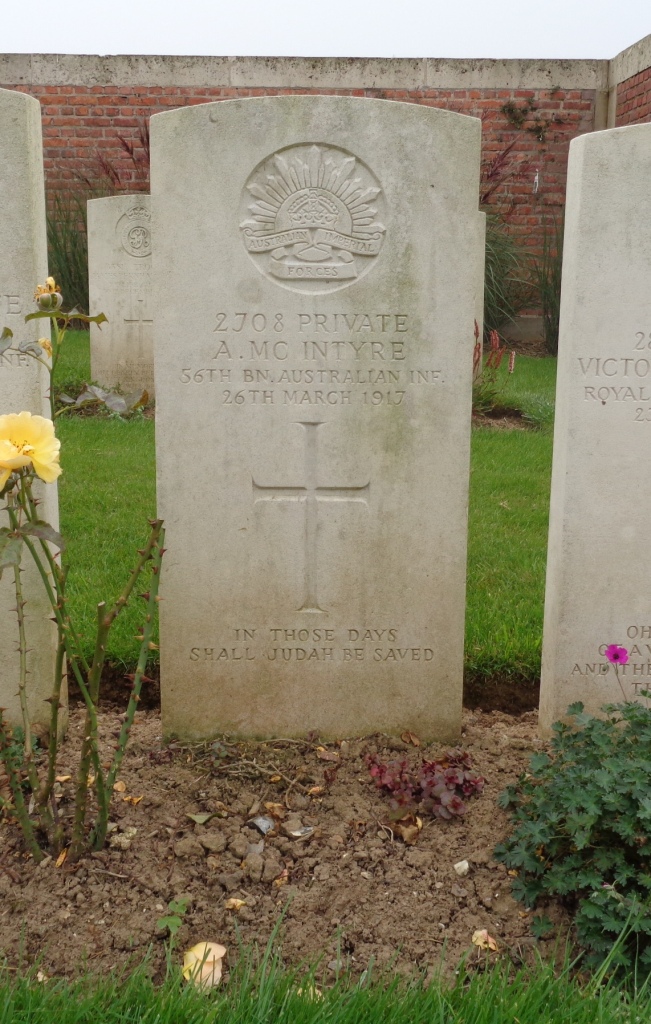
Archibald McIntyre's headstone at Puchervillers British Cemetery, France (Photograph: S & H Thompson 5/9/2014)

Archibald McIntyre’s headstone at Puchevillers British Cemetery, France (Photograph: S & H Thompson 5/9/2014)

Private McIntyre’s name is commemorated on panel 162 on the Australian War Memorial First World War Roll of Honour.

Note: Archibald McIntyre’s father wrote on his Australian War Memorial Roll of Honour Circular that he came to Australia when he was 22, and that he ‘sailed round world once or twice as a sea apprentice in a sailing ship. Traded from Australia to New Zealand for a time. Joined in the Coo-ee March. Two brothers in British Army (one killed).’[2]

[1] McIntyre, Archibald. Letter to [A. H. Miller], 16th April 1916, Alex Halden (Joe) Miller papers mainly relating to the Gilgandra Coo-ee Recruitment March, New South Wales, 1912-1921, 1939, held at the Mitchell Library (State Library of N.S.W.)

[2] Archibald McIntyre 2708 Australian War Memorial Roll of Honour Circular, http://static.awm.gov.au/images/collection/pdf/RCDIG1068881–64-.PDF

William Emerton HUNTER

William Emerton HUNTER

Per his military service record (regimental no. 4807), William Emerton Hunter was born at Sydney, N.S.W. He gave his age as 21 years and 1 month, his marital status as single, and his occupation as wheat lumper. His description on his medical was height 5 feet 11 inches tall, weight 172 lbs., with a fair complexion, blue eyes, and brown hair. His religious denomination was Church of England. He claimed that he had no previous military service. He joined the Coo-ees at Geurie. He completed his medical on the 16th October 1915 at Wellington, and was attested at Dripstone by Captain Nicholas on the 19th October 1915.

When the Coo-ees were in Orange, he was to receive some sad news from his mother. The incident was reported in an article titled ‘Tragedy of the War’ in The Leader, as follows: ‘When the Coo-ees arrived at Wade Park on Saturday there was a big parcel of mail waiting for the members of the patriotic band. One fine hefty young fellow named Hunter held out his hand for his letter, and with a smile on his face, walked to the end of the pavilion to read it. He knew by the handwriting on the envelope that it was from his mother in Sydney, who was waiting eagerly for her boy to arrive, at the end of the glorious march from back o’ beyond. He had hardly scanned the first few lines when tears bedimmed his eyes, and then he burst out into a paroxysm of grief. The letter read, “My darling boy.-It is sad news I have to tell. Your two brothers who left Sydney with the 18th Battalion were killed in action on the 27th of August. Be brave, my boy, and try to bear it as your mother and sisters are trying to do. I will send you 10/ on Monday if I have the money.” There was much more of a private nature, and those who were handed the letter to read were visibly affected. The young fellow was broken-hearted, but even the sad blow has not deterred him from carrying out his intentions of going to the front, and now he is doubly eager to be off and avenge .his brothers’ death. The Mayor has given £5 of the money collected for the Coo-ees’ entertainment to the poor lad’s mother. His brothers entered the firing line on the 14th, and were in action till they received their death wounds.’[1]

According to newspaper reports, money raised from a collection made for Mrs Hunter was sent home with Private Hunter, who was allowed to go home for a few days to spend some time with his mother.[2]

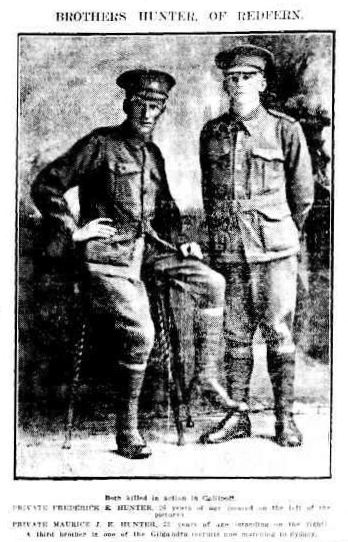
Photo of William Emerton Hunters 2 brothers killed at Gallipoli (Sydney Morning Herald 1/11/1915)

Photo of William Emerton Hunter’s 2 brothers killed at Gallipoli (Sydney Morning Herald 1/11/1915)

This photograph of Private Hunter’s two brothers Frederick and Maurice Hunter was published in The Sydney Morning Herald on 1st November 1915 with the caption “Brothers Hunter of Redfern both killed in action at Gallipoli … a third brother is one of the Gilgandra recruits now marching to Sydney”.[3]

Private Hunter was to hear from his mother again on the march. The Cumberland Argus and Fruitgrowers Advocate reported that at the recruiting meeting held for the Coo-ees in the Park at Parramatta on 10th November 1915: ‘A lady here stepped on to the platform and said her name was Mrs. Annie [sic] Hunter, and that she lived at Young Street, Redfern. Two of her sons had been killed at Gallipoli on August 27, and her third son was now with Captain Hitchen’s men. “I only had three boys,” she said, “and two have been killed; the third one is with the ‘Coo-ees,’ and I wish that I had another one to give in the cause of the Empire.”[4]

After completing the Coo-ee March Private Hunter went to Liverpool Camp as reinforcement for the 13th Battalion.

On Private Hunter’s embarkation roll his address at time of enrolment was 50th Young Street, Redfern, N.S.W., and his next of kin is listed as sister, Miss A. Hunter, 50th Young Street, Redfern, N.S.W. (On his attestation paper in his service record his next of kin is listed as mother, Mrs F.[Fanny] Hunter, 50A Young Street, Redfern, N.S.W, which is crossed out and changed to sister, Miss Annie Hunter, 50A Young Street, Redfern, N.S.W. His sister Annie Hunter’s name is also mentioned in other documents in his service record).

On 8th March 1916 Private Hunter along with many of the other Coo-ees departed Sydney on the HMAT A15 Star of England, and arrived in Egypt on the 11th April 1916. On the 19th April 1916 Private Hunter was transferred to the 45th Battalion at Tel-el-Kebir.

On the 2nd June 1916 Private Hunter left Alexandria aboard the transport Kinfauns Castle bound for France, arriving at Marseilles on the 8th June 1916.

Private Hunter served with the 45th Battalion during its first action at Fleurbaix, France in July 1916. Private Hunter then moved with the 45th Battalion to Pozieres, France, in early August 1916. Private Hunter was killed in action in the vicinity of Pozieres, France, on 7th August 1916. He had initially been reported wounded in the field on 7/8th August 1916, then was posted as wounded & missing. Following a court of enquiry on 26th April 1917 he was officially reported killed in action on 7th August 1916. Private Hunter has no known grave.

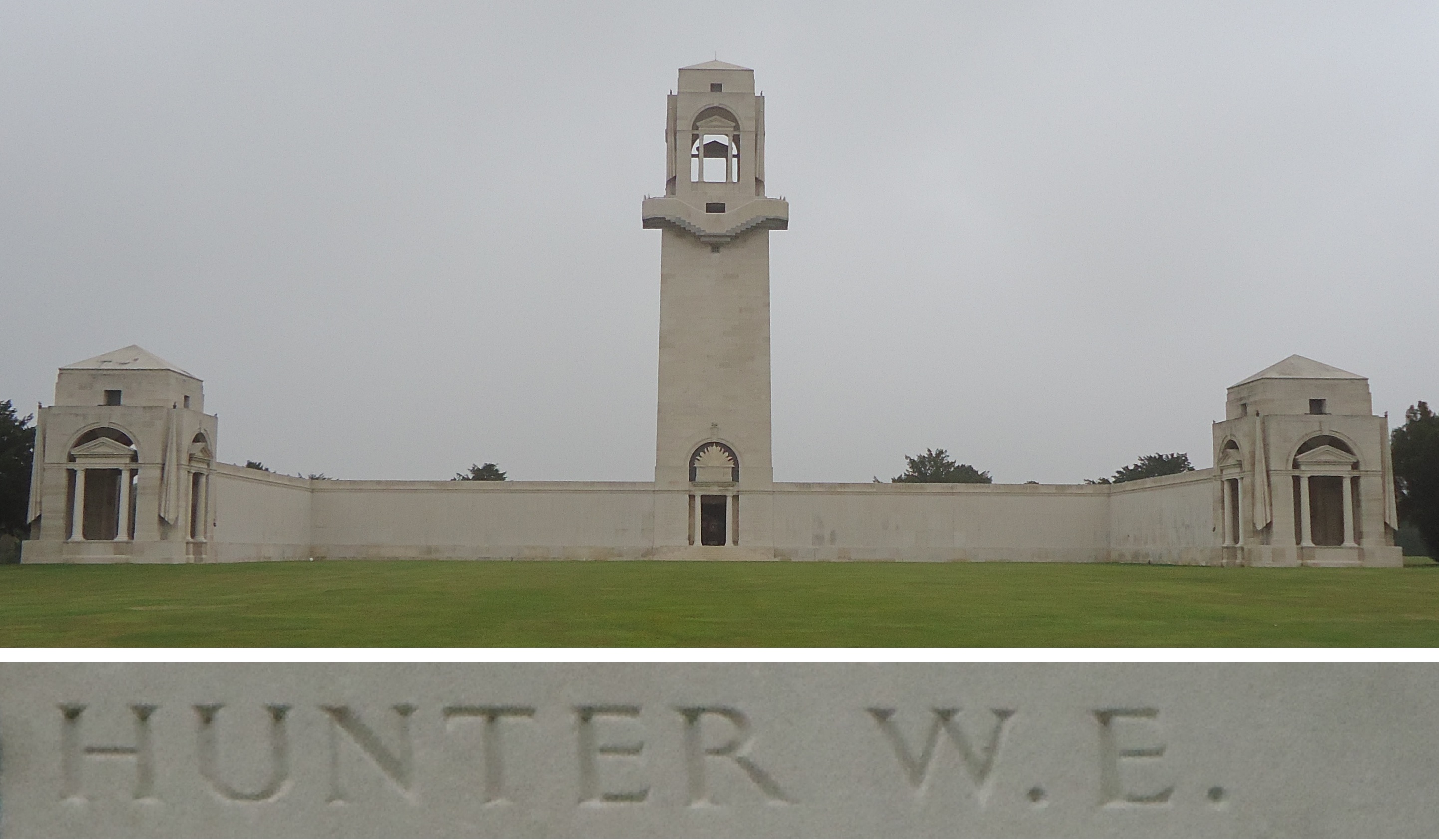
Private Hunter is remembered on the Australian National Memorial at Villers-Bretonneux in France.

Private Hunter's name on the Villers-Brettoneux Memorial (Photograph: S. Thompson 7/9/2014)

Private Hunter’s name on the Villers-Bretonneux Memorial (Photograph: S. Thompson 7/9/2014)

Private Hunter’s name is commemorated on panel 139 on the Australian War Memorial First World War Roll of Honour.

His name is also listed on the Redfern War Memorial (along with the names of his two brothers).

Note: Having already lost 2 sons to the war, after her son William was posted wounded and missing in 1916,  Mrs F. Hunter moved to a war widows’ home later that year in The Boulevarde, Sans Souci, which had been built for her by the Kogarah branch of the Voluntary Workers’ Association, and named “Coo-ee” in memory of the third son who had ‘marched with Hitchen’s Coo-ees’.[5]

[1]‘A tragedy of the War’, Leader, 25 October 1915, p. 1., http://nla.gov.au/nla.news-article117842543

[2] ‘Mr Arkins and the “Coo-ees.”, Molong Argus, 29 October 1915, p. 7, http://nla.gov.au/nla.news-article105660877

[3] ‘Heroes of the Dardanelles’, The Sydney Morning Herald, 1 November 1915, p. 5., http://nla.gov.au/nla.news-article15622222

[4] ‘The great recruiting meeting in the park’, The Cumberland Argus and Fruitgrowers Advocate, 13 November 1915, p. 11, http://nla.gov.au/nla.news-article86101772

[5] ‘War homes’, The Sydney Morning Herald, 25 September 1916, p. 5, from http://nla.gov.au/nla.news-article15684629 ; ‘War widows’ homes’, Sunday Times, 24 September 1916, p. 6, http://nla.gov.au/nla.news-article121344784


Joseph PARRISH

Joseph PARRISH

Per his military service record (regimental no. 4866), Joseph Parrish was born at Monmouthshire, Wales. He gave his age as 18 years and 5 months, his marital status as single, and his occupation as miner. His description on his medical was height 5 feet 4 inches tall, weight 118 lbs., with a fair complexion, black eyes, and black hair. His religious denomination was Methodist. He claimed that he had no previous military service. He joined the Coo-ees at Wellington. He completed his medical on the 16h October 1915 at Wellington, and was attested by Captain Nicholas at Orange on the 24th October 1915. A note “Presented consent at Orange 24/10/1915” is written at the top of his attestation paper.

After completing the Coo-ee March he went to Liverpool Camp as reinforcement for the 13th Battalion.

On his embarkation roll his address at time of enrolment was Boolaroo, via Newcastle, N.S.W., and his next of kin is listed as father, J. Parish, Boolaroo, via Newcastle, N.S.W.

On 8th March 1916 Private Parrish along with many of the other Coo-ees departed Sydney on the HMAT A15 Star of England, and arrived in Egypt on the 11th April 1916. On the 16th April 1916 Private Parrish was transferred to the 4th Pioneer Battalion at Tel-el-Kebir.

On the 4th June 1916 Private Parrish left Alexandria aboard the Transport Scotian bound for France, arriving at Marseilles on the 11th June 1916. Private Parrish served with the 4th Pioneer Battalion until the 10th of August 1917 when the Battalion was conducting night works on communication trenches in the vicinity of Kemmel, Belgium. Private Parrish was evacuated from the field sick, and on the 12th August he was admitted to the 13th Australian Field Ambulance, then sent to the 4th Division Rest Station. He was discharged on the 22nd August 1917, and rejoined his Battalion on the 28th August 1917 whilst it was resting at Neuve Eglise, France.

On the 17th October 1917 the 4th Pioneer Battalion was conducting road works on the Zonnebeke Road. On this day Private Parrish was charged with ‘conduct to the prejudice of good order & military discipline, in that he after being placed on a task in the forward area quitted same without authority’. He was awarded 14 days Field Punishment Number 2 and fined 14 days forfeiture of pay.

On the 12th May 1918 Private Parrish was transferred to the 4th Machine Gun Battalion. On the 10th June 1918 the 4th Machine Gun Battalion was in action in the vicinity of Villers Bretonneux when Private Parrish received a gun shot wound to his neck. He was admitted to the 4th Australian Field Ambulance. He was moved to the 61st Casualty Clearing Station later that day. On the 11th June 1918 he was placed on the Number 17 Ambulance Train for evacuation to the 53rd General Hospital at Boulogne. He was admitted to the 53rd General Hospital on the 12th June 1918 where he was also diagnosed with Broncho Pneumonia.

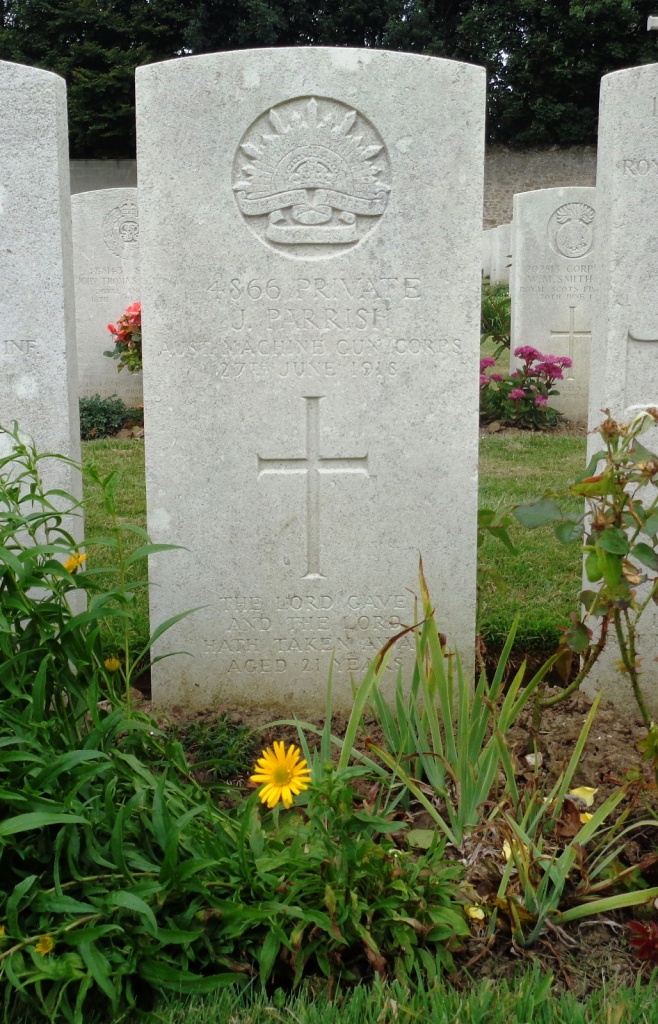
On the 27th June 1918 Private Parrish died of his wounds. He is buried in the Terlincthun British Cemetery, France.

Joseph Parrish's headstone at Terlincthun British Cemetery, France (Photograph: H. Thompson 5/9/2014)

Joseph Parrish’s headstone at Terlincthun British Cemetery, France (Photograph: H. Thompson 5/9/2014)

Private Parrish’s name is commemorated on panel 176 on the Australian War Memorial First World War Roll of Honour.

His name is also listed on the Boolaroo District Roll of Honour.

Spencer John LETCHER

Spencer John LETCHER

Per his military service record (regimental no. 4832),Spencer John Letcher was born at Cowra, N.S.W.[1]  He gave his age as 18 years and 1 month (though he was younger), his marital status as single, and his occupation as painter. His description on his medical was height 5 feet 8 inches tall, weight 132 lbs., with a fair complexion, grey eyes, and fair hair. His religious denomination was Methodist. He claimed that he had no previous military service. He completed his medical on the 28th October 1915, and was attested at Bathurst on the 28th October 1915. He joined the Coo-ees at Bathurst.

After completing the Coo-ee March he went to Liverpool Camp as reinforcement for the 13th Battalion.

On his embarkation roll his address at time of enrolment was 15 Busby Street, Bathurst, N.S.W., and his next of kin is listed as father, J. J. [John James] Letcher, 15 Busby Street, Bathurst, N.S.W.

On 8th March 1916 Private Letcher along with many of the other Coo-ees departed Sydney on the HMAT A15 Star of England, and arrived in Egypt on the 11th April 1916.

On the 19th of April 1916 he transferred to the 45th Battalion in Egypt.

On the 2nd of June 1916 Private Letcher left Alexandria aboard the transport Kinfauns Castle bound for France, arriving at Marseilles on the 8th June 1916.

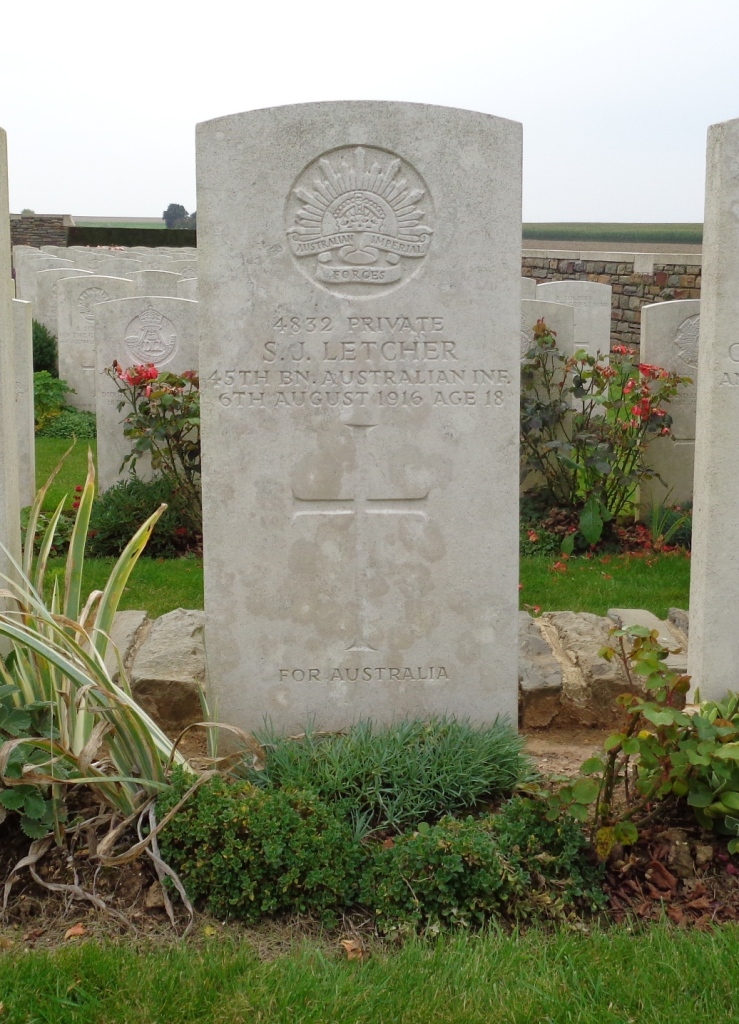
Private Letcher served with the 45th Battalion through its first action at Fleurbaix, France in July 1916, then moved with the Battalion to Pozieres in early August 1916. It was whist the 45th Battalion was in action in the vicinity of Pozieres, France, that Private Letcher was killed in action on the 6th August 1916. He was buried on the battlefield.

After the war Private Letcher’s grave was located and his remains exhumed. He was reburied at the nearby A.I.F. Burial Ground, Grass Lane, Flers, France.

Private S. J. Letcher's headstone at AIF Burial Ground, France (Photograph: H. Thompson 4/9/2014)

Private S. J. Letcher’s headstone at AIF Burial Ground, France (Photograph: H. Thompson 4/9/2014)

Private Letcher’s name is commemorated on panel 140 on the Australia War Memorial First World War Roll of Honour.

His name is also remembered on the Bathurst South Public School Roll of Honour board.

Research note:  His NSW Birth Certificate shows that he was born on 8th March 1899, so he was actually only 16 years and 7 months when he joined the Coo-ee March, and only 17 years and 4 months of age when he died.[2]


[1] NAA: B2455, LETCHER SPENCER JOHN

[2] NSW Birth Certificate, LETCHER SPENCER J 11458/1899 JOHN J LOUISA COWRA

Lewis LEOVILLE

Lewis LEOVILLE

Per his military service record (regimental no. 5489), Lewis Leoville was born at Marseilles, France. He is listed with the alternate spelling of his first name as Louis Leoville on some documents in his service record (and in earlier newspaper advertisements for his hairdressing saloon business). He is listed as being a naturalised British Subject. He gave his age as 41 years, his marital status as married, and his occupation as barber. His description on his medical was height 5 feet 6 inches tall, weight 156 lbs., with a dark complexion, grey eyes, and dark brown hair. His religious denomination was Roman Catholic. He claimed that he had 3 months previous military service in the French Army. He completed his medical on the 3rdNovember 1915 at Lithgow, and was attested at Lithgow on the same day.

After the march he went to Liverpool Camp as 15th reinforcement for the 13th Battalion. He was transferred to 17th Reinforcement for the 13th Battalion on 29th March 1916.

On his embarkation roll his address at time of enrolment was Binalong, N.S.W., and his next of kin is listed as wife, Mrs R. Leoville, Wagga Wagga N.S.W.

On 9th April 1916 Private Leoville departed Sydney on the HMAT Nestor A71 (along with Coo-ees Harold Uhr and Daniel Lynch).

After arriving in Egypt he was transferred to the 45th Battalion on the 20th May 1916.

On the 7th June 1916 Private Leoville left Alexandria aboard the transport Huntspill bound for France, arriving at Marseilles on the 14th June 1916. He was sent to the 4th Division Base Depot at Etaples, France, until the 29th July 1916, when he departed to join the 45th Battalion.

On the 4th August 1916 Private Leoville was taken on strength of the 45th Battalion when it at Tara Hill two miles north east of Albert, France, preparing to move to the front lines.

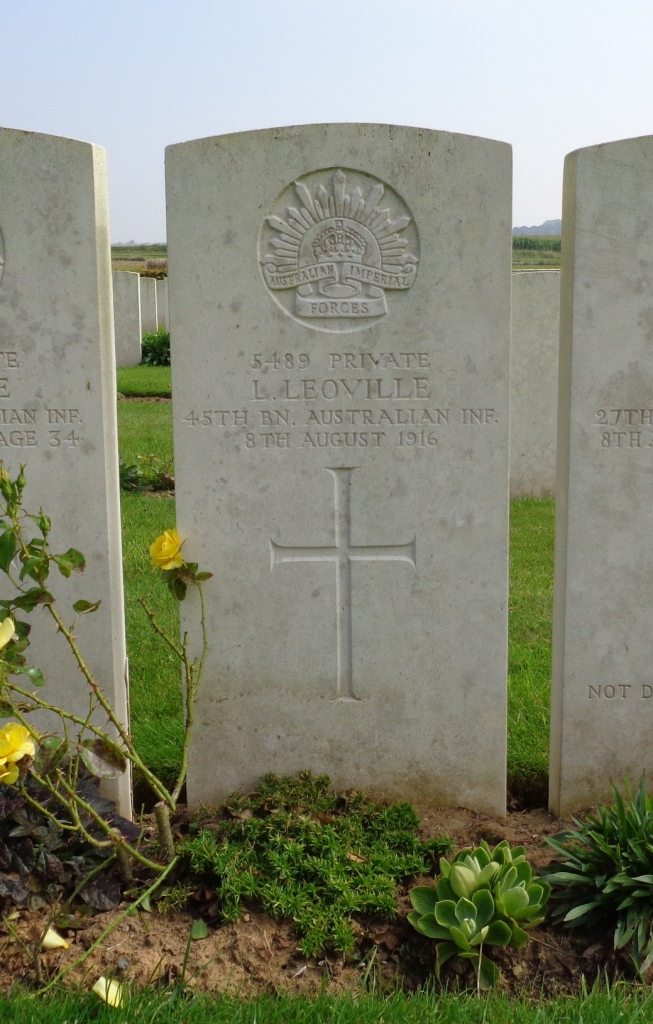
On the 8th August 1916 the 45th Battalion was in the front lines in the vicinity of Poziers, France when Private Leoville was wounded by a high explosive artillery shell. He was evacuated to the 13th Australian Field Ambulance which was set up in the village of Warloy- Baillon. Private Leoville had suffered wounds to his head, face, right leg and abdomen, and he died of these wounds that same day.

Private Leoville was buried in the Warloy-Baillon Communal Cemetery Extension, France.

Lewis Leoville's headstone at Warloy-Baillon Communal Cemetery Extension, France (Photograph: H. Thompson 4/9/2014)

Lewis Leoville’s headstone at Warloy-Baillon Communal Cemetery Extension, France (Photograph: H. Thompson 4/9/2014)

Private Leoville’s name is commemorated on panel 140 on the Australian War Memorial First World War Roll of Honour.

Edward Joseph MCGARRY

Edward Joseph MCGARRY

Per his military service record (regimental no. 4920), Edward Joseph McGarry was born at Kelso, N.S.W. He gave his age as 35 years and 8 months, his marital status as married, and his occupation as fuelman. His description on his medical was height 5 feet 9 ¼ inches tall, weight 12 stone, with a dark complexion, brown eyes, and black hair. His religious denomination was Roman Catholic. He claimed that he had no previous military service. He joined the Coo-ee March at Bathurst. He was attested at Bathurst on the 28th October 1915, but did not complete his medical until the 13th November October 1915 at Liverpool.

After completing the Coo-ee March he went to Liverpool Camp as reinforcement for the 13th Battalion.

On 7th February 1916 he was charged with being absent without leave for 5 days,

On his embarkation roll his address at time of enrolment was 7 Lord Street, Bathurst, N.S.W., and his next of kin is listed as wife, Mrs S. McGarry, 7 Lord Street, Bathurst, N.S.W.

On 8th March 1916 Private McGarry departed Sydney along with many other Coo-ees on the HMAT A15 Star of England, arriving in Egypt on the 11th April 1916.

On the 16th April 1916 he was transferred to the 4th Pioneer Battalion.

On the 4th June 1916 Private McGarry left Alexandria aboard the Transport Scotian bound for France, disembarking at Marseille on the 11th June 1916.

On the 28th September 1916 Private McGarry was admitted to the 4th Field Ambulance sick. He was admitted with Influenza, and transferred to the Division Rest Staton on the 29th September 1916. He was then admitted to the 13th Australian Field Ambulance with Influenza.

On the 4th October 1916 Private McGarry was discharged to duty.

On the 12th December 1916 Private McGarry was wounded in action with a gun shot wound to the chest. He died at No. 38 Casualty Clearing Station at Heilly on 13th December 1916, and was buried on the same day in Heilly Station Cemetery, which was adjacent to the Clearing Station.

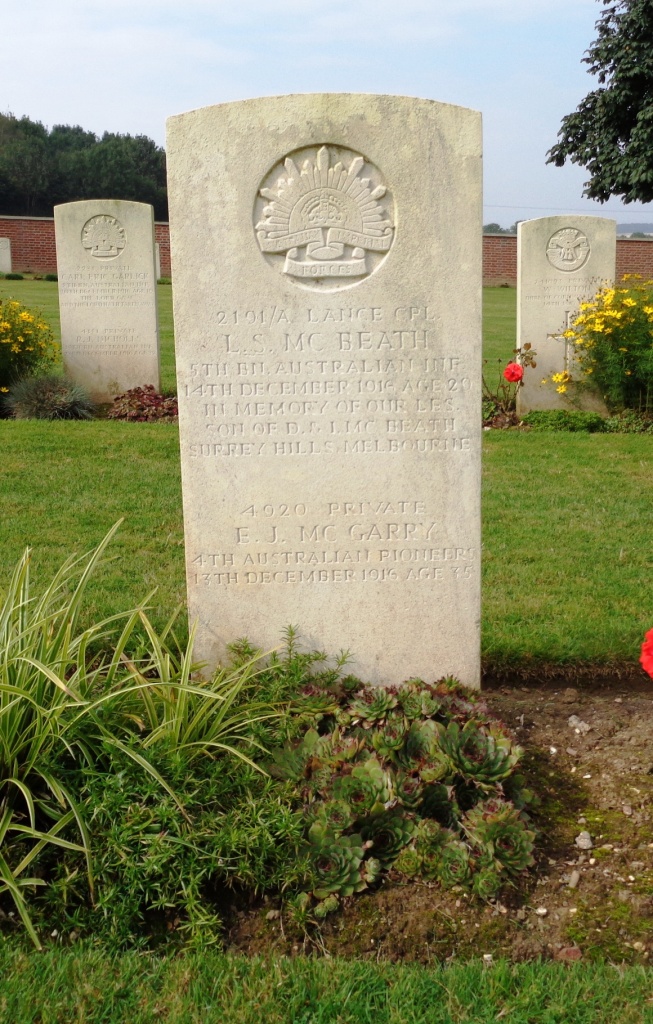
Edward Joseph McGarry's headstone at Heilly Station Cemetery, France. His name is on the bottom of the headstone (Photograph: H. Thompson, 4/9/2014)

Edward Joseph McGarry’s headstone at Heilly Station Cemetery, France. His name is on the bottom of the headstone (Photograph: H. Thompson, 4/9/2014)

An article titled ‘Died on service Private E. J. McGarry A “Coo-ee’s” sacrifice’ in the National Advocate (29/12/1916, p. 1) noted that before enlisting, he was ‘employed in the locomotive department on the Bathurst railway’, and that he left a wife and two children.

Percy Walter HOLPEN

Percy Walter HOLPEN

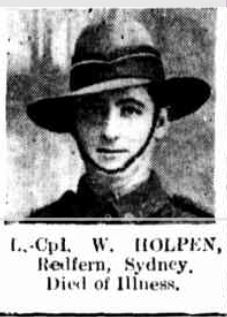
L. Cpl. W. Holpen, Redfern, Sydney. Died of Illness (Sydney Mail, 8/1/1919)

L. Cpl. W. Holpen, Redfern, Sydney. Died of Illness (Sydney Mail, 8/1/1919)

Per his military service record (regimental no. 2196), Percy Walter Holpen was born at Brisbane, Queensland. He gave his age as 21 years and 11 months, his marital status as single, and his occupation as carter. His description on his medical was height 5 feet 9 inches tall, weight 172 lbs., with a fair complexion, blue eyes, and light brown hair. His religious denomination was Church of England. He claimed that he had no previous military service. According to his Attestation paper in his service record he joined on 16th October 1915, when the Coo-ees were in Wellington. He did a preliminary medical at Wellington on 16th October 1915, and was provisionally accepted for enlistment at Dripstone by Captain Nicholas on the 19th October 1915. He completed his medical on the 11th December 1915 at Liverpool, and was attested at Liverpool on the same day, with his service dated from 16th October 1915.

After completing the march he went to Liverpool Camp and trained for the 15th reinforcements for the 1st Light Horse Regiment.

On his embarkation roll his address at time of enrolment was 84 Walker Street, Redfern, Sydney, N.S.W., and his next of kin is listed as father, Walter Holpen, 84 Walker Street, Redfern, Sydney, N.S.W.

On 21st March 1916 Trooper Holpen departed Sydney on the HMAT A26 Armadale, arriving in Egypt on the 24th April 1916. He was sent to the 1st Light Horse Training Regiment at Serapeum.

On the 1st May 1916 he was transferred to the 4th Pioneer Battalion.

On the 4th June 1916 Private Holpen left Alexandria aboard the Transport Scotian bound for France, arriving at Marseille on the 11th June 1916.

On the 10th July 1916 Private Holpen marched out of the 4th Pioneer Battalion whilst it was engaged in works in the vicinity of Fleurbaix, France, for transfer to the 46th Battalion. He marched into the 46th Battalion the next day whilst it was being relieved from the trenches in the vicinity of Sailly, France.

On the 25th August 1916 Private Holpen was admitted to the 13th Field Ambulance sick. On the 28th August 1916 he was moved to the 1st Australian Rest Station. On the 4th September 1916 he was discharged to return to duty. He rejoined the 46th Battalion the next day whilst it was resting at Rubempre, France, after coming out of the trenches in the vicinity of Poziers, France.

On the 1st December 1916 whilst the Battalion was engaged on road making at New Charlton Camp, Bazentin, France,  Private Holpen was charged with insolence to an officer and absenting himself without leave thereby missing a duty which devolved to another soldier. He was awarded 7 days Field Punishment no. 2 and fined one day’s pay.

On the 27th December 1916 Private Holpen was charged with being absent without leave from 2100 on the 20th December 1916 till 1330 on the 21st December 1916 whilst the Battalion was training at new Carlton Camp, Baxentin, France. He was fined a total of 16 days forfeiture of pay.

On the 18th January 1917 when the 46th Battalion was manning the front line trenches in front of Fricourt, France, Private Holpen was wounded in action, receiving a gun shot wound to his chest. Private Holpen was evacuated to a Casualty Clearing Station. On the 24th January 1917 he was admitted to the 3rd Stationary Hospital at Rouen, France. On the 28th January 1917 he was placed aboard the Hospital Ship Warilda at Le Harve, France, for transport to England. He arrived the next day and was admitted to the 1st London General Hospital.

Private Holpen was discharged from the 1st London General Hospital on the 24th March 1917, and granted Leave, to report to the Training Depot at Wareham, England, on the 4th April 1917. On the 10th May 1917 Private Holpen was transferred to the 65th Battalion that was training at Ludgershall, England.

On the 26th June 1917 Private Holpen was charged with being absent without leave from 1200 on the 24th June 1917 till 1530 on the 25th June 1917. He was awarded 6 days Field Punishment No. 2 and forfeiture of 8 days pay.

On the 19th September 1917 Private Holpen was transferred to the overseas Training Brigade for return to the 46th Battalion and France.

On the 20th September 1917 Private Holpen was charged with being absent without leave from 1700 on the 18th September 1917 till 2200 18th of September 1917. He was fined a total of 12 days pay.

On the 4th October 1917 Private Holpen was charged with being found beyond the limits Field by AIF Depots Orders without leave. He was awarded one day Field Punishment no. 2.

On the 14th October 1917 Private Holpen departed Southampton, England, for France, arriving at Le Harve the next day where he marched into the 4th Australian Division Base Depot. Private Holpen left the 4th Australian Division Base Depot on the 18th October 1917 to rejoin the 46th Battalion. He arrived at the 46th Battalion on the 19th October 1917 whilst it was in action around Ypres, Belgium. On the 12th November 1917 he was promoted to Lance Corporal while the Battalion was resting at Coyceques, France.

On the 25th January 1918 the 46th Battalion was conducting training at Perrone, France. Lance Corporal Holpen was charged with being absent without leave from 2100 on the 6th January 1917 till 1830 on the 7th January 1917. He was demoted to Private and fined 2 days pay.

On the 23rd April 1918 a Field General Court Martial was held where Private Holpen had been charged with Desertion being absent without leave from the 31st March 1918 to the 13th April 1918. He was found Guilty and sentenced to 5 years Penal Servitude.

On the 20th May 1918 the 5 year sentence was suspended. However, Private Holpen was soon in trouble again, being charged with escaping from confinement and being absent without leave from 27th May 1918 to 1st June 1918. On the 25th June 1918 another Field General Court Martial was held where Private Holpen was charged with this offence. He was found Guilty and sentenced to 2 years imprisonment with hard labour.

On the 27th July 1918 Private Holpen was admitted to the No.7 Military Prison to undergo his 5 year and 2 year sentences concurrently. On the 7th September 1918 the 5 years penal servitude was commuted to 2 years imprisonment with hard labour.

On the 19th November 1918 Private Holpen was admitted to the 30th General Hospital at Calais suffering from Influenza. On the 23rd November 1918 Private Holpen was listed as seriously ill, and on the 26th November 1918 he succumbed to the illness and died.

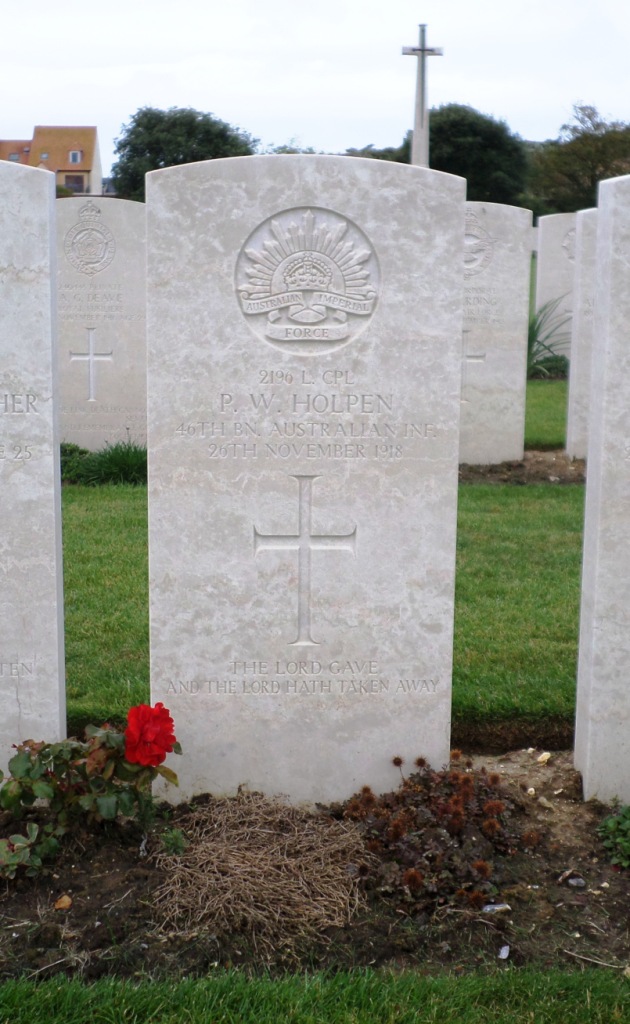
Private Holpen was buried at the Les Baraques Military Cemetery at Calais, France. Percy Walter Holpen has the rank of Lance Corporal inscribed on his headstone.

Percy Walter Holpen's headstone, Le Baraques Military Cemetery, France (Photograph: H. Thompson 28/8/2014)

Percy Walter Holpen’s headstone, Le Baraques Military Cemetery, France (Photograph: H. Thompson 28/8/2014)

Percy Walter Holpen gave incorrect details about his age when he joined the Coo-ees. His father Walter Holpen gave the particulars on his Circular for the Australian War Memorial Roll of Honour after the war, and said his son was only 20 years of age when he died.[1] He was born on the 9th January 1898, according to his Queensland birth registration under the name of Walter Percival Holpen, the son of Walter and Sarah (nee Jackson) Holpen.[2] He would therefore have only been 17 years and 9 months of age when he joined the Coo-ees in Wellington on 16th October 1915.

[1] ‘Percy Walter Holpen, AWM Roll of Honour, http://www.awm.gov.au/people/rolls/R1635220/

[2] ‘Walter Percival Holpen’, Australia Birth Index, 1788-1922, Ancestry.com

Frank HUMPHREY

Frank HUMPHREY

Per his military service record (regimental no. 1887), Frank Humphrey was born at Hull, Yorkshire, England. He gave his age as 33 years and 3 months, his marital status as single, and his occupation as bricklayer. His description on his medical was height 5 feet 4 inches tall, weight 136 lbs., with a dark complexion, greenish eyes, and brown hair. His religious denomination was Church of England. He claimed that his previous military service consisted of seven months with Roystons Horse in South Africa during the Zulu rebellion. He completed his medical on the 9th October 1915 at Gilgandra, and was attested by Captain Nicholas at Gilgandra on the same day.

His address on his initial application to enlist paper was C/o Mrs McCrossen, Albert Street, Hornsby via Sydney, N.S.W.

After completing the Coo-ee March he went to Liverpool Camp as reinforcement for the 13th Battalion, however on the 4th January 1916 he was discharged with his services being no longer required, after a second period of being absent without leave.

Frank Humphrey attempted to enlist again on the 11th February 1916 at Wangaratta in Victoria. He was successful and allocated to the 3rd reinforcements for the 60th Infantry Battalion.

On his embarkation roll his address as time of enrolment was Railway Hotel, Wangaratta, and his next of kin is listed as mother, Mrs Matilda Johnstone, 31 Thorsley Street, Princess Avenue, Hull, England.

He embarked for Egypt aboard the HMAT A17 Port Lincoln at Melbourne on the 1st May 1916, arriving at Port Suez on the 10th June 1916. He was taken on strength at Tel-el-Kebir on 9th July 1916. He was admitted to No. 2 Australian General Hospital at Tel-el-Kebir on 23rd July 1916 with Adentitis. He was discharged back to duty on 28th July 1916.

On the 2nd August 1916 Private Humphrey left Alexandria aboard the Transport Francovia bound for France.

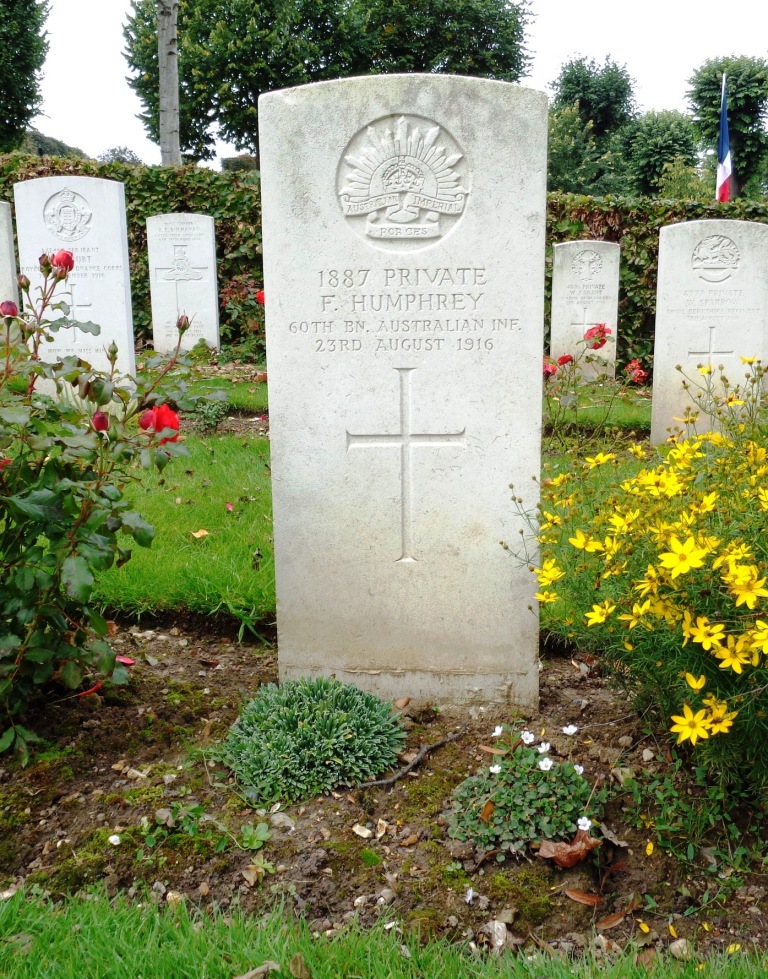
After arrival in France Private Humphrey was admitted to the No. 7 Canadian Stationary Hospital at Le Harve with Bacillary Dysentry on 19th August 1916. He died of his illness on the 23rd August 1916, and is buried at the Ste Marie Cemetery at Le Harve, France.

Frank Humphrey's headstone at Ste. Marie Cemetery, Le Havre, France (Photograph: H. Thompson 2/9/2014)

Frank Humphrey’s headstone at Ste. Marie Cemetery, Le Havre, France (Photograph: H. Thompson 2/9/2014)

His name is also remembered on the Cooee March Memorial Park Gateway (Gilgandra).

John Thomas SMITH

John Thomas SMITH

Per his military service record (regimental no. 4891), John Thomas Smith was born at Wigan, Lancashire, England. He gave his age as 30 years, his marital status as single, and his occupation as miner. His description on his medical was height 5 feet 7 inches tall, weight 10 stone 7 lbs., with a fair complexion, brown eyes, and brown hair. His religious denomination was Church of England. He completed his medical on the 16th October 1915 at Wellington, where he joined the Coo-ee March, and was attested by Captain Nicholas on the 19th October 1915 at Stuart Town. He claimed to have had no previous military service.

After completing the march he went to Liverpool Camp as reinforcement for the 13th Battalion.

On his embarkation roll his address at time of enrolment was Queen Street, Wellington, N.S.W., and his next of kin is listed as friend, L. A. Walters, Anhitn, 6 Fernbank Street, Marrickville, Sydney, N.S.W.

Private Smith departed Sydney on the HMAT Star of England on the 8th of March 1916. He arrived in Egypt on the 11th April 1916.

On the 25th April 1916 he was transferred from the 4th Training Battalion at Tel-el Kibir to the 4th Pioneer Battalion, where he was then taken on strength at Serapeum on the 29th April 1916.

On the 4th June 1916 Private Smith left Alexandria aboard the Transport Scotian bound for France, arriving at Marseille on the 11th June 1916.

Private Smith was one of four soldiers in his unit wounded in action on 10th January 1917, receiving a high explosive wound to his stomach, whilst the 4th Pioneer Battalion was undertaking work on the railway line near the village of Longueval, France. He was transferred to the 25th Ambulance Train on 11th January 1917 and admitted to the 12th General Hospital at Rouen on 12th January 1917 with a gun shot wound to the abdomen wall. He was transferred to the Convalescent Depot at Rouen on 24th January 1917, then to Base Depot “A” on 30th January 1917. He was transferred from the 4th Australian Division Base Depot back to his unit on 15th February 1917, rejoining from wounded on 17th January 1917.

He reported to hospital sick from the field on 29th June 1917, and was admitted to 39th General Hospital at Havre on 3rd July 1917. He marched into the 4th Australian Division Base Depot from hospital on 23rd July 1917. He then was readmitted to 39th General Hospital on 3rd August 1917, then on 31st August 1917 he was discharged, and returned to the 4th Australian Division Base Depot. On 7th September he marched out of the 4th Australian Division Base Depot, then returned to his unit in the field on 10th September 1917.

On the 25th October 1917 he was admitted to the 12th Canadian Field Ambulance with an accidentally dislocated right shoulder, then was transferred on the 26th October 1917 to the 13th Canadian Field Ambulance. On the 27th October he was transferred to 36th Ambulance Train, then admitted to 6th Convalescent Depot on 31st October 1917. He was discharged from the hospital at Etaples on the 8th November 1917, then marched in to the 4th Australian Division Base Depot at Havre on 10th November 1917. He returned to his unit in the field on 14th November 1917.

On 22nd February 1918 he reported to 13th Australian Field Ambulance sick, and was admitted to the 4th Australian Field Ambulance with Scabies. He returned to his unit on 28th February 1918.

Private Smith’s service record reports he was ‘wounded in action’ on the 5th April 1918, and was admitted to the 13th Australian Field Ambulance. According to the 4th Pioneer Battalion’s war diary, on 5th April 1918 the battalion was in camp near Henencourt Wood when it was shelled by German artillery. Private J. T. Smith is listed in the Casualties list as wounded by ‘H. E. Shell’. He was admitted to 22nd General Hospital at Camiers with a gun shot wound dislocated right shoulder on 6th April 1918. He was transferred to a hospital ship on 8th April 1918 and embarked for England, being admitted to Dorset County Hospital at Dorchester on 9th April 1918.

Private Smith died of his wounds on 23rd April, 1918, of gun shot wound dislocation of right shoulder (haemoptysis), at Dorset County Hospital, Dorset, England.

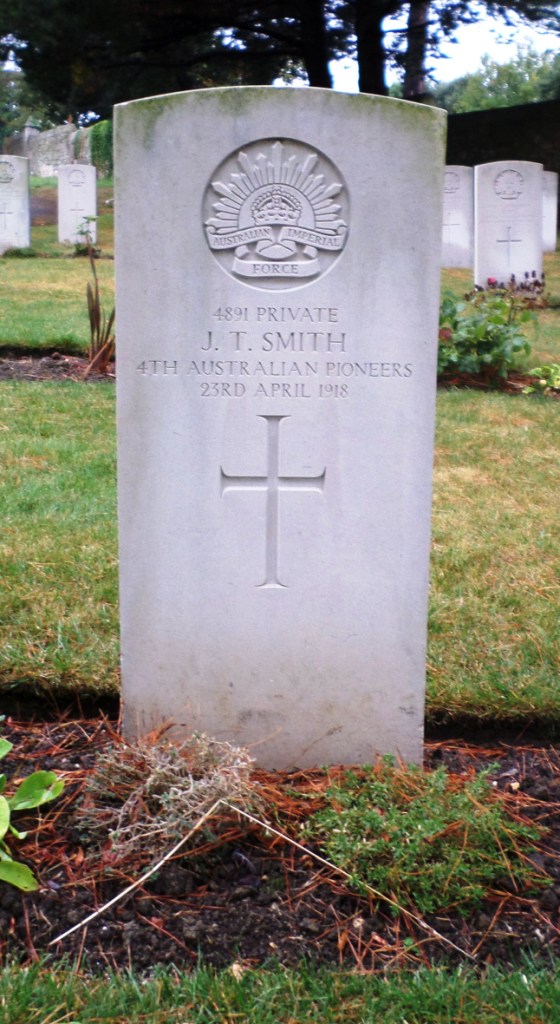
John Thomas Smith’s headstone at Melcombe Regis Cemetery, Weymouth, England (Photograph: H. Thompson 25/8/2014)

John Thomas Smith’s headstone at Melcombe Regis Cemetery, Weymouth, England (Photograph: H. Thompson 25/8/2014)

Private Smith was buried with full military honours on the 27th April, 1918 at Melcombe Regis Cemetery, Weymouth, Dorset, England.