Category Archives: Recruits

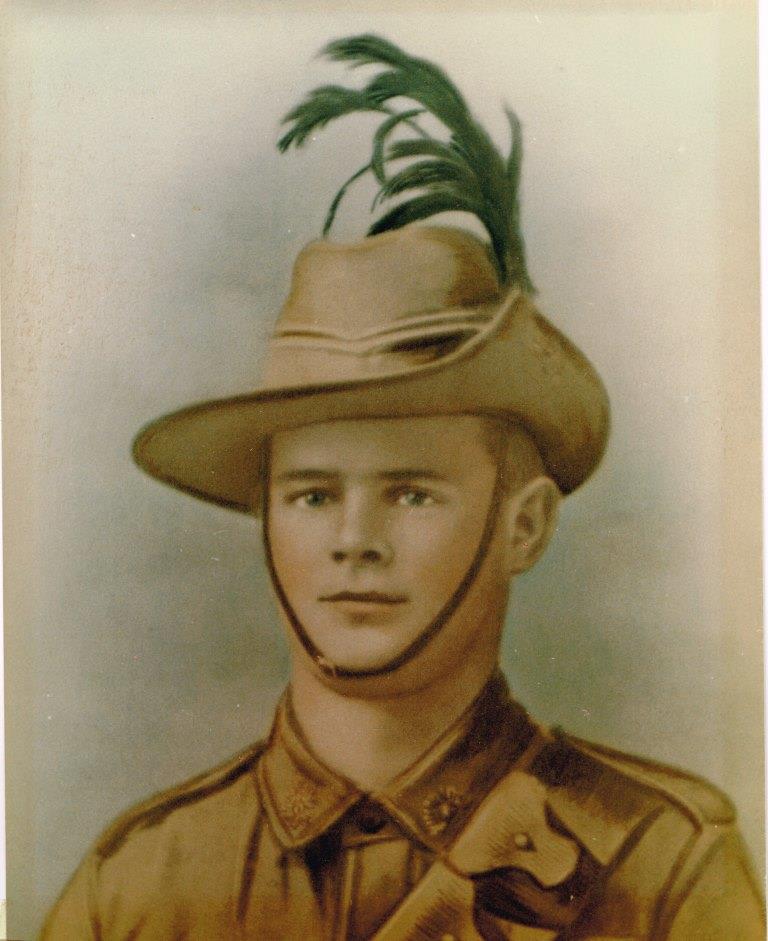
Charles Robert RICHARDSON

Charles Robert RICHARDSON

Per his military service record (regimental no. 4884), Charles Robert Richardson was born at Castle Hill, N.S.W.  He gave his age as 24 years and 8 months, his marital status as single, and his occupation as labourer. His description on his medical was 5 feet 5 ½ inches tall, weight 132 lbs., with a fair complexion, blue eyes, and brown hair. His religious denomination was Church of England. He claimed that he had no previous military service. He completed his medical examination, and was attested by Lieutenant R. Howe, at Parramatta, on the 11th November 1915.

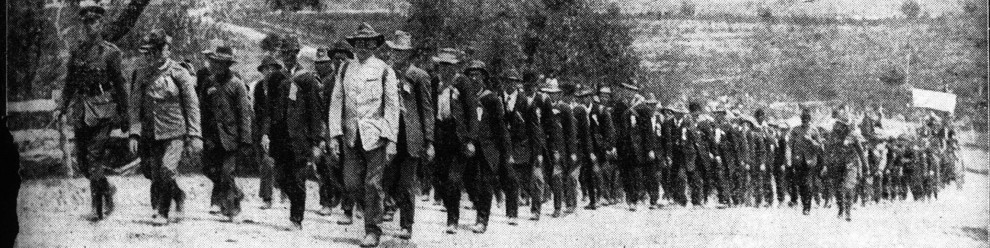
After a successful recruiting meeting the evening before, the Coo-ees left Parramatta on the morning of 11th November 1915, with an official count of 27 new recruits from that town.

After the Coo-ee March Charles Robert Richardson went into Liverpool Camp as reinforcement for the 13th Battalion.

On Private Richardson’s embarkation roll his address at time of enrolment was C/o  Mrs Clark, Harris Street, Harris Park, N.S.W., and his next of kin is listed as his mother, Mrs M.A. Richardson, C/o Mrs McKay, Sydney Road, Granville, N.S.W.

On 8th March 1916 Private Richardson departed Sydney on the HMAT A15 Star of England, along with many of the other Coo-ees, as part of the 15th reinforcements for the 13th Battalion. He arrived in Egypt on 11th April 1916.

On 16th April 1916 he was transferred to the 5th Division Cyclist’s Company (along with fellow Coo-ee Private Megarrity).

On 17thJune 1916 Private Richardson left Alexandria aboard the Transport Manitou bound for France, arriving at Marseilles on 25th June 1916.

On 23rd July 1916 Private Richardson was detached for duty with the A.P.M. of the New Zealand Division.

On 8th November 1916 Private Richardson was admitted to the 103rd Field Ambulance suffering Influenza.  On 11th November  1916 he was transferred to a Rest Station.  He rejoined the unit on 16th November 1916.

On 21st November 1916 Private Richardson took part in a trench raid during which he was wounded in action, receiving gunshot wounds to his left leg and arms.  He was evacuated to 103rd Field Ambulance, then to the 8th Casualty Clearing Station .

On 23rd November 1916 he was placed aboard the 18th Ambulance Train for evacuation to the 13th General Hospital at Boulogne, France.

On 26th November 1916 he was embarked at Boulogne on the Hospital Ship Jan Breydel for transport to England.  He was admitted to the Chatham Military Hospital that same day, with multiple gunshot wounds, knees and arms.

On 20th March 1917 Private Richardson was transferred to the 2nd Australian Auxiliary Hospital at Southall, England.

On 22nd March 1917 he was discharged from hospital and granted leave, to report to the Number 2 Command Depot at Weymouth, England, on 6th April 1917.

On 23rd May 1917 Private Richardson departed England at Devonport, aboard the H.M.A.T. Ayrshire, to return to Australia.

He arrived in Sydney on 20th July 1917, and was discharged Medically Unfit on 20th October 1917.
Albert Warren PEARCE

Albert Warren PEARCE

Per his military service record (Depot), Albert Warren Pearce was born at Richmond, N.S.W. He gave his age as 38 years and 7 months, his marital status as single, and his occupation as labourer. His description on his medical was height 6 feet tall, weight 12 stone 7 lbs., with a fair complexion, blue eyes, and fair hair. His religious denomination was Anglican. He claimed to have had six years previous military service in the Royal Australian Artillery. He completed his medical on 7th October 1915 at Gilgandra, and was attested by Captain Nicholas on 9th October 1915 at Gilgandra.

After completing the Coo-ee March he went to Liverpool Camp as reinforcement for the 13th Battalion.

Following a further medical examination before the Medical Board after arriving at Liverpool Camp with the Coo-ees, Private Pearce was discharged on 29th November 1915 as medically unfit, with defective vision.

On 21st March 1916 Albert Warren Pearce re-enlisted at Dubbo, N.S.W. He passed his medical examination, and was attested at Dubbo, on 23rd March 1916. He trained at Dubbo Depot Company as a reinforcement for the 46th Battalion, until 17th April 1916.

Private Pearce was transferred to Liverpool Camp on 18th April 1916, as reinforcement for the 1st Battalion.

On his embarkation roll his address at time of enrolment was Teroit Street, Richmond, N.S.W., and his next of kin was listed his mother, J. [Jane] Pearce, at the same address.

On 9th September 1916 Private Pearce (regimental no. 6296) departed Sydney on the HMAT A14 Euripides with the 20th reinforcements for the 1st Battalion.

Private Pearce disembarked at Plymouth, England, on 26th October 1916, and he was sent to the 1st Training Battalion.

On 21st November 1916 Private Pearce marched into camp at Fovant from No. 3 Command Depot at Wool in England. He was later moved to No. 7 Camp at Lark Hill, England.

On 23rd June 1917 he was transferred from the 1st Training Battalion to the 17th Field Ambulance, that was forming at Durrington, England.

On 25th October 1917 the 17th Field Ambulance was disbanded, and Private Pearce was sent to the Australian Army Medical Corps Training Depot at Park House, England.

On 4th November 1917 he was attached to the Group Hospital Sutton Veny, England for duty.

Private Pearce left Avonmouth near Bristol, England, on 2nd of January 1919 aboard the SS Karmala, to return to Australia.

He arrived in Australia on 25th February 1919. He was discharged medically unfit due to defective vision on 13th April 1919.

Percy Edward BLACKWOOD

Percy Edward BLACKWOOD

Per his military service record (Depot), Percy Edward Blackwood was born at South Melbourne, Victoria. He gave his age as 29 years, his marital status as single, and his occupation as labourer. His description on his medical was height 5 feet 10 inches tall, weight 154 lbs., with a dark complexion, blue eyes, and brown hair. His religious denomination was Church of England. He claimed that he had no previous military service. He completed his medical on Wellington on 27th October 1915, then made his way to catch up with the Coo-ees at Bathurst, where he was attested by Captain Eade at Bathurst on 28th October 1915.

The National Advocate named Percy Edward Blackwood as one of those who responded to the call made by the Coo-ees for more recruits at Bathurst.[1]

After completing the march he went to Liverpool Camp as reinforcement for the 5th Depot Battalion.

On 17th November 1915 Private Blackwood went before a Medical Board where he was deemed as unfit for military service due to deficient teeth. Private Blackwood was discharged medically unfit on 29th November 1915.

Percy Blackwood re-enlisted in the AIF on 21st December 1915 at Casula, N.S.W. He was attested at Casula on 23rd December 1915, and assigned to Depot Battalion.

He was allocated as a reinforcement for the 20th Battalion on 20th January 1916.

On 5th February 1916 Private Blackwood was charged with being absent without leave from 2nd to the 5th February 1916. He was fined 4 days pay.

On 19th March 1916 Private Blackwood was charged with being absent without leave from 17th to 19th March 1916. He was fined 3 days pay.

On 4th April 1916 Private Blackwood was charged with being drunk and absent without leave on 3rd April 1916 in George Street, Sydney. He was charged and fined 10 Shillings, and his Commanding Officer also recommended he be discharged. On 6th April 1916 Private Blackwood was discharged services no longer required.

Percy Blackwood re-enlisted in the AIF again on 26th October 1916 at Dubbo, N.S.W. He was assigned to Dubbo Depot Battalion until 3rd November 1916, when he was transferred to Liverpool. He was allocated as a reinforcement for the 3rd Battalion.

On his embarkation roll his address at the time of his subsequent enrolment was P.O., Cobar, N.S.W., and his next of kin is listed as his father, J. Blackwood, Montague Street, South Melbourne.

Private Blackwood (regimental no. 6957) departed Sydney on the HMAT A24 Benalla on 9th November 1916, with the 23rd reinforcements for the 3rd Battalion.

On 8th December 1916 he was charged with being absent without leave for 6 hours on the 4th of December 1916 at sea on the A24 Benalla troopship. He was fined 3 days pay.

Private Blackwood disembarked at Devonport, England, on 9th January 1917.

He was sent to the 1st Training Battalion at Lark Hill, England.

On 27th February 1917 Private Blackwood was charged with failing to answer defaulter’s parade on 17th February, 24th February, and 25th February 1917. He was awarded 7 days field punishment number 2.

On 15th March 1917 Private Blackwood was charged with being absent without leave from Tattoo on 10th March till 1700 on 11th March 1917. He was awarded 6 days field punishment number 2 and fined 11 days pay

On 5th May 1917 he was charged with being absent from Headquarters fatigue from 1430 till 2200 on 4th May 1917. He was awarded 1 day field punishment number 2, and forfeited 2 days pay.

On22nd May 1917 Private Blackwood departed Folkestone, England, bound for France.

On 10th June 1917 Private Blackwood was taken on strength of the 3rd Battalion when it was resting at Buire, France.

On 16th August 1917 Private Blackwood was charged with being absent without leave from 2100 on 12th August 1917 till 1830 on 13th August 1917. He was awarded 7 days field punishment number 2 and fined 9 days pay.

On 18th January 1918 Private Blackwood was charged with being absent without leave from 1200 on 31st December 1917 till he surrendered himself to the NCO in charge of the Bailleul Town Guard at 0640 on 1st January 1918. He was fined 12 days pay.

On 7th February 1918 Private Blackwood went on leave to England.

On 19th April 1918 Private Blackwood went before a Field General Court Martial charged with being absent without leave over furlough, from 0730 on 22nd February 1918 till apprehended by the Civil Police in London on 15th March 1918. He was also charged with being absent without leave from 9 a.m. on 12th April 1918 to 10 a.m. on 13th April 1918. He was awarded 90 days field punishment number 2 and fined 110 days pay.

On 30th July 1918 Private Blackwood went before a Field General Court Martial charged with desertion while on active service. He had been absent without leave from 2 p.m. on 12th July 1918 to 6.30 pm on 20th July 1918. He was found guilty and sentenced to 10 years penal servitude. He was sent to the Number 7 Military Prison at Calais, France.

On 5th October 1918 Private Blackwood’s sentence was commuted to 2 years in prison.

On 24th March 1919 Private Blackwood went before a Field General Court Martial charged with joining in a mutiny at the Number 7 Military Prison by ‘continuing … not to fall in after having been warned by proper authorities’. He was found guilty and sentenced to 11 years penal servitude.

On 18th April 1919 Private Blackwood was transferred to Portland Convict Prison in England.

On 9th September 1919 Private Blackwood departed England aboard the H.T. Raranga.

He arrived in Australia on 29th October 1919, and was discharged services no longer required on 30th October 1919.

[1] ‘The response : 21 volunteers from Bathurst’, National Advocate, 29 October 1915, p. 5, http://nla.gov.au/nla.news-article158157113


Edward Montgomery SHEPPARD

Edward Montgomery SHEPPARD

Per his military service record (Depot), Edward Montgomery Sheppard was born at Gerogery, near Albury, N.S.W. He gave his age as 25 years and 1 month, his marital status as single, and his occupation as fettler. His description on his medical was height 5 feet 8 inches tall, weight 136 lbs., with a fair complexion, blue eyes, and light brown hair. His religious denomination was Church of England. He claimed he had no previous military experience.

His initial Application to enlist in the Australian Imperial Force form was addressed to the Recruiting officer at Wallerawang, and his postal address was Public School, Rydal, [where his father had been the School Teacher].

He was attested at Lithgow by Captain Eade on 2nd November 1915, when the Coo-ees were at Lithgow, and completed his medical on 2nd November 1915 at Lithgow.

The Lithgow Mercury reported on 5th November 1915 that “Ted” Sheppard had joined the Coo-ees at Lithgow. [1]

After completing the Coo-ee March he went to Liverpool Camp as reinforcement for the 13th Battalion.

His service record shows he served with the 13th Battalion at Liverpool Camp from 11th November 1915 to 17th February 1916, when he was ‘posted as a deserter’.

At the end of March 1917 Edward Sheppard was notified by the Police to go back to the Military as he was never discharged from his previous enlistment.

He completed another Application to enlist in the Australian Imperial Force form on 25th April 1917, addressed to the Recruiting Officer at Lithgow.

A further attestation paper in his military service record showed a “Joined on” date of re-enlistment in the AIF of 7th May 1917, and that he had been working as a charger (furnace man) at G. & C. Hoskins Steel Foundry at Lithgow before this re-enlistment.

On his embarkation roll his address at the time of his subsequent enrolment was Lithgow, N.S.W., and his next of kin is listed as his father, William Charles Sheppard, School Teacher, Belmore, N.S.W.

On 31st October 1917 Private Sheppard (regimental service no. 4710) departed Sydney on the HMAT A14 Euripides with the 13th reinforcements for the 1st Pioneer Battalion.

A certificate of medical examination, and attestation, were completed “At sea” on 11th November 1917, on the HMAT A14 Euripides.

He disembarked at Devonport in England on 26th December 1917, and was sent to the Pioneer Training Battalion at Sutton Veny.

Two days later, on 28th December 1917 he was admitted to hospital sick with scabies. He was discharged on 3rd January 1918.

On 10th January 1918 Private Sheppard was again sent to hospital suffering with scabies. He was discharged on 16th January 1918.

On 31st March 1918 Private Sheppard was sent to hospital again suffering with scabies. He was discharged on 4th April 1918.

On 29th April 1918 Private Sheppard was charged with being absent without leave from midnight on 24th April 1918 till apprehended by the Military Police at 9.45 p.m. on 26th April 1918. He was awarded 2 days Field Punishment number 2 and fined 4 days pay.

On 14th August 1918 Private Sheppard was charged with being absent without leave from 9.30 a.m. on 11th August 1918 till reporting back at 6.30 a.m. on 12th August 1918. He was awarded 2 days Field Punishment Number 2 and fined 3 days pay.

On 28th October 1918 Private Sheppard was sent to hospital suffering conjunctivitis he was discharged on the 1st of November 1918.

On 11th March 1919 Private Sheppard was sent to the Number 1 Command Depot at Sutton Veny, England.

On 29th April 1918 Private Sheppard was charged with being absent without leave from midnight 24th April 1918 to 9.45 p.m. on 26th April 1918. He was awarded 2 days field punishment No. 2, and forfeited 4 days pay.

On 2nd July 1918 he was attached to Depot Wiltshire Regiment at Devizes in England until 27th July 1918.

On 18th August 1918 he has charged with being absent without leave at Sutton Veny from 9.30 a.m. on 11th August 1918 until 6.30 a.m. on 12th August 1918.  He was awarded 2 days field punishment No. 2, and forfeited 3 days pay.

On 28th October 1918 he was admitted to a military hospital with conjunctivitis.  He was discharged from Sutton Veny Hospital on 1st November 1918.

On 1st April 1919 Private Sheppard transferred to the Australian Army Service Corps Depot at Parkhouse, England.

On 5th June 1919 Private Sheppard was charged with being absent without leave from 2200 on 31st May 1919 till 2100 on 1st June 1919. He was fined 1 days pay.

On 30th July 1919 Private Sheppard was charged with being absent without leave from 2130 on 18th July 1919 till 1500 on 25th July 1919. He was awarded 7 days field punishment number 2 and fined 14 days pay.

On 22nd October 1919 he married Matilda Maud Miller, a 23 year old widow, at the Register Office at Warminster, England.

On 21st November 1919 Private Sheppard was placed on indefinite leave.

Private Sheppard returned to Australia with his new wife on H.T. Runic on 20th December 1919.

He disembarked in Australia on 6th February 1920.

He was discharged on 12th March 1920.

[1] ‘Barometer of patriotism’, Lithgow Mercury, 5 November 1915, p. 4, http://nla.gov.au/nla.news-article218448463

John Robert LEE

John Robert LEE

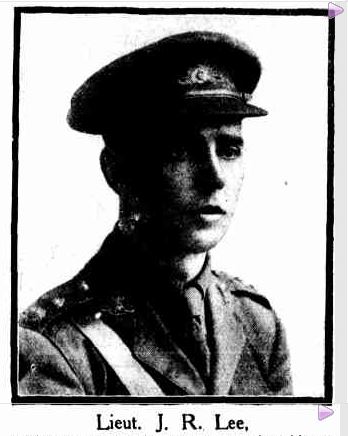
Lieutenant J. R. Lee (Sydney Mail, 3/3/1920)

Lieutenant J. R. Lee (Sydney Mail, 3/3/1920)

Per his military service record (Lieutenant) John Robert Lee was born at Lancaster, Durham, England. He gave his age as 29 years and 11 months, his marital status as single, and his occupation as water engineer. His description on his medical was height 5 feet 11 ½ inches tall, weight 10 stone 7 lbs., with a dark complexion, blue eyes, and dark hair. His religious denomination was Methodist. He claimed to have previous military service with the Gilgandra Rifle Club. He completed his medical on the 7th October 1915 at Gilgandra, and was attested by Captain Nicholas at Gilgandra on the 9th October 1915.

On the Coo-ee March Private Lee was made an acting Quarter Master Sergeant in the travelling committee of control appointed for the Coo-ee March at Stuart Town, with Major Wynne as chairman, Captain Hitchen, Mr H. T. Blacket, and Acting Sergeant Stephens as Secretary, during a visit by A. H. Miller (Secretary), and C. H. Richards and P. J. MacManus, from the Gilgandra Recruiting Committee.[1] In this role he was a recruiting speaker on the march.[2] He gave many of the recruiting speeches on the march from Gilgandra to Sydney.

John Robert Lee had been brought to Australia by the Methodist Home Missionary Society in 1911, and he was sent initially to Leeton, where he established the first Methodist church in that town.[3]  The Rev. J. R. Lee had been appointed a probationary clergyman at Gilgandra in 1913, but following his transfer elsewhere after this 12 month appointment, he had resigned from the ministry to take up farming near Gilgandra in 1914, where he remained a lay preacher, before joining the Coo-ee March.[4]

The Dubbo Liberal and Macquarie Advocate reported on ‘his powerful recruiting speech’ at Dubbo:

‘He said that the “Coo-ees” were deeply sensible of the warm-hearted receptions they had been accorded so far, and they hoped that there would be hundreds of them by the time they reached Sydney. They hoped this idea of Captain Hitchen’s would be an inspiration to the young men all along the route. Personally, he was glad to do what he could to get Australia to realise the seriousness of the situation and the obligation of service… “The  ‘Coo-ees’ are after men,” cried Mr. Lee, “and we want you. There never was a time when your country more needed you. I hope every young man will realise the position as Hitchen’s ‘Coo-ees’ realise it…”. [5]

After completing the Coo-ee March he went to Liverpool Camp as reinforcement for the 13th Battalion.

Sergeant-Major Lee was a recruiting campaigner for the State Recruiting Committee on the ‘Wallabies’ and ‘North Coaster’ recruiting marches in December 1915 and January 1916.[6]

He applied for a commission in the Australian Imperial Forces on 10th July 1916, after completing a course at the Officer Training School at Duntroon on 20th June 1916.

He was appointed 2nd Lieutenant, and was posted to the 17th Reinforcements for the 24th Battalion on 25th July 1916.

On his embarkation roll his rank was 2nd Lieutenant, and his address at time of enrolment was Gilgandra, N.S.W., and his next of kin is listed as his mother, J. Sanders, Oliver Ford, Conrett, Durham, England.

2nd Lieutenant Lee departed Sydney on the HMAT A8 Argyllshire on 31st October 1916 with the 17th reinforcements for the 24th Battalion, bound for England.  He disembarked at Devonport on 10th January 1917.

He was taken on strength of 24th Battalion in France on 23rd March 1917.

He was transferred to the 21st Battalion in France on 2nd April 1917.

He wrote in a letter dated 15th April 1917 to the editor of the Gilgandra Weekly:

“… when I joined the battalion (21st) about two months ago they had had a fair innings for a time and were due for a spell. Nevertheless, was able to join in the trot on the heels of the Hun through Bapaume and villages near by. Began to think by the rate Fritz was falling back that we had started on that long last route march to Berlin, only it was a little bit different to that good old Western trail from Gilgandra to the sea…”.[7]

He was promoted to Lieutenant on 17th May 1917.

Lieutenant Lee attended the General Headquarters Gun School from 3rd to 8th September 1917.

He went on leave to England on 20th October 1917, and returned from leave on 3rd November 1917.

Lieutenant Lee injured his knee on 23rd November 1917, whilst the Battalion was training undertaking a football match at Locre, Belgium.

On 25th November he was admitted to the 14th General Hospital at Boulogne in France.

On 30th November 1917 Lieutenant Lee was evacuated to England on H.S. St. David, and admitted to the 3rd London General Hospital with a dislocation of his right knee.

On 12th March 1918 he began his return to Australia on the troopship Kenilworth Castle.

He arrived in Sydney on the HMAT Kanowna on 24th May 1918.

His appointment was terminated on 22nd June 1918.

[1] ‘Our soldiers’, The Dubbo Liberal and Macquarie Advocate, 26 October 1915, p. 2, http://nla.gov.au/nla.news-article77601552

[2] ‘Sergt-Major J. R. Lee’, The Blue Mountain Echo, 19 November 1915, p. 3, http://nla.gov.au/nla.news-article108047436

[3] ‘Personal’, Spectator and Methodist Chronicle, 19 November 1915, p. 1618, http://nla.gov.au/nla.news-article154174538

[4] ‘The Gilgandra March’, The Methodist, 20 November 1915, p. 7, http://nla.gov.au/nla.news-article155442595

[5] ‘The “Coo-ees” arrival in Dubbo’, The Dubbo Liberal and Macquarie Advocate, 15 October 1915, p. 5, http://nla.gov.au/nla.news-article77601264

[6] ‘Route Marches’, The Sun, 26 November 1915, p. 8,  http://nla.gov.au/nla.news-article221913106 ; ‘The Marches. Wallabies start’, The Sydney Morning Herald, 9 December 1915, p. 10, http://nla.gov.au/nla.news-article15630157 ; ‘The Federal Elections’, Dungog Chronicle : Durham and Gloucester Advertiser,  28 November 1918, p. 7, http://nla.gov.au/nla.news-article134142941

[7] ‘Lieutenant J. R. Lee’, Gilgandra Weekly,  22 June 1917, p. 22, http://nla.gov.au/nla.news-article108453939


Thomas ANDERSON

Thomas ANDERSON

Per his military service record (Depot), Thomas Anderson was born at Redfern, N.S.W. He gave his age as 34 years and 6 months, his marital status as single, and his occupation as labourer. His description on his medical was height 5 feet and 8 inches tall, weight 154 lbs., with a fair complexion,[grey eyes], and brown hair. His religious denomination was Roman Catholic. He claimed that he had no previous military service. He gave his address as Roslyn Street, Mascot, N.S.W., on his initial Application to enlist in the Australian Imperial Force form. He completed his medical on the 25th October 1915 at Wellington (7 days after the Coo-ees left), then travelled to catch up with the Coo-ees at Blayney, and was attested by Captain Eade at Blayney on 26th October 1916.

He was listed in The Bathurst Times as being one of the five Wellington recruits who joined the Coo-ees at Blayney. [1]

After completing the Coo-ee March he went to Liverpool Camp as reinforcement for the 13th Battalion.

On 7th December 1915 Private Anderson, with fellow Coo-ee Private Denmead, while under the influence of liquor, were charged with begging alms in Campbell Street, Sydney, after they had ‘asked a military police officer for a “sprat” to get a drink’.[2] Along with Private Denmead, he appeared before the Central Police Court, and was sentenced to one hour’s imprisonment.

Private Anderson was charged with being absent without leave from 1st December 1915 to 12th December 1915, and as a result, on 14th December 1915 he was discharged as not likely to become an efficient soldier.

On 24th April 1916 Thomas Anderson re-enlisted at Bathurst, where he gave his occupation as miner, and went into Depot Camp at Bathurst. He was transferred to the 53rd Battalion on 26th April 1916. On 5th July 1916 he transferred to the Trench Mortar Battery at Menangle Park.

On his embarkation roll his address at time of enrolment was Portland, N.S.W., and his next of kin was listed his sister, Mrs M. Cox, Roslyn Street, Mascot, Sydney, N.S.W.

ON 7th November 1916 Private Anderson embarked from Sydney with the 2nd reinforcements for the Light Trench Mortar Battery on the HMAT Ceramic A40, with regimental no. 1190.

He disembarked at Plymouth in England on 21 November 1916 for further training.

On 7th February 1917 he marched into the 4th Training Battalion at Codford in England.

On the 22nd February 1917 Private Anderson was taken on strength of the 13th Battalion.

On 27th February 1917 Private Anderson proceeded overseas from Folkstone to France, to reinforce the 13th Battalion.

On 1st March 1917 Private Anderson marched into the 4th Australian Division Base Depot at Etaples in France. On 5th March 1917 he marched out of the 4th Australian Division Base Depot to join the 13th Battalion. On 6th March 1917 Private Anderson was taken on strength of the 13th Battalion whilst it was training at Ribemont in France.

Just over a month later, on 11th April 1917, the 13th Battalion was involved in an attack on the Hindenburg Line. During this attack Private Anderson was wounded in action, receiving a gunshot wound to his right hand. Private Anderson was evacuated to the 56th Casualty Clearing Station, then placed aboard the 11th Ambulance Train. On 13th April 1917 he was admitted to the 1st General Hospital.

On 19th April 1917 Private Anderson was placed aboard the Hospital Ship Londonderry at Rouen for evacuation to England. On 20th April 1917 he was admitted to the 1st Southern General Hospital at Birmingham, England.

On 12th June 1917 Private Anderson was discharged from hospital, and granted leave to report to the Number One Command Depot at Pernham Downs in England on 16th June 1917.

On 30th June 1917 Private Anderson was charged with being absent without leave from 3.30 pm on 26th June 917 until 8.20 pm on 27th June 1917. He was forfeited two days pay.

On 30th July 1917 Private Anderson was attached to the 9th Training Battalion at Durrington in England.

On 7th January 1918 Private Anderson was sent to the Number Two Command Depot at Weymouth in England.

On 10th March 1918 Private Anderson departed England to commence his return to Australia aboard the Durham Castle for discharge with ankylosis in his right thumb. His ship stopped at Cape Town in South Africa.

On 30th April 1918 he was charged at Cape Town with (1) Conduct to the prejudice of good order and military discipline in that he failed to be on board HT Orontes at sailing time 2 pm, the draft to which he belonged having embarked at 10.30 am, and (2) being absent without leave from 2 pm on 19th April 1918 until 8 pm on 21st April 1918, when he reported back. He was awarded 168 hours detention and fined 31 days pay. He also was absent without leave from 10 pm on 29th April 1918 to 4.30 pm on 3rd May 1918, and his sentence of 168 hours for this offence was concurrent with his awarded detention on 22nd April 1918.

On 4th May 1918 Private Anderson departed Cape Town aboard the HT Borda bound for Australia.

He arrived in Sydney on 1st June 1918, and was discharged medically unfit on 5th July 1918.

[1] ‘Western news’, The Bathurst Times, 27 October 1915, p. 3, http://nla.gov.au/nla.news-article111244211

[2] ‘Begging Alms’, National Advocate, 10 December 1915, p. 5, http://nla.gov.au/nla.news-article158151776


Harold Roy Devlin UHR

Harold Roy Devlin UHR

Per his initial WWI military service record (regimental no. 5471), Harold Uhr was born at Woollahra, Sydney. He gave his age as 18 years and 10 months, his marital status as single, and his occupation as labourer. His description on his medical was height 5 feet 9 inches tall, weight 140 lbs., with a dark complexion, grey eyes, and brown hair. His religious denomination was Church of England. He claimed that he had no previous military service.

His “joined on” date on both his Australian Imperial Force Attestation Paper of Persons Enlisted for Service Abroad, and embarkation roll, was 7th November 1915, when the Coo-ees were recruiting at Lawson. He was reported as having being a Coo-ee in later newspaper articles in both the Sunday Times and The Cumberland Argus and Fruitgrowers Advocate.[1] He appears to have been re-attested for some reason, as his service record records that he was attested, and undertook his medical examination, at Liverpool on 30th March 1916.

After the Coo-ee March he went to Liverpool Camp as reinforcement for the 13th Battalion.

On his embarkation roll his address at time of enrolment was Waratah Street, Lawson, N.S.W., and his next of kin is listed as his mother, Mrs K. M. [Kate] Uhr, Co/ Post Office, Wentworthville, N.S.W.

On 9th April 1916 Private Uhr departed Sydney on the HMAT Nestor A71 (along with Coo-ees Lewis Leoville and Daniel Lynch), with the 17th Reinforcement for the 13th Battalion.

Soon after arriving in Egypt, on 28th May 1916 Private Uhr was admitted to the 2nd Australian Stationary Hospital at Tel El Kebir, sick with Influenza. On 29th May 1916 he was transferred to the 2nd Australian General Hospital at Abassisa, Egypt.

On 10th July 1916 Private Uhr boarded the H.T. Clan McGillivray at Suez for return to Australia, suffering Rheumatism and Bronchitis. He was discharged Medically Unfit on 26th September 1916.

On 11th December 1916 he reenlisted in the Australian Imperial Force at Sydney under his full name Harold Roy Devlin Uhr, and he was allocated as reinforcement for the 17th Battalion (regimental no. 51639). However, the following month he was discharged Medically Unfit on 13th of January 1917.

On 27th July 1917 Harold Roy Devlin Uhr reenlisted for a third time in the Australian Imperial Force at Sydney (regimental no. 7115), and he was allocated to the 21st Reinforcement for the 17th Battalion.

He departed Sydney on the HMAT Euripides A14 on 31st October 1917, with the rank of Acting Corporal. During the voyage he was admitted to the ship’s hospital at sea on 14th November 1917, and was discharged the next day.

Acting Corporal Uhr arrived at Devonport, England on 25th December 1917. He was sent to the 5th Training Battalion at Fovant, England, where he reverted to the rank of Private two days later on 27th December 1917.

He was re-appointed Acting Corporal at Fovant on 25th February 1918., then reverted to the rank of Private on 31st March 1918.

Private Uhr departed England on 1st April 1918, bound for France. On 16th April 1918 he marched into the 17th Battalion, when it was in the front lines in the vicinity of Gentelles, France.

On 6th August 1918 the 17th Battalion was at Blangy Tronville, France when Private Uhr was evacuated to the 47th Casualty Clearing Station sick with Trench Fever. On 7th August 1918 Private Uhr was placed on board the 20th Ambulance Train and taken to the 10th General Hospital at Rouen, France, where he was admitted on 8th August 1918.

On 17th August 1918 he was invalided by Hospital Ship to England. He was admitted to the Bristol War Hospital on 18th August 1918.

On 26th August 1918 Private Uhr was transferred to the 3rd Australian Auxiliary Hospital at Dartford, England. On 30th August 1918 he was granted leave, to report to the Number 4 Command Depot at Hurdcott, England on 13th September 1918.

On 13th October 1918 Private Uhr was admitted sick to the Number 2 Group Hospital at Hurdcott, England. He was discharged on 19th October 1918.

On 8th January 1919 Private Uhr departed England aboard the Orsova for return to Australia.

He was discharged Medically Unfit on 16th April 1919.

[1] ‘The Coo-ees, en route for Berlin, anniversary of their start’, Sunday Times, 8 October 1916 , p. 9, http://nla.gov.au/nla.news-article121335018 ; ‘Of the Boys’, The Cumberland Argus and Fruitgrowers Advocate’, 8 February 1919 , p. 11, http://nla.gov.au/nla.news-article86116771


William Sidney LOVETT

William Sidney LOVETT

Per his military service record (regimental no. 25563), William Sidney Lovett was born at Wellington, N.S.W. He gave his age as 19 years and 7 months, his marital status as single, and his occupation as labourer. His description on his medical examination was height 5 feet 5 ¾ inches tall, weight 141 lbs., with a fair complexion, blue eyes, and brown hair. His religious denomination was Church of England. He claimed that he had six months experience in the Senior Cadets at Wellington.

W. S. Lovett was named in the Leader as one of the recruits who joined the Coo-ees at Orange.[1] He was attested by Captain Nicholas at Orange on the 24th October 1915, and completed his medical examination in Orange on the same day. It was noted on his initial Application to Enlist in the Australian Imperial Force form addressed to the Recruiting Officer at Orange that his parents were both deceased.

After completing the Coo-ee March he went to Liverpool Camp as reinforcement for 13th Battalion.

On 1st February 1916 he was transferred to the reinforcements of the 7th Field Artillery Brigade.

On 6th June 2016 he was designated a Gunner.

On his embarkation roll his address at time of enrolment was Warren, N.S.W., and his next of kin is listed as Miss E. M. [Ethel Mary] Gardiner, friend, “Coolma,” Lower Wycombe Road, Neutral Bay, Sydney, N.S.W.

Gunner Lovett departed Sydney on the HMAT Orsova A67 on 29th July 1916 with the 2nd Reinforcements for the 7th Field Artillery Brigade, and arrived at Plymouth in England on 14th September 1916.

On 6th October 1916 Private Lovett was charged with A.W.L., overstaying leave from midnight on 28th September 1916 to 4 pm on 29th September 1916. He was fined 2 days pay.

On the 24th of October 1916 he marched into the 14th Training Battalion at Hurdcott, Wiltshire, England.

On 25th November 1916 he was admitted to Fovant Military Hospital in England sick. He was discharged on 12th December 1916, and marched into the 14th Training Battalion at Hurdecott. He was re-admitted to hospital for observation on 20th December 1916.

On 8th February 1917 Private Lovett departed Folkestone aboard the S.S. Invicta bound for France. He marched into the 5th Australian Division Base Depot at Etaples, France on 9th February 1917.

He was taken on strength of the 55th Infantry Battalion on 12th February 1917 when it was preparing to move into the front line in the vicinity of Longueval, France.

On 10th May 1917 the 55th Battalion was manning the front line near Noreuil, France, when Private Lovett was wounded in action by a gas poisoning. He was sent to the 8th Australian Field Ambulance. On 11th May 1917 he was moved back to the 3rd Casualty Clearing Station. On 12th May 1917 he was placed aboard the 20th Ambulance Train and on 13th May 1917 he was admitted to the 3rd Canadian Stationary Hospital at Doullens, France. On 20th May 1917 he was transferred to the 18th General Hospital at Camiers in France.

On 30th May 1917 he was placed aboard a Hospital Ship for evacuation to England. He was admitted to the 3rd London General Hospital at Wandsworth, England, later that day.

He was discharged on 15th September 1917 and granted two weeks leave, and to report to the Number 2 Command Depot at Weymouth, England, on 29th September 1917.

On 6th October 1917 Private Lovett was transferred to the Number 4 Command Depot at Codfod, England. On 12th October 1917 he was transferred to the Overseas Training Brigade at Perhham Downs.

On 2nd November 1917 Private Lovett departed Southampton bound for France.

He marched into the 5th Australian Division Base Depot at le Harve, France, on 3rd November 1917.

On 14th November 1917 Private Lovett rejoined the 55th Battalion. On the same day he was admitted to the 50th Casualty Clearing Station suffering Dermatitis. On the 16th of November 1917 he was placed aboard the 20th Ambulance Train and moved back to the 26th General Hospital at Etaples, France on the 17th of November 1917. On the 20th of November 1917 he was transferred to the 25th General Hospital. He was discharged on the 5th of December and sent to the 5th Australian Division Base Depot at Le Harve, France.

On 24th December 1917 Private Lovett was transferred to the 7th Field Artillery Brigade and designated a Gunner, and marched out to the 3rd Division Artillery.

On 14th January 1918 Gunner Lovett was appointed Driver.

On 5th November 1918 Driver Lovett went on leave to England. He returned from leave on 25th November 1918.

On 12th February 1919 Driver Lovett was admitted to the 47th Casualty Clearing Station suffering Influenza. On 20th February 1919 he was moved to the 55th Casualty Clearing Station. On 22nd February 1919 he was placed aboard the 31st Ambulance Train, and on 24th February 1919 he was admitted to the 14th General Hospital. He was discharged on 3rd March 1919, and sent to the Australian Base Depot at Le Harve, France.

On 9th April 1919 Driver Lovett was admitted to the 39th General Hospital with Scabies. He was discharged on 13th April 1919.

On the 15th of April 1919 Driver Lovett departed France bound for England to commence his return to Australia. He arrived at Southampton on 16th April 1919 and marched into the Number 2 Group.

On 15th June 1919 Driver Lovett departed England aboard the H.T. Swakopmund bound for Australia.

He arrived in Australia on 2nd August 1919, and was discharged Termination of Period of Enlistment on 17th September 1919.

[1] ‘The Recruits,’ Leader, 25 October 1915, p. 4 , http://nla.gov.au/nla.news-article117842599


Peter WILSON

Peter WILSON

Peter Wilson. Photograph courtesy of Gilgandra Museum and Historical Society.

Peter Wilson. Photograph courtesy of Gilgandra Museum and Historical Society.

Per his military service record (regimental no. 2404), Peter Wilson was born at Nyngan, N.S.W. He gave his age as 21 years and 2 months, his marital status as single, and his occupation as labourer.  His description on his medical was height 5 feet 7 ½ inches tall, weight 12 stone 7 lbs., with a fair complexion, blue eyes, and fair hair. His religious denomination was Church of England.

He completed his medical at Gilgandra on 7th October 1915, and was attested by Captain Nicholas at Gilgandra on 9th October 1915. He claimed he had no previous military service.

After completing the Coo-ee March he went Menangle Light Horse Camp as reinforcement for the 7th Light Horse Regiment.

Private Wilson received a wristlet watch at a welcome home function held for some of the Coo-ees home on leave at Gilgandra at the end of December 1915. According to the speaker, Mr Garling, said Private Wilson ‘was very keen to do his duty for his country’, and ‘had made several attempts to enlist but had been rejected. However, he underwent a course of physical training, which improved his constitution and physique to such an extent that the next time he presented himself he was accepted’.[1]

On his embarkation roll his address as time of enrolment was Myrtle Street, Gilgandra, and his next of kin is listed as his sister, Miss Christiana Wilson, Miller’s Point, Sydney, N.S.W.

Trooper Wilson departed Sydney on the HMAT Palermo A56 on 18th April 1916, with the 16th Reinforcements for the 7th Light Horse Regiment.

After arriving in Egypt he was taken on strength by the 2nd Light Horse Training Regiment at Tel-el Kebir on 10th June 1916.

On 10th July 1916 he was transferred to the 1st Field Squadron Engineers.

On 19th July 1916 he was admitted to the Scottish Horse Field Ambulance, then was admitted to the 31st General Hospital at Port Said in Egypt with a condition not yet diagnosed on 20th July 1916. On 25th July he was transported by hospital train to Cairo, and was admitted to the 3rd Australian General Hospital at Abbassia with Pyrexia. He was discharged and returned to duly on 27th July 1916.

Private Wilson served with the 1st Field Squadron Engineers during the campaigns in Gaza and Palestine.

On 29th October 1917 he went to hospital sick and reverted to Sapper. On 31st October 1917 he was admitted to the 43rd Stationary Hospital with Cellulitis hand. On 10th January 1918 he was sent by hospital train, and admitted to the 24th Stationary Hospital at Kantara. On 11th January 1918 he was admitted to the 31st General Hospital at Port Said. On 27th January 1918 he was admitted to 14 Australian General Hospital at Port Said. On 2nd February 1918 he was sent to a Rest Camp at Port Said.

On 13th February 1918 he left the Rest Camp, and joined the Engineer Training Unit at Moascar.

On 27th February 1918 he was attached to D Troop IFSE for duty in the field.

His record of service notes that on 26th April 1918 he received superficial abrasions to his arms and hands and hip when he was thrown from a pontoon wagon at Jerusalem.

On 28th April 1918 he was admitted to the 66th Casualty Clearing Station at Jerusalem with Diarrhoea. He was transferred to the 75th Casualty Clearing Station on 30th April 1918. On 2nd May 1918 he was admitted to the 47th Stationary Hospital at Gaza. On 6th May 1918 he was transferred to 24 Stationary Hospital at Kantara. On 8th May 1918 he was transferred to 1st Australian General Hospital at Port Said in Egypt with Contused Hands. On 11th May 1918 he was sent to a Rest Camp at Port Said. On 22nd May 1918 he was sent to a Rest Camp at Moascar. On 31st May 1918 he was admitted to 2 Australian Stationary Hospital sick, and was discharged on 3rd September 1918 to a Rest Camp at Port Said.

He marched out to the Engineers Training Unit at Moascar on 18th September 1918.

On 28th September 1918 he was sent to 1st Field Squadron Engineers, and was taken on strength in the field on 1st October 1918. On 1st October 1918 he was made Driver.

On 19th June 1919 he was temporarily attached to AIF Headquarters at Kantara as a Driver.

Driver Wilson commenced his return to Australia on 3rd July 1919 aboard the H.T. Malta at Kantara.

He was discharged termination of period of enlistment on 25th September 1919.

[1] [No title], Gilgandra Weekly, 7 January 1916, p. 12, http://trove.nla.gov.au/newspaper/article/119922632


Henry James Naughton BLAKEMAN

Henry James Naughton BLAKEMAN

Per his military service record (regimental no. 4442), Henry James Naughton Blakeman was born at York, Western Australia. He gave his age as 21 years and 5 months, his marital status as single, and his occupation as plumber. (However his Certificate of Discharge in his service record states he was only 17 years of age when he enlisted, and his birth was registered in Western Australia in 1898).[1] His description on his medical was height 5 feet 8 inches tall, weight 122 lbs., with a fair complexion, blue eyes, and brown hair. His religious denomination was Roman Catholic. He claimed that he had had 6 months previous military service with the Cadets and served 3 years with the 41st Infantry.

He was attested at Lithgow by Captain Eade on 2nd November 1915, when the Coo-ees were at Lithgow, and completed his medical on 3rd November 1915 at Lithgow.

After completing the Coo-ee March he went to Liverpool Camp as reinforcement for the 13th Battalion.

On his embarkation roll his address at time of enrolment was Bowenfels, Cascade Street, Katoomba, N.S.W., and his next of kin is listed as his father, H. N. [Henry Naughton] Blakeman, at the same address.

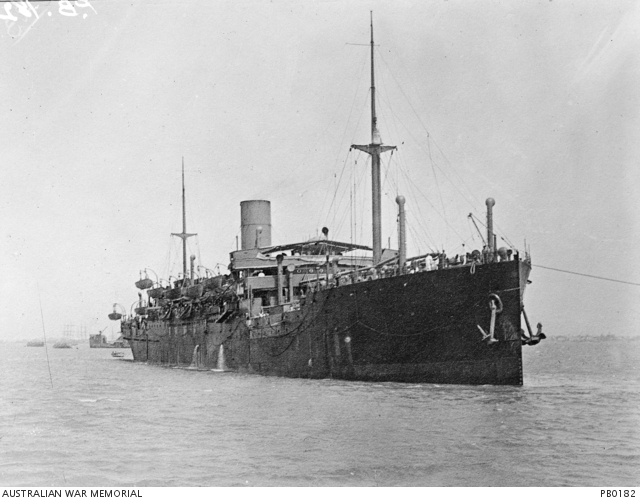
On 16th February 1916 Private Blakeman was one of the first group of Coo-ees to embark overseas on active service, and departed Sydney on the HMAT Ballarat A70 as 14th reinforcement for the 13th Battalion.

HMAT Ballarat A70, 18/2/1916. Photograph from the AWM Collection PB0182.

HMAT Ballarat A70, 18/2/1916. Photograph from the AWM Collection PB0182.

The HMAT Ballarat A70 arrived in Egypt on 22nd March 1916.

On 1st April 1916 Private Dawson, (along with the other Coo-ees he had travelled to Egypt with), was transferred to the 54th Battalion at Ferry Post.

On 23rd May 1916 Private Blakeman was sent to a Field Ambulance suffering from Abcess. On 25th May 1916 he was transferred to No. 2 Casualty Clearing Station at Ferry Post in Egypt. On 28th May 1916 he was discharged and rejoined his unit.

On 19th June 1916 Private Blakeman left Alexandria aboard H.T. Caledonian bound for France, and arrived at Marseilles on 29th June 1916.

On the night of the 19/20th July 1916 Private Blakeman was with the 54th Battalion when it participated in the Battle of Fromelles in France. During the battle he was wounded in action, suffering a shrapnel wound to his left thigh, and was sent to a Field Ambulance.

On 21st July 1916 he was sent back to the 32nd Stationary Hospital at Wimereux, France. On 22nd July 1916 he was placed aboard the Hospital Ship Cambria at Boulogne in France for evacuation to England. The next day, on 23rd July 1916, he was admitted to the Chatham Military Hospital at Chatham, England.

On 13th October 1916 Private Blakeman was discharged from hospital and granted leave to report to the Number 1 Command Depot at Pernham Downs, England on 28th October 1916.

On 1st November 1916 he was transferred to the 14th Training Battalion at Wareham, England.

On 12th November 1916 Private Blakeman departed Folkestone, England aboard the Transport Princess Clementine bound for France. He marched out to rejoin the 54th Battalion on 15th November 1916 when it was training at Rainneville in France.[2]

On 1st February 1917 Private Blakeman was sent to the 15th Australian Field Ambulance suffering Trench Feet.

On 11th February 1917 he was moved back to a Casualty Clearing Station with Septic Feet. On 12th February 1917 he was placed aboard the 15th Ambulance Train and transferred to the 12th General Hospital at Rouen in France, where he was admitted on 13th February 1917.

On 3rd March 1917 he was transferred to the 2nd Convalescent Depot.

He was discharged on 13th March 1917, and marched into the 5th Division Base Depot at Etaples, France.

On 17th March 1917 Private Blakeman departed the 5th Division Base Depot and re-joined the 54th Battalion on 18th March 1917, which was in the vicinity of Beaulencourt in France.[3]

On 19th April 1917 Private Blakeman was sent to the 8th Australian Field Ambulance suffering from Enteritis. On 20th April 1917 he was moved back to a Casualty Clearing Station, then to the 5th Division Rest Station.

He was discharged on 11th May 1917 and rejoined the 54th Battalion on 12th May 1917, when it was at Noreuil in France, preparing to move into the front line at the Hindenburg Line in the vicinity of Reincourt, France.[4]

On 9th July 1917 Private Blakeman was detached to the 14th Machine Gun Company.

On 28th August 1917 he was transferred from the 54th Battalion to the 14th Machine Gun Company, which later became part of the 5th Machine Gun Battalion.

On 3rd February 1918 Private Blakeman went on leave to England. He returned to the 5th Machine Gun Battalion on 20th February 1918.

After the Armistice, on 19th November 1918 Private Blakeman went on leave to England.

He returned to the 5th Machine Gun Battalion on 3rd December 1918.

On 22nd January 1919 Private Blakeman was detached for duty at the Corps workshops. He returned to the 5th Machine Gun Battalion on 2nd March 1919.

On 22nd March 1919 Private Blakeman marched into the Australian Base Depot at Le Harve in France.

On 1st April 1919 he departed Le Harve in France, and arrived at Weymouth in England on 2nd April 1919, and marched in to Number 2 Command Depot.

Private Blakeman departed Devonport in England on 15th May 1919 for return to Australia, aboard the H.T. Orontes. He disembarked at Sydney on 1st July 1919.

He was discharged from the AIF Termination of Period of Enlistment on 23rd August 1919.

[1] WA Birth Registration 1898, Number 5054, Henry James Naughton Blakeman / Henry Naughton Blakeman and Annie Catherine Kelly.

[2] AWM4 23/71/10 – November 1916, Australian Imperial Force unit war diaries, 1914-18 War, 54th Battalion.

[3] AWM4 23/71/14 – March 1917, Australian Imperial Force unit war diaries, 1914-18 War, 54th Battalion.

[4] AWM4 23/71/16 – May 1917, Australian Imperial Force unit war diaries, 1914-18 War, 54th Battalion.