Category Archives: Description of the route

Day 14, Saturday, 23 October, 1915, Molong to Orange

Transcription of extract from an article titled ‘The Route March : Section Leaders Appointed’ from The Farmer and Settler, 15 October, 1915, p. 3, [part 3 of 5 parts]:
…[Continued]
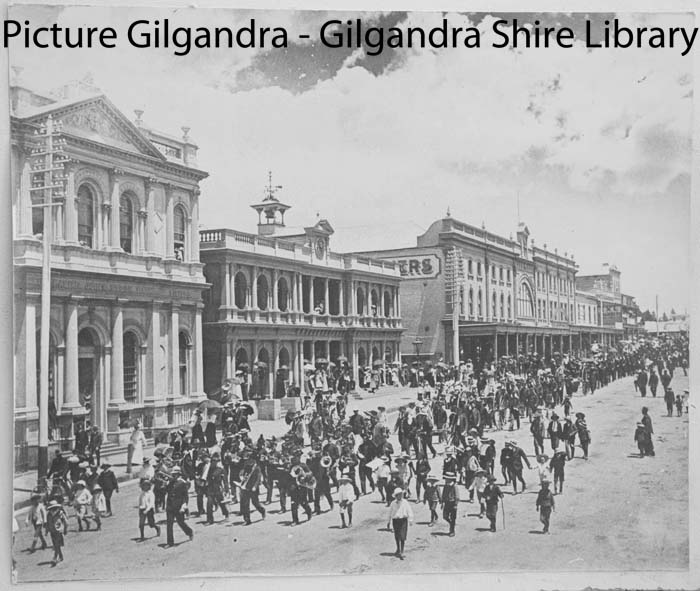
Arriving in Orange (Photograph courtesy of Gilgandra Shire Library)

Coo-ees marching past the post office in Summer Street, Orange (Photograph courtesy of Gilgandra Shire Library)

Orange.
The two miles between the night camp and the cook’s advanced party were covered before breakfast on Saturday morning, and then a move was made toward Orange.

It was recognised that the thundery appearance of the sky made it imperative that no time should be lost, but before a start could be made the rain began to come down. The programme arranged by the Orange people was that the column should enter the town at three o’clock, but the rain rendered it imperative to get the men under cover at the earliest possible moment, as a number were without overcoats, and were to receive them at Orange. The town was entered, therefore, about noon, and the Mayor, Alderman E. T. McNeilly, led the way by back streets to Wade Park, where clothes were dried and dry socks issued. One hundred and thirty pairs of socks had just been received from Misses Grant and Moyan, Kirrlbilli, Sydney, for the use of the “Coo-ees,” and they could not have arrived at a more opportune time. Tho Mayoress, Mrs, McNeilly, was found hard at work with a staff of ladies preparing a substantial meal, which was much appreciated by the men, as was also the 2-oz. of “medicine” per man prescribed by the Mayor; the “Follow the King” ideal is being lived up to all through the march, but the circumstances were held to warrant something “medicinal” after the wetting.

After dinner and a spell the “fall in” was sounded and the “Coo-ees”‘ were taken back to the town boundary where a procession was marshalled, and the formal entry made. Rain continued to fall at intervals; notwithstanding this, however, there was a great crowd along the route to the town hall. The Orange town band, the Light Horse, Citizen Forces, and Scouts were in the procession, and the guard of honor was a detachment of soldiers under Sergeant Crook, who had come front Liverpool, Holdsworthy, and Warwick Farm training camps, paying their own expenses, all for the purpose of doing honor to Hitchen’s “Coo-ees.” The Citizen Forces kept a clear space in front of the town hall, and the mayor and aldermen, the shire president, representative clergy, and Messrs. Fitzpatrick, M.L.A. (none the worse for his march and his wetting), H. R. M. Pigott, M.H.R., and many others, welcomed Captain Hitchen and his corps. Captain Hitchen was taken up to the balcony and introduced to the crowd, numbering about four thousand persons, and brief speeches were made by leading men. Captain Hitchen returned thanks, and in apologising for lack of words said that his thanks were none the loss heartfelt, so he would call on Q.M.-Sergeant Lee to speak for him and the “Coo-ees.” Lee got that part of the business over quickly, and, seeing so large a crowd assembled, he seized the opportunity of making a recruiting appeal. Nine men stepped forward to fill the blank files, and word was received that more would come later, so the “snow- ball” should be the bigger by fifteen men if they all pass the doctor.

The sun peeped out for a moment as the National Anthem was being played, but as the sky was again becoming overcast, the proceedings broke up with cheers for everybody, not the least hearty of which were for “Captain Bill Hitchen and his “Coo-ees'” as the great welcome banner put it.

A sumptuous banquet had been prepared under the pavilion at Wade Park, to which over a hundred hungry recruits sat down at 6 p.m. The Mayor presided, and later proposed the health of Captain Hitchen and his men, together with the health of the men that had volunteered that afternoon, and the men that were already soldiers, and had come from the training camps to honor the “Coo-ees.” Mr. J. L. C. Fitzpatrick, in supporting the toast, had a dig at the military authorities for their red-tape and cold-water methods in making these Orange recruits pay their own fares and expenses in welcoming the Gilgandra contingent, Q.M.-Sergeant Lee and Mayor Wynn spoke for the men.

A continental had been arranged to be held in Wade Park after tea, but as the weather still refused to behave, it was called off.’

Click here to view the article on Trove: http://nla.gov.au/nla.news-article116655979
Day 13, Friday, 22 October, 1915, Boomey to Molong

Transcription of extract from an article titled ‘The Route March : Section Leaders Appointed’ from The Farmer and Settler, 15 October, 1915, p. 3, [part 2 of 5 parts]:
…[Continued]

Molong.
Boomey was bidden farewell at 8 a.m. on Friday, 22nd, and several miles covered to The Shades, where the men of the column were treated to a poultry breakfast. Mr. It. E. Johnson, the local school teacher, a most enthusiastic worker, had his thirty or forty school children paraded to meet the marching army, and showed them a point in marching. The children also sang patriotic songs during the brief meal, and in this respect also reflected credit on their teacher. Sergeant Sam Ball, of the Light Horse, which body met the “Coo-ees” a mile or so along the road, was also an energetic organiser of the little reception, and the ladies cannot be praised enough for the trouble they took to do honor to the marching recruits. Headed by the Light Horse, the remainder of the sixteen miles to Molong was left behind with the memories of the generous treatment en route. Arriving at the outskirts of the town at 11.30, a procession was formed, and the principal streets were traversed to the martial airs of the Molong town band. At the saluting base at the recreation ground, the mayor, Alderman J. S. Taylor, inspected the column and expressed himself well pleased with the men’s appearance. After the order to dismiss, cordials were served out, and the river availed of, the opportunity for a wash. Luncheon was the next item on the programme. One of the staff had a stock of “Coo-ees” ribbons for sale at a shilling each, and we have reason to believe that at the conclusion of his   speech, he sold over a pounds’ worth.

At the recruiting meeting after lunch, Messrs. J. C. L. Fitztpatrick, M.L.A., W. Johnson, ex-M.L.A., Major Wynne, and Q.M.-Sergeant Lee were the chief speakers. Two men volunteered, and were duly sworn in, and four men turned up from Parkes, sent on by the Recruiting Association. Two other men caught up from Coonamble.

It is a significant fact that many men come along after the column has passed. There can be no doubt that the effect is greater than would appear from the actual number of men enrolled at the time. If Captain Hitchen has the opportunity of coming along again in January, as he at present intends, he will gather up an ever so much larger army, both because the harvest labor will be released, and because (this Recruiting March will have stirred up the apathetic and opened their eyes to their responsibility in this present crisis.

At three o’clock sharp the procession was re-formed, and the road to Orange taken. Tea was partaken of at Mr. Hebden’s station, about five miles out, and then the recruits pushed on at a leisurely marching pace, for the night camp. The idea of the moonlight walk was to cut as much as possible off the following day’s march, so that Orange could be entered with the men in fresh a condition as possible. The cook and No. 1 transport pushed on further, to Armstrong’s property.

The local member, Mr. Fitzpatrick, marched out of Molong with the “Coo-ees,” after seeing that they wanted for nothing in the way of blankets, sox, etc. He camped with the men. The en- rolling officer, Captain Nicholas, was sitting up by the camp fire until half- past eleven that night swearing in the latest batch of recruits.’

Click here to view the article on Trove: http://nla.gov.au/nla.news-article116655979
Day 12, Thursday, 21 October, 1915, Euchareena to Boomey

Transcription of extract from an article titled ‘The Route March : Section Leaders Appointed’ from The Farmer and Settler, 15 October, 1915, p. 3, [part 1 of 5 parts]:

‘THE ROUTE MARCH
Section Leaders Appointed
THE SNOWBALL GROWING AS IT ROLLS.

As there was no formal public entertainment on Wednesday evening at Euchareena, and as the men had arrived fairly fresh, a good night’s rest put them into good fettle, and they were ready to make an early start on the ten-mile walk to Boomey. Lunch was taken three miles out under the willows at Nembriggan [i.e. Newbriggan] Creek, a charming, little spot on the road to Molong. The food was that which had been left over at the Euchareena tea, so the cook’s work was light. On the way a shearing shed in full operation was inspected, and one of the shearers signified his intention of enlisting, promising to join the “Coo-ees” at Orange. The proprietors, Messrs. Brazier Bros., gave a sheep to assist the commissiariat.

Advantage was taken of the long luncheon halt at Newbriggang [sic] Creek to divide the column into sections, so that the best possible appearance may be made when marching, and also, more important still, to enable the organising staff and N.C.O’s to handle the men more efficiently. One complete platoon of sixty-nine men was formed as follows :-
No. 1 (Gilgandra) Section.-Sergeant in charge and sixteen Gilgandra men.
No. 2 (Gilgandra) Section.-Corporal in charge; the section completed by incorporating nine Dubbo men.
No. 3 (Wellington) Section.- Corporal   in charge, and sixteen Wellington men.
No. 4 (Wellington) Section.-Sergeant in charge, and the section completed by including eight Wongarbon men.
The remainder of the strength will form the nucleus of a new section, and a number of men have been told off to special duties.

After lunch the men were marched off in sections, each acting independently of the others, and under the control 0f its own section leader. The arrangement was highly satisfactory, both N.C.O’s, and men feeling much better pleased with themselves than under the previous system where all marched in one body. The effect, too, of the four separate sections marching into Boomey at a few paces interval with the transports following, was much more attractive from a spectacular point of view.

Boomey.
Four o’clock was the schedule time of arrival at Boomey, and the recruits arrived “on the tick,” to find the ladies hard at work preparing tea.

It is a never-ceasing wonder to the “Coo-ees” how such feasts can possibly be prepared out in the open bush, with apparently only a dozen houses within miles. The presence of a large collection of vehicles might possibly furnish a clue if one were only curious enough to ask how far the good people had come. Mr. A. A. Rodgers, President of the Amaroo Shire Council, addressed a few words of welcome, and expressed, on behalf of the residents, their appreciation of the spirit that moved the “Coo-ees” to take up their burden for the Empire. “Spruiker” Lee acknowledged the reception on behalf of the recruits, switching into a little recruiting appeal to try to snare one or two likely birds that were fluttering round the edge of the net; but without avail.

After tea an impromptu camp fire concert was held, and some “Coo-ee” talent was unearthed, so assisted by local volunteers, a very pleasant evening spent.

A pair of blankets and an overcoat were given to one of the men by the ladies present, who saw that he was needing them. As recruits had come in rather heavily, the stock of blankets had run out. However, more were even then waiting at Orange.’

Click here to view the article on Trove: http://nla.gov.au/nla.news-article116655979
Day 11, Wednesday, 20 October, 1915, Stuart Town to Euchareena

Transcription of extract from an article titled ‘The Route March : Growth of the “Snowball”’ in The Farmer and Settler, 22 October, 1915, p. 3 [part 3 of 3]
… [Continued]

‘Breakfast over, the transports were loaded for Euchareena. The lunching place was Store Creek, where the few inhabitants and the school children gave every assistance in preparing the lunch, besides providing milk, eggs, butter etc. The school children ran races for “Hitchen’s Coo-ee” badges, and also adorned the boys with roses. The first time that flowers were offered to the recruits was at Wellington, where an old French lady threw rose petals over the marching men. Since then, at Dripstone, Stuart Town, and now at Euchareena, the roses have been forthcoming. Here they were positively garlanded with roses.

Euchareena’s Welcome.
It must have been an impressive sight to the little knot of ladies that stood waiting by the Salvation Army hall at Euchareena to see across the valley that little band of one hundred men coming marching down the long, white road to the valley head where nestles the town-ship, then curve and come again over the rise, marching like veterans. The prettiest part of the picture was the children, dressed in their best, and waving the good old Union Jack. Camp was pitched in the school grounds, and then, after a brief welcome speech had been made by Mr. O’Reilly, the school teacher, and songs had been rendered by the little tots, the tea provided by the local folk was partaken of. The usual recruiting meeting was held after tea, the speeches being made from the platform of a railway shed. One young man was enrolled, and there are hopes of one or two more being persuaded to come. Three men caught up by the mail train, and one went on to Orange.’

Click here to view the article on Trove: http://nla.gov.au/nla.news-article116649160

Day 10, Tuesday, 19 October, 1915, Dripstone to Stuart Town

Transcription of extract from an article titled ‘The Route March : Growth of the “Snowball”’ in The Farmer and Settler, 22 October, 1915, p. 3 [part 2 of 3]

… [Continued]

‘Lunch at Mumbil.
An early start was made on Tuesday for the next halting point on the itinerary, which was a seven-mile stretch to Mumbil. Arrived there, the local school children sang for the “Coo-ees,” and their mothers and sisters provided a most acceptable lunch in a paddock adjacent to the queer old school house. Cheers were given, and the people assured the recruits of their good will, but they furnished no additions to the force. Mumbil was warmly thanked by the spokesmen of the party, then a move forward was made to the night camp at Stuart Town.

The Stuart Town Function.
After a swim, a mile or so out of town, column of route was once more formed, and the boys marched in, headed by the school children, and took up their quarters in the local hall. As there was no suitable accommodation available for entertainment, the townspeople arranged to give the men tea in McAtamney’s Hotel, but, of course, the “follow the King” rule held good, even there. The usual recruiting meeting was held after tea in the hall, resulting in four names being handed in. All were not able to go at once; two will follow in a day or two, and the others, as usual, will be carried on with the column until the next doctor is found. Supper was dispensed as usual by the good-hearted womenfolk, who furnished mountains of beautiful cake and pastry —though the recruits are beginning to wonder if sweets constitute quite the best ration for marching men. The boys sometimes sigh for red meat.’

Click here to view the article on Trove: http://nla.gov.au/nla.news-article116649160

Day 9, Monday, 18 October, 1915, Wellington to Dripstone

Transcription of extract from an article titled ‘The Route March : Growth of the “Snowball”‘  in The Farmer and Settler, 22 October, 1915, p. 3 [part 1 of 3]

‘THE ROUTE MARCH
Growth of the “Snowball”
THE “FIERY CROSS” IN THE WEST.

As the route march moves eastward the column not only grows in numerical strength, but it takes on more and more the character of a drilled and disciplined force. The men are marching well and   learning all they can of the game. One platoon has now been formed, and a second approaches full strength; acting non-coms, have also been appointed ; and as each fresh batch of recruits is added, the men are quickly “licked into shape.” The commissiariat department is working more and more smoothly; and the intelligence department is also getting into smooth running order. Mr. Harley Blackett has placed his car at the disposal of the force, and an intelligence officer goes over the ground in advance of the column checking the arrangements for camping and receptions, and studying the roads from the standpoint of a marching army with a certain distance to cover in a given time. The consequence is a clockwork adherence to the time-table.

The column marched out of Wellington nearly a hundred strong, including the staff and commisariat assistants; but the published story that there are already a hundred recruits is an “intelligent anticipation of events.” Twenty-six additional men joined at Wellington, so, with Gilgandra’s thirty-one, Dubbo’s nine, Wongarbon’s eight, and Geurie’s two, there were exactly seventy-six sworn recruits when the march swung out of town on Monday morning. Before the column had proceeded far the sergeant of police, an indefatigable recruiter, had overtaken it with four more in a motor car, and yet others are known to have thought the matter over, and to have decided to “catch up with the procession” in a day or two.  Advices have been received from towns along the line that numbers of men arc only waiting for the necessary forms to come along, when they will join the great march.

Soon after leaving Wellington, a fine, large ensign was presented to the captain by Mr. Bertie Gaden, and this flag now floats from the top of No. 1 transport waggon, in company with a Union Jack.

Lunch was prepared by the “Coo-ee’s” cook at Mr. J. Hoffner’s farm, a pleasant break in the day’s tramp.

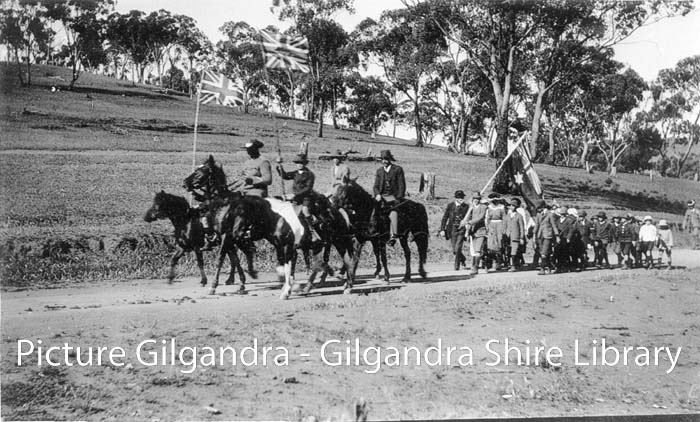
Coo-ees being lead into Dripstone, NSW (Photograph courtesy of Gilgandra Shire Library)

Coo-ees being led into Dripstone, NSW (Photograph courtesy of Gilgandra Shire Library)

Dripstone’s Reception.
Dripstone turned out in force to welcome the “Coo-ees,” and a fine tea was provided in the hall by the ladies. Considering the smallness or the settlement the reception was a remarkably fine one. A noticeable feature of the entertainment afforded the column on its eastward march is that the smaller the place the more trouble is taken by the people to assist and entertain the men, and it might almost be said the heartier the welcome. As instances, Wongarbon and Maryvale, might be quoted. Wongarbon has certainly eclipsed all others, and its gifts and good cheer were out of all proportion to its size.

After the Dripstone tea a recruiting meeting was held, but the young men that remain are unresponsive when it comes to the point of enlisting. Q.M.S. Lee was spelled on this occasion, and the recruiting addresses were delivered by Mssrs. H. Blacket[t], Major Wynne, and W. J. Johnson. The evening concluded with dancing, which might have continued to the rosy dawn of another day if the boys had not brought in their blankets and commenced spreading them among the tripping feet of the dancers. Realising that it was not a fair thing to expect the recruits to march all day and dance all night, the hint was good humoredly taken, and the floor vacated.’

Click here to view the article on Trove: http://nla.gov.au/nla.news-article116649160

Day 8, Sunday, 17 October, 1915, Wellington

Transcription of extract from an article titled ‘Hitchen’s Coo-ees’ in The Wellington Times, Monday, 18 October, 1915, p. 3.

Note: This extract also covers the recruiting meeting held on Saturday night on 16 October, 1915.

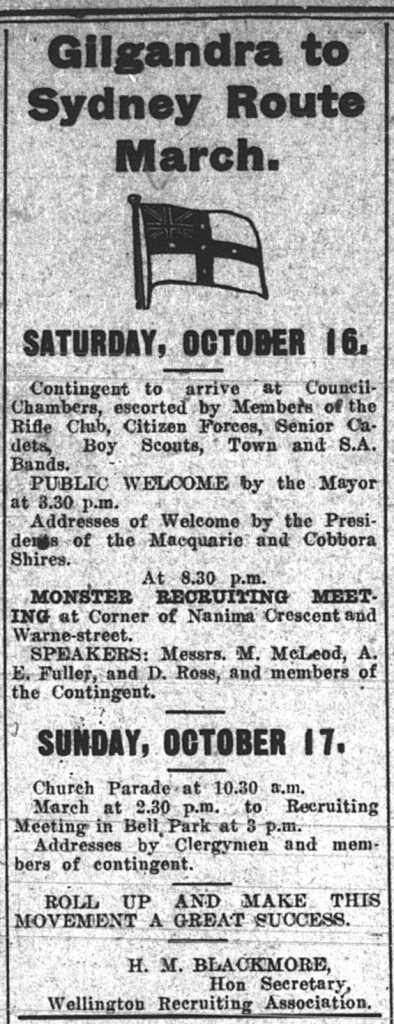
Program of events at Wellington (Wellington Times 14/10/1915)

Program of events at Wellington (Wellington Times 14/10/1915)

‘HITCHEN’S COO-EES.
THE SNOWBALL GROWS.
… [Continued]

THE RECRUITING MEETINGS.
There was a great gathering at the foot of Warne-street on Saturday night for the first of the recruiting meetings, but a start was not made until 9 o’clock to permit people from the shops to attend. A lorry was drawn up in front of Mr. Paul’s workshops, and on it were Alderman McLeod, the Mayor of Orange (Alderman McNeilly), Mr. H. M. Blackmore (secretary of the Wellington Recruiting Association), Mr. L. J. Astley (Dubbo Recruiting Association), and Mr. W. J. Johnson, formerly Federal member for the district, who was in khaki, and who had come to assist in the recruiting movement.
Alderman McLeod mad a fervid appeal. He regretted that he was not able to go personally, but he had made sacrifices, as must be done by all.
Alderman McNeilly (Mayor of Orange), Quartermaster-Sergeant Lee, Cr. Fuller, Mr. L. J Astley, and Private Johnson made stirring appeals in which the peril of the Empire was alluded to, and need for men strongly insisted on.
There was another big meeting at Bell Park on Sunday afternoon when spirited speeches were made by Alderman McLeod, Adjutant Diehms (Salvation Army), Sergeant Barker, Quartermaster-Sergeant Lee, and Private W. J. Johnson. Mr. Paul read a stirring letter from the front, and there was cheering when it was announced that the D.C.M. had been awarded to Colin Farlow, and that another son of Mr. Angus Campbell had enlisted at Sydney. Then Mr. Hitchens returned his thanks for the treatment of the Coo-ees, and there was intense excitement when the chairman presented the leader with a Union Jack with the words “Wellington,” on it, and the National Anthem, and cheers for the King and the Gilgandra recruits closed a most enthusiastic meeting.
This morning the Coo-ees left for Dripstone, and are due in Orange next Sunday.
After the Coo-ees had left this morning six more recruits came into Wellington and passed the doctor. They were taken along the road to join the company, four being conveyed by Mr. C. J. Shakespeare in his motor car; one by Senior-Sergeant Nies in a sulky, and the sixth by Constable Griffin in another conveyance.

CARE OF THE RECRUITS.
With reference to the care of the recruits, Mr. Ferguson gave the Protestant Hall for their camp rent free, as well as the yard for the marquee for the officers, the Wellington Stores, Ltd., gave the use of the stretchers, and the procuring and arrangement of the beds were carried out by Messrs. A. Kennard and J. Bere, with the aid of assistants. Mr. R. M. Kimbell did the catering and cooked the food without charge, the flour being supplied by McLeod’s mill, and the bread baked by the firm above mentioned; while gifts of meat and other foods and money were liberally made by the tradespeople and residents. The recruits were served with plentiful meals during their stay, and a fine hot dinner yesterday, and Mr. Kimbell and his staff assisted by S. Green and J. Bere, did the waiting. The meals were served in the drill hall, which was decorated for the occasion by Mr. Stoddart and assistants.

CHURCH PARADES.
About 10.30 on Sunday morning the bands, cadets, and military headed the Coo-ees in a march round the town.
There were special services at the churches yesterday. At St. John’s the Rev. E. S. Benyon, of Geurie, was the preacher. Father Eviston made reference to the occasion in the Catholic Church, and a united service of Presbyterians, Baptists, Methodists, and Salvationists was conducted at the Methodist Church, the preacher being the Rev. H. R. Grassick.
Mr. Harry Taylor has consented to sell the impedimentia of the Coo-ees after their arrival in Sydney, and spell the horses used on the journey from Gilgandra, with the view to their subsequent disposal.

SCHOLARS AND RECRUITS.
When the Gilgandra recruits reached in front of the district school this morning, they were halted while the 700 children were lined up and gave the boys a cheer. Each man was then presented with a box of chocolates, and had a flower pinned to his coat, and they went on their way to the sound of more cheering from the lusty throats of the youngsters.’

Day 7, Saturday, 16 October, 1915, Geurie to Wellington

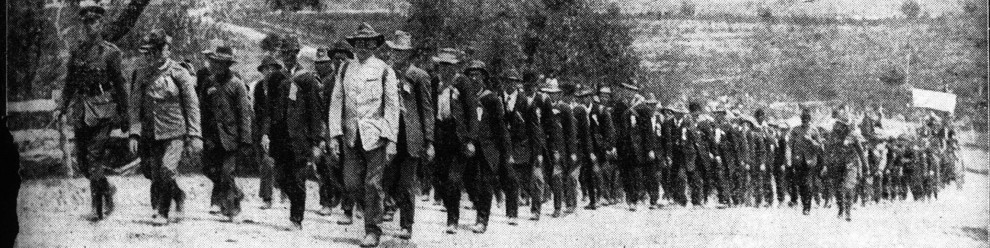
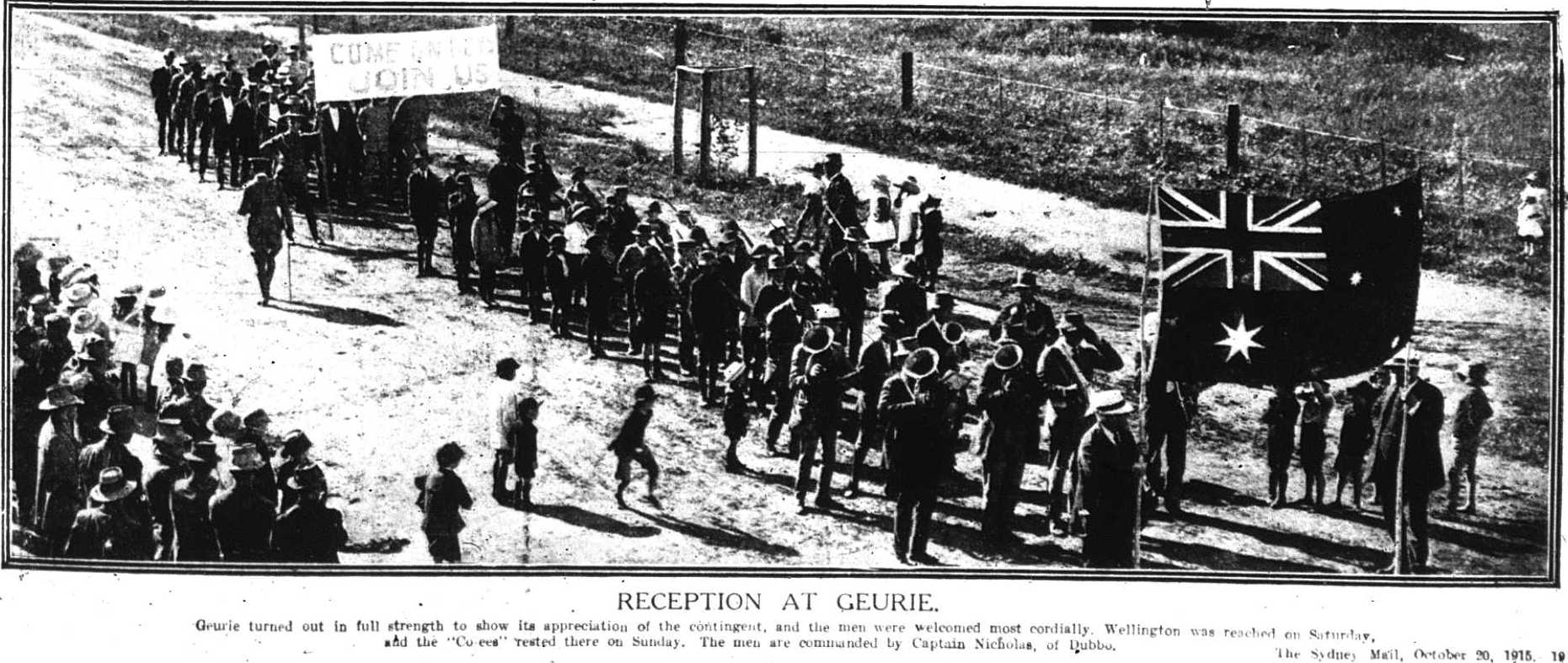
Reception at Geurie (Sydney Mail 20 Oct 1915)

Reception at Geurie (Sydney Mail 20/10/1915)

Transcription of extract from an article titled ‘The Route March’ in The Farmer and Settler, 19 October, 1915, p. 3, [part 3 of 3 parts]:

‘THE ROUTE MARCH
The Snowball Growing
THE ADVANCE FROM DUBBO TO WELLINGTON.
[Continued] …

Maryvale’s Luncheon.
The road to Wellington was fourteen miles long, but the weather was pleasant, and the going easy. Also there was a refreshing break at Maryvale, where a superb al-fresco luncheon of turkey and plum pudding had been provided by the generous-hearted women of the district Maryvale cheered the recruits and the recruits cheered Maryvale, and then  swung out on the road to Wellington.

Arrival at Wellington.
Outside the town, the column, now sixty strong, was met by bands, militia, police, riflemen, and cadets, Alderman M. McLeod and Mr. H. M. Blackmore, secretary of the Wellington Recruiting Association, representing the townspeople officially. Half the town and district took part in this outside welcome; and then in the council chambers there was speech- making and cheering and recruiting and donating— all in the most enthusiastically patriotic spirit. Ald. McLeod, Cr. A. E. Fuller, president of Macquarie Shire Council, Cr. Donald Ross, president of Cobbora Shire Council, and Mr. T. H. Thrower, M.L.A., member for the district, welcomed the recruits: and Mr. Hitchcn acknowledged the compliments of the speakers. Later the recruits were entertained at tea by the local Red Cross Society, and then marched to their sleeping quarters in the Protestant Hall.   Wellington added thirty recruits on Saturday, and much gear. Two horses were auctioned and £33 raised; an hotel collection netted £17; the employees of one store gave £5, and the proprietors more. “Go to the stores and get the   boots you need,” said one of the local re-cruiting committee; “we will foot the bill.” That was the spirit of the Wellington reception.’

Click here to access the article on Trove: http://nla.gov.au/nla.news-article116648940

Day 6, Friday, 15 October, 1915, Wongarbon to Geurie

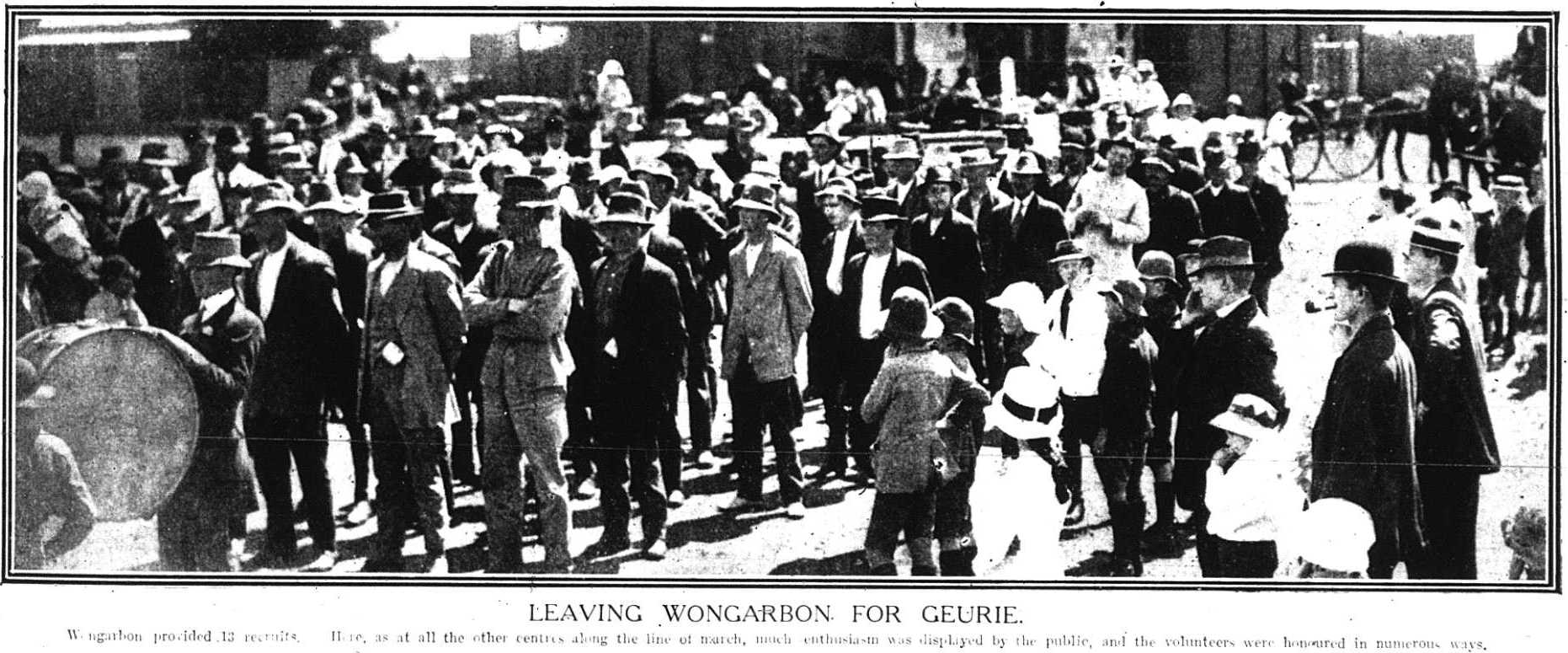
Leaving Wongarbon (Sydney Mail 20 Oct 1915)

Leaving Wongarbon (Sydney Mail 20/10/1915)

Transcription of extract from an article titled ‘The Route March’ in The Farmer and Settler, 19 October, 1915, p. 3, [part 2 of 3 parts]:

‘THE ROUTE MARCH
The Snowball Growing
THE ADVANCE FROM DUBBO TO WELLINGTON.
[Continued] …

‘Geurie’s Reception.
On Friday morning the route march passed on to Geurie, arriving at one o’clock, just in time for the trenchman’s feed that the contingent’s own cook had prepared at the Royal Hall from viands locally supplied. In the afternoon escorted by the local band, the school children and hundreds of district residents, the recruits marched to the park where a successful recruiting appeal was made. Three men signed on to follow the drum, and four others signified their intention of following after harvest. Afternoon tea in the park, to which every home for miles around had contributed a hamper, was followed by a social, with more recruiting speeches. As a result of a tarpaulin collection in the afternoon the sum of £18 was handed to Mr. Hitchen before the column left. The Governor-General, who was passing through Geurie, sent word that he would like to meet the contingent. They were therefore paraded at the railway station on Saturday morning, and his excellency and Major Sands inspected them. He declared the Gilgandra scheme the finest recruiting movement in Australia, and promised to be in Sydney to welcome the army when it marched in and stormed the city.

The Governor-General’s words of warm approval greatly heartened the men, and they started on their way to Wellington with an additional spring in their step.’

Click here to access the article on Trove: http://nla.gov.au/nla.news-article116648940

Day 5, Thursday, 14 October, 1915, Dubbo to Wongarbon

Transcription of extract from an article titled ‘The Route March’ in The Farmer and Settler, 19 October, 1915, p. 3, [part 1 of 3 parts]:

‘THE ROUTE MARCH
The Snowball Growing
THE ADVANCE FROM DUBBO TO WELLINGTON.
Last issue of the ‘Farmer and Settler’ left the Great Western Flying Column at Dubbo, where Captain Nicholas and his men met with the right royal reception to which they were entitled as the King’s men off to the wars. The most popular man in the western districts of New South Wales at the present time is Mr. W. T. Hitchen, the man that started the snow-ball rolling, and every town along the line lifts its corporate hat to Gilgandra and its recruiting association, the members of which made “Bill Hitchen’s idea” an actuality of the recruiting campaign.

Wongarbon’s Welcome.
The column marched out of Dubbo with colors flying shortly after noon last Thursday, a great concourse of people in the streets wishing them God-speed, and twelve local recruits falling in behind. The school band played the march out of town, and gave the boys a final cheer. Wongarbon was reached at tea-time. Three hundred people met the march a mile out of town. The Wongarbon band, the school children, and the members of the rifle club, joined the great procession, and citizens, mounted, driving, and on foot escorted the force to its rendezvous, cheering all the way. On arrival at the town, Cr. A. F. Morely, on behalf of the Shire Council, welcomed the ”snowball army” amid a scene of, tremendous enthusiasm. After pitching their tents and washing off the grime of the roads, the recruits marched to the local hall, where they were the guests of the citizens at a banquet to which over five hundred persons paid for admission. Captain D. Bowling, head master of the local school, and captain of the rifle club, presided, and put into words the public appreciation of the route march scheme, and the general hope that it would be a huge recruiting success. Captain Nicholas and Mr. Hitchen briefly responded and Recruit Lee made a recruiting speech, the quality of which is suggested by the fact that at its close thirteen men stepped forward and gave their names, either to march under Captain Nicholas, or to come after harvest. A collection for wayside expenses brought in £18.’

Click here to access the article on Trove: http://nla.gov.au/nla.news-article116648940