Thomas LIPSCOMBE

Thomas LIPSCOMBE

Per his military service record (regimental no. 4826), Thomas Lipscombe was born at Collingwood, Victoria.[1] He gave his age as 35 years and 7 months, his marital status as single, and his occupation as labourer. His description on his Certificate of Medical Examination was [height not recorded], weight 161 lbs., with a fair complexion, brown eyes, and fair hair. His religious denomination was Church of England. He claimed that he had no previous military service.

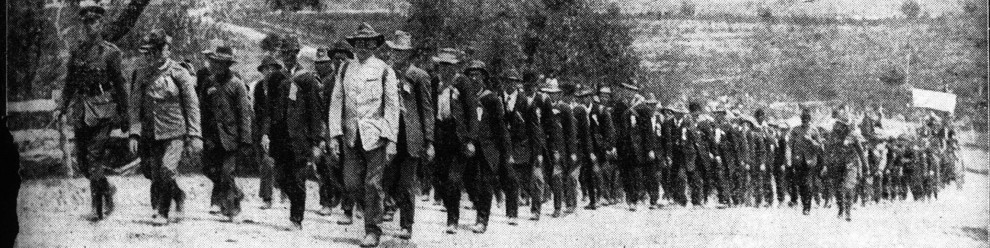
His ‘Joined on’ date on his Attestation Paper of Persons Enlisted for Service Abroad form was 9th November 1915 (the day the Coo-ees marched from Springwood to Penrith). The Oath to the taken by person being enlisted section on his Attestation Paper was dated from 9th November 1915. His Statement of Service in his service record is also dated from 9th November 1915, so it appears he may have joined the Coo-ee March on this day.

He completed his medical examination at Ashfield on 11th November 1915, and was attested at Ashfield by Lieutenant F. Middenway on the 11th November 1915 (the day the Coo-ees marched from Parramatta to Ashfield).

After completing the Coo-ee March he went to Liverpool Camp as reinforcement for the 13th Battalion.

On 6th January 1916 Private Lipscombe was charged with being absent without leave from the Liverpool Camp from 9th December 1915 to 3rd January 1916. He was fined.

On 5th February 1916 Private Lipscombe was charged with being absent without leave from the Liverpool Camp for 5 days. He was fined 25 shillings.

The Dubbo Dispatch and Wellington Independent reported on 3rd March 1916 that ‘’Private T. Lipscombe has been in town the past few days taking farewell of his friends prior to preceeding to the front, whither he expects to sail next week’.[2]

On his embarkation roll his address at time of enrolment was his address was Australian Hotel, Dubbo.[3]  His next of kin was listed as friend, ‘P. J. Kennay’, Australian Hotel, Dubbo, N.S.W.  [This was probably P.J. Kennedy, licencee of the Austalian Hotel, Dubbo].[4]

Troopship HMAT A15 Star of England. Australian War Memorial Collection AWM H17014.

On 8th March 1916 Private Lipscombe departed Sydney on the HMAT A15 Star of England along with many of the other Coo-ees.  He arrived in Egypt on the 11th April 1916.

On 16th April 1916 Private Lipscombe was transferred to the 4th Division Artillery at Tel-el-Kebir, Egypt.

On 22nd May 1916 he was transferred to the 110th Battery.

On 1st  June 1916 he was designated a Driver, and transferred to the 10th Field Artillery Brigade.

On 5th June 1916 Driver Lipscombe left Alexandria aboard the HMT Oriana bound for France.  He arrived at Marseilles on 13th June 1916.

On 22nd January 1918 Driver Lipscombe went on leave to Paris.  He returned to the 10th Field Artillery Brigade on the 3rd of February 1918.

However, he had overstayed his leave, and had been due back on the 30th of January 1918.  He was arrested and held in detention.  Driver Lipscombe was found guilty of being absent without leave at a Court Martial held on 3th February 1918.  He was awarded 28 days Field Punishment No. 2 and fined 42 days pay.

On 18th August 1918 Driver Lipscombe was granted leave to England. He returned to the 10th Field Artillery Brigade in France on 9th September 1918.

On 3rd December 1918 Driver Lipscombe departed France, bound for England to commence his return to Australia. He arrived at Folkestone, England, later that day.

On 9th January 1919 Driver Lipscombe was charged with being absent without leave from 2359 on 7th January 1919 till 2120 on 8th January 1919. He was fined 1 days pay.

Driver Lipscombe departed Liverpool, England on 19th February 1919 for return to Australia aboard the H.T. Orca.

He arrived in Sydney on 3rd April 1919.

He was discharged medically unfit on 18th July 1919.


[1] NAA: B2455, LIPSCOMBE THOMAS

[2] Our Soldiers. (1916, March 3). Dubbo Dispatch and Wellington Independent (NSW : 1887 – 1932), p. 1. Retrieved April 7, 2018, from http://nla.gov.au/nla.news-article228634920

[3] Australia War Memorial. First World War Embarkation Rolls, Thomas Lipscombe, HMAT Star of England A15, 8th March 1916.

[4] AUSTRALIAN HOTEL. (1917, December 4). Dubbo Dispatch and Wellington Independent (NSW : 1887 – 1932), p. 1. Retrieved April 7, 2018, from http://nla.gov.au/nla.news-article228195676
 

Andrew George LENNOX

Andrew George LENNOX

Per his military service record (regimental no. 4824),  Andrew George Lennox was born at Bourke, N.S.W.[1]  He gave his age as 19 years and 8 months, his marital status as single, and his occupation as railway porter.  His description on his Certificate of Medical Examination was height 5 feet 7 inches tall, weight 185 lbs., with a medium complexion, grey eyes, and medium brown hair.  His religious denomination was Presbyterian. He claimed to have had no previous military service.

A send-off was held on Thursday 28th October 1915 at the Court House Hotel in Cobar for Andrew Lennox, Norman Francisco, and brothers Walter and Robert Mitchell, and they were then cheered by many friends when they left Cobar by train on Saturday 30th October 1915 to join the A.I.F.[2]

All four of them completed their medical examinations, and were attested, at Dubbo on Monday 2nd November 1915, (the day the Coo-ees were at Lithgow).

Andrew Lennox then traveled by train with these three other Cobar men to catch up with the Coo-ees.  They were waiting to join the Coo-ee March when the Coo-ees arrived at Mt. Victoria three days later, on Thursday 4th November 1915.[3]

After completing the Coo-ee March Private Lennox went to Liverpool Camp as reinforcement for the 13th Battalion.

Private Lennox and fellow Coo-ee Private Francisco while home on leave were given a farewell at the Star Hotel in Cobar on Saturday, 1st January 1916.[4]

On his embarkation roll his address at time of enrolment was Marshall Street, Cobar, N.S.W., and his next of kin was listed as his father, A. Lennox, at the same address.[5]

On 8th March 1916 Private Lennox, along with many of the other Coo-ees, departed Sydney on the HMAT A15 Star of England, with the 15th reinforcements for the 13th Battalion.

Troopship HMAT A15 Star of England. Australian War Memorial Collection AWM H17014.

He arrived in Egypt on 11th April 1916.

On 16th April 1916 he transferred to the 4th Pioneer Battalion at Tel El Kebir, Egypt.

On 4th June 1916 Private Lennox left Alexandria aboard the Transport Scotian bound for France.  He arrived at Marseilles on 11th June 1916.

He served with the 4th Pioneer Battalion in France and Belgium.

On 1st September 1918 Private Lennox went on leave to England.

He returned to the 4th Pioneer Battalion on 17th September 1918, and was transferred to the 4th Machine Gun Battalion in France.

On 16th November 1918 Private Lennox was sent to the 4th Australian Field Ambulance sick. He was moved back to the 50th Casualty Clearing Station on 17th November 1918.

On 22nd November 1918 he was placed aboard the 2nd Ambulance Train and moved to the 2nd Convalescent Depot, arriving on 23rd November 1918. On 24th November 1918 he was transferred to the 39th General Hospital at Le Harve, France, where he was admitted on 25th November 1918.

On 26th December 1918 Private Lennox was placed aboard a Hospital Ship for evacuation to England.  He was admitted to the Australian Dermatological Hospital at Bulford, England, on 27th December 1918.

On 10th May 1919 he was discharged from hospital, and sent to the Convalescent Training Depot at Parkhouse, England.

On 12th May 1919 Private Lennox was sent back to the 1st Australian Dermatological Hospital at Bulford sick.

He was discharged from hospital on 21st July 1919, and sent to the No. 2 Group at Sutton Veny, England.

On 22nd August 1919 Private Lennox left England on the H.T.t Anchises bound for Australia.

He arrived in Australia on 13th October 1919.

He was discharged Termination of Period of Enlistment on 5th December 1919.


[1] NAA B2455, LENNOX ANDREW GEORGE

[2] ‘Summary’, Western Age, 30 October 1915, p. 2. Retrieved August 5, 2017, from http://nla.gov.au/nla.news-article136723099

[3] Summary’, Western Age, 6 November 1915, p. 2. Retrieved April 4, 2017, from http://nla.gov.au/nla.news-article136724708

[4] Valedictory. (1916, January 4). Western Age (Dubbo, NSW : 1914 – 1932), p. 2. Retrieved February 18, 2018, from http://nla.gov.au/nla.news-article136725949

[5] Australia War Memorial. First World War Embarkation Rolls, Andrew George Lennox, HMAT Star of England A15, 8th March 1916.

James MCGEECHAN

James McGEECHAN

Per his military service record (Depot), James McGeechan was born at Lithgow, N.S.W.[1]  He gave his age as 27 years and 3 months, his marital status as single, and his occupation as engine driver.  His description on his Certificate of Medical Examination was height 5 feet 4 ½ inches tall, weight 127 lbs., with a fair complexion, grey eyes, and black hair. His religious denomination was Presbyterian.  He claimed to have no previous military service.

He completed his medical examination at Lithgow on 3rd November 1915.  He was attested by Lieutenant F. Middenway at Lithgow on 3rd November 1915 (the day the Coo-ees marched from Lithgow to Hartley).

His postal address on his initial Application to Enlist in the Australian Imperial Force form was Bridge Street, Lithgow.

His next of kin on his Attestation Paper was listed as his stepmother, Bridge Street, Lithgow.

After completing the Coo-ee March he went into Liverpool Camp with the Coo-ees.

On 17th November 1915 Private McGeechan went before a Medical Board at Liverpool Camp, where he was found to suffer from Hemiplegia, and was unfit for active service.

On 22nd November 1915 Private McGeechan was charged with being absent from his post while on guard on 20th November 1915. He was issued a warning.

On 29th November 1915 Private McGeechan was discharged medically unfit.


[1] NAA: B2455, MCGEECHAN J

John HOGAN

John HOGAN

Per his military service record (regimental no. 2354), John Hogan was born at Gunnedah, N.S.W.[1] He gave his age as 45 years, his marital status as single, and his occupation as labourer.  His description on his Certificate of Medical Examination was height 5 feet 9 inches tall, weight 154 lbs., with a dark complexion, blue eyes, and dark hair. His religious denomination was Roman Catholic.

He completed his medical examination at Wellington on 17th October 1915 (the day the Coo-ees rested at Wellington), and was attested by Captain T. A. Nicholas at Stuart Town on 19th October 1915. He claimed to have previous military service in the Boer War.

After completing the Coo-ee March he went Menangle Light Horse Camp as reinforcement for the 7th Light Horse Regiment.

On his embarkation roll his address as time of enrolment was Wellington, N.S.W., and his next of kin is listed was listed as friend, James William Hoy, Hermitage Flat, Lithgow, N.S.W.[2]

Trooper Hogan departed Sydney on the HMAT Palermo A56 on 18th April 1916, with the 16th Reinforcements for the 7th Light Horse Regiment.

After arriving in Egypt he was taken on strength by the 2nd Light Horse Training Regiment at Tel-el Kebir on 10th June 1916.

On 6th July 1916 he was taken on strength of the 2nd Double Squadron at Serapeum.

On 30th July 1916 Trooper Hogan he was transferred to the 1st Field Squadron Engineers Australian and New Zealand Mounted Division at Kantara, Egypt.

On 30th September 1917 Sapper Hogan was detached for duty with the Gamli Light Railway.

On 25th January 1918 he was sent to the military Dump at Ludd, Palestine.

He returned to his unit on 9th March 1919.

Sapper Hogan began his return to Australia on 3rd July 1919,  aboard the H.T. Malta at Kantara, Egypt.

Sapper Hogan arrived in Australia on 10th August 1919.

He was discharged Termination of Period of Enlistment on 25th September 1919.


[1] NAA: B2455, HOGAN J 2354

[2] Australia War Memorial. First World War Embarkation Rolls, John Hogan 2354, HMAT Palermo A56, 18th April 1916.

Alexander Muir NIMMO

Alexander Muir NIMMO

Per his military service record (Depot), Alexander Muir Nimmo was born at Katoomba, N.S.W.[1]  He gave his age as 26 years and 2 months, his marital status as single, and his occupation as letter carrier. His description on his Certificate of Medical Examination was height 5 feet 3 ½ inches tall, [weight not recorded], with a fair complexion, blue eyes, and brown hair. His religious denomination was Presbyterian. He claimed that he had no previous military service.

He listed his next of kin on his Attestation Paper as his father, Joseph Nimmo, Parke Street, Katoomba, N.S.W.

His postal address on his initial Application to Enlist in the Australian Imperial Force form was Parke Street, Katoomba.

The Oath to be taken by person being enlisted section on his Attestation Paper was signed by Lieutenant F. Middenway at Katoomba on 5th November 1915 at Katoomba (the day to Coo-ees arrived at Katoomba).  He completed his medical examination on the 6th November 1915 at Katoomba.   The Certificate of Attesting Officer section of his Attestation Paper was signed by Lieutenant Edward F. Shaw on 13th November 1915.

‘Alex M. Nimmo’ was named in The Blue Mountain Echo as one of the recruits who joined the Coo-ees at Katoomba.[2]

After completing the Coo-ee March he went to Liverpool Camp as reinforcement for the 13th Battalion.

Private Nimmo, along with several other local Coo-ees, including Privates Trow, Davis, Pettigrew, Perkins, Hayes, Duff, and Mason, was given a send-off at the Empire Theatre in Katoomba on Wednesday evening 15th December 1915, where Mayor James presented them with medals, and  ‘spoke highly of the courage of the boys who marched away with the Coo-ees,  and wished them every luck in the great fight they were undertaking’.[3]  The Blue Mountain Echo reported that ‘Private Alex Nimmo responded on behalf of the departing soldiers, voicing a very appropriate appreciation’.[4]

On 17th December 1915, Private Nimmo was charged by the Civil Police in Sydney for traveling in a railway car without paying the fare. He was fined 5 shillings.

Two months later, on 17th February 1916 Private Nimmo went before a medical board at Liverpool Camp, where he was diagnosed to be medically unfit not due to misdconduct.

Private Nimmo was discharged from the A.I.F. on 22nd February 1916 medically unfit.


[1] NAA: B2455, NIMMO ALEXANDER MUIR

[2] MARCH O’ER THE MOUNTAINS. (1915, November 12). The Blue Mountain Echo (NSW : 1909 – 1928), pp. 2-3. Retrieved September 21, 2015, from http://nla.gov.au/nla.news-article108042142

[3]  Benefit to Our Boys. (1915, December 17). The Blue Mountain Echo (NSW : 1909 – 1928), p. 6. Retrieved April 7, 2018, from http://nla.gov.au/nla.news-article108041454

[4] Benefit to Our Boys. (1915, December 17). The Blue Mountain Echo (NSW : 1909 – 1928), p. 6. Retrieved April 7, 2018, from http://nla.gov.au/nla.news-article108041454

Stories for 200 Coo-ees now on website

Stories for 200 Coo-ees now on website

I have now written individual stories for 200 of the 263 men who were recruited to join the A.I.F. on the 1915 Gilgandra to Sydney Coo-ee March.

This is an ongoing project, which I (hopefully) aim to complete by the end of the Centenary of Anzac period.

Their names are listed on https://cooeemarch1915.com/the-men/

Click on their names to link to their stories.

Helen Thompson

Patrick WILLIS

Patrick WILLIS

Per his military service record (Depot), Patrick Willis was born at Yass, N.S.W.[1] He gave his age as 34 years, his marital status as single, and his occupation as shearer. His description on his Certificate of Medical Examination was height 5 feet 4 inches tall, weight 144 lbs., with a medium complexion, grey eyes, and brown hair. His religious denomination was recorded as Roman Catholic. He claimed that he had no previous military service.

He listed his mother, Mrs Catherine Willis, Sorrell Street, Parramatta North, as his next of kin on his Attestation Paper.

The Wellington Times reported  ‘Willis’ as one of the 8 named men who offered themselves as recruits to join the Coo-ee March at the recruiting meeting held at the Wongarbon Hall on 14th October 1915.[2]

‘P. Willis’ was listed as one of the Wongarbon boys with the Coo-ees in The Dubbo Liberal and Macquarie Advocate.[3]

He completed his medical examination on 16th October 1915 at Wellington (the day the Coo-ees arrived at Wellington), and was attested by Captain Nicholas at Dripstone on the 19th October 1915.

After completing the Coo-ee March he went to Liverpool Camp as reinforcement for the 13th Battalion.

On 7th February 1916 Private Willis was charged with being absent without leave from 27th January 1916 to 6th February 1916. He was fined 50 shillings.

On 24th February 1916 Private Willis was charged with being absent without leave from 18th February 1916 till 23rd February 1916. He was recommended to be discharged.

Private Willis was discharged services no longer required on 25th February 1916.


[1] NAA: B2455, WILLIS PATRICK

[2] ON THE TRACK. (1915, October 18). Wellington Times (NSW : 1899 – 1954), p. 3. Retrieved April 2, 2018, from http://nla.gov.au/nla.news-article143388423

[3] Our Soldiers (1915, October 29). The Dubbo Liberal and Macquarie Advocate (NSW : 1894 – 1954), p. 4. Retrieved April 2, 2018, from http://nla.gov.au/nla.news-article77601711


Joseph WILSON

Joseph WILSON

Per his military service record (Depot), Joseph Wilson was born at Glasgow, Scotland.[1]  He gave his age as 40 years and 3 months, his marital status as single, and his occupation as labourer.  His description on his Certificate of Medical Examination was height 5 feet 8 inches tall, weight 11 stone 4 lbs., with a fair complexion, blue eyes, and grey hair.  His religious denomination was Presbyterian.  He claimed he had no previous military service.

He was attested at Lawson on 7th November 1915 (the day the Coo-ees rested at Lawson), and completed his medical examination at Lawson on 8th November 1915.

His next of kin was recorded on his Australian Imperial Force Attestation Paper of Persons Enlisted for Service Abroad form as his brother, John Wilson, Victoria.

After completing the Coo-ee March he went to Liverpool Camp as reinforcement for the 13th Battalion.

On 22nd November 1915 Private Wilson was charged with drunkenness in Company Lines on 21st November 1915. He was issued with a warning.

On 14th December 1915 Private Wilson was charged with being absent without leave from 2nd December 1915 till 12 noon on 13th December 1915. He was recommended to be discharged.

On 15th December 1915 Private Wilson was discharged not likely to become an efficient soldier.

[1] NAA B2455, WILSON J

Fallen Coo-ees commemorated at Australian War Memorial Last Post Ceremonies

Fallen Coo-ees commemorated at Australian War Memorial Last Post Ceremonies

Last Post Ceremony at Australian War Memorial

The Last Post Ceremony is held in the Commemorative area of the Australian War Memorial each day. This ceremony commemorates the 102,000 Australians who gave their lives in war and other operations, and whose names are recorded on the Australian War Memorial’s Roll of Honour.  The story behind one of the names remembered on the Roll of Honour is told at each Last Post Ceremony.

Five of the 41 Coo-ees who died while overseas on active service during the First World War have been commemorated in a Last Post Ceremony at the Australian War Memorial during the Centenary period.

These services have been recorded, and can be viewed on the Australian War Memorial website:

Private Harold Brooks DAVIS (4759) – Last Post Ceremony held 2nd March 2016

https://www.awm.gov.au/collection/C2133669

Private James CRAWFORD (4753) – Last Post Ceremony held 8th August 2016

https://www.awm.gov.au/collection/AWM2016.2.221/

Private Charles Arthur FINN (6289) – Last Post Ceremony held 6th April 2017

https://www.awm.gov.au/collection/C2278409

Private Harold BAXTER (4370) – Last Post Ceremony held 16th April 2017

https://www.awm.gov.au/collection/C2278419

Private Frank HUMPHREY (1887) – Last Post Ceremony held 23rd April 2017

https://www.awm.gov.au/index.php/collection/C2278426

Three more fallen Coo-ees will be remembered in a Last Post Ceremony at the Australian War Memorial this year:

Lance Corporal Laurence Leslie MAGUIRE – Last Post Ceremony to be held 2nd April 2018

Private Stanley Everard STEPHENS  – Last Post Ceremony to be held 11th April 2018

Private William Thomas HITCHEN – Last Post Ceremony to be held 3rd September 2018

If you are not able to attend these services at the Australian War Memorial, you can watch the Last Post Ceremonies live online from 4.55 pm AEST at https://www.awm.gov.au/commemoration/last-post-ceremony

The web addresses for the archived videorecordings for these three Last Post Ceremonies will be added to this webpage at a later date this year.

TIMELINE April 1918

TIMELINE April 1918

Monday, 1 April 1918

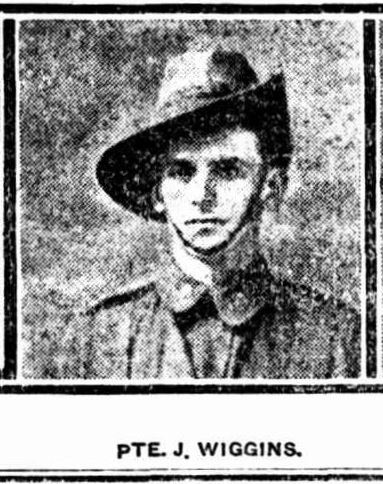
Private Jack Graham WIGGINS  [45th Battalion) was placed aboard the Hospital Ship Ville de Liege for evacuation to England, where he was admitted to the Norfolk War Hospital (after being  wounded  in action on 28th March 1918 with a shrapnel wound to his left thigh).

Pte. J. Wiggins (Sunday Times, 8/10/1916, p. 9)

Tuesday, 2 April 1918

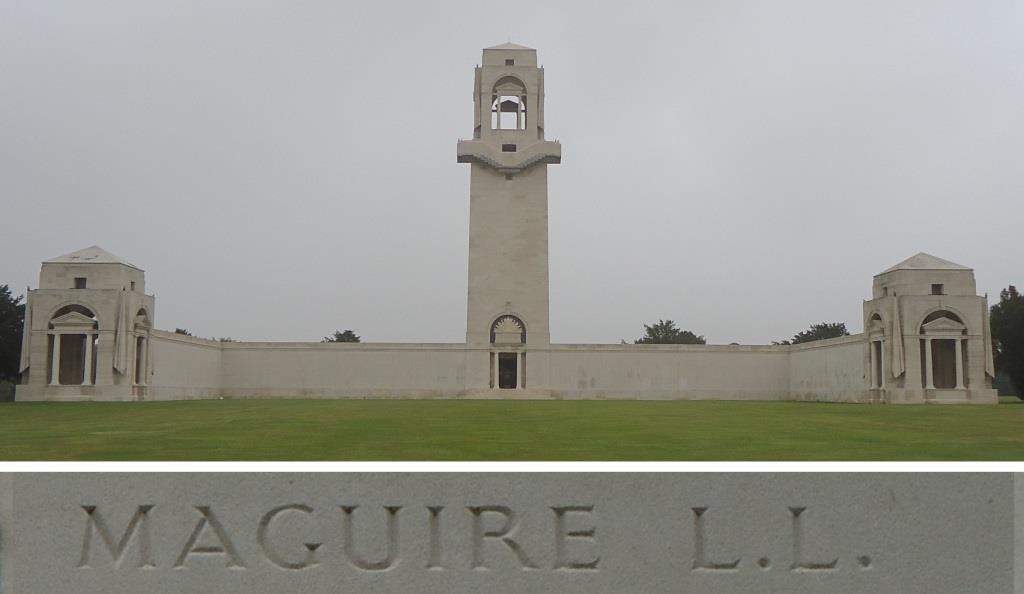
Lance Corporal Laurence Leslie MAGUIRE (45th Battalion) was killed in action during a German artillery barrage when manning the line against the German offensive near Dernacourt, France,  on 2nd April 1918. He has no known grave.

Lance Corporal Maguire’s name on the Villers-Bretonneux Memorial, France (Photograph: S. & H. Thompson 7/9/2014)

Trooper David James O’ROURKE  (12th Light Horse Regiment) was part of a watering party at Jaffa, Palestine, when a horse kicked him in the left knee, and he was sent to the 4th Light Horse Field Ambulance.

David James O’Rourke. Photograph courtesy of Warren O’Rourke.

Wednesday, 3 April 1918

Trooper David James O’ROURKE  (12th Light Horse Regiment) was sent to the 43rd Stationary Hospital.

Thursday, 4 April 1918

Private John Herbert WATTS  (4th Pioneer Battalion) was sent to the 4th Australian Field Ambulance suffering from Influenza. He was later transferred to the 56th General Hospital in France.

Friday, 5 April 1918

Sergeant Sydney Raymond CARVER  (45th Battalion) was wounded in action for a second time in the vicinity of Dernacourt, France, during the Second Battle of Dernacourt, with a gunshot wound to his abdomen, and was sent to the 13th Australian Field Ambulance, then moved back the 29th Casualty Clearing Station.

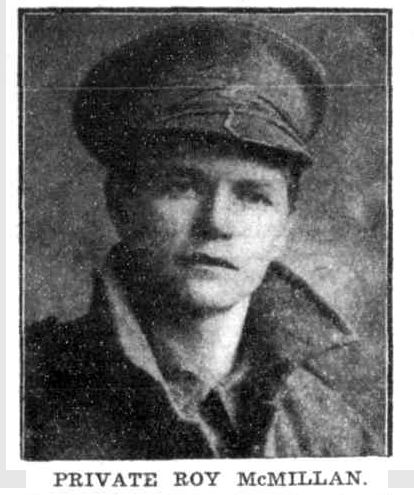
Private Cyril Roy MCMILLAN  (45th Battalion) was reported missing in action in the vicinity of Dernacourt, France, during the Second Battle of Dernacourt – he was  captured as a prisoner of war.

Private Roy McMillan (Cumberland Argus and Fruitgrowers Advocate, 11/5/1918)

Private John Thomas SMITH  (4th Pioneer Battalion) was wounded in action in the vicinity of Henencourt Wood, France, by an artillery shell.

Trooper David James O’ROURKE  (12th Light Horse Regiment) was transferred to the 44th Stationary Hospital at Kantara, Egypt.

Saturday, 6 April 1918

Private William WEBBER  (45th Battalion) was killed in action in the vicinity of Dernacourt, France, when an artillery shell burst in the trench he was manning.

Private John Thomas SMITH  (4th Pioneer Battalion) was transferred to the 22nd General Hospital at Camiers, France .

Trooper David James O’ROURKE  (12th Light Horse Regiment) was transferred to the 14th Australian General Hospital at Port Said, Egypt.

Sergeant Sydney Raymond CARVER (45th Battalion)  was placed aboard the 27th Ambulance Train.

Sunday, 7 April 1918

Sergeant Sydney Raymond CARVER  (45th Battalion)  was placed aboard the 27th Ambulance Train and then admitted to the 7th Canadian General Hospital WHERE.

Monday, 8 April 1918

Private John Thomas SMITH  (4th Pioneer Battalion) was sent by hospital ship to England.

Tuesday, 9 April 1918

Private John Thomas SMITH  (4th Pioneer Battalion) was admitted to the Dorset County Hospital at Dorchester.

Thursday, 11 April 1918

Private John William THOMPSON  (54th Battalion) was wounded in action with a shrapnel would to his left hand.

Friday, 12 April 1918

Private John William THOMPSON  (54th Battalion) was admitted to the 12th General Hospital at Rouen, France.

Saturday, 13 April 1918

Private John William THOMPSON  (54th Battalion) was sent to the 5th Australian Division Base Depot at Le Havre, France.

Monday, 15 April 1918

Private Frank BLACK  (42nd Battalion) departed England aboard the transport Marathon for return to Australia for medical discharge.

Private Charles Henry MAIDENS  (13th Battalion) departed England aboard the Transport Marathon for return to Australia for medical discharge.

Tuesday, 16 April 1918

Private John Herbert WATTS  (4th Pioneer Battalion) was evacuated to England, and admitted to the Northampton Hospital, suffering Trench Fever.

Sunday, 21 April 1918

Private Walter CAVILL (55th Battalion) departed England aboard the Transport Suvic for return to Australia suffering Trench Fever.

Tuesday, 23 April 1918

Private John Thomas SMITH  (4th Pioneer Battalion) died of wounds  at the Dorset County Hospital at Dorcherster.

Wednesday, 24 April 1918

Private Percy George BROWN  (54th Battalion) was wounded in action, being gassed in the vicinity of Villers Bretonneux, France, during the Second Battle of Villers-Bretonneux.

Corporal John MARTIN  (54th Battalion) was wounded in action in the vicinity of Villers Bretonneux with a gunshot wound to his chest, during the Second Battle of Villers-Bretonneux. He was taken to the 15th Australian Field Ambulance.

Thursday, 25 April 1918

Private Percy George BROWN  (54th Battalion) was sent to the 10th General Hospital, at Rouen.

Corporal John MARTIN  (54th Battalion)  was moved back to the 61st Casualty Clearing Station, then onto the 10th General Hospital at Rouen, France.

Sergeant Sydney Raymond CARVER  (45th Battalion)  was placed aboard the Hospital Ship Princess Elizabeth for evacuation to England.

Friday, 26 April 1918

Driver Peter WILSON  (1st Field Engineers Squadron) was injured when he was thrown from a pontoon wagon at Jerusalem, Palestine.

Sergeant Sydney Raymond CARVER  (45th Battalion)  was admitted to a hospital in England.

Saturday, 27 April 1918

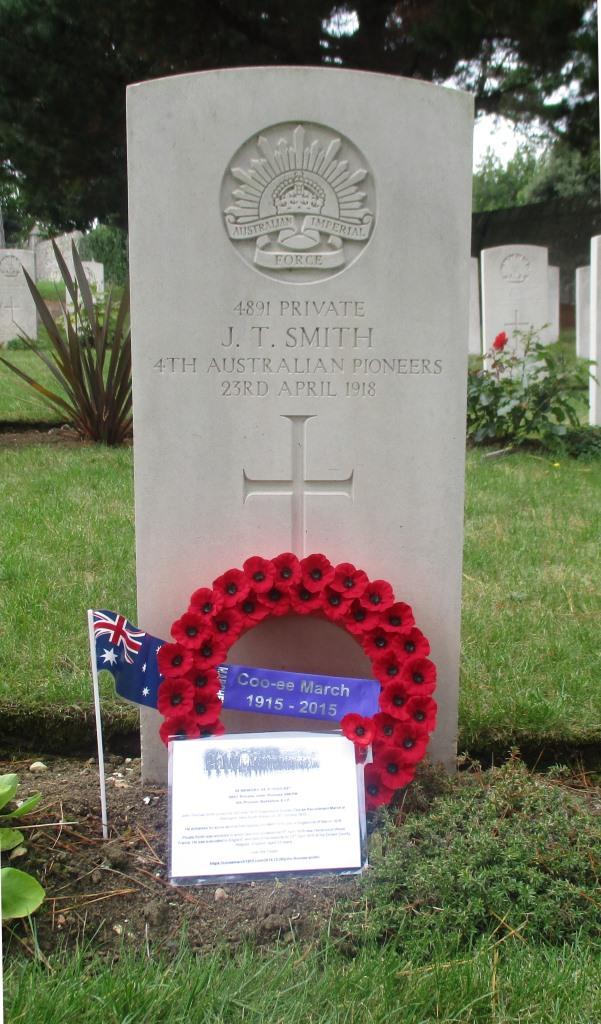
Private John Thomas SMITH  (4th Pioneer Battalion) was buried at Melcomb Regis Cemetery in Weymouth, England, with full military honours.

John Thomas Smith’s headstone at Melcombe Regis Cemetery, Weymouth, England (Photograph: S. & H. Thompson 14/9/2016)

Sunday, 28 April 1918

Private Percy George BROWN  (54th Battalion) was sent to the 73rd General Hospital at Trouville, France.

Private William Allan Luther PHILPOTT  (13th Battalion) departed Durban, South Africa, on the H.M.A.T. Field Marshall, bound for Australia, for medical discharge.

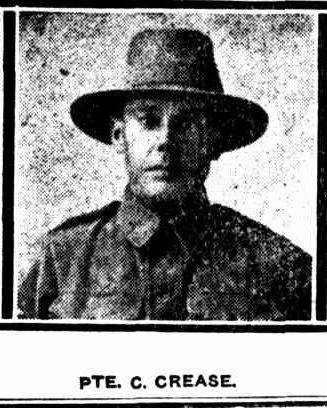
Private Charles CREASE  (13th Battalion) departed Cape Town South Africa aboard the H.M.A.T. Field Marshall for return to Australia, for medical discharge.

Private Charles Crease (Sunday Times 8/10/1916)

Tuesday, 30 April 1918

Lance Corporal Reginald Henry CHAMBERLAIN  (35th Battalion)  was wounded in action, being gassed, while manning the front line in the vicinity of Morlancourt, France, and he was evacuated to the 9th Australian Field Ambulance.

Private John Herbert WATTS  (4th Pioneer Battalion) was transferred to the 1st Australian Auxiliary Hospital at Harefield.