Yearly Archives: 2014

Thomas Walter DOWD

Thomas Walter DOWD

Per his military service record (regimental no. 6244), Thomas Walter Dowd was born at Wellington, N.S.W. He gave his age as 31 years and 11 months, his marital status as single, and his occupation as farmer. His description on his medical was height 5 feet 8 3/8 inches tall, weight 150 lbs., with a fair complexion, blue eyes, and brown hair. His religious denomination was Roman Catholic. He claimed that he had no previous military service.

He was one of the thirteen men who stepped forward and gave his name, ‘either to march under Captain Nicholas, or to come after harvest’, when the Coo-ees recruited in Wongarbon on 14th October 1915.[1]  It is not clear where he joined the Coo-ee March, but written on the top of the first page in his service record is that he ‘Presented at Orange 24/10/15’. He completed his medical on the 24th October 1915 at Orange, and was attested at Orange on 24th October 1915.

There is a docket in the official correspondence of the march dated 24th November 1915, for “T. Dowd, barbering for Coo-ees 21 days @5/- £5-0-0”. This was the profession he was to undertake later in his life after the end of the First World War.

After completing the remainder of the march he went to Liverpool Camp as reinforcement for the 13th Battalion, where he was Acting Sergeant.

On his embarkation roll his address at time of enrolment was Wongarbon, N.S.W., and his next of kin is listed as his father, T. Dowd, Maryvale, N.S.W.

Acting Sergeant Dowd departed Sydney on the HMAT Euripides A14 on the 9th September 1916, and arrived at Plymouth, England, on the 26th October 1916.   On the 4th November 1916 he marched into the 4th Training Battalion.

On the 28th December 1916 Acting Sergeant Dowd departed Folkestone aboard the Princess Clementine bound for France. On the 29th December 1916 he marched into the 4th Australian Division Base Depot at Etaples where he reverted to the rank of Private.

On the 5th February 1917 Private Dowd was taken on strength of the 19th Battalion. On the 27th April 1917 he was promoted to Lance Corporal. On the 20th May 1917 Lance Corporal Dowd was detached for duty with the 20th Battalion, then on the 16th June 1917 he was detached for duty with the 5th Australian Machine Gun Company.

On the 24th October 1917 Lance Corporal Dowd attended the 6th Officer Cadet Training Battalion at Oxford.

A Confidential Report in his service record dated 27th March 1918 (while he still had the rank of Lance Corporal) had the following remarks: “A very fine character, with any amount of common-sense, grit and determination, also a certain amount of originality. Will lead men anywhere, and win affection and confidence”.

He qualified for a commission on the 30th April 1918. He then attended a Machine Gun course.

On the 1st June 1918 he was appointed a Second Lieutenant and on the 31st July 1918 was taken on strength of the 2nd Australian Machine Gun Battalion.

On the 3rd September 1918 Second Lieutenant Dowd was wounded in action, and admitted to the 5th Field Ambulance suffering shrapnel wounds to the face and hand. He was moved back to the 53rd Casualty Clearing Station, then to the 20th General Hospital, where he remained until the 20th September 1918.

Second Lieutenant Dowd rejoined his unit on 2nd November 1918. He was promoted to Lieutenant on the 8th November 1918

On the 2nd January 1919 Lieutenant Dowd went to the United Kingdom on leave. He returned to his unit on the 18th January 1919.

Lieutenant Dowd departed England on the 19th April 1919 aboard the H.T. Sardinia for return to Australia. He arrived at Sydney on the 8th June 1919. He was discharged on the 21st July 1919.

[1] ‘The Route March’, The Farmer and Settler, 19 October 1915, p. 3.


John MCNAMARA

John MCNAMARA

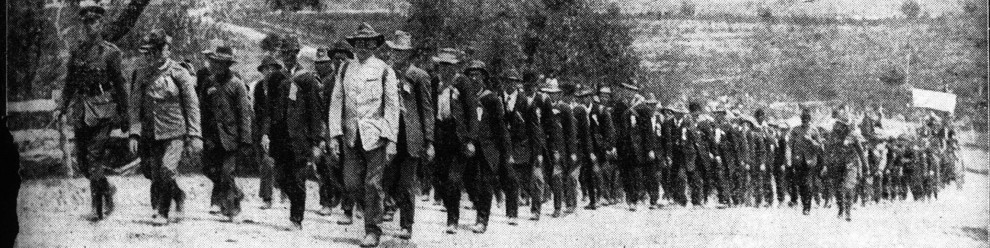
Coo-ees on the road to Balladoran (Sydney Mail 20/10/1915)

Coo-ees on the road to Balladoran – John McNamara is in the front row second from the right, next to Captain Nicholas on far right (Sydney Mail 20/10/1915)

Per his military service record, John McNamara was born at Sydney, N.S.W. His WWI service record shows that he initially tried to enlist on 14th December 1914 at Traralgon in Victoria, where he gave his age as 47 years. (Based on his age given in his entry in the Sudan Nominal Roll on the Australian War Memorial website, it is likely he was even older). On his enlistment papers when he joined the Coo-ees at Gilgandra, he miraculously lost two years, giving his age as 45 years and 2 months. He listed his marital status as single, and his occupation as a butcher. His description on his medical was height 5 feet 11 inches tall, weight 160 ½ lbs., with a medium complexion, grey eyes, and light brown hair. His religious denomination was Roman Catholic. He completed his medical on the 9th October 1915 at Gilgandra, and was attested by Captain Nicholas on the 9th October 1915 at Gilgandra. He claimed to have 5 years in the Regular Forces of New South Wales throughout the Boer War, and a total of 15 years’ previous military service. He gave his address as c/- H. Burns, Exhibition Dairy, Botany Road, Sydney. He listed his next of kin as his nephew, Valentine McNamara, Exhibition Dairy, Botany Road, Sydney.

After completing the march he went to Liverpool Camp as reinforcement for the 13th Battalion.

After two periods of being absent without leave (17th to 24th January 1916, and 3rd to 11th February 1916), on the 16th February 1916 Private McNamara was discharged with his services no longer being required.

The veteran of the Coo-ees : John McNamara

Transcript of an article titled “The Veteran of the “Coo-ees” from The Dubbo Liberal and Macquarie Advocate, November 16, 1915, p. 2.

THE VETERAN OF THE “COO-EES.”

As long as ever he can remember, John McNamara, the grizzled old veteran, who marched in the front rank of the “Coo-ees” all the way down to the coast, has had a hankering after a military life. He first enlisted during the early eighties in the New South Wales Artillery, which was then under the control of the State Government. On the outbreak of the Soudan campaign he volunteered, for service, and secured a place in the field battery. At the conclusion of the campaign he was awarded the Soudan medal and clasp and the Khedive’s bronze star. His next experience of active service was under Major Forbes in the Matabele campaign, for which he holds the medal.

On the outbreak of hostilities in South Africa McNamara joined Brabant’s Horse, and went right through the war, gaining the Queen’s Medal and four clasps, the Kings Medal and two clasps, and also the Distinguished Conduct Medal. During the same campaign he also served in the Imperial Light Horse under Colonel Duncan McKenzie, and in the Western Province Mounted Rifles. At the conclusion of hostilities he enlisted in the Transvaal Mounted Police as a trooper, and during the Cape Colony rebellion a mounted patrol in which he was had a brush with the famous rebel leader Maritz at Toutlebosch Kop. Later as he resigned from the mounted police, and secured employment on the Cape-Cairo railway, being stationed at Wankas, a town 60 miles north of Buluwayo. Here he contracted black-water fever, and on his recovery he went to New Zealand. He remained there for some years, but the call of the bush was too strong, and six years ago he came over to New South Wales. He attempted to enlist at the beginning of the present war, but was rejected owing to the fact that he was over 35. Now things are changed. He is going to the front, and his heart’s desire being satisfied, there is no happier man in the “Coo-ees” than John McNamara.

Click here to view the article on Trove: http://nla.gov.au/nla.news-article77602239

Letter from W. H. Saunders to his sister

Extract from a letter written by William Hilton Saunders sent to his sister Doris in Wongarbon, which was published in an article titled ‘Letters from the Front. Driver H. Saunders’ in the Wellington Times, 16 October, 1916, p. 2.

“LETTERS FROM THE FRONT.
DRIVER H. SAUNDERS.
From Driver H. Saunders, (“Somewhere in France,” 13th August, 1916), to his sister, Miss Saunders, at Wongarbon:—
This is only my second letter from France, although I have sent several field service cards and a packet of fancy P.C.’s. I feel almost ashamed of myself to think I have been about two months over here and only written twice because I can just imagine how you all watch the incoming mails for a letter from “someone in France.” I hope you have received all my letters O.K. I wrote one from Serapeum, containing 17 pages; let me know if you got it alright. The only mail I have received since coming to France was a couple of papers on July 2nd and about three days ago three letters from Australia, all dated 11th July. I can tell you, Dot, I was some pleased, and felt about six months younger. I had just read the letters, and walked down the village, when who should I meet but Will Collyer. He had just arrived from England with some reinforcements, and was getting fixed up at headquarters. He looks well and was very pleased to see me. He was in England for about two months, and has had a good time.

… I saw Don Stewart and a few more of the 13th boys, including Les Anelzark [sic] and Will Robinson, also saw Mr. McKillop, one of our 13th Batt. Lieutenants. Well, Doris, we have been in action, and I had my first experience of shell fire. Fritz shelled four of our waggons one day, and one of our mules was hit in the leg and destroyed. ‘Twas in broad daylight, and when we started to get away a high explosive landed on the road 2 feet behind our waggon. It was fairly close, but although we got covered in mud and dirt, and the explosion lifted the timber about 2 feet in the air, nobody was hurt. It made my ears ring for a while, but although I have been up amongst the batteries with a bombardment in full swing, I have not felt the slightest effect. It is a very pretty and fascinating sight to watch the star shells and shrapnel bursting at night time; the sky is as bright as day, and it always reminds me of some gigantic industrial enterprise with the roaring of the cannon and rattle of machine guns representing the machinery. Our job is not a very dangerous one, but the closer we are to the line the more interesting it becomes. We are now a good many miles away from the roar of the big guns, in a quiet and secluded little village, about 10 miles from anywhere   and somewhere in France, so now, you, by that detailed description of our position, should know exactly where we are camped. (Rats.) We are resting, but expect to be doing another “shove” in the “big push” before very long, and although we have a fair weight to push, the muscle of our chaps will tell in the end, and you will be laying the table for five instead of four as is now the case. Ernie May is still with us, and looks splendid. He is quite fat and looks better now than I have ever seen him. There is no doubt this is a great life, and a healthy one. I will get my photo taken one of these days and send you a couple.

… Mack is in one of the mortar batteries, but I have not had a line from him. I have not received the parcel Mum mentioned, but I suppose it will turn up some day. How are all the home folk? I hope they are all well. I believe it is very cold at home this winter. The weather is lovely in beautiful France, but of course it is summer time now. Well, Doris, I must close now as space is limited. Best wishes to all my friends.”

Click here to view this article in Trove:http://nla.gov.au/nla.news-article137408900

 [Note: William Collyer, “Mack” Wilfred Ernest McDonald, and Ernest May were other Coo-ees from Wongarbon. Donald Stewart was a Coo-ee from Wellington. Leslie Anlezark was a Coo-ee from Orange].

William Hilton SAUNDERS

William Hilton SAUNDERS

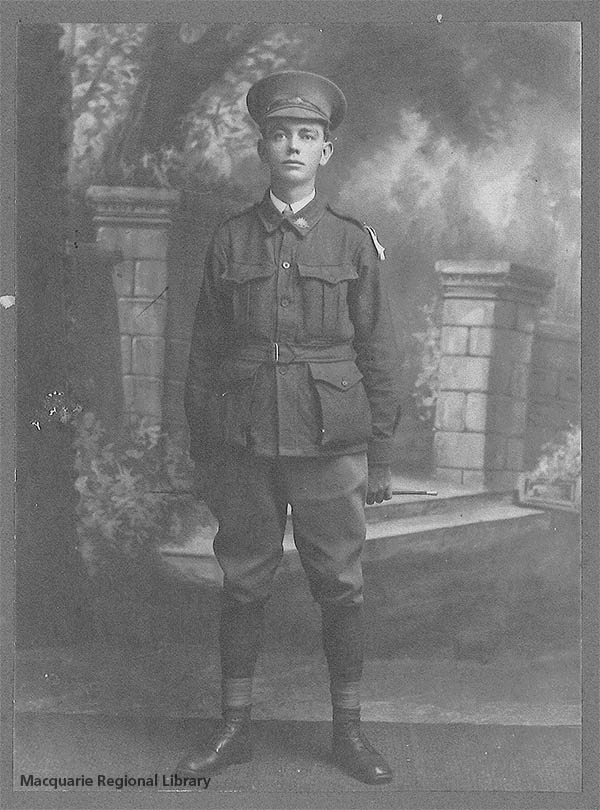
William Hilton Saunders (Photograph courtesy of Macquarie Regional Library)

William Hilton Saunders (Photograph courtesy of Macquarie Regional Library)

Per his military service record (regimental no. 4901), William Hilton Saunders was born at Goodooga, N.S.W. He gave his age as 21 years and 2 months, his marital status as single, and his occupation as Grocer. His description on his medical was height 5 feet 7 ½ inches tall, weight 9 stone 10 lbs., with a fair complexion, greenish grey eyes, and fair hair. His religious denomination was Anglican. He completed his medical on the 8th October 1915 at Gilgandra before the march began. He was attested at Stuart Town on the 19th October 1915. He claimed that he had no previous military service.

He was one of the thirteen men who stepped forward and gave his name, ‘either to march under Captain Nicholas, or to come after harvest’, when the Coo-ees recruited in Wongarbon on 14th October 1915.[1]

After completing the remainder of the march he went to Liverpool Camp as reinforcement for the 13th Battalion.

On his embarkation roll his address at time of enrolment was Wongarbon, N.S.W., and his next of kin is listed as his father, E. J. Saunders, Wongarbon, N.S.W.

Private Saunders departed Sydney on the HMAT Star of England on the 8th of March 1916. He arrived in Egypt on the 11th of April 1916. On the 16th of April 1916 he transferred to the 4th Division Artillery at Telelkebir, and was taken on strength of the 10th Field Artillery Brigade. He was appointed Driver on 18th May 1916. On the 23rd of May 1916 he was taken on strength of the 4th Division Ammunition Column.

On the 6th June 1916 Driver Saunders left Alexandria aboard HMT Oriana, bound for France, arriving at Marseille on the 13th June 1916.

On the 17th August 1917 Driver Saunders was charged with, when on active service, being drunk in Calais about 9.15 pm. He was awarded 21 days Field Punishment Number Two.

On the 15th October 1917 Driver Saunders was wounded in action suffering a gunshot wound to his right foot. He was evacuated to the 3rd Field Ambulance. On the 16th October 1917 he was sent to the 35th General Hospital, and on the 19th October 1917 he boarded a ship for England. On 20th October 1917 he was admitted to the East Suffolk Hospital.

Driver Saunders was granted leave from Hospital on the 20th November 1917. On the 9th January 1918 Driver Saunders departed Southampton to return to France. He rejoined his unit on the 15th January 1918.

On the 2nd September 1918 Driver Saunders was admitted to the 13th Field Ambulance sick. On the 5th September 1918 he was transferred to the 41st Stationary Hospital. On the 6th September 1918 he was sent to the 9th General Hospital at Rouen. On the 12th September 1918 he went to the 11th Convalescent Depot. Driver Saunders rejoined his unit on the 28th September 1918.

On the 26th October 1918 Driver Saunders went on leave to the United Kingdom. On the 18th November 1918 Driver Saunders was charged with being Absent Without Leave from 6.00 am on the 12th November 1918 to 10.10 pm on the 16th November 1918.

Per his 1918 war diary, this period of absence was while he was celebrating the Armistice in London. His entry for the 16th November 1918 was: “Had a great day … Here I am pinched by the MPs & in Warwick Square quite forgot that my pass is overdue & I should have gone back. Oh yes days ago. Who cares”.[2]

He was awarded forfeiture 5 days pay on 18th November 1918, which was increased to a total forfeiture of 10 days pay on 2nd January 1919.

On the 12th May 1919 Driver Saunders departed England for return to Australia aboard the HT Port Napier. He arrived in Sydney on the 5th July 1919, and was discharged on the 19th August 1919.

[1] ‘The Route March’, The Farmer and Settler, 19 October 1915, p. 3.
[2] Saunders, William Hilton, personal diary, 1918.

Wilfred Ernest MCDONALD

Wilfred Ernest MCDONALD

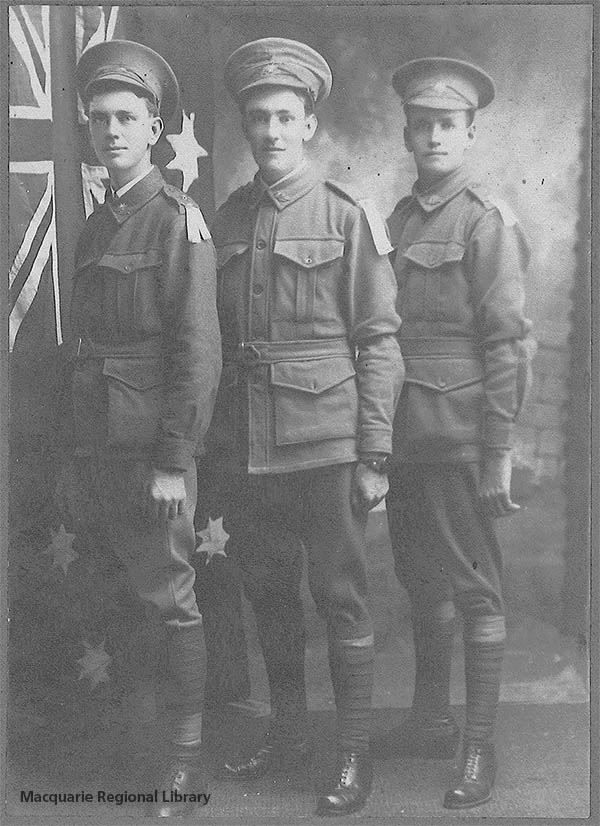
W. Hilton Saunders, Ernest May, and Wilfred McDonald, at Dubbo, ca. Dec. 1915 (Photograph courtesy of Macquarie Regional Library)

W. Hilton Saunders, Ernest May, and Wilfred McDonald, at Dubbo, ca. Dec. 1915 (Photograph courtesy of Macquarie Regional Library)

Per his military service record (regimental no. 4858), Wilfred Ernest McDonald was born at Dubbo, N.S.W. He gave his age as 21 years and 1 month, his marital status as single, and his occupation as laborer. He claimed that he had no previous military service. His description on his medical was height 5 feet 6 ½ inches tall, weight 9 stone 2 lbs., with a fair complexion, greenish grey eyes, and fair hair. His religious denomination was Anglican. He completed his medical on the 8th October at Gilgandra before the beginning of the march.

He was one of the thirteen men who stepped forward and gave his name, ‘either to march under Captain Nicholas, or to come after harvest’, when the Coo-ees recruited in Wongarbon on 14th October 1915.[1] He was attested at Stuart Town on 19th October 1915.

After completing the march he went to Liverpool Camp as reinforcement for the 13th Battalion.

On his embarkation roll his address at time of enrolment was Wongarbon, N.S.W., and his next of kin is listed as his father, H. G. McDonald, Wongarbon, N.S.W.

Private McDonald departed Sydney on the HMAT Star of England on the 8th of March 1916. He arrived in Egypt on the 11th of April 1916. On the 16th of April 1916 he transferred to the 4th Division Artillery at Telelkebir. On the 27th May 1916 he was taken on strength of the 4th Division Ammunition Column.

On the 6th June 1916 Gunner McDonald left Alexandria aboard HMT Oriana, bound for France, arriving at Marseille on the 13th June 1916.

On the 25th June 1916 Gunner McDonald was transferred to the V4 Heavy Trench Mortar Battery.

On the 10th October 1916 Gunner McDonald was admitted to the 4th Australian Field Ambulance with conjunctivitis to his right eye. He was sent back to the 3rd Casualty Clearance station on the 11th October 1916 then to the 15th Casualty Clearance Station at Hazebrouck on the 12th October 1916. On the 20th October 1916 he was sent back to the 13th Stationary Hospital at Boulogne. On the 26th October 1916 Gunner McDonald was admitted to the 26th General Hospital at Etaples suffering a corneal ulcer. On the 10th November 1916 he was transferred to the 6th Convalescent Depot also at Etaples then on the 23rd November 1916 he was readmitted to the 26th General Hospital with Influenza. On the 27th November 1916 he was sent back to the 6th Convalescent Depot then on the 1st December 1916 he was transferred to the 5th Convalescent Depot at Cayeux. On the 22nd December 1916 Gunner McDonald rejoined his Unit.

On the 2nd of February 1917 Gunner McDonald was charged with ‘’Disobeying in such a manner as to show a wilful defiance of authority a lawful command given personally by his superior officer in the execution of his office’’. A Field General Court Martial was held on the 17th February 1917 where Gunner McDonald was found guilty. He was sentenced to Five years Penal Servitude. On the 25th February 1917 the sentence was suspended.

On the 3rd of May 1917 Gunner McDonald was with his unit occupying a position between Ecoust and Bullecourt in France, preparing to support an attack, when they came under heavy German artillery fire. The store of mortar bombs was struck during this bombardment and exploded, destroying all the battery weapons and equipment. A total of 9 men were killed, 14 were wounded, 8 suffered shell shock and 16 were reported Missing In Action. Gunner McDonald was amongst the missing. This status was later amended to Killed In Action. His name is listed on the Villers-Bretonneux Memorial.

His name is also listed on the Dubbo War Memorial, and the Wongarbon Soldiers Memorial.

[1] ‘The Route March’, The Farmer and Settler, 19 October 1915, p. 3.
Bombardier E. C. N. May – letter home

Extract from a letter titled ‘Bombar[d]ier E. C. N. May’, published in the Wellington Times, 14 September, 1916, p. 3.

“BOMBAR[D]IER E. C. N. MAY.

Bombardier E. C. N. May writes to his parents and sisters at Wongarbon from France (9/7/16) as follows:— Received your welcome letter, dated 19/4/16, also one from Mr. W. Moore, and two from Ida. I am always pleased to hear from my friends, but I am sure the majority of my letters go astray or are probably lying in some base.

Well, parents, I have been in France now nearly a month, and I am now well within the war zone area. The 4th D.A.C. are doing their bit. I have experienced shell fire while taking ammunition to the battery, and so far came off lucky. …

I’ve just been away drawing rations. I saw H. Saunders, he is O.K.; he is in No. 1 section. A. Eschelon. Aeroplanes are a common sight here, and are seen at all times during the day, and at night the bursting shrapnel in the sky denotes that aircraft are busy. I have sent you many French post cards and curios, and have others already on the way home. Kindly remember me to all enquiring friends. I am quite well and pray you are all the same at home, and that you still keep hopeful of my return. I may add we are now moving off again, and I’ve no time for writing more, so now, dear parents and sisters, farewell.”

Click here to view the article on Trove: http://nla.gov.au/nla.news-article137416072

Ernest Charles Norman MAY

Ernest Charles Norman MAY

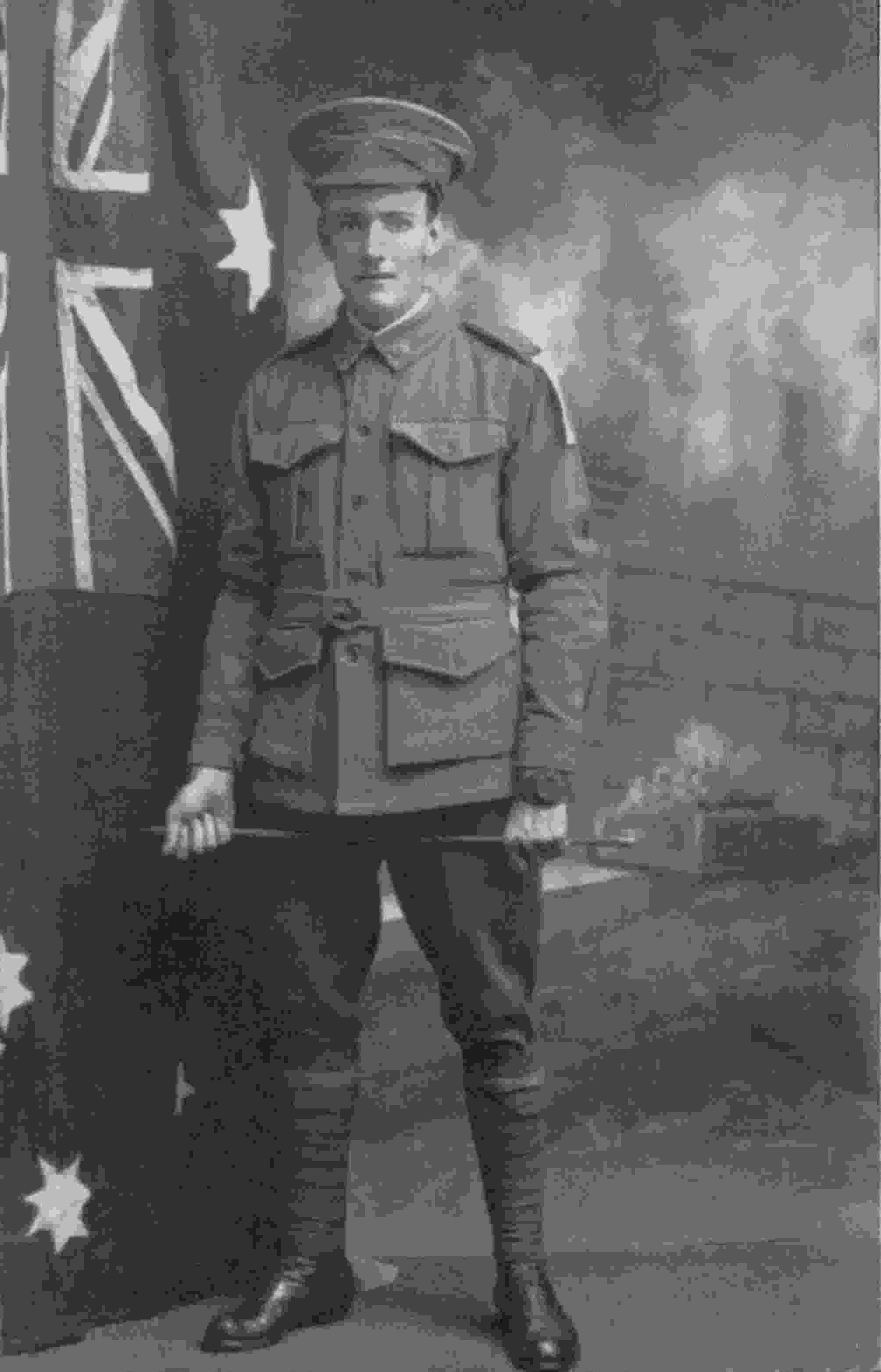
Ernest May (Photograph courtesy of  M. Baxter)

Ernest May (Photograph courtesy of Mrs M. Baxter)

Per his military service record (regimental no. 4851), Ernest Charles Norman May was born at Wongarbon, N.S.W. He gave his age as 23 years, his marital status as single, and his occupation as laborer. His description on his medical was height 5 feet 8 inches tall, weight 145 lbs., with a fair complexion, brown eyes, and brown hair. His religious denomination was Church of England. He was one of the thirteen men who stepped forward and gave his name, ‘either to march under Captain Nicholas, or to come after harvest’, when the Coo-ees recruited in Wongarbon on 14th October 1915.[1] However, he did not undertake his medical until 24th of October 1915 at Orange, where he also was attested. A note on the top of his service record said he ‘presented at Orange 24/10/15’. He claimed previous military service as a member of the Wongarbon Rifle Club.

After completing the remainder of the march he went to Liverpool Camp as reinforcement for the 13th Battalion.

On his embarkation roll his address at time of enrolment was Wongarbon, N.S.W., and his next of kin is listed as his father, C. May, Wongarbon, N.S.W.

Private May departed Sydney on the HMAT Star of England on the 8th of March 1916. He arrived in Egypt on the 11th of April 1916. On the 16th of April 1916 he transferred to the 4th Division Artillery at Telelkebir, and was taken on strength of the 10th Field Artillery Brigade. On the 23rd of May 1916 he was taken on strength of the 4th Division Ammunition Column. On the 27th of May 1916 he was promoted to Bombardier.

On the 6th of June 1916 Bombardier May left Alexandria aboard HMT Oriana, bound for France, arriving at Marseille on the 13th June 1916.

On the 21st February 1917 Bombardier May transferred to the 1st Ammunition Sub Park and was reclassified a Private. On the 27th September 1917 he was reclassified a Driver Motor Transport.

On the 25th February 1918 Driver May was granted leave to the United Kingdom. He re-joined his unit in France on the 11th March 1918.

On the 12th March 1918 Driver May was taken on strength of the 1st Australian Division Motor Transport Company.

On the 7th March 1919 he was promoted to Lance Corporal. On the 23rd March 1919 he was promoted to Corporal. On the 9th April 1919. Corporal May was granted leave to the United Kingdom. He returned to his unit on the 21st April 1919. On the 20th May 1919 Corporal May was transferred to the 2nd Division Motor Transport Company.

On the 8th June 1919 Corporal May was admitted to the 20th Casualty Clearance Station sick with herpes zoster (shingles). On the 15th June 1919 he was transferred to the 3rd Australian Auxiliary Hospital. On the 18th June 1919 Corporal May was granted leave. On the 2nd July 1919 Corporal May reported to Headquarters Number 2 Group Sutton Veny.

Corporal May returned to Australia aboard the transport Takada, leaving England on the 18th July 1919, and disembarking at Sydney on the 7th September 1919. He was discharged on the 25th November 1919.

[1] ‘The Route March’, The Farmer and Settler, 19 October 1915, p. 3.
John Herbert WATTS

John Herbert WATTS

Per his military service record (regimental no. 2260), John Herbert Watts was born at Dunedoo, N.S.W. He gave his age as 18 years, his marital status as single, and his occupation as Casual linesman. His description on his medical was height 5 feet 7 ½ inches tall, weight 137lbs., with a medium complexion, brown eyes, and light brown hair. His religious denomination was Methodist. He joined the Coo-ee March at Dubbo. He completed his medical on the 4th October 1915 at Dubbo, and was attested on the 14th October 1915 at Dubbo. He claimed to have no previous military service.

After completing the march he went to Liverpool Camp. He was appointed as 15th reinforcement for the 1st Light Horse Regiment at Liverpool on 7th February 1916.

On his embarkation roll his address at time of enrolment was Lewis Street, Mudgee, N.S.W., and his next of kin is listed as his father, Nathaniel Watts, Lewis Street, Mudgee, N.S.W.

Trooper Watts departed Sydney on the HMAT A25 Armadale on the 21st March 1916. He arrived in Egypt on the 24th April 1916.

On the 1st May 1916 he was transferred to the 4th Pioneer Battalion at Serapeum.

On the 4th June 1916 he embarked on the transport Scotian at Alexandria to join the British Expeditionary Force in France. He disembarked in Marseilles on 11th June 1916.

Private Watts was appointed Driver on 2nd December 1916.

Per his service record, Driver Watts name was mentioned in Sir D. Haig’s despatch on the 7th April 1918, as deserving of special mention for conspicuous services rendered, which was promulgated in the Commonwealth of Australia Gazette, No. 165, 24th October 1918. The recommendation was ‘for continuous good service from 23rd September, 1917 to 25th February, 1918’.

Following being admitted to hospital sick with pyrexia on the 4th April 1918, Driver Watts was evacuated to England with Trench Fever on 16th April 1918, where he was admitted to Duston War Hospital in Northampton. On 30th April 1918 he was transferred to 1st Australian Auxiliary Hospital at Harefield. He was granted leave from 2nd May 1918 to 16th May 1918. Driver Watts returned from furlough on 17th May 1918 and marched into No. 4 Command Depot, Hurdcott. From the 8th to the 13th August he was admitted to the Camp Isolation Hospital at Hurdcott with Scabies.

Driver Watts returned to France on 22nd September 1918. He was admitted to hospital on 21st November 1918, and transferred to England on 9th January 1919, and admitted to the 1st Australian Dermatological Hospital at Bulford on 10th January 1919.

Driver Watts departed England on 31st March 1919 on the HT Khyber to return to Australia, and disembarked in Sydney on 14th May 1919.

He was discharged on 16th May 1919.

Henry MOSS

Henry MOSS

Per his military service record (regimental no. 2221), Henry Moss was born at Mossgiel, N.S.W. He gave his age as 24 years, his marital status as single, and his occupation as shearer. His description on his medical was height 5 feet 5 ½ inches tall, weight 152 lbs., with a medium complexion, grey eyes, and dark brown hair. His religious denomination was Church of England.  He joined the Coo-ee March at Dubbo. He undertook a preliminary medical at Cobar on 11th October 1915, giving his postal address on this document as “Cobar”. He completed his medical on the 13th October 1915 at Dubbo, and was attested on the 13th October 1915 at Dubbo. He claimed to have no previous military service.

After completing the remainder of the march he went to Liverpool Camp. He was appointed as 15th reinforcement for the 1st Light Horse Regiment at Liverpool on 7th February 1916.

On his embarkation roll his address at time of enrolment was Bulli, South Coast, N.S.W., and his next of kin is listed as his mother, Mrs. Elizabeth Moss, Bulli, South Coast, N.S.W.

Private Moss departed Sydney on the HMAT A25 Armadale on the 21st March 1916. He arrived in Egypt on the 24th April 1916.

On the 18th May 1916 he was transferred to the 4th Pioneer Battalion at Serapeum.

On the 4th June 1916 he embarked on the transport Scotian at Alexandria to join the British Expeditionary Force in France. He disembarked in Marseilles on 11th June 1916.

Private Moss was appointed Lance Corporal in the field on 17th November 1916.

On the 4th June 1916 L/Corporal Moss was transferred to the 45th Battalion.

L/Corporal Moss was wounded in action on 7th June 1917, when he received gunshot wounds to his left arm compound fracture to his humerus, and was taken to the 53rd Casualty Clearing Station. On the 8th June he was moved to the 7th General Hospital at St Omer. On the 14th August he was admitted to the 3rd Australian Auxiliary Hospital in Dartmouth in England.

On 29th August 1917 L/Corporal Moss was discharged from hospital and sent to No. 2 Command Depot at Weymouth.

L/Corporal Moss departed England on 26th September 1917 on the HMAT Borda to return to Australia, and disembarked in Sydney on 25th November 1917.

He was discharged medically unfit on 2nd March 1918.