Category Archives: Towns

Day 10, Tuesday, 19 October, 1915, Dripstone to Stuart Town

Transcription of extract from an article titled ‘The Route March : Growth of the “Snowball”’ in The Farmer and Settler, 22 October, 1915, p. 3 [part 2 of 3]

… [Continued]

‘Lunch at Mumbil.
An early start was made on Tuesday for the next halting point on the itinerary, which was a seven-mile stretch to Mumbil. Arrived there, the local school children sang for the “Coo-ees,” and their mothers and sisters provided a most acceptable lunch in a paddock adjacent to the queer old school house. Cheers were given, and the people assured the recruits of their good will, but they furnished no additions to the force. Mumbil was warmly thanked by the spokesmen of the party, then a move forward was made to the night camp at Stuart Town.

The Stuart Town Function.
After a swim, a mile or so out of town, column of route was once more formed, and the boys marched in, headed by the school children, and took up their quarters in the local hall. As there was no suitable accommodation available for entertainment, the townspeople arranged to give the men tea in McAtamney’s Hotel, but, of course, the “follow the King” rule held good, even there. The usual recruiting meeting was held after tea in the hall, resulting in four names being handed in. All were not able to go at once; two will follow in a day or two, and the others, as usual, will be carried on with the column until the next doctor is found. Supper was dispensed as usual by the good-hearted womenfolk, who furnished mountains of beautiful cake and pastry —though the recruits are beginning to wonder if sweets constitute quite the best ration for marching men. The boys sometimes sigh for red meat.’

Click here to view the article on Trove: http://nla.gov.au/nla.news-article116649160

Day 9, Monday, 18 October, 1915, Wellington to Dripstone

Transcription of extract from an article titled ‘The Route March : Growth of the “Snowball”‘  in The Farmer and Settler, 22 October, 1915, p. 3 [part 1 of 3]

‘THE ROUTE MARCH
Growth of the “Snowball”
THE “FIERY CROSS” IN THE WEST.

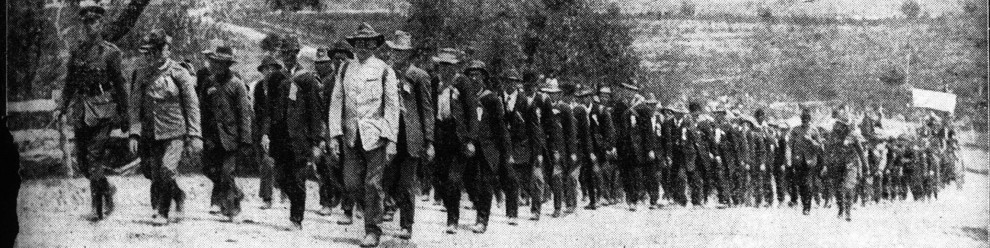
As the route march moves eastward the column not only grows in numerical strength, but it takes on more and more the character of a drilled and disciplined force. The men are marching well and   learning all they can of the game. One platoon has now been formed, and a second approaches full strength; acting non-coms, have also been appointed ; and as each fresh batch of recruits is added, the men are quickly “licked into shape.” The commissiariat department is working more and more smoothly; and the intelligence department is also getting into smooth running order. Mr. Harley Blackett has placed his car at the disposal of the force, and an intelligence officer goes over the ground in advance of the column checking the arrangements for camping and receptions, and studying the roads from the standpoint of a marching army with a certain distance to cover in a given time. The consequence is a clockwork adherence to the time-table.

The column marched out of Wellington nearly a hundred strong, including the staff and commisariat assistants; but the published story that there are already a hundred recruits is an “intelligent anticipation of events.” Twenty-six additional men joined at Wellington, so, with Gilgandra’s thirty-one, Dubbo’s nine, Wongarbon’s eight, and Geurie’s two, there were exactly seventy-six sworn recruits when the march swung out of town on Monday morning. Before the column had proceeded far the sergeant of police, an indefatigable recruiter, had overtaken it with four more in a motor car, and yet others are known to have thought the matter over, and to have decided to “catch up with the procession” in a day or two.  Advices have been received from towns along the line that numbers of men arc only waiting for the necessary forms to come along, when they will join the great march.

Soon after leaving Wellington, a fine, large ensign was presented to the captain by Mr. Bertie Gaden, and this flag now floats from the top of No. 1 transport waggon, in company with a Union Jack.

Lunch was prepared by the “Coo-ee’s” cook at Mr. J. Hoffner’s farm, a pleasant break in the day’s tramp.

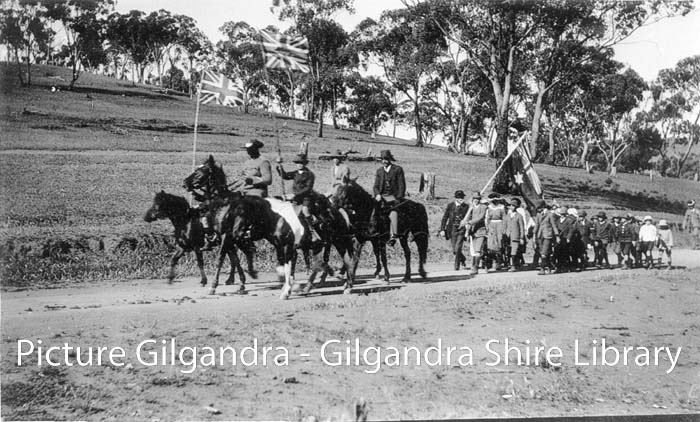
Coo-ees being lead into Dripstone, NSW (Photograph courtesy of Gilgandra Shire Library)

Coo-ees being led into Dripstone, NSW (Photograph courtesy of Gilgandra Shire Library)

Dripstone’s Reception.
Dripstone turned out in force to welcome the “Coo-ees,” and a fine tea was provided in the hall by the ladies. Considering the smallness or the settlement the reception was a remarkably fine one. A noticeable feature of the entertainment afforded the column on its eastward march is that the smaller the place the more trouble is taken by the people to assist and entertain the men, and it might almost be said the heartier the welcome. As instances, Wongarbon and Maryvale, might be quoted. Wongarbon has certainly eclipsed all others, and its gifts and good cheer were out of all proportion to its size.

After the Dripstone tea a recruiting meeting was held, but the young men that remain are unresponsive when it comes to the point of enlisting. Q.M.S. Lee was spelled on this occasion, and the recruiting addresses were delivered by Mssrs. H. Blacket[t], Major Wynne, and W. J. Johnson. The evening concluded with dancing, which might have continued to the rosy dawn of another day if the boys had not brought in their blankets and commenced spreading them among the tripping feet of the dancers. Realising that it was not a fair thing to expect the recruits to march all day and dance all night, the hint was good humoredly taken, and the floor vacated.’

Click here to view the article on Trove: http://nla.gov.au/nla.news-article116649160

Day 8, Sunday, 17 October, 1915, Wellington

Transcription of extract from an article titled ‘Hitchen’s Coo-ees’ in The Wellington Times, Monday, 18 October, 1915, p. 3.

Note: This extract also covers the recruiting meeting held on Saturday night on 16 October, 1915.

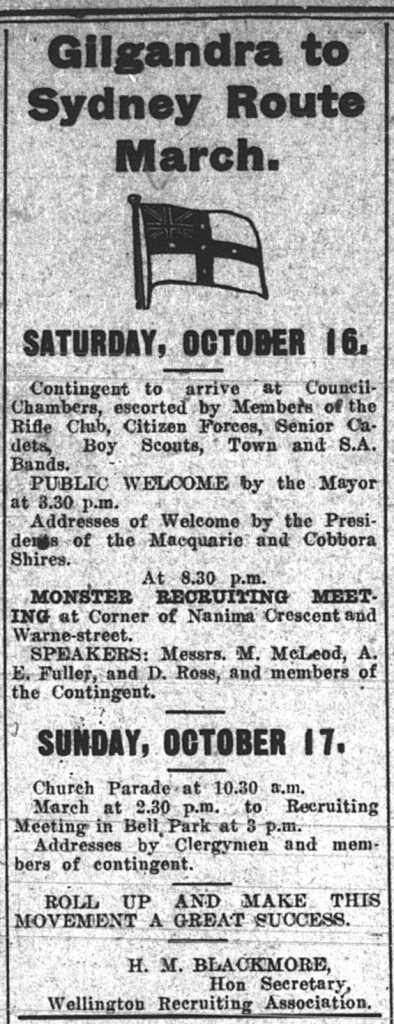
Program of events at Wellington (Wellington Times 14/10/1915)

Program of events at Wellington (Wellington Times 14/10/1915)

‘HITCHEN’S COO-EES.
THE SNOWBALL GROWS.
… [Continued]

THE RECRUITING MEETINGS.
There was a great gathering at the foot of Warne-street on Saturday night for the first of the recruiting meetings, but a start was not made until 9 o’clock to permit people from the shops to attend. A lorry was drawn up in front of Mr. Paul’s workshops, and on it were Alderman McLeod, the Mayor of Orange (Alderman McNeilly), Mr. H. M. Blackmore (secretary of the Wellington Recruiting Association), Mr. L. J. Astley (Dubbo Recruiting Association), and Mr. W. J. Johnson, formerly Federal member for the district, who was in khaki, and who had come to assist in the recruiting movement.
Alderman McLeod mad a fervid appeal. He regretted that he was not able to go personally, but he had made sacrifices, as must be done by all.
Alderman McNeilly (Mayor of Orange), Quartermaster-Sergeant Lee, Cr. Fuller, Mr. L. J Astley, and Private Johnson made stirring appeals in which the peril of the Empire was alluded to, and need for men strongly insisted on.
There was another big meeting at Bell Park on Sunday afternoon when spirited speeches were made by Alderman McLeod, Adjutant Diehms (Salvation Army), Sergeant Barker, Quartermaster-Sergeant Lee, and Private W. J. Johnson. Mr. Paul read a stirring letter from the front, and there was cheering when it was announced that the D.C.M. had been awarded to Colin Farlow, and that another son of Mr. Angus Campbell had enlisted at Sydney. Then Mr. Hitchens returned his thanks for the treatment of the Coo-ees, and there was intense excitement when the chairman presented the leader with a Union Jack with the words “Wellington,” on it, and the National Anthem, and cheers for the King and the Gilgandra recruits closed a most enthusiastic meeting.
This morning the Coo-ees left for Dripstone, and are due in Orange next Sunday.
After the Coo-ees had left this morning six more recruits came into Wellington and passed the doctor. They were taken along the road to join the company, four being conveyed by Mr. C. J. Shakespeare in his motor car; one by Senior-Sergeant Nies in a sulky, and the sixth by Constable Griffin in another conveyance.

CARE OF THE RECRUITS.
With reference to the care of the recruits, Mr. Ferguson gave the Protestant Hall for their camp rent free, as well as the yard for the marquee for the officers, the Wellington Stores, Ltd., gave the use of the stretchers, and the procuring and arrangement of the beds were carried out by Messrs. A. Kennard and J. Bere, with the aid of assistants. Mr. R. M. Kimbell did the catering and cooked the food without charge, the flour being supplied by McLeod’s mill, and the bread baked by the firm above mentioned; while gifts of meat and other foods and money were liberally made by the tradespeople and residents. The recruits were served with plentiful meals during their stay, and a fine hot dinner yesterday, and Mr. Kimbell and his staff assisted by S. Green and J. Bere, did the waiting. The meals were served in the drill hall, which was decorated for the occasion by Mr. Stoddart and assistants.

CHURCH PARADES.
About 10.30 on Sunday morning the bands, cadets, and military headed the Coo-ees in a march round the town.
There were special services at the churches yesterday. At St. John’s the Rev. E. S. Benyon, of Geurie, was the preacher. Father Eviston made reference to the occasion in the Catholic Church, and a united service of Presbyterians, Baptists, Methodists, and Salvationists was conducted at the Methodist Church, the preacher being the Rev. H. R. Grassick.
Mr. Harry Taylor has consented to sell the impedimentia of the Coo-ees after their arrival in Sydney, and spell the horses used on the journey from Gilgandra, with the view to their subsequent disposal.

SCHOLARS AND RECRUITS.
When the Gilgandra recruits reached in front of the district school this morning, they were halted while the 700 children were lined up and gave the boys a cheer. Each man was then presented with a box of chocolates, and had a flower pinned to his coat, and they went on their way to the sound of more cheering from the lusty throats of the youngsters.’

Day 7, Saturday, 16 October, 1915, Geurie to Wellington

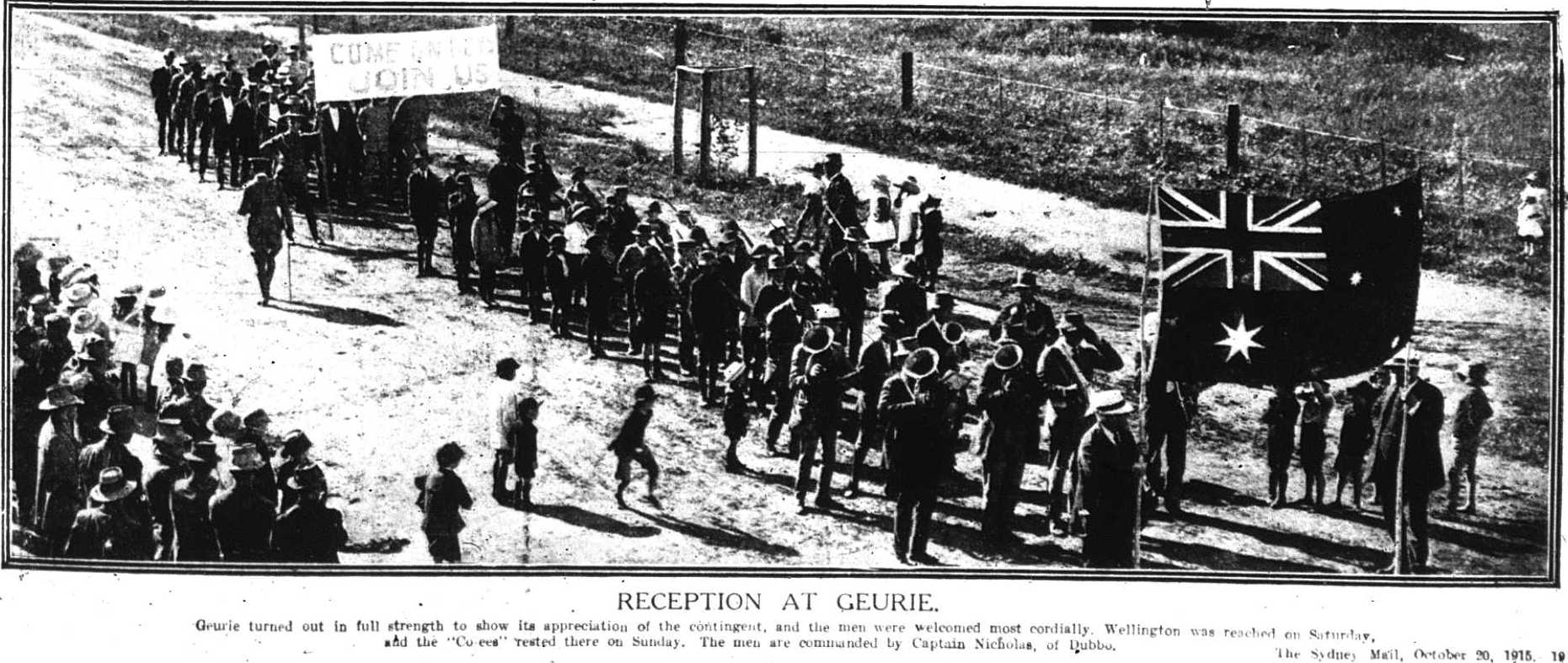
Reception at Geurie (Sydney Mail 20 Oct 1915)

Reception at Geurie (Sydney Mail 20/10/1915)

Transcription of extract from an article titled ‘The Route March’ in The Farmer and Settler, 19 October, 1915, p. 3, [part 3 of 3 parts]:

‘THE ROUTE MARCH
The Snowball Growing
THE ADVANCE FROM DUBBO TO WELLINGTON.
[Continued] …

Maryvale’s Luncheon.
The road to Wellington was fourteen miles long, but the weather was pleasant, and the going easy. Also there was a refreshing break at Maryvale, where a superb al-fresco luncheon of turkey and plum pudding had been provided by the generous-hearted women of the district Maryvale cheered the recruits and the recruits cheered Maryvale, and then  swung out on the road to Wellington.

Arrival at Wellington.
Outside the town, the column, now sixty strong, was met by bands, militia, police, riflemen, and cadets, Alderman M. McLeod and Mr. H. M. Blackmore, secretary of the Wellington Recruiting Association, representing the townspeople officially. Half the town and district took part in this outside welcome; and then in the council chambers there was speech- making and cheering and recruiting and donating— all in the most enthusiastically patriotic spirit. Ald. McLeod, Cr. A. E. Fuller, president of Macquarie Shire Council, Cr. Donald Ross, president of Cobbora Shire Council, and Mr. T. H. Thrower, M.L.A., member for the district, welcomed the recruits: and Mr. Hitchcn acknowledged the compliments of the speakers. Later the recruits were entertained at tea by the local Red Cross Society, and then marched to their sleeping quarters in the Protestant Hall.   Wellington added thirty recruits on Saturday, and much gear. Two horses were auctioned and £33 raised; an hotel collection netted £17; the employees of one store gave £5, and the proprietors more. “Go to the stores and get the   boots you need,” said one of the local re-cruiting committee; “we will foot the bill.” That was the spirit of the Wellington reception.’

Click here to access the article on Trove: http://nla.gov.au/nla.news-article116648940

Day 6, Friday, 15 October, 1915, Wongarbon to Geurie

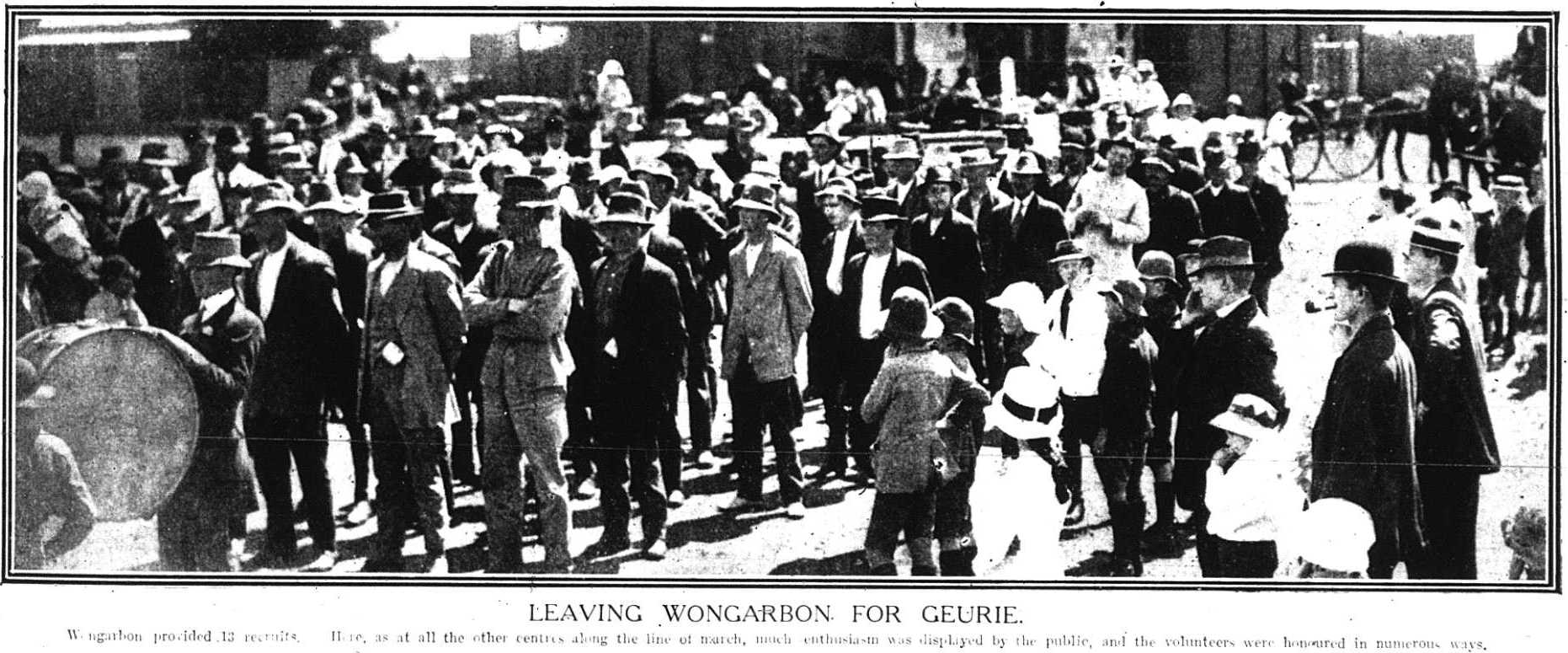
Leaving Wongarbon (Sydney Mail 20 Oct 1915)

Leaving Wongarbon (Sydney Mail 20/10/1915)

Transcription of extract from an article titled ‘The Route March’ in The Farmer and Settler, 19 October, 1915, p. 3, [part 2 of 3 parts]:

‘THE ROUTE MARCH
The Snowball Growing
THE ADVANCE FROM DUBBO TO WELLINGTON.
[Continued] …

‘Geurie’s Reception.
On Friday morning the route march passed on to Geurie, arriving at one o’clock, just in time for the trenchman’s feed that the contingent’s own cook had prepared at the Royal Hall from viands locally supplied. In the afternoon escorted by the local band, the school children and hundreds of district residents, the recruits marched to the park where a successful recruiting appeal was made. Three men signed on to follow the drum, and four others signified their intention of following after harvest. Afternoon tea in the park, to which every home for miles around had contributed a hamper, was followed by a social, with more recruiting speeches. As a result of a tarpaulin collection in the afternoon the sum of £18 was handed to Mr. Hitchen before the column left. The Governor-General, who was passing through Geurie, sent word that he would like to meet the contingent. They were therefore paraded at the railway station on Saturday morning, and his excellency and Major Sands inspected them. He declared the Gilgandra scheme the finest recruiting movement in Australia, and promised to be in Sydney to welcome the army when it marched in and stormed the city.

The Governor-General’s words of warm approval greatly heartened the men, and they started on their way to Wellington with an additional spring in their step.’

Click here to access the article on Trove: http://nla.gov.au/nla.news-article116648940

Day 5, Thursday, 14 October, 1915, Dubbo to Wongarbon

Transcription of extract from an article titled ‘The Route March’ in The Farmer and Settler, 19 October, 1915, p. 3, [part 1 of 3 parts]:

‘THE ROUTE MARCH
The Snowball Growing
THE ADVANCE FROM DUBBO TO WELLINGTON.
Last issue of the ‘Farmer and Settler’ left the Great Western Flying Column at Dubbo, where Captain Nicholas and his men met with the right royal reception to which they were entitled as the King’s men off to the wars. The most popular man in the western districts of New South Wales at the present time is Mr. W. T. Hitchen, the man that started the snow-ball rolling, and every town along the line lifts its corporate hat to Gilgandra and its recruiting association, the members of which made “Bill Hitchen’s idea” an actuality of the recruiting campaign.

Wongarbon’s Welcome.
The column marched out of Dubbo with colors flying shortly after noon last Thursday, a great concourse of people in the streets wishing them God-speed, and twelve local recruits falling in behind. The school band played the march out of town, and gave the boys a final cheer. Wongarbon was reached at tea-time. Three hundred people met the march a mile out of town. The Wongarbon band, the school children, and the members of the rifle club, joined the great procession, and citizens, mounted, driving, and on foot escorted the force to its rendezvous, cheering all the way. On arrival at the town, Cr. A. F. Morely, on behalf of the Shire Council, welcomed the ”snowball army” amid a scene of, tremendous enthusiasm. After pitching their tents and washing off the grime of the roads, the recruits marched to the local hall, where they were the guests of the citizens at a banquet to which over five hundred persons paid for admission. Captain D. Bowling, head master of the local school, and captain of the rifle club, presided, and put into words the public appreciation of the route march scheme, and the general hope that it would be a huge recruiting success. Captain Nicholas and Mr. Hitchen briefly responded and Recruit Lee made a recruiting speech, the quality of which is suggested by the fact that at its close thirteen men stepped forward and gave their names, either to march under Captain Nicholas, or to come after harvest. A collection for wayside expenses brought in £18.’

Click here to access the article on Trove: http://nla.gov.au/nla.news-article116648940

Day 4, Wednesday, 13 October, 1915, Mogriguy to Dubbo

Transcription of extract from an article titled ‘Coo-ees Column’ in The Farmer and Settler, 15 October, 1915, p. 3, [part 3 of 3 parts]:

 ‘COO-EE’S’ COLUMN’
The March from Gilgandra, A GREAT CHARGE AGAINST THE TURKEYS.
[Continued] …

 Pleasant times at Brocklehurst.  
 Wednesday morning broke cloudy, with a promise of further rain, when the column took the road for Brocklehurst.  The ladies of Mogriguy had provided breakfast, and no time was lost in starting on the longest stage of the whole route march.  The effect of further rain on the black soil was to produce a sticky glue through which the men tramped.  As the rain continued, the transports were stopped, and the waterproof sheets donated at Gilgandra were unpacked; these kept the men dry in the nine miles’ tramp before lunch.

Mr. A. Carson, the school teacher, had arranged with the ladles of Brocklehurst to prepare lunch, and they did this cheerfully and well despite the rain.  The ‘Coo-ees’ did justice to this part of the programme, and were then treated to a round of patriotic kissing by a bevy of Brocklehurst girls.  The schoolchildren led the march on to the Dubbo road, and the girls escorted the recruits for a mile on their way despite the rain.

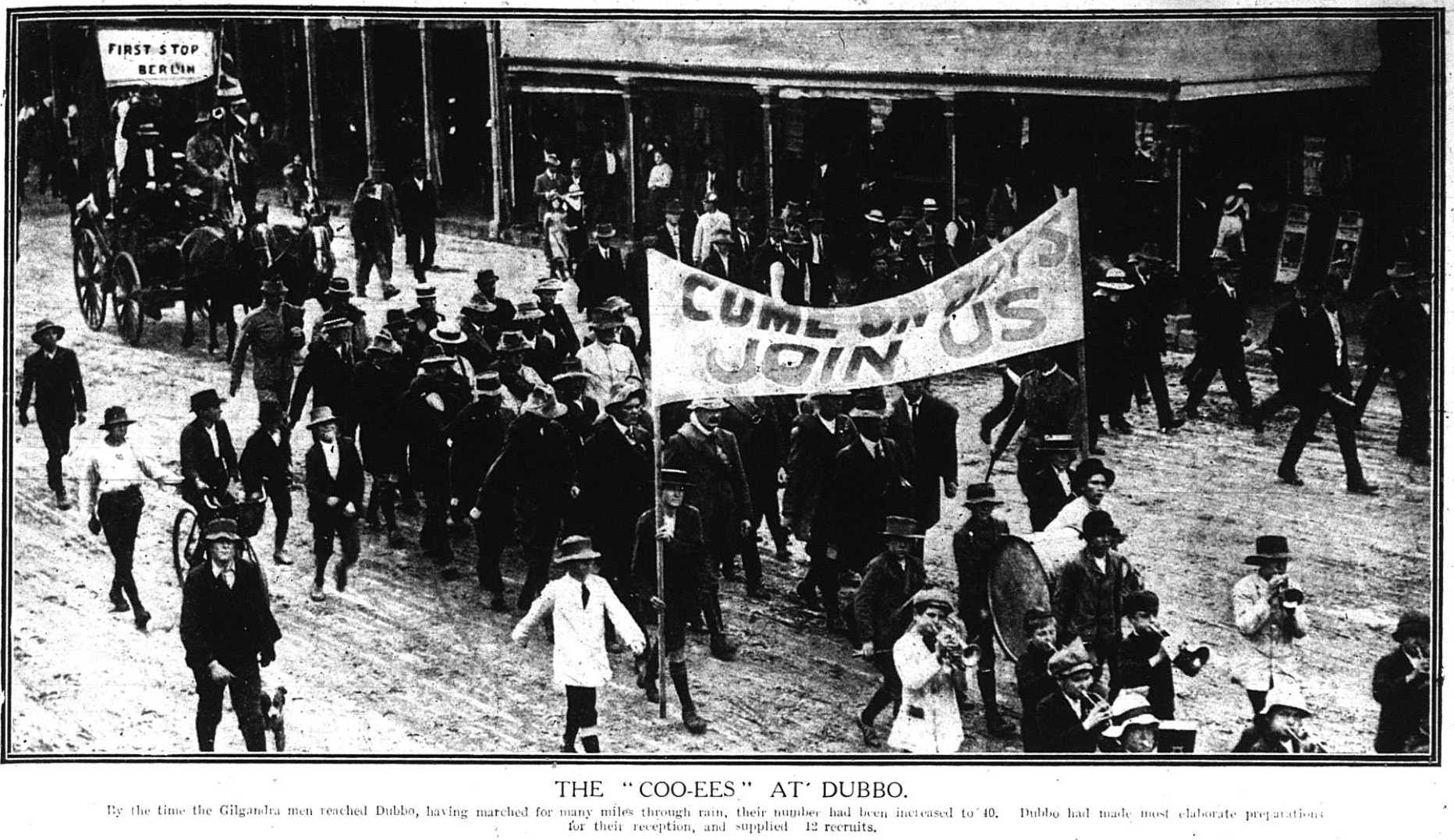
Coo-ees at Dubbo (Town & Country Journal 20/10/1915)

Coo-ees at Dubbo (Town & Country Journal 20/10/1915)

The Welcome at Dubbo.
It was four miles to Dubbo, and on the outskirts of the town the column was met by the recruits in camp at Dubbo, and the town band as an escort.  There was a great crowd at the centre of the town, where a procession was formed, comprising the school band, Dubbo troops, the town band, the ‘Coo-ees’ and the transport waggons. The procession paraded the main streets to the town hall, where the mayor, Ald. J. Barden, and two thousand citizens were waiting.  The scene was, one of unprecedented enthusiasm.  Before the civic welcome had well begun, however, orders were received that the troops should proceed at once to the show ground camp to have overcoats issued to them; and the whole crowd followed them there and back.

Naturally, the ladies, who had tea ready, were highly indignant with the authorities over their “unceremonious and unwarranted interference.”

Coo-ees at Dubbo (Sydney Mail 20 Oct 1915)

Coo-ees at Dubbo (Sydney Mail 20/10/1915)

The mayor was considerately brief in his speech of welcome, but none the less cordial.  After a light repast of tea and cakes, the ‘Coo-ees’ marched to the drill hall for a wash, and later to the Protestant Hall to a big ‘meat tea,’ of steak and eggs, bread and butter and jam; a pleasant change of menu after banquets and poultry and such delicacies.  At a great recruiting meeting on Wednesday night, addresses were given by the chairman, Ald. Barden, Mr. Grimm, M.L.A., and Mr. Lee, and two more men were convinced that they should find places in the ranks of the ‘Coo-ees’ to fight in the great cause of civilisation versus barbarism.  Just before the meeting began two Parkes’ men presented themselves, stating that they wished to accompany Hitchens’ army to Berlin, via Constantinople. Thus the snowball army grows as it rolls onward.

Yesterday (Thursday) the march proceeded to Wongarbon.’

Click here to view the article on Trove:http://nla.gov.au/nla.news-article116673914

Day 3, Tuesday, 12 October, 1915 Eumungerie to Mogriguy

Transcription of extract from an article titled ‘Coo-ees Column’ in The Farmer and Settler, 15 October, 1915, p. 3, [part 2 of 3 parts]:

‘COO-EE’S’ COLUMN’
The March from Gilgandra, A GREAT CHARGE AGAINST THE TURKEYS.
[Continued]  …

The March on Mogriguy.
A start was made next morning, the 12th, and after bidding farewell to the townspeople, represented by Mr. Wheaton and Senior-constable Clarke, the snow-ball army stepped out for Mogriguy. A welcome waterhole just outside the town was availed of by a number of the recruits for a swim, and, thus refreshed, little time was lost in getting to the farm of Mr. J. H. Taylor, who was kindly leading the way through private property, and his own wheat crop, with the idea of cutting several miles off the regular track. When remonstrated with for permitting us to tread down his crop, Mr. Taylor said that he didn’t mind, it would bring him luck he remarked afterwards, when the rain came; that he was glad he had done so, as the ‘Coo-ees’ had brought the rain.

The heat had been intense since the commencement of the march from Gilgandra, and the dust and flies, a torment, but Tuesday morning broke cloudy with a westerly wind. Rain came after dinner before Mogriguy was reached, at five in the afternoon, where great preparations had been made for our reception.

Owing to the generosity of the folk along the route, the transport waggon was proving inadequate, so arrangements were made for the purchase of an additional team and waggon in Dubbo. Meanwhile a conveyance was loaned as far as Mogriguy, and then another one provided to see the troops in to Dubbo.  Mr. Taylor, perceiving the necessity for a light vehicle for the advance agent, has kindly lent a sulky and horse to go right through to Sydney.

The rain did not damp the ardor of the Mogriguy residents; on the contrary, as the district is given over to wheat growing and the crops were badly in need of rain, every man, woman, and child trudged rejoicing and smiling through the rain and the sticky black soil mud to welcome the Gilgandra recruits.  After a bath and an excellent tea, the troops were in good fettle to listen to Councillor Godwin’s words of welcome, and Mr. James Ritchie’s spirited remarks. Captain Nicholas, in responding on behalf of the men, said that he had been urgently requested by the young ladies present to extend leave of absence to the men so that they might enjoy the entertainment; that was to be provided after the supper; he was, however reluctantly compelled, in the interests of the men themselves, to refuse the necessary permission on the ground that a heavy march had just been concluded in oppressive heat, and the longest stage of the Gilgandra-Sydney route was that of the morrow, so that it was imperative that the men should have a good night’s rest.  He said that he was beginning to think that the Turk would not kill the men, but that the Turkey might, and that before they had gone very far on the road to Sydney.

The organiser of the great recruiting scheme, Mr. Hitchen, and Q.M. Sgt. Lee, also thanked the residents for their cordial welcome.

A quaint conceit in connection with the midday meal at Mogriguy was the labelling of the turkey luncheon table ‘Gallipoli,’ which the recruits were ordered to charge. When they had cleared the whole peninsula of the ‘Turks’ the British flag was hoisted to celebrate the achievement.

Later in the evening an appeal was made for recruits to join the march, but no men were forthcoming. This was a pity, as Eumungerie [sic] is the first centre at which the appeal has failed to draw any response.

The men were camped in an empty building for the night, and a start was made bright and early on Wednesday morning on the nine-mile stage to Brocklehurst, where a nice luncheon was provided by the ladies. Rain fell almost continuously, and the men were thoroughly well drenched as they marched.’

Click here to view the article on Trove:http://nla.gov.au/nla.news-article116673914

Day 2, Monday, 11 October, 1915, Balladoran to Eumungerie

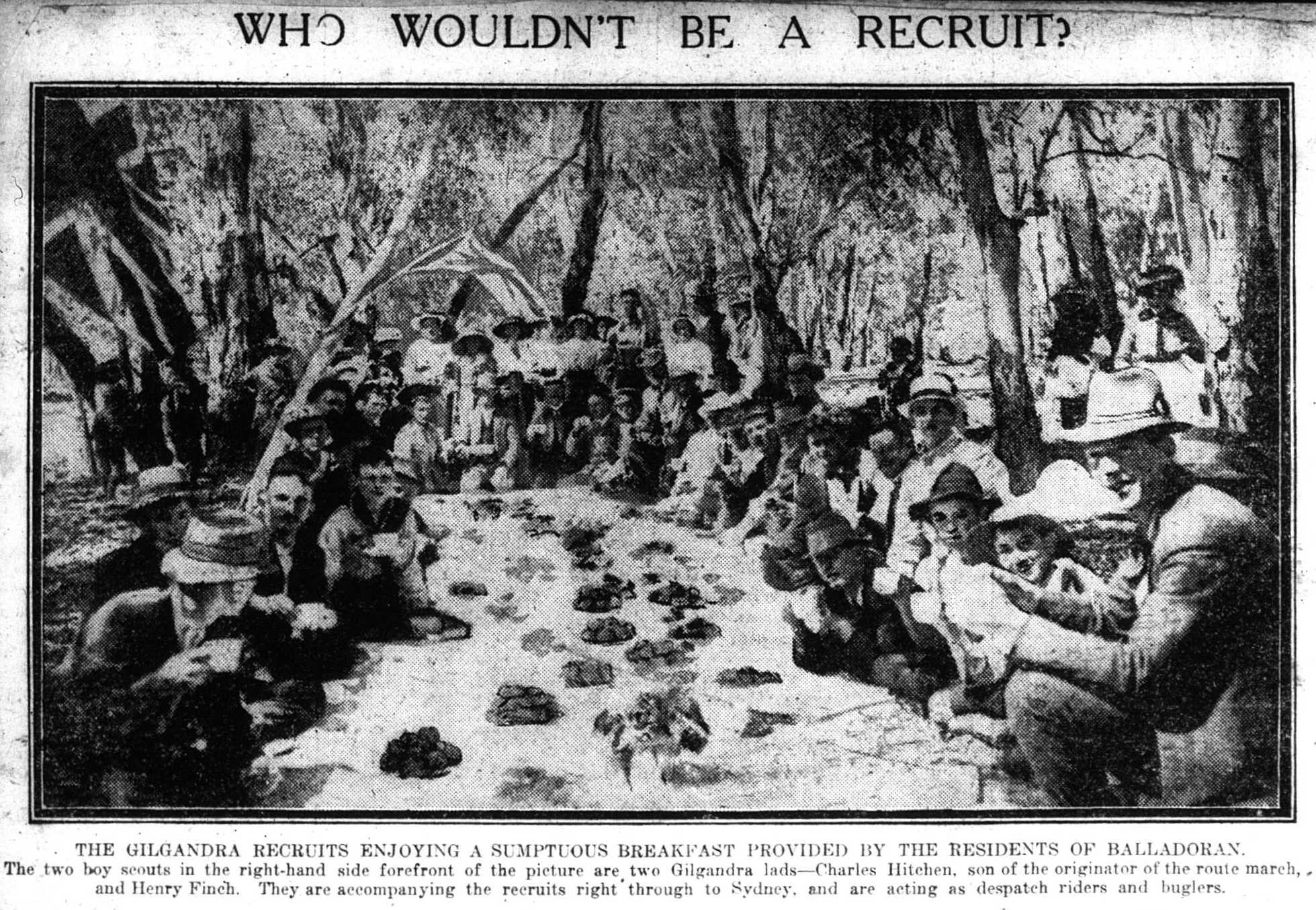
Breakfast at Balladoran (Daily Telegraph 14/10/1915)

Breakfast at Balladoran (Daily Telegraph 14/10/1915)

Transcription of extract from an article titled ‘Coo-ees Column’ in The Farmer and Settler, 15 October, 1915, p. 3, [part 1 of 3 parts]:

‘COO-EE’S’ COLUMN’
The March from Gilgandra, A GREAT CHARGE AGAINST THE TURKEYS.

The ‘Coo-ees’ moved out of Balladoran at half-past ten on Monday morning on the second day’s march, the Union Jack and the Australian flag leading and a company of school children acting as a guard of honor.

At the town boundary a halt was made, and a short address was delivered by Mr. Berriman on behalf of the townspeople.  He spoke of the great deeds performed by the Australians at the Dardanelles, and expressed a confident belief that in years to come hearts would glow and pulses thrill at the story of the achievements of ‘Hitchen’s Coo-ees.’

Captain Nicholas, O.C., and Q.M.S. Lee responded, expressing the ‘Coo-ees’ ” gratitude to the Balladoran residents for their liberal hospitality. The men gave three cheers for the towns-people, then the schoolmaster led the children in singing the National Anthem, and cheers for the soldiers were lustily given to finish.

The march was then resumed under unpleasant conditions. The weather was very warm, and the dust and flies were particularly objectionable. By easy stages Mr. Wheaton’s homestead, two miles from Eumungerie, was reached. The transport waggons and cook had preceded the party, so lunch was ready, prepared from the stores carried, and was thoroughly enjoyed, as the good people of Gilgandra and Balladoran had given liberally of the best.’

Arrival at Eumungerie.

After a good rest, some instruction in the elements of drill was given by the officer commanding, and a move was then made to Eumungerie, which was the location of the second night’s camp. This town was reached a little after five o’clock, and the boys were delighted to find   that arrangements had been made for them to have a shower bath. They appreciated the thoughtfulness that put the ablutions earlier on the programme than the speech-making; and they enjoyed the speeches all the more for having clean skins. The dinner provided by the ladies of Eumungerie was an excellent one, and the boys, fresh from their bath, did full justice to it. Mr. J. Wheaton, chairman of the Eumungerie Recruiting Association, Mr. McLennan, vice-chairman, and Mr. McKeown, secretary, voiced the townspeople’s welcome, and Q.M.S. Lee, the ‘Coo-ees” official speechmaker, responded on behalf of his comrades.

After dinner there was music and dancing, then when the crowd was at its biggest, Mr. Wheaton introduced Mr. McLachlan, the school inspector from Dubbo, and Mr. Blackett, who had driven from forty miles the other side of Dubbo, to meet the Gilgandra recruits. These gentlemen and Mr. Lee delivered rousing recruiting speeches, and two young men, S. Walker, of Balladoran, and H. Sharpe, of Eumungerie, announced their intention of being in the January contingent after harvest. When these men stepped up on the platform they were given a hearty cheer that must have strengthened their resolution to do their duty for King and country.

An appeal for the Sheepskin Vest Fund found ready givers, and one local lady, Mrs. H. Griffith, gave £1 to the ‘Coo-ees” marching fund.

Advantage was taken of the occasion by the townspeople to present one of the   ‘Coo-ees’ that joined from Eumungerie with a wristlet watch to show their appreciation of his manliness and sense of duty in thus enlisting to take up his share of the burden. [This was Leslie Greenleaf].

The evening concluded with more dancing and the singing of several songs, but the majority of the ‘Coo-ees’ were glad to ‘sneak’ away to their blankets.

During the stay at Eumungerie, Mr. J. Wheaton showed a fine spirit of patriotic generosity in giving the recruits carte-blanche at his store; attempts to thank him were good naturedly brushed aside. A noticeable feature of all the good treatment is that the people absolutely refuse to be thanked, and, indeed, declare that they cannot do enough for the boys from the Castlereagh that are going forth at the call of duty.’

Click here to view the article on Trovehttp://nla.gov.au/nla.news-article116673914

Day 1, Sunday, 10th October, 1915, Gilgandra to Balladoran

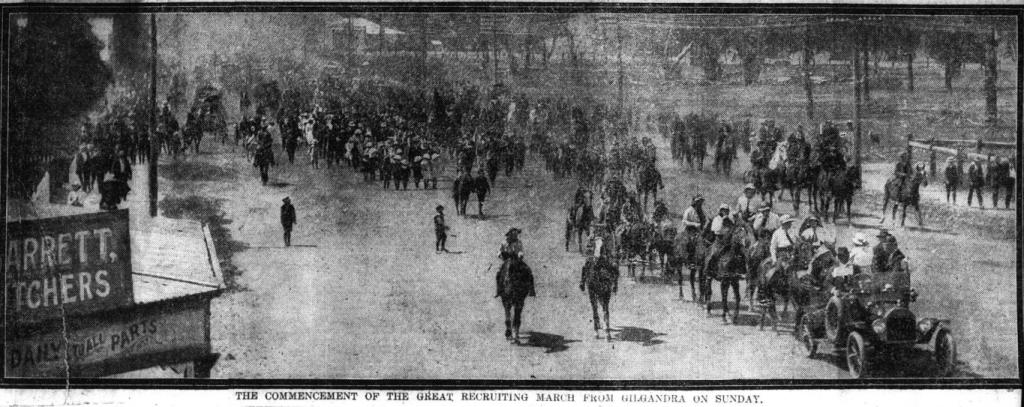
The start at Gilgandra (Daily Telegraph 12/10/1915)

The start at Gilgandra (Daily Telegraph 12/10/1915)

Transcribed from The Farmer and Settler, 12 October, 1915, p. 3.

‘THE ROUTE MARCH. Gilgandra to the Coast TRIUMPHANT SEND-OFF BY THE PEOPLE.

Gilgandra’s greatest of all events, the start of the route march, became a fact of history on Sunday last, when the contingent after a simple religious ceremony stepped out on its long march to the coast.

On Saturday, when the ‘Farmer and Settler’ special reporter, who will march to Sydney, arrived at Gilgandra, he found Captain Nicholas and Drs. Burkitt and Cooper, of Dubbo, on the ground. Captain Nicholas has been appointed to take charge of the contingent, and be will be their leader and instructor all the way through to Sydney.

On Saturday afternoon twenty-five recruits were sworn in. Two failed to pass the doctor, but they will march through to the coast nevertheless. The number of recruits would have been double if the recruiting association had not been compelled to wait so long for the permission of the military authorities, the result being that many men grew tired of waiting, and went into camp. The doctor said that the Gilgandra men were as fine a body of recruits as he had seen, with good feet and sound constitutions. On Saturday night a torchlight procession paraded the town, headed by the band. The recruits were followed by the rifle club and the boy scouts. In the interval of a picture show, Major Winn, of Sydney, and Private Lee, the ex-clergyman recruit, made special appeals to the young men to volunteer.

There were fully three thousand persons, almost the whole population of the district, at the open-air consecration service on Sunday morning, when the Rev. W. Jenkins commended the men to their Creator.

The shire president, Mr. Barden, said he was sure that the twenty-five starting out would be five hundred at the end of the long march. Almost the whole of the people, the largest gathering ever seen at Gilgandra, accompanied the march to Boberah, where a general programme of hand-shaking took place. A guard of honor of young horsewomen   rode at the head of the procession, and the local recruiting association and shire councillors took part. Captain Nicholas formed up his little force — grown already to thirty-one men; and Mr. W. T. Hitchens had the honor of giving the first words of command–‘Quick march.’ Amid resounding cheers the route march had begun, and it was followed for several miles of its long journey, by a great cavalcade of horses and vehicles. Then there was a halt, with more good-byes, more cheers, and the rifle club fired a parting volley.

The heat was intense, and the dust hung over the troops like a pillar of cloud — a fiery cloud, so that when the first stop, Marthaguy, was reached, all were grateful for the lunch spread by the residents, and not less for the facilities provided for a wash and a freshen up. At Marthaguy one new recruit fell in. Many of the Gilgandra folk still followed the column. The young daughter of a prominent citizen left her car and marched alongside the men for some distance; she announced her intention of being present in Martin Place at the finish, and declared that if she had been a boy she would have marched all the way, and gone to the front with the contingent. It is a pity that some of the boys have not the spirit of the girls.
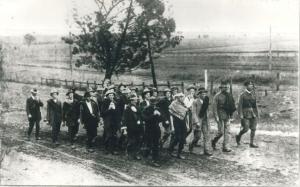
Patriotic sons of the West. A 320 mile march (Sydney Mail 20/10/1915)

‘Patriotic sons of the West. A 320 mile march’ – Coo-ees on the road to Balladoran (Sydney Mail 20/10/1915)

At Balladoran the townspeople met the column a mile out of town and escorted them to their camp with banners, and gave them a hearty welcome. The camp was reached at five o’clock, and here another recruit joined the column.

Following are the names of the first twenty-five to enlist:–

John Quinn, John Macnamara, Stanley E. Stephens, Jack Hunt, William L. Hunt, Albert W. Pearce, Leslie W. Greenleaf, Arthur C. Finn, Francis N. White, Alfred Wardroffe, Victor Quinton, William Alston, Sidney Bennett, John R. Lee, Harold Baxter, Charles R. Wheeler, E. T. Hitchen, James McKeown, James Crowford, Charles E. Marchant, Andrew J. MacGregor, Lawrence L. McGuire, Robert C. Campbell, Peter Wilson, and Frank Humphrey.’

Click here to view the article on Trove: http://nla.gov.au/nla.news-article116668904