Category Archives: Research notes

Updating blog entries for individual Coo-ees

I am working through the blogs I have posted for individual Coo-ees to date, adding details about their description from their medical in their service records –  height, weight, complexion, colour of eyes, and hair, and also their religious denomination.

I am also adding details for any local war memorials that list the name of fallen Coo-ees.

I will also update previous blog entries when I obtain more photographs, or find out more information from newspaper articles and other sources.

If you are following this blog by email, please note that these updated blog entries will not be re-posted, so please check this website from time to time to see what changes have been made to the records.

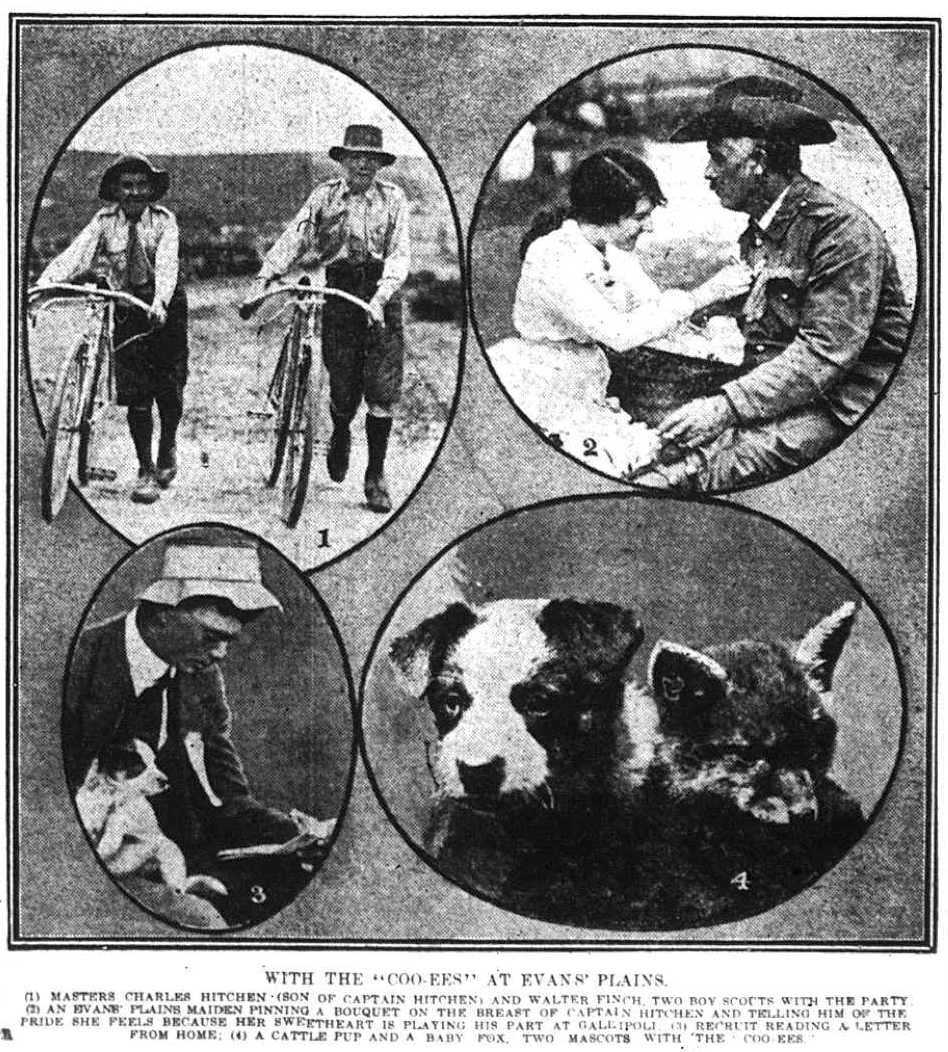
Fox mascot presented to the Coo-ees at Evans Plains

With the Coo-ees at Evans Plains (Daily Telegraph 30/10/1915)

With the Coo-ees at Evans Plains (Daily Telegraph 30/10/1915)

I have often wondered how the Coo-ees ended up with a fox cub as a mascot on the Coo-ee March. This is described in the following article, along with the ‘patriotic songs’ sung by the school children at Evan’s Plains. School children often took part in welcoming and entertaining the Coo-ees at each town and village visited on the march. It is interesting to note that the Coo-ees were expecting to reinforce the Australian men fighting at Gallipoli when they signed up on the Coo-ee March, not the Western Front.

Transcript of an article titled ‘At Evans Plains” published in the Bathurst newspaper National Advocate on 30 October 1915, p. 3.

‘AT EVAN’S-PLAINS.
YOUNG FOX AS MASCOT

The residents of Evan’s Plains extended a hearty welcome to the Gilgandra Coo-ees.   The Cooe-ees arrived about noon on Thursday, escorted by two local horsemen, Messrs. Cecil Colley and Morris Windsor who rode out some distance along the road to meet them. An energetic ladies committee, under the charge of Mrs. J. Dwyer and Miss Ivy Maher, worked hard to make the short stay of the men as pleasant as possible. Mr. Hugh McKay also rendered valuable assistance. Refreshments were served under the poplars on the property of Mr. J. Wardman. Several patriotic songs were rendered by the school children, whilst the good wishes for a safe return were expressed by several of the residents. The Coo-ees were presented by Mr. Frank Windsor with a young fox as a token from the Plains, which they intend to take along with them to Gallipoli.’

Click here to view the article on Trove: http://nla.gov.au/nla.news-article158152710

Letters home and family photographs

A daughter of Donald Stewart (who joined the Coo-ees at Wellington) contacted me recently via the blog, so I have posted transcriptions of some of the letters he wrote home to his family while he was a prisoner of war in a German prison camp during the First World War, which were published in the family’s local newspaper The Wellington Times.

We are discovering through our research on the Coo-ees that several of them were held as prisoners of war during the First World War, including Donald Stewart from Wellington, Joseph Armstrong who joined the Coo-ees at Dubbo, and Allan Collquhoun and Cecil Roy McMillan, who both joined the Coo-ees at Parramatta.

Letters sent home to family and friends by the Coo-ees – whether they were training in camp, on a troopship, prisoners of war, fighting on the front, or behind the lines – provided information about their experiences during the war, and their thoughts and feelings at the time.  It is great that some of these letters were published in local newspapers during the First World War, so that we can read about their experiences today.

Some family members have also sent me a photograph of their Coo-ee relative, with permission to include it on the individual blog entry for their Coo-ee, and it is fantastic to be able to be able to put a face to the name of individual Coo-ees.

Newspapers also published individual photographs of some of the Coo-ees during the war years, which I have been collecting, but I may not have found all of these yet.  If more photographs become available, I will add these to each individual Coo-ees blog entry.

If anyone has personal letters, diaries, or photographs of the Coo-ees, I would very much like to hear from you. Please email me at cooeemarch1915@gmail.com.

Update on visiting the graves and memorials of the Coo-ees

Update on visiting the graves and memorials of the Coo-ees

Over the past 21 days Stephen and I have visited 22 cemeteries and memorials in England, and 161 cemeteries and memorials in France, Belgium, The Netherlands, and Germany, to take photographs of the headstones or names on memorials of  about 762 WWI or WWII soldiers who were from our local Central West NSW area (and a few family members), and those who were recruits on the Coo-ee March, the Boomerang March, and the Kookaburra March.

Coo-ees who died during WWI are in 27 of these cemeteries and memorials, including the Menin Gate at Iepers (Ypres) in Belgium, and the Australian National Memorial at Villers-Bretonneux in France.

I had hoped to include a brief blog entry about each of these cemeteries and memorials, and the names of the Coo-ees who are buried or named there while on holidays, however due to our busy schedule, I have not been able to complete this project. I will continue with these entries, and blog entries for individual Coo-ees, focusing on those who died during WWI, once I return to Australia at the end of September.

Visiting so many cemeteries and memorials over the past three weeks, many of them dotting the rural landscape and villages which were the WWI battlefields in France and Belgium, has given us an overview of the scope and the tragedy of the many young mens’ lives that were lost during this conflict.

We were impressed with the upkeep of the cemeteries by the Commonwealth War Graves Commission, which have beautifully manicured lawns, and flowers (including many roses) and shrubs.

We also noted that in just about every cemetery we visited there were small Australian flags, small wooden crosses, and soldiers photographs and other mementoes (even a beer stubby holder) on many of the Australian war graves.

Earlier this afternoon we visited the Villers-Brettoneux Memorial to photograph the 180 names on our list of soldiers, who had no known grave – 11 of these were Coo-ees.

An epitah on the last Coo-ee grave we visited this afternoon – Harold Baxter from Gilgandra, at the Bancourt British Cemetery near Bapaume in France – was particularly touching:

“Harold dear, brave boy
Thou wert too young to die
But duty called”.


Visiting the graves and memorials of the Coo-ees in England, France and Belgium

Visiting the graves and memorials of the Coo-ees

I am currently on holidays overseas with my husband Stephen. Included in our busy itinerary over the next few weeks is visiting the graves of the Coo-ees who died while on active service in England, France and Belgium during the First World War, and/or the memorials where their names are commemorated, if they have no known grave. This will include visiting approximately 27 cemeteries and memorials, including the Menin Gate at Iepers (Ypres) in Belgium, and the Australian National Memorial at Villers-Bretonneux in France.

I plan to include a brief blog entry about each of these cemeteries and memorials, and the names of the Coo-ees who are buried or named there.

We are taking photographs of each grave, or name on the memorial, to include on each individual Coo-ee’s blog entry after we return to Australia, which will form a Roll of Honour for the Coo-ees on this blog.

The “Gilgandra barber” and the Coo-ees welcomed in Lithgow

Article titled “Coo-ees Welcomed” from the Democrat, 6th November 1915, p. 2.

‘“Coo-ees” Welcomed.

The Gilgandra braves — the “Coo-ees” — were accorded an enthusiastic reception on Monday last. They left Wallerawang at 9.30 a.m., and marched to Middle River, where they halted. They were met there by the men of the Lithgow camp and a right royal time was spent. It is an offence to have long hair, and as the laws of the Medes and Persians altereth not, neither do the laws according to the Gilgandra recruits alter. At least six of the Lithgow boys needed tonsorial attention and the “Gilgandra barber,” who sat as judge, declared them guilty and sentenced them to be shorn of their curly locks. Despite protests, the chief executioner carried out his duties to the satisfaction of all but the six. These latter have now cool heads — it will prevent them from becoming hot-headed.

“’Fall in” was then sounded, and the two squads of soldiers marched to Bowenfels, where they halted to await the welcome ceremonies.

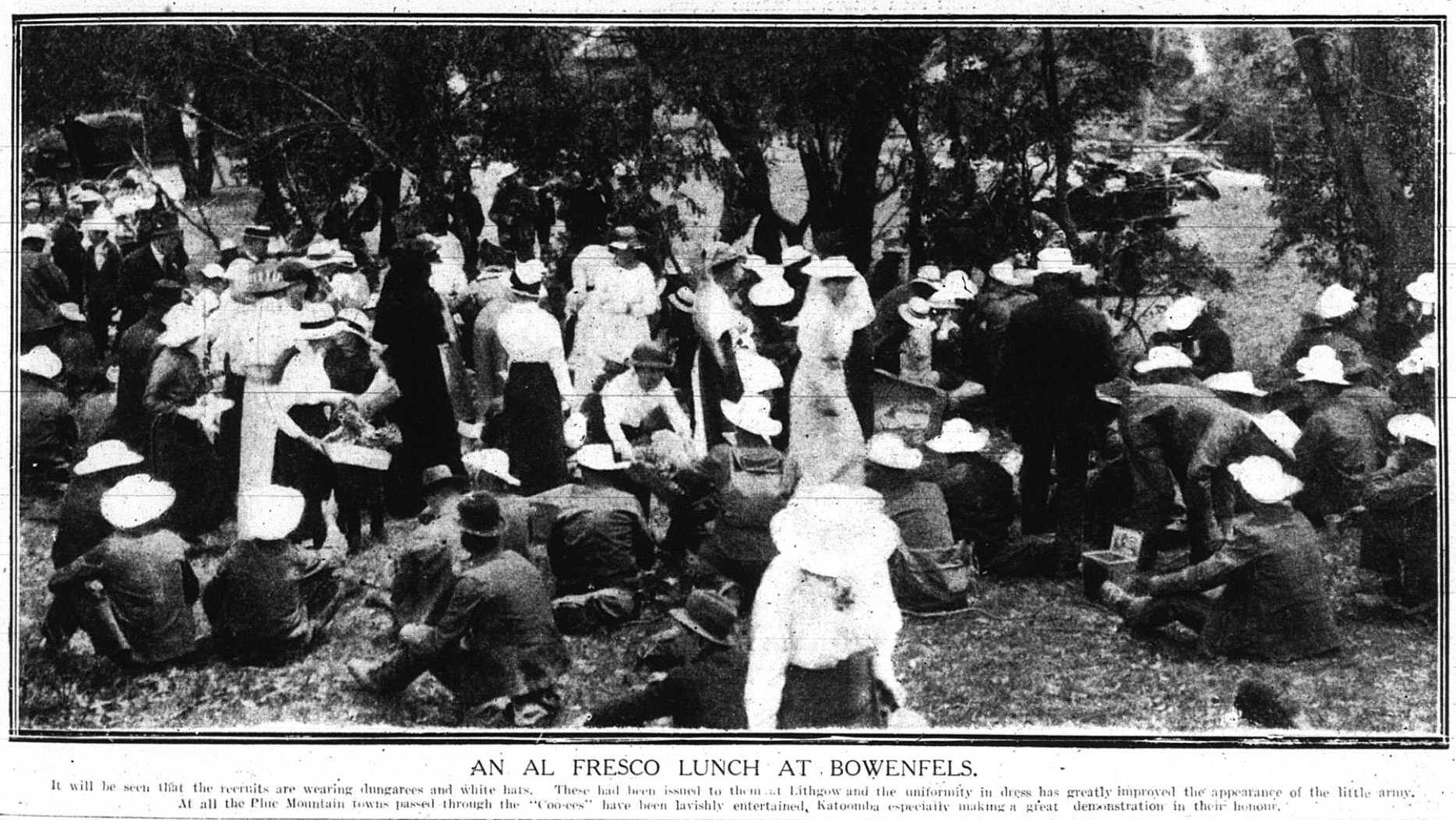
An Al Fresco lunch at Bowenfels (Sydney Mail 10/11/1915)

An Al Fresco lunch at Bowenfels (Sydney Mail, 10/11/1915)

The visitors looked in the pink of condition and were as hard as nails. They had increased their number by five at Wallerawang.  

The welcome arrangements were admirably carried out by the chief marshals (Messrs. A. E. Roper and Saunderson). There was not a hitch anywhere. This is as it should be and the gentlemen concerned are to be congratulated.


The Cooerwull school children sang “Advance Australia Fair” capitally, while the Lithgow children also did well.     


The Town Band played at the meeting place, and played beautifully.

The Mayor (Ald. Pillans) then welcomed the “Coo-ees” to Lithgow in a speech admirably suited to the occasion — being short, concise, and good. Major Wynne responded on behalf of the visitors. 

The procession was then formed, the mounted police in front, then the aldermen, the Progress Association and prominent townspeople, then came the Lithgow recruits, followed the Town Band, and then came the “Coo-ees,”‘ each town being represented by their respective units — a flag with the name or the town being the line of demarkation. Then we had our own cadets, with trumpeters playing smartly and briskly. Patrols of Boy Scouts, under Scout-master Lamb, were also in evidence and added considerably to the success of the procession. The civilians also joined in as well as scores of motor cars, buggies, ‘busses, etc. The procession wended its way along Main-street, across Eskbank bridge, up Railway Parade, and into the Trades Hall, which had been kindly loaned for the occasion.


At six o’clock the braves were entertained at luncheon at the Town Hall. This over, it had been intended to have a smoke social, but as the Oddfellows Hall proprietary had kindly granted a free pass for their picture show to the men, they all preferred that, and a splendid programme was screened to the enjoyment of the vast audience present.


On Tuesday advantage was taken of having squad drill, after which general leave was granted. The men were also given white hats and dungarees and they looked more like soldiers than they did in civilian costume.


The squad has two mascots — a young cattle dog and a fox. The young recruit who had charge of them said, “Now I’ve got them over the worst of their trouble, all the others want to collar them, but they won’t get them. They’re mine.”’

Click here to access the article on Trove:http://nla.gov.au/nla.news-article103569195

The Coo-ee mascots [cropped photograph] (Daily Telegraph, 30/10/1915)

The Coo-ee mascots [cropped photograph] (Daily Telegraph, 30/10/1915)

Note: According to a docket in the official correspondence of the march, Thomas Dowd, a recruit from Wongarbon, was paid for 21 days barbering services on the march, so he appears to have been the “Gilgandra barber” in the above article.
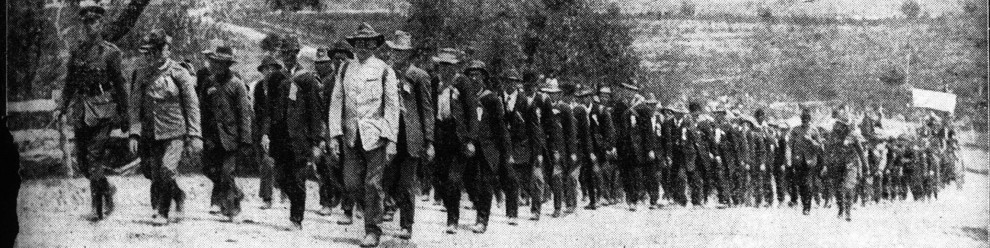
Hair-cuts at Blayney

When the Coo-ees were at Blayney, the Blayney Recruiting Association paid two local barbers to cut the hair of about 80 of the men at the showground, where the Coo-ees were camped.[1]

This event is described in an extract of an article titled ‘Western News’, from The Bathurst Times, 29th October, 1915, p. 3.

‘WESTERN NEWS
(By Our Travelling Representative.)
BLAYNEY, Thursday.
A DAY OF HAIR-CUTS.

On Wednesday tho hairdressers of Blayney had a busy time in exercising the tonsorial art on tho Gilgandra “Coo-ees.” Curly locks and straight growths were trimmed and cut, and marching recruits emerged from the chairs feeling fresh and fit. One of the men, however, expressed his disapproval of a close crop. He gave the reason. “Some time ago,” he explained, “I got a knock on the head and since then I have always kept my hair pretty long so as to protect the scar, but now I’ve had a close crop and it shows out. Not only that my hat is now several sizes too large for my head. I stuffed a daily paper in so as to make it a closer fit, but that didn’t do any good. It’s still too big.” He was quite distressed about it. It appeared to worry him more than all tho thoughts of going off to fight for his country.’

Click here to access the article on Trove: http://nla.gov.au/nla.news-article111246715

[1] ‘Gilgandra to the Coast’, The Farmer and Settler, 29 October 1915, p. 3.

Oral recording by Leslie Greenleaf about the Coo-ee March

Oral recording of Leslie Webster Greenleaf’s recollection of the Coo-ee March

An oral recording is held in the Australian War Memorial sound collection (ID number S00329), which has the title: : ‘Leslie Webster Greenleaf, MM, as a private, 13th Battalion, discusses his part in the Gilgandra “Cooee March” in October 1915 in an interview with Kaye Mallison’.

This recording covers Leslie Webster Greenleaf’s recollection of joining at Gilgandra, the march to Sydney, training in Liverpool, the trip on the troopship ‘Star of England’, final parade in Egypt, and subsequent break-up of the Coo-ees, which he described as “that was the end of the era for the Coo-ees”, and his subsequent troopship journey to France.

This oral recording can be listened to online at http://www.awm.gov.au/collection/S00329/

To listen to this recording, click on the “Sound” link next to the file name.

Ernest SIMPSON (aka C. A. SIMPSON)

Ernest Simpson (aka C. A. Simpson)

One of the men who lined up to join the Coo-ee March at Gilgandra has been listed as “C. A. Simpson” on the Cooee March Memorial Park gateway in Gilgandra, and in the book The Coo-ee March by John Meredith (1981).

Simpson was incorrectly named as “C. Simpson” in a photo published in the Daily Telegraph (pictured on left below), which possibly lead to the incorrect initials being assigned to him.

C_Simpson_C_Finn_C_Marchant_JR_Lee_DailyTelegraph_11Oct1915_p9

Paraded for medical inspection … (left to right): Messrs. C. Simpson, C. Finn, C. Marchant, and J. R. Lee (Daily Telegraph, 11/10/1915)

An article in The Farmer and Settler (19 October 1915, p. 3) reported that ‘In addition to the men sworn in at Gilgandra and at towns en route, the great march column numbers: … Simpson, temporarily unfit, but hoping to pass the doctor in Sydney’.[1]  Further down the same page is reported: ‘One of the men marching to Sydney has failed to pass the doctor. He waited for three weeks in Gilgandra, paying his own hotel expenses, and then when he stripped off for the medical inspection he was “turned down” for hernia. He is physically the strongest man that has offered, and, is otherwise “as sound as a bell”. He intends to march to Sydney, undergo an operation upon arrival, and submit himself again’.[2]

A chance review last week of a document held in the official correspondence from the march held in the Mitchell Library, which lists an “E. Simpson” with a period of enlistment from “9/10 to 11/11/15” with other Coo-ees still waiting for payment for their period of service who had been rejected as medically unfit on arrival at Liverpool Camp,  has enabled his identity to be established.[3]

Knowing the correct initial for his first name, and that he had actually enlisted,  allowed for his service record to be located on the National Archives of Australia website. He is listed under the name Ernest Simpson, joining on 9th October 1915, at Gilgandra. He was born in Horsham, Victoria, and gave his age as 33 years, and his occupation as labourer. There are no details entered for his description on his medical certificate form in his service record papers.  His next of kin is listed as his father, Duncan Simpson, Renmark, South Australia.

On the ‘Detailed medical history of an invalid’ form in his service record dated 17th November 1915 at Liverpool, he was found by the medical board to have a double inguinal hernia, and to be unfit for military service.  He was medically discharged on 29th November 1915.

[1] ‘Route March notes’, The Farmer and Settler, 19 October, 1915, p. 3, http://nla.gov.au/nla.news-article116648915

[2] ‘Failed to pass the doctor’, The Farmer and Settler, 19 October, 1915, p. 3, http://nla.gov.au/nla.news-article116648912

[3] The Alex Halden (Joe) Miller papers mainly relating to the Gilgandra Coo-ee Recruitment March, New South Wales, 1912-1921, 1939, MLMSS 5081


Letters home

Letters sent home to Australia from soldiers to family and friends were sometimes published in local newspapers during the First World War, so that their news could be shared with their local communities.  As was the case at the time, these letters give an insight into the individual war experiences of these soldiers.

In the course of my research I have found some letters written by several Coo-ees which were published in local newspapers during the First World War, including The Wellington TimesThe Dubbo Liberal and Macquarie AdvocateThe Nepean Times, and The Farmer and Settler. A selection of these letters will be included in this blog, which cover:

  •  the voyage on the Star of England troopship from Sydney to Egypt (which took the majority of the Coo-ees overseas),
  • the first experiences of some of them “over the top” in the trenches,
  • the loss of some of the Coo-ees in battle,
  • the experience of one as a prisoner of war in Germany,
  • how much the Coo-ees valued letters they received from home, and
  • the importance of the socks and other comforts sent overseas to the soldiers.