Category Archives: Recruits

Hector Andrew George LEE

Hector Andrew George LEE

Per his military service record (Depot), Hector Andrew George Lee was born at Redfern, N.S.W. [1]  He gave his age as 25 years and 10 months, his marital status as widower, and his occupation as labourer.  His description on his Certificate of Medical Examination form was height 5 feet 10 inches tall, weight 199 lbs., with a dark complexion, brown eyes, and brown hair. His religious denomination was left blank.  He claimed that he had no previous military service.

His next of kin was recorded on his Attestation Paper of Persons Enlisted for Service Abroad as his mother, Lucy Lee, Marquet Street, Rhodes N.S.W.

He completed his medical examination, and was attested by Lieutenant Frank Middenway, when the Coo-ees were at Ashfield, on 11th November 1915.

After completing the Coo-ee March he went to Liverpool Camp as reinforcement for the 13th Battalion.

On 16th  December 1915 Private Lee was charged at Liverpool Camp with being absent without leave for 10 days from 7th to 16th December, and also with being drunk on parade.

He was discharged on 20th December 1915 unlikely to become an efficient soldier.


[1] NAA: B2455, LEE HECTOR ANDREW GEORGE

Charles Thomas KING

Charles Thomas KING

Per his military service record (Depot), Charles Thomas King was born at Tuena, N.S.W.[1]  He gave his age as 35 years and 7 months, his marital status as married, and his occupation as labourer, on his Australian Imperial Force Attestation Paper of Persons Enlisted for Service Abroad form.

He claimed that he had no previous military service.  He also stated that he had been previously rejected as unfit for service for varicocele.

His next of kin was recorded as wife, Mary Isabel King, with address Bent Street, Katoomba.

Charles Thomas King joined the Coo-ee March at Springwood.[2]

He undertook a Preliminary Medical Examination at Springwood on 8th November 1915.   His height was recorded as 5 feet 9 inches on his ‘Preliminary Medical Examination’ section on his initial Application to Enlist in the Australian Imperial Force form.

He was attested at Springwood by Lieutenant F. Middenway on 8th November 1915, the day the Coo-ees marched from Lawson to Springwood.  His Description, and Certificate of Medical Examination sections, were not completed on his Attestation Paper.

After completing the Co-ee March he went to Liverpool Camp as reinforcement for the 13th Battalion.

On 17th November 1915 Private King went before a Medical Board at Liverpool Camp, where he was found to be unfit for active service due to varicocele.

Private King was discharged medically unfit on the 29th of November 1915.


[1] NAA: B2455, KING C T

[2] ‘Rejected Coo-ee starving’, Sunday Times, 2 April 1916, p. 9. Retrieved June 20, 2015, from http://nla.gov.au/nla.news-article121342361


Frederick JENNINGS

Frederick JENNINGS

Per his military service record (Depot), Frederick Jennings was born in New York.[1] He gave his age as 40 years and 3 months, his marital status as single, and his occupation as labourer & sailor. His description on his Certificate of Medical Examination form was 5 feet 7 inches tall, weight 10 stone, with a dark complexion, brown eyes, and dark hair. His religious denomination was recorded as being  Church of England. He claimed that 3 years previous military experience apprenticed in the American Army.

His next of kin was recorded on his Attestation Paper of Persons Enlisted for Service Abroad form as his brother, Michael Jennings, New York, U.S.A.

Frederick Jennings stated in a Statutory Declaration in his service record that he joined the Route March of recruits marching from Gilgandra to Sydney at Wellington.  He completed his medical examination at Wellington on 16th October 1915, and was attested at Wellington on 18th October 1915.

After completing the Coo-ee March he went to Liverpool Camp as reinforcement for the 13th Battalion.

On 17th November 1915. Private Jennings went before a Medical Board at Liverpool Camp, where he was found to be unfit for military service due to Varicose Veins.

Private Jennings was discharged medically unfit on 29th November 1915.


[1] NAA: B2455, JENNINGS FREDERICK

Albert George HULBERT

Albert George HULBERT

Per his military service record (Depot), Albert George Hulbert was born at Wollongong, N.S.W.[1]  He gave his age as 19 years and 7 months, his marital status as married, and his occupation as labourer.  His description on his Certificate of Medical Examination was height 5 feet 2 inches tall, weight 128 lbs., with a fair complexion, bluish eyes, and brown hair. His religious denomination was Church of England.  He claimed that he had 4 years previous military service [cadets].

His next of kin was recorded on his Attestation Paper of Persons Enlisted for Service Abroad  form as his father, Walter John Hulbert, Dunblane Street, Camperdown  N.S.W.   His father gave his permission for his son to join the A.I.F. in a letter dated 20th November 1915 in his service record.

He completed his medical examination, and was attested by Lieutenant Edward J. Shaw, at Ashfield on 11th November 1915.

After completing the Coo-ee March he went to Liverpool Camp as reinforcement for the 13th Battalion.

On 29th January 1916 Private Hulbert was charged with being absent without leave for 3 days. He was fined 15 shillings.

On 7th February 1916 he was charged with being absent without leave for 6 days. He was fined 30 shillings.

On 24th February 1916 Private Hulbert was charged again with being absent without leave from 17th to 24th February 1916.

As a result of his continuous absences he was discharged services no longer required, on 24th February 1916.


[1] NAA: B2455, HULBERT A G DEPOT

Robert GILCHRIST

Robert GILCHRIST

Per his military service record (Depot), Robert Gilchrist was born at Millthorpe, N.S.W.[1]  He gave his age as 40 years, his marital status as single, and his occupation as labourer. His description on his Certificate of medical examination was height 5 feet 9 ½ inches tall, weight 10 stone 8 lbs, with a fair complexion, blue eyes, and brown hair.  His religious denomination was Roman Catholic.  He claimed to have 4 weeks previous military experience at Holsworthy Camp, and that he had left through sickness.

His next of kin on his Attestation paper was his mother, Mrs Mary Gilchrist, McLaughlan Street, Orange N.S.W. (His younger brother Arthur Gilchrist joined the Coo-ees at Orange on 24th October 1915).

The Molong Argus reported that Robert Gilchrist stepped forward to join the Coo-ees at an open air recruiting meeting held at Euchareena on 20th October 1915.[2]

He completed his medical examination at Molong on 22nd October 1915, and was attested by Captain Nicholas at ‘Molong (8 miles east)’, along with several other Coo-ees, on 22nd October 1915.

On 31st October 1915 when the Coo-ees were having a rest day at Wallerawang, Private Gilchrist was charged  by Captain Eade with drunkenness. He was fined 30 shillings.

After completing the march he went to Liverpool Camp as reinforcement for the 13th Battalion.

On 19th November 1915 Private Gilchrist was charged with attempting to break guard. He was reprimanded.

On 7th December 1915 Private Gilchrist was charged with being absent without leave from Liverpool Camp from 3rd to 7th December 1915. He was recommended to be discharged.

Private Gilchrist was discharged on 10th December 1915 unlikely to become an efficient soldier.


[1] NAA: B2455, GILCHRIST R

[2] ‘The “Coo-ees” at Euchareena’, Molong Argus,  29 October 1915, p. 1. Retrieved August 7, 2017, from http://nla.gov.au/nla.news-article105660892

Edgar DAWSON

Edgar DAWSON

Per his military service record (Depot), Edgar Dawson was born at Bathurst, N.S.W.[1]  He gave his age as 29 years and 7 months, his marital status as married, and his occupation as labourer.  His description on his Certificate of Medical Examination was height 5 feet 8 ¼ inches tall, weight 116 lbs., with a dark complexion, bluish eyes, and brown hair. His religious denomination was Church of England.  He claimed that he had no previous military service.

His next of kin was recorded on his Attestation Paper of Persons Enlisted for Service Abroad as his wife, Mrs E. [Coral Edith] Dawson, Post Office, Bathurst N.S.W.

He completed his medical examination, and was attested by Lieutenant Frank Middenway, at Ashfield on 11th November 1915.

However, his Oath in his Attestation Paper was dated from 4th November 1915, and the date of 4th November 1915 was recorded at the bottom of the front page of his Attestation Paper near his signature, which was the day the Coo-ees marched from Hartley to Mt. Victoria.

An initial Application to Enlist in the Australian Imperial Force form dated 2nd November 1915 in his service record shows that he undertook a preliminary medical examination at Bathurst on 2nd November 1915, and “Route March Mt. Victoria” is written at the top of this form, so it appears he may have first presented to join the Coo-ee March at Mt. Victoria.

After completing the Coo-ee March he went to Liverpool Camp as reinforcement for the 13th Battalion.

On 15th January 1916 Private Dawson went absent without leave.

On 17th February 1916 he was posted as a deserter.

Private Dawson returned to the Liverpool Camp with a Doctor’s Certificate dated 19th February 1916 stating he had been suffering from Entero-colitis.

His service record shows that on 22nd February 1916 his wife sent a letter requesting his discharge on the grounds that she believed that he was ‘not physically robust to go to the front’.

On 25th February 1916 Private Dawson went before a Medical Board that found him fit for military service.

On 3rd March 1916 Private Dawson’s wife sent another letter requesting his discharge due to their three young children aged 7, 5, and 3 years,  being sick with measles.

She sent another letter on 7th March 1916 stating that she also was sick and was not able to look after their children on her own. These letters did not appear to have any effect, and on 13th March 1916 Private Dawson went absent without leave again.

On 13th April 1916 Private Dawson was apprehended by the Military Police and taken to Victoria Barracks.

On 20th April 1916 he was discharged from the Australian Imperial Force ‘at wife’s request’.

[1] NAA: B2455, DAWSON E

Walter James MITCHELL

Walter James MITCHELL

Per his military service record (regimental no. 4842),  Walter James Mitchell was born at Cobar, N.S.W.[1]  He gave his age as 37 years and 5 months, his marital status as married, and his occupation as Contractor.  His description on his Certificate of Medical Examination was height 5 feet 7 inches tall, weight 147 lbs., with a fair complexion, grey eyes, and light brown hair.  His religious denomination was Presbyterian. He claimed to have had no previous military service.

A send-off was held on Thursday 28th October 1915 at the Court House Hotel in Cobar for Walter and his brother Robert Mitchell, Norman Franciso, and Andrew Lennox, and they were then cheered by many friends when they left Cobar by train on 30th October 1915 to join the A.I.F.[2]

Walter Mitchell completed his medical examination, and was attested, at Dubbo on 2nd November 1915, (the day the Coo-ees were at Lithgow).

Walter and his brother Robert Mitchell, Andrew Lennox, and Norman Francisco then travelled to catch up with the Coo-ees, and  were waiting to join the Coo-ee March when the Coo-ees arrived at Mt. Victoria two days later, on 4th November 1915.[3]

After completing the Coo-ee March he went to Liverpool Camp as reinforcement for the 13th Battalion.

On his embarkation roll his address at time of enrolment was Cobar, N.S.W., and his next of kin was listed as his wife, Mrs H. G. [Henrietta] Mitchell, C/o W. Mitchell, Cobar, N.S.W.  His rank was listed as Acting Corporal.[4]

A farewell was held at the Masonic Hall in Cobar at the Masonic Hall on Friday 3rd March 1916 to bid farewell to Corporal Walter Mitchell, and his brother Private Bob Mitchell, and Private Fred Duncan. The Western Age reported that  ‘Corporal Walter Mitchell, on rising to respond on behalf of himself and his comrades, was loudly cheered’, and in a ‘very affected speech he said words failed to thank to people of Cobar for all the kind remarks and their nice presents’, and that they would ‘cherish them wherever it was their lot to be sent’, and that it was a ‘great wrench for him to go, but he realised duty had to be done, and he was going to do his little bit’.[5]

On 8th March 1916 Acting Corporal Mitchell, along with his brother, and many of the other Coo-ees, departed Sydney on the HMAT A15 Star of England, with the 15th reinforcements for the 13th Battalion.  He arrived in Egypt on 11th April 1916.

On 16th April 1916 he was transferred to the 4th Division Artillery at Tel-el-Kebir, and taken on strength of the 10th Field Artillery Brigade, with the rank of Gunner.

On 22nd May 1916 Gunner Mitchell was transferred to the 37th Battery.

On 5th June 1916 Gunner Mitchell left Alexandria aboard the HMT Oriana bound for France.  He arrived at Marseilles on 13th June 1916.

On 24th October 1916 Gunner Mitchell was taken on the strength of the 10th Field Artillery Brigade.

On 25th October 1916 Gunner Mitchell was appointed as a Temporary Bombardier.

On 9th March 1917 Temporary Bombardier Mitchell was sent to the 4th Australian Field Ambulance sick. On 12th March 1917 he was moved back to a Casualty Clearing Station, and reverted to the rank of Gunner.

On 19th April 1917 he was placed aboard the 20th Ambulance Train, and evacuated to the 14th Stationary Hospital at Boulogne, France.

On 22nd April 1917 Gunner Mitchell was placed aboard Hospital Ship Jan Breydel for evacuation to England, with meningitis.

On 23rd April he was admitted to the Addington Park War Hospital outside London, England.

On 18th May 1917 Gunner Mitchell was transferred to the Royal Herbert Hospital at Woolwich, England.

On 8th August 1917 he was transferred to the 1st Australian Auxiliary Hospital at Harefield Park, England.

Gunner Mitchell was discharged on the 18th of August 1917, and sent to the No. 2 Command Depot at Weymouth, England.

On 27th September 1917 Gunner Mitchell departed England aboard the H.T.  Suevic bound for Australia, for medical discharge with Myalgia debility after C. S. Fever.

He arrived in Australia on 20th November 1917.

Private Mitchell was welcomed home and presented with a silver cup by the people of Cobar, and the Red Cross Association, at the Masonic Hall in Cobar on 5th December 1917.[6]

Private Mitchell was discharged medically unfit on 31st January 1918.


[1] NAA: B2455, MITCHELL WALTER JAMES

[2] ‘Summary’, Western Age, 30 October 1915, p. 2. Retrieved August 5, 2017, from http://nla.gov.au/nla.news-article136723099

[3] ‘Summary’, Western Age, 6 November 1915, p. 2. Retrieved April 4, 2017, from http://nla.gov.au/nla.news-article136724708

[4] Australia War Memorial. First World War Embarkation Rolls, Walter James Mitchell, HMAT Star of England A15, 8th March 1916.

[5] ‘Cobar’s Farewell’, Western Age (Dubbo, NSW : 1914 – 1932), 10 March 1916, p. 2. Retrieved August 5, 2017, from http://nla.gov.au/nla.news-article136721446

[6] ‘Cobar Soldiers’ Red Cross Association’,Western Age, 7 December 1917, p. 3. Retrieved August 5, 2017, from http://nla.gov.au/nla.news-article136909226


Arthur Joseph CUMMINGS

Arthur Joseph CUMMINGS

Per his military service record (regimental no. 6125), Arthur Joseph Cummings was born at Redfern, Sydney, N.S.W.[1] He gave his age as 22 years, his marital status as single, and his occupation as labourer. His description on his Certificate of Medical Examination was 5 feet 4 inches tall, weight 122 lbs., with a dark complexion, grey eyes, and brown hair. His religious denomination was Church of England. He claimed that he had no previous military service.

He completed his medical examination at Wellington on 16th October 1915. He was attested by Captain T. A. Nicholas at Mumbil on 19th October 1915.

After the Coo-ee March he went into Liverpool Camp until 9th January 1916, when his service record records him as being a deserter.

His service record shows he recommenced his military service in the A.I.F., in the 1st Battalion at Liverpool Camp on 7th June 1916.

On 22nd August 1916 Private Cummings departed Sydney on the HMAT Wiltshire A18, as part of the 19th reinforcements for the 1st Battalion.

On his embarkation roll his address at time of enrolment was 9 Centre Street, Redfern, N.S.W., and his next of kin was listed as his father, A. [Arthur] Cummings, at the same address.[2]

He disembarked at Freemantle in Western Australia on 30th August 1916, where he was sent to hospital sick.

He was discharged on 31st October 1916 and sent to the Black Boy Army Camp in Western Australia.

On 21st November 1916 he was transferred to the Rockingham Army Camp.

On 30th December 1916 Private Cummings was charged with failing to answer roll call at 1400 and failing to report for morning treatment at hospital. He was fined 2 Shillings and Six Pence.

On 9th February 1917 he was transferred to the Karrakatta Army Camp in Western Australia.

On 23rd February 1917 Private Cummings was charged with overstaying his leave from 2300 on the 23rd of February 1917 till 0700 on 23rd February 1917. He was fined 5 shillings, and forfeited 6 days pay.

On 4th March 1917 Private Cummings was charged with breaking away from escort whilst in detention. He was fined 5 pounds and sentenced to 128 hours detention.

On 13th April 1917 he was charged with being absent without leave from 2300 on 1st April 1917 till apprehended by the Military Police at 1000 on 11th April 1917. He forfeited 10 days pay, and was sentenced to 168 hours detention.

On 4th May 1917 Private Cummings was charged with being absent without leave from 27th April 1917 till being apprehended in Charles Street, Perth, by the Military Police at 1100 on 4th May 1917. He was fined 8 days pay and sentenced to 8 days detention.

On 17th May 1917 Private Cummings was charged with overstaying his leave from midnight on 13th   May 1917 till arrested in Perth at 2040 on 17th May 1917, creating a disturbance on a train, violently resisting and breaking arrest, and remaining absent till arrested in Perth. He was fined 4 days pay and sentenced to 28 days detention.

On 24th May 1917 Private Cummings was charged with being in possession of tobacco and pipe in detention barracks at Freemantle. He was sentenced to 2 days bread and water

On 19th June 1917 Private Cummings was charged with overstaying his leave from midnight on 14th June 1917 till 0900 on 19th June 1917. He was fined 6 days pay and sentenced to 6 days confined to camp.

On 20th June 1917 Private Cummings with whilst a defaulter remaining absent from1800 on 20th June 1917 till arrested by the military Police at 1315 on 23rd June 1917. He  forfeited 3 days pay, and was sentenced to 168 hours detention.

On 29th June 1917 Private Cummings departed Freemantle aboard the HMAT Borda A30 bound for England, with the 8th reinforcements 44th Infantry Battalion.

He arrived at Plymouth, England, on 25th August 1917.

On 26th August 1917 Private Cummings marched into the 11th Training Battalion at Durrington, England.

On 11th October 1917 Private Cumming was admitted to Sutton Veny Military Hospital with diarrhoea.  He was discharged to the 1st Training Battalion at Sutton Veny on 16th October 1917.

On 3rd December 1917 Private Cummings was charged with being absent without leave from midnight on 20th November 1917 till arrested by the Civil Police in London at 1030 on 29th November 1917. He was awarded 9 days field punishment number 2 and fined 21 days pay.

On  23rd January 1918 Private Cummings departed Southampton, England, bound for France. He joined  the 1st Battalion when it was in the trenches in the vicinity of Messines, Belgium, on 26th  January 1918.

On 7th March 1918 the 1st Battalion was manning the front line in the vicinity of Hollebeke, Belgium, when Private Cummings was evacuated sick with bronchial catarrh.

On 2nd April 1918 he was transferred from the 9th Canadian Stationery Hospital to No. 1 Convalescent Camp at Boulogne.

On 11th April 1918 Private Cummings was at the No. 1 Convalescent Depot at Boulogne, France, where he was charged with being dirty on parade and smoking on parade, on 10th April 1918. He was fined one days pay.

On 21st April 1918 he was discharge to the Australian Infantry Base Depot at Le Havre, France.

On 18th May 1918 Private Cummings departed France bound for England classed B2.

He arrived at the No. 2 Command Depot at Weymouth, England, on 19th May 1918.

On 31st May 1918 he marched out to No. 4 Convalescent Depot at Hurdcott, England.

On 12th July 1918 Private Cummings went to the Camp Isolation Hospital sick with Scabies.

On 23rd July 1918 Private Cummings was charged with being absent without leave from 28th June 1918 till being apprehended in London on 8th July 1918.  He was also charged with resisting escort, and assault.  He was sentenced to 105 days detention.

On 24th July 1918 Private Cummings was admitted to the detention ward of the 1st Australian Dermatological Hospital at Bulford, England.

He was discharged on 5th August 1918 and sent to the Detention Barracks at Lewes, England.

On 24th October 1918 the remainder of Private Cummings sentence was remitted, and he was released from Lewes and sent to the No. 4 Command Depot.

On 7th December 1918 Private Cummings was charged with being absent without leave from 2130 on 18th November 1918 till 27th November 1918. He was awarded 18 days field punishment no.  2 and fined 32 days pay.

Private Cummings departed England aboard the H.T.  Aneas on 18th December 1918 with debility, bound for Australia.

He arrived in Australia on 11th February 1919, and was discharged medically unfit on 11th May 1919.


[1]  NAA: B2455, CUMMINGS A J

[2] Australia War Memorial. First World War Embarkation Rolls, Arthur Joseph Cummings, HMAT Wiltshire A18, 22nd August 1916.
 

Charles CREASE

Charles CREASE

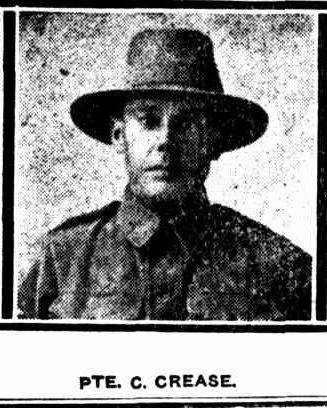
Private Charles Crease (Sunday Times 8/10/1916)

Per his military service record (regimental no. 4754), Charles Crease was born at Camperdown, N.S.W.[1]  He gave his age as 38 years, his marital status as single, and his occupation as labourer.  His description on his Certificate of Medical Examination was height 5 feet 6 inches tall, weight 146 lbs., with a ruddy complexion, brown eyes, and dark brown hair. His religious denomination was Roman Catholic.  He claimed to have no previous military service.

He was attested by Lieutenant F. Middenway when the Coo-ees were at Lawson on 7th November 1915.  He completed his medical examination at Lawson on 8th November 1915.

After completing the Coo-ee March he went to Liverpool Camp as reinforcement for the 13th Battalion.

On his embarkation roll his address at time of enrolment was Kiyare, Simmonds Street, Enmore, N.S.W.[2]  His next of kin was listed as his sister, Mrs J. Latham, at the same address.

On 8th March 1916 Private Crease, along with many of the other Coo-ees, departed Sydney on the HMAT A15 Star of England. He arrived in Egypt on 11th April 1916.

On 19th April 1916 Private Crease was transferred to the 45th Battalion at Tel-el-Kebir.

On the 2nd June 1916 Private Crease left Alexandria aboard the transport Kinfauns Castle bound for France.  He disembarked at Marseilles on 9th June 1916.

Private Crease served with the 45th Battalion through its first action at Fleurbaix, France in July 1916 then as it moved to Pozieres in early August 1916.

On 12th August 1916 the 45th Battalion was in reserve trenches between Pozieres and Martinpuich, when Private Crease was wounded in action, receiving a shrapnel wound to his left hand.[3]  He was evacuated to the 44th Casualty Clearing Station.  On 13th August 1916 he was sent to the 24th General Hospital at Etaples, France.

On 6th September 1916 Private Crease was discharged from hospital, and sent to the 4th Australian Division Base Depot.

On 17th October 1916 Private Crease rejoined the 13th Battalion when it was conducting training and supplying fatigue parties at Murrumbidgee Camp at La Clyette, Belgium.[4]

On 9th May 1917 the 13th Battalion was conducting training at Bresle, France, when Private Crease was admitted to the 56th Casualty Clearing Station suffering Neuritis.  He rejoined the Battalion on 15th May 1917.

On 29th September 1917 the 13th Battalion was near Zonnebeke, Belgium, when Private Crease was wounded in action, receiving shrapnel wounds to his arm, legs and chest.[5] He was evacuated to the 3rd Australian Field Ambulance, then on to the 10th Casualty Clearing Station.

On 5th October 1917 Private Crease was moved back to the 1st Canadian General Hospital at Etaples, France.

On 16th October 1917 Private Crease was evacuated to England on the Hospital Ship Newhaven, where he was admitted to the 1st Western General Hospital at Liverpool, England.

Private Crease was discharged from hospital on 12th December 1917, and granted leave till 26th December 1917, when he reported to the No. 4 Command Depot at Hurdcott, England.

On 27th December 1917 Private Crease was admitted to the camp hospital sick [VD Venereal Disease]. He was discharged on 3rd January 1918.

On 14th February 1918 Private Crease was transferred to the No. 2 Command Depot at Weymouth, England.

Private Crease left England on 12th March 1918 for return to Australia aboard the S.S. Kenilworth Castle. The ship arrived at Cape Town, South Africa on 28th March 1918. On 28th April 1918 Private Crease departed Cape Town aboard the H.T. Field Marshall.

He arrived in Australian on 22nd May 1918 (gunshot wound right groin and abdomen).

He was discharged termination of period of enlistment on 23rd June 1919.


[1] NAA: B2455, CREASE C

[2] Australia War Memorial. First World War Embarkation Rolls, Charles Crease, HMAT Star of England A15, 8 March 1916.

[3] Australian Imperial Force unit war diaries, 1914-18 War, AWM4 Subclass 23/62 – 45th Infantry Battalion, AWM4 23/62/6 – August 1916.

[4] Australian Imperial Force unit war diaries, 1914-18 War, AWM4 Subclass 23/62 – 45th Infantry Battalion, AWM4 23/62/8 – October 1916.

[5] Australian Imperial Force unit war diaries, 1914-18 War, AWM4 Subclass 23/62 – 45th Infantry Battalion, AWM4 23/62/19 – September 1917.

Ernest TATTERSALL

Ernest TATTERSALL

Per his military service record (regimental no. 4904), Ernest Tattersall was born at Parkes, N.S.W.[1]  He gave his age as 31 years and 11 months, his marital status as single, and his occupation as miner. His description on his Certificate of Medical Examination was 5 feet 8 inches tall, weight 154 lbs., with a medium complexion, blue eyes, and brown hair. His religious denomination was Church of England. He claimed that he had no previous military service.

A letter from his sister in his service record states that ‘He enlisted at Wellington with the Coo-ees’. [2] He completed his medical examination at Wellington on 16th October 1915. He was attested by Captain T. A. Nicholas at Mumbil on 19th October 1915.

After the Coo-ee March he went into Liverpool Camp as reinforcement for the 13th Battalion.

On 3rd February 1916 Private Tattersall was charged with being absent without leave from Liverpool Camp. He was fined 10 shillings.

On his embarkation roll his address at time of enrolment was Piesley Street, Orange, N.S.W., and his next of kin was listed as his sister Mrs. F. Phillips, at the same address.[3]

On 8th March 1916 Private Tattersall departed Sydney on the HMAT A15 Star of England, along with many of the other Coo-ees, as part of the 15th reinforcements for the 13th Battalion. He arrived in Egypt on 11th April 1916.

On the 16th of April 1916 he was transferred to the 4th Pioneer Battalion.

On 4th June 1916 Private Tattersall left Alexandria aboard the Transport Scotian bound for France.  He arrived at Marseilles on 11th June 1916.

Private Tattersall served with the 4th Pioneer Battalion in France until 14th October 1916, when he was sent to the 12th Australian Field Ambulance suffering from an ulcer to the left leg. He was moved back to the 10th Casualty Clearing Station. On 15th October 1916 he was placed aboard the 23rd Ambulance Train for evacuation to the 25th General Hospital at Hardelot, France, where he was admitted on 16th October 1916.

On 20th October 1916 Private Tattersall was placed aboard the Hospital Ship St David at Boulogne for evacuation to England. On 21st October 1916 he was admitted to the Tonbridge General Hospital.

He was discharged from hospital on 23rd November 1916 for leave until 8th December 1916.  He marched in to the No. 1 Command Depot at Perham Downs, England, on 9th December 1916.

On 12th January 1917 Private Tattersall went before a Medical Board where he was classified as C2 [unfit for overseas temporarily unfit for home service].

On 10th April 1917 Private Tattersall was transferred to the No. 2 Command Depot at Weymouth, England.  A document in his service record dated 10th April 1917 at Weymouth noted ‘Old injury L. leg. Leg swells after marching’.

On 17th April 1917 Private Tattersall was detached for duty with the Ordinance Depot at Bhurtpore Barracks, Tidworth.

On 22nd July 1917 Private Tattersall left England on the H.T. Nestor bound for Australia.

He arrived at Sydney on 25th September 1917, and was discharged Medically Unfit on 24th October 1917, with a compound fracture to the left leg [pre-existing injury from 10 years before].

Note: Ernest Tattersall died from Pneumonic Influenza in Sydney on 14th March 1919.


[1] NAA: B2455, TATTERSALL ERNEST

[2] NAA: B2455, TATTERSALL ERNEST, letter from Mrs F. Phillips to Officer in Charge, Base Records Office, Victoria Barracks, Melbourne, Victoria, 24th August 1916.

[3] Australia War Memorial. First World War Embarkation Rolls, Ernest Tattersall, HMAT Star of England A15, 8 March 1916.