Category Archives: Recruits

Sidney BENNETT

Sidney BENNETT

Sidney Bennett (Photograph courtesy of his of his grand-daughters D. Ayers and J. Pemberton)

Sidney Bennett (Photograph courtesy of his of his grand-daughters D. Ayers and J. Pemberton)

Per his military service record (regimental no. 4732), Sidney Bennett was born at Paddington, Sydney. He gave his age as 24 years and 10 months, his marital status as single, and his occupation as labourer.  His description on his medical was height 5 feet 9 ½ inches tall, weight 11 stone 5 lbs., with a dark complexion, blue eyes, and dark hair. His religious denomination was Roman Catholic. He completed his medical on the 8th October 1915 at Gilgandra and was attested by Captain Nicholas on the 9th October 1915 at Gilgandra. He claimed to have had no previous military service.

On his embarkation roll his address as time of enrolment was Hornsey, David Street, North Sydney, N.S.W., and his next of kin is listed as father, Mr H. Bennett, Hornsey, David Street, North Sydney, N.S.W.

After completing the march he went to Liverpool Camp as reinforcement for the 13th Battalion.

Private Bennett departed Sydney on the HMAT A15 Star of England on the 8th March 1916. On the 19th of April 1916 he transferred to the 45th Battalion in Egypt.

On the 2nd June 1916 Private Bennett left Alexandria aboard the Kinfauns Castle bound for France, arriving at Marseilles on the 8th June 1916.

On the 22nd September 1916 he received a gunshot wound to his left forearm whilst conducting a working party near Vierstraat, Belgium. He was hospitalised and evacuated to England.

On the 13th September 1918 he was transferred to the 54th Battalion, and on the 11th October 1918 to the 56th Battalion.

Private Bennett commenced his return to Australia on the HT Devanha on 8th May 1919, arriving in Australia on the 19th June 1919. He was discharged on the 10th August 1919.

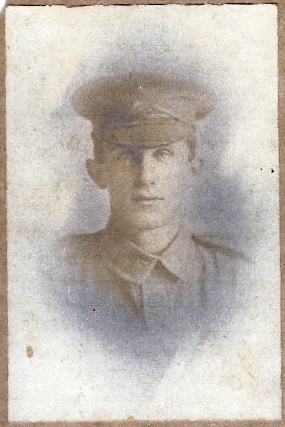
Harold BAXTER

Harold BAXTER

Per his military service record (regimental no. 4730), Harold Baxter was born at Illford, Essex, England.[1]  He gave his age as 22 years and 4 months [although he was several years younger], his marital status as single, and his occupation as a farm labourer.  His description on his medical was height 5 feet 9 inches tall, weight 11 stone, with a medium dark complexion, blue eyes, and dark hair. His religious denomination was Methodist.

He completed his medical examination on the 10th October 1915 at Gilgandra and was attested by Captain Nicholas on the 9th October 1915 at Gilgandra. He claimed to have had no previous military service.

After completing the Coo-ee March he went to Liverpool Camp as reinforcement for the 13th Battalion.

On his embarkation roll his address as time of enrolment was Euronga, Gilgandra, N.S.W., and his next of kin is listed as father, [Mr J.] Baxter, 727 Romford Road, Manor Park, Essex, England.

Private Baxter departed Sydney on the HMAT A15 Star of England, along with many of the other Coo-ees, on the 8th March 1916. On the 19th April 1916 he transferred to the 45th Battalion in Egypt.

On the 2nd June 1916 Private Baxter left Alexandria aboard the Kinfauns Castle bound for France, arriving at Marseilles on the 8th June 1916.

Private Baxter survived the fighting on the Somme unscathed, however on the 22nd November 1916, near Guedecourt, France, he was one of 3 members of the Battalion killed during a intercompany relief by a heavy German artillery barrage that also wounded 7 other members of the Battalion.

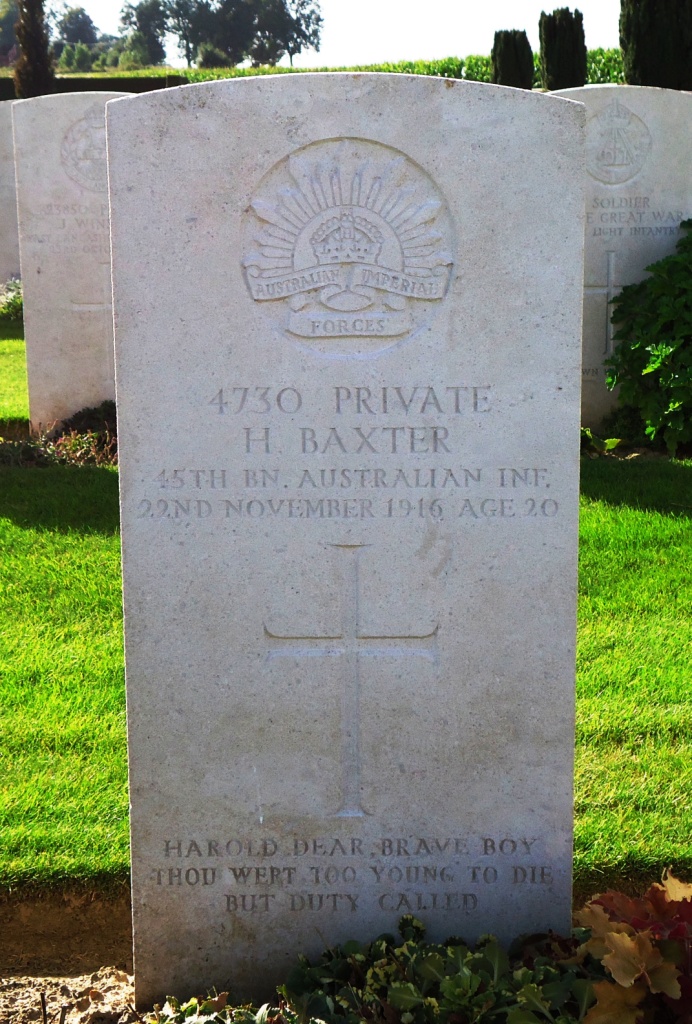
He is buried at Bancourt British Cemetery, at Bancourt, France.  His age at death was listed as only being 20 years of age on his headstone.

Harold Baxter headstone, Bancourt British Cemetery (Photograph: S & H Thompson 2012)

Harold Baxter headstone, Bancourt British Cemetery (Photograph: S & H Thompson 2012)

His name is also listed on the Cooee March Memorial Park Gateway (Gilgandra).

Research note:  His Birth Certificate lists his date of birth as 14th May 1897, so he was only 18 years and 4 months when he enlisted on the Coo-ee March.  He was only 19 years and 6 months old when he died.[2]

[1] NAA: B2455, BAXTER H

[2] General Register Office Birth Certificate, Harold Jubilee Baxter, Ilford, County of Essex, 14 May 1897, son of James Aram Baxter and Rhoda Baxter formerly Kilner.

William ALSTON

William ALSTON

William Alston on the occasion of his marriage to Miss. I. Quinton, sister of Coo-ee Victor Quinton, at Gilgandra, 1923 (Photograph courtesy of Dell Tschanter)

William Alston on the occasion of his marriage to Miss. I. Quinton, sister of Coo-ee Victor Quinton, at Gilgandra, 1923 (Photograph courtesy of  Dell Tschanter)

Per his military service record (regimental no. 1086), William Alston was born at Walgett, N.S.W. He gave his age as 23 years and 4 months, his marital status as single, and his occupation as general labourer.  His description on his medical was height 6 feet tall, weight 168 lbs., with a dark complexion, brown eyes, and black hair. His religious denomination was Anglican.  He completed his medical on the 7th October 1915 at Gilgandra and was attested by Captain Nicholas on the 9th October 1915 at Gilgandra. He claimed to have had no previous military service.

On his embarkation roll his address as time of enrolment was Narrabri West, N.S.W., and his next of kin is listed as sister, Miss Jane Alston, Narrabri West, N.S.W.

A letter from William Alston which was printed in The Dubbo Liberal and Macquarie Advocate reports his impression of the early stages of the Coo-ee March:

‘Private W. Alston, who is a member of the Coo-ees, writing to a friend from Wellington said:- “We are having the time of our lives everywhere along the track. The people had most magnificent spreads and a most places a banquet at night. I reckon the men who gave in their names and never came up are missing the time of their lives, but you can’t call them men, they are only shirkers. I myself have had good times in Gil., but nothing to compare with this. If they keep on treating us like this I will have to get a new suit of clothes, as these will be too small. The crops from Dubbo to here look splendid. We Gil. boys have our lips nearly kissed off by the girls. We have got so used to it that we kiss married women and all. It shows they think something of us.”’[1]

After completing the march he went into camp at Menangle Park as reinforcement for the Camel Corps.

Trooper Alston departed Sydney on the RMS Mongolia on the 8th July 1916. After his arrival in Egypt, on the 19th August 1916 he was taken on strength of the 1st Light Horse Training Regiment. On the 7th September 1916 he was taken on strength of the Imperial Camel Corps. On the 25th January 1917 he was taken on strength of the 1st ANZAC Battalion of the Imperial Camel Brigade.

On the 19th April 1917 Trooper Alston was with the 1st Battalion when it attacked a Turkish position outside Gaza in Palestine. Trooper Alston was one of 164 members of the Battalion wounded in the attack receiving a gunshot wound to his left arm and the side of his foot. Another 32 members of the Battalion were killed in the attack.

Trooper Alston was hospitalised for his wounds and re-joined his unit on the 17th July 1917.

On the 7th July 1918 he was transferred to the 14th Light Horse Regiment.

Trooper Alston departed Port Said, Egypt, aboard the HT Dorset on 29th April 1919, commencing his return to Australia. He arrived in Australia on the 11th June 1919, and was discharged on the 26th July 1919.

[1]‘Coo-ees and kisses’, The Dubbo Liberal and Macquarie Advocate, 5 November, 1915, p 6, http://nla.gov.au/nla.news-article77601844


The Coo-ees in Liverpool Camp

Transcription of an article titled ‘Route Marches : Gathering of the Clans : The “Cooees” winning praise in camp’  in The Farmer and Settler, 5 January, 1916, p. 3.

‘ROUTE MARCHES.
Gathering of the Clans
THE “COOEES” WINNING PRAISE IN CAMP.

The lying rumors that have been spread — maliciously by enemy sympathisers, without a doubt — concerning the men that took part in the Gilgandra route march render it expedient that a few definite facts should be published to nail the lies like vermin on a barn door.

When the Inspector-General (General McCay) reviewed the troops in training at Liverpool camp the other day, he did the job thoroughly, taking them battalion by battalion, and company by company, criticising severely when the facts called for it, and giving a little carefully measured praise where it was due. When he had seen E company of the 13th Battalion he complimented the commanding officer on the appearance of his men, and said that they were “the steadiest on parade that day.” He did not know until later that E company was the present regimental name of our old friends, the “Coo-ees.” These men from the west had been in camp little more than a month, and the companies they were so flatteringly compared with consisted in some cases of men that had been drilling for three months or more; so the compliment was something for the “Coo-ees” to be proud of.

Another fact suggesting that the time spent in marching to the seaboard is not wasted: On the day of the great “round up” in Sydney, when every man in uniform outside the camps was called upon “to show cause,” the whole force at Liverpool was taken for a fourteen miles forced march over rough roads, on a stifling day under a broiling sun. “The Coo-ees did it smiling, while nearly all the rest were nearer tears” is the way in which an observer illustrates the contrast in condition between the men that had marched over the Blue Mountains and the others. So route marches not only bring the young men of the rural settlements face to face with their duty, but they have some definite value also in fitting men for soldiering.

Now for some statistics: The Coo-ees marched into camp 273 strong, and seven men were added from other units, because of technical knowledge or for other reasons. Of this number, unfortunately, twenty-one failed to pass the severe Liverpool medical test, and sixteen, for medical or disciplinary reasons, have since been transferred to the home defence forces, or have been discharged — not a large proportion to lose in comparison with the camp experience of other units. And although thirty men, at their own request, have been transferred to the Light Horse, it will be seen that the “Coo-ees” column is still substantially intact, an assertion that is further supported by the fact that every non-com. but one in the present E company marched with the column from the west. The company sergeant-major is S. E. Stephens, who, since his service with the first expeditionary force in New Guinea, has been on the “Farmer and Settler” editorial staff; he went to Gilgandra to report the route march for this journal, re-enlisted there, and marched into camp with the column. The platoon sergeants are: H. Davenport, of Wongarbon; L. R. Anlezark, of Orange; T. W. Dowd. of Wongarbon; and E. S. Taylour, of Wentworthville. Corporals: C. H. Maidens, of Molong; W. W. Smith, of Geurie; J. E. L. Hourigan of Parramatta; J. G. Cameron, of Gilgandra; J. McKeown, of Gilgandra; and Pay Corporal J. C. Gilmour, of Coonamble. Others of the men gathered in on that first route march are qualifying for the non-com. class; but unfortunately, as the “Coo-ees” are reinforcements for a battalion already at the front, and not part of a new battalion, these ranks may be only temporary. How well, on the whole, the “Coo-ees” are behaving, and how quickly they are assimilating the lessons to be learned at Liverpool is evidenced by the fact, that although they only marched into camp on November 14th, a fairly big draft has already been made upon E company to make up the 14th reinforcements for the battalion at the front.

The next time that the story is whispered that the “Coo-ees” proved to be a bad lot, the readers of the “Farmer and Settler” will be able to say that they know better; that the “Coo-ees” are the pride of their company officers, have been complimented by General McCay, came smiling out of a forced march, have lost very few men through misbehavior, and are getting fit so rapidly that they will very shortly all be in Europe putting fresh battle names on the proud colors of the “Fighting Thirteenth.”’

Click here to access the article on Trove: http://nla.gov.au/nla.news-article116676486

Day 1, Sunday, 10th October, 1915, Gilgandra to Balladoran

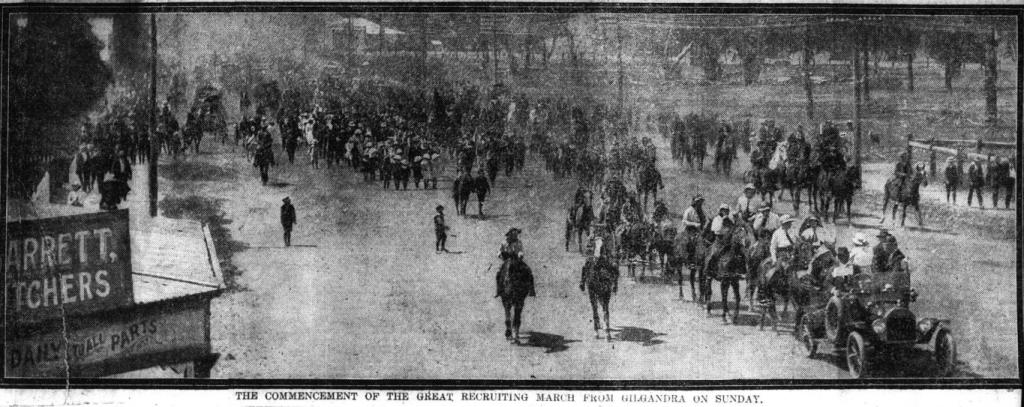
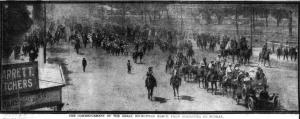
The start at Gilgandra (Daily Telegraph 12/10/1915)

The start at Gilgandra (Daily Telegraph 12/10/1915)

Transcribed from The Farmer and Settler, 12 October, 1915, p. 3.

‘THE ROUTE MARCH. Gilgandra to the Coast TRIUMPHANT SEND-OFF BY THE PEOPLE.

Gilgandra’s greatest of all events, the start of the route march, became a fact of history on Sunday last, when the contingent after a simple religious ceremony stepped out on its long march to the coast.

On Saturday, when the ‘Farmer and Settler’ special reporter, who will march to Sydney, arrived at Gilgandra, he found Captain Nicholas and Drs. Burkitt and Cooper, of Dubbo, on the ground. Captain Nicholas has been appointed to take charge of the contingent, and be will be their leader and instructor all the way through to Sydney.

On Saturday afternoon twenty-five recruits were sworn in. Two failed to pass the doctor, but they will march through to the coast nevertheless. The number of recruits would have been double if the recruiting association had not been compelled to wait so long for the permission of the military authorities, the result being that many men grew tired of waiting, and went into camp. The doctor said that the Gilgandra men were as fine a body of recruits as he had seen, with good feet and sound constitutions. On Saturday night a torchlight procession paraded the town, headed by the band. The recruits were followed by the rifle club and the boy scouts. In the interval of a picture show, Major Winn, of Sydney, and Private Lee, the ex-clergyman recruit, made special appeals to the young men to volunteer.

There were fully three thousand persons, almost the whole population of the district, at the open-air consecration service on Sunday morning, when the Rev. W. Jenkins commended the men to their Creator.

The shire president, Mr. Barden, said he was sure that the twenty-five starting out would be five hundred at the end of the long march. Almost the whole of the people, the largest gathering ever seen at Gilgandra, accompanied the march to Boberah, where a general programme of hand-shaking took place. A guard of honor of young horsewomen   rode at the head of the procession, and the local recruiting association and shire councillors took part. Captain Nicholas formed up his little force — grown already to thirty-one men; and Mr. W. T. Hitchens had the honor of giving the first words of command–‘Quick march.’ Amid resounding cheers the route march had begun, and it was followed for several miles of its long journey, by a great cavalcade of horses and vehicles. Then there was a halt, with more good-byes, more cheers, and the rifle club fired a parting volley.

The heat was intense, and the dust hung over the troops like a pillar of cloud — a fiery cloud, so that when the first stop, Marthaguy, was reached, all were grateful for the lunch spread by the residents, and not less for the facilities provided for a wash and a freshen up. At Marthaguy one new recruit fell in. Many of the Gilgandra folk still followed the column. The young daughter of a prominent citizen left her car and marched alongside the men for some distance; she announced her intention of being present in Martin Place at the finish, and declared that if she had been a boy she would have marched all the way, and gone to the front with the contingent. It is a pity that some of the boys have not the spirit of the girls.
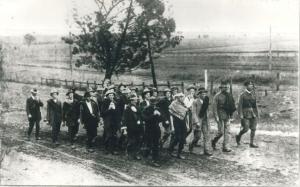
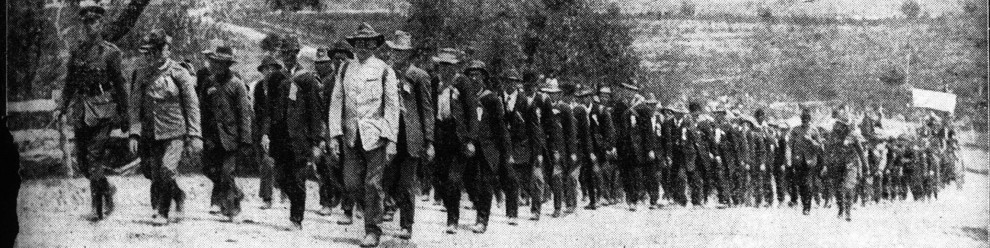
Patriotic sons of the West. A 320 mile march (Sydney Mail 20/10/1915)

‘Patriotic sons of the West. A 320 mile march’ – Coo-ees on the road to Balladoran (Sydney Mail 20/10/1915)

At Balladoran the townspeople met the column a mile out of town and escorted them to their camp with banners, and gave them a hearty welcome. The camp was reached at five o’clock, and here another recruit joined the column.

Following are the names of the first twenty-five to enlist:–

John Quinn, John Macnamara, Stanley E. Stephens, Jack Hunt, William L. Hunt, Albert W. Pearce, Leslie W. Greenleaf, Arthur C. Finn, Francis N. White, Alfred Wardroffe, Victor Quinton, William Alston, Sidney Bennett, John R. Lee, Harold Baxter, Charles R. Wheeler, E. T. Hitchen, James McKeown, James Crowford, Charles E. Marchant, Andrew J. MacGregor, Lawrence L. McGuire, Robert C. Campbell, Peter Wilson, and Frank Humphrey.’

Click here to view the article on Trove: http://nla.gov.au/nla.news-article116668904