Category Archives: Recruits

John Edward Leslie HOURIGAN

John Edward Leslie HOURIGAN

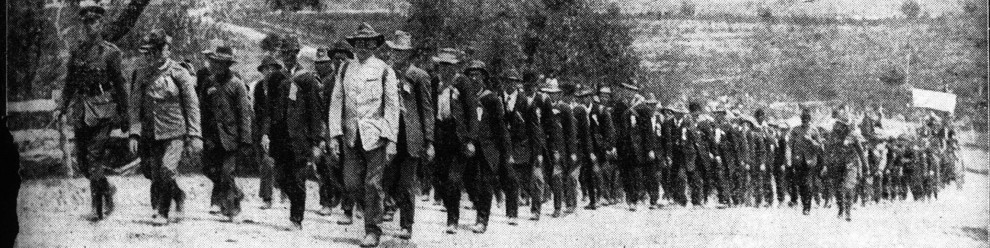
Corporal J. E. L. Hourigan (Cumberland Argus and Fruitgrowers Advocate 12/8/1916)

Corporal J. E. L. Hourigan (Cumberland Argus and Fruitgrowers Advocate 12/8/1916)

Per his military service record (regimental no. 4787), John Edward Leslie Hourigan was born at Parramatta, N.S.W. He gave his age as 21 years and 1 month, his marital status as single, and his occupation as carter. His description on his medical was height 5 feet 7 inches tall, weight 166 lbs., with a fair complexion, blue eyes, and fair hair. His religious denomination was Roman Catholic. He claimed to have 4 years U. T. [universal training] experience and was still serving.

“Jack” Hourigan was reported in The Cumberland Argus and Fruitgrowers Advocate as enlisting with the Coo-ees at Parramatta.[1] He completed his medical on the 11th November 1915 at Parramatta, and was attested by Lieutenant R. Howe at Parramatta on the 11th November 1915.

After completing the Coo-ee March he went to Liverpool Camp as reinforcement for the 13th Battalion. His service record shows he was made Acting Corporal from 11th November 1915.

He was reported in The Farmer and Settler on 5th January 1916 as being one of the Corporals in E company from the “Coo-ees” column, and it was noted that ‘as the “Coo-ees” are reinforcements for a battalion already at the front, and not part of a new battalion, these ranks may be only temporary’.[2]

On his embarkation roll his address at time of enrolment was 415 Church Street, Parramatta, N.S.W., and his next of kin is listed as his father, J. Hourigan, at the same address.

On 8th March 1916 Acting Corporal Hourigan departed Sydney on the HMAT A15 Star of England, along with many of the other Coo-ees, as part of the 15th reinforcements for the 13th Battalion. He arrived in Egypt on 11th April 1916.

On 19th April 1916, he was transferred to the 45th Battalion in Egypt,  along with some of the other Coo-ees.

On 29th May 1915 his promotion to Corporal was confirmed.

On 2nd June 1916 Corporal Hourigan left Alexandria aboard the transport Kinfauns Castle bound for France with other members of the 45th Battalion, arriving at Marseilles on 8th June 1916.

On 8th July 1916 the 45th Battalion was in the front line for the first time in the vicinity of Fleurbaix, France, when Corporal Hourigan was wounded in action, receiving a severe gunshot wound to his scalp. He was evacuated to the 4th Australian Field Ambulance then moved back to the 8th Casualty Clearing Station on 9th July 1916.

On 21st July 1916 he was sent to the 30th General Hospital at Calais in France. On 22nd July he was placed aboard the Hospital Ship Brighton for evacuation to England. He was admitted to the Wharncliffe War Hospital at Sheffield in England on 23rd July 1916.

On 21st September 1916 Corporal Hourigan was transferred to the 1st Australian Auxiliary Hospital at Harefield, England.

On 23rd September 1916 he was discharged from hospital, and marched into the Number 2 Command Depot at Weymouth, England.

On 14th October 1916 he was charge with overstaying leave from 3 p.m. on 11th October until 8 p.m. on 13th October 1916. He was reprimanded by the Colonel, and forfeited 3 days pay.

Corporal Hourigan was transferred to the Infantry Draft Depot at Pernham Downs in England on 24th January 1917.

On 13th March 1917 Corporal Hourigan departed Folkestone bound for France. He arrived at the 4th Australian Division Base Depot at Etaples in France on 14th March 1917. Corporal Hourigan rejoined the 45th Battalion on 29th March 1917 when it was training in the vicinity of Bapaume, France.

In October 1917 Corporal Hourigan was sent to the Lieutenants Training School at the 4th Australian Division Base Depot at Le Harve in France, however on 15th October 1917 he was charged with absenting himself from 10 p.m. on 13th October until 9.20 p.m. on 14th October 1917. He was reprimanded by the Commanding Officer, fined 2 days pay, and sent back to the 45th Battalion on 22nd October 1917.

On 21st January 1918 Corporal Hourigan went on 14 days leave to England.

He rejoined the Battalion on 9th February 1918 when it was being relieved from the front line in the vicinity of Hollebeke in Belgium.

On 25th March 1918 the 45th Battalion was moving by motor buses from Belgium to the Somme battlefield in France, when Corporal Hourigan sprained his left ankle.[3] He was evacuated to the 12th Australian Field Ambulance, then moved back to the 1st Australian Casualty Clearing Station, then placed aboard the 20th Ambulance Train, where he was conveyed to the 9th Canadian Stationary Hospital, being admitted on 26th March 1918.

On 29th March 1918 he was sent to the 7th Convalescent Depot at Boulogne, France.

On 10th April 1918 he was moved to the 10th Convalescent Depot.

On 18th April 1918 he marched into the 4th Australian Division Base Depot at Le Harve, France.

Corporal Hourigan rejoined the 45th Battalion on 13th May 1918 when it was in action in the vicinity of Villers Brettoneux, France.

On 6th November 1918 Corporal Hourigan was promoted to Sergeant.

Following the Armistice, on 19th November 1918 Sergeant Hourigan went on leave to England. He rejoined the 45th Battalion on 6th December 1918.

On 21st April 1919 Sergeant Hourigan marched into the Australian Base Depot at Le Harve to commence his return to Australia. He left for England the next day, on 22nd April 1919.

On 11th May 1919 Sergeant Hourigan departed England aboard the Transport Borda bound for Australia.

He arrived in Australia on 28th June 1919, and was discharged Termination of period of Enlistment on 12th August 1919.

[1] ‘Of the Boys’, The Cumberland Argus and Fruitgrowers Advocate, 7 June 1919, p. 8, http://nla.gov.au/nla.news-article86115560

[2] ‘Route Marches. Gathering of the Clans. The “Cooees”winning praise in camp’, The Farmer and Settler, 5 January 1916, p. 3, http://nla.gov.au/nla.news-article116676486

[3] Lee, J. E., The chronicle of the 45th Battalion A.I.F., East Sussex : The Naval & Military Press Ltd, [2009], p. 58.
William Allan Luther PHILPOTT

William Allan Luther  PHILPOT / PHILPOTT

Per his military service record (regimental no. 5164), William Allan Luther Philpot was born at Ashfield, N.S.W. (He signed his name as W. A. L. Philpott). He gave his age as 19 years, his marital status as single, and his occupation as carter. His description on his medical was height 5 feet 6 inches tall, weight 120 lbs., with a fresh complexion, brown eyes, and brown hair. His religious denomination was Congregational. He claimed that he had no previous military service, and that he had been rejected for the AIF in the past.

He completed his medical examination, and was attested by Lieutenant F. Middenway, at Ashfield on 11th November 1915, where the Coo-ees held a recruitment meeting, and stayed in the Drill Hall that evening.

After the Coo-ee March he went to Liverpool Camp as reinforcement for the 13th Battalion.

On 4th January 1916 Private Philpot was transferred from B Company to D Company in the 13th Battalion.

On 3rd February 1916 Private Philpot was charged with being absent from parade without leave. He was fined 1 days pay.

On 2nd March 1916 he was again charged with being absent without leave, and fined 1 days pay.

On his embarkation roll his address at time of enrolment was Morwin Street, Canberbury, Sydney, N.S.W., and his next of kin was listed as his mother, Mrs M. A. Philpot, at the same address.

Private Philpot (along with fellow Coo-ees Private William Griffiths and Robert Hickey) departed Sydney on the HMAT A16 Star of Victoria A16 on 31st March 1916, as 16th reinforcements for the 13th Battalion. They arrived in Egypt on 8th May 1916.

After further training with the 4th Training Battalion, Private Philpot was taken on strength of the 13th Battalion at Serapeum on 28th May 1916.

On 1st June 1916 Private Philpot left Alexandria aboard the Transport Transylvania bound for France, and arrived at Marseilles on 8th June 1916.

On 1st July 1916 the 13th Battalion was manning the front line at White City post in the vicinity of Bois-Grenier in France. Private Philpot was wounded in action during a German bombardment, and was evacuated suffering shell shock.

He was moved back to the 14th General Hospital, being admitted on 13th July 1916. On 14th July 1916 he was placed aboard the Hospital Ship St Dennis at Boulogne, for evacuation to England.

He was admitted to the Northumberland War Hospital at Gosforth in England on 15th July 1916.

On 31st July 1916 he was transferred to the Woodcote Park Convalescent Hospital at Epsom in England.

On 10th September 1916 he was discharged and sent to the Number 1 Command Depot at Pernham Downs, England.

On 14th September 1916 Private Philpot was granted leave to report back to the Depot at Pernham Downs on 6th October 1916.

On 31st October 1916 Private Philpot was admitted to the Dehli Hospital at Pernham Downs suffering from Influenza.

On 29th November 1916 he was transferred to the Red Cross Hospital at Hungerford in England. He was discharged and sent back to the Number 1 Command Depot on 4th January 1917.

On 27th January 1917 Private Philpot was admitted to Tidworth Military Hospital, suffering from an unknown illness. He was discharged and sent back to the Number 1 Command Depot on 5th March 1917.

On 14th March 1917 Private Philpot was admitted sick to Dehli Hospital at Pernham Downs, and returned to his unit the next day.

On 23rd March 1917 Private Philpot was transferred to the newly formed 61st Battalion at Wareham in England.

On 21st April 1917 he was transferred back to the 13th Battalion and Number 1 Command Depot at Pernham Downs, England.

On 12th May 1917 Private Philpot marched into Number 1 Command Depot at Pernham Downs, England.

On 27th May 1917 Private Philpot was transferred to the 69th Squadron of the Australian Flying Corps at South Carlton in Lincolnshire.

On 24th August 1917 3rd A.M. [Air Mechanic 3rd Class] Philpot departed England for France. He disembarked at Le Harve in France on 25th August 1917.

Soon after his arrival in France, on 28th August 1917 3rd A.M. Philpot was admitted to hospital sick. He was discharged from hospital on 20th September 1917, and joined the 69th Squadron, which had recently relocated to Savy in France.

On 17th October 1917 3rd A.M. Philpot was admitted to the 3rd Australian General Hospital at Abbeville in France, suffering from D.A.H. otitis.

On 20th October 1917 he was placed aboard the 32nd Ambulance Train, and on 21st October 1917 he was placed aboard a Hospital Ship for evacuation to England with otitis media. He was admitted to the 3rd London General Hospital later that same day.

On 22nd December 1917 he was transferred to the 1st Australian Auxiliary Hospital at Harefield, England.

On 2nd January 1918 he was granted leave to report to the Number 3 Command Depot at Hurdcott in England on 16th January 1918.

On 19th February 1918 Private Philpot was transferred to the Number 2 Command Depot at Weymouth, England.

On 12th March 1918 Private Philpot commenced his return to Australia, and departed England aboard the Transport Kenilworth Castle. He transferred to the H.M.A.T. Field Marshall, and departed Durban in South Africa on 28th April 1918, and arrived in Australia on 23rd May 1918.

He was discharged Medically Unfit on 21st August 1918.

James Birrell DAWSON

James Birrell DAWSON

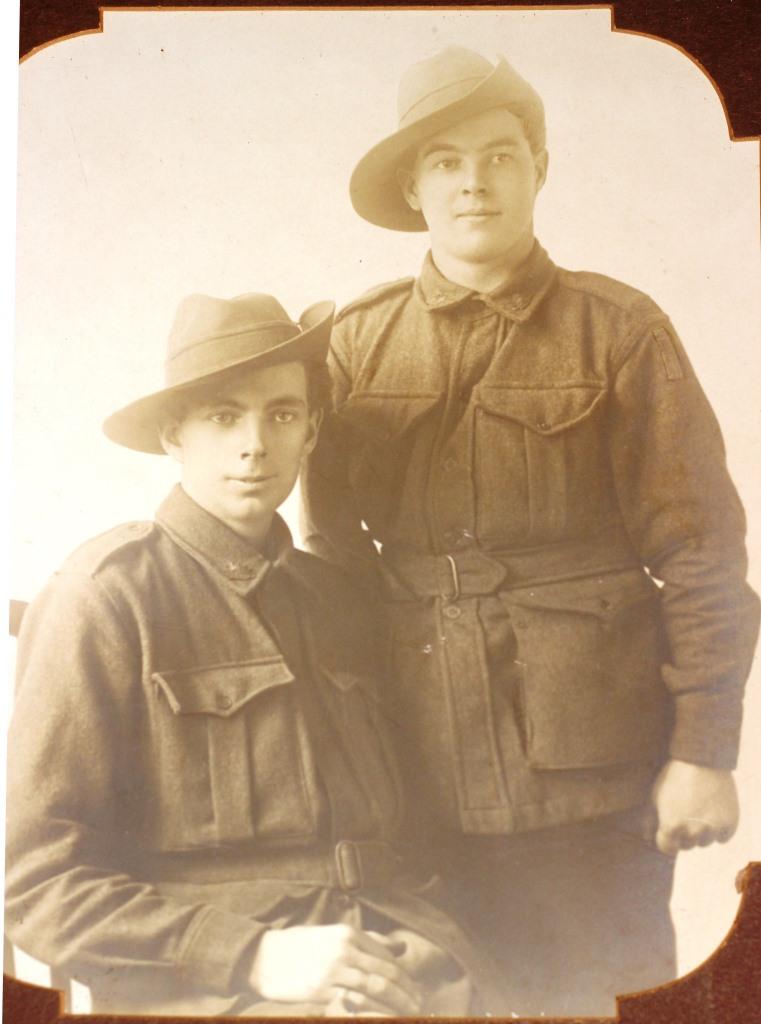
Walter Goodlet (left) and James Birrell Dawson (right), both amputees. Photograph courtesy of James Dawson's great granddaughter Jamie Stacey.

Coo-ees Walter Goodlet (left) and James Dawson (right), both amputees. Photograph courtesy of James Dawson’s great-grandson Jamie Stacey.

Per his military service record (regimental no. 4469), James Birrell Dawson was born at Joadga Creek, N.S.W. He gave his age as 19 years and 9 months, his marital status as single, and his occupation as miner. His description on his medical was height 5 feet 3 ¾ inches tall, weight 122 lbs., with a fresh complexion, brown eyes, and brown hair. His religious denomination was Presbyterian. He claimed that he had 12 months previous military experience with the Senior Cadets in Lithgow, and that he had been rejected by the 41st Infantry [Regiment of the Militia] for being ‘not tall enough’.

He completed his medical on 31s October 1915 at Lithgow, but was not attested until 13th November 1915 at Liverpool (by Lieutenant Edward Shaw). His ‘joined on’ date was 2nd November 1915.

The Lithgow Mercury reported that ‘He was formerly employed as a wheeler at the Oakey Park colliery’, and that he ‘enlisted with the “Coo-ees” and marched to Sydney with this body of men’.[1]

After completing the Coo-ee March he went to Liverpool Camp as reinforcement for the 13th Battalion.

A farewell party was held for Private Dawson at Oakey Park in early January 1916 before his departure overseas, where he was presented with a fountain pen, military hairbrush, and comb, and ‘dancing and singing were indulged in until the small hours’.[2]

On his embarkation roll his address at time of enrolment was Oakey Park, Lithgow, N.S.W, and his next of kin is listed as his father, G. [George] Dawson, at the same address.

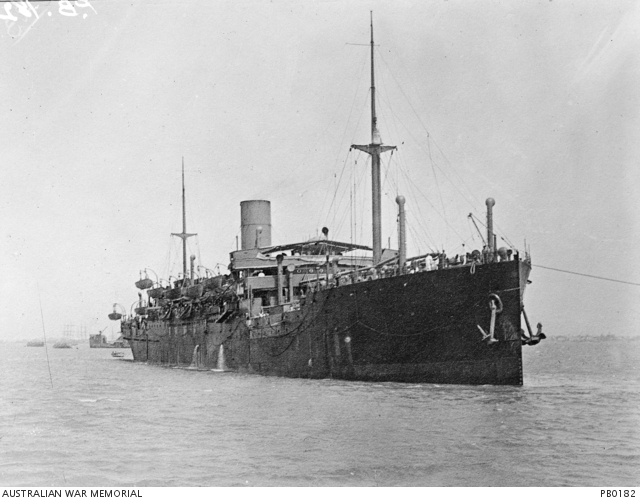
On 16th February 1916 Private Dawson was one of the first group of Coo-ees to embark overseas on active service, and departed Sydney on the HMAT Ballarat A70 as 14th reinforcement for the 13th Battalion.

HMAT Ballarat A70, 18/2/1916. Photograph from the AWM Collection PB0182.

HMAT Ballarat A70, 18/2/1916. Photograph from the AWM Collection PB0182.

The HMAT Ballarat A70 arrived in Egypt on 22nd March 1916.

On 1st April 1916 Private Dawson, (along with the other Coo-ees he had travelled to Egypt with), was transferred to the 54th Battalion at Ferry Post.

On 19th June 1916 Private Dawson left Alexandria aboard H.T. Caledonian bound for France, arriving at Marseilles on 29th June 1916.

On the night of the 19/20th July 1916 Private Dawson was with the 54th Battalion when it participated in the Battle of Fromelles. During the battle he was wounded in action, suffering a gun shot wound to his right forearm.

He was treated by the 15th Australian Field Ambulance, then moved back to the 1st Australian Casualty Clearing Station. On 21st July 1916 he was placed aboard an Ambulance Train, and moved back to the 30th General Hospital at Calais, France. His right arm was amputated due to his wounds.

On 3rd August 1916 he was placed aboard the Hospital Ship Newhaven for evacuation to England. Later that day he was admitted to the Huddersfield War Hospital.

On 8th September he was taken on strength by No. 2 Command Depot, Weymouth, England.

A letter that Private Dawson wrote home to his mother during his time convalescencing at Weymouth in England was published in the Lithgow Mercury:

‘Private James Dawson, Lithgow, writing to his mother from Monte Video camp, Weymouth, Dorset, under date September 11 [1916], said he was quite well. His arm (which was amputated) was about healed up and did not trouble him at all then. He had been in England since August 3. He was in Huddersfield Hospital until September 8, when he was removed to the first-named address. While he was a Huddersfield he had an enjoyable time. He was only there three days before he was out to three garden parties in succession, and had a “great time.” They were the first Australians to go there and the people could not do enough for them. He always had plenty of places to go to for tea. All the picture shows and theatres were free to them, and even the young ladies used to take the chaps home to tea with them, and it was a great place. But it was very quiet at Weymouth after having been at Huddersfield’. [3]

On 20th September 1916 he was transferred to the 2nd Australian Auxiliary Hospital at Southall, England, which specialised in fitting artificial limbs.

On 21st December 1916 Private Dawson was discharged from hospital, and granted furlough, to report back to the 2nd Australian Auxiliary Hospital on 5th January 1917.

During his stay at the 2nd Australian Auxiliary Hospital he wrote the following letter home to his mother, which was published in the Lithgow Mercury:

‘Pte. James Dawson, writing from the 2nd Australian Auxiliary Hospital, Southall, England, to his mother, Mrs G. Dawson, Oakey Park, under date February 9 [1917], says:–“I am getting on splendidly. I have had another operation since I last wrote, making three in all. But I think it will be the last, as I have been measured for the artificial arm and will be getting it in two or three weeks. I am having a very good time here – always going out to tea or theatre parties, etc. In fact, the people can’t do enough for us. We are getting well looked after in hospital, but I am getting sick of hospital life. It has been nothing else but snow these last few weeks. No sun ever shines; it is only wind and snow. I don’t think they have any summer at all. I received the other day four letters addressed to Egypt. They chased me all round the country. They were very dirty and torn when I got them; otherwise they were all right. I have only had one parcel but no papers. I don’t know where those sent got to.[4]

On 5th April 1917 Private Dawson was discharged from the 2nd Australian Auxiliary Hospital to commence his return to Australia.

Private Dawson departed Devonport, England on 4th May 1917, aboard the Transport Themistocles. Also travelling with him on the same ship was his friend and fellow Coo-ee Walter Goodlet, who had also lost an arm.

They disembarked at Sydney on 5th July 1917.

Private Dawson was discharged medically unfit, with a disability of an amputated right arm, on 12th December 1917.

[1] ‘Wounded in France’, Lithgow Mercury, 2 August 1916, p. 2, http://nla.gov.au/nla.news-article218730143

[2] ‘Presentation to Pte. Jas. Dawson’, Lithgow Mercury, 10 January 1916, p. 2, http://nla.gov.au/nla.news-article218732433

[3] ‘Our Soldiers’ Letter Box’, Lithgow Mercury, 8 November 1916 p. 1, http://nla.gov.au/nla.news-article218724555

[4] ‘Our Soldiers’ Letter Box. Private James Dawson’, Lithgow Mercury, 27 April 1917, p. 7, http://nla.gov.au/nla.news-article218761454


William Henry PEPPERNELL

William Henry PEPPERNELL

Per his military service record (regimental no. 541), William Henry Peppernell was born at Cowra, N.S.W. He gave his age as 28 years and 11 months, his marital status as single, and his occupation as railway ganger. His description on his medical was height 5 feet 7 inches tall, weight 152 lbs., with a ruddy complexion, brown eyes, and black hair. His religious denomination was Roman Catholic. He claimed 12 months previous military experience in the Mullion Creek Rifle Club.

‘W. Peppernal (ganger)’ was named in the Western Age on 3rd November 1915 as one of ‘three young men, railway employees’, that enlisted at the conclusion of a recruitment meeting held in Canbelego [which is near Cobar], at which Private Fern, M.L.A. spoke, that would ‘leave Canbelego by train on Tuesday, and join the Coo-ees beyond Bathurst’.[1]

His postal address on his initial Application to enlist in the Australian Imperial Force form dated 30th October 1915 was ‘Canbelego’, and he undertook a Preliminary medical examination at Canbelego on the same date.

He was attested by Captain Eade on 7th November 1915 at Lawson (when the Coo-ees were at Lawson), and completed his medical on 13th November at Liverpool.

After completing the Coo-ee March he went to Liverpool Camp as reinforcement for the 13th Battalion.

On 19th February 1916 he transferred to B Company in the 36th Battalion, to join his two brothers Frederick and Henry who had enlisted in January 1916.

On his embarkation roll his address at time of enrolment was Kerr’s Creek, Orange, N.S.W., and his next of kin is listed as his mother, Mrs Annie Peppernell, at the same address.

On 13th May 1916 Private Peppernell (along with his two brothers) departed Sydney on the HMAT Beltana A72, arriving in Devonport, England, on the 9th July 1916.

After spending the next four months in England with the 36th Battalion in training, Private Peppernell on 22nd November 1916 departed from Southampton, England, bound for France.

Private Peppernell was with the 36th Battalion when it moved into the trenches on the Western Front in early December 1916.

His brother Private Frederick Peppernell (regimental no. 535), was with him in the 36th Battalion during the Battle of Messines in Belgium, when his brother was killed in action on 7th June 1917. The Australian Red Cross Society Wounded and Missing Enquiry Bureau Files record Private W.H. Peppernell’s statement made on 6th November 1917: ‘My brother F. Peppernell went out with me in a carrying party for the Messines advance. I saw him last about 30 yards in front of me. The enemy was sniping us and I told him to take cover. He got into a shell hole and I did not see him again. I enquired at the Clearing Station by could hear nothing of him. I have heard since from home in Australia that he has been killed’.[2]

On the 12th of October 1917 the 36th Battalion was involved in an unsuccessful attack to capture Passchendaele Ridge near the village of Passchendaele (First Battle for Passchendaele) during the ongoing Third Battle of Ypres in Belgium. During this attack Private Peppernell was wounded in action, receiving a gunshot wound to his right knee, and he was admitted to the 3rd Australian Casualty Clearing Station.

He was evacuated to England on Hospital Ship Carisbrooke Castle on 20th October 1917, and was admitted to Voluntary Aid Detachment Hospital Cheltenham Area with a gun shot wound to right thigh slight on 21st October 1917.

Private Peppernell was given leave from 21st November 1917 to 5th December 1917, then reported to No. 1 Command Depot.

On 3rd January 1918 Private Peppernell departed Southampton to France. On 10th January 1918 he rejoined the 36th Battalion in Belgium.

On 12th March 1918 Private Peppernell was promoted to Lance Corporal.

Lance Corporal Peppernell was recommended (but not awarded) a Military Medal for his actions on 4th April 1918, while the 36th Battalion helped to defeat a major attack by the Germans on Villers-Bretonneux in France. The recommendation reads:

William Henry PEPPERNELL. For conspicuous gallantry and devotion to duty. Previous to the launching of a counter-attack by his Battalion on the 4th April 1918, and when the enemy was advancing in force, L/Cpl. PEPPERNELL went forward under heavy fire and located the enemy, affording valuable information to his Company Commander which enabled him to avoid heavy casualties. Decoration recommended MM.[3]

The 36th Battalion was disbanded on 30th April 1918 to reinforce other units, and Lance Corporal Peppernell was transferred to the 33rd Battalion in France.

On 4th June 1918, Lance Corporal Peppernell was wounded in action for a second time, with a gun shot wound to the left arm, while the 33rd Battalion was in in the vicinity of Villers-Bretonneux in France.

He was taken first to the 10th Australian Field Ambulance, then to the 5th Casualty Clearing Station. He was admitted to the 12th General Hospital in Rouen on 8th April 1918.   On 10th June 1918 he was evacuated to England.

On 11th June 1918 Lance Corporal Peppenell was admitted to Horton County of London War Hospital in England with gun shot to the left arm, severe.

On 26th June 1918 he was transferred to the 3rd Auxiliary Hospital in Dartford.

On 1st July 1918 he was discharged to No. 3 Command Depot at Hurdcott.

On 26th August 1918 Lance Corporal Peppenell was admitted to 1st Australian Dermatological Hospital in Bulford. He was discharged to Convalescent Training Depot, Parkhouse, on 28th August 1918.

On 11th October 1918 he was transferred to No. 1 Command Depot at Sutton Veny.

Lance Corporal Peppernell commenced his return to Australia on the HMAT Orsova on 8th January 1919. He arrived in Australia on 3rd March 1919.

The Leader reported that Lance Corporal Peppernell was welcomed at Kerr’s Creek Railway Station on 10th March 1919 by a large number of residents, and a welcome home function was held that Friday evening, where he was presented with a medal which was inscribed with his name and battalion colours.[4]

He was discharged medically unfit on 10th April 1919.


[1] ‘Canbelego News’,Western Age, 3 November 1915, p. 2, http://nla.gov.au/nla.news-article136727753

[2] 535 Frederick Peppernell, Red Cross Wounded and Missing Enquiry Bureau Files, 1914-1918 War 1DRL/0428, https://www.awm.gov.au/people/rolls/R1499936/

[3] Australian War Memorial, Honours and Awards: William Henry Peppernell, Lance Corporal, 36th Australian Infantry Battalion, First World War, 1914-1918, Recommendation: Military Medal, https://www.awm.gov.au/people/rolls/R1622124/

[4] ‘Kerr’s Creek welcome’, Leader, 17 March 1919, p. 4, http://nla.gov.au/nla.news-article117856950 ; ‘Kerr’s Creek’, Leader, 7 April 1919, p. 5, http://nla.gov.au/nla.news-article117857839


William Solomon CISSMAN

William Solomon CISSMAN

Per his military service record (regimental no. 1706), William Solomon Cissman was born at Waterloo, Sydney, New South Wales. He gave his age as 33 years, his marital status as single, and his occupation as labourer.  His description on his medical was height 5 feet 4 inches tall, weight 131 lbs., with a dark complexion, dark eyes, and dark hair. His religious denomination was Church of England.

His name was listed as one of the men who joined the Coo-ees at Wellington in the Wellington Times.[1] He completed his medical at Wellington on 16th October 1915, and was attested by Captain Nicholas at Mumbil on 19th October 1915. He claimed to have no previous military service. He is recorded as having been an apprentice jockey for 5 years on his service record.

After completing the Coo-ee March he went to Menangle Light Horse Camp as reinforcement for the 6th Light Horse Regiment.

His initial regimental number was recorded as 2313 in his service record, but this has been crossed out and replaced with number 1706. His statement of service records he was transferred to the 8th Reinforcement of the 12th Light Horse Regiment on 1st February 1916.

Private Cissman was charged with being absent from all parades without leave on 18th March 1916, for which he forfeited 1 days pay, was fined 1£, and was confined to barracks for 14 days.

On his embarkation roll his address as time of enrolment was Waterloo, Sydney, N.S.W., and his next of kin is listed as his brother, John Alfred Cissman, at the same address.

On 5th May 1916 Trooper Cissman departed Sydney on the HMAT Karroo A10, as 8th reinforcement for the 12th Light Horse Regiment, arriving in Egypt on the 7th June 1916. (Private Arthur Ernest McGregor also embarked on the same ship).

After arriving in Egypt he was taken on strength by the 2nd Light Horse Training Regiment at Tel-el-Kebir on 24th June 1916.

On 15th July 1916 Trooper Cissman was taken on strength of the Imperial Camel Corps at Tel-el-Kebir.

On 2nd August 1916 he was admitted to No. 2 Stationary Hospital at Tel-el-Kebir.

On 3rd August 1916 he was taken on strength of the Imperial Camel Corps at Moascar, from Hospital.

On 30th August 1916 Trooper Cissman was charged with being absent without leave from 0540 on 26th August 1916 till 0800 on 30th August 1916. He was awarded 7 days confined to barracks and fined 5 days pay.

On 1st September 1916 Trooper Cissman was admitted to the 24th Stationary Hospital with Club Foot. On 3rd September 1916 he was transferred to the 3rd Australian General Hospital at Cairo with Talipus Varus.

Trooper Cissman departed at Suez, Egypt aboard the Hospital Ship Kanowna on 23rd September 1916, commencing his return to Australia, for discharge with Talipus Varus.

He arrived in Australia on 28th October 1916, and was discharged medically unfit on 7th December 1916.

[1] ‘Hitchen’s Coo-ees’, Wellington Times, 18 October 1915, p. 3, http://nla.gov.au/nla.news-article143388424


Francis Noel WHITE

Francis Noel WHITE

Per his military service record (regimental no. 2395), Francis Noel White was born at Canterbury, Kent, in England. He gave his age as 35 years and 9 months, his marital status as single, and his occupation as wheelwright.  His description on his medical was height 5 feet 7 ½ inches tall, weight 12 stone 7 lbs., with a fair complexion, blue eyes, and fair hair. His religious denomination was Anglican.

He completed his medical at Gilgandra on 7th October 1915, and was attested by Captain Nicholas at Gilgandra on 9th October 1915. He claimed to have had 2 years and 3 days previous military service with the Royal East Kent Mounted Rifles. He also stated he had been rejected once before as unfit for His Majesty’s Service with a “hit knee”.

After completing the Coo-ee March he went to Menangle Light Horse Camp as reinforcement for the 6th Light Horse Regiment.

Francis Noel White was reported in The Bathurst Times as having been charged at Bathurst Police Court with ‘having travelled between Sydney and Bathurst without a ticket on the night of February 5’ 1916, and also ‘having attempted to travel on the return journey’ without a ticket, and was described as ‘a member of the Sixth Light Horse, and a rather good-looking Englishman of cultured speech’, who was ‘fortunate enough to be remembered favorably by Captain Hitchen’, and that ‘had not Captain Hitchen came to his rescue’, White ‘would in all probability be now spending two days in the shamed seclusion of the Bathurst Gaol’, instead of back in camp at Liverpool. White said in court that he was on final leave, and that he sailed on Friday. White also said that ‘he was from England originally’, and had been ‘working on stations up to the time’ he joined the Coo-ees. Captain Hitchen ‘informed the Bench that White had come all the way with the “Coo-ees” as a transport driver’, and that White had been in his ‘employ for a few weeks before the commencement of the march’, and that he ‘had found him a man of good character at all times, and one who had conducted himself well right through the piece’, and offered to pay White’s fare.[1]

An initial regimental number of 2254 is crossed out on his service record, and ‘16th REINFTS 6th L.H.’ stamped over 15th Reinforcements 6th Regiment, A.L.H., which had initially been recorded for his unit, so it appears this episode may have held up his embarkation overseas.

On his embarkation roll his address as time of enrolment was not recorded, and his next of kin is listed as his mother, Mrs Merser, c/o Mrs Bosworth, “Linton”, College Lane, East Grimstead, Sussex, England.

Trooper White departed Sydney on the HMAT Hymttus 1 on 3rdof May 1916, as 16th Reinforcements for the 6th Light Horse Regiment.

After arriving in Egypt he was taken on strength by the 2nd Light Horse Training Regiment at Tel-el Kebir on 27th June 1916.

On 8th September 1916 he was temporarily attached to Military Police Headquarters, at Moascar.

On 27th September 1916 a Field General Court Marshal was held at Moascar, where Private White charged with drunkenness when on active service on 20th September 1916, and he was sentenced to 21 days Field Punishment Number 2.

On 1st October 1916 he was admitted to the 24th Stationary Hospital, with Paraphimosis.

He rejoined Police Headquarters from Hospital on 14th October 1916.

On 18th October 1916 he rejoined the 6th Light Horse Regiment.

On 16th November 1916 Trooper White was transferred to the Imperial Camel Corps at Abbassia. On 19th November 1916 he was taken on strength of 3rd Company, Imperial Camel Corps.

Trooper White served with the Imperial Camel Corps in El-Mustagidda and El-Arish in Egypt until 5th February 1917, when after jumping off a camel he aggravated an old injury to his right knee where he had been ‘kicked by a horse 11 years ago’ , resulting in him being hospitalised.  He was taken by hospital train and admitted to the 24th Stationary Hospital with Synovitis knee on 9th February 1917.

On 12th February 1917 he was admitted to the No. 14 Australian General Hospital at Abbassia.

On 8th March 1917 Trooper White embarked from Suez, Egypt, aboard the HMAT Willochra bound for Australia, with Arthritis in the right knee.

He arrived at Melbourne on 25th April 1917. He was discharged medically unfit in Sydney on 25th May 1917.

[1] ‘A Coo-ee charged at Police Court : Captain Hitchen to the rescue’, The Bathurst Times, 8 February 1916, p. 4. http://nla.gov.au/nla.news-article109940688


Ronald Hector PERKINS

Ronald Hector PERKINS

Per his military service record (regimental no. 2472), Ronald Hector Perkins was born at Katoomba, N.S.W. He gave his age as 21 years and 4 months, his marital status as single, and his occupation as carrier’s employee. His description on his medical was height 5 feet 7 inches tall, weight approximately 180 lbs., with a fresh complexion, blue eyes, and brown hair. His religious denomination was Congregational. He claimed that he had no previous military service ‘excepting compulsory training’. He completed his medical on the 5th November 1915 at Katoomba, and was attested at Katoomba by Lieutenant F. Middenway on the same day.

He was named in The Blue Mountain Echo as one of the recruits who joined the Coo-ees at Katoomba.[1]

After completing the march he went to Menangle Park Camp as reinforcement for the 6th Light Horse Regiment.

On his embarkation roll his address at time of enrolment was Bent Street, Katoomba, N.S.W., and his next of kin is listed as his mother, Mrs Fanny Perkins, at the same address.

On 26th April 1916 Trooper Perkins departed Sydney on the HMAT Port Macquarie A39.

After arriving at Suez in Egypt, on 21st June 1916 Trooper Perkins was taken on strength with the 2nd Light Horse Training Regiment at Te-el-Kebir.

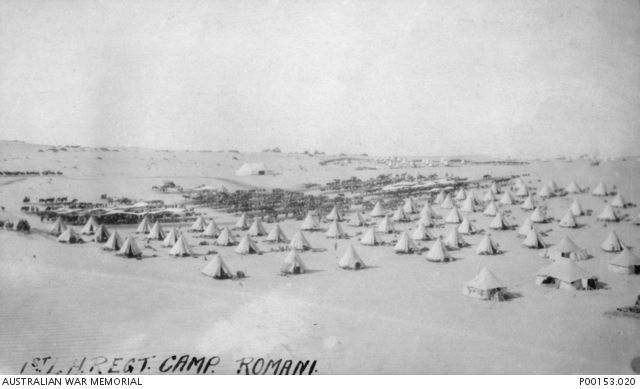
On 5th July 1916 Trooper Perkins transferred to the 1st Light Horse Regiment at Romani in Palestine.

Photograph of ‘Horse and tent lines of the 1st Australian Light Horse Regiment’, Romani Area, ca. August 1916. Part of the Australian War Memorial Collection. P00153.020

Photograph of ‘Horse and tent lines of the 1st Australian Light Horse Regiment’, Romani Area, ca. August 1916. Part of the Australian War Memorial Collection. P00153.020

The 1st Light Horse Regiment participated in the Battle of Romani 3-5th August 1916.[2]

On 6th August 1916 Trooper Perkins was admitted to the 1st Australian Stationary Hospital at Ismallia, Egypt, with an injury to his left shoulder. On 9th August 1916 he was transferred to the 3rd Australian General Hospital at Abbassia, Egypt. On 5th of September 1916 he was transferred to the British Red Cross Convalescent Hospital at Montazah, Egypt. He was discharged to duty on 18th September 1916.

He was taken on strength with the 1st Light Horse Regiment from the 1st Light Horse Training Regiment at Moascar, Egypt, on 13th October 1916.

On 2nd August 1917 Trooper Perkins was appointed as a temporary Driver.

On 6th September 1917 Driver Perkins was sent to a rest camp at Port Said, Egypt. He rejoined the 1st Light Horse Regiment on 16th September 1917.

On 16th March 1918 Driver Perkins’ rank status was formally changed to Driver.

On 15th May 1918 Driver Perkins was charged with when on active service on 3rd May 1918 being out of bounds in Jerusalem without a pass. He was fined one days pay.

On 16th June 1918 Driver Perkins was charged with on the 14th of June 1918 polluting drink ration by washing a horse within two yards of a stream, refusing to give his name and number to a member of the Military Police, and failing to produce an identity disc. He was fined two days pay.

On 27th September 1918 Driver Perkins was sent to hospital sick with malaria. On 30th September 1918 he was moved to the 66th Casualty Clearing Station. On 3rd October 1918 he was sent to the 26th Casualty Clearing Station, then admitted to the 47th Stationary Hospital at Gaza, Palestine later that day.

On 5th October 1918 he was transferred to the 44th Stationary Hospital. On 13th October 1918 he was transferred to the 14th Australian General Hospital at Port Said, Egypt.

He was discharged on 8th November 1918 and sent to a Rest Camp at Port Said, Egypt.

On 10th November 1918 Driver Perkins was granted 14 days leave in Cairo, Egypt. He returned from leave on 24th November 1918, and rejoined the 1st Light Horse Regiment at Moascar, Egypt, on 29th November 1918.

On 13th March 1919 Driver Perkins embarked from Kantara, Egypt, and commenced his return to Australia aboard the H.T. Ulimaroa. He arrived in Australia on 24th April 1919.

His parents invited about 100 guests to a function held at the Masonic Hall in Katoomba on Wednesday evening 30th April 1919 to welcome home their sons ‘Harold and Ron Perkins back from the front’, and a ‘pleasant evening was spend with music and dancing’.[3]

He was discharged from the A.I.F. medically unfit on 23rd June 1919.

[1] ‘March o’er the Mountains’, The Blue Mountain Echo, 12 November 1915, pp. 2-3, http://nla.gov.au/nla.news-article108042142

[2] AWM4 Australian Imperial Force unit war diaries, 1914-18 War, Item no. 10/6/16, 1st Australian Light Horse Regiment, August 1916, accessed 3 April 2016, https://www.awm.gov.au/collection/RCDIG1011913/

 [3] ‘Welcome back’, The Blue Mountain Echo, 2 May 1919 , p. 4, http://nla.gov.au/nla.news-article108252021


William Henry GRIFFITHS

Per his military service record (regimental no. 5089), William Henry Griffiths was born at Waterloo Flat, Victoria. He gave his age as 33 years and 2 months, his marital status as single, and his occupation as engine driver. His description on his medical was height 5 feet 7 inches tall, weight 9 stone 10 lbs., with a fair complexion, hazel eyes, and auburn (dark) hair. His religious denomination was Roman Catholic. He claimed that he had no previous military service.

William Griffiths was named in an article titled ‘Blayney recruits’ in the Leader as one of six men who have joined ‘as a result of the visit of the Coo-ees to Blayney’.[1] The Coo-ees had held a recruiting meeting and stayed overnight at Blayney on 26th October 1915.

He completed his medical examination at Orange on 1st November 1915, and was attested at at Orange on the same day.

After the Coo-ee March he went to Liverpool Camp as reinforcement for the 13th Battalion.

On 18th February 1916 he was charged with being absent without leave for two days, and he was fined ten shillings. On 21st February 1916 he was charged with being absent from parade, and he was fined five shillings.

On his embarkation roll his address at time of enrolment was 2 Hambleton Street, Albert Park, Melbourne, Victoria, and his next of kin was listed as his father, E. R. Griffiths, at the same address.

An initial Regimental No. 4784 is crossed out on his Attestation Paper, and replaced with 5089. Private Griffiths departed Sydney on the HMAT A16 Star of Victoria A16 on 31st March 1916 with two other Coo-ees, as 16th reinforcements for the 13th Battalion. He arrived in Egypt on the 8th May 1916.

On 7th June 1916 Private Griffiths left Alexandria aboard a transport ship bound for France, and he arrived at Marseilles on 14th June 1916.

He was sent to the 4th Division Base Depot at Etaples, France. He marched in and was taken on strength of the 13th Battalion on 21st July 1916, when it was training at Naours, France.

On 21st August 1916 Private Griffiths was sent to the 3rd Canadian General Hospital at Boulogne, France, suffering Nephrites.

On 25th August 1916 he was evacuated to England aboard the Hospital Ship Brighton. Later that day he was admitted to the Guildford War Hospital at Guildford, England.

On 20th November 1916 he was transferred to the 1st Australian Auxiliary Hospital at Harefield, England. On 2nd December 1916 he was discharged from Hospital, and sent to the Number 2 Command Depot at Weymouth, England.

On 2nd January 1917 Private Griffiths was sent to the Infantry Drafting Depot at Pernham Downs, England. On 22nd July 1917 he departed Southampton, bound for France. He arrived at the 4th Australian Division Base Depot on 24th July 1917. He departed the 4th Australian Division Base Depot on the 9th of August 1917, and rejoined the 13th Battalion on 11th August 1917, when it was conducting working parties in the vicinity of Neuve Eglise, Belgium.

On 25th September 1917 the 13th Battalion was manning the front line trenches in the vicinity of Westhoek, Belgium, when Private Griffiths was wounded in action, receiving a shrapnel wound to his chest. He was moved back to the 3rd Australian Field Ambulance. On 27th September 1917 he was moved to the 3rd Casualty Clearing Station, where he was placed aboard the 24th Ambulance Train, and moved to the 7th Canadian General Hospital at Etaples, France.

On 10th October 1917 he was placed aboard the hospital Ship Lille De Liege and evacuated to England. He was admitted to the Royal Surrey War Hospital at Guildford in England later that day.

Private Griffiths was discharged from hospital on 29th November 1917, and granted leave to report to the Number 1 Command Depot at Sutton Veny on the 13th of December 1917.

On 18th January 1918 Private Griffiths was admitted to the Sutton Veny Military Hospital, suffering Bronchitis. He was discharged and sent back to the Number 1 Command Depot on 12th February 1918.

On 16th March 1918 Private Griffiths was transferred to the Australian Motor Transport Service as a cleaner.

His service record includes a certified extract of a marriage certificate for a marriage on 21st August 1918 between William Henry Griffiths (soldier) and Kathleen Spires at Christ Church, Chelsea, England.

On 31st January 1919 Private Griffiths marched into the Number 2 Command Depot at Weymouth, England, to commence his return to Australia. On 5th February 1919 he was transferred to the Number 1 Command Depot at Sutton Veny, England.

Private Griffiths departed England on 2nd April 1919 for return to Australia with his wife, aboard the H.T. Benalla. He arrived in Australia on 5th May 1919.

He was discharged medically unfit on 15th November 1919.

[1] ‘Blayney recruits’, Leader, 29 October 1915, p. 8, http://nla.gov.au/nla.news-article117842821

Leslie SULLIVAN

Leslie SULLIVAN

Per his military service record (regimental no. 2230), Leslie Sullivan was born at Orange, N.S.W. He gave his age as 18 years, his marital status as single, and his occupation as general labourer. His description on his certificate of medical examination was height 5 feet 8 inches tall, weight 9 stone 13 lbs., with a fair complexion, blue eyes, and fair hair. His religious denomination was Roman Catholic. He claimed that he had no previous military service.

The Wellington Times named Leslie J. Sullivan as one of six recruits who ‘handed in their names’ after an address given at Bodangora by Private W. J. Johnson (who was also the Mayor of Auburn), who was accompanying the Coo-ees from Wellington to Orange to assist with the recruiting speeches.[1]

Leslie Sullivan completed his medical examination at Wellington on 16th October 1915 (when the Coo-ees were at Wellington). His father James Sullivan gave his signature for consent to the enlistment of his son on the Application to Enlist in the Australian Imperial Force paper which was addressed to the Recruiting Officer at Dripstone, and dated 19th October 1915. He was attested at Dripstone by Captain Nicholas on the 19th October 1915.

The Wellington Times reported that Leslie Sullivan in a note home described the Coo-ee March ‘trip as splendid, and says it is worth walking over the mountains to see the wonderful sights, and that he also ‘speaks very highly of the O.C., and says there is not a man among them who would not follow him to the hottest fighting place in the Dardanelles’.[2]

After completing the Coo-ee March he went to Liverpool Camp as reinforcement for the 6th Light Horse Regiment.

The Wellington Times reported that Leslie Sullivan was given a send-off by the people of Bodangora in the Convent School Hall on Monday 7th February 2016, with singing, dancing and recitations during the evening’s festivities, where he was presented with a wristlet watch, a pocket wallet, a safety shaving set in a silver case, and a set of military hair brushes in a leather case. He was also given a fountain pen in a silver case to give to Trooper Jimmy [James] Taylor at Liverpool Camp, who had left with him from Bodangora to join the Coo-ees. In returning thanks, Trooper Sullivan said ‘he could not speak well, but he thanked them and would do his best’.[3]

On his embarkation roll his address at time of enrolment was Bodangora, Wellington, N.S.W., and his next of kin is listed as his mother, Mrs Alice Elizabeth Sullivan, at the same address.

On 22nd March 1916 Trooper Sullivan departed Sydney on the HMAT A4 Pera, as 15th reinforcement for the 6th Light Horse Regiment.

After arriving at Suez in Egypt, on the 21st April 1916 Trooper Sullivan was admitted to the Government Hospital sick. On 22nd April 1916 Trooper Sullivan was taken on strength of the 2nd Light Horse Training Battalion, whilst in hospital.

On 25th April 1916 he was transferred to the 1st Australian Dermatological Hospital at Abbassia, Egypt. He was discharged on 2nd June 1916 and marched into the 2nd Light Horse Training Regiment at Tel-el-Kebir, Egypt on 5th June 1916.

On 6th July 1916 Trooper Sullivan was transferred to the 2nd Double Squadron at Serapeum, Egypt.

On 2nd November 1916 he was transferred to the 4th Australian Camel Regiment at Abbassia, Egypt.

On 13th January 1917 Trooper Sullivan was charged with being absent without leave from 1800 till 2030 on 11th January 1917. He was awarded 7 days confined to barracks.

On 24th January 1917 Trooper Sullivan was charged with being absent without leave from 1700 till 2120 on the 23rd January 1917. He was awarded 14 days confined to barracks.

On 7th February 1917 Trooper Sullivan was transferred to the 17th Company of the Imperial Camel Corps.

On 10th March 1918 Trooper Sullivan was sent to the Port Said Rest Camp. He rejoined his unit on 8th April 1918.

On 28th May 1918 Trooper Sullivan was promoted to Lance Corporal.

On 29th June 1918 Lance Corporal Sullivan was admitted to the Isolation Camp sick. On 10th July 1918 he was transferred to the 26th Stationary Hospital at Ismailia, Egypt. On 1st August 1918 he was sent to the Port Said Rest Camp. He was discharged on 15th August 1918.

On 23rd August 1918 Lance Corporal Sullivan was transferred to the 14th Light Horse Regiment at Ismailia, Egypt.

On 25th October 1918 Lance Corporal Sullivan was sent to hospital sick. On 5th November 1918 he was transferred to the 31st General Hospital at Ismailia, Egypt, suffering from Influenza. He was discharged on 16th November 1918. On 20th November 1918 he was sent to the Port Said Rest Camp.

He rejoined his unit on 12th December 1918.

On 5th February 1919 Lance Corporal Sullivan was admitted to hospital suffering from Malaria. He was transferred to a Convalescent Depot on 6th March 1919.

He rejoined his unit at Moascar on 13th March 1919.

On 14th June 1919 he was charged with being absent without leave from 0630 till 0915 on 8th June 1919, and was deprived of one day’s pay.

Lance Corporal Sullivan commenced his return to Australia on H.T. Dongola from Kantara in Egypt on 24th July 1919. He disembarked at Sydney on 28th August 1919.

He was discharged on 21st October 1919.

[1] ‘District news. Bodangora’, Wellington Times, 21 October 1915, p. 5, http://nla.gov.au/nla.news-article143396661

[2] ‘District news. Bodangora’, Wellington Times, 11 November 1915 , p. 5, http://nla.gov.au/nla.news-article143396376

[3] ‘Send off to Trooper Leslie Sullivan’, Wellington Times, 10 February 1916 , p. 7, http://nla.gov.au/nla.news-article143392079


Clement Patrick KANE

Clement Patrick KANE

Per his military service record (regimental no. 2208), Clement Patrick Kane was born at Cunamulla, Queensland. He gave his age as 21 years and 1 month, his marital status as single, and his occupation as labourer. His description on his certificate of medical examination was height 5 feet 7 ½ inches tall, weight 160 lbs., with a medium complexion, blue eyes, and brown hair. His religious denomination was Roman Catholic. He claimed that he had no previous military service.

C. P. Cane was one of the thirteen men who ‘stepped forward and gave their names, either to march under Captain Nicholas, or to come after harvest’ after the recruiting meeting held to raise recruits for the Coo-ee March at Wongarbon on Thursday evening 14th October 1915.[1]

His Application to Enlist in the Australian Imperial Force paper was addressed to the Recruiting Officer at Wellington, and dated 16th October 1915, when the Coo-ees were in Wellington. He gave his postal address as Coolah, N.S.W. He completed his medical examination at Wellington on 16th October 1915, and was attested at Dripstone by Captain Nicholas on the 19th October 1915.

After completing the march he went to Liverpool Camp and trained for the 15th reinforcements for the 1st Light Horse Regiment.

On his embarkation roll his address at time of enrolment was P.O., Wellington, N.S.W. and his next of kin is listed as his sister, Mrs G. Guilford, at the same address.

On 21st March 1916 Trooper Kane departed Sydney on the HMAT A26 Armadale. After arriving in Egypt, he was taken on strength of the 1st Light Horse Training Regiment on 24th April 1916 at Tel-el-Kebir. On the 15th of May 1916 he was transferred to the Artillery details.

On 28th May 1916 Gunner Kane left Alexandria bound for England, on the HMT Corsican, arriving at Plymouth on 12th June 1916.

On 9th August 1916 Gunner Kane was appointed a Driver.

On 12th August he departed England, and on 13th August 1916 he was attached to the 4th Division Artillery details at Etaples, France.

On 17th August 1916 Driver Kane was transferred to the 5th Division Ammunition Column, and he was taken on strength of this unit in the field on 21st August 1916, when it was in the vicinity of Erquinghem, France.

On 30th December 1917 Driver Kane went on leave for two weeks to the United Kingdom. He rejoined his unit in France on 14th January 1918.

On 17th June 1918 he reverted to Gunner at his own request.

On 4th November 1918 He was transferred to the 14th Field Artillery Brigade.

On 16th November 1918 he was re-appointed Driver.

On 8th January 1919 Driver Kane went on leave to the United Kingdom until 22nd January 1919. He then rejoined his unit in France on 25th January 1919.

On 9th April 1919 he returned to England to await return to Australia

Driver Kane commenced his return to Australia on 22nd May 1919, departing from Liverpool aboard the H.T. Durham.

He was discharged at Sydney on 13th September 1919.

[1] ‘The route march’, The Farmer and Settler, 19 October 1915 , p. 3, http://nla.gov.au/nla.news-article116648940 ; ‘On the track’, Wellington Times (NSW : 1899 – 1954), 18 October 1915, p. 3, http://nla.gov.au/nla.news-article143388423