Category Archives: Recruits

Francis Albury HOLLAND

Francis Albury HOLLAND

Per his military service record (regimental no. 4800), Francis Albury Holland was born at Wyong, N.S.W.[1] He gave his age as 22 years, his marital status as single, and his occupation as laborer. His description on his medical was height 5 feet 4 ½ inches tall, weight 141 lbs., with a medium complexion, brown eyes, and dark hair. His religious denomination was Church of England. He claimed that he had 4 months previous military service with the Australian Rifles.

He completed his medical examination on the 2nd November 1915 at Lithgow, and was attested by Captain A. C. Eade at Lithgow on 2nd November 1915.

After completing the Coo-ee March he went to Liverpool Camp as reinforcement for the 13th Battalion.

On his embarkation roll his address at time of enrolment was Alison Road, Wyong, N.S.W., and his next of kin is listed as his mother, Mrs. L. [Louisa] Holland, at the same address.

On 8th March 1916 Private Holland departed Sydney on the HMAT A15 Star of England, along with many of the other Coo-ees, arriving in Egypt on 11th April 1916.

On 19th April 1916 he was transferred to the 45th Battalion.

On 2nd June 1916 Private Holland left Alexandria aboard the Transport Kinfauns Castle bound for France, arriving at Marseilles on 8th  June 1916.

Private Holland served with the 45th Battalion in France until 27th July 1916, when he was admitted to the 1st New Zealand Stationary Hospital at Amiens, France, suffering from Epilepsy.

On 31st July 1916 he was transferred to the 1st Australian General Hospital at Rouen, France.

On 4th August 1916 he was placed aboard the Hospital Ship Marama at Havre for evacuation to England.

He was admitted to the 2nd Birmingham War Hospital in England on 6th August 1916.

Private Holland was discharged on 13th September 1916, and sent to the No. 2 Command Depot at Weymouth, England.

On 17th October 1916 Private Holland departed Portland, England, aboard the H.M.A.T. Ajana, bound for Australia.

On 20th November 1916 he was charged with Breaking Hospital at sea on 17th November 1916. He was awarded 24 hours detention.

Private Holland arrived in Australia in early December 1916, and was discharged medically unfit on 20th January 1917.

[1] NAA: B2455, HOLLAND F A 4800

George Arthur FAWBERT

George Arthur FAWBERT

Per his military service record, George Athur Fawbert on his initial Application to Enlist in the Australian Imperial Force form gave his age as 28 years, his marital status as married, and his occupation as carpenter.[1] (There is no Attestation Paper in his military service record for this enlistment). His postal address on the Application to Enlist in the Australian Imperial Force form was Craigend Street, Leura. He passed the preliminary medical examination at Katoomba on 5th November 1915, and was provisionally accepted for enlistment in the Australian Imperial Force by Lieutenant F. Middenway at Katoomba on 6th November 1915. The Coo-ees held a recruiting meeting, and stayed overnight at Katoomba, on 5th November 1915.

‘G. A. Fawbert’ was listed in The Blue Mountain Echo as one of the men who ‘marched out’ with the Coo-ees at Katoomba.[2]

However, his Application to Enlist in the Australian Imperial Force form was amended on 12th January 1916 to being unfit for active service due to defective vision.

A separate military service record with regimental no. N43066, shows George Arthur Fawbert re-enlisted a few months later, where he was attested, and passed his certificate of medical examinatinon at Leura, on 3rd April 1916.[3]  On this Attestation Paper of Persons Enlisted for Service Abroad, he stated that his place of birth was Bristol, England. He gave his age as 28 years, his marital status as married, and his occupation as carpenter (musician). His description on his certificate of medical examination was height 5 feet 4 inches tall, weight 10 stone 2 lbs., with a fair complexion, blue eyes “6/6 with glasses”, and fair hair. His religious denomination was Church of England.   He listed his next of kin as his wife, May Fawbert, Craigend Street, Leura. He did not mention his previous enlistment with the Coo-ees, stating he had no previous military experience.

His “Joined on” date was 26th June 1916, when he was sent to Depot Battalion at Bathurst Camp.

On 18th August 1916 Private Fawbert was transferred to the 54th Battalion.

On 14th November 1916 he was transferred to Liverpool Camp.

On 30th January 1917 Private Fawbert was discharged medically unfit with deficient vision.

The next day, George Arthur Fawbert re-enlisted in the Australian Imperial Force for home service with the Headquarters Band based at Liverpool Camp.[4] On this Attestation Paper of Persons Enlisted for Home Service, he stated he was born in the Parish of Katoomba in or near the town of Leura. He gave his age as 28 years 10 months, his marital status as married, and his occupation at music teacher.  He listed his next of kin as his wife, May Fawbert, Leura. He stated he has ten months previous experience in the A.I.F. and was discharged medically unfit. His certificate of medical examination on 31st January 1917 passed him “fit for Band”.  He was attested at Liverpool on 31st January 1917.

On 6th May 1918 Bandsman Fawbert was charged at the Liverpool Camp with disobedience of orders, by leaving an instrument in a hut not under cover, and not folding blankets before leaving hut, on 2nd May 1918. He was severely reprimanded.

He served with the Headquarters Band at Liverpool until he was discharged on 18th December 1918 Termination of Period of Enlistment.

[1] NAA: MT1486/1, FAWBERT/GEORGE ARTHUR

[2] ‘March o’er the Mountains. Gilgandra to the Sea. “Coo-ees En Route’, The Blue Mountain Echo, 12 November 1915, p. 3. Retrieved January 8, 2017, from http://nla.gov.au/nla.news-article108042142

[3] NAA: B2455, FAWBERT G A [Note incorrectly indexed under George Alfred Fawbert]

[4] NAA: MT1486/1, FAWBERT/GEORGE ARTHUR

Jacob Isak PALMGREN

Jacob Isak PALMGREN

Per his military service record (Depot), Jacob Isak Palmgren was born at Stockholm, Sweden. He stated he was a naturalised British subject. He gave his age as 33 years and 10 months, his marital status as single, and his occupation as engine driver. His description on his certificate of medical examination was height 5 feet 6 ½ inches tall, weight 154 lbs., with a dark complexion, blue eyes, and brown hair. His religious denomination was Lutherian.   He listed his next of kin as friend, Mr. W. Richard, Wongarbon, N.S.W.

“J. T. Palmyren” was reported in The Dubbo Liberal and Macquarie Advocate on 29th October 1915 as being one of the ‘Wongarbon boys’ with the Coo-ees.[1]

It appears he was one of the thirteen men who stepped forward and gave his name, ‘either to march under Captain Nicholas, or to come after harvest’, when the Coo-ees recruited in Wongarbon on 14th October 1915.[2]

He completed his medical examination on the 16th October 1915 at Wellington (while the Coo-ees were staying in this town).  He was attested by Captain Nicholas while the Coo-ees were at Stuart Town on the 19th October 1915. He claimed that he had no previous military service.

After completing the remainder of the Coo-ee March he went to Liverpool Camp as reinforcement for the 13th Battalion.

On 7th December 1915 he was charged with being absent without leave from the 3rd to the 7th of December 1915. He was fined 1 Pound.

The Wellington Times reported on 13th January 1916 that the ‘Wongarbon folk’ gave a farewell on New Year’s Eve to ‘the local lads who had joined the Coo-ees’, and were back in Wongarbon on final leave, and that the ‘guests of the evening were Sergeants T. Dowd and H. Davenport, and Privates W. McDonald, E. May, and J. Palmgren’.[3]  They were each presented with a wristlet watch.

Private Palmgren was charged with being absent without leave from the 1st to the 3rd February 1916, being absent from special all night piquet on 5th  February 1916, and being absent without leave from the 10th to the 13th February 1916.  He was fined another pound.

On 15th February 1916 Private Palmgren went before a Medical Board at Liverpool Camp due to bad haemorrhoids. On 22nd February 1916 Private Palmgren was discharged medically unfit.

On 30th December 1916 Jacob Isak Palmgren re-enlisted at Dubbo. He completed his medical examination, and was attested, at Dubbo on 30th December 1916.  He was at Sydney Showground Camp in 3rd Depot Battalion from 2nd January to the 4th January 1917, then was placed in the 9th reinforcements for the 45th Battalion on 4th January 1917.

On his embarkation roll his address at time of enrolment was Wongarbon, N.S.W.  His next of kin was listed as his friend, William Richard, Wongarbon, Western Line, N.S.W.  His religion was recorded on this document as Unitarian.

Private Palmgren (regimental no. 3432) departed Sydney on the HMAT Anchises A68 just over three weeks from re-enlisting, on 24th January 1917. He arrived at Devonport in England on 27th March 1917.

He marched into the 12th Training Battalion at Codford the same day.

Two days later, on 29th March 1917 Private Palmgren was admitted to the 1st Australian Dermatological Hospital at Bulford sick. He was transferred to Parkhouse on 23rd April 1917.  He was discharged from hospital on 9th May 1917.

On 2nd November 1917 Private Palmgren departed Southampton, England, for France, as reinforcement for the 45th Battalion.  He arrived in Havre, France, the next day, and marched in to the Australian Infantry Base Depot.

On 8th November 1917 he marched out to join the 36th Battalion.

On 17th November 1917 he was taken on strength of the 36th Battalion from the 9th reinforcements for the 45th Battalion, when the 36th Battalion was resting at Vieux-Berquin, France.

On12th February 1918 Private Palmgren was admitted to hospital sick. He rejoined the 36th Battalion on 14th February 1918.

On 30th April 1918 Private Palmgren was transferred to the 34th Battalion while it was at Franvillers.   He also was admitted to the Casualty Clearing Station sick with Influenza on the same day.

On 2nd May 1918 he was admitted to the 3rd Stationary Hospital at Rouen with Influenza. He was transferred to No. 2 Convalescent Depot at Rouen  on 6th May 1918. He was moved to the No. 1 Convalescent Depot at Rouelles the next day.  He was discharged to the Australian Infantry  Base Depot on  Havre on 17th May 1918.

On 12th June 1918 he marched back out to the Front , and rejoined his unit on 18th June 1918.

On 11th July 1918 Private Palmgren was charged with being absent without leave from 9.30 pm on 6th July 1918 to 9.30 pm on 8th July 1918. He was awarded 14 days Field Punishment No. 2 and forfeiture of 17 days days pay.

On 20th July 1918 he was admitted to the 5rh Casualty Clearing Station sick with Pyrexia. He rejoined his unit on 29th July 1918.

On 23rd August 1918 Private Palmgren was slightly wounded in action when the 34th Battalion was in the line near Vaire-sous-Corbie, France.  He remained on duty with the Battalion.

On 31st August 1918 he was wounded a second time when the 34th Battalion was attacking along the Somme River between Bray and Curlu, France. He was admitted to the 53rd Casualty Clearing Station. The next day we was evacuated, and admitted to the 2nd General Hospital in Havre on 1st September 1918, with a gunshot wound to his nose. On 7th September 1918 he was transferred to No. 1 Australian Convalescent Depot at Havre.

On 12th September 1918 Private Palmgren was discharged to the Australian Infantry Base Depot, where he was charged with when being on active service (1) drunkenness, and (2) absent from 9.30 pm to 9.45 pm on 9th September 1918. He was awarded forfeiture of 14 days pay.

He was admitted to the 39th General Hospital in Havre two days later, on 14th September 1918.  He remained in hospital until 5th November 1918, when he was discharge to the Australian Infantry Base Depot at Havre.

On 16th November 1918 Private Palmgren was charged with being absent with drunkenness and being absent without leave from 0930 to 2130 on 8th November 1918. He was also charged with being in town without a pass.  He was awarded 14 days field punishment no. 2, and forfeited 15 days pay.

Private Palmgren marched out to rejoin his unit on 2nd December 1918.

On 18th January 1919 Private Palmgren was chargd with being absent without leave from 0900 to 1930 on 5th January 1919, and drunkenness.  He was awarded 7 days field punishment no. 2, and forfeited 9 days pay.

Private Palmgren departed France on 21st April 1919, and marched in to Codford, England on 22nd April 1919.

He was granted leave from 20th June 1919 to report to Sutton Veny on 31st July 1919.  His leave was extended to 22nd August 1919.

Private Palmgren commenced his return to Australia from England aboard the H.T.  Euripides on 8th September 1919.  He disembarked in Sydney on 24th October 1919.

He was discharged termination period of enlistment on 1st December 1919.


[1] ‘Our Soldiers’, The Dubbo Liberal and Macquarie Advocate,  29 October 1915, p. 4. Retrieved December 18, 2016, from http://nla.gov.au/nla.news-article77601711

[2] ‘The Route March’, The Farmer and Settler, 19 October 1915, p. 3. Retrieved December 26, 2016, from http://nla.gov.au/nla.news-article116648940

[3] ‘Wongarbon’,  (1916, January 13). Wellington Times, 13 January 1916, p. 5. Retrieved December 18, 2016, from http://nla.gov.au/nla.news-article143393008


Louis Henry ATTENBOROUGH

Louis Henry ATTENBOROUGH

Per his military service record (regimental no. 4728), Louis Henry Attenborough was born at Stratton Audley, Oxford, [England]. He gave his age as 44 years and 6 months, his marital status as single, and his occupation as mechanic. His description on his certificate of medical examination was height 5 feet 8 inches tall, weight 10 stone 10 lbs., with a fresh complexion, grey eyes, and hair  ‘going grey’. His religious denomination was ‘Free Thinker’. He claimed that he had no previous military service. His  ‘Joined on’ date was recorded as 27th October 1915.

Louis Attenborough was named in an article titled ‘Blayney recruits’ in The Leader as one of six men who have joined ‘as a result of the visit of the Coo-ees to Blayney’.[1] The Coo-ees had held a recruiting meeting and stayed overnight at Blayney on 26th October 1915.

He was attested by Captain Eade at Bathampton on 27th October 1915, where the Coo-ees stayed that evening, after leaving Blayney that morning.

After the Coo-ee March he went to Liverpool Camp as reinforcement for the 13th Battalion.

He did not complete his medical examination until 13th November 1915, at Liverpool Camp.

On his embarkation roll his name was recorded as ‘Lewis Henry Attenborough’, and his address at time of enrolment was Blayney, N.S.W. His next of kin was listed as his brother, A. W. [Arthur] Attenborough, Alagallah, Bowral Street, Kensington, N.S.W. His religion was recorded on this document as Church of England.

On 8th March 1916 Private Attenborough, along with many of the other Coo-ees, departed Sydney on the HMAT A15 Star of England, and arrived in Egypt on the 11th April 1916.

On 16th April 1916 Private Attenborough, along with some of the other Coo-ees, was transferred to the 4th Pioneer Battalion at Tel-el-Kebir.

On 4th June 1916 Private Attenborough left Alexandria aboard the Transport Scotian, bound for France. He arrived at Marseilles on 11th June 1916.

Private Attenborough served with the 4th Pioneer Battalion in France for the next six months, until on 9th December 1916, when he was sent to the 5th Australian Field Ambulance sick with Influenza. On 10th December 1916 he was moved back to the 38th Casualty Clearing Station.  On 11th December 1916 he was placed aboard the 5th Ambulance Train, for transfer to the 9th General Hospital at Rouen, France.

On 24th December 1916 he was placed aboard the Hospital Ship Dunluce Castle at Le Harve, France, for evacuation to England, with Debility. Later that day he was admitted to the Cambridge Hospital at Aldershot, England.

On 18th January 1917 Private Attenborough was granted leave, to report to the No. 1 Command Depot at Pernham Downs, England, on the 2nd of February 1917.

On 7th February 1917 Private Attenborough went before a Medical Board, where he was found to have Deafness, Senility and Rheumatism, and to be overage – he was recorded as being “58” years of age at his ‘last birthday’ on a Medical Report on an Invalid form in his service record. [If this stated age was actually correct, this may have made him the oldest Coo-ee to go overseas on active service]. Stated on the Medical Report on an Invalid dated 7th February 1917 in his service record was: ‘Has been somewhat deaf for years but in August while passing one of our own guns was deafened by its firing’.

On 12th February 1917 he was transferred to the No. 2 Command Depot at Weymouth, England.

On 6th April he marched out from No. 2 Command Depot at Weymouth for return to Australia.

On 4th May 1917 Private Attenborough departed England from Plymouth aboard the H.T. Themistocles for discharge. (Also being sent home on the same ship were Coo-ees James Birrell Dawson, Walter James Goodlet, and James McKeown).

Private Attenborough arrived in Sydney on 5th July 1917.

He was discharged medically unfit on 23rd August 1917.


Note: A letter in his service record dated 8th April 1921 shows that Louis Henry Attenborough had returned to England by this date, as it reported he was at that time residing at Fern Cottage, 90 Bath Road, Heston-Hounslow, Middlesex.

[1] ‘Blayney Recruits’, Leader , 29 October, 1915, p. 8. Retrieved December 17, 2016, from http://nla.gov.au/nla.news-article117842821


Leslie Reginald ANLEZARK

Leslie Reginald ANLEZARK

Per his military service record (regimental no. 4726), Leslie Reginald Anlezark was born at Orange, N.S.W. He gave his age as 26 years and 8 months, his marital status as single, and his occupation as brick-setter. His description on his certificate of medical examination was height 5 feet 7 ½ inches tall, weight 9 stone 6 lbs., with a fair complexion, grey eyes, and brown hair.  He had a heart pierced by a dagger tattooed on his right upper arm. His religious denomination was Church of England. He claimed that he had three years previous military service, and had been rejected as unfit by the A.I.F. in August 1914 due to his eyesight.

He completed his medical on 24th October 1915 at Orange, and was attested by Captain Nicholas at Orange on 24th October 1915.  He was given the rank of Acting Sergeant on 24th October 1915, when he joined the Coo-ees at Orange.

After completing the Coo-ee March he went to Liverpool Camp as reinforcement for the 13th Battalion, retaining his rank as Acting Sergeant.

On 21st November 1915 Acting Sergeant Anlezark was charged with being absent without leave from the Liverpool Camp. He received a warning.

A letter Acting Sergeant Anlezark wrote to Mr E. T. McNeilly, the Mayor of Orange, while he was in Liverpool Camp, was published in The Leader on 14th February 1916, in which he wrote:

“…Now for some statistics: The Coo-ees marched into camp 273 strong and seven me were added from other units, because of technical knowledge or for other reasons. Of this number unfortunately, twenty one failed to pass the severe Liverpool medical test, and sixteen, for medical or disciplinary reasons, have since been transferred to the home defence forces, or have been discharged – not a large proportion to lose in comparison with the camp experience of other units. And, although thirty men, at their own request, have been transferred to the Light Horse, it will be seen that the Coo-ees column is still substantially intact, an assertion that is further supported by the fact that every non-com but one in the present E. Company marched with the column from the west. The company sergeant major is S. E. Stephens, who, since his service with the first expeditionary force in New Guinea, has been on the ‘Farmer and Settler’ editorial staff. He went to Gilgandra to report the route march for this journal, re-enlisted there, and marched into camp with the column. The platoon sergeants are H. Davenport, of Wongarbon; L. R. Anlezark, of Orange; T. W. Dowd, of Wongarbon; and E. S. Taylor, of Wentworthville. Corporals: C. H. Maidens, of Molong; W. W. Smith, of Geurie; J. E. L. Hourigan, of Parramatta; J. G. Cameron, of Gilgandra; J. McKeown, of Gilgandra; and Pay Corporal, J. C. Gilmour, of Coonamble. Others of the men gathered in on that first route march are qualifying for the non com class; but, unfortunately, as the Coo-ees are reinforcements for a battalion already at the front, and not part of a new battalion, these ranks may only be temporary.

How well, on the whole, the Coo-ees are behaving, and how quickly they are assimilating the lessons to be learned at Liverpool, is evidenced by the fact that, although they only marched into camp on November 14, a fairly big draft has already been made upon E company to make up the 14th reinforcements for the battalion at the front…”.[1]

On his embarkation roll his address at time of enrolment was C/o Mrs R. Benfield, Railway Estate, Hurstville, N.S.W., and his next of kin was listed as a friend, Mrs L. Benfield, at the same address.

On 8th March 1916 Acting Sergeant Anlezark, along with many of the other Coo-ees, departed Sydney on the HMAT A15 Star of England, as 15th reinforcements for the 13th Battalion, and arrived in Egypt on the 11th April 1916.

He was transferred to the 45th Battalion on 19th April 1916.

On 2nd June 1916 Private Anlezark left Alexandria aboard the transport Kinfauns Castle, bound for France.  He arrived at Marseilles on 8th June 1916.

Private Anlezark served with the 45th Battalion through its first action at Fleurbaix, France in July 1916, then as through the battles around Pozieres and Mouquet Farm in August, September and October 1916.

On 24th November 1916 the 45th Battalion was holding the front line trenches in the vicinity of Guedecourt in France, when Private Anlezark was evacuated to the 36th Casualty Clearing Station suffering from Influenza. He was placed aboard the 24th Ambulance Train and sent to the 12th General Hospital at Rouen, France, where he was admitted on 25th November 1916.

On 8th December 1916 he was also diagnosed to be suffering from trench fever, and was evacuated to England by the Hospital Ship Aberdonian.  He was admitted  to the War Hospital at Reading, England, on 9th December 1916.

On 17th January 1917 Private Anlezark was discharged from hospital, and granted leave till 1st February 1917, to report to the No. 1 Command Depot at Pernham Downs, England.

On 23rd March 1917 Private Anlezark was transferred to the 61st Battalion at Wareham, England.

On 29th April 1917 he was transferred back to the 45th Battalion, and departed Folkestone, England, for return to France.

On 30th April 1917 he marched into the 4th Australian Division Base Depot at Etaples, France.

On 4th May 1917 he rejoined the 45th Battalion when it was preparing to move at Bouzincourt, France.

Just over one month later, on 7th June 1917 the 45th Battalion was engaged in action around the Messines Ridge, Belgium, attacking German trenches.  During the attack Private Anlezark was wounded in action, receiving a bullet wound to his right arm. He was evacuated to the 9th Casualty Clearing Station on 8th June 1917.  He was then admitted to the 9th General Hospital at Rouen, France, on 9th June 1917.

On 14th June 1917 he was evacuated to England on the Hospital Ship St George, with a gun shot wound to his right arm.

He was admitted to the 3rd London General Hospital at Wandsworth in England on 15th June 1917.

On 25th June 1917 he was transferred to the Grove Military Hospital at Tooting, England.

On 23rd August 1917 he was moved to the 1st Australian Auxiliary Hospital at Harefield, England.

On 1st September 1917 Private Anlezark was discharged from hospital, and granted leave till 15th  September 1917, to report to the No. 2 Command Depot at Weymouth, England.

On 20th September 1917 Private Anlezark was transferred to the No. 3 Command Depot at Hurdcott, England.

On 19th October 1917 he was moved to the Overseas Training Brigade.

On 10th November 1917 Private Anlezark departed Southampton England bound for France. On 11th November 1917 he arrived at the 4th Australian Division Base Depot at Le Harve, France.

On 27th November 1917 he rejoined the 45th Battalion when it was training at St Quentin, France.

Less than a month later, on 24th December 1917 the 45th Battalion was training near Peronne, France, when Private Anlezark was admitted to the 11th Australian Field Ambulance suffering from Influenza.  On 31st December he was transferred to the 1st Casualty Clearing Station.  He was discharged to duty on 4th January 1918.

Private Anlezark rejoined the 45th Battalion on 22nd January 1918, when it was training at La Clyette, Belgium.

On 28th July 1918 Private Anlezark was granted leave to Paris, France.

He returned from leave in Paris to the 45th Battalion on 7th August 1918, when the Battalion was near Hamel, France, preparing for a major offensive against German positions, which began the next day.

Private Anlezark served with the 45th Battalion for the remainder of the war.

On 27th January 1919 Private Anlezark departed Le Harve bound for England, arriving at Weymouth on 28th January 1919, where he marched into the Overseas Training Brigade.

On 19th February 1919 Private Anlezark was charged with being absent without leave from 2359 on 17th February 1919 till 1200 on 18th February 1919. He was fined two days pay.

On 22nd February 1919 he was transferred to the No. 1 Command Depot at Sutton Veny, England.

On 4th March 1919 Private Anlezark was admitted to the 1st Australian General Hospital at Sutton Veny with cellulitis of face.

Private Anlezark departed Southampton, England, on 6th May 1919, aboard the H.M.A.H.S.  Karoola, bound for Australia.

He arrived in Sydney on 28th June 1919.  He was discharged termination of period of enlistment on 18th October 1919.


[1] ‘The Coo-ees’, The Leader, 14 February 1916, p. 6. Retrieved December 17, 2016, from http://nla.gov.au/nla.news-article117790684
 

John BRENNAN

John BRENNAN

Per his military service record (Depot), John Brennan was born at Brisbane. He gave his age as 32 years and 2 months, his marital status as single, and his occupation as dealer. His description on his medical was height 5 feet 4 inches tall, weight 132 lbs., with a dark complexion, brown eyes, and black & grey hair. His religious denomination was Roman Catholic. He claimed that he had no previous military service.

John Brennan completed his medical examination on 26th October 1915 at Wellington (8 days after the Coo-ees had left through that town), then travelled to Blayney to catch up with the Coo-ees.  He was attested at Blayney by Captain Eade on 26th October 1915.  He claimed that he had no previous military service.

His address was recorded as ‘P.O. Geurie’ on his initial Application to Enlist in the Australian Imperial Force form .

It appears that John Brennan may have been one of the four unnamed men reported in the Wellington Times who signified their intention of joining the Coo-ee March at the appeal made at the Church of England Ball the night the Coo-ees stayed at Geurie on 15th October 1915.[1]

The Farmer and Settler reported that five men arrived to join the Coo-ees at Blayney on the 26th October 1915, by the late train from Geurie.[2]  The Dubbo Liberal and Macquarie Advocate named ‘J. Brennan’ as one of four recruits from Geurie that caught the evening mail train at Wellington to join the Coo-ees at Blayney, (joining  A. Lynne [known as a Gilgandra recruit] and W. Smith, who had caught the train at Geurie).[3]

After completing the march he went to Liverpool Camp as reinforcement for the 13th Battalion.

On 17th November 1915 Private Brennan went before a Medical Board at Liverpool Camp, where he was diagnosed to suffer from varicocele, and unfit for active service.

On 4th December 1915 Private Brennan was discharged from the A.I.F. as medically unfit.

[1] ‘Hitchen’s Coo-ees’, Wellington Times, 18 October 1915, p. 3, http://nla.gov.au/nla.news-article143388423

[2] ‘Gilgandra to the Coast : the “Snowball” growing as it rolls’, The Farmer and Settler, 29 October, 1915, p. 3, http://nla.gov.au/nla.news-article116671286

[3] ‘Geurie’, The Dubbo Liberal and Macquarie Advocate, 29 October 1915, p. 2, http://nla.gov.au/nla.news-article77601626


William SMITH (4602 Gilgandra)

William SMITH (4602 Gilgandra)

Per his initial military service record (Depot), William Smith was born at Gilgandra, N.S.W.  He gave his age as 19 years and 11 months, his marital status as single, and his occupation as labourer.  His description on his Certificate of medical examination was height 5 feet 8 inches tall, weight 11 stone, with a dark complexion, blue eyes, and dark hair.  His religious denomination was Presbyterian.  William Smith completed his medical examination at Gilgandra on 11th October 1915 (the day after the Coo-ees had left Gilgandra), but was not attested by Captain Nicholas until when the Coo-ees were at Stuart Town on 20th October 1915.  He claimed to have previous military experience in the Gilgandra Rifle Club.

It is unclear exactly where William Smith caught up with the Coo-ees, but his initial Application to Enlist in the Australian Imperial Force form dated 11th October 1915 was addressed to the Recruiting Officer at Eumungerie, so it appears his intent was to catch up with the Coo-ees at Eumungerie.  His parents Thomas E. Smith and Margaret E. Smith both signed this form to give their consent, as he was under 21 years of age.   His “Joined on” date on his Attestation Paper was 19th October 1915 (when the Coo-ees were marching from Dripstone to Stuart Town).

He was known as one of Gilgandra’s 35 recruits.

After completing the Coo-ee March he went to Liverpool Camp for training.

Private Smith was examined by a Medical Board at Liverpool Camp, and was discharged as medically unfit on 29th November 1915.

On 1st November 1916 William Smith re-enlisted at Dubbo, and was appointed to Dubbo Depot Battalion.  This Attestation Paper listed his occupation as grocer, and his age as 21 years.  He claimed that he had previous military in the A.I.F., and that he had been discharged due to sickness.

On 9th November 1916 he was transferred to the reinforcements for the 30th Battalion at Liverpool Camp.

On Private Smith’s embarkation roll his address at time of enrolment was Newtown, Gilgandra, N.S.W., and his next of kin is listed as his mother, Mrs Emma Smith, at the same address.

Private Smith departed Sydney on the HMAT Beltana A72 on 25th November 1916 with the 12th reinforcements for the 30th Battalion.

He arrived at Devonport, England, on 29th January1917, and marched into the 8th Training Battalion at Hurdcott, England.

On 31st January 1917 Private Smith was sent to the Camp 10 Hospital at Hurdcott sick.  On 1st February 1917 he was transferred to the Fovant Military Hospital with Mumps.  He was discharged on 15th February 1917 and sent back to the 8th Training Battalion.

Five months later, on 14th July 1917 Private Smith was again admitted to the Camp 10 hospital sick.  He was discharged and returned to the 8th Training Battalion on the 23rd of July 1917.

On 29th August 1917 Private Smith was charged with being absent without leave from midnight on 28th August 1917 until brought back to camp under escort on 11th September 1917.  He was awarded 14 days detention, and forfeited 33 days pay.  He entered Woking Detention Barracks to serve his sentence on 21st September 1917.

On 5th November 1917 Private Smith marched in to the 14th Training Battalion at Codford, England, from the 8th Training Battalion.

On 29th November 1917 Private Smith was charged again with being absent without leave from midnight on 18th November 1917 to 8.15 pm on 24th November 1917.  He was awarded 14 days field punishment No. 2, and forfeited 20 days pay.

On 4th of December 1917 Private Smith proceeded overseas from Southampton to France to reinforce the 56th Battalion.

Upon arrival in France he was sent to the 5th Division Base Depot at Le Harve, France.

On 8th December 1917 he was sent to march out to his unit.

On 11th December 1917, Private Smith was charged with when on active service absenting himself from entrainment on 9th December 1917.  He was awarded 28 days field punishment No. 2 on 11th December 1917.

Private Smith was taken on strength of the 56th Battalion on 13th December 1917, when it was moving from Kemmel, Belgium to Desvres, France.

On 15th January 1918 the 56th Battalion was conducting training at Tingry, France, when Private Smith was sent to the 5th Australian Field Ambulance sick.  He was admitted to a General Hospital in Etaples on 17th January 1918.  On 26th January 1918 he was discharged from hospital to the Australian Infantry Base Depot. .

He marched out to his unit from the Australian Infantry Base Depot at Le Harve on 3rd February 1918.  He rejoined the 56th Battalion on the 17th of February 1918 when it was in the vicinity of Hollebeke, Belgium.

On 20th February 1918 Private Smith was detached for duty with the 14th Field Company Engineers.

A week later, on 27th February 1918 he was sent to the 14th Australian Field Ambulance with Defective Vision.  He was discharged on the 1st of March 1918, and rejoined the Battalion when it was in reserve at Wytschaete, Belgium.

Three weeks later, on 21st March 1918 Private Smith was sent to the 15th Australian Field Ambulance sick with Bronchitis.  He was moved to the 5th Division Rest Station later that day.  On the 22nd of March 1918 he was moved to the 13th Casualty Clearing Station.

On 2nd April 1918 Private Smith was taken by ambulance train and admitted sick to the 55th General Hospital at Boulogne, France.  On 9th April 1918 he was admitted to No. 7 Convalescent Depot at Boulogne.  He was moved to No. 10 Convalescent Depot at Ecault, France, on 11th April 1918.

He was discharged on 25th April 1918, and sent to the  Australian Infantry Base Depot at Le Harve, France.

On 24th May 1918 he marched out to his unit.

On 1st June 1918 Private Smith was charged with drunkenness on 31st May 1918.  He was fined 10 shillings.

On 2nd June 1918 Private Smith rejoined the 56th Battalion when it was conducting training at Bussy Les Daours, France.

On 27th June 1918 Private Smith was charged with being absent from 8.45 am parade without permission.   He was awarded 2 days field punishment No. 2 on 28th June 1918.

On 21st December 1918 the 56th Battalion had just marched to Sivry in Belgium the day before to set up camp for the winter, when Private Smith was sent to the 56th Casualty Clearing Station sick.  On the 23rd of December 1918 he was admitted to the 7th General Hospital sick at Wimereux, France.  On the 24th of December 1918 he was transferred to the 39th General Hospital at Le Harve, France.

Private Smith was transferred to England on the H.T. St. Patrick on 15th January 1919.  On 16th January 1919 he was admitted to the 1st Australian Dermatological Hospital at Bulford, England.

He was discharged on the 7th of March 1919 and transferred to the Convalescent Training Depot at Parkhouse, England.

On 11th March 1919 Private Smith was re-admitted sick to the 1st Australian Determatological Hospital at Bulford, England.

On 11th April 1919 Private Smith was charged with being out of bounds and being in possession of a Khaki uniform whilst a patient at the 1st Australian Dermatological Hospital.  He was awarded 27 days detention and fined 27 days pay.

On 12th April 1919 Private Smith was admitted to the Lewes Detention Barracks to undergo his sentence.

He was released on 7th May 1919, and returned to the 1st Australian Determatological Hospital.

On 10th May 1919 Private Smith was transferred to the 1st Australian General Hospital at Sutton Veny, England.

He was discharged on 2nd June 1919, and transferred to the Number 5 Group at Weymouth, England.

Private Smith commenced his return to Australia aboard the H.M.A.T. Friedrichsruh on 8th July 1919.

He arrived in Australia on 4th September 1919, and was discharged at Sydney on 12th October 1919.

Sidney James De Courcy HEUSTON

Sidney James De Courcy HEUSTON

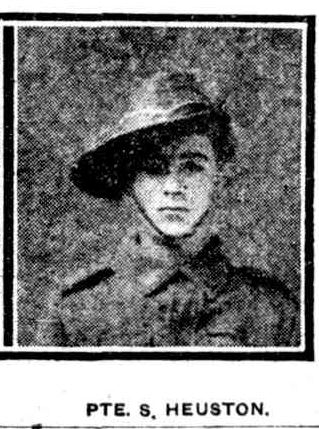
Pte. S. Heuston (The Globe and Sunday Times War Pictorial, 14/10/1916)

Pte. S. Heuston (The Globe and Sunday Times War Pictorial, 14/10/1916)

Per his military service record (regimental no. 4796), Sidney James De Courcy Heuston was born at Coonamble, N.S.W.  He gave his age as 18 years and 1 month, his marital status as single, and his occupation as plumber.  His description on his medical was height 5 feet 7 ¾ inches tall, weight 8 stone 3 lbs., with a dark complexion, grey eyes, and dark brown hair.  His religious denomination was Methodist.  He claimed that he had four years previous military service with the Senior Cadets.

Written on the top of his Attestation Paper is that he ‘Presented at Orange 24/10/15’.  He completed his medical examination on the 24th October 1915 at Orange, and was attested by Captain Nicholas at Orange on 24th October 1915.  “S. J. Deloury Hewston”was named as one of the men who were recruited to join the Coo-ees at Orange in the Leader. [1]

His initial Application to Enlist in the Australian Imperial Force form dated 24th October 1915 was addressed to the Recruiting Officer at Orange, and his postal address was Parkes Street, Wellington.  His parents George Heuston and Louise Heuston both signed this form, giving consent for their son to join, as he was under 21 years of age.  However, it was noted that he had joined the Coo-ee March at Wellington in an article in the Sunday Times a year after he had joined.[2]  His place of enlistment is listed as ‘Wellington’ on the Medical Report on an Invalid form dated 25th September 1916 in his service record.  So it appears he may first have presented to join the Coo-ees when they recruited at Wellington on 16th and 17th October 1915, then caught up with them and joined them at Orange where the Coo-ees stayed overnight on 24th October 1915, after his parents had signed his consent form.

After completing the Coo-ee March he went to Liverpool Camp as reinforcement for the 13th Battalion.

On 7th February 1916 Private Heuston was charged at Liverpool Camp with being absent from special picquet on 5th February 1916.  He was fined 5 shillings.

On his embarkation roll his address at time of enrolment was Park[es] Street, Wellington, N.S.W., and his next of kin is listed as his father, G. W. DeC. Heuston, at the same address.

On 8th March 1916 Private Heuston, along with many of the other Coo-ees, departed Sydney on the HMAT A15 Star of England, and arrived in Egypt on 11th April 1916.

On 19th April 1916, he was transferred to the 45th Battalion in Egypt, along with some of the other Coo-ees.

On 2nd June 1916 Private Hueston left Alexandria with several other Coo-ees in  45th Battalion aboard the transport Kinfauns Castle, bound for France, arriving at Marseilles on 8th June 1916.

Private Heuston served with the 45th Battalion through its first action at Fleurbaix, France, in July 1916 then as it moved to Pozieres in early August 1916.

On the night of the 5th/6th of August 1916 the 45th Battalion was in the front line trenches between Pozieres and Martinpuich, France.  Private Heuston was wounded in action on 6th August 1916, suffering a gunshot wound to his right leg, and was evacuated to the 3rd Casualty Clearing Station.

He was then admitted to the 13th General Hospital at Boulogne, France, on 7th August 1916.

On 11th August 1916 Private Hueston was sent by the Hospital Ship Jan Breydel to England, and admitted to the 1st Birmingham War Hospital, with a gunshot wound to the right thigh.

On 6th September 1916 Private Heuston was transferred to the 1st Australian Auxiliary Hospital at Harefield, England (3 days after Captain Bill Hitchen had died in the same hospital).

On 28th September 1916 he was discharged from hospital and sent to Weymouth, England.

On 12th November 1916 Private Heuston departed England aboard the H.T. Wiltshire, bound for Australia.

He arrived in Sydney on 31st December 1916, and was discharged medically unfit on 28th February 1917.

[1] ‘The Recruits’, Leader, 25 October 1915,  p. 4, http://nla.gov.au/nla.news-article117842599

[2] ‘The Coo-ees’, Sunday Times, 8 October 1916, p. 9, http://nla.gov.au/nla.news-article121335018


Henry NEIRHOFF

Henry NEIRHOFF

Per his military service record (regimental no. 6836), Henry Neirhoff was born at Sydney, N.S.W.  He gave his age as 24 years and 1 month, his marital status as single, and his occupation as labourer.  His description on his Certificate of medical examination was height 5 feet 3 inches tall, weight 133 lbs, with a fair complexion, blue eyes, and auburn hair.  His religious denomination was Church of England.

‘H. Nierhoff’[sic] was named as being one of the ‘Wongarbon boys’ with the Coo-ees in the Dubbo Liberal and Macquarie Advocate.[1]  He may have been one of the thirteen men who stepped forward and gave his name, ‘either to march under Captain Nicholas, or to come after harvest’, when the Coo-ees recruited in Wongarbon on 14th October 1915.[2]

An initial Application to Enlist in the Australian Imperial Force form in his file was addressed to the Recruiting Officer at Wellington, and gave his postal address as Wongarbon, and was dated 17th October 1915 (the date the Coo-ees left Wellington).

‘H. Neirhoff’ was named as one of six men who joined the Coo-ees ‘on the road from Wellington’ in the Molong Express and Western District Advertiser.[3]

Henry Neirhoff completed his medical examination at Molong on 22nd October 1915, and was attested by Captain Nicholas at ‘Molong (8 miles east)’, along with several other Coo-ees, on 22nd October 1915.  He claimed to have no previous military experience.

After completing the Coo-ee March he went to Liverpool Camp as a reinforcement for the 13th Battalion.

On Monday 3rd January 1916 Private Neirhoff was presented with a wristlet watch by the people of Wongarbon as a send-off present at the Wongarbon Railway Station platform.[4]

On Private Neirhoff’s embarkation roll his address at time of enrolment was Wongarbon, N.S.W., and his next of kin is listed as his brother, R. [Rudolph] Neirhoff, Penshurst, N.S.W.

Private Neirhoff departed Sydney on the SS Port Nicholson on 8th November 1916 with the 22nd reinforcements for the 13th Battalion.

He arrived at Devonport, England on 10th January 1917, and marched into the 4th Training Battalion at Codford, England.

On 16th February 1917 Private Neirhoff was charged with overstaying his leave from midnight 2nd February 1917 till noon 12th February 1917. He was sentenced to 10 days detention and fined 23 days pay.

On 27th February 1917 Private Neirhoff was sent to Bulford Hospital with Scabies. He was discharged on 6th March 1917.

On 22nd May 1917 Private Neirhoff departed from Southampton, England, bound for France.  He was taken on strength of the 13th Battalion on 10th June 1917, when it was in the front line in the vicinity of Messines, Belgium.

On 20th December 1917 a Field General Court Martial was held where Private Neirhoff was charged with desertion whilst on active service from Belgian Chateau camp on 23rd September 1917, to 7th November 1917.  He pleaded not guilty, and was found not guilty of desertion, but guilty of being absent without leave.  He was sentenced to 2 years hard labour.

On 3rd January 1918 Private Neirhoff was admitted to No. 4 Military Prison at Rouen, France, to commence his sentence.

On 31st October 1918 Private Neirhoff was sent to the 10th General Hospital at Rouen, France, suffering Piles.  He was sent back to prison on 9th November 1918.

On 4th February 1919 Private Neirhoff was released from prison with the unserved portion of his sentence suspended.  He rejoined the 13th Battalion on 12th February 1919.

On 4th March 1919 Private Neirhoff was detached for duty at the Corps workshop at Jeumont, France.

On 26th April 1919 he was sent to the Base Depot at Le Harve.

He departed France on 13th May 1919, and arrived in Southampton, England, on 14th of May 1919.

On 23rd July 1919 Private Neirhoff departed England aboard the H.M.A.T. Main, bound for Australia.

He arrived in Sydney on 15th October 1919, and was discharged Termination of Period of Enlistment on 7th November 1919.

[1] ‘Our Soldiers’, The Dubbo Liberal and Macquarie Advocate, 29 October 1915, p. 4, http://nla.gov.au/nla.news-article77601711

[2] The Route March’, The Farmer and Settler, 19 October 1915, p. 3, http://nla.gov.au/nla.news-article116648940

[3] ‘The “Coo-ees” Come’, Molong Express and Western District Advertiser, 23 October 1915, p. 10, http://nla.gov.au/nla.news-article101050484

[4] ‘Wongarbon Soldiers Farewelled’, The Dubbo Liberal and Macquarie Advocate, 7 January 1916, p. 5, http://nla.gov.au/nla.news-article77603646

Joseph William EDWARDS

Joseph William EDWARDS

Per his initial military service record (Depot), Joseph William Edwards was born at Marsden [near Forbes], N.S.W.  He signed his name as William Edwards.  He gave his age as 21 years and 5 months, his marital status as single, and his occupation as general labourer.  His description on his Certificate of medical examination was height 5 feet 9 inches tall, weight 186 lbs, with a medium complexion, brown eyes, and black hair.  His religious denomination was Roman Catholic.  His next of kin on his initial Attestation paper was his father, Joseph Benjamin Edwards, Gilgandra, N.S.W.  He completed his medical examination at Molong on 22nd October 1915, and was attested by Captain Nicholas at ‘Molong (8 miles east)’, along with several other Coo-ees, on 22nd October 1915.  He claimed to have no previous military experience.

‘W. Edwards’ was named as one of six men who joined the Coo-ees ‘on the road from Wellington’ in the Molong Express and Western District Advertiser.[1]

After completing the Coo-ee March he went to Liverpool Camp as reinforcement for the 13th Battalion.

Per his Detailed Medical History of an Invalid form dated 10th January 1916, he enlisted at Wellington, so it appears he first presented to join the Coo-ees when they were recruiting at Wellington.  This form recorded that on 4th January 1916 Private J. W. Edwards was at the Liverpool Railway Station when he jumped off a train on the wrong side and fell, and he suffered a hernia to his left oblique.  He was recommended to have an operation, however he declined.  The Medical Board subsequently found him unfit for military service, and recommended his discharge.

Private Edwards was discharged medically unfit on 15th January 1916.

Joseph William Edwards re-enlisted in the A.I.F. on 27th April 1916 at Dubbo, N.S.W., and he was appointed to Dubbo Depot Battalion.

He was transferred from Dubbo Depot Battalion to Invalids Section A.I.F. Victoria Barracks Sydney N.S.W. from 26th May 1916 to 9th August 1916.

He was transferred from Dubbo Depot Battalion to Liverpool Camp as reinforcement for the 3rd Battalion on 20th September 1916.

On Private Edward’s embarkation roll his address at time of enrolment was Wellington, N.S.W., and his next of kin is listed as his father, J. B. Edwards, P.O., Wellington, N.S.W.

Private Edwards (regimental no. 6744) departed Sydney on the SS Port Nicholson on 8th November 1916 with the 22nd reinforcements for the 3rd Battalion.  He arrived at Devonport, England on 10th January 1917.

He was sent to the 1st Training Battalion at Larkhill, England.

On 10th April 1917 Private Edwards proceeded overseas to France from Folkestone, England.

On 30th April 1917 he marched out to his unit from the Australian Division Base Depot at Etaples.

On 2nd May 1917 Private Edwards was taken on strength of the 3rd Battalion when it was manning the front line in the vicinity of Vaulx, France.

On 13th May 1917 Private Edwards was sent to hospital sick.  He rejoined the Battalion on 29th May 1917.

On 10th July 1917, the 3rd Battalion was conducting ‘recreational training and bomb throwing competitions’ at Buire, France, when 13 men in the Battalion were accidentally wounded by a bomb explosion.[2]  Private Edwards received a severe bomb wound to his back and left hand, and was transported by the 3rd Australian Field Ambulance to the 56th Casualty Clearing Station.  On 23rd July he was admitted to the 1st General Hospital in France.

On 28th of July 1917 Private Edwards was placed aboard the H.T. Warilda for evacuation to England.

He was admitted to the 3rd Southern General Hospital at Oxford, England on 29th July 1917 with bomb wound back severe.

He was listed as ‘Wounded … Pte. J. W. Edwards (Wellington), dangerously’ in the ‘War Casualties’ list in the Evening News on 9th August 1917.[3]

On 30th August 1917 he was transferred to the 3rd Australian Auxiliary Hospital at Darford, England.

On 3rd September 1917 Private Edwards was discharged from hospital and granted leave to report to Weymouth, England on 17th September 1917.

On 19th October 1917 Private Edwards departed England  to commence his return to Australia aboard the H.T. Port Lyttleton.  He arrived in Australia on 16th December 1917.

On 21st January 1918 Private Edwards was discharged medically unfit.

[1] ‘The “Coo-ees” Come’, Molong Express and Western District Advertiser, 23 October 1915, p. 10, http://nla.gov.au/nla.news-article101050484

[2] Australian Imperial Force unit war diaries, 1914-18 War, AWM4 Subclass 23/20 – 3rd Infantry Battalion, AWM4 23/20/29 – July 1917.

[3] ‘War Casualties. New South Wales Losses. 329th List.’, Evening News, 9 August 1917, p. 2, http://nla.gov.au/nla.news-article121255198