Charles Henry MAIDENS

Charles Henry MAIDENS

Per his military service record (regimental no. 4930), Charles Henry Maidens was born at Doncaster, England.[1]  He gave his age as 38 years and 1 month, his marital status as single, and his occupation as labourer.  His description on his Certificate of Medical Examination was height 5 feet 5 inches tall, weight 10 stone, with a fair complexion, light brown eyes, and brown hair.  His religious denomination was Church of England.  He claimed that he had 6 years and 11 months previous military service in England, and had been invalided with fever.

He completed his medical examination at Molong on 22nd October 1915, and was attested by Captain Nicholas at ‘Molong (8 miles east)’, along with several other Coo-ees, on 22nd October 1915.  He was made Acting Corporal on the Coo-ee March on the same day.

After completing the Coo-ee March he went to Liverpool Camp as a reinforcement for the 13th Battalion.

He initially retained his rank of Acting Corporal when he was a Liverpool Camp.[2]

However, on 21st February 1916, Acting Corporal Maidens was charged at Liverpool with being drunk and incapable of performing duty on 19th February 1916. He was reduced to the rank of Private and fined 20 shillings.

On his embarkation roll his address at time of enrolment was General Post Office, Sydney, N.S.W.[3] His next of kin is listed as his father, C. Maidens, 91 Catherine Street, Doncaster, England.

On 8th March 1916 Private Maidens, along with many of the other Coo-ees, departed Sydney on the HMAT A15 Star of England with the 15th reinforcements for the 13th Battalion, and arrived in Egypt on the 11th April 1916.

On 7th June 1916 Private Maidens left Alexandria aboard a transport bound for France.  He arrived at Marseilles on 14th June 1916.

On 18th July 1916 Private Maidens was admitted to the 26th General Hospital at Etaples, France, suffering Cystitis. On 22nd August he was discharged to No. 6 Convalescent Depot.

Private Maidens was taken on strength of the 4th Australian Division Base Depot in France on 7th September 1916.

On 25th October 1916 Private Maidens marched out to the 1st ANZAC Headquarters in France with a draft of P.B. [permanent base] men.

On 13th December 1916 Private Maidens was sent to a rest station suffering from Influenza. On 2nd January 1917 he was transferred to the 20th Casualty Clearing Station at Heilly, France. On 3rd of January 1917 he was admitted to the 8th General Hospital at Rouen, France, with debility. On 21st January 1917 he was sent to No. 2 Convalescent Depot at Rouen for base details. On 23rd January 1917 he marched in to the 4th Australian Division Base Depot at Etaples, France.

On 4th April 1917 Private Maidens was detached to the 1st ANZAC Salvage Corps at Etaples.

A Medical Board found him medically fit for duty on 9th May 1917.

On 26th May 1917 Private Maidens rejoined the 13th Battalion, when it was training at Doulieu, France.[4]

Private Maidens served with the 13th Battalion for almost two months on the Western Front until 23rd July 1917, when he was sent to the 13th Australian Field Ambulance, suffering D.A.H. [disordered action of the heart]. On 24th July he was moved to the 2nd Australian Casualty Clearing Station. On 25th July he was placed aboard the 38th Ambulance Train, and moved to the 4th General Hospital at Rouen, France. On 4th August 1917 he was discharged from hospital, and marched into the 4th Australian Division Base Depot.

On 15th August 1917 Private Maidens went before a Medical Board and was found medically unfit ‘Age V.D.H.’ [valvular disorder of the heart].  He was placed aboard a ship at Le Havre and sent to England. He marched into the No. 2 Command Depot at Weymouth on 16th August 1917.   He was classed as P.B. [permanent base] by a Medical Board the same day.

On 29th August 1917 Private Maidens was charged with smoking on parade. He was awarded 3 days Field Punishment No. 2.

On 18th September 1917 Private Maidens was transferred to the No. 4 Command Depot at Codford, England. A medical report in his service record dated the same day recorded ‘Very nervous. Slight tachy cardia. Age 46’.  [So his age appears to have been about 44 when he joined the Coo-ee March, not the 38 years and 1 month that he stated on his Attestation Paper].

On 7th November 1917 Private Maidens was sent to the Group Isolation Hospital at Hurdcott suffering Scabies. He was discharged on 15th November 1917.

On 24th November 1917 Private Maidens was transferred to the No. 2 Command Depot at Weymouth, England.

On 18th January 1918 Private Maidens was charged with being absent without leave from 2130 on 16th January 1918 until 2220 on 16th January 1918. He was awarded 3 days Field Punishment No. 2.

On 15th April 1918 Private Maidens departed England aboard the H.M.A.T. Marathon bound for Australia, for medical discharge ‘over age D.A.H.’.

He arrived in Australia on 12th June 1918.

He was discharged medically unfit on 12th December 1918.

Note: In a letter in his service record dated 19th September 1935, he stated that he ‘had a dugout blown in on me. I received shell shock and D.A.H.’

[1] NAA: B2455, MAIDENS CHARLES HENRY

[2] ROUTE MARCHES (1916, January 5). The Farmer and Settler (Sydney, NSW : 1906 – 1955), p. 3. Retrieved December 3, 2017, from http://nla.gov.au/nla.news-article116676486

[3] Australian War Memorial. First World War Embarkation Roll, Charles Henry Maidens,  4930.

[4] Australian Imperial Force unit war diaries, 1914-18 War – AWM4 Subclass 23/30 – 13th Infantry Battalion, May 1917
James SIMPSON

James SIMPSON

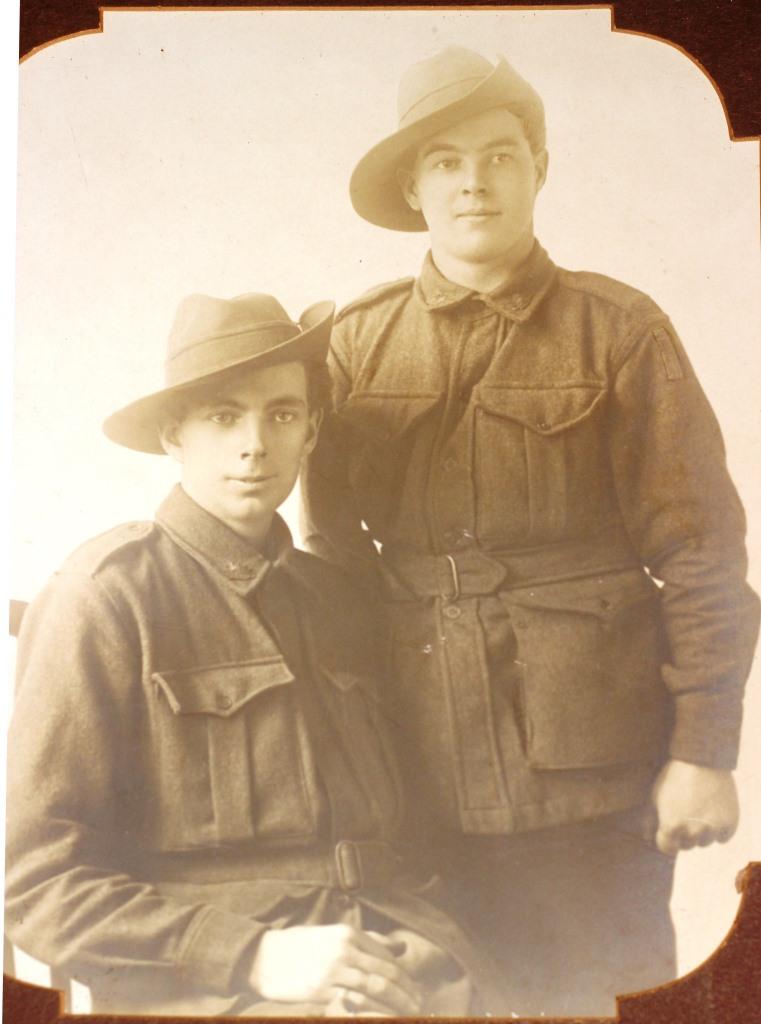
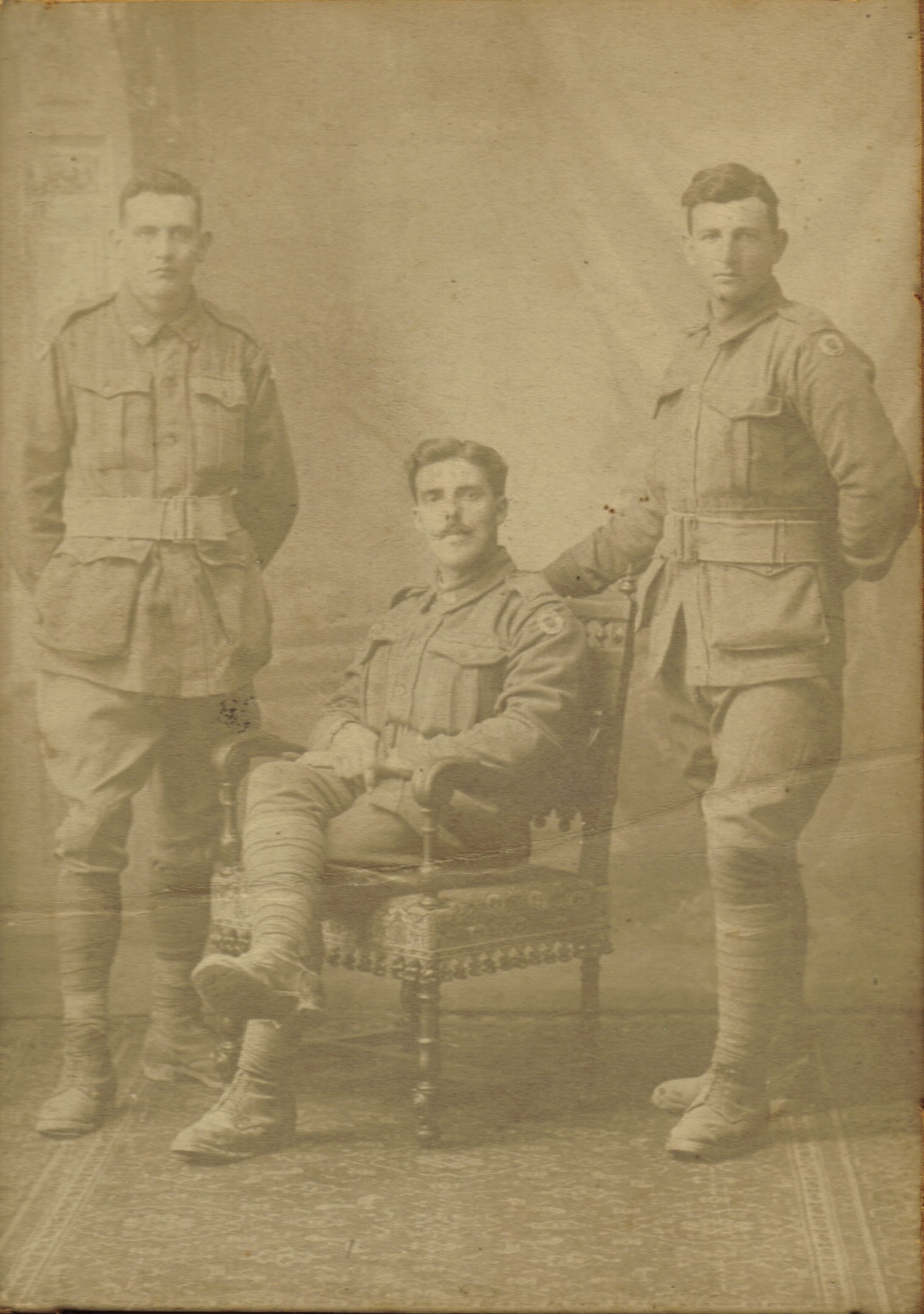
Private James Simpson, seated in centre (Photograph courtesy of his grandson K. Flook)

Per his military service record (regimental no. 4928), James Simpson was born at Hollytown, Scotland.[1] He gave his age as 30 years, his marital status as single, and his occupation as iron and steel smelting. His description on his Certificate of Medical Examination was height 5 feet 6 ¾ inches tall, with a dark complexion, hazel eyes, and black hair. His religious denomination was Presbyterian. He claimed that he had no previous military service.

He completed his medical examination, and was attested by Lieutenant F. Middenway, at Springwood on 8th November 1915 (the day the Coo-ees arrived at Springwood).

After the Coo-ee March he went to Liverpool Camp as reinforcement for the 13th Battalion.

On 4th February 1916 Private Simpson was charged with being absent without leave for 1 day from the Liverpool Camp. He was fined 5 shillings.

On 22nd February 1916 he was charged with being absent without leave for 4 days. He was fined 2 pounds.

On his embarkation roll his address at time of enrolment was not listed. His next of kin is listed as his sister, Miss L. Simpson, Midcot, Mossend, Lanarkshire, Scotland.[2]

On 8th March 1916 Private Simpson, along with many of the other Coo-ees, departed Sydney on the HMAT A15 Star of England with the 15th reinforcements for the 13th Battalion, and arrived in Egypt on the 11th April 1916.

Troopship HMAT A15 Star of England. Australian War Memorial Collection AWM H17014.

On 16th April 1916 Private Simpson was transferred to the 4th Pioneer Battalion at Tel-el-Kebir.

On 15th May 1916 Private Simpson was sent to the 12th Australian Field Ambulance sick. He was discharged on 19th May 1916.

On 4th June 1916 Private Simpson left Alexandria aboard the Transport Scotian bound for France.  He arrived at Marseilles on 11th June 1916.

After serving with the 4th Pioneer Battalion in France for 6 months, on 14th December 1916 Private Simpson was sent to the 13th Australian Field Ambulance sick with Diarrhoea. He was sent to the ANZAC Rest Station later that day. He was discharged and rejoined his unit on 31st December 1916.

On 21st July 1917 Private Simpson was sent to the 13th Australian Field Ambulance sick. He was moved back to the 2nd Casualty Clearing Station. On 23rd July 1917 he was placed aboard the 12th Ambulance Train and on 26th July 1917 he was admitted to the 39th General Hospital at Le Harve, France.

He was discharged from hospital and marched into the 4th Australian Base Depot at Le Harve on 6th September 1917.

On 10th September 1917 Private Simpson was readmitted sick to the 39th General Hospital. He was discharged to the 1st Australian Clearning Station on 26th September 1917.

He rejoined the 4th Pioneer Battalion on 17th January 1918.

On 5th March 1918 Private Simpson was charged with being absent without leave from 0900 on 26th February 1918 till 1530 on 5th March 1918. He was fined 18 days pay.

On 14th October 1918 Private Simpson was granted leave to England. He rejoined the 4th Pioneer Battalion on 30th October 1918.

On 27th January 1919 Private Simpson marched into the Australian Base Depot at Le Harve to commence his return to England.

On 10th February 1919 Private Simpson departed the 4th Australian Division Base Depot at Le Harve for England. He arrived at Weymouth, England, on 11th February 1919.

On 1st July 1919 Private Simpson left England on the H.T. Frankfurt bound for Australia.

He arrived in Australia on 21st August 1919.

He was discharged termination of period of enlistment on 13th October 1919.


[1] NAA B2455, SIMPSON JAMES

[2] Australian War Memorial. First World War Embarkation Rolls, James Simpson,  4928.

Richard Gilbert Clarence WRIGLEY

Richard Gilbert Clarence WRIGLEY

Per his military service record (regimental no. N214093), Richard Gilbert Clarence Wrigley was born in Gilgandra, N.S.W.[1] He gave his age as 22 years and 3 months, his marital status as single, and his occupation as horse breaking. His description on his Certificate of Medical Examination form was 5 feet 7 inches tall, weight 10 stone, with a fair complexion, blue eyes, and fair hair. His religious denomination was recorded as being Anglican. He claimed to have 18 months previous military service with the Gilgandra  9th Light Horse Regiment.

His next of kin was recorded on his Australian Imperial Force Attestation Paper of Persons Enlisted for Service Abroad form as his father, Mr T. J. Wrigley, Post Office, Gilgandra.

“Dick” Wrigley was reported to having mounted the platform following an appeal for recruits at another soldier’s farewell in Gilgandra on 21st October 1915, and the Gilgandra Weekly reported that ‘“Dick” will pick up the “Coo-ees” at Wallerawang’.[2]

He completed his medical examination at Gilgandra on 26th October 1915 (16 days after the start of the Coo-ee March).

Along with Tyson Ryan, also from Gilgandra, he caught up with the Coo-ees, and was attested by Captain A. C. Eade at Lawson on 7th November 1915 (the day the Coo-ees rested at Lawson).

After completing the Coo-ee March he went to Liverpool Camp as reinforcement for the 1st Australian Light Horse Regiment.

Trooper Wrigley was apprehended by the civil police on24th December 1915 for being drunk and absent without leave for four days. On 30th December 1915 he was charged with being absent without leave for two days on 29th and 30th December.  He was fined  £1 and forfeited 2 days pay.

Private “Dick” Wrigley and Corporal “Bill” Hitchen were given a send-off at the Australian Hall in Gilgandra on Monday 20th March 1916.[3]

On the 4th May 1916 Trooper Wrigley was posted as a deserter from Menangle Park. On 19th May 1916 a warrant was issued for his arrest.

The warrant was withdrawn on 30th January 1919.


[1] NAA: B2455, WRIGLEY R G C

[2] ‘Another for the Front’, Gilgandra Weekly, 29 October 1915,  p. 12. Retrieved December 1, 2017, from http://nla.gov.au/nla.news-article119923921

[3] ‘Good-bye!’, Gilgandra Weekly, 24 March 1916, p. 25. Retrieved December 1, 2017, from http://nla.gov.au/nla.news-article119923643


John BARTLEY

John BARTLEY

Per his military service record (Depot), John Bartley was born at Ballarat, Victoria.[1] He gave his age as 33 years and 4 months, his marital status as single, and his occupation as shearer. His description on his Certificate of Medical Examination was 5 feet 7 inches tall, weight 168 lbs., with a dark complexion, brown eyes, and black hair. His religious denomination was Church of England. He claimed that he had no previous military service.

He completed his medical examination at Wellington on 16th October 1915 (when the Coo-ees were at Wellington). He was attested by Captain T. A. Nicholas at Mumbil on 19th October 1915.

His next of kin was recorded on his Australian Imperial Force Attestation Paper of Persons Enlisted for Service Abroad form as Charlotte Crougey, Osborne Street, Williamstown, Melbourne, Victoria.

After the Coo-ee March he went into Liverpool Camp.

On 17th November 1915 Private Bartley went before a medical Board at Liverpool Camp where he was deemed as unfit for military service due to defective vision.

Private Bartley was discharged medically unfit on 29th November 1915.


[1] NAA: B2455, BARTLEY J

Charles Edward BOW

Charles Edward BOW

Per his military service record (regimental no. 4735), Charles Edward Bow was born at Parramatta, N.S.W.[1] He gave his age as 29 years and 4 months, his marital status as single, and his occupation as bricklayer. His description on his Certificate of Medical Examination was height 5 feet 3 ½ inches tall, weight 9 stone 6 lbs., with a dark complexion, brown eyes, and black hair. His religious denomination was Congregational. He claimed that he had no previous military service.

He completed his medical examination at Ashfield on 12th November 1915, and was attested at Ashfield by Lieutenant S. Stilling on the 12th November 1915 (on the last day of the Coo-ee March, the day the Coo-ees marched from Ashfield to Sydney).

After completing the Coo-ee March he went to Liverpool Camp as reinforcement for the 13th Battalion.

On 22nd December 1915 Private Bow was charged with being absent without leave from the Liverpool Camp on the 17th, 18th and 19th of December 1915. He was fined.

On 8th February 1916 he was charged with being absent without leave from the Liverpool Camp on the 1st and 2nd of February 1916. He was fined.

On his embarkation roll his address at time of enrolment was his address was C/o Mrs J. Langan, Tolorno, Coventry Road, Homebush, N.S.W.  His next of kin was listed as his father, G.[George] Bow, Phillip Street, Parramatta, N.S.W.

On 8th March 1916 Private Bow departed Sydney on the HMAT A15 Star of England along with many of the other Coo-ees, arriving in Egypt on the 11th April 1916.

On 16th April 1916 Private Bow was transferred to the 4th Pioneer Battalion at Tel-El-Kebir, Egypt.

On 4th June 1916 Private Bow left Alexandria aboard the Transport Scotian bound for France, arriving at Marseilles on 11th June 1916.

Private Bow served with the 4th Pioneer Battalion in France until on 20th September 1917 when Private Bow was admitted to the 1st Australian Casualty Clearing Station with Malaria. On 27th September 1917 he was transferred to the 2nd Stationary Hospital at Abbeville, France, with a fissure.

On 2nd October 1917 he was placed aboard a Hospital Ship bound for England. He was admitted to the 1st Southern General Hospital at Birmingham, England with severe Haemorrhoids.

On 11th October 1917 Private Bow was discharged from Hospital and granted leave to report to the No. 1 Command depot at Sutton Veny, England, on 25th October 1917.

On 3rd November 1917 Private Bow was admitted to the Sutton Veny Military Hospital suffering Asthma. He was discharged to No. 1 Command Depot at Sutton Veny on 9th of November 1917.

On 4th December 1917 Private Bow was found by a Medical Board to have chronic bronchitis.

On 29th December 1917 Private Bow marched out to No. 2 Command Depot at Weymouth, England.

On 30th January 1918 Private Bow commenced his return to Australia aboard the H.T. Euripides for medical discharge from Plymouth, England.

He arrived in Australia on 21st March 1918.

He was discharged medically unfit with chronic bronchitis at Sydney on 4th May 1918.


[1] NAA B2455, BOW C E

Timeline December 1917

TIMELINE December 2017

Saturday, 1 December 1917

Private Ernest Henry KING  (4th Pioneer Battalion) was promoted to Lance Corporal.

Wednesday, 5 December 1917

Private Percy Frederick COOPER  (45th Battalion) was admitted to the 2nd Canadian General Hospital suffering from Trench Fever.

Sunday, 9 December 1917

Private Percy Frederick COOPER  (45th Battalion) was transferred to the 3rd Convalescent Depot.

Wednesday, 12 December 1917

Private James Birrell DAWSON (54th Battalion) was discharged medically unfit, with a disability of an amputated right arm.

Coo-ees Walter Goodlet (left) and James Birrell Dawson (right), both amputees. Photograph courtesy of James Dawson’s great grandson Jamie Stacey.

Thursday, 13 December 1917

Private William Charles ELLERY (45th Battalion) was admitted to the 9th General Hospital at Rouen France suffering from Rheumatic Fever.

Friday, 14 December 1917

Private William Charles ELLERY (45th Battalion) was placed aboard a hospital ship for evacuation to England.

Saturday, 15 December 1917

Private William Charles ELLERY (45th Battalion) was admitted to the University War Hospital at Southampton England suffering from chronic rheumatism.

Sunday, 16 December 1917

Private Jack Henry HUNT (45th Battalion) arrived in Australia aboard the H.T. Port Lyttleton for medical discharge.

Jack Hunt, Lemaire Studios, Military Camp, Liverpool. Photograph courtesy of Iain and Judy Macdonald.

Private Joseph William EDWARDS (3rd Battalion) arrived in Australia aboard the H.T. Port Lyttleton for medical discharge.

Lance Corporal James MAHER (45th Battalion) departed England aboard the Hospital Ship No. 2 bound for Australia for medical discharge.

James Maher, 1915 (Photograph courtesy of L. Leo)

Thursday, 20 December 1917

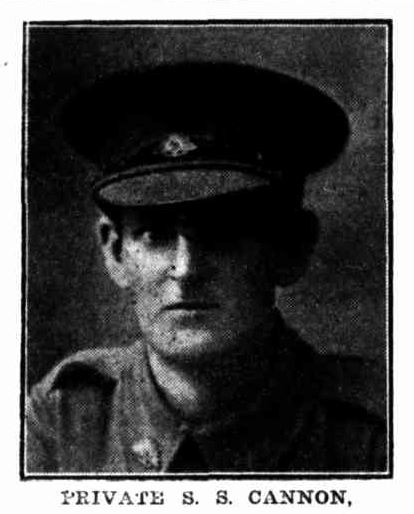
Private Sidney Stanley CANNON (4th Pioneer Battalion) departed England aboard the H.M.A.T.  Runic bound for Australia for medical discharge.

Private Sidney Stanley Cannon (Cumberland Argus and Fruitgrowers Advocate, 7/7/1917)

Private William CAIRNS (13th Battalion) left England aboard the H.M.A.T. Runic bound for Australia for medical discharge.

Tuesday, 25 December 1917

Private Joseph John WILLIAMS (13th Battalion) was discharged medically unfit with debility.

Monday, 24 December 1917

Private Leslie Reginald ANLEZARK (45th Battalion) was admitted to the 11th Australian Field Ambulance suffering from Influenza.

Tuesday, 25 December 1917

Private Harold Roy Devlin UHR (17th Battalion) arrived at Devonport England from Australia aboard the Transport Euripides.

Saturday, 29 December 1917

Private Joseph Francis HEALEY (13th Battalion) was discharged medically unfit with gun shot wound to the left leg, and over age.

Monday, 31 December 1917

Private Robert Clyde CAMPBELL  (13th Battalion) arrived in Australia aboard the Transport Berrima for medical discharge.

Private Robert AYRES (13th Battalion) arrived in Australia aboard the Transport Berrima for medical discharge.

Private Leslie Reginald ANLEZARK (45th Battalion) was transferred to the 1st Casualty Clearing Station with Influenza.

Robert AYRES

Robert AYRES

Per his military service record (regimental no. 4729), Robert Ayres was born at Surrey Hills, N.S.W.[1]  He gave his age as 41 years and 11 months, his marital status as married, and his occupation as cab driver.  His description on his Certificate of Medical Examination was height  5 feet 5 ½ inches tall, weight 140 lbs., with a fair complexion, blue eyes, and fair hair. His religious denomination was Wesleyan.  He claimed to have no previous military service.

He completed his medical examination at Ashfield on 11th November 1915.  He was attested by Lieutenant F. Middenway when the Coo-ees were at Ashfield on 11th November 1915.

After completing the Coo-ee March he went to Liverpool Camp as reinforcement for the 13th Battalion.

On his embarkation roll his address at time of enrolment was 2 Mill Street, Croydon, N.S.W.[2]  His next of kin was listed as his wife, Mrs M. [Martha] Ayres, at the same address.

On 8th March 1916 Private Ayres, along with many of the other Coo-ees, departed Sydney on the HMAT A15 Star of England. He arrived in Egypt on 11th April 1916.

On 7th of June 1916 Private Ayres left Alexandria aboard the H.T. Ionian bound for France.  He arrived at Marseilles on 14th June 1916.

He joined the 13th Battalion in France on 19th August 1916.

Ten days later, on 29th August 1916 the 13th Battalion was in action around Mouquet Farm, France.  During the previous 24 hour period the 13th Battalion was under heavy artillery fire, and had suffered a total of 18 killed, 99 wounded and 33 missing.[3] Private Ayres was one of those wounded, being evacuated to a Casualty Clearing Station suffering Shell Shock.

On 6th September 1916 Private Ayres was sent to the 3rd Convalescent Depot at Etaples, France.

On 9th September 1916 he marched into the 4th Australian Division Base Depot at Etaples.

On 7th January 1917 Private Ayres re-joined the 13th Battalion when it was at Mametz, France.[4]

On 29th January 1917 Private Ayres was detached for duty at the Corps Baths at Heilly, France.

On 20th April 1917 Private Ayres was sent to hospital. He re-joined the 13th Battalion on 26th April 1917, when it was training at Ribemont, France.[5]

On 14th September 1917 Private Ayres was detached from the 13th Battalion for duty at the 4th Australian Division Base Depot at Le Harve, France. He arrived on 16th September 1917.

On 26th September 1917 Private Ayres was transferred to England.  He arrived at Weymouth, England, on 27th September 1917, where he marched into the No. 2 Command Depot.

Private Ayres departed England on 31st October 1917 for return to Australia, suffering senility, aboard the H.M.A.T. Berrima.

He disembarked at Sydney on 31st December 1917.

Private Ayres was discharged medically unfit on 31st January 1918.


[1] NAA: B2455, AYRES R

[2] Australian War Memorial. First World War Embarkation Roll, Robert Ayres, 4729.

[3] Australian Imperial Force unit war diaries, 1914-18 War – AWM4 Subclass 23/30 – 13th Infantry Battalion, August 1916.

[4] Australian Imperial Force unit war diaries, 1914-18 War – AWM4 Subclass 23/30 – 13th Infantry Battalion, January 1917.

[5] Australian Imperial Force unit war diaries, 1914-18 War – AWM4 Subclass 23/30 – 13th Infantry Battalion, April 1917.

William Charles ELLERY

William Charles ELLERY

Per his military service record (regimental no. 4769), William Charles Ellery was born at Castlemaine, Victoria.[1]  He gave his age as 43 years and 7 months, his marital status as single, and his occupation as labourer.  His description on his Certificate of Medical Examination was height 5 feet 9 inches tall, weight 168 lbs., with a dark complexion, brown eyes, and brown hair. His religious denomination was Wesleyan.  He claimed to have no previous military service.

In the Dunedoo Chronicle section of the Mudgee Guardian and North-Western Representative, it was reported that a large crowd farewelled Mr. W. C. Ellery at the local train station, ‘who left by train for Lithgow in the hope of joining Hitchen’s “Coo-ees”’.[2]

He completed his medical examination at Ashfield on 11th November 1915.  He was attested by Lieutenant F. Middenway when the Coo-ees were at Ashfield on 11th November 1915.  His ‘Oath to be taken by person being enlisted’ section on his Attestation Paper was dated from 2nd November 1915 (when the Coo-ees were in Lithgow).

After completing the Coo-ee March he went to Liverpool Camp as reinforcement for the 13th Battalion.

On his embarkation roll his address at time of enrolment was Dunedoo, N.S.W.[3]  His next of kin was listed as friend, W. Miller, C/o A. Yeo, Merrygoen, Dunedoo, N.S.W.

On 8th March 1916 Private Ellery, along with many of the other Coo-ees, departed Sydney on the HMAT A15 Star of England. He arrived in Egypt on 11th April 1916.

On 19th April 1916 Private Ellery was transferred to the 45th Battalion at Tel-el-Kebir.

On 18th June 1916 Private Ellery left Alexandria aboard the Kinfauns Castle bound for France, arriving at Marseilles on 29th June 1916.

Private Ellery served with the 45th Battalion through its first action at Fleurbaix, France in July 1916 then through the battles around Pozieres and Mouquet Farm in August, September and October 1916.

On 31st December 1916  the 45th Battalion was training at Flesslers, France when Private Elley was evacuated sick. On 11th January 1917 Private Ellery was admitted to the 8th Australian Field Ambulance suffering Rheumatism. He was discharged on 16th January 1917, and rejoined the 45th Battalion when it was manning the front line in the vicinity of Gudecourt, France.

On 23rd April 1917 the 45th Battalion was training at Bresle, France, when Private Ellery was admitted to the 13th Australian Field Ambulance suffering from Chronic Rheumatism.

He was discharged to duty on 4th May 1917, and returned to the 45th Battalion on 6th May 1917, when it was still at Bresle, France.

On 14th May 1917 Private Ellery was admitted to the 7th Australian Field Ambulance suffering from Chronic Rheumatism. He was discharged on 25th May 1917, and rejoined the 45th Battalion when it was at Neuve Eglise, France, providing working parties in the rear area of the front.

On 12th December 1917 the 45th Battalion was training at Haut Allaines, France, when Private Ellery was evacuated sick. On 13th December 1917 he was evacuated to the 9th General Hospital at Rouen, France, suffering from Rheumatic Fever.

On 14th December 1917 Private Ellery was placed aboard a Hospital Ship for evacuation to England.

On 15th December 1917 he was admitted to the University War Hospital at Southampton, England suffering Chronic Rheumatism.

On 9th January 1918 he was transferred to the 3rd Australian Auxiliary Hospital at Dartford, England.

On 13th January 1918 Private Ellery was discharged from hospital, and marched into the No. 2 Command Depot at Weymouth, England.

Private Ellery commenced his return to Australia aboard the H.T. Dunvegan Castle on 13th March 1918.  On 21st May 1918 he embarked at Captetown, South Africa, aboard H.T. Tofua.

He disembarked at Melbourne on 14th June 1918.

He was discharged medically unfit with chronic rheumatic arthritis on 3rd August 1918.

Note: It appears from a newspaper article about his welcome home to Dunedoo on 27th November 1918 that the surname of “Ellery” that he enlisted under may have been an assumed name, and that his surname was actually “Burly” or “Burley”.[4]


[1] NAA: B2455, ELLERY W C

[2] ‘The Doings Of The West’, Gilgandra Weekly (NSW : 1915 – 1929), 12 November 1915, p. 15. Retrieved November 12, 2017, from http://nla.gov.au/nla.news-article119922120

[3] Australian War Memorial. First World War Embarkation Roll, William Charles Ellery.

[4] ‘Presentation to Returned Soldiers’, Mudgee Guardian and North-Western Representative, 5 December 1918, p. 11. Retrieved November 12, 2017, from http://nla.gov.au/nla.news-article157145589


Harold Edgar GRAHAM

Harold Edgar GRAHAM

Per his military service record (Depot), Harold Edgar Graham was born at Narrandera, N.S.W.[1]  He gave his age as 23 years and 4 months, his marital status as single, and his occupation as cook.  His description on his Certificate of Medical Examination was height 5 feet 7 ½ inches tall, weight 11 stone, with a florid complexion, hazel eyes, and light brown hair.  His religious denomination was recorded as Roman Catholic.  He claimed that he had no previous military service.

His postal address on his initial Application to Enlist in the Australia Imperial Force form, addressed to the Recruiting Officer at Molong, was Tottenham via Trangie N.S.W.  His next of kin on his Attestation Paper was recorded as his father, A. E. Graham, at the same address.

He was one of the four recruits sent by the Parkes Recruiting Association by train to join the Coo-ees at Molong.

‘Harold E. Graham’ was reported as one of ‘five recruits to meet the contingent at Molong’ in the Molong Express and Western District Advertiser on 23rd October 1915.[2]

He completed his medical examination on 22nd October 1915 at Molong, and was attested by Captain T. Nicholas eight miles east of Molong on the same day.

After completing the Coo-ee March he went to Liverpool Camp as reinforcement for the 13th Battalion.

Less than a week later, a letter in his service record dated 18th November 1915 reports that ‘this man came before Redfern Court charged with riotous behaviour in Redfern and was fined 10/- or 10 hours has 7 days to pay’.[3]  He was also charged by the military authorities with being absent without leave the same day, and was given a warning.

The Forbes Advocate reported on  Friday 10th December 1915 that Coo-ees ‘H. Grahame’ [sic] and ‘T. Taylor’, on final leave with two other soldiers, attended a send-off at Bogan Gate on Thursday night, where they were presented with a wristlet watch each.[4]

Private Graham was soon in trouble again with the law, going before the Police Court at Parkes on 24th December 1915, where along with fellow Coo-ee Thomas W. Taylor, he ‘pleaded guilty to a charge of stealing, in company, the sum of £5 from the person of Frank Williams’.[5]

The Western Champion reported on 30th December 1915 that ‘the accused, who appeared in court in the uniform of the Australian Imperial Forces, were two of the men who joined the Gilgandra “Coo-ees” as recruits from Parkes’, and that the ‘men originally came from the Bogan Gate district’.[6]

They were both sentenced to four months in Goulburn Gaol. [7]

Private Graham’s period of service in the Infantry Depot at Liverpool is recorded on his Statement of Service as being from 22nd October 1915 to 9th January 1916, when he was recorded as being a Deserter.

He was discharged from the A.I.F. on 31st March 1916, with the reason for discharge being recorded as ‘convicted Civil Court’.


[1] NAA: B2455, GRAHAM H E

[2] ‘The “Coo-ees” Come’, Molong Express and Western District Advertiser, 23 October 1915, p. 10. Retrieved November 5, 2017, from http://nla.gov.au/nla.news-article101050484

[3] Letter, Sgt. F. Matheson, 18/11/15, NAA: B2455, GRAHAM H E

[4] ‘Bogan Gate’, The Forbes Advocate, 10 December 1915, p. 6. Retrieved November 5, 2017, from http://nla.gov.au/nla.news-article100289126

[5] ‘Two Beauties’, Western Champion, 30 December 1915, p. 17. Retrieved November 5, 2017, from http://nla.gov.au/nla.news-article112310980

[6] ‘Two Beauties’, Western Champion, 30 December 1915, p. 17. Retrieved November 5, 2017, from http://nla.gov.au/nla.news-article112310980

[7] Harold Edgar Graham gaol record, Goulburn Gaol, NSW State Archives and Records, https://www.records.nsw.gov.au/index_image/2232_a006_a00603_5979000090r


TIMELINE November 1917

TIMELINE November 1917

Wednesday, 1 November 1917

Private Laurence Leslie MAGUIRE (45th Battalion) was promoted to Lance Corporal.

Private Thomas Henry TURVEY MM (45th Battalion) was discharged medically unfit.

Private T. H. Turvey, of Gilgandra “Coo-ees”, awarded Military Medal (Newspaper unknown, 1917)

Sunday, 4 November 1917

Private Albert Warren PEARCE was attached to the Group Hospital at Sutton Venny for duty.

Monday, 5 November 1917

Private George Elsie EWENS (45th Battalion)  left England for return to Australia aboard the H.M.A.T. Themistocles.

Pte. George Ewens, of Manduarama (Evening News, 20/11/1917)

Monday, 12 November 1917

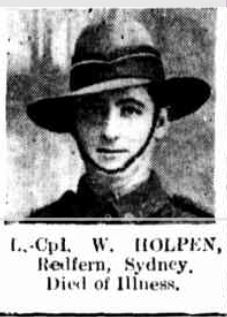
Private Percy Walter HOLPEN (46th Battalion) was promoted to Lance Corporal.

L. Cpl. W. Holpen, Redfern, Sydney. Died of Illness (Sydney Mail, 8/1/1919)

Friday, 16 November 1917

Driver Walter CAVILL (55th Battalion) was evacuated to England on the Hospital Ship St. Andrew suffering with Trench Fever.

Saturday, 17 November 1917

Driver Walter CAVILL (55th Battalion) was admitted to the 1st Western General Hospital at Liverpool, England, suffering from Trench Fever (serious).

Tuesday, 20 November 1917

Private Joseph John WILLIAMS (13th Battalion) arrived in Sydney on H.T. Suevic .

Gunner Walter James MITCHELL (10th Field Artillery Brigade) arrived in Sydney on H. T. Suevic.

Private Colin David WREN (4th Pioneer Battalion) arrived in Sydney on H. T. Suevic.

Colin David Wren. Photograph courtesy of P. Kahler.

Thursday, 22 November 1917

Private Thomas William EVANS (45th Battalion) was discharged medically unfit.

Sunday, 25 November 1917

Private George DAVIDSON (4th Pioneer Battalion) arrived in Sydney aboard the H.M.A.T. Borda.

Lance Corporal Henry MOSS (45th Battalion) arrived in Sydney aboard the H.M.A.T. Borda.

Private Leo Ambrose STINSON (20th Battalion) arrived in Australia aboard the  H.M.A.T.  Borda for medical discharge.