The 22 Ashfield recruits

Who were the 22 Ashfield recruits?

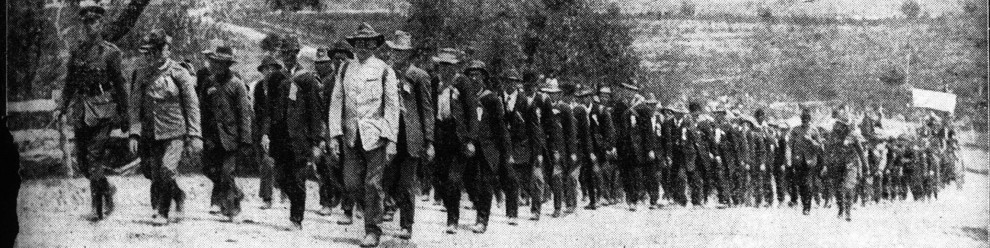
The Coo-ees held a recruiting meeting, and stayed the night at the Drill Hall at Ashfield on Thursday, 11th November, 1915 – their last night of the Coo-ee March on their long route from Gilgandra to Sydney.

This is now the site of the Ashfield Boys High School gymnasium, and a new car park named Coo-ee Car Park in memory of the 1915 Coo-ee March built recently by the Wests Ashfield Leagues Club.  A plaque about the Coo-ees at Ashfield was unveiled at the Coo-ee Car Park on 21st April 2015.
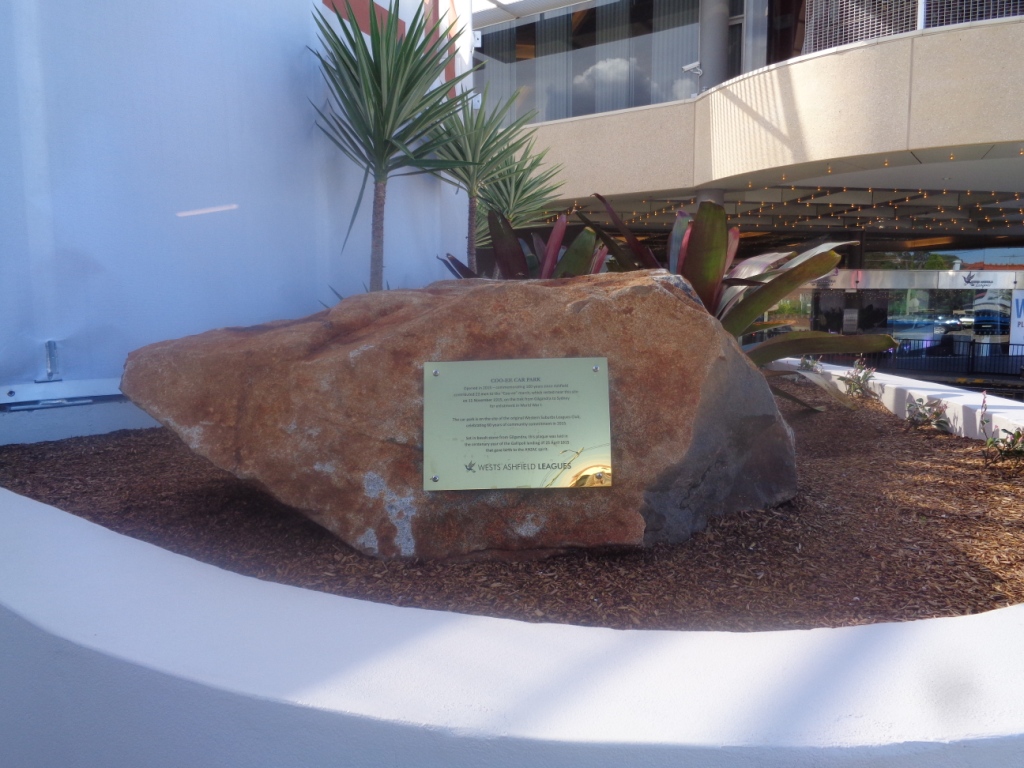
Plaque at Coo-ee Car Park, Ashfield (Photograph: S. & H. Thompson, 23/4/2015)

Plaque at Coo-ee Car Park, Ashfield (Photograph: S. & H. Thompson, 23/4/2015)

A plaque on an obelisk is situated in the grounds of the Ashfield Boys High School. It has been there for some time. On it are the words: “Celebrating Gilgandra Coo-ee Marchers 11 November 1915 22 Ashfield men joined with the Coo-ee marches here on this day”.

Coo-ee March obelisk at Ashfield Boys High School (Photograph: S. & H. Thompson 3/3/2014)

Coo-ee March obelisk at Ashfield Boys High School (Photograph: S. & H. Thompson 3/3/2014)

Although the “official” count for the total number of Coo-ees recruited on the 1915 Gilgandra to Sydney Coo-ee March per newspaper articles of the time was 263, with Ashfield having a total of 22 recruits, the Sydney Morning Herald reported on 13th November 1915 (p. 19) that ‘the contingent left the western suburb’ of Ashfield ‘about 263 strong, but there are others now to be sworn in – men who joined the little army yesterday.’ The Farmer and Settler reported about Coo-ees numbers on 21st December 1915 (p. 3) that ‘there were no fewer than 277 men on their last pay sheet in camp’.

We have found the following names of 23 men who were attested at Ashfield at the time the Coo-ees were recruiting at Ashfield. We note that one (Bert Kilduff) had paperwork dating only from 12th November 1915 in his service record, so perhaps the ”official” count of 22 recruits was taken the night before at Ashfield, and he was not included.  Although two others also completed their medical examination and signed their attestation paper at Ashfield on the 12th November 1915 (Thomas Edward Bow and Charles Seal), they had both signed the bottom of the first page in their ‘Attestation paper of persons enlisted for service abroad’ on the 11th November 1915.

Attested 11th November 1915 at Ashfield

Robert AYRES (service no. 4729)

Richard John CROCKER (no service no.)

Edward Lewis CUDDEFORD (service no. 5352)

Harold Brooks DAVIS (service no. 4759)

Edgar DAWSON (no service no.)

Thomas DELANEY (service no. 4764)

William ELLERY (service no. 4769)

Richard EVANS (service no. 5368)

Joseph Jacob John HERRINGE (service no. 5700)

Robert Michael HICKEY (service no. 5099)

Albert HULBERT (no service no.)

Hector LEE (service no. Depot)

Thomas LIPSCOMBE (service no. 4826)

Sam LUKE (service no. 4830)

Joseph Raymond MCGUIRE (service no. 4857)

Selby George MEGARRITY (service no. 4841)

William Allen Luther PHILPOT/PHILPOTT (service no. 5164)

William WEBBER (service no. 4917)

Jack Graham WIGGINS (service no. 4918)

Joseph John WILLIAMS (service no. 4912)

Attested 12th November 1915 at Ashfield the (the day the Coo-ees left Ashfield and the last day of the Coo-ee March)

Charles Edward BOW (service no. 4735)

Bert KILDUFF (service no. 4818)

Thomas SEAL (service no. 4895)

Not all of these men were local to the Ashfield area. Some were men who had joined the Coo-ees earlier in the march, or caught up with them at Ashfield, who signed their attestation paper to enlist in the Australian Imperial Force at Ashfield.

William Ellery was reported to be a long term resident of the Dunedoo area before he left to join the Coo-ees.  Edgar Dawson started filling out his paperwork in his service record in Bathurst.  Jack Wiggins was known as a Springwood recruit. Sam Luke joined the Coo-ees at St Marys. Selby Megarrity undertook his medical at Penrith, the day before the Coo-ees arrived at Ashfield.

Fourteen of the Ashfield recruits embarked overseas with the majority of the Coo-ees on the transport  HMAT A15 Star of England on the 8th March 1916.  Five more embarked on other ships soon after.

An individual blog entry will be added to this website for each of the above named Coo-ees.

Lightfoot Lamonby HAMPSON

Lightfoot Lamonby HAMPSON

Per his military service record (regimental no. 4790), Lightfoot Lamonby Hampson was born at Wigton, Cumberland, England. He gave his age as 37 years, his marital status as married, and his occupation as painter.  He had worked at the ironworks in Lithgow prior to enlisting. His description on his medical was height 5 feet 5 inches tall, with a medium dark, grey eyes, and brown hair. His religious denomination was Baptist. He claimed that he had 3 years experience in the Militia. He completed his medical on the 6th November at Lawson (on the day the Coo-ees arrived at Lawson), but was not attested until the 13th November 1915 at Liverpool (after the end of the march). His date of joining on the nominal roll was the 9th November 1915 (the day the Coo-ees arrived at Penrith).

After the end of the Coo-ee March he went to Liverpool Camp with his son Charles Alfred Hampson (who had joined the Coo-ees at Lithgow) as reinforcement for the 13th Battalion.

On his embarkation roll Lightfoot Hampson’s address at time of enrolment was Redgalein, Hussans [sic]Walls Road, Lithgow, N.S.W. (the same as his son Charles’s address), and his next of kin is listed as sister-in-law, guardian of his children, Mrs. L. Hampson, Wanderee, Ferry Street, Drummoyne, N.S.W. (Lightfoot Hampson had four children – the eldest Charles Alfred Hampson who he had decided to enlist with on the Coo-ee March, and three younger sons, and one daughter).

On 8th March 1916 Private Hampson departed Sydney on the HMAT A15 Star of England, accompanied by his son Charles, and many of the other Coo-ees. He arrived in Egypt on 11th April 1916.

On 16th April 1916 Gunner Hampson was transferred to the 4th Division Artillery at Tel-el-Kebir (along with his son Charles).

On 21st April 1916 he was taken on the strength of the 10th Field Artillery Brigade and posted to the 10th Brigade Ammunition Column at Serapeum (along with his son Charles). On the 27th May they were both taken on strength of the 4th Division Ammunition Column.

On 6th June 1916 Gunner Hampson left Alexandria aboard the HMT Oriana (along with his son Charles) bound for France, arriving at Marseilles on 13th June 1916.

On 29th June 1916 Gunner Hampson’s designation was changed to Driver. (His son Charles was also mustered as Driver on the same day).

On 23rd August 1916 the 4th Division Ammunition Column was at Acquin, France when Driver Hampson was evacuated with Influenza. On 30th August 1916 he was admitted to the 4th Stationary Hospital at St Omer, France. He was returned to his unit on the 10th September 1916.

On 18th September 1916 he attended the Trench Mortar School at Berthen (along with his son Charles). On 30th September 1916 they both rejoined the 4th Division Ammunition Column when it was at Vlamertinghe near Ypres, Belgium.

On 5th November 1916 Driver Hampson reverted back to Gunner at his own request. (His son Charles also reverted to Gunner at his own request on the same day).

On 22nd December 1916 he and his son Charles were both transferred to the 10th Field Artillery Brigade which was in the Somme Sector near Flers, France, and were posted to the 110th Howitzer Battery.

According to the 10th Australian Field Artillery Brigade unit war diary, on 28th April 1917 the 110th Howitzer Battery was carrying out a gas shell bombardment on the village of Riencourt-les-Cagnicourt during the 1st Battle of Bullecourt. His son Gunner Charles Hampson was killed in action on this day. The loss of the son who he had enlisted with, embarked overseas with, trained in Egypt with, and fought alongside in France with, must have been devastating for Lightfoot Hampson.

On 6th May 1917 the 10th Field Artillery Brigade was in action during the Battle of Bullecourt when Gunner Hampson was wounded in action by German counter battery fire. He received wounds to his back and face. Gunner Hampson was evacuated to the 23rd Field Ambulance. On 7th May 1917 he was moved to the 45th Casualty Clearing Station. On 8th May he was placed aboard the 4th Ambulance Train and conveyed to the 6th General Hospital at Rouen, France. On 13th May 1917 he was transferred to a Convalescent Depot. On 12th June 1917 Gunner Hampson was discharged and sent to the Base Depot at Le Harve, France.

On 29th June 1917 Gunner Hampson rejoined the 10th Field Artillery Brigade.

On 8th December 1917 Gunner Hampson was detached to attend a course at the 2nd Army School. He rejoined the Brigade on 7th January 1918 when it was in the vicinity of Hollebeke, Belgium.

On 1st September 1918 Gunner Hampson was granted leave in England. He returned to the 10th Field Artillery Brigade on 20th September 1918 when it was in action in the vicinity of Villeret, France.

On 4th March 1919 Gunner Hampson left his unit bound for the Base Depot at Le Havre to commence his return to Australia. On 13th March 1919 he departed Le Havre bound for England. He arrived at Weymouth, England, on 14th March 1919, marching into the Number 4 Command Depot.

On 1st May 1919 Gunner Hampson departed England aboard the China to return to Australia. He arrived in Australia on 11th June 1919, and was discharged on 26th July 1919.

Charles Alfred HAMPSON

Charles Alfred HAMPSON

Per his military service record (regimental no. 4789), Charles Alfred Hampson was born at Petersham, N.S.W.[1] He gave his age as 17 years and 8 months, his marital status as single, and his occupation as machinist. He had worked at the Small Arms Factory in Lithgow prior to enlisting. His description on his medical was height 5 feet 2 inches tall, weight 108 lbs., with a medium complexion, grey eyes, and blue grey [sic] hair. His religious denomination was Baptist. He claimed that he had no previous military service. He completed his medical on the 31st October 1915 at Lithgow, and was attested at Lithgow on the 1st November 1915. His father’s signature giving his consent for his son to enlist is on Charles Hampson’s initial Application to enlist form.

His father Lightfoot Lamonby Hampson, with address Redgalein, Hassans Walls Road, Lithgow, N.S.W., was first listed as his next of kin on his Attestation paper, but this was changed to his grandmother, Mrs Dorothy Hampson, at the same address, after his father enlisted with the Coo-ees as well, catching up with them by the time they reached Lawson.

Although Charles Alfred Hampson gave his age as 17 years and 8 months on his Attestation paper, his birth certificate shows that he was born on 11 February 1899, so Charles had upped his age by one year, and was only actually 16 years and 8 months when he enlisted, which made him one of the youngest of the Coo-ees.[2]

After completing the march he went to Liverpool Camp as reinforcement for the 13th Battalion (along with his father).

On his embarkation roll his address at time of enrolment was Redgalein, Hussans [sic] Walls Road, Lithgow, N.S.W. His father Lightfoot Hampson was issued with regimental no. 4790, the next number after his.

On 8th March 1916 Private Hampson departed Sydney on the HMAT A15 Star of England, accompanied by his father Lightfoot Hampson, and many of the other Coo-ees. He arrived in Egypt on 11th April 1916.

On 16th April 1916 Gunner Hampson was transferred to the 4th Division Artillery at Tel-el-Kebir (along with his father Lightfoot).

On 21st April 1916 he was taken on the strength of the 10th Field Artillery Brigade and posted to the 10th Brigade Ammunition Column at Serapeum (along with his father). On the 27th May they were both taken on strength of the 4th Division Ammunition Column.

On the 6th June 1916 both Gunner Hampsons left Alexandria aboard the HMT Oriana bound for France, arriving at Marseilles on the 13th June 1916.

On the 29th June 1916 he was mustered as Driver. (His father was also mustered as Driver on the same day).

On the 2nd August 1916 Driver Hampson was charged with using insolent language to his superior officer, and not immediately obeying an order given by his superior officer. On 3rd August 1916 he was awarded 14 days Field Punishment no. 2 by the Commanding officer of the 4th Division Ammunition Column.

On 16th September 1916 he attended the Trench Mortar School at Berthen (along with his father). They both returned to their unit on 30th September 1916, when it was at Vlamertinghe near Ypres, Belgium.

On 5th November 1916 he reverted to Gunner at his own request. (His father also reverted to Gunner at his own request on the same day). On 2nd December 1916 he was admitted to the 5th Field Ambulance with chilled feet. On 17th December 1916 he returned to his unit from the Field Ambulance.

On 22nd December 1916 he was transferred to the 10th Australian Field Artillery Brigade which was in the Somme Sector near Flers, France, and was posted to the 110th Howitzer Battery (along with his father).

According to the 10th Australian Field Artillery Brigade unit war diary, on 28th April 1917 the 110th Howitzer Battery were carrying out a gas shell bombardment on the village of Riencourt-les-Cagnicourt during the 1st Battle of Bullecourt. Gunner Charles Hampson was killed in action on this day. The loss of the son who he had enlisted with, embarked overseas with, trained in Egypt with, and fought alongside in France with, must have been devastating for his father Lightfoot Hampson.

Gunner Hampson is buried in the H.A.C. Cemetery, Ecoust-St. Mein, Arras, Nord Pas de Calais, France.

Charles Alfred Hampson's headstone at H.A.C. Cemetery, France (Photograph: S. & H. Thompson, 6/9/2014)

Charles Alfred Hampson’s headstone at H.A.C. Cemetery, France (Photograph: S. & H. Thompson, 6/9/2014)

Gunner Hampson’s name is commemorated on panel 16 on the Australian War Memorial First World War Roll of Honour.

Gunner Hampson’s name is also listed on the Lithgow War Memorial.

[1] NAA: B2455, HAMPSON C A

[2] NSW Birth Certificate 6276/1899 HAMPSON  CHARLES A  LIGHTFOOT L  ROSE H  PETERSHAM

H.A.C. Cemetery – France

H.A.C. CEMETERY

On 6th September 2014 Stephen and I drove to the H.A.C. Cemetery, which is located about 800 metres south of Ecoust-St. Mein, which is a village between Arras, Cambrai and Bapaume.

According to the Commonwealth War Graves Commission website http://www.cwgc.org/, the village of Ecoust was captured by the 4th Australian and 7th Divisions on the 2nd April 1917. This cemetery was started to be used after this battle by the 7th Division. After the Armistice further graves were added to this cemetery for soldiers who had been buried on the battlefields of Bullecourt and Ecoust and other nearby burial grounds. There are now almost 2,000 soldiers buried or commemorated in this cemetery. Over half of these are unidentified.

There are two Coo-ees buried in this cemetery – Charles Arthur Finn, a blacksmith who joined the Coo-ees at Gilgandra, who was killed in action near Bapaume on the 7th April 1917, and  Charles Alfred Hampson, a machinist who joined the Coo-ees at Lithgow, who was killed in action two weeks later at Ecoust-St. Mein on the 28th April 1917.

The photograph below shows Charles Finn’s headstone (centre) at the H.A.C. Cemetery.

H.A.C. Cemetery at Ecoust-St. Mein, France (Photograph: S. & H. Thompson, 6/9/2014)

H.A.C. Cemetery at Ecoust-St. Mein, France (Photograph: S. & H. Thompson, 6/9/2014)

A photograph of the headstones on Charles Finn’s and Charles Hampson’s graves will be placed on their individual blog entries, and form part of a Roll of Honour for the fallen Coo-ees on this blog.

The Cooee March : a special Anzac presentation in the Daily Telegraph

 The Cooee March : a special Anzac presentation in

the Daily Telegraph

The Daily Telegraph has recently featured a twelve part presentation (published in issues from 31st March to 11th April 2015) prepared by Andrew Carswell and Warren Brown, based on their 12 day trek in the footsteps of the Coo-ee marchers from Gilgandra to Sydney in February this year, during which they unearthed some fascinating stories, and had some interesting experiences with the locals.

Andrew Carswell met with me on the 21st January and I spoke to him about our research on the 1915 Coo-ee march and the 263 individual Coo-ees. I talked about my blog cooeemarch1915.com, and showed him some entries, and told him I would send him some links to 1915 newspaper articles and some of my blog entries that might be of interest to his research, and suggested he might like to get in contact with some families of some of the Coo-ees, including Donald Stewart and Ernie May, which I am very pleased he was able to do.

The links below are to electronic versions of the articles. I am not sure how long the links will remain active.

I was very interested to read the article on Coo-ee Donald Stewart from Wellington, who became a prisoner of war following the Battle of Fromelles in France, and wrote letters home to a young woman he met when the Coo-ees were at Blayney, and who he was later to marry. I have transcribed several of his letters sent home from his family about his prisoner of war experiences on my blog that were published in the Wellington Times.  It is amazing what treasure troves some families have on their Coo-ees.

I might just note that in the last article listed below which has the words “For when the guns fell silent and the boats returned to Sydney Harbour, only 222 Cooees walked down that gangway, leaving 41 fallen behind”, the figure of 41 of the 263 Coo-ees dying on active service during the First World War is based on this being the number that I gave him that we have found in our research on the Coo-ees (and that not all of the remaining 222 went overseas).

http://www.dailytelegraph.com.au/news/nsw/meet-the-cooee-marchers-our-anzac-heroes-before-they-became-legends/story-fni0cx12-1227285265440

Meet the Cooee Marchers: Our Anzac heroes before they became legends by Andrew Carswell, The Daily Telegraph, March 31, 2015

http://www.dailytelegraph.com.au/news/nsw/cooee-march-kisses-from-eumungerie-stand-test-of-time/story-fni0cx12-1227286636831

Cooee March kisses from Eumungerie stand test of time by Warren Brown, The Daily Telegraph,  April 01, 2015

http://www.dailytelegraph.com.au/news/nsw/anzac-spirit-alive-and-well-in-wongarbon-100-years-after-cooee-march/story-fni0cx12-1227288118334

Anzac spirit alive and well in Wongarbon, 100 years after Cooee march by Warren Brown, The Daily Telegraph, April 02, 2015

http://www.dailytelegraph.com.au/news/nsw/brians-vision-keeps-step-with-spirit-of-the-cooee-marchers/story-fni0cx12-1227289687923

Brian’s vision keeps step with spirit of the Cooee Marchers by Warren Brown, The Daily Telegraph,  April 03, 2015

[No link available to ‘’River a relief after rigours of the road’’ by Warren Brown, The Daily Telegraph, April 04, 2015 p. 41]

http://www.dailytelegraph.com.au/news/nsw/wwi-diggers-love-letters-from-the-trenches-to-his-one-true-love-found-decades-after-death/story-fni0cx12-1227290333260

WWI digger’s love letters from the trenches to his one true love found decades after death by Andrew Carswell,  The Sunday Telegraph, April 05, 2015 [online version of article below]

http://www.pressreader.com/australia/the-sunday-telegraph-sydney/20150405/282226599235979/TextView

Mud, blood and his one true love by Andrew Carswell, The Daily Telegraph, April 05, 2015

http://www.dailytelegraph.com.au/news/nsw/the-cooee-march-shearing-sheds-full-of-willing-recruits/story-fni0cx12-1227292325544

Sheds full of willing recruits by Andrew Carswell, The Daily Telegraph, April 06, 2015

http://www.dailytelegraph.com.au/news/nsw/the-cooee-march-let-them-eat-cake-and-so-we-tucked-in/story-fni0cx12-1227293377704

The Cooee March: Let them eat cake … and so we tucked in by Warren Brown, The Daily Telegraph, April 07, 2015

http://www.dailytelegraph.com.au/news/nsw/the-cooee-march-woolshed-at-bathampton-estate-offered-troops-shear-relief/story-fni0cx12-1227294718652

The Cooee March: Woolshed at Bathampton Estate offered troops shear relief by Andrew Carswell, The Daily Telegraph, April 08, 2015

http://www.dailytelegraph.com.au/news/nsw/the-cooee-march-following-in-the-footsteps-of-our-finest/story-fni0cx12-1227296085779

The Cooee March: Following in the footsteps of our finest by Warren Brown, The Daily Telegraph, April 09, 2015

http://www.dailytelegraph.com.au/news/nsw/the-cooee-march-hitchen-family-proud-of-warrior-tradition/story-fni0cx12-1227297722551

The Cooee March: Hitchen family proud of warrior tradition by Andrew Carswell, The Daily Telegraph, April 10, 2015

http://www.pressreader.com/australia/the-daily-telegraph-sydney/20150411/282016145848164/TextView

Our long haul is over, theirs had just begun by Andrew Carswell, The Daily Telegraph, April 11, 2015

Charles William Gordon CONROY

Charles William Gordon CONROY

Per his military service record (regimental no. 4460), Charles William Gordon Conroy was born at Thames, New Zealand. He gave his age as 41 years and 6 months, his marital status as married, and his occupation as chemist. His description on his medical was height 5 feet 4 ¾ inches tall, weight 9 stone 2 lbs., with a fair complexion, grey eyes, and brown hair. His religious denomination was Church of England. He claimed to 6 months previous military service with the Rifle Corps, Waihi, N.Z. He undertook his medical on the 25th October 1915 at Orange, and was attested on 25th October 1915 at Orange by Captain Nicholas, “Gilgandra Recruits”, on the day the Coo-ees left Orange.

After completing the Coo-ee March Private Conroy went to Liverpool Camp as reinforcement for the 13th Battalion.

On his embarkation roll his address at time of enrolment was Orange Post Office, N.S.W., and his next of kin is listed as his wife, Mrs. M. J. Conroy, Orange Post Office, N.S.W.

Private Conroy departed Sydney on the HMAT A70 Ballarat along with a group of other Coo-ees on the 16th February 1916 as 14th Reinforcement for the 13th Battalion.

A note in his service record reports that Private Conroy was found guilty on 9th March 1916 while on the HMAT A70 Ballarat en route for Egypt of being absent without leave and breaking ranks at Columbo on 7th March 1916, and was fined £1.

Private Conroy arrived in Egypt on the HMAT A70 Ballarat on 22nd March 1916. On the 1st April 1916 he was transferred to the 54th Australian Infantry Battalion.

While in Egypt he was sent to the Field Ambulance at Katoomba Heights on 23rd May 1916. He was discharged from No. 1 Field Ambulance at Ferry Post and rejoined his unit on 26th May 1916.

He embarked on the HT Caledonian at Alexandria on 19th June 1916, and disembarked at Marseilles, France, on 29th June 1916.

Private Conroy participated in the 54th Battalion’s attack on the Germans in the Battle of Fromelles on 19th/20th July 1916. He was reported missing on 19th/20th July 1916, which was changed to be reported as Killed in Action 19th/20th July 1916 on 28th July 1916.

Private Conroy has no known grave, and his name is commemorated at the V. C. Corner Australian Cemetery and Memorial at Fromelles, France.

V.C. Corner Cemetery and Memorial (Photograph: H. Thompson 1/9/2014)

V.C. Corner Cemetery and Memorial (Photograph: S & H Thompson 1/9/2014)

"CONROY C W" name on V. C. Corner Cemetery and Memorial (Photograph: S & H Thompson, 1/9/2014)

“CONROY C. W.” name on V. C. Corner Cemetery and Memorial (Photograph: S & H Thompson 1/9/2014)

Private Conroy’s name is also commemorated on panel 158 on the Australian War Memorial First World War Roll of Honour.

Samuel LUKE

Samuel LUKE

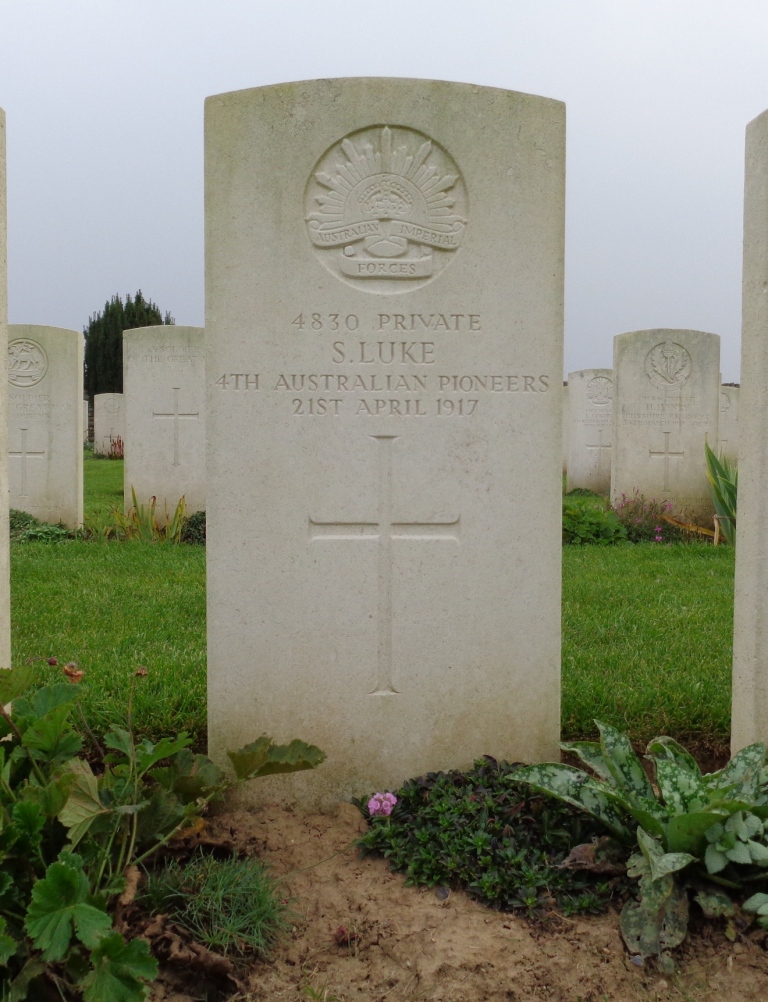
Per his military service record (regimental no. 4830), Samuel Henry Luke was born at St. Marys, N.S.W. He gave his age as 38 years and 11 months, his marital status as single, and his occupation as Laborer. His description on his medical was height 5 feet 8 inches tall, weight 154 lbs., with a medium complexion, brown eyes, and brown hair. His religious denomination was Church of England. He claimed that he had no previous military service. He completed his medical on the 11th November, 1915 at Ashfield, and was attested at Ashfield on the 11th November, 1915.

However, according to the Nepean Times (13/11/1915, p. 6), he joined the Coo-ees on Wednesday 10th November 1915, when they were at St. Marys.

After completing the march he went to Liverpool Camp as reinforcement for the 13th Battalion.

On his embarkation roll his address at time of enrolment was St. Marys, near Penrith, N.S.W., and his next of kin is listed as brother, J. Luke, St. Marys, near Penrith, N.S.W.

On 8th March 1916, Private Luke departed Sydney on the HMAT Star of England, arriving in Egypt on the 11th April 1916.

He was sent to the 4th Training Battalion at Tel El Kebir, Egypt where he trained until the 25th of April 1916 and was transferred to the 4th Pioneer Battalion at Serapeum, Egypt being taken on strength on the 29th of April 1916.

On 4th June 1916 Private Luke left Alexandria aboard the Transport Scotian bound for France, arriving at Marseilles on 11th June 1916.

Private Luke served with the 4th Pioneer Battalion throughout its service on the Western Front including Pozieres in August 1916, Mouquet Farm in September 1916, and Flers in October 1916.

On 21st April 1917 during the First Battle of Bullecourt the 4th Pioneer Battalion was constructing tramways in the vicinity of Vaulx–Vraucourt, France when Private Luke was killed in action by a high explosive shell. He was buried in the Vaulx Hill Cemetery, France.


Samuel Luke's headstone at Vaulx Hill Cemetery, France (Photograph: S & H Thompson, 6/9/2014)

Samuel Luke’s headstone at Vaulx Hill Cemetery, France (Photograph: S & H Thompson, 6/9/2014)

Private Luke’s name is commemorated on panel 174 on the Australian War Memorial First World War Roll of Honour.

Private Luke’s name is also listed on the St. Marys War Memorial.

Vaulx Hill Cemetery – France

VAULX HILL CEMETERY

On 6th September 2014 Stephen and I drove to Vaulx Hill Cemetery, which is located near the village of Vaulx-Vraucaourt in France, 6 km north-east of Baupaume.

According to the Commonwealth War Graves Commission website http://www.cwgc.org/, Vaulx Hill Cemetery started in September 1918, and further graves were added after the Armistice from the nearby battlefields.

There are 856 Commonwealth soldiers either buried or commemorated in this cemetery.

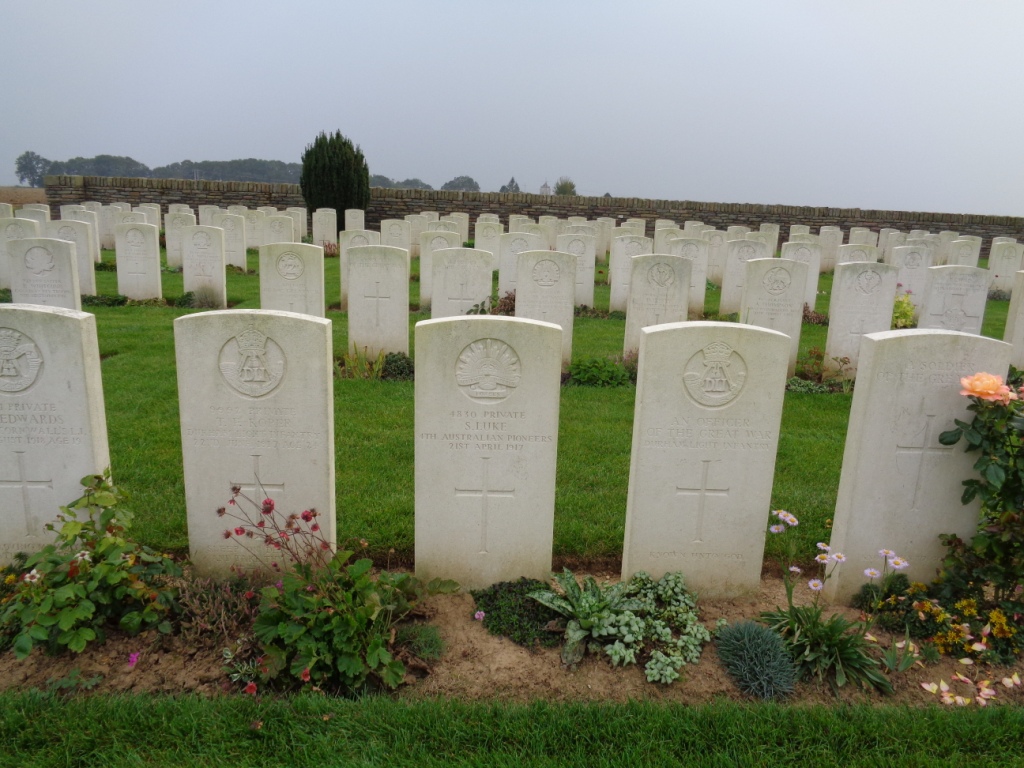
Samuel Luke, a labourer on enlistment per his service record, who joined the Coo-ees at St. Marys, is the only Coo-ee buried in this cemetery. He was killed in action on 21st April 1917.

The photograph below shows Samuel Luke’s grave (centre) at Vaulx Hill Cemetery.

Vaulx Hill Cemetery, France (Photograph: S & H Thompson, 6/9/2014)

Vaulx Hill Cemetery, France (Photograph: S & H Thompson, 6/9/2014)

A photograph of the headstone on Samuel Luke’s grave will be placed on his individual blog entry, and form part of a Roll of Honour for the fallen Coo-ees on this blog.

New tab titled The Men

I have added a new tab titled “The Men” to the cooeemarch1915.com website, which provides an alphabetical list of those Coo-ees for which I have written an individual blog entry to date.

I am writing a blog entry for each of the 263  individual Coo-ees.  However, it takes time to research each one’s service record and to find any newspaper articles, photographs, etc. relating to each person.  This is an ongoing project, so please go to the website from time to time to see what new names have been added to the list.

Please click on the name  of the Coo-ee to be linked to their blog entry.  Please also click on the tags for their names at the bottom of their record to go to other entries on this website containing a reference to their names.

Coo-ees in the Battle of Fromelles, and the first Coo-ee to die on active service

Coo-ees in the Battle of Fromelles, and the first Coo-ee to die on active service

On the 16th February 1916 15 Coo-ees departed Sydney as 14th Reinforcement for the 13th Battalion aboard the HMAT A70 Ballarat. These men left Sydney before the bulk of the Coo-ees embarked from Sydney on the HMAT Star of England on the 8th March 1916.

Upon the arrival of the HMAT A70 Ballarat in Egypt on the 22nd March 1916, these 15 Coo-ees were transferred to the 54th Battalion. Two of them (Percy George Brown and John William Thompson) fell ill and was hospitalised, but the other 13 departed for France on 19th June 1916 aboard the HT Caledonian, arriving at Marseilles on 29th June 1916.

After their arrival in France another Coo-ee fell ill (John Martin) and was hospitalised in England. Two others (John Tarlington and Colin David Wren) transferred to the 4th Pioneer Battalion, and another (Eugene Norris) to the 57th Battalion, with nine Coo-ees remaining with the 54th Battalion.

The 54th Battalion was one of the four battalions that comprised the 14th Brigade, and the 57th Battalion was one of the four Battalions of the 15th Brigade. Both Brigades were part of the 5th Australian Division that fought in the Battle of Fromelles. The Battle of Fromelles on the 19th July 1916 was the first major battle to be fought by Australian troops on the Western Front, and the 54th Battalion suffered heavy casualties. The 57th Battalion was in reserve during that initial assault, and the Coo-ee in that Battalion was not injured.

According to the Australian War Memorial (https://www.awm.gov.au/wartime/36/article.asp), the Battle of Fromelles was a disaster, and  the ‘worst 24 hours in Australian history’, with 5,533 Australian casualties in one night, which was  ‘equivalent to the total Australian casualties in the Boer War, Korean War and Vietnam War put together’.   The attack commenced at 6 pm on 19th July 1916, and was over by 8 am on the 20th July.

Of the nine Coo-ees in the 54th Battalion at Fromelles, 42 year old Charles William Gordon Conroy (who joined the Coo-ees at Orange), and 19 year old Joseph Patrick Wallis (Wailes) (who joined the Coo-es at Dubbo) were both killed in action during the Battle of Fromelles, on 19th/20th July 1916.  They were both listed with no known grave, and their names were commemorated at the V.C. Corner Australian Cemetery and Memorial at Fromelles, France.   The body of Joseph Wallis was identified in 2010, and he was reinterred in the Fromelles (Pheasant Wood) Military Cemetery in France.

Henry Blakeman (Lithgow), James Dawson (Lithgow), John Fox (Bathurst) and William Walker (Molong) were wounded at the Battle of Fromelles. Joseph Armstrong (who joined the Coo-ees at Dubbo) and Donald Stewart, one of the youngest of the Coo-ees, (who joined at Wellington), were captured, and spent the rest of the First World War as prisoners of war. Only one of the nine Coo-ees in the 54th Battalion (Edwin Fuller from Orange) survived the Battle of Fromelles unscathed.

However, Thomas Thorne, (who joined the Coo-ees at Lawson), was the first of the Coo-ees to die while on active service overseas. He embarked from Sydney on the HMAT Star of England on 8th March 1916, and had arrived in Egypt on the 11th April 1916. Acting Sergeant Thomas Thorne became ill while on a transport ship taking him from Egypt to England, and he was admitted to Devonport Military Hospital on 16th June 1916. He died of illness two days later of Pneumonia on 18th June 1916 (aged 23), having not seen any active service.

Note: I wish to acknowledge the research assistance of Stephen Thompson in writing this article.