John TARLINGTON

John TARLINGTON

Per his military service record (regimental no. 4605), John Tarlington was born at Glen Innes, N.S.W. He gave his age as 38 years and 7 months, his marital status as married, and his occupation as laborer. His description on his medical was height 5 feet 10 inches tall, weight 11 stone 5 lbs., with a fair complexion, blue eyes, and dark hair. His religious denomination was Roman Catholic.

On his attestation paper dated 26th October 1915, John Tarlington claimed previous service of 10 months in South Africa during the Boer War with the New South Wales Mounted Infantry, and 2 months previous service with the 18th Battalion.

John Tarlington had enlisted previously in the AIF on 20th May 1915 (with regimental no. 727) and completed two months training before being discharged at his wife’s request on 8th July 1915. Noted on this previous attestation paper dated 20th May 1915 was that at he had ‘Served 13th Battalion Discharged for breaking leave’. According to a statement in his service record that John Tarlington had made at the time of his 20th May 1915 enlistment, as he was unable to produce a discharge certificate for his previous service, he had enlisted about the ‘middle of November 1914 and was pooled’ to the 13th Battalion, from which he had been ‘discharged the day before embarkation on a charge of “Overstaying leave”’. He was ‘granted 24 hours leave, & returned to camp about 24 hours late, owing to severe illness’ of his wife, and on his return he was told his ‘place had been filled’ on account of his absence , and he was ‘then ordered off the ground by one of the Military Police’.

John Tarlington was in the process of applying to re-enlist in the AIF for the third time before he joined up with the Coo-ees at Blayney. On his initial Application to enlist form in his service record dated 11th October 1915 at Lithgow, John Tarlington gave his address as Coombing Park, Carcoar, N.S.W.  A letter in his service record stated that he would present himself on the 26th October after he had given two week’s notice to his employer. It appears he presented himself to the Coo-ee March at Blayney on the 26th October, instead of returning to Lithgow to enlist.

He completed his medical examination on the 26th October 1915 at Blayney, and was attested by Captain Eade at Blayney on 26th October 1915.

After completing the Coo-ee March he went to Liverpool Camp as reinforcement for the 13th Battalion.

On his embarkation roll his address at time of enrolment was Guildford Road, Guildford, N.S.W., and his next of kin is listed as his wife, Mrs. S. [Susan] Tarlington, Guildford Road, Guildford , N.S.W.

Private Tarlington departed Sydney on the HMAT Ballarat on 16th February 1916. He arrived in Egypt on 22nd March 1916. On 1st April 1916 he was transferred to the 54th Battalion at Ferry Post, Egypt.

On 14th April 1916 Private Tarlington reported to the 14th Field ambulance sick, and he was sent to the 2nd Casualty Clearing Station, then to the Number 1 Australian Stationary Hospital at Ismalia, Egypt. The next day 15th April 1916 Private Tarlington was admitted to the 1st Dermatological Hospital at Abassia, Egypt. He was discharged on 21st April 1916.

On 23rd May 1916 Private Tarilington was transferred to the 4th Pioneer Battalion.

Private Tarlington left Alexandria on 6th June 1916 aboard the Transport Ionian bound for France, arriving at Marseilles on 15th June 1916. He went to the 4th Australian Division Base Depot at Etaples, France. On 21st June 1916 he departed Etaples and joined the 4th Pioneer Battalion the next day on 22nd June 1916 when it was at Armentieres, France constructing defensive works.

On 6th August 1916 the 4th Pioneer Battalion was maintaining Tramway Trench in the ruins of the village of Pozieres which was under heavy German artillery fire during the Battle of Pozieres when Private Tarlington was killed in action. Also killed with him in the 4th Pioneer Battalion on the same day were fellow Coo-ees Oliver James Harmon (who joined the Coo-ees at Parramatta), and Karl Alex Frederick Neilson (who joined the Coo-ees at Springwood).

According to his Red Cross Wounded and Missing report, Private Tarlington was killed by a shell as ‘he got on the top of the trench at Pozieres to allow some wounded men to pass along the trench’, and he was buried ‘afterwards just over the parapet of the trench’, and ‘the grave was not marked’.[1]

Private Tarlington has no known grave, and is remembered on the Villers-Bretonneux Memorial in France. He left a widow and a son.
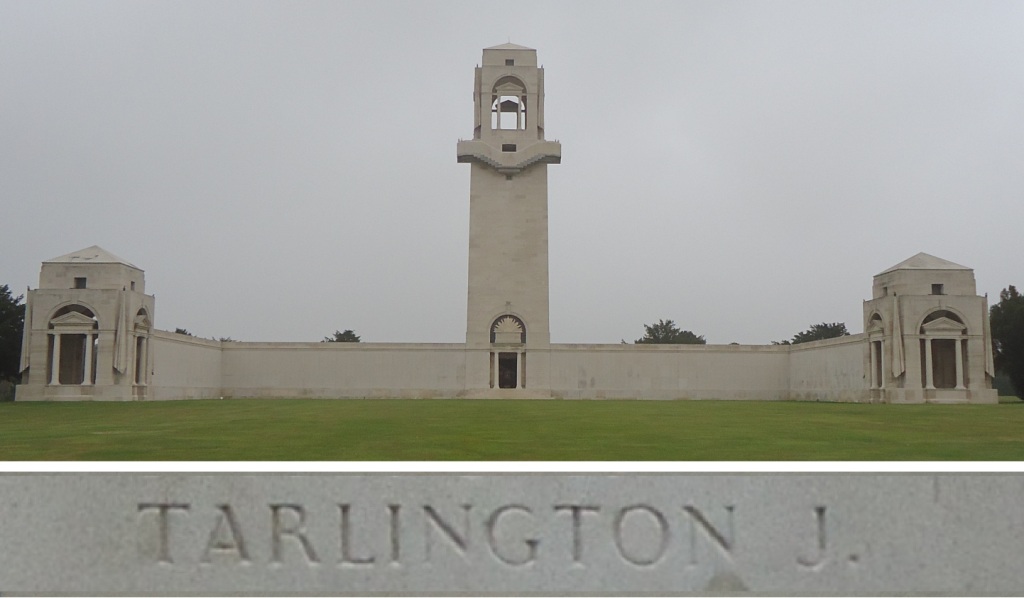
Private Tarlington's name on the Villers-Bretonneux Memorial, France (Photograph: S. & H. Thompson 7/9/2014)

Private Tarlington’s name on the Villers-Bretonneux Memorial, France (Photograph: S. & H. Thompson 7/9/2014)

Private Tarlington’s name is commemorated on panel 174 on the Australian War Memorial First World War Roll of Honour.

Private Tarlington’s name is also remembered on the Guildford Soldiers Memorial at the Soldiers Memorial School of Arts Hall at Guildford.

[1] ‘4605 Private John Tarlington’, Red Cross Wounded and Missing Enquiry Bureau Files, 1914-1918 War 1DRL/0428, http://static.awm.gov.au/images/collection/pdf/RCDIG1059988–1-.pdf
 

Oliver James HARMON

Oliver James HARMON

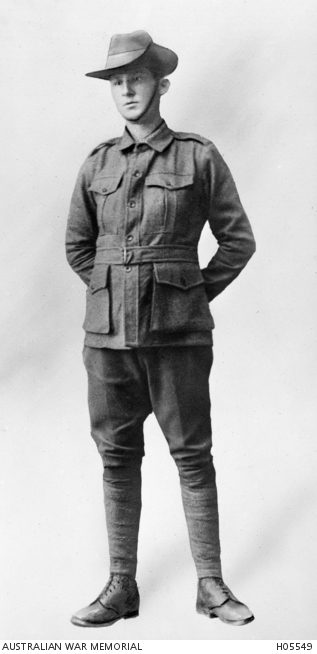
Private O. J. Harmon, ca. 1916 (Photograph: Australian War Memorial)

Private O. J. Harmon, ca. 1916 (Photograph: Australian War Memorial)

Per his military service record (regimental no. 4791), Oliver James Harmon was born at Redfern, N.S.W. He gave his age as 31 years and 11 months, his marital status as single, and his occupation as boiler makers’ assistant. His description on his medical was height 5 feet 10 ½ inches tall, weight 160 lbs., with blue eyes, and dark hair. His religious denomination was Church of England. He claimed that he had no previous military service. He completed his medical on the 10th November 1915 at Parramatta, and was attested at Ashfield on the 11th November 1915.

According to The Cumberland Argus and Fruitgrowers Advocate, he ‘had done a good deal of shearing in the West, and was personally known to many of the Gilgandra Coo-ees, whom he had joined when they passed through Parramatta’.[1]

After completing the Coo-ee March he went to Liverpool Camp as reinforcement for the 13th Battalion.

On his embarkation roll his address at time of enrolment was Alfred Street, Granville, N.S.W., and his next of kin is listed as his father, W. H. Harmon, Alfred Street, Granville, N.S.W.

On 8th March 1916 Private Harmon departed Sydney on the HMAT A15 Star of England along with many of the other Coo-ees, arriving in Egypt on the 11th April 1916.

On 16th April 1916 Private Harmon was transferred to the 4th Pioneer Battalion at Tel-El-Kebir, Egypt.

On 4th June 1916 Private Harmon left Alexandria aboard the Transport Scotian bound for France, arriving at Marseilles on 11th June 1916.

On 25th June 1916 the 4th Pioneer Battalion was at Armentieres, France, constructing defensive works. On this day Private Harmon was placed under arrest for Disobeying a Lawful Command Given By a Superior Officer (he did not accompany a Corporal to draw stores when ordered to do so) and Using Insubordinate Language To a Superior Officer (to the same Corporal). He was held in custody until a Field General Court Martial was held on the 8th of July 1916 at Fleurbaix, France. He was sentenced to 14 days Field Punishment Number 2.

On 6th August 1916 the 4th Pioneer Battalion was maintaining Tramway Trench in the ruins of the village of Pozieres which was under heavy German artillery fire during the Battle of Pozieres when Private Harmon was killed in action. Also killed with him in the 4th Pioneer Battalion on the same day were fellow Coo-ees John Tarlington (who joined the Coo-ees at Blayney), and Karl Alex Frederick Neilson (who joined the Coo-ees at Springwood).

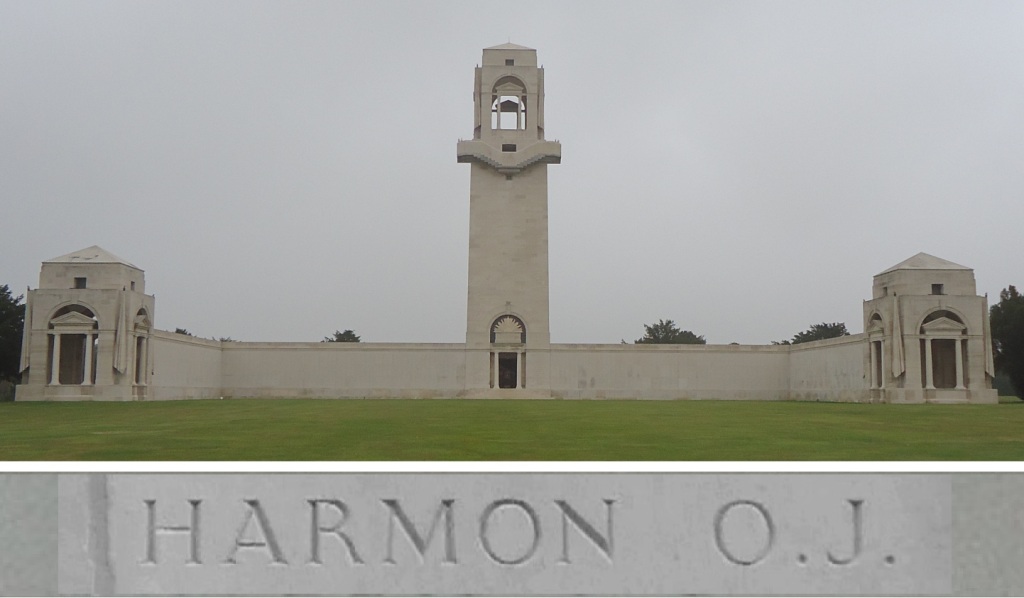
Private Harmon has no known grave, and is remembered on the Villers-Bretonneux Memorial in France.

Private Harmon's name on the Villers-Bretonneux Memorial, France (Photograph: S. & H. Thompson 7/9/2014)

Private Harmon’s name on the Villers-Bretonneux Memorial, France (Photograph: S. & H. Thompson 7/9/2014)

Private Harmon’s name is commemorated on panel 174 on the Australian War Memorial First World War Roll of Honour.

Private Harmon’s name is also remembered on the Granville War Memorial.

[1] ‘Killed in action’, The Cumberland Argus and Fruitgrowers Advocate, 9 September 1916, p. 10, http://nla.gov.au/nla.news-article86076476


Francis Charles FINLAYSON

Francis Charles FINLAYSON

Per his military service record (regimental no. 6251), Francis Charles Finlayson was born at Redfern, N.S.W. He gave his age as 28 years, his marital status as married, and his occupation as book keeper. His description on his medical was height 5 feet 11 inches tall, weight 140 lbs., with a fair complexion, grey eyes, and fair hair. His religious denomination was Roman Catholic. He claimed that he had no previous military service. He completed his medical on the 11th November 1915 at Parramatta, and was attested at Parramatta on 11th November 1915.

After completing the Coo-ee March he went to Liverpool Camp as reinforcement for the 13th Battalion.

On 3rd of February 1916 Private Finlayson was charged with being Absent Without Leave from the Liverpool Camp on the 1st and 2nd of February 1916. He was fined two days forfeiture of pay. On the 7th of March 1916 Private Finlayson was made an Acting Corporal.

After further training in Australia, Acting Corporal Finlayson departed Sydney on the HMAT A14 Euripides on 9th September 1916, as 20th reinforcement for the 13th Battalion. With him travelled fellow Coo-ees Acting Sergeant Thomas W. Dowd, and Acting Sergeant Stanley E. Stephens.

On his embarkation roll his address at time of enrolment was George Street, Parramatta, N.S.W., and his next of kin is listed as his wife, Mrs. M.[May] Finlayson, 5 Trafalgar Street, Armidale [sic] (Annandale), N.S.W.

He arrived at Plymouth, England, on 26th October 1916. On 4rd November 1916 Acting Corporal Finlayson marched into the 4th Training Battalion at Codford, England.

On 16th January 1917 Acting Corporal Finlayson left Folkestone aboard the SS Princess Victoria bound for France, marching into the 4th Division Base Depot at Etaples on 17th January 1917. Upon marching into the 4th Australian Division Base Depot he reverted to his substantive rank of Private.

On 21st January 1917 Private Finlayson was taken on strength of the 13th Battalion whilst it was at Mametz, France conducting fatigue duties.

On 4th February 1917 the 13th Battalion was taking part in an attack on the German trenches in the vicinity of Guedecourt, France. During this action Private Finlayson was killed in action.

According to a letter written home from Private Charlie C. Carr, another soldier from Parramatta, dated 12th February 1917, Frank Finlayson was killed at his side. He wrote: ‘He was in the same platoon, and had only just joined us up. It was his first time in the trenches. He had a great nerve and proved himself a splendid fighter. We had just attacked and taken the German position, when they opened up terribly heavy artillery fire. Frank bravely went out to carry in a wounded German, and got in quite safely, but it was only about five or ten minutes after that he was killed by a German high explosive shell’.[1]

This night was also fellow Coo-ee Stanley E. Stephens ‘first hop-over’ and ‘baptism of fire’ raid against the German trenches, in the same company. He wrote in a letter published in The Farmer and Settler on 17th August 1917 that on the night of 4th February Finlayson was on his left just before the hop-over, and their objective was a trench ‘known as Stormy trench, in which Fritz had a strong post’. He reported that ‘a mess-tin full of rum’ was passed along, and ‘everyone took a swig, and passed it on’, and that he ’gulped down a couple of mouthfuls and handed it to Fin’. After taking the trench and some German prisoners, they returned to their own trench. Stephens reported that ‘Finlayson was separated from us in the hop-over, and entered the trench some distance on our right’, and the Germans began a bombardment ‘putting them into us’. He continued that about midnight ‘Fin. Came along the trench looking for us’, and that ‘after yarning for a minute or two he went back to fetch his web gear and rifle, etc., up to our ‘possy’. Stephens wrote that ‘he and I had been mates for a long while, back in Kiama’, and he ‘had only been gone about ten minutes when another mate named Moss Paine came to tell me that Fin. was killed’, and that he ‘went back along the trench with Moss, but Fin. had been hit in the chest with a piece of shell that exploded in the trench, and had dropped without a word’.[2]

Private Finlayson has no known grave. He left a widow and three young children.

His name is remembered on the Villers-Bretonneux Memorial, France.

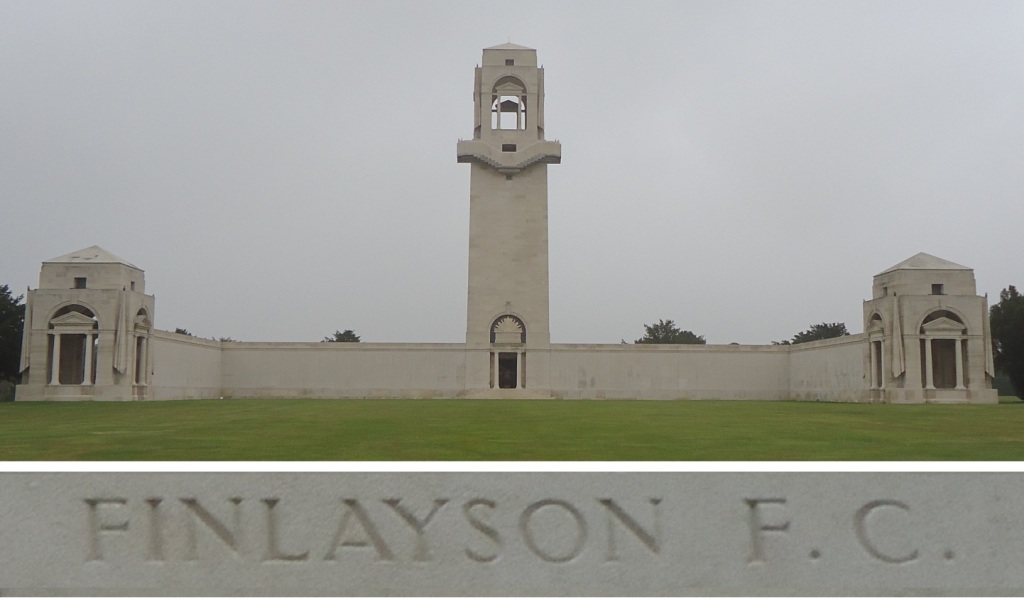
Private Finlayson's name on the Villers-Bretonneux Memorial, France (Photograph: S. & H. Thompson 7/9/2014)

Private Finlayson’s name on the Villers-Bretonneux Memorial, France (Photograph: S. & H. Thompson 7/9/2014)

Private Finlayson’s name is commemorated on panel 69 on the Australian War Memorial First World War Roll of Honour.

F. C. Finlayson’s name is also remembered on the Parramatta War Memorial.

[1] ‘Letters Home’, The Cumberland Argus and Fruitgrowers Advocate, 21 April 1917, p. 4. http://nla.gov.au/nla.news-article86090288

[2] ‘A baptism of fire’, The Farmer and Settler, 17 August 1917, p. 2, http://nla.gov.au/nla.news-article116642518


Allan James DENMEAD

Allan James DENMEAD

Per his military service record (regimental no. 3017), Allen James Denmead was born at Goulburn, N.S.W. [His first name is spelt elsewhere as Allan]. He gave his age as 27 years and 8 months, his marital status as married, and his occupation as labourer. His description on his medical was height 5 feet 9 inches tall, weight 10 stone 8 lbs., with a fair complexion, blue eyes, and brown hair. His religious denomination was Roman Catholic. He claimed that he had no previous military service. He was attested at Bathurst by Captain Eade on the 28th October 1915.

His preliminary medical examination report on his Application to enlist form in his service record, signed at Bathurst on 22nd October 1915, noted that he ‘has Varicose Veins in legs & willing to have them operated on’. His medical certificate was not signed during the march.

After completing the march he went to Liverpool Camp with the Coo-ees as reinforcement for the 13th Battalion.

His medical certificate was signed at Liverpool Camp on 13th November 1915, however this had the note “signed in error”. Whilst at Liverpool Camp Private Denmead went before a medical board on 29th November 1915 where he was deemed unfit for military service due to having Varicose Veins in both legs. He was discharged on the 13th of December 1915.

The National Advocate reported that ‘Private Denmead joined the “Coo-ees” at Bathurst, but on arrival in Sydney he was discharged to undergo an operation’, and ‘on recovering he again enlisted’.[1]

On 28th June 1916 he re-enlisted at Bathurst under the name Allan James Denmead. He claimed 7 weeks previous military experience at Liverpool with the A.I.F. before being medically discharged. He stated that his trade or calling was butcher on this attestation paper. He attended the Showground in Bathurst and underwent a medical which he passed [his varicose veins not being noted], and he was attested on 28th June 1916 at Bathurst. He went into camp and began training as part of the 7th reinforcements for the 53rd Battalion.

On his embarkation roll his address at time of enrolment was 69 Rocket Street, Bathurst, N.S.W., and his next of kin is listed as his wife, Mrs. Mary [Ester] Jane Denmead, 69 Rocket Street, Bathurst, N.S.W.

Private Denmead departed Sydney on the HMAT A11 Ascanius on 25th October 1916. He arrived in Devonport, England, on 28th December 1916. He was sent to the 14th Training Battalion at Hurdcott, England.

On 28th February 1917 Private Denmead departed Folkestone aboard the SS Golden Eagle for France. He arrived at the 5th Australian Division Base Depot at Etaples on 1st March 1917. On 21st March he joined departed the 5th Australian Division Base Depot bound for the 19th Battalion, having been transferred from the 53rd Battalion. On 23rd March 1917 Private Denmead joined the 19th Battalion whilst it was at the village of Grevillers in France repairing billets and roads.

Private Denmead was with the 19th Battalion as it saw action around Noreuil, France, in April 1917.

On 3rd May 1917 the 19th Battalion was part of an attack on the Hindenburg Line in the vicinity of Bullecourt, France. During this unsuccessful attack Private Denmead was reported Missing in Action.

A Court of Enquiry held by the 19th Battalion on 11th December 1917 reported that he was now listed as Killed in Action on the 3rd of May 1917.

His family inserted the following notice in the National Advocate (17/1/1918 p. 2):

‘Honor Roll. DENMEAD,–Private Allen James Denmead, killed in action at Bullecourt on May 3rd, 1917, aged 29 years. Previously reported missing on that date.
In a soldier’s grave he’s lying,
Somewhere in Bullecourt he fell,
Little we thought when he left us,
It would be our last farewell.
Loving remembrance will last forever.
Inserted by his loving wife Ettie, and children Rose, Harold, and Daisy’.[2]

Private Denmead has no known grave and his name is remembered on the Villers-Bretonneux Memorial, France.

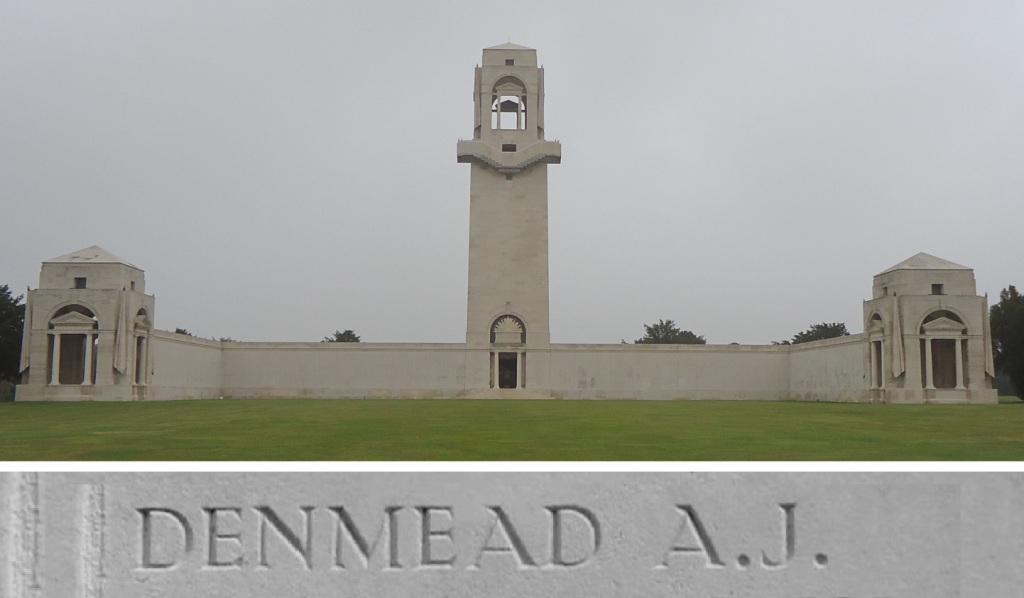
A.J. Denmead's name on the Villers-Brettoneux Memorial (Photograph: S. & H. Thompson, 7/9/2015)

A.J. Denmead’s name on the Villers-Brettoneux Memorial (Photograph: S. & H. Thompson, 7/9/2015)

Private Denmead’s name is commemorated on panel 88 on the Australian War Memorial First World War Roll of Honour.

[1] ‘A “Cooee” Missing’, National Advocate, 8 June 1917, p. 2, http://nla.gov.au/nla.news-article158485185

[2] ‘Advertising’, National Advocate, 17 January, 1918, p. 2. http://nla.gov.au/nla.news-article158501973


Villers-Bretonneux Memorial – France

VILLERS-BRETONNEUX MEMORIAL

On 7th August 2014 Stephen and I visited the Australian National Memorial at Villers-Bretonneux Military Cemetery, which is located about 2 km north of the village of Villers-Bretonneux. It was our second visit to this memorial.

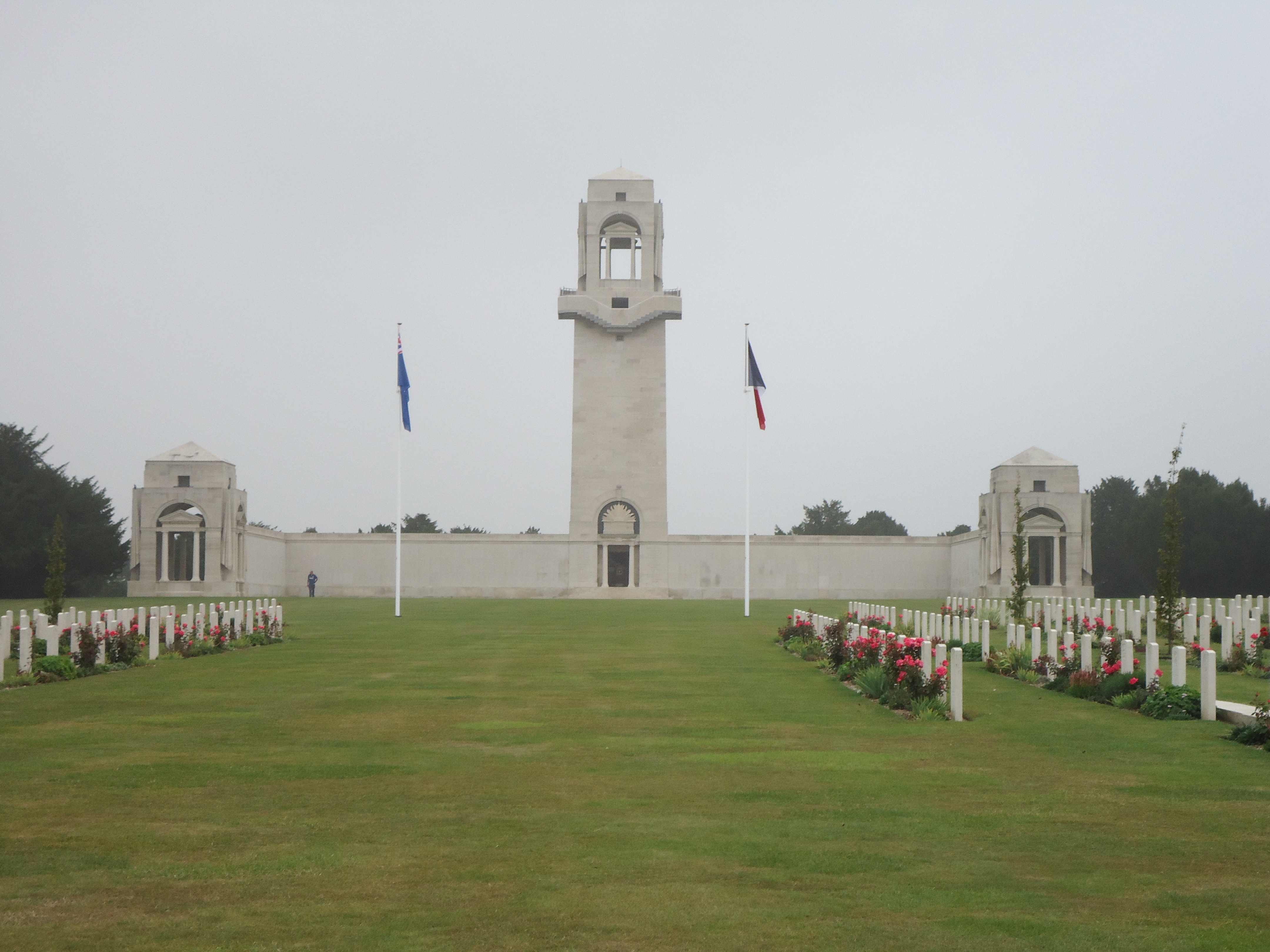
The photograph below shows the Villers-Bretonneus Memorial, with some of  the headstones in the Villers-Bretonneux Military Cemetery in the foreground.

Villers-Bretonneux Memorial, France (PhotographL S. & H. Thompson, 5/9/2012)

Villers-Bretonneux Memorial, France (Photograph: S. & H. Thompson, 5/9/2012)

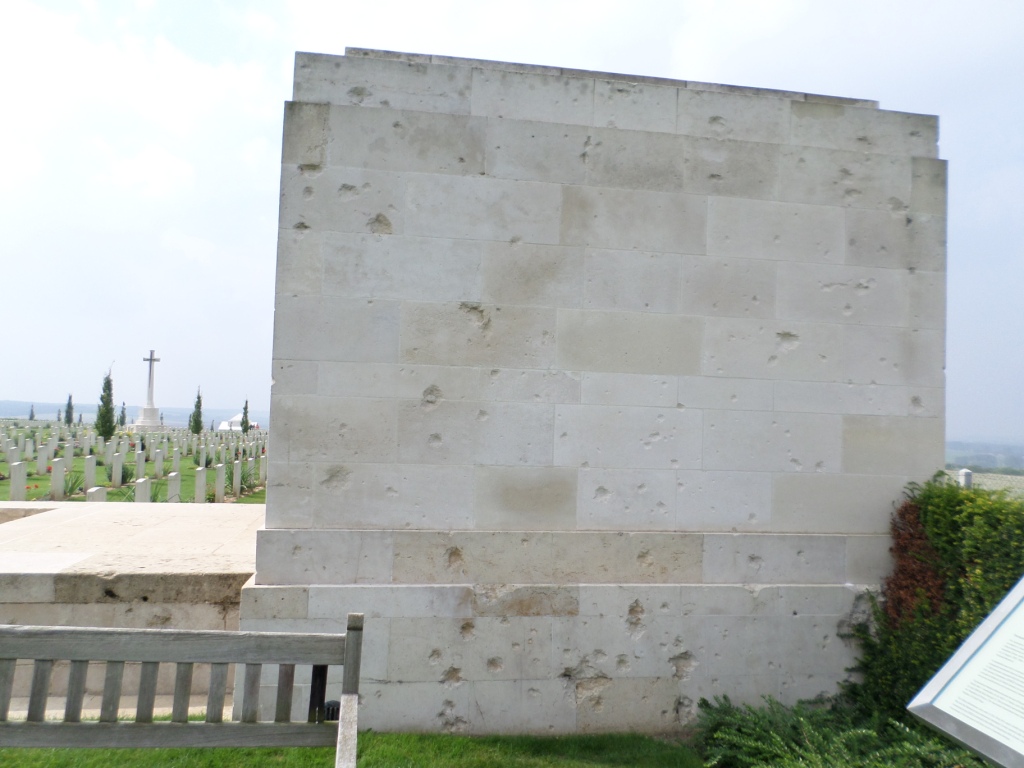
Red poppies grow in the garden beds near the entrance to the memorial. Beautiful roses and other flowers are planted in amongst the graves in the cemetery section. Bullet holes from World War II German aircraft can be seen on a wall, and on the tower.

Bullet holes in wall at Villers-Bretonneux Memorial (Photograph: S. & H. Thompson, 7/9/2014)

Bullet holes in a wall at Villers-Bretonneux Memorial (Photograph: S. & H. Thompson, 7/9/2014)

A quite prophetic article in The Dubbo Liberal and Macquarie Advocate described the importance of this memorial, which was unveiled by King George VI on 22 July 1938, as follows:

‘A magnificent and dignified structure, it will perpetuate the memory of thousands of Australians who gave their lives on the battlefields of France in the greatest war the world has yet known. It is not the only war memorial dedicated to the memory of Australians and other sons of the Empire who died in France, but to us it is the most significant, for it marks the scene where Australians played an outstanding part in stemming the flow of the grey enemy hordes which threatened to engulf France. It was there, on April 24, 1918, that sons of Australia helped to halt the Germans who had burst through the British lines. It was the turning point of the war, for it was followed with a counter attack on April 24 – eve of the third anniversary of Anzac Day – which started the general allied advance that eventually brought peace. On that Anzac eve, there were 2500 Australian casualties, so the blood toll was heavy. The Villers-Bretonneux Memorial however, symbolises something more that the feats of arms and self-sacrifice of Australia’s sons. It stands as a reminder of the bond between France and the British Empire, cemented imperishably during 1914-18. Australians joined with the French in facing a common enemy, and France will not forget. Even when Time dims the memories of the awful horrors of the war years, the Villers-Bretonneux and other memorials will stand as mute sentinels of the friendship between the French and English. Generations to come will remember that French soil has been enriched by British blood; that sons of Australia and other parts of the Empire are sleeping beneath the poppies which blow on the foreign land they died to save …’[1]

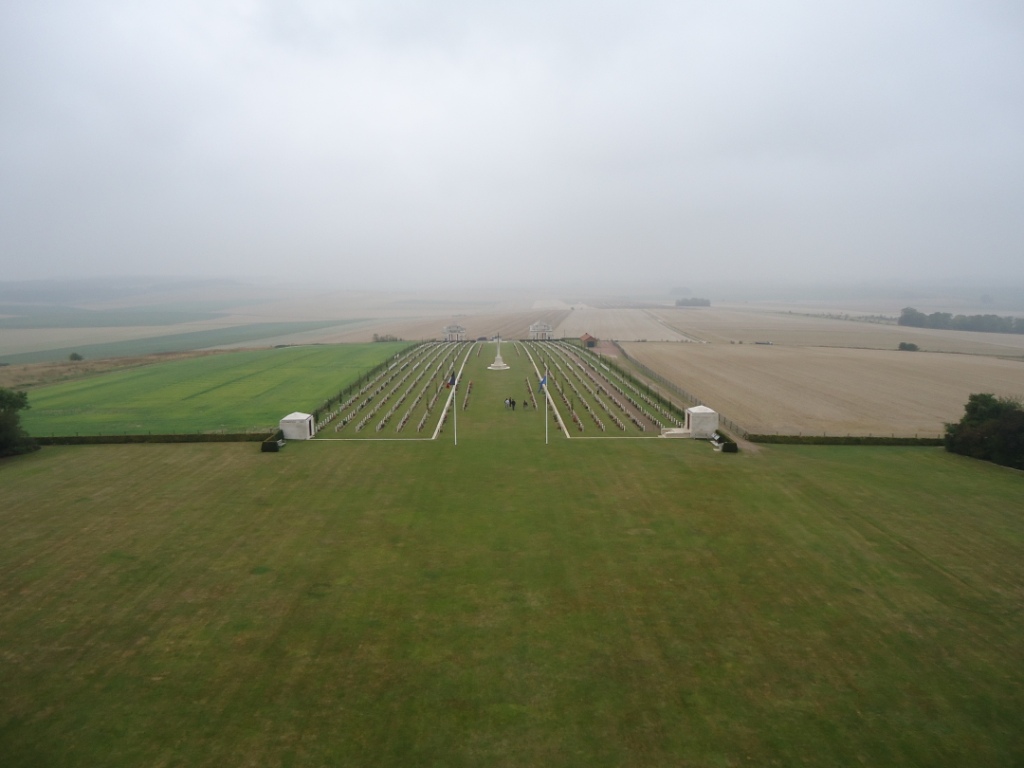
The photograph below, taken from the tower at the top of the memorial, looking towards the main entrance, shows the size of the beautifully laid out site, and the rolling hills of the surrounding French countryside.

Looking from the Tower to the Main Entrance at Villers-Bretonneux Memorial (Photograph: S. &. H. Thompson 5/9/2012)

Looking from the Tower to the Main Entrance at Villers-Bretonneux Memorial (Photograph: S. &. H. Thompson 5/9/2012)

This Australian National Memorial was erected to commemorate all Australian soldiers who fought and died in France and Belgium during the First World War, and to name those who have no known grave.

According to the Commonwealth War Graves Commission website http://www.cwgc.org/, the names of 10,762 Australian soldiers are commemorated by this memorial. They died in the battlefields of the Somme, and Arras, and in the advance by the Germans in 1918, and the Allied advance to victory.

The memorial is situated behind the Villers-Bretonneux Military Cemetery, which contains the remains of graves brought in from other burial grounds and the battlefields in the area.

The names of 12 Coo-ees are commemorated at this memorial. Their names are listed in unit order on the walls.

Wilfred Ernest McDONALD 4th HTM Bty, who joined the Coo-ees at Wongarbon

Karl Alex Frederick NEILSEN 4th Pioneer BN, who joined the Coo-ees at Springwood

Oliver James HARMON 4th Pioneer BN, who joined the Coo-ees at Parramatta

John TARLINGTON 4th Pioneer BN, who joined the Coo-ees at Blayney

Francis Charles FINLAYSON 13th BN, who joined the Coo-ees at Parramatta

Stanley Everard STEPHENS 13th BN, who joined the Coo-ees at Gilgandra

Allan James DENMEAD 19th BN, who joined the Coo-ees at Bathurst

William Emerton HUNTER 45th BN, who joined the Coo-ees at Geurie

Lawrence Leslie MAGUIRE 45th BN, who joined the Coo-ees at Gilgandra

Jack MORRIS 45th BN, who joined the Coo-ees at Parramatta

William WEBBER 45th BN, who joined the Coo-ees at Ashfield

Rowland John WILSON 45th BN, who joined the Coo-ees at Lawson

A photograph of their name on the Villers-Bretonneux Memorial will be placed on each individual Coo-ee’s blog entry, and form part of a Roll of Honour for the fallen Coo-ees on this blog.

[1] Villers-Bretonneux, The Dubbo Liberal and Macquarie Advocate, 23 July 1938, p. 2, http://nla.gov.au/nla.news-article132276037


Harold Brooks DAVIS

Harold Brooks DAVIS

Per his military service record (regimental no. 4759), Harold Brooks Davis was born at Parramatta, N.S.W.[1] He gave his age as 18 years [though he was much younger than this], his marital status as single, and his occupation as plumber. His description on his medical was height 5 feet 7 inches tall, weight 100 lbs., with a dark complexion, grey eyes, and dark brown hair. His religious denomination was Methodist. He claimed that he had no previous military service.

It is not certain where Harold Brooks Davis joined the Coo-ee March.  His “Joined on” date on his attestation paper was the 8th November 1915, the day the Coo-ees travelled from Lawson to Springwood. The Blue Mountain Echo reported that ‘he joined the “Coo-ees” in their memorable march o’er the Mountains’.[2] The Farmer and Settler reported that ‘a halt of only fifteen minutes was made at Leura, but two recruits joined’ following a recruiting address on 6th November 1915.[3]  The names of the two recruits who stepped forward at his home town of Leura were not reported in local newspapers at the time.

However he did not complete his medical until three days later, on the 11th November 1915 at Ashfield, and he was attested at Ashfield on the 11th November 1915. The Coo-ees had a recruitment meeting and stayed in Ashfield at the Drill Hall on the night of 11th November 1915 – the last night of the march.

After completing the Coo-ee March he went to Liverpool Camp as reinforcement for the 13th Battalion.

On his embarkation roll his address at time of enrolment was Northcote Street, Leura, N.S.W., and his next of kin is listed as his father, J. [James] Davis, Northcote Street, Leura, N.S.W.

Private Davis departed Sydney on the HMAT Star of England along with many of the Coo-ees on the 8th March 1916. He arrived in Egypt on the 11th April 1916.

On the 19th April 1916 he transferred to the 45th Battalion in Egypt.

On the 2nd June 1916 Private Davis left Alexandria aboard the transport Kinfauns Castle bound for France, arriving at Marseilles on the 8th June 1916.

Private Davis served with the 45th Battalion through its first action at Fleurbaix, France in July 1916, then the Battle of the Somme around Poziers, Mouquet Farm, and Flers.

On 5th January 1917 the 45th Battalion was at Dernacourt, France, preparing to move forward into the front lines, when Private Davis was evacuated to the Anzac Rest Station with a Septic Foot. He remained at the Rest Station until 31st January 1917, when he rejoined the Battalion when it was at Mametz, France, resting and providing working parties behind the lines.

Just three weeks later, on 21st February 1917 Private Davis received multiple gunshot wounds when the 45th Battalion was engaged in action at Gueudecourt, France. He was evacuated to the 45th Casualty Clearing Station.

On 27th February 1917 he was evacuated by the 21st Hospital Train to the 6th General Hospital at Rouen, France, where he died of his wounds the next day, on 28th February 1917.

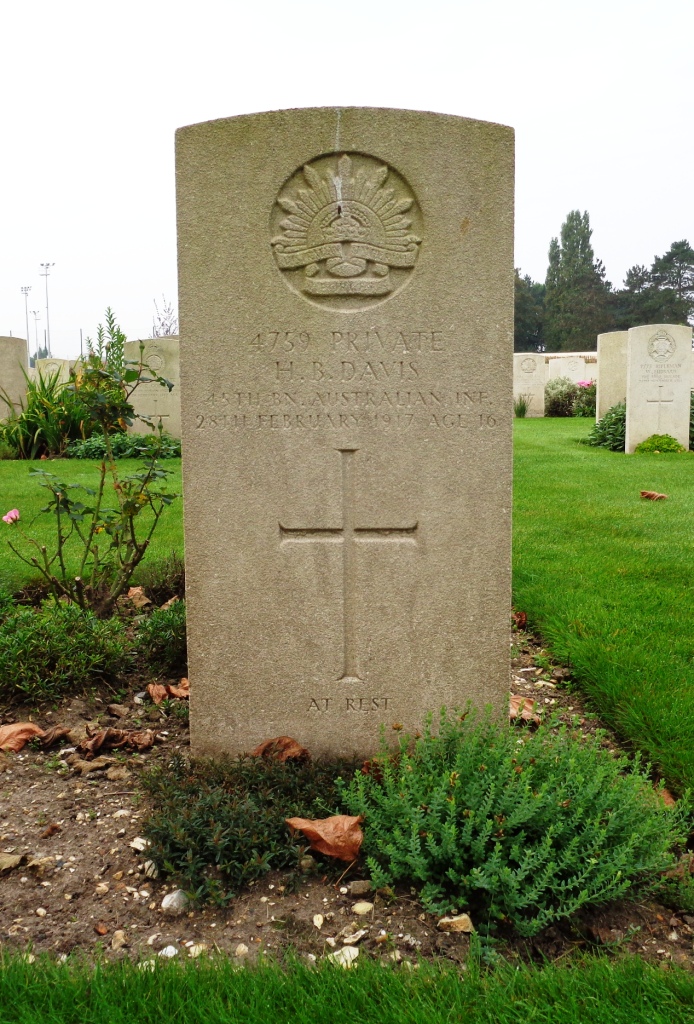
Private Davis is buried in the St. Sever Cemetery Extension at Rouen, France.

Harold Brooks Davis' headstone at St. Sever Cemetery Extension, Rouen, France (Photograph: S. & H. Thompson 7/9/2014)

Harold Brooks Davis’ headstone at St. Sever Cemetery Extension, Rouen, France (Photograph: S. & H. Thompson 7/9/2014)

Private Davis’ name is commemorated on panel 139 on the Australian War Memorial First World War Roll of Honour. His age at time of death is recorded on the Australian War Memorial Roll of Honour database, and on his headstone, as being 16 years of age.

His birth certificate shows that he was born on 1st March 1901, the son of James Davis and Elizabeth Davis (nee Brooks).[4]  This means that he had been only 14 years, 8 months, and 7 days old, when he joined the Coo-ee March. He was the youngest of the Coo-ees.

Sadly, when he died of his wounds on 28th February 1917, he was still only 15 years old – this was the day before his 16th birthday.

Private Davis’ name is also remembered on the Leura Lone Pine Park Memorial Gates.

[1] NAA: B2455, DAVIS H B

[2] ‘Leura’, The Blue Mountain Echo, 9 March 1917, p. 3, http://nla.gov.au/nla.news-article108247441

[3] ‘The route march’, The Farmer and Settler, 9 November 1915, p. 3, http://nla.gov.au/nla.news-article116669569

[4] NSW Birth Certificate Parramatta 15787/1901 Harold B. Davis

St. Sever Cemetery Extension – France

ST. SEVER CEMETERY EXTENSION, ROUEN

On 7th September 2014 Stephen and I drove to St. Sever Cemetery Extension at Rouen in France.

The majority of the soldiers that died at the Commonwealth camps and hospitals stationed at Rouen during the First World War were buried in the city cemetery of St. Server. A military extension was begun in September 1916, and the last burial took place in April 1920.

There are 8,348 Commonwealth burials from the First World War in this very large cemetery.

Harold Brooks Davis, a young plumber from Leura on enlistment per his service record, who joined the Coo-ees in the Blue Mountains, is the only Coo-ee buried in this cemetery. He died of wounds on 28th February 1917.

The photograph below shows Private Davis’s headstone (centre) at St. Sever Cemetery Extension at Rouen.

St. Sever Cemetery Extension, Rouen, France (Photograph: S. & H. Thompson 7/9/2014)

St. Sever Cemetery Extension, Rouen, France (Photograph: S. & H. Thompson 7/9/2014)

A photograph of the headstone on Private Davis’s grave will be placed on his individual blog entry, and form part of a Roll of Honour for the fallen Coo-ees on this blog.

William Hilton Saunders war diaries available online

William Hilton Saunders war diaries

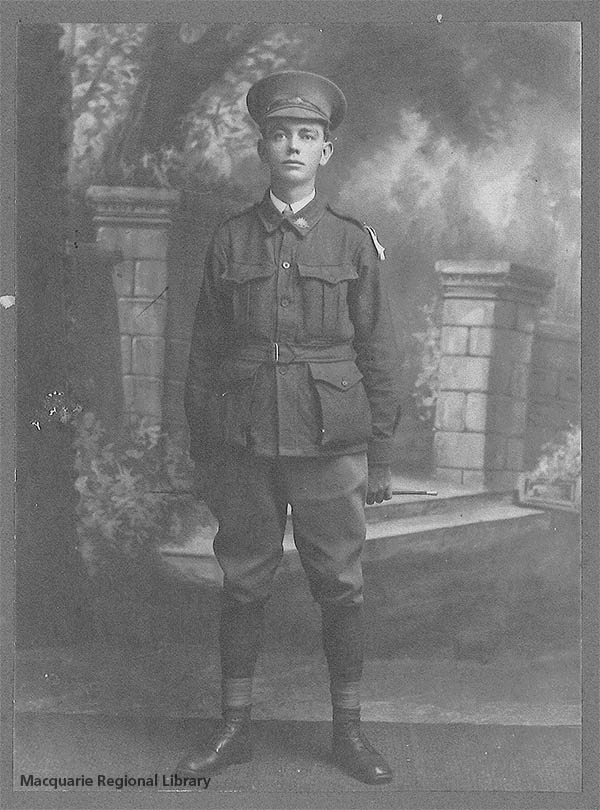
William Hilton Saunders (Photograph courtesy of Macquarie Regional Library)

William Hilton Saunders (Photograph courtesy of Macquarie Regional Library)

William Hilton Saunders joined the Coo-ee March at Wongarbon. Several of the many letters he wrote home were published in local newspapers. He also kept diaries from 1915 to 1919, which are now part of the UNSW Canberra Academy Library’s manuscripts collection.

Stephen and I visited the Academy Library at the Australian Defence Force Academy in Canberra on 22nd August 2013 to view W. Hilton Saunders’ war diaries. There were 5 small fragile diaries, sealed in bags, which we were able to look at under supervision, wearing white gloves. There were many diary entries of interest in these diaries that I would have liked more time to read, but the time we had available to visit was limited, and it was difficult to write many notes in pencil, wearing gloves.

I was advised by the State Library of New South Wales last week that William Hilton Saunders’ war diaries (1916-1919) are now available online on this library’s website at http://www.acmssearch.sl.nsw.gov.au/search/itemDetailPaged.cgi?itemID=1323843. To access the digitised diaries, click on the Collection Hierarchy tab, then the title for each year’s diary, then click on ‘view images’.

This online access to W. Hilton Saunders’ diaries provides a wonderful opportunity to read through the wartime diary entries of one of the Coo-ees, following his experiences in the First World War, from his training at Liverpool Camp, to his voyage from Sydney to Egypt on the HMAT A15 Star of England, his experiences in the training camp at Egypt, and then on the Western Front, and on hearing of the Armistice that ended the war.

Unfortunately the 1915 diary has not been digitised, probably due to its limited number of entries, with none until the end of the year. The 1915 diary had an inscription inside it from a family member dated 8th October 1915 (the day W. Hilton Saunders did his medical and original attestation at Gilgandra before the march commenced). Unfortunately he did not make any entries for the period of the march, only a mention of arriving in Liverpool camp.   There were however lots of female names and addresses written in the back of this 1915 diary with addresses from many the towns and villages along the march, from Stuart Town onwards (where he re-signed his attestation form on 19th October 1915).

W. Hilton Saunders was one of the main contingent of Coo-ees that embarked from Sydney on HMAT A15 Star of England on 8th March 1916, which arrived in Egypt on 11th April 1916. He recorded daily entries in his diary for this period.

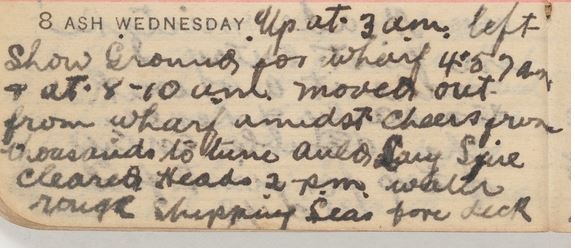
W. Hilton Saunders recorded the following details in his diary for the day the Coo-ees loaded onto the HMAT A15 Star of England, and left Sydney Harbour through the Heads:

W. H. Saunders diary entry 8/3/1916 (Image part of the State Library of NSW collection)

W. H. Saunders diary entry 8/3/1916 (Image from the State Library of NSW collection)

March 1916: 8 Ash Wednesday. “Up at 3 a.m. left Show Ground for wharf 4.57 a.m. & at 8.10 a.m. moved out from wharf amidst cheers from thousands to tune Auld Lang Syne Cleared Heads 2 p.m. water rough chopping seas fore deck”.

The Coo-ees when they joined the Coo-ee March and enlisted in the AIF had expected to be going as reinforcements to support the ANZAC troops on Gallipoli. That campaign finished while they were still in training in Liverpool Camp.

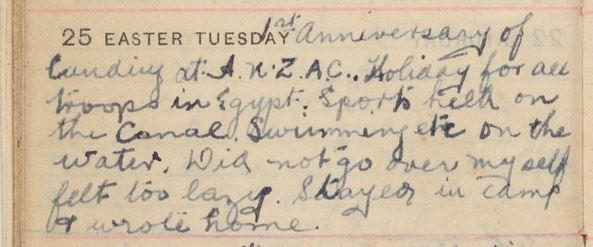
Yesterday as I attended the dawn service at the Dubbo War Memorial commemorating 100 years since the ANZAC troops had landed at Gallipoli, I had wondered what W. Hilton Saunders had wrote in his diares about his experience on the first Anzac Day held on 25th April 1916, where a sports day was held in the Australian camp in Egypt, where he and the other Coo-ees were in training. He wrote the following words:

W. H. Saunders diary entry 25/4/1916 (Image part of the State Library of NSW collection)

W. H. Saunders diary entry 25/4/1916 (Image from the State Library of NSW collection)

April 1916: 25 Easter Tuesday. “1st anniversary of landing at A.N.Z.A.C. Holiday for all troops in Egypt. Sports held on the Canal. Swimming etc. on the water. Did not go over myself felt too lazy. Stayed in camp & wrote home.”

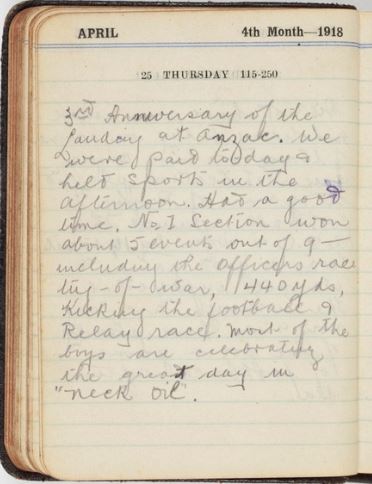
He wrote no entry in his diary for Anzac Day in 1917, but in 1918 he wrote the following entry about his Anzac Day experience for that year:

W. H. Saunders diary entry 25/4/1918 (Image part of the State Library of NSW collection)

W. H. Saunders diary entry 25/4/1918 (Image from the State Library of NSW collection)

April 1918: 25 Thursday. “3rd Anniversary of the landing at Anzac. We were paid today & held sports in the afternoon. Had a good time. No. 1 Section won about 5 events out of 9 – including the officers race … 440 yds, kicking the football & Relay race. Most of the boys are celebrating the great day in “neck oil”. [aka beer].


Coo-ee March plinth at Dubbo War Memorial

Coo-ee March plinth at Dubbo War Memorial

After attending the dawn service at Dubbo War Memorial this morning along with a record size crowd, I took the opportunity to view the new Coo-ee March plinth on the Anzac Memorial Walk at Victoria Park, just near the cenotaph.

'The Coo-ee March' plinth near Dubbo War Memorial (Photograph: H. Thompson 25/4/2015)

‘The Coo-ee March’ plinth near Dubbo War Memorial (Photograph: H. Thompson 25/4/2015)

It is one of ten plinths recently erected by Dubbo City Council to commemorate different aspects of Dubbo’s involvement in the First World War, which was officially unveiled last Thursday, 23rd April 2015.

The Coo-ees had held a recruiting meeting in Dubbo, and stayed overnight at Dubbo Military Camp at Dubbo Showground on 13th October 1915.

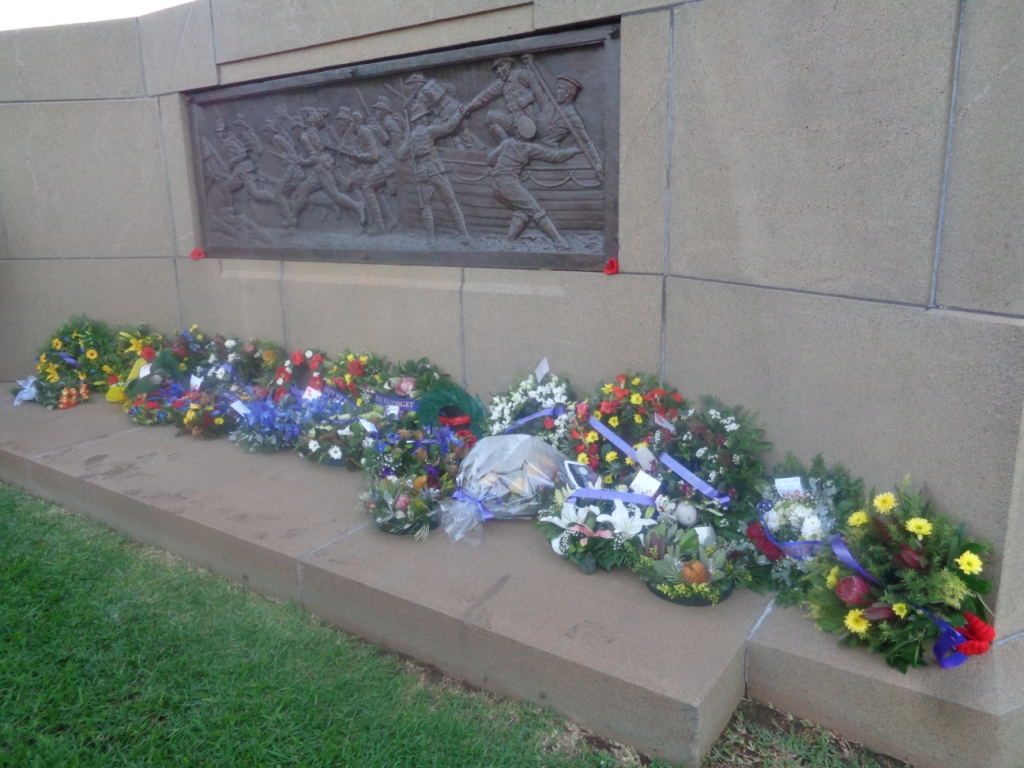
Looking at the wreaths laid on the cenotaph I remembered reading a 1925 newspaper article in the Dubbo Liberal about the unveiling of this cenotaph and laying of the wreaths ceremony held 90 years ago today, on Anzac Day in 1925.

The wreaths included a ‘beautiful wreath nearly three foot in diameter, to the memory of the unknown soldier’, and ‘individual wreaths and those to battalions’ which ‘covered the whole of the base on one side of the monument’, and ‘above the wreaths was placed the historic flag which had been carried by “The Coo-ees” in their march from Gilgandra to Sydney’.[1]

Wreaths at Dubbo War Memorial in the same area where a flag from the Coo-ee March was displayed during the 1925 unveiling of the cenotaph (Photograph: H. Thompson, 25/4/2015)

Wreaths at Dubbo War Memorial in the same area where a flag from the Coo-ee March was displayed during the 1925 unveiling of the cenotaph (Photograph: H. Thompson, 25/4/2015)

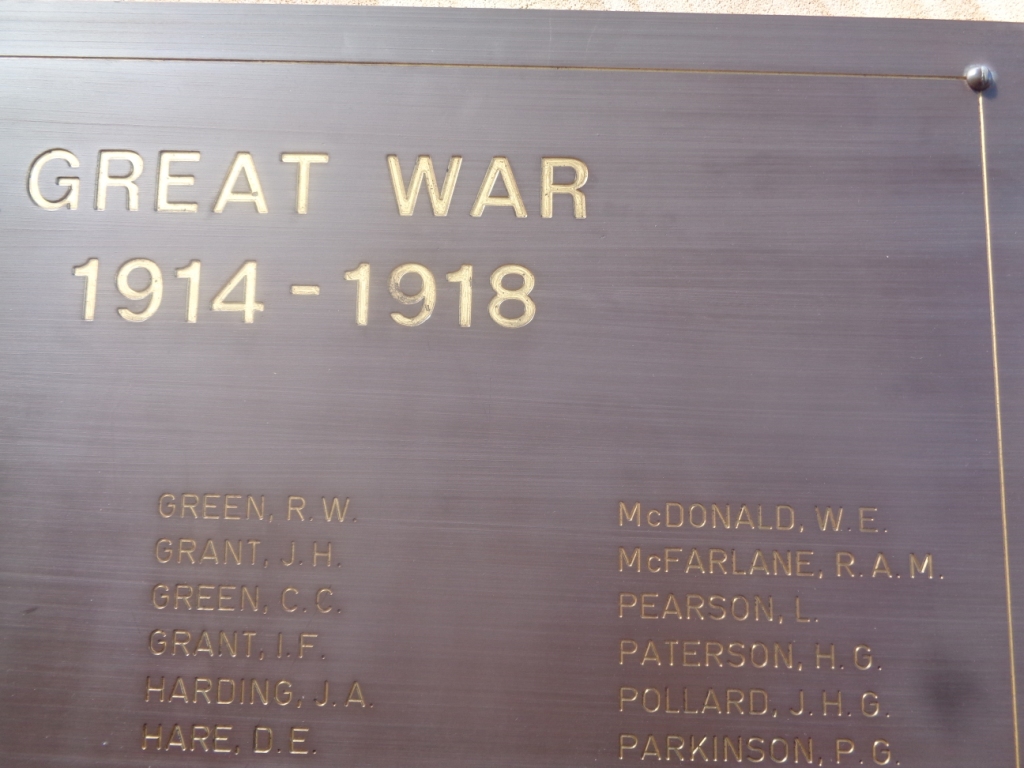
Wilfred Ernest McDonald’s name is listed on the Dubbo War Memorial Roll of Honour, who was born in Dubbo, and had joined the Coo-ees at Wongarbon.  He was killed in action in France on 3rd May 1917 and has no known grave.

'MCDONALD W E' name on Dubbo War Memorial Roll of Honour (Photograph: H. Thompson, 25/4/2015)

‘McDONALD W E’ name on Dubbo War Memorial Roll of Honour (Photograph: H. Thompson, 25/4/2015)

[1] “Laying wreaths,” The Dubbo Liberal and Macquarie Advocate, 28 Apr 1925, p. 4, http://nla.gov.au/nla.news-article76099146.


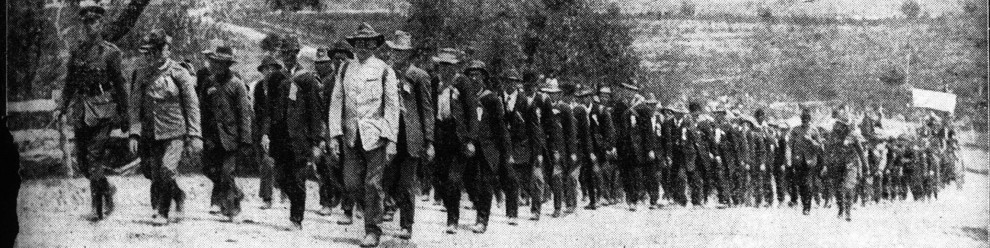
The Coo-ees at Colyton (on their way from Penrith to Parramatta)

The Coo-ees at Colyton (on their way from Penrith to Parramatta)

On Wednesday 10th November 1915, the Coo-ees left Penrith to march the four miles to St. Marys, arriving at about 8.30 am.[1]  There they ate an elaborate breakfast on tables under the shade of the trees in Victoria Park, prepared by the ladies of St. Marys. Here they gained another recruit, Samuel Luke, a 38 year old single labourer who had lived on Mamre Road with his mother and stepfather.[2] (His name is listed on the St. Marys War Memorial in Victoria Park in St. Marys).

At 10 am the Coo-ees left St. Marys and travelled down the historic Western Road (now the Great Western Highway) to the village of Colyton, where they were presented with a sum of money which had been collected by the Colyton school children, and presented with a tanned sheepskin vest which the headmaster Mr Aston had arranged.[3]

The Nepean Times reported that at Colyton ‘another recruit, viz Mr J Barnett, joined’.[4] I found no service record for a J. Barnett joining the Coo-ees at Colyton, but did find a 1919 article in the Nepean Times which reports on a welcome home speech for a returned soldier – Driver Clarrie Barnett – given by Mr J Aston, headmaster of Colyton Public School where the returned soldier had been a student, whom he described as having ‘linked up with the Coo-ees when they passed through Colyton’.[5] Clarrie (Clarence Roy) Barnett, who had been a 21 year old bank teller from Mount Druitt, had signed his attestation paper in his service record at Liverpool on the 10th November 1915. So it appears he was a Coo-ee “for a day”, marching out of Colyton with the Coo-ees when they left that village, then making his own way further down the road to Liverpool Camp to enlist that same day.

The Farmer and Settler reported that a recruit that joined at Colyton ‘was one of the family of McGregors that has already given five sons to the Empire, and that ‘as the family said their brave but tearful farewells to the sixth McGregor, all that witnessed the incident realised the fine loyalty of the McGregors’.[6]

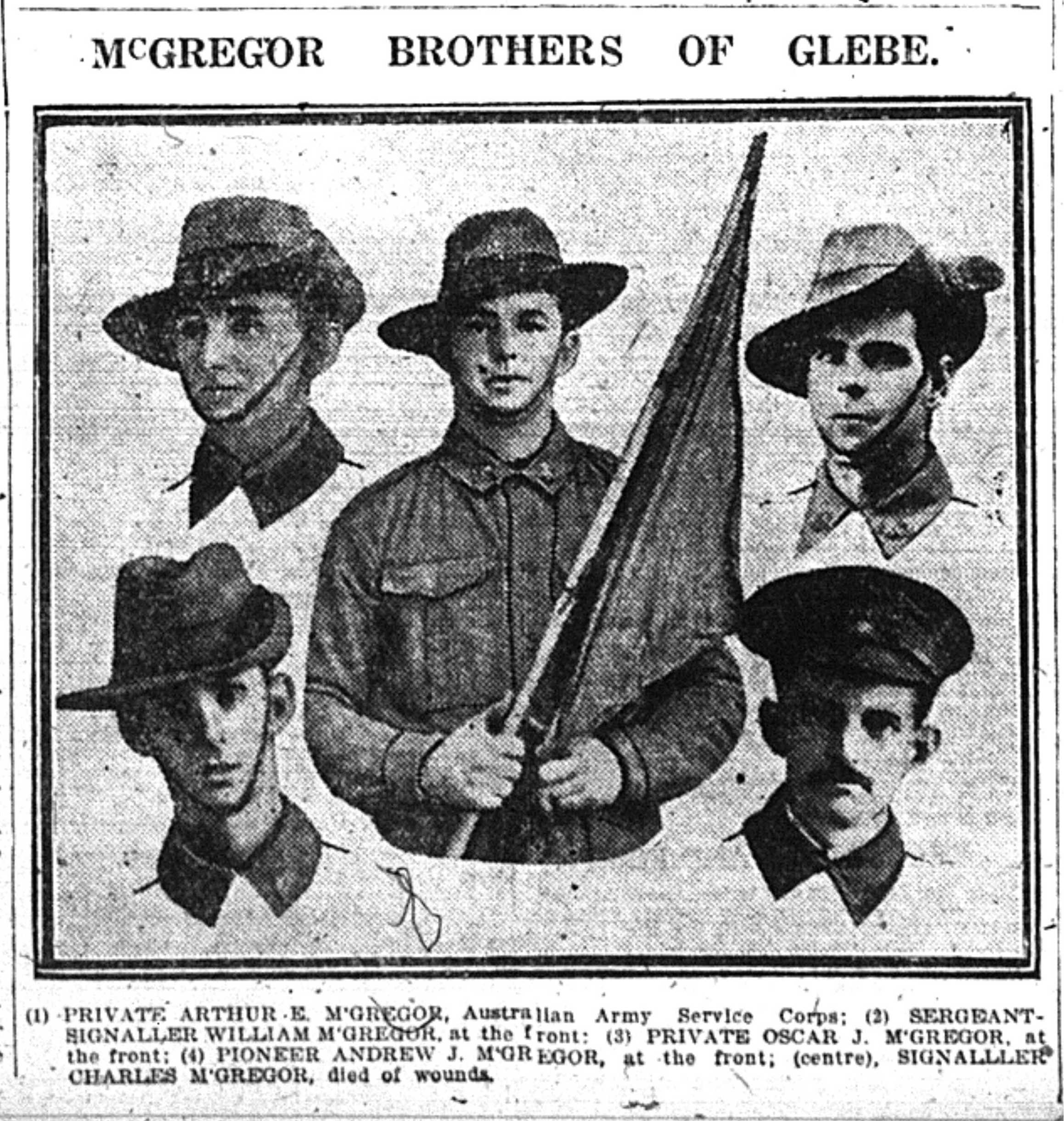
I have only found service records for five of these six McGregor brothers, who were the sons of Andrew and Alice M. McGregor. The photograph below shows the five sons who enlisted.

The McGregor brothers - 2 were Coo-ees (Daily Telegraph, 22/9/1916)

The McGregor brothers – 2 were Coo-ees [top left, bottom right]  (Daily Telegraph, 22/9/1916)

Two of these brothers joined the Coo-ee March – Arthur Ernest McGregor who signed his attestation paper at Springwood on the 8th November 1915 (when the Coo-ees were at Springwood), and Andrew James McGregor (the eldest), who joined the Coo-ees at the start of the march at Gilgandra. Both were married, and both their families were living in Sydney at the time, so it appears that one of them left the march temporarily and then rejoined the march at Colyton, accompanied by some family members to see them off.

After leaving Colyton the Coo-ees marched to Eastern Creek, where they were met by the President of Blacktown Shire Council, Col. Pringle, and Cr. James Angus, who was president of the local recruiting committee, and had lunch provided by the ladies of Rooty Hill and Eastern Creek in the Walgrove school grounds.[7]

The Coo-ees then proceeded to Prospect and on to Parramatta.


[1] ‘St. Marys’, Nepean Times, 13 November, 1915, p. 6, http://nla.gov.au/nla.news-article86168744

[2] ‘The St. Marys Fatality’, Nepean Times, 24 January, 1914, p. 8, http://nla.gov.au/nla.news-article86169108

[3] ‘St. Marys’, Nepean Times, 13 November, 1915, p. 6, http://nla.gov.au/nla.news-article86168744

[4] ‘St. Marys’, Nepean Times, 13 November, 1915, p. 6, http://nla.gov.au/nla.news-article86168744

[5] ‘Mount Druitt’, Nepean Times, 9 August, 1919, p. 4, http://nla.gov.au/nla.news-article86190825

[6] ‘The Route March : In the suburbs of Sydney’, The Farmer and Settler, 12 November, 1915, p. 3, http://nla.gov.au/nla.news-article116652489

[7] 1915 ‘The Route March : In the suburbs of Sydney’, The Farmer and Settler (Sydney, NSW : 1906 – 1957), 12 November, p. 3, viewed 21 April, 2015, http://nla.gov.au/nla.news-article116652489