William FARTHING

William FARTHING

Per his military service record (regimental no. 4773), William Farthing was born at Moss Vale, N.S.W. He gave his age as 29 years and 10 months, his marital status as married, and his occupation as laborer. His description on his medical was height 5 feet 11 inches tall, weight 155 lbs., with a fair complexion, blue eyes, and sandy hair. His religious denomination was Church of England. He claimed that he had no previous military service.

He completed his medical on the 10th November 1915 at Parramatta, and was attested at Parramatta on the 11th November 1915. The Coo-ees had held a recruiting meeting in the Park at Parramatta on the evening of the 10th November, where it was reported that 41 men had offered themselves as recruits.[1]

After completing the Coo-ee March he went to Liverpool Camp as reinforcement for the 13th Battalion.

On 21st January 1916 Private Farthing was charged with being absent from parade at the Liverpool Camp, and he was fined 5 shillings. On 3rd February 1916 he was charged with being absent without leave for 1 day, and he was fined 5 shillings. On 21st February 1916 he was charged with being absent without leave for 2 days, and he was fined 20 shillings.

On his embarkation roll his address at time of enrolment was Eglington Street, Lidcombe, N.S.W., and his next of kin is listed as his wife, Mrs A. M. [Ada May] Farthing, Eglington Street, Lidcombe, N.S.W.

On 8th March 1916 Private Farthing departed Sydney on the HMAT A15 Star of England, along with many of the other Coo-ees, as part of the 15th reinforcements for the 13th Battalion. On 27th March 1916 he was charged with breaking ship, and was fined 5 pounds.

He arrived in Egypt on the HMAT A15 Star of England on 11th April 1916.

On 18th April he was admitted to the 2nd Australian Stationary Hospital at Tel El Kebir, Egypt, suffering from mumps. He was discharged on 26th April 1916. On 30th April 1916 Private Farthing was again admitted to the 2nd Australian Stationary Hospital suffering mumps. He was discharged on 31st May 1916, and proceeded to England [date and ship unknown].

On 21st June 1916 Private Farthing was admitted to the 1st Australian Auxiliary Hospital at Harefield, England sick (on the same day that Bill Hitchen was also admitted to the same hospital).

He was discharged on 9th November 1916 and sent to the Number 1 Command Depot at Pernham Downs, England, arriving on 11th November 1916.

On 5th December 1916 Private Farthing was charged with being absent from 0900 on 2nd December until 1930 on 3rd December 1916. He was awarded 48 hours detention and fined 4 days pay.

On 16th January 1917 Private Farthing departed England on the ship Princess Victoria bound for France. He arrived at the 4th Australian Division Base Depot at Etaples on 17th January 1917.

On 21st January 1917 Private Farthing marched into the 13th Battalion when it was performing fatigue duties at Mametz, France.

On 15th August 1917 Private Farthing was detached to the 4th Australian Division Traffic Police. On 30th October 1917 he was charged with Neglecting to Obey a Lawful Order given by a Superior Officer. He was awarded forfeiture of 21 days pay. He was also sent back to the 13th Battalion.

On 8th September 1918 Private Farthing went on leave to England. He rejoined the 13th Battalion on 24th September 1918 when it was at Picquigny, France.

On 31st December 1918 Private Farthing went to Paris on leave. He returned on 7th January 1919 and was admitted to the Canadian General Hospital suffering Inguinal Adenitis. On 5th February 1919 he was transferred to the 3rd Stationary Hospital. On 17th February 1919 he was sent to England on board a hospital ship and admitted to the King George Hospital in London suffering from boils.

On 25th February 1919 Private Farthing was discharged from hospital and went on leave to report to the Number 1 Command Depot at Sutton Veny on 11th March 1919.

On 13th March 1919 Private Farthing marched into the Number 2 Command Depot at Weymouth, England.

On 5th April 1919 Private Farthing departed England aboard the transport Armagh bound for Australia. He arrived in Sydney on 20th May 1919 and was discharged Termination of Period of Enlistment on 4th July 1919.

[1] ‘The procession’, The Cumberland Argus and Fruitgrowers Advocate, 13 November 1915, p. 11, http://nla.gov.au/nla.news-article86101767
William Joseph MUNRO

William Joseph MUNRO

Per his military service record (regimental no. 4853), William Joseph Munro was born at Parramatta, N.S.W. He gave his age as 23 years, his marital status as single, and his occupation as station hand / laborer. His description on his medical was height 5 feet 6 ½ inches tall, weight 135 lbs., with a dark complexion, light hazel eyes, and black hair. His religious denomination was Roman Catholic. He claimed that he had no previous military service.

He completed his medical on the 10th November 1915 at Parramatta, and was attested at Parramatta on the 11th November 1915. The Coo-ees had held a recruiting meeting in the Park at Parramatta on the evening of the 10th November, where it was reported that 41 men had offered themselves as recruits.[1]

After completing the Coo-ee March he went to Liverpool Camp as reinforcement for the 13th Battalion.

On his embarkation roll his address at time of enrolment was Ox Hide, Cook Street, Lidcombe, N.S.W., and his next of kin is listed as his father, J. Munro, Ox Hide, Cook Street, Lidcombe, N.S.W.

On 8th March 1916 Private Munro departed Sydney on the HMAT A15 Star of England, along with many of the other Coo-ees, as part of the 15th reinforcements for the 13th Battalion. He arrived in Egypt on 11th April 1916.

On 7th June 1916 Private Munro left Alexandria aboard the Transport Ionian bound for France, arriving at Marseilles on 14th June 1916.

He was sent to the 4th Australian Division Base Depot at Etaples, France. On 21st July 1916 he joined the 13th Battalion whilst it was training at the Somme, France. He participated in the 13th Battalion’s first major offensive action in France at Pozieres in August 1916.

On 30th August 1916 Private Munro was with the 13th Battalion when it was in action at Pozieres, France. On this day Private Munro was reported Missing In Action.

On 27th September 1916 Private Munro was reported to be a Prisoner of War being held at Gefangenenlager at Dulmen in Westfalia, Germany. On the 16th of December 1916 he was reported to have been moved to Munster 1/W, Germany.

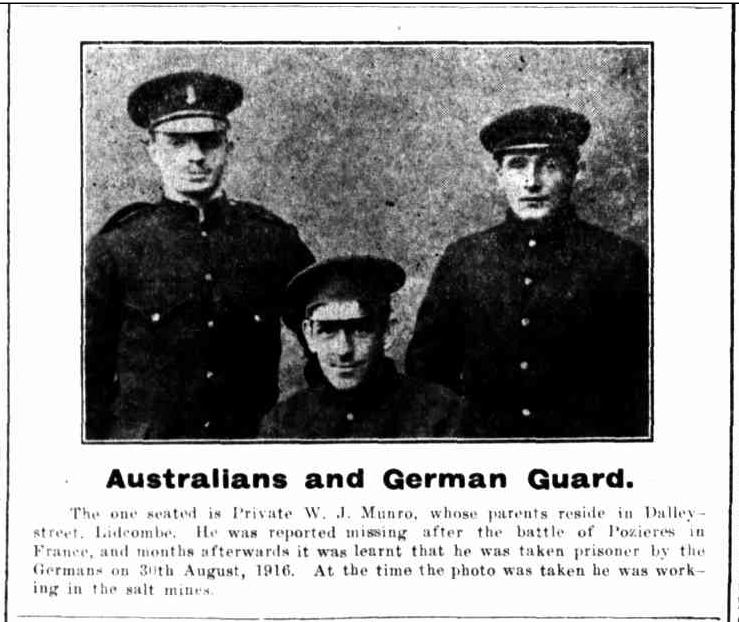
A photo of him appeared in the Cumberland Argus and Fruitgrowers Advocate on 8th June 1918 with another prisoner of war and a German prison guard, reporting that he was working in the salt mines.[2]


W. J. Munro (seated) with another prisoner of war and a German guard, 1918 (Cumberland Argus and Fruitgrowers Advocate, 8/6/1918)

W. J. Munro (seated) with another prisoner of war and a German guard, 1918 (Cumberland Argus and Fruitgrowers Advocate, 8/6/1918)

Private Munro remained a prisoner for the remainder of the war. In December 1918 he was repatriated to England, arriving at Hull on 7th December 1918, and in London on 9th December 1918.

On 28th January 1919 Private Munro was charged with Being Absent Without Leave from 10 am on 11th January 1919 until 9 am on 28th January 1919. He was fined a total of 34 days pay. On 29th January 1919 Private Munro marched into the Number One Command Depot at Sutton Veny, England.

On 2nd March 1919 Private Munro departed England aboard the Derbyshire bound for Australia. He arrived in Australia on 24th April 1919, and was discharged Termination of Period of Enlistment on 9th June 1919.

[1] ‘The procession’, The Cumberland Argus and Fruitgrowers Advocate, 13 November 1915, p. 11, http://nla.gov.au/nla.news-article86101767
[2] ‘Australians and German Guard’, The Cumberland Argus and Fruitgrowers Advocate, 8 June 1918, p. 10, http://nla.gov.au/nla.news-article86207336


William Henry NICHOLLS

William Henry NICHOLLS

Per his military service record (regimental no. 2369), William Henry Nicholls was born at Camperdown, Sydney, N.S.W.[1]  He gave his age as 27 years and 6 months, his marital status as single, and his occupation as contractor. His description on his medical was height 5 feet 10 inches tall, weight 143 lbs., with a fair complexion, green eyes, and brown hair. His religious denomination was Church of England. He claimed that he had 12 months experience in the school cadets.

He completed his medical on the 2nd October 1915 at Coonamble, and was attested at Coonamble on the 21s October 1915. However another Application to enlist in the Australian Imperial Force form in his service record was made at Dubbo on 21st October 1915 (after the Coo-ee March had passed through this town), and his medical examination form dated 2nd October 1915 at Coonamble is countersigned by Dr. E.H. Burkett at Dubbo and dated 21st October 1915.

William Henry Nicholls was reported to have been ‘one of the Coo-ees’ in the Leader.[2] It appears that he was one of the two men from Coonamble reported in the Gilgandra Weekly as catching up with the Coo-ees at Molong on 22nd October 1915 – the other being ‘Coonambleite’ Jack Parker, who also did his medical at Dubbo on 21st October 1915.[3]

After completing the Coo-ee March he went to Liverpool Camp as reinforcement for the 13th Battalion.

On the 23rd March 1916 he was transferred to the 16th Reinforcements for the 7th Light Horse Regiment.

On his embarkation roll his address at time of enrolment was Coonamble, N.S.W., and his next of kin is listed as his aunt, Salina [sic] Ann Bradbury, Richmond, Rocky Point Road, Sans Souci, N.S.W.

On 18th April 1916 Trooper Nicholls departed Sydney on the HMAT A56 Palermo, arriving in Egypt on 18th May 1916.

On 21st May 1916 Trooper Nicholls was admitted to the Government Hospital at Suez with Mumps. On 17th June 1916 he was discharged from hospital and rejoined the 2nd Light Horse Training Regiment at Tel-El-Kebir, Egypt.

On 5th August 1916 Trooper Nicholls departed the 2nd Light Horse Training Regiment to join the 7th Light Horse Regiment. On 16th August 1916 Trooper Nicholls marched into the 7th Light Horse Regiment when it was resting at Bir Etmaler, Egypt.

On 14th February 1917 the Regiment was conducting training at Masaid, Egypt. Trooper Nicholls was detached to the Division Headquarters for duty. He returned to the Regiment on 1st March 1917 when it was resting at Sheik Zowaiid, Egypt.

On 8th March 1917 the Regiment was conducting usual camp duties at Bir Abu Shunnar, Egypt – on this day Trooper Nicholls was charged with loss of equipment viz sword and bayonet.

On 24th of April 1917 the Regiment was manning outposts and Patrolling in the Sinai after being involved in the Second Battle of Gaza. A Squadron of the 7th Regiment had an engagement with a party of Turkish Cavalry at Tel Al Tarar. 18 Turks were captured one of them wounded. Trooper Nicholls was evacuated to the 54th Casualty Clearing Station at Deir el Belah suffering Heat Exhaustion. On 25th April 1917 he moved by Hospital Train to the 26th Casualty Clearing Station at El Arish, arriving on 28th April 1917. On 30th April 1917 he was transferred to the 24th Stationary Hospital at Kantara, Egypt, suffering from Pyrexia (Fever), arriving on the 1st of May 1917. Later that day he was transferred to the 14th Australian General Hospital at Abbassia, Egypt.

On 16th May 1917 Trooper Nicholls was discharged from hospital and reported to the 2nd Light Horse Training Regiment at Moascar, Egypt.

On 30th May 1917 Trooper Nicholls was detached for duty at the Headquarters of the Australian New Zealand Mounted Division Training Centre. Trooper Nicholls remained on this detached duty until 7th November 1917 when he was sent back to the 2nd Light Horse Training Regiment.

On 18th November 1917 Trooper Nicholls left the 2nd Light Horse Training Regiment for return to the 7th Light Horse Regiment. On the way, on 20th November 1917 he was admitted to the 2nd Light Horse Field Ambulance suffering from Gonorrhoea. That same day he was transferred to the 66th Casualty Clearing Station. On 21st November 1917 he was transferred to the 44th Stationary Hospital at Kantara, Egypt. On 22nd November 1917 he was sent to the 2nd Australian Stationary Hospital at Moascar, Egypt.

On 18th December 1917 Trooper Nicholls was discharged from hospital and returned to the 2nd Light Horse Training Regiment. On 31st December 1917 Trooper Nicholls was sent to the rest camp at Port Said, Egypt. On 20th January 1918 he left the rest camp and returned to the 2nd Light Horse Training Regiment.

On 21st March 1918 Trooper Nicholls was charged with When on Active Service Absenting himself Without Leave from 0900 20th March 1918 until he reported himself at 0830 21st March 1918. He was awarded 7 days confined to Camp and fined 2 days pay.

On 12th April 1918 Trooper Nicholls rejoined the 7th Light Horse Regiment when it was in action around Wadi Augua, Palestine.

On 7th May 1918 the 7th Light Horse Regiment was at Jericho, Palestine, when at 0500 eight enemy aeroplanes bombed the camp. The Regiment’s casualties were 3 killed and 10 wounded. Trooper Nicholls was one of those killed in action.

Trooper Nicholls is buried in the Jerusalem War Cemetery, Israel.

Grave of Trooper W. H. Nicholls at Jerusalem War Cemetery (Photograph: S. & H. Thompson 20/2/2020)

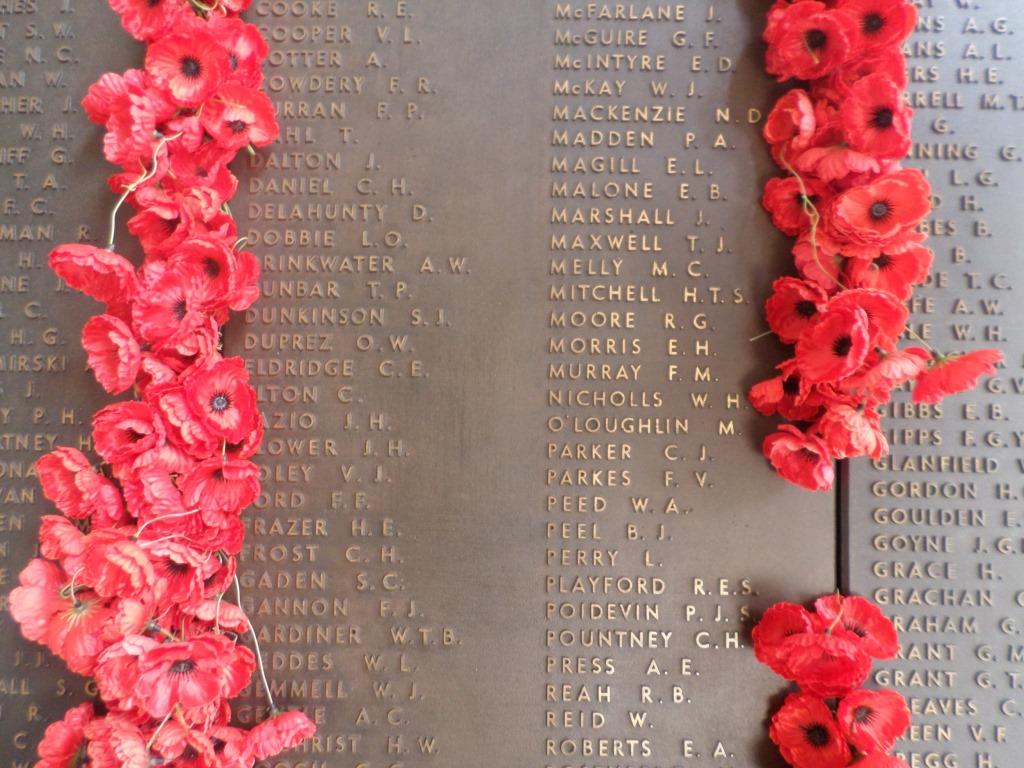
Trooper Nicholls’ name is commemorated on panel 5 on the Australian War Memorial First World War Roll of Honour.

W. H. Nicholls' name on the Australian War Memorial Roll of Honour (Photograph: S. &. H. Thompson 5/1/2015)

W. H. Nicholls’ name on the Australian War Memorial Roll of Honour (Photograph: S. &. H. Thompson 5/1/2015)

The Commonwealth War Graves Commission Register lists that he was the son of the late Arthur and Louisa Nicholls.[4]

[1] NAA B2455, NICHOLLS W H

[2] ‘Personal’, Leader, 22 May 1918, p. 1, http://nla.gov.au/nla.news-article100963899

[3] ‘With the “Coo-ees.” From town to town’, Gilgandra Weekly , 20 October 1915, p. 2. http://nla.gov.au/nla.news-article119923919 ; ‘Our soldiers’, The Dubbo Liberal and Macquarie Advocate, 2 November 1915, p. 2. http://nla.gov.au/nla.news-article77601759

[4] Nicholls, Tpr. William Henry, 2369, Commonwealth War Graves Commission Register, Jerusalem War Cemetery, http://www.cwgc.org/find-war-dead/casualty/647728/NICHOLLS,%20WILLIAM%20HENRY


Thomas JACKSON

Thomas JACKSON

Per his military service record (regimental no. 4816), Thomas Jackson was born at Longford, Derby, Derbyshire, England. He gave his age as 32 years and 2 months, his marital status as single, and his occupation as labourer. His description on his medical was height 5 feet 5 ½ inches tall, weight 146 lbs., with a fair complexion, brown eyes, and dark hair. His religious denomination was Church of England. He claimed that he had no previous military service.

Thomas Jackson had come to Australia about 1911, when he was 28 years of age.[1] The Wellington Times recorded “Jackson” as one of the four recruits who stepped forward offering to join the Coo-ee March when the Coo-ees recruited at Geurie on 15th October 1915.[2]

He completed his medical on the 16th October 1915 at Wellington, and was attested at Dripstone by Captain Nicholas on the 19th October 1915.

After completing the march he went to Liverpool Camp as reinforcement for the 13th Battalion.

On 2nd February 1916 Private Jackson was charged with being Absent Without Leave for one day. He was fined one days forfeiture of pay.

On his embarkation roll his address at time of enrolment was Longford, near Derby, England, and his next of kin is listed as his mother, Mrs L. [Louisa] Jackson, Longford, near Derby, England.

On 8th March 1916 Private Jackson along with many of the other Coo-ees departed Sydney on the HMAT A15 Star of England, and arrived in Egypt on the 11th April 1916.

On the 3rd of May 1916 Private JACKSON was hospitalised at the 31st General Hospital at Port Said sick. He was discharged to duty on 2nd June 1916.

Private Jackson proceeded overseas to join his unit in France [date and ship unknown], via England, leaving the 4th Training Battalion at Rollestone on 30th July 1916. He marched into the 4th Division Base Depot at Etaples in France on 1st August 1916. On 19th August 1916 he was taken on strength of the 13th Battalion whilst it was resting at Pernois, after just coming out of the line at Pozieres.

On 25th September 1916 whilst the 13th Battalion was in action in the vicinity of Voormezeele, Belgium, Private Jackson was admitted to the 12th Australian Field Ambulance suffering from Enteritis. He rejoined the Battalion on the 1st of October 1916.

On 11th April 1917 Private Jackson was with the 13th Battalion when it launched an unsuccessful attack on the Hindenburg Line in the vicinity of Bullecourt, France. During this attack Private Jackson was wounded in action, receiving shrapnel wounds to his face and neck. He was evacuated to the 56th Casualty Clearing Station. On 13th April he was admitted to the 11th Stationary Hospital at Rouen. On 14th April he was admitted to the 2nd Convalescent Depot at Rouen. On 21st April he was discharged and sent to the 4th Australian Division Base Depot at Etaples. On 30th April 1917 he rejoined the 13th Battalion whilst the Battalion was conducting training at Ribemont, France.

On 28th May 1917 Private Jackson was charged with being Absent Without Leave from Tattoo roll call on 24th May 1917 from 9.00 pm to 9.45 pm whilst the Battalion was in training. He was fined one days pay.

On 16th June 1917 Private Jackson was with the 13th Battalion when it was manning support trenches in the vicinity of Messines, Belgium. Private Jackson was one of two men killed from the 13th Battalion that day. Another five men were wounded.

Per his service record he was “buried N. of Hill 63 and about 250 yds N.E. of thatched cottage and about 100 yds West of above, close to Old Dugouts of support trench 1 ¾ mls S.S.W of Messines France”. However, Private Jackson’s grave could not be located after the war, and his name is remembered on the Menin Gate Memorial at Ieper (Ypres), Belgium.

T. Jackson's name on the Menin Gate Memorial (Photograph: S. & H. Thompson 11/9/2012)

T. Jackson’s name on the Menin Gate Memorial (Photograph: S. & H. Thompson 11/9/2012)

Private Jackson’s name is commemorated on panel 69 on the Australian War Memorial First World War Roll of Honour.

His name is also remembered on the St. Chad’s Church War Memorial, at Longford in Derbyshire, England.[3]

[1] Thomas Jackson, Australian War Memorial Roll of Honour Circular, https://www.awm.gov.au/people/rolls/R1643701/

[2] ‘Hitchen’s Coo-ees’, Wellington Times, 18 October 1915, p. 3, http://nla.gov.au/nla.news-article143388423

[3] ‘Thomas Jackson’, Longford St. Chad’s Church War Memorial, Derbyshire, England, http://www.militaryimages.net/media/longford-church-war-memorial-derbyshire.57565/

Laurence Leslie MAGUIRE

Laurence Leslie MAGUIRE

Per his military service record (regimental no. 4840), Laurence Leslie Maguire was born at Gilgandra, N.S.W. He gave his age as 25 years and 11 months, his marital status as single, and his occupation as laborer. His description on his medical was height 5 feet 4 ½ inches tall, weight 10 stone 7 lbs., with a fair complexion, blue eyes, and fair hair. His religious denomination was Anglican. He claimed that he had no previous military service. He completed his medical on the 8th October 1915 1915 at Gilgandra, and was attested by Captain Nicholas at Gilgandra on the 9th October 1915.

After completing the Co-ee March he went to Liverpool Camp as reinforcement for the 13th Battalion.

On his embarkation roll his address at time of enrolment was Woodvale Park, Curban, N.S.W., and his next of kin is listed as his father, R. Maguire, Belmore Street, Gulgong, N.S.W.

On 8th March 1916 Private Maguire along with many of the other Coo-ees departed Sydney on the HMAT A15 Star of England, and arrived in Egypt on the 11th April 1916.

After arriving in Egypt he was transferred to the 45th Battalion on the 20th May 1916.

On the 7th June 1916 Private Maguire left Alexandria aboard the transport Huntspill bound for France, arriving at Marseilles on the 14th June 1916.

On the 19th July 1916 Private Maguire was taken on strength of the 45th Battalion.

On 6th November 1916 the 45th Battalion had just arrived at Dernancourt, France for training when Private Maguire was injured by having his right foot scalded. He was sent to the 1st New Zealand Stationary Hospital at Amiens, France. On 9th November 1916 he was sent by hospital train to the 8th General Hospital at Rouen, France, arriving on the 10th of November 1916. On 27th November 1916 he was sent to Le Harve, France, where on 28th November 1916 he boarded the hospital ship Gloucester Castle. After arriving in England he was admitted to the 2nd Southern General Hospital at Bristol, England.

On 10th January 1917 Private Maguire was discharged from the 2nd Southern General Hospital and went on leave until 25th January 1917, when he reported to the No. 1 Command Depot at Pernham Downs, England.

On 3rd February 1917 Private Maguire was admitted to the 1st Camp Hospital at Parkhouse, England sick. He remained hospitalised until 14th April 1917. He returned to the No. 1 Command Depot on 16th April 1917.

On 25th April 1917 Private Maguire was transferred to the 62nd Battalion which was then forming in England. Private Maguire went to the battalion lines at Windmill Hill Camp. On 12th September 1917 Private Maguire was returned to the 45th Battalion, after the decision was made to disband the 62nd Battalion. On 12th September 1917 Private Maguire departed Southampton, England bound for France.

On 13th September 1917 Private Maguire marched into the 4th Australian Division Base Depot at Etaples, France. On 21st September 1917 he departed Etaples to rejoin the 45th Battalion. On 22nd of September 1917 Private Maguire arrived at the 45th Battalion when it was about to go into action in the Ypres area of Belgium, in the Passchendaele offensive.

On 1st November 1917 he was appointed Lance Corporal.

After serving with the 45th Battalion during the winter of 1917-1918, Lance Corporal Maguire was killed in action during a German artillery barrage when manning the line against the German offensive near Dernacourt, France,  on 2nd April 1918.

According to a letter sent home to his father that was published in the Mudgee Guardian and North-Western Representative by Captain Holman, 45th Battalion, Lance Corporal Maguire was buried on the embankment of the Albert-Amiens railway, near Albert, France.[1] His service record reports that he was buried at Albert, France. However after the war his grave could not be located, and he has no known grave.

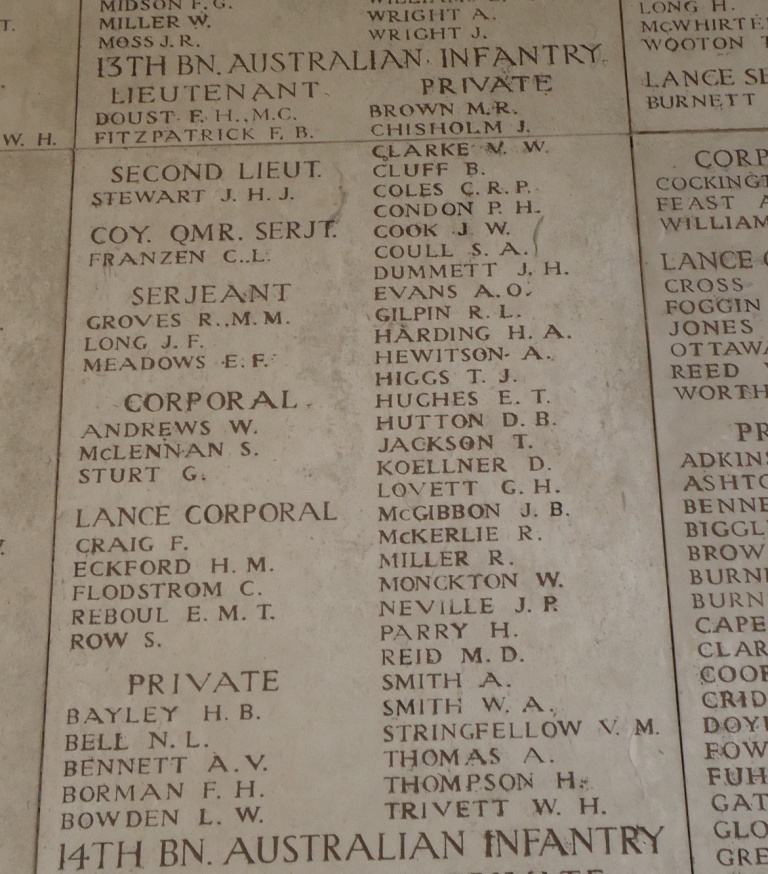
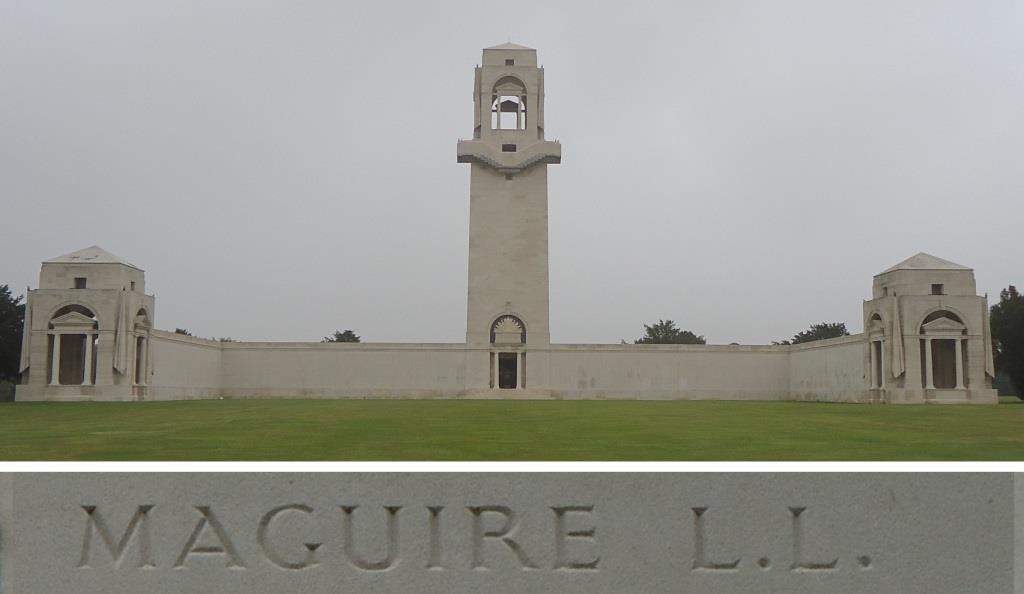
Lance Corporal Maguire is remembered on the Australian National Memorial at Villers-Bretonneux, France. The register at the Villers-Bretonneux Memorial notes that he was the son of Richard Gould Maguire, and Charlotte Maguire, of Gulgong, N.S.W.

Lance Corporal Maguire's name on the Villers-Bretonneux Memorial, France (Photograph: S. & H. Thompson 7/9/2014)

Lance Corporal Maguire’s name on the Villers-Bretonneux Memorial, France (Photograph: S. & H. Thompson 7/9/2014)

Lance Corporal Maguire’s name is commemorated on panel 140 on the Australian War Memorial First World War Roll of Honour.

Lance Corporal Maguire’s name is also remembered on the Gilgandra War Memorial.

[1] ‘How ‘Laurie Maguire was killed’, Mudgee Guardian and North-Western Representative, 15 July 1918, p. 1, http://nla.gov.au/nla.news-article156994727


Blue dungarees and white hats

BLUE DUNGAREES AND WHITE HATS

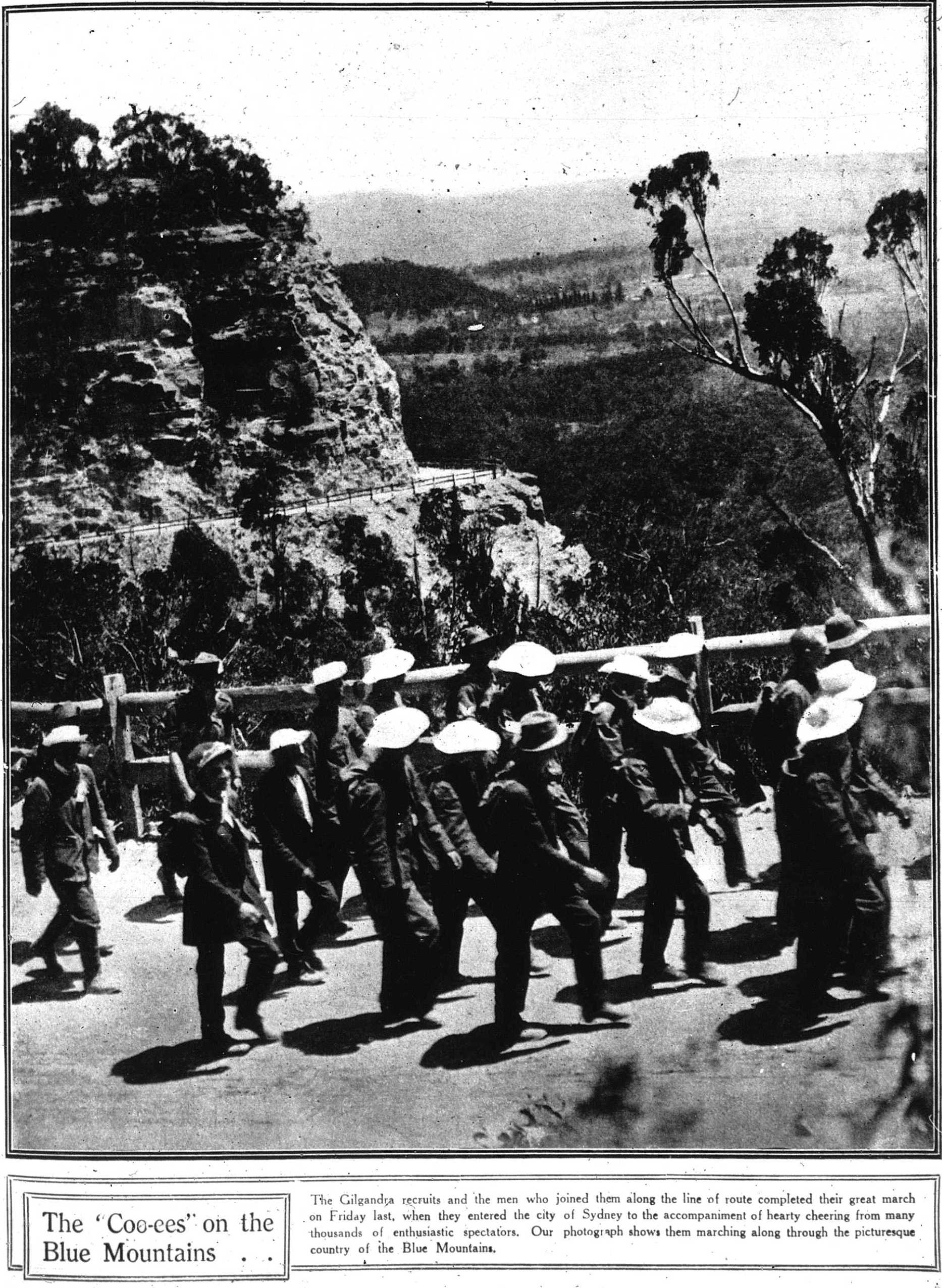
The blue dungaree suits and white hats issued to the Coo-ee recruits at Lithgow were not unique to the 1915 Coo-ee March.

Following Australian Imperial Force (AIF) Order No. 2 on 26 August 1914, which ‘prescribed the uniform, kit, and necessaries to be issued to each member of the AIF’, enrolling recruits in the AIF were to be issued with a dungaree jacket, a pair of dungaree trousers, and a white hat. [1] This hat was described as a ‘white linen hat’ in The Sydney Morning Herald.[2]

“Marmalades” – the new raw recruits in the military camps – were issued with the blue dungaree suits and white hats as their initial uniform, which, according to an article in the National Advocate, if not washed before being worn for the first time, gave a ‘blue tint’ to the mens’ skins, ‘a tinge which gradually deepens upon further acquaintance’ with the unwashed suits.[3]

The Minister for Defence had instructed that dungarees were to be issued to the recruits on the Coo-ee March at Lithgow or Wallerawang, ‘so that the men may finish their march in some approach to uniform’.[4]

Coo-ees on Victoria Pass (Sydney Mail 17/11/1915)

Coo-ees in their crisp new dungaree suits and white hats climbing Berghofers Pass on their way to Mt. Victoria (Sydney Mail 17/11/1915)

Following the issue of the blue dungarees and white hats to the Coo-ees at Lithgow, The Farmer and Settler noted that when the Coo-ees were welcomed at Mount Victoria the men looked ‘more soldierly than they had done, with their new uniform, dungarees and white hats – the recruits’ dress of the training camps’.[5]

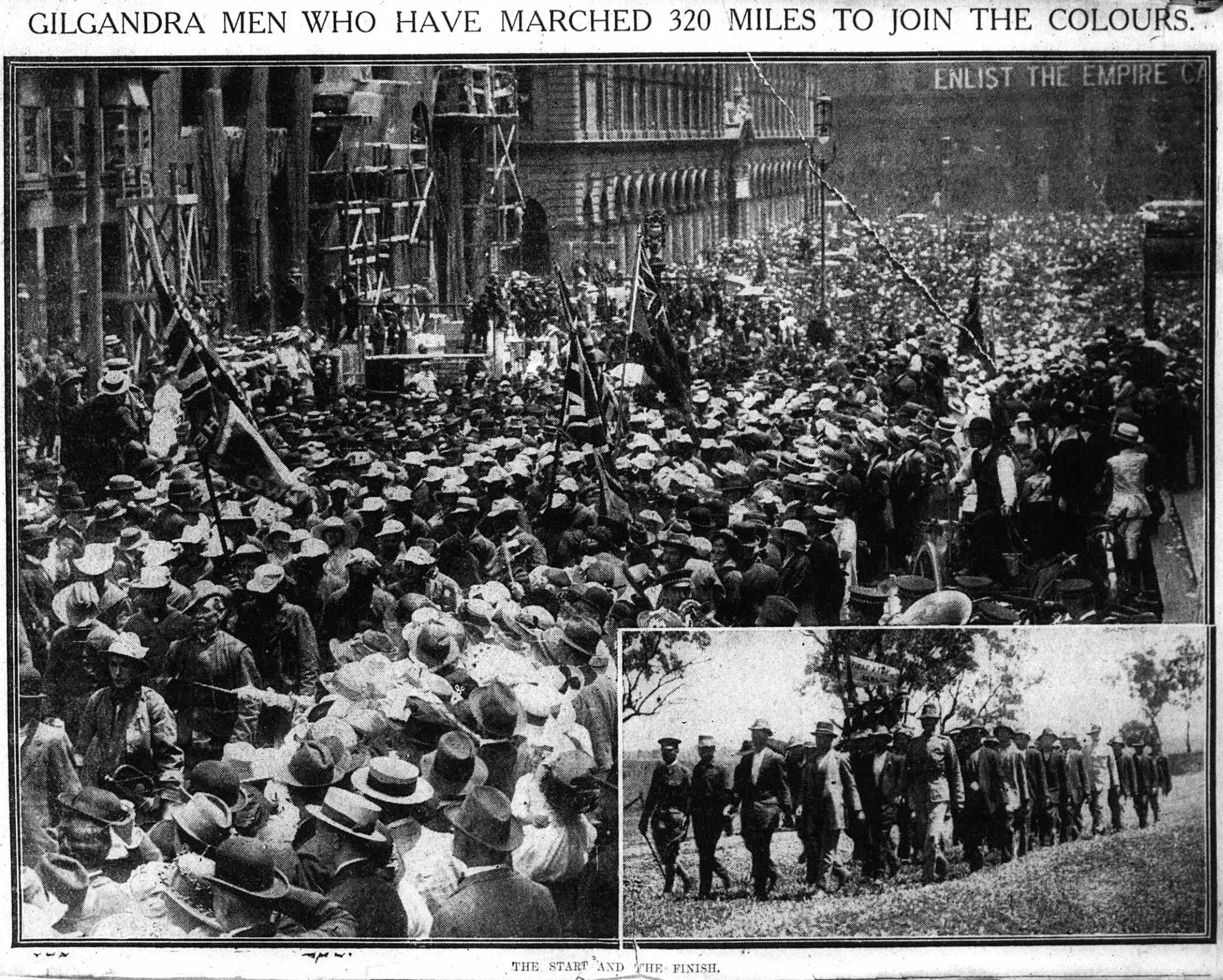
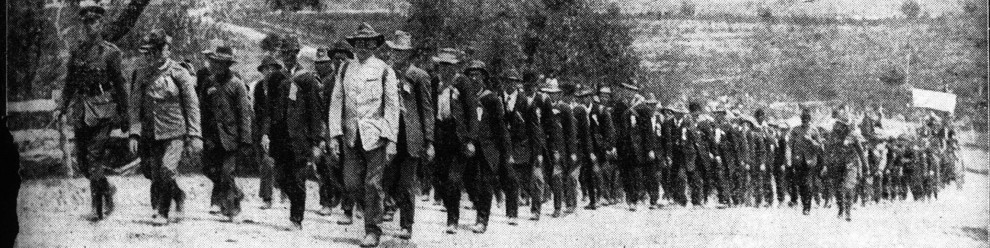
The Sydney Morning Herald reported on their arrival and triumphant procession into the city of Sydney that they ‘wore blue dungarees which didn’t always fit them, and they were somewhat travel-stained and weary after five weeks’ march – somewhat slouchy, in fact; but the city never gave a more enthusiastic welcome to any body of men that it gave to these 263 men from the country.’[6]

The start and the finish (Sydney Morning Herald 13/11/1915)

The start and the finish (Sydney Morning Herald 13/11/1915)

[1]Australian War Memorial, ‘Soldier’s kit, First World War (1914), https://www.awm.gov.au/encyclopedia/soldiers_kit/

[2] ‘Our troops. Enrolling recruits. The equipment’, The Sydney Morning Herald, 28 September 1914, p. 8, http://nla.gov.au/nla.news-article15544205

[3] ‘Liverpool Camp’, National Advocate, 2 October 1915, p. 7, http://nla.gov.au/nla.news-article158151954

[4] Great Route March. Gilgandra to the coast : the “snowball” growing as it rolls’, The Farmer and Settler, 29 October 1915, p. 3. Retrieved June 27, 2015, from http://nla.gov.au/nla.news-article116671286

[5] ‘The Route March through the mountains. The column reviewed by the Governor-General’, The Farmer and Settler, 9 November 1915, p. 3, http://nla.gov.au/nla.news-article116669569

[6] ‘The Coo-ees. Gilgandra men in Sydney. A Great Welcome. Stirring scenes’, The Sydney Morning Herald, 13 November 1915, p. 19, http://nla.gov.au/nla.news-article15624720


Karl Alex Frederick NIELSON

Karl Alex Frederick NIELSON

Per his Application for Certificate of Naturalization dated 4th September 1915, under the name Karl Axel Frederik Nielsen, he was born on 19th December 1890 at Nestved, Sjaelland, Denmark, and arrived in Newcastle, Australia, from the United States of America on 15th April 1913, on the Canada Cape.[1] Per a letter in this file dated 29th August 1915 he applied to be naturalized so he could be eligible to enlist to join a “mate” who had already enlisted.

Per his military service record (regimental no. 4865), Karl Alex Frederick Nielson was born at Sjelland, Denmark. He gave his age as 24 years and 11 months, his marital status as single, and his occupation as Bushman. His description on his medical was height 5 feet 10 inches tall, with a ruddy complexion, grey eyes, and dark brown hair. His religious denomination was Church of England. He claimed that he had no previous military service. Although he did not complete his medical examination until 13th November 1915 at Liverpool, and was attested at Liverpool on the 13th November 1915, his date of joining on the nominal roll was recorded as the 8th November 1915, when the Coo-ees were on their way from Lawson to Springwood. Per The Blue Mountains Echo he was one of three recruits to join the Coo-es from Hazelbrook.[2]

After the Coo-ee March he went to Liverpool Camp as reinforcement for the 13th Battalion.

On his embarkation roll he is named as Karl Axle Nielson, and his address at time of enrolment was C/- Mrs. Hook, Wentworth Falls, Blue Mountains, N.S.W. His next of kin is listed as Mrs D. [i.e. E.] Hook, Wentworth Falls, Blue Mountains, N.S.W.

Mrs [Ellen] Hook described him in a letter dated 4th December 1921 in his service record as “a mate of my son [Augustus “Gus” James Hook, who had joined the AIF on 26th August 1915] and always made my place his home long before he enlisted”.

On 8th March 1916 Private Nielson along with many of the other Coo-ees departed Sydney on the HMAT A15 Star of England, and arrived in Egypt on the 11th April 1916.

On 16th April 1916 Private Nielson was transferred to the 4th Pioneer Battalion at Tel-el-Kebir.

On 6th May 1916 Private Nielson was admitted to the 54th Casualty Clearing Station at Serapeum, Egypt, with an illness Not Yet Diagnosed. That same day he was transferred to the 12th Field Ambulance. On 22nd May 1916 Private Nielson was discharged and returned to his unit

On 4th June 1916 Private Nielson left Alexandria aboard the Transport Scotian bound for France, arriving at Marseilles on 11th June 1916.

On 15th July 1916 the 4th Pioneer Battalion was at Canaples, France, conducting training. On this day Private Nielson was charged with Conduct to the Prejudice of Good Order and Military Discipline in that he while on Parade replied in an insubordinate manner to NCO who was instructing Parade. He was awarded one day Field Punishment Number 2.

On 6th August 1916 the 4th Pioneer Battalion was maintaining Tramway Trench in the ruins of the village of Pozieres which was under heavy German artillery fire during the Battle of Pozieres when Private Nielson was killed in action. Also killed with him in the 4th Pioneer Battalion on the same day were fellow Coo-ees Oliver James Harmon (who joined the Coo-ee March at Parramatta), and John Tarlington (who joined at Blayney).

An entry in Private Nielson’s service record notes that he was ‘Believed buried at Copse Avenue Pozieres’. However his body was not able to be located.

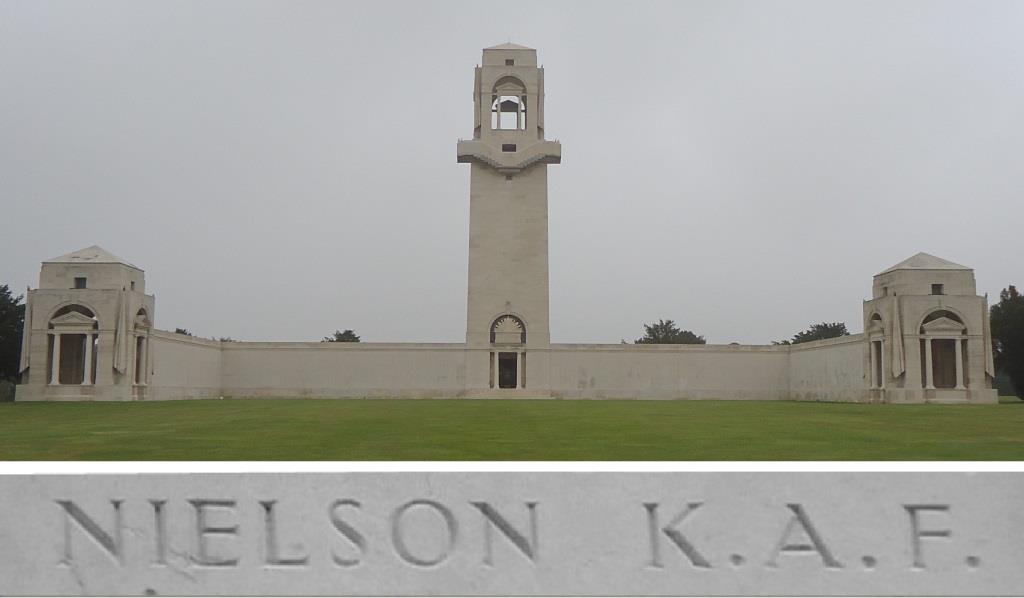
Private Nielson is remembered on the Australian National Memorial at Villers-Bretonneux in France.

Private Nielson's name on the Villers-Bretonneux Memorial, France (Photograph: S. & H. Thompson 7/9/2014)

Private Nielson’s name on the Villers-Bretonneux Memorial, France (Photograph: S. & H. Thompson 7/9/2014)

Private Nielson’s name is commemorated on panel 114 on the Australian War Memorial First World War Roll of Honour. His place of association is Hazelbrook.

Hi name is also remembered on the Wentworth Falls War Memorial.

[1] Karl Axel Frederik Nielsen, Hazelbrook, Labourer, ‘Application for Certificate of Naturalization’, stamped 17 September 1915, http://recordsearch.naa.gov.au/scripts/Imagine.asp?B=33454

[2] ‘Hazelbrook’, The Blue Mountain Echo , 19 November 1915, p. 6, http://nla.gov.au/nla.news-article108047454. Note: named as “Harry Neilsen”, and “An earlier recruit, Mr. Gus Hook, was also present”.


Rowland John WILSON

 Rowland John WILSON

Per his military service record (regimental no. 4910), Rowland John Wilson was born at Tallawang, N.S.W.[1]  He gave his age as 24 years and 1 month, his marital status as single, and his occupation as labourer. His description on his medical was height 5 feet 6 inches tall, weight 10 stone 6 lbs., with a fair complexion, grey eyes, and brown hair. His religious denomination was Roman Catholic. He claimed that he had 3 months experience with the Lawson Rifle Club. The “Joined on” date on his Attestation Paper was 7th November 1915.  He was attested at Lawson on 7th November 1915.

After completing the march he went to Liverpool Camp as reinforcement for the 13th Battalion. He completed his medical examination at Liverpool on 15th November 1915.

On his embarkation roll he is listed under the name Ronald John Wilson, and his address at time of enrolment was Queens Road, Lawson, N.S.W.  His next of kin is listed as his brother [i.e. uncle], P. J. Wilson, Queens Road, Lawson, N.S.W.

On 8th March 1916 Private Wilson along with many of the other Coo-ees departed Sydney on the HMAT A15 Star of England, and arrived in Egypt on the 11th April 1916. On the 19th April 1916 Private Wilson was transferred to the 45th Battalion at Tel-el-Kebir.

On the 2nd June 1916 Private Wilson left Alexandria aboard the transport Kinfauns Castle bound for France, arriving at Marseilles on the 8th June 1916.

Private Wilson served with the 45th Battalion during its first action at Fleurbaix, France in July 1916. Private Wilson then moved with the 45th Battalion to Pozieres, France, in early August 1916.

Private Wilson was killed on the night of the 7th/8th August 1916 when the 45th Battalion was under heavy enemy artillery fire between Pozieres and Martinpuich in the Battle of Pozieres – the same night that fellow Coo-ee William Emerton Hunter was killed, who was also in the 45th Battalion.

Private Wilson’s date of death is recorded as 8th August 1916. He has no known grave.

Private Wilson is remembered on the Australian National Memorial at Villers-Bretonneux in France.

Private Wilson's name on the Villers-Bretonneux Memorial, France (Photograph: S. & H. Thompson 7/9/2014)

Private Wilson’s name on the Villers-Bretonneux Memorial, France (Photograph: S. & H. Thompson 7/9/2014)

Private Wilson’s name is commemorated on panel 141 on the Australian War Memorial First World War Roll of Honour.

His name is also remembered on the Lawson War Memorial.

[1] NAA: B2455, WILSON R J

William WEBBER

William WEBBER

Per his military service record (regimental no. 4917), William Webber was born at Granville, N.S.W. He gave his age as 23 years and 5 months, his marital status as single, and his occupation as fitter. His description on his medical was height 5 feet 5 inches tall, weight 136 lbs., with a fair complexion, blue eyes, and brown hair. His religious denomination was Church of England. He claimed that he had no previous military experience. He completed his medical on the 11th November 1915 at Ashfield, and was attested at Ashfield on the 11th November 1915.

After completing the Coo-ee March he went to Liverpool Camp as reinforcement for the 13th Battalion.

On his embarkation roll his address at time of enrolment was Walker Street, Five Dock, N.S.W., and his next of kin is listed as his mother, Mrs. M. E. [Mary Elizabeth] Webber, Walker Street, Five Dock, N.S.W.

On 8th March 1916 Private Webber departed Sydney on the HMAT A15 Star of England, along with many of the other Coo-ees, arriving in Egypt on the 11th April 1916. On the 19th April 1916 he was transferred to the 45th Battalion at Serapeum.

On 1st May 1916 at Serapeum, Egypt, Private Webber was charged with Being Absent Without Leave from 0815 on 29th April 1916 to 1500 on 30th April 1916. He was awarded 7 days Confined to Barracks and forfeiture of four days pay. On 25th May 1916 Private Webber was charged with being Absent for Parade at 1830. He was awarded 7 days Confined to Barracks.

On 2nd June 1916 Private Webber left Alexandria aboard the Transport Kinfauns Castle bound for France, arriving at Marseilles on 8th June 1916.

Private Webber served with the 45th Battalion through its first action at Fleurbaix, France in July 1916.

On 6th August 1916 the 45th Battalion was in action between Pozieres and Martinpuch, France. They had been under heavy artillery fire since entering the battle the day before, and suffered numerous casualties, with 32 killed (including fellow Coo-ee Jack Morris who had joined the Coo-ees at Parramatta), and 70 wounded. Private Webber was evacuated suffering shell shock, and listed as wounded in action. He was sent back to the 1st Australian Rest Station. On 14th August 1916 Private Webber returned to the Battalion when it was relieving the 46th Battalion in the front line near Pozieres.

On 16th September 1916 the 45th Battalion had been moved to Victoria Camp near Rhenninghelst, Belgium, conducting training. On this day Private Webber was charged with being Absent for Parade at 0645, 0900, 1400 on 15th September 1916. He was awarded 7 days field Punishment Number 2.

On 7th November 1916 the 45th Battalion was at Dernacourt, France, conducting training, when Private Webber was charged with Conduct to the Prejudice of Good Order and Military Discipline to with making remarks likely to cause insubordination. He was awarded 14 days Field Punishment Number 2.

On 11th November 1916 the 45th Battalion moved forward from Dernacourt to Fricourt, France. At 1030 on this day Private Webber went missing. He was not located until 1115 on 7th December 1916. Private Webber was placed under arrest and sent to the 4th Australian Division Base Depot at Etaples, France, under escort.

On 26th December 1916 a Field General Court Martial was held with Private Webber being charged with When on Active Service Deserting his Majesty’s Service. Private Webber was found guilty and sentenced to be shot. On 3rd January 1917 the sentence was varied by General Rawlinson, Commander of the 4th Army, to 10 years Penal Servitude.

On 20th January 1917 Private Webber was admitted to the Number 1 Military Prison at Rouen, France, to undergo his sentence. On 4th February 1917 the sentence was commuted to 2 years Imprisonment with Hard Labour by the Commander In Chief.

On 25th January 1918 Private Webber was released from the number 1 Military Prison at Rouen, France, with the remainder of his sentence being suspended. On 29th January 1918 Private Webber rejoined the 45th Battalion whilst it was training at La Clytte, Belgium.

On 6th April 1918 the 45th Battalion was in action in the vicinity of Dernacourt, France, when Private Webber was killed by an artillery shell that burst in the trench he was manning.

Private Cyril Roy McMillan, who had joined the Coo-ees at Parramatta, was taken as a German prisoner of war in the same battle, and he reported after his release in a letter to “The Argus” dated 20th November 1918, that Webber, whom he described as one of his ‘mates’ he had ‘enlisted with’, had been ‘killed alongside’ him, just before they ‘started to advance on the Germans’ (The Cumberland Argus and Fruitgrowers Advocate, 18/1/1919, p. 10).

Private Webber was initially buried in the trench by his platoon members, then later reinterred at the Millencourt Communal Cemetery near Albert, however in later fighting the grave was lost or destroyed and could not be located.

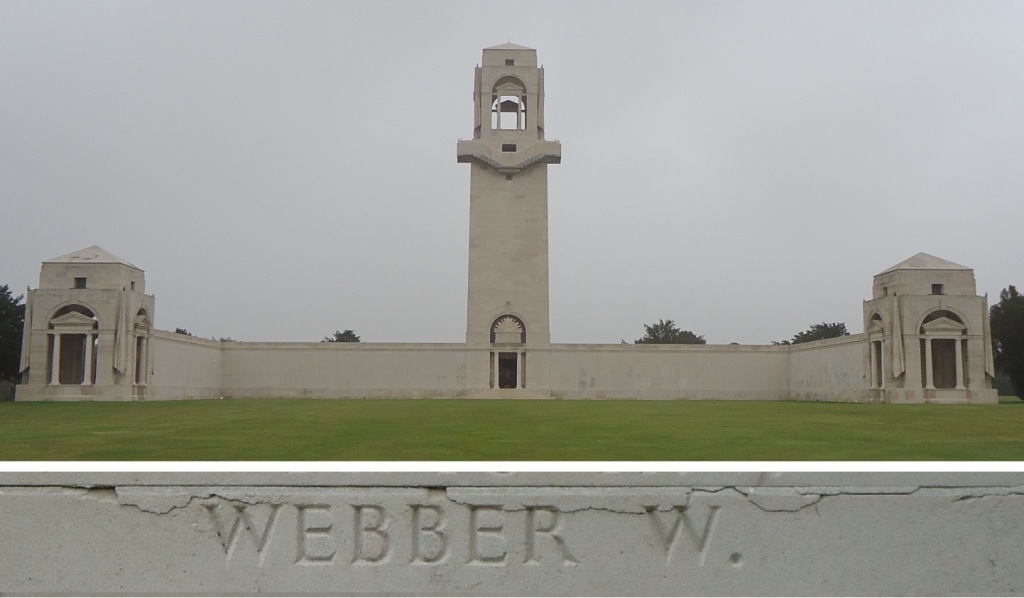
Private Webber has no known grave, and is remembered on the Villers-Bretonneux Memorial, France.

Private Webber's name on the Villers-Bretonneux Memorial, France (Photograph: S. & H. Thompson 7/9/2014)

Private Webber’s name on the Villers-Bretonneux Memorial, France (Photograph: S. & H. Thompson 7/9/2014)

Private Webber’s name is commemorated on panel 140 on the Australian War Memorial First World War Roll of Honour.

Private Webber’s name is also remembered on the Five Dock War Memorial.

Jack MORRIS

Jack MORRIS

Jack Morris (Photograph: Australian War Memorial)

Jack Morris (Photograph: Australian War Memorial)

Per his military service record (regimental no. 4849), Jack Morris was born at Pennant Hills, N.S.W. He gave his age as 18 years and 1 month, his marital status as single, and his occupation as rivetter. His description on his medical was height 5 feet 4 ½ inches tall, weight 134 lbs., with a fair complexion, grey eyes, and light hair. His religious denomination was Wesleyan. He claimed that he had 4 years previous V.T. experience. He completed his medical on the 11th November 1915 at Parramatta, and was attested at Parramatta on the 11th November 1915. A note in his service record from his mother Annie Morris gave permission for her son Jack Morris to enlist in the Australian Expeditionary Force, dated 11th November 1915.

After completing the Coo-ee March he went to Liverpool Camp as reinforcement for the 13th Battalion.

On his embarkation roll his address at time of enrolment was Sorrell Street, Parramatta, N.S.W., and his next of kin is listed as his widowed mother, Mrs. A. [Annie] Morris, Sorrell Street, Parramatta, N.S.W.

On 8th March 1916 Private Morris departed Sydney on the HMAT A15 Star of England, along with many of the other Coo-ees, arriving in Egypt on the 11th April 1916. On the 19th April 1916 he was transferred to the 45th Battalion at Serapeum. On the 23rd April 1916 he was sent to hospital sick. He rejoined the 45th Battalion on 1st May 1916.

On 2nd June 1916 Private Morris left Alexandria aboard the transport Kinfauns Castle bound for France, arriving at Marseilles on 8th June 1916.

Private Morris served with the 45th Battalion through its first action at Fleurbaix in France in July 1916, then as it moved to Pozieres in early August 1916. It was whist the 45th Battalion was in action in the vicinity of Pozieres, France, that Private Morris was killed in action on the night of the 5th/6thth of August 1916. His official date of death is the 6th August 1916. He has no known grave.

He died in the Battle of Pozieres on the same day as three Coo-ees in the 4th Pioneer Division – Oliver Harmon, another Coo-ee who joined at Parramatta, John Tarlington, who joined the Coo-ees at Blayney, and Karl Alex Frederick Neilson, who joined the Coo-ees at Springwood.

His death was reported in The Cumberland Argus and Fruitgrowers Advocate (9/9/1916 p. 4) as follows:

‘The Late Private Jack Morris.
The only son of a Parramatta widow.
One of the very sad cases of the losses of brave young soldiers was that when it was officially reported early this week to Mrs. Morris, widow, of Sorrell-street, Parramatta North, that her only son, a well-known Parramatta lad, Private Charles John (“Jack”) Morris, who enlisted at Parramatta with “the Coo-ees,” had been killed. Private Morris was born at Pennant Hills, and he would have been 19 years of age, had he lived, on the 28th of October. He was educated at the Brothers’ School, Parramatta North. His last letter was received three weeks ago, and was dated June 24. He had been to Egypt, and had then gone on to France, and was at the time of writing at the back of the fighting line, and within the sound of the guns. He left four sisters. He was reported to have been killed in action on the 5th or 6th of August.

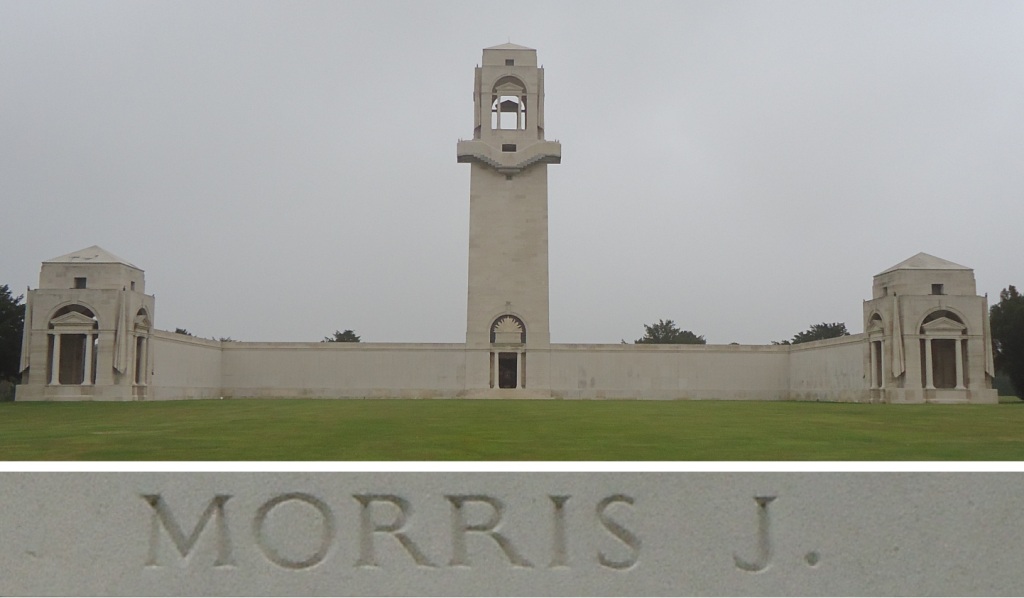
Private Morris is remembered on the Villers-Bretonneux Memorial, France.

Private Morris' name on the Villers-Bretonneux Memorial, France (Photograph: S. & H. Thompson 7/9/2014)

Private Morris’ name on the Villers-Bretonneux Memorial, France (Photograph: S. & H. Thompson 7/9/2014)

Private Morris’ name is commemorated on panel 140 on the Australian War Memorial First World War Roll of Honour.

Private Morris’ name is also listed on the Parramatta War Memorial (under C. J. Morris).