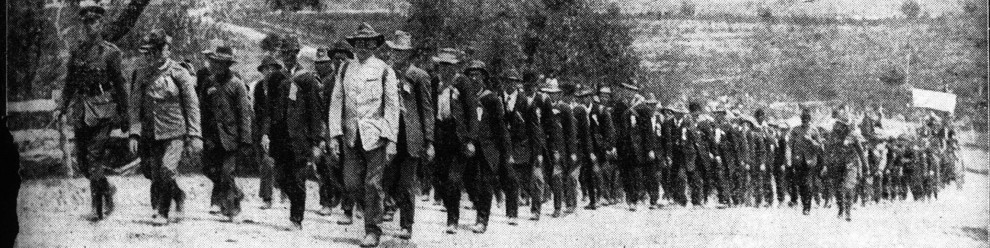
Samuel CLARK

Samuel CLARK

Per his initial military service record (Depot), Samuel Clark was born at Coonabarabran, N.S.W. He gave his age as 33 years and 1 month, his marital status as single, and his occupation as labourer. His description on his medical was height 5 feet 2 ½ inches tall, weight 118 pounds, with a medium complexion, grey eyes, and dark brown hair. His religious denomination was Church of England. He completed his medical examination at Dubbo on 8th November 1915, and was attested by at Dubbo on 8th November 1915. He claimed to have 3 months previous service in the Australia Light Horse, then was discharged due to illness.

His next of kin in his service record was listed as his mother, Mrs Josephine McDonald, Frederick Street, Dudley, near Newcastle.

The postal address he gave on his initial Application to enlist in the Australian Imperial Force form at Dubbo on 22nd October 1915 was ‘Coonamble’. He did a preliminary medical examination at Coonamble on 22nd October 1915.

A Statutory Declaration in his service record stated that he ‘joined the Route March of recruits marching from Gilgandra to Sydney’.  Although he enlisted at Dubbo on 8th November 1915, the Coo-ees were marching from Lawson to Springwood in the Blue Mountains on that date. He would have had to have caught up by train to join the Coo-ee March as it neared Sydney.

A letter from The Council of the Municipality of Penrith dated 3rd May 1916 stated that S. Clark ‘joined the Coo-ees at Penrith’, so he must have been one of the two recruits referred to in the Nepean Times as ‘not residents’ who joined the Coo-ee March during the Coo-ees’ overnight stay at Penrith on the 9th November 1915.[1]

After the Coo-ee March, Private Clark went before a Medical Board at Liverpool Camp on 17th November 1915, and was found medically unfit with Varicole, and was discharged on 29th November 1915.

[1] Alex Halden (Joe) Miller papers mainly relating to the Gilgandra Coo-ee Recruitment March, New South Wales, 1912-1921, 1939. Gilgandra Coo-ee Recruitment March correspondence and papers, 1915-1939 ; ‘Coo-ees at Penrith’, Nepean Times, 13 November 1915, p. 3, http://nla.gov.au/nla.news-article86168730

Selby George MEGARRITY

Selby George MEGARRITY

Per his military service record (regimental no. 4841), Selby George Megarrity was born at Luddenham near Penrith N.S.W. (He was the son of Robert George Megarrity, a dairyman at Wallacia, and Kate Megarrity nee Vicary). He gave his age as 19 years and 9 months, his marital status as single, and his occupation as labourer. His description on his medical was 5 feet 8 ½ inches tall, weight 146 lbs., with a fair complexion, blue eyes, and sandy hair. His religious denomination was Church of England. He claimed that he had no previous military service. He did his medical examination on 10th November when the Coo-ees were at Penrith, however he was not attested until the Coo-ees were at Ashfield on 11th November 1915.

A note signed by his father R. G. Megarrity dated 16th November 1915 is in his service record, stating: ‘This is to certify that I give my consent to my son Selby George to enlist with the Gilgandra Coo-ees’.

Selby George Megarrity (along with A. Easterbrook and W. A. Sutton) was one of the three Penrith men reported as stepping forward to join the Coo-ees ‘amidst the cheers of the audience’, in response to Mr Blacket’s recruitment speech and call of “What do we want, Coo-ees?” and their response of “We want men – men, and plenty of them!”, during the open-air Concert held for the Coo-ees at Penrith on the evening of Tuesday, 9th November, 2015.[1]

He was given a sendoff at Wallacia on Saturday 11th December 1915, which was attended by over 150 people, where he was presented with a leather vest, wristlet watch and money belt from the residents, and a parcel from Mulgoa Red Cross Society containing two pairs socks, two undershirts, two pairs pyjamas and a muffler.[2]

On Selby George Megarrity’s embarkation roll his address at time of enrolment was Wallacia, via Penrith, N.S.W., and his next of kin is listed as his father, R. G. Megarrity, Wallacia via Penrith, N.S.W. His date of joining is recorded as 9th November 1915 (the day the Coo-ees arrived in Penrith).

On 8th March 1916 Private Megarrity departed Sydney on the HMAT A15 Star of England, along with many of the other Coo-ees, as part of the 15th reinforcements for the 13th Battalion. He arrived in Egypt on 11th April 1916.

On 16th April 1916 he was transferred to the 5th Division Cyclist’s Company.

On 18th April 1916 he was sent to the 15th Field Ambulance suffering from influenza. On 19th April 1916 he was transferred to Hospital at Ferry Post, Egypt. He was discharged and rejoined his unit on 21st April 1916.

On [17]h June 1916 Private Megarrity departed Alexandra, Egypt, bound for England. He arrived at Marseilles, France, on 25th June 1916.

On 12th July 1916 Private Megarrity was admitted to the 50th Casualty Clearing Station suffering from Chicken Pox. On 15th July 1916 he was transferred to the 7th General Hospital. He was discharged and returned to his unit on 23rd July 1916.

On 23rd May 1916 Private Megarrity was detached for duty as an escort to the 2nd ANZAC Corps Commander. On 29th September 1916 he rejoined the Corps Cyclist Battalion.

On 10th October 1916 Private Megarrity was detached to the Signals School.

Private Megarrity went on leave in France from 20th January 1917 until 10th February 1917, when he returned to the Cyclist Battalion.

On 18th May 1917 Private Megarrity was detached for duty with the Corps Anti Aircraft Section. He rejoined the Battalion on 25th May 1917.

On 2nd July 1917 Private Megarrity was detached to the Signalling School. He rejoined the Battalion on 6th July 1917.

On 23rd July 1917 Private Megarrity was detached to the Power Buzzer School. He rejoined the Battalion on 1st August 1917.

On 20th November 1917 Private Megarrity was detached for duty with the New Zealand 5th Otago Battalion. He returned from the detachment on 25th November 1917.

On 16th January 1918 Private Megarrity was taken on strength of the Australian Corps Cyclist Battalion.

On 9th March 1918 Private Megarrity went on leave to England. He returned to the Cyclist Battalion on 26th March 1918.

On 1st November 1918 Private Megarrity went on leave again to England, where he was still on leave at the time of the Armistice. He returned to the Cyclist Battalion on 19th November 1918.

On 7th February 1919 Private Megarrity was transferred to the Australian Corps Signal Company and his rank designation was changed to Sapper.

On 24th April 1919 Sapper Megarrity departed Havre in France to commence his return to Australia. He arrived at Southampton on 25th April 1919 and marched into the Number 1 Group at Sutton Veny, England.

On 16th June 1919 Sapper Megarrity departed England aboard the Transport Ormonde bound for Australia. He arrived in Australia on 4th August 1919, and was discharged Termination of Period of Enlistment on 26th September 1919.

His name is listed (under McGarrity, J.) as one who served on the Penrith 1914-1918 Roll of Honour at Penrith City Memory Park war memorial.

[1] ‘Coo-ees at Penrith’, Nepean Times, 13 November 1915, p. 3, http://nla.gov.au/nla.news-article86168730

[2] ‘Soldier’s send-off’, (1915, December 18). Nepean Times, 18 December 1915, p. 6, http://nla.gov.au/nla.news-article86165454
 

Badges worn by the Coo-ees

Badges worn by the Coo-ees (purple ribbons with silver writing)

I was fascinated to read about the ‘purple badges’ worn by the Coo-ees in the following paragraph published in the Sydney Morning Herald on 13th November, 1915:

‘Thus had the little army grown since it started out from Gilgandra on October 10 twenty-five strong. Ten more men from the little western town, set in a district where bug hearts are, joined the original twenty-five on the way; and from Dubbo, Wongarbon, Geurie, Wellington, Stuart Town, Molong, Orange, Blayney, Bathurst, Yetholme, Wallerawang, Lithgow, and the towns along the mountains, and, indeed, all the way down to Sydney, other batches joined in, and were supplied with dungarees and white hats – and the purple badges with the silver lettering, “Gilgandra Coo-ees—Hitchens’ Own,” with which the contingent set out.’[1]

What were these “purple badges” that the Coo-ees had worn on the Coo-ee March?

I recently visited the State Library of New South Wales to view one of these “badges”, after learning that one of them was in the Alex Halden (Joe) Miller papers in the Mitchell Library Collection. I obtained permission to take the following photograph:

Coo-ee badge (purple ribbon). Part of the Mitchell Library Collection at the State Library of NSW (Photograph: H. Thompson 22/5/2015)

Coo-ee badge (purple ribbon). Part of the Mitchell Library Collection at the State Library of NSW (Photograph: H. Thompson 22/5/2015)

It was amazing to see the purple ribbon in such pristine condition – I could still see the sprinkles of the silver paint used for the lettering on the ribbon.

Researching the purple badges worn by the Coo-ees further, I found that at Euchareena the ‘school children ran races for Hitchen’s “Coo-ee” badge’.[2]

At Molong over a pound’s worth of “Coo-ees” ribbons were sold for a shilling each to raise money for the march.[3]

The Leader reported that the Coo-ees wore their purple badges pinned to their shoulders when they marched through Orange.[4]

The rolls of ribbon for the Coo-ee badges had been supplied by Wises’, Ltd., in Sydney.[5]

So, along with the ones worn by the Coo-ees, and these additional ribbons that were sold and given away during the march, there were hundreds of them in people’s possessions at the conclusion of the Coo-ee March in 1915.

I wonder how many other Coo-ee badge ribbons are still in existence 100 years after they were worn on the Coo-ee March, hidden away in a family member’s First World War memorabilia tin or box, or in a photo album or scrapbook?

[1] ‘The Coo-ees. Gilgandra Men in Sydney’, The Sydney Morning Herald, 13 November, 1915, p. 19.

[2] ‘With the “Coo-ees.”’, Gilgandra Weekly, 29 October 1915, p. 2.

[3] ‘The Route March’, The Farmer and Settler, 26 October, 1915, p. 3.

[4] ‘Hitchen’s March to the Sea’, Leader, 25 October, p. 4.

[5] ‘Gilgandra Recruiting Association’, Gilgandra Weekly, 26 November, 1915, p. 4.


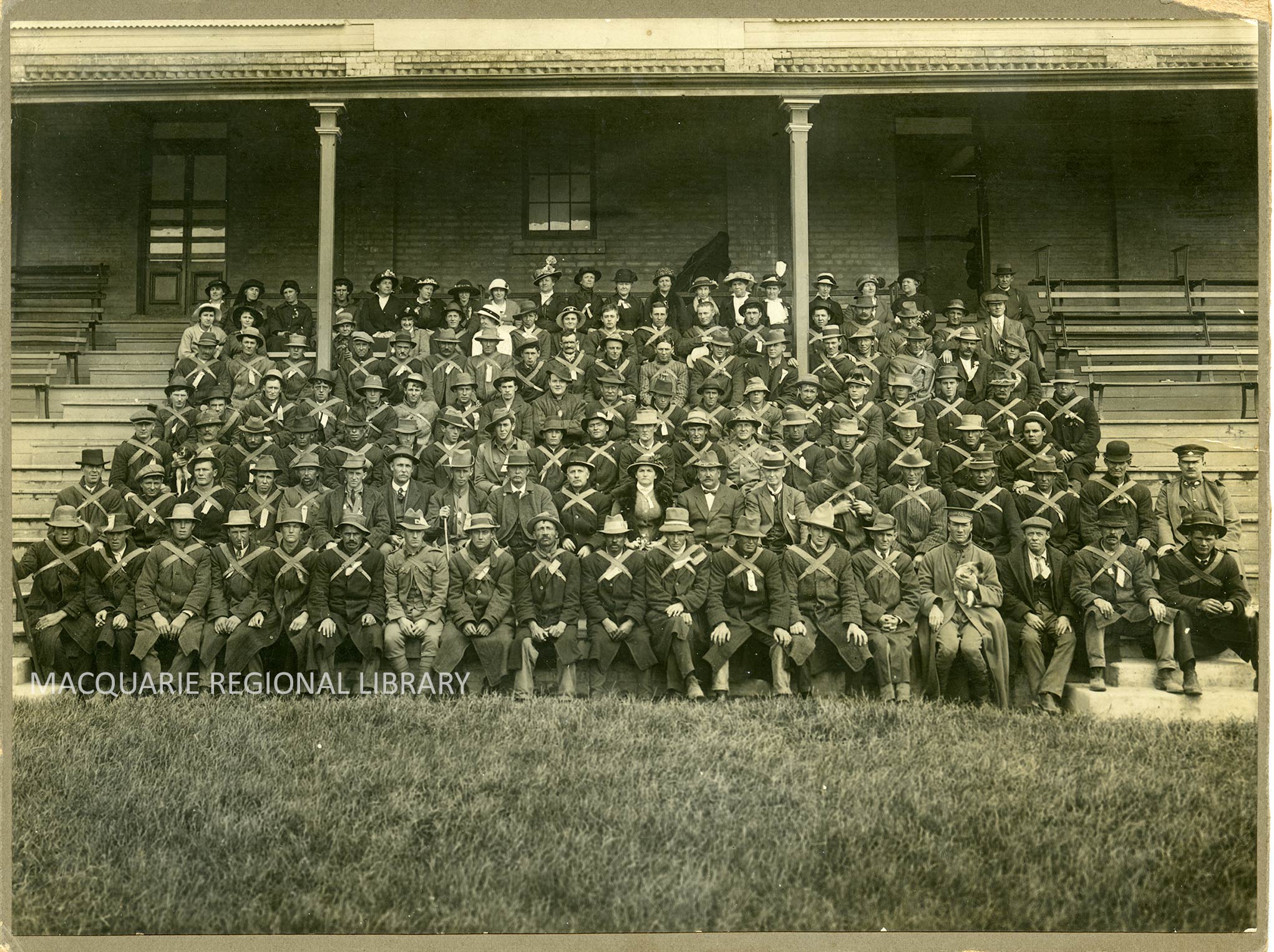
Updated photo of the Coo-ees at Orange

Macquarie Regional Library has kindly supplied me with a higher resolution view copy of the photograph of the Coo-ees at Orange for this website.  I have replaced the photo on the https://cooeemarch1915.com/2015/07/26/photo-of-the-coo-ees-at-orange/ page with this better image.

For those who follow my blog posts by email you might like to revisit this page and click twice on the photo to increase its size. They quality of the photograph is quite remarkable.

See if you can find the two little dogs in the photograph.  Harder to spot is a little black kitten!

Included in this photograph are the men who enlisted in the Coo-ee Recruitment March as they marched from Gilgandra to Dubbo, Wongarbon, Geurie, Wellington, Stuart Town, Euchareena, Molong, through to Orange, where the photograph was taken. (Some may be missing, including the 5 in Orange Hospital sick at the time).

If you have a photograph of a Coo-ee in your family photo collection that joined  the Coo-ee March between Gilgandra to Orange, please take a moment and see if you can find him in this group photograph.

Please send an email to me at cooeemarch1915@gmail.com if anyone can identify any of the people in this photograph.

Photo of the Coo-ees at Orange

PHOTO OF THE COO-EES AT ORANGE

The Coo-ees at Wade Park, Orange, October 1915. Photograph courtesy of Macquarie Regional Library

The Coo-ees at Wade Park, Orange, October 1915. Photograph courtesy of Macquarie Regional Library

This is a photograph of the Coo-ees who were in the Gilgandra to Sydney Cooee-Recruitment March, taken while they were in Orange in October 1915.  Inscribed on the back of the photograph is “The Coo-ees at Orange”.

Except for Captain Bill Hitchen from Gilgandra (sitting in the middle of the second row from the bottom), the people in it are not identified.

This original photograph is part of the Local Studies Collection at Macquarie Regional Library.  A high resolution digital copy can be purchased from Macquarie Regional Library for the purpose of private research and study, and the quality of the image allows you to zoom in on each face and see each individual Coo-ee quite clearly.  Further information about the photograph can be found on the Macquarie Regional Library website at http://catalogue.mrl.nsw.gov.au/cgi-bin/spydus.exe/ENQ/OPAC/BIBENQ?BRN=170437

Included in this photograph are the men who enlisted as they marched from Gilgandra to Dubbo, Wongarbon, Geurie, Wellington, Stuart Town, Euchareena, Molong, to Orange, where the photograph was taken. (Some may be missing, including the 5 in Orange Hospital sick at the time).

There are approximately 104 men, and 23 women seated on a grandstand, which was situated at Wade Park in Orange. Most of the women are seated at the back.

Names of the dignitaries and local Orange people included in the photograph were reported in a 1915 newspaper article, and these people too need to be identified in this photograph. Per The Leader (17 November 1915, p. 8): ‘Seated in the group are the Mayor and Mayoress (Ald. and Mrs E. T. Neilly) Mr H. J. Leary, secretary of the Orange Recruiting Association. Mr. A. J. McCoy, headmaster of the Orange Public School, Mr. V. H. Millard, and the ladies who gave their services towards looking after “Hitchen’s Own” what time they were in Orange.’

A project I am working on is to identify as many Coo-ees as possible in this photograph. Please send an email to cooeemarch1915@gmail.com if anyone can identify any of the people in this photograph.

Alan John Burnett EASTERBROOK

Alan John Burnett EASTERBROOK

Per his military service record (regimental no. 4772), Alan John Burnett Easterbrook was born at Penrith N.S.W. He gave his age as 23 years and 6 months, his marital status as single, and his occupation as baker. His description on his medical was height5 feet 11 inches tall, weight 172 lbs., with a fair complexion, blue eyes, and light brown hair. His religious denomination was Church of England. He claimed that he had no previous military service. His joined on date on his Attestation paper in his service record is dated 9th November 1915, however he did not complete his medical examination, and his attestation, until 2nd December 1915, at Liverpool.

‘Allen [sic] Easterbrook’ (along with J. Megarrity and W. A. Sutton) was one of the three Penrith men reported as stepping forward to join the Coo-ees ‘amidst the cheers of the audience’, in response to Mr Blacket’s recruitment speech and call of “What do we want, Coo-ees?” and their response of “We want men – men, and plenty of them!”, during the open-air Concert held for the Coo-ees at Penrith on the evening of Tuesday, 9th November, 2015.[1]

After the Coo-ee March he went to Liverpool Camp as reinforcement for the 13th Battalion.

On 15th December 1915 Private Easterbrook was charged with being Absent Without Leave and he was fined. On 16th February 1916 he was again charged with Being Absent Without Leave and Being Absent from Special Parade. He was fined again. On 21st February 1916 he was again charged for Being Absent Without Leave for two days. He received another fine.

On Allan [sic] John Burnett Easterbrook’s embarkation roll his address at time of enrolment was High Street, Penrith, N.S.W., and his next of kin is listed as his mother, Mrs E. [Elizabeth] Easterbrook, High Street, Penrith, N.S.W. His date of joining is recorded as 9th November 1915.

On 8th March 1916 Private Easterbrook departed Sydney on the HMAT A15 Star of England, along with many of the other Coo-ees, as part of the 15th reinforcements for the 13th Battalion. He arrived in Egypt on 11th April 1916.

On 7th June 1916 Private Easterbrook left Alexandria aboard the Transport Ionian bound for France, arriving at Marseilles on 14th June 1916.

On 26th July 1916 Private Easterbrook was at the 4th Australian Division Base Depot when he was charged with Falling out of the line of march without a permit and Remaining absent from Training Parade, and he was fined one day’s pay.

On 19th of August 1916 Private Easterbrook joined the 13th Battalion when it was in action around Pozieres, France. Private Easterbrook served through the fighting around Pozieres until 30th August 1916 when he was reported wounded in action. He was admitted to hospital sick on 1st September 1916 in France.

Private Easterbrook’s experience at Pozieres was reported in an article published in the Nepean Times, 18th August 1917 (p. 2):

‘Private Easterbrook gave … a vivid impression of operations, in which he was engaged, culminating in the heroic advance on Pozieres, in which on 29th August, 1916, he sustained casualties – wounds from shrapnel … The attack on that sector of the enemy’s positions at Pozieres in which Private Easterbrook took part was timed for midnight, and in recounting the valiant rush to the German trenches, Private Easterbrook says, “it was about five past twelve when we hopped over the parapet. A good many of our chaps dropped on the way across … Later on that eventful wintry morning he succumbed to the shrapnel “visitation,” and some days afterwards was sent to Boulogne Hospital, France; and was subsequently transferred across the channel to the 1st Eastern General Hospital Cambridge, where he had the best of nursing and medical treatment. On becoming convalescent, Private Easterbrook spent several weeks in sight-seeing in London, and other parts of England, and is loud in his praises of the lavish hospitality meted out to Australian soldiers by the people of England ….’[2]

On 5th September 1916 Private Easterbrook was placed aboard the Hospital Ship St David at Boulogne, France, bound for England. Upon arrival he was admitted to the 1st Eastern General Hospital in Cambridge, England, suffering from Rheumatism. On 10th October he was transferred to the 3rd Auxiliary Hospital at Southall, England with Gun Shot Wound back. He was granted furlough in London from 16th to 31st October 1916.

He marched into No. 1 Convalescent Depot at Perham Downs on 3rd November 1916.

On 8th November 1916 he was transferred to the 1st Australian Dermatological Hospital at Bulford, England, sick, and  suffering from Rheumatism. He was discharged on the 8th of March 1917 and marched into the 2nd Command Depot at Weymouth, England.

On the 23rd May 1917 Private Easterbrook embarked from Devonport on the A33 Ayrshire bound for Australia with Rheumatism. He arrived in Sydney on the 19th of July 1917, and was discharged medically unfit on the 21st of August 1917.

His name is listed on the 1914-1919 Penrith Roll of Honour at Penrith City Memory Park.

[1] ‘Coo-ees at Penrith’, Nepean Times, 13 November 1915, p. 3, http://nla.gov.au/nla.news-article86168730

[2] ‘Returned Soldier’, Nepean Times, 18 August 1917, p. 2, http://nla.gov.au/nla.news-article86146710


Leo Ambrose STINSON

Leo Ambrose STINSON

Per his military service record (Depot), Leo Ambrose Stinson was born at Boomey, near the town of Wellington, N.S.W. He gave his age as 18 years and 11 months, his marital status as single, and his occupation as storeman. His description on his medical was height 6 feet and ½ inch tall, weight 9 stone 7 lbs., with a dark complexion, brown eyes, and dark hair. His religious denomination was Roman Catholic. He claimed that he had no previous military service. He completed his medical on the 22nd October 1915 at Gilgandra (12 days after the Coo-ees left), then caught up with the Coo-ees, and was attested at Blayney by Captain Eade on the 26th October 1915 (when the Coo-ees were at Blayney).

Leo Stinson was the recruit who joined the Coo-ees at Blayney from Gilgandra by train that was reported in the The Farmer and Settler, 29 October, 1915, p. 3.[1]

After completing the march he went to Liverpool Camp into D Coy 5th Battalion.

Following a further medical examination before the Medical Board on 17th November 1915 after arriving at Liverpool Camp with the Coo-ees, Private Stinson was discharged on the 29th of November 1915 as medically unfit, with deficient chest measurement.

On 18th March 1916 Leo Stinson re-enlisted at Dubbo, where he passed his medical and was attested. After some training he embarked from Sydney on 9th September 1916 as 15th reinforcement for the 20th Battalion on the HMAT A14 Euripides. He was given regimental no. 5644.

On his embarkation roll his address at time of enrolment was Miller Street, Gilgandra, N.S.W., and his next of kin is listed his father, John Nicholas Stinson, Rydal, N.S.W.

He arrived at Plymouth in England on 26th October 1916.

Private Stinson trained in England until 13th December 1916, when he was sent to Etaples in France. He joined the Battalion in France on 26th January 1917.

On the 15/16th of April 1917 a German attack broke through the front line near Lagnicourt in France and the guns of the 2nd Australian Field Artillery Brigade were captured. The 20th Battalion was involved in the counterattack that recaptured the guns and forced the Germans back to their lines. Over 200 Germans were captured by the Battalion in this operation. Six members of the Battalion were killed, and were 16 wounded, including Private Stinson, who received a gunshot wound to his back and another to his right arm. Private Stinson was evacuated to the 9th Casualty Clearing Station, then admitted to the 10th General Hospital in Rouen on 17th April 1917. He was then sent to England on 29th April 1917, and was admitted to the 5th Southern General Hospital on 30th April 1917.

On 7th July 1917 Private Simpson was discharged from the 5th Southern General Hospital to No. 1 Auxiliary Hospital at Harefield.

On 26th September 1917 Private Stinson left England on the HMAT Borda bound for Australia. He arrived in Melbourne on 25th November 1917, and was discharged as medically unfit on 4th January 1918.

On 22nd July 1919 Private Stinson re-enlisted in the Special Service AIF (regimental no. 86082), and on 12th August 1919 he departed Sydney bound for Europe as an escort for deportees being sent to Europe. He arrived at London on 12th October 1919. On 5th December 1919 Private Stinson commenced his return to Australia, arriving on 23rd January 1920. He was discharged on 7th February 1920.

Leo Stinson also enlisted in the AIF in the Second World War.

[1] ‘Great Route March. Gilgandra to the Coast’, ’, The Farmer and Settler, 29 October 1915, p. 3, http://nla.gov.au/n la.news-article116671286


Ernest Stephen TAYLOUR

Ernest Stephen TAYLOUR

Per his military service record (regimental no. 4905), Ernest Stephen Taylour was born at London, England. He gave his age as 37 years and 8 months, his marital status as married, and his occupation as labourer. His description on his medical was height 5 feet 3 inches tall, weight 134 lbs., with a dark complexion, brown eyes, and black hair. His religious denomination was Church of England. He claimed to have no previous military service.

He completed his medical on the 11th November 1915 at Parramatta, and was attested at Parramatta on the 11th November 1915. The Coo-ees had held a recruiting meeting in the Park at Parramatta on the evening of the 10th November, where it was reported that 41 men had offered themselves as recruits.[1]

After completing the Coo-ee March he went to Liverpool Camp as reinforcement for the 13th Battalion. His service record shows he was made Acting Sergeant on 11th November 1915.

He was reported in The Farmer and Settler on 5th January 1916 as being one of the Platoon Sergeants in E company from the “Coo-ees” column, and it was noted that ‘as the “Coo-ees” are reinforcements for a battalion already at the front, and not part of a new battalion, these ranks may be only temporary’.[2]

On his embarkation roll his address at time of enrolment was Farndon, Prospect Road, Wentworthville, N.S.W., and his next of kin is listed his wife, Mrs M. [Miriam] Taylour, Farndon, Prospect Road, Wentworthville, N.S.W.

On 8th March 1916 Acting Sergeant Taylour departed Sydney on the HMAT A15 Star of England, along with many of the other Coo-ees, as part of the 15th reinforcements for the 13th Battalion. He arrived in Egypt on 11th April 1916.

On 19th April 1916 he transferred to the 45th Battalion in Egypt.

On 2nd June 1916 Private Taylour left Alexandria aboard the transport Kinfauns Castle bound for France, arriving at Marseilles on 8th June 1916.

On 7th August 1916 the 45th Battalion was in the front lines in the vicinity of Pozieres, France, when Private Taylour was evacuated from the field suffering shell shock. He was moved back to the 3rd Casualty Clearing Station, then on 8th August 1916 he was moved to the 13th General Hospital at Boulogne, France. On 9th August 1916 he was placed aboard the hospital ship Jan Breydel for evacuation to England.

On 10th August 1916 he was admitted to the St Lukes War Hospital at Halifax, England.

On 9th October 1916 Private Taylour was discharged from hospital and marched into the Number 2 Command Depot at Weymouth, England.

On 2nd November 1916 he was transferred to the Number 4 Command Depot at Wareham, England.

On 12th April 1917 Private Taylour marched out to Number 2 Base Depot at Weymouth.

On 4th May 1917 Private Taylour departed Devonport, England, aboard H.M.A.T. Runic bound for Australia. He arrived in Australia on 6th July 1917, and was discharged Medically Unfit on 14th August 1917.

[1] ‘The procession’, The Cumberland Argus and Fruitgrowers Advocate, 13 November 1915, p. 11, http://nla.gov.au/nla.news-article86101767

[2] ‘Route Marches. Gathering of the Clans. The “Cooees”winning praise in camp’, The Farmer and Settler, 5 January 1916, p. 3, http://nla.gov.au/nla.news-article116676486


Maurice Bertram FREE

Maurice Bertram FREE

Per his military service record (regimental no. 4776), Maurice Bertram Free was born at Forbes, N.S.W. He gave his age as 32 years and 11 months, his marital status as married, and his occupation as poultry farmer. His description on his medical was height 5 feet 7 ½ inches tall, weight 110 lbs., with a dark complexion, bluish eyes, and black hair. His religious denomination was Church of England. He claimed to have 18 months military service in the G. R. Regiment.

He completed his medical on the 10th November 1915 at Parramatta, and was attested at Parramatta on the 11th November 1915. The Coo-ees had held a recruiting meeting in the Park at Parramatta on the evening of the 10th November, where it was reported that 41 men had offered themselves as recruits.[1]

After completing the Coo-ee March he went to Liverpool Camp as reinforcement for the 13th Battalion. His service record shows he was made Acting Corporal on 11th November 1915.

On his embarkation roll his address at time of enrolment was Baulkham Hills, N.S.W., and his next of kin is listed his wife, Mrs G.[Grace] Free, Cr. Chetwynd Grove and Mary Street, Merrylands, N.S.W.

On 8th March 1916 Acting Sergeant Free departed Sydney on the HMAT A15 Star of England, along with many of the other Coo-ees, as part of the 15th reinforcements for the 13th Battalion. He arrived in Egypt on the HMAT A15 Star of England on 11th April 1916.

On 19th April 1916 he transferred to the 45th Battalion in Egypt.

On 2nd June 1916 Private Free left Alexandria aboard the transport Kinfauns Castle bound for France, arriving at Marseilles on 8th June 1916.

Private Free served with the 45th Battalion through its first action at Fleurbaix, France, in July 1916, then through the battles around Pozieres and Mouquet Farm in August, September, and October 1916.

On 7th October 1916 the 45th Battalion was training at La Clytte, Belgium, where Private Free was promoted to Lance Corporal.

On 15th October 1916 the 45th Battalion conducted a raid upon the German trenches opposite. The raiding party suffered 4 men wounded. Also during the retaliatory artillery barrage 2 men were killed and 8 wounded. It is not clear if Lance Corporal Free was amongst the raiding party but he was wounded in the field, receiving a slight shrapnel wound to his chest. He was evacuated to the 12th Australian Field Ambulance. He rejoined the Battalion on 17th October 1916.

On the 15th of February 1917 the 45th Battalion was training at Mametz Camp, France when Lance Corporal Free was promoted to Temporary Corporal. His rank became permanent on 6th April 1917.

On 27th April 1917 he was promoted to Temporary Sergeant, and detached to 4th Division Infantry School for duty. On 4th June 1917 he was promoted to Sergeant.

On 9th June 1917 the 45th Battalion was in action around Messines, Belgium when Sergeant Free was wounded in action suffering a gunshot wound to his right hand. He was evacuated to the 9th Australian Field Ambulance, then on to 2nd Australian Casualty Clearing Station, then the 19th Ambulance Train, for journey to the 2nd Camp Hospital at Rouen, France. He was discharged on the 2nd of July 1917 and sent to the 4th Australian Division Base Depot at Le Harve, France, arriving on 5th July 1917.

Sergeant Free departed the 4th Australian Division Base Depot on 12th November 1917 and arrived back at the 45th Battalion on 27th November 1917, whilst it was training at St Quentin, France.

On 15th April 1918 Sergeant Free was made a Company Quarter Master Sergeant.

On 29th June 1918 CQMS Free went to England on leave. He returned from leave on 17th July 1918.

On 24th September 1918 CQMS Free was detached for duty with the 27th American Division. He rejoined the 45th Battalion on 2nd October 1918.

On 11th December 1918 CQMS Free marched into the Australian Base Depot at Le Harve, France, for a Medical Board. CQMS Free went before the Medical Board on 17th December 1918. He was classified as B2 and transferred to England, and arrived at Weymouth on 18th December 1918.

On 18th January 1919 CQMS Free departed England aboard the H.T. Ulysses bound for Australia.

He arrived in Australia on 4th February 1919, and was discharged Medically Unfit on 19th July 1919.

[1] ‘The procession’, The Cumberland Argus and Fruitgrowers Advocate, 13 November 1915, p. 11, http://nla.gov.au/nla.news-article86101767

Allan COLQUHOUN

Allan COLQUHOUN

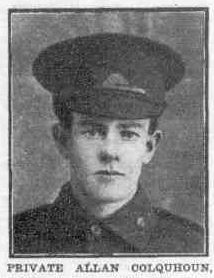
Allan Colquhoun (CumberlandArgus and Fruitgrowers Advocate, 16/11/1918)

Allan Colquhoun (Cumberland Argus and Fruitgrowers Advocate, 16/11/1918)

Per his military service record (regimental no. 4749), Allan Colquhoun was born at Glebe, Sydney, N.S.W. He gave his age as 18 years and 4 months, his marital status as single, and his occupation as saddler. His description on his medical was height 5 feet 4 ¾ inches tall, weight 104 ½ lbs., with a fair complexion, blue eyes, and light brown hair. His religious denomination was Church of England. He claimed that he had 4 years military service in the cadets.

He completed his medical on the 10th November 1915 at Parramatta, and was attested at Parramatta on the 11th November 1915. The Coo-ees had held a recruiting meeting in the Park at Parramatta on the evening of the 10th November, where it was reported that 41 men had offered themselves as recruits.[1]

After completing the Coo-ee March he went to Liverpool Camp as reinforcement for the 13th Battalion.

On his embarkation roll his address at time of enrolment was Redmont [sic, i.e. Belmont] Street, Merrylands, N.S.W., and his next of kin is listed as his aunt, M. Colquhoun, Redmont Street, Merrylands, N.S.W.

On 8th March 1916 Private Colquhoun departed Sydney on the HMAT A15 Star of England, along with many of the other Coo-ees, as part of the 15th reinforcements for the 13th Battalion. He arrived in Egypt on 11th April 1916.

On 11th May he was admitted to hospital at Tel El Kebir, Egypt, suffering from Influenza. He was discharged on 5th June 1916.

On 6th August 1916 Private Colquhoun left Alexandria aboard the Transport Megantic bound for England.

On 23rd September 1916 Private Colquhoun departed England bound for France. He arrived at the 4th Australian Division Base Depot at Etaples on 24th September 1916.

On 21st of October 1916 Private Colquhoun marched into the 13th Battalion when it was in billets at Steenvoorde, Belgium.

On 1st January 1917 the 13th Battalion was at a Brigade Sports day at Rainneville, France when Private Colquhoun was admitted to the 4th Australian Field Ambulance suffering a dog bite. He rejoined the 13th Battalion on 7th January 1917 when it was leaving its billets at Ribemont, France.

On 23rd February 1917 the 13th Battalion was training at Ribemont, France, when Private Colquhoun was admitted to the 3rd Australian Field Ambulance suffering a hernia. He was transferred to the 4th Division Rest Station on 27th February 2017. He rejoined the 13th Battalion on 6th March 1917 at Ribemont, France.

On 11th April 1917 the 13th Battalion was involved in an attack on the Hindenburg Line in the vicinity of the village of Reincourt, France. During this attack the Battalion suffered 25 killed, 118 wounded, and 367 missing. Private Colquhoun was one of those reported missing in action.

On 23rd June 1917 the German authorities reported that Private Colquhoun was a Prisoner of War and was being held at Limburg, Germany.

An article in The Cumberland Argus and Fruitgrowers Advocate on 16th November 1918 reported:

‘Private Allan Conquhoun, who has been a prisoner of war in Gefangenenager [sic] Schneidemuhl, Germany, for over eighteen months, is a nephew of Mr and Mrs A. Colquhoun, of Belmont Street, Merrylands. This young soldier, who is only 21 years of age, joined the “Coo-ees” in Parramatta and sailed for the front on 8th March, 1916, being attached to the 15th Reinforcements of 13th Battalion. In a letter to Miss L. Allmark, of Granville, he says:–“I am the only Australian in this camp, and I spend my time learning the German language. I get good treatment here, but only for the Red Cross parcels I don’t know what I’d do in the way of food. I am in the best of health and you need not worry about me having a bad time, as I am getting on tip top, and hope to be home very soon.”[2]

On 1st December 1918 Private Colquhoun was repatriated to England. He was admitted to the 1st Australian Auxiliary Hospital at Harefield, England. On 13th December 1918 he was granted leave to report back to the hospital on 4th January 1919.

On 5th March 1919 Private Colquhoun departed England aboard the transport Nevesa bound for Australia. He arrived in Sydney on 26th April 1919, and was discharged Termination of Period of Enlistment on 10th June 1919.

[1] ‘The procession’, The Cumberland Argus and Fruitgrowers Advocate, 13 November 1915, p. 11, http://nla.gov.au/nla.news-article86101767

[2] ‘Our Brave Boys on the Battle Fields’, The Cumberland Argus and Fruitgrowers Advocate, 16 November 1918, p. 10, http://nla.gov.au/nla.news-article86210502