Monthly Archives: February 2014

Day 26, Thursday, 4 November, 1915, Hartley to Mount Victoria

Transcription of an extract from an article titled ‘The Route March : Through Lithgow District’ in The Farmer and Settler, 5 November, 1915, p. 3 [part 4 of 4]
… [Continued]

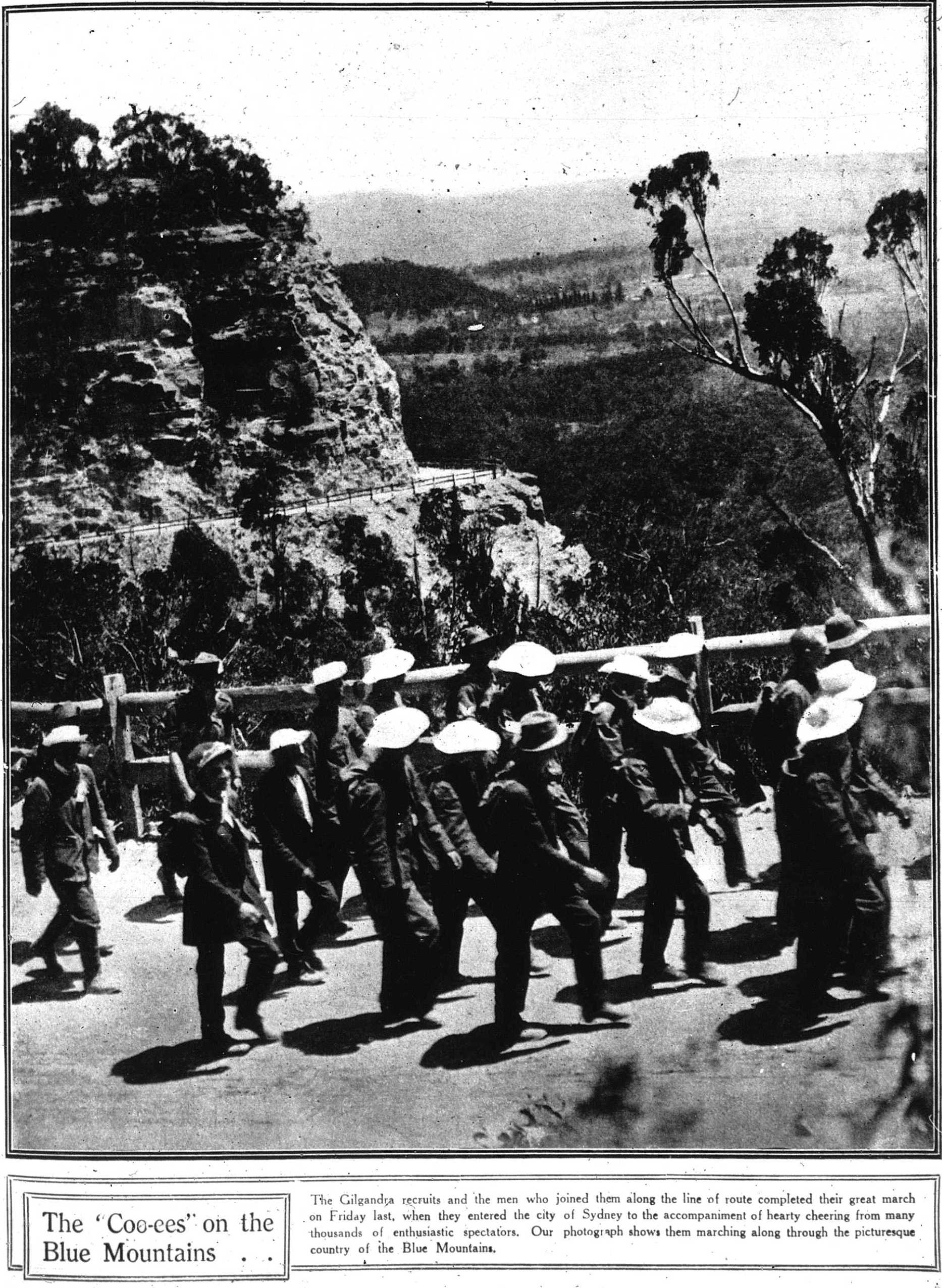
Coo-ees climbing Berghofers Pass on Mt. Victoria (Sydney Mail 17/11/1915)

Coo-ees climbing Berghofers Pass on Mt. Victoria (Sydney Mail 17/11/1915)

Mount Victoria.    
New Victoria Pass was negotiated on Thursday, and the grade tried the transport horses severely. The men appreciated the scenery, but were glad when Mt. Victoria was reached, as it was a dry stage, and the day was warm as it ever could be in the mountains. About a mile out of town the column was met by the Rev. P. J. Hefferman and a party of school children and townspeople. Seven recruits were there also, lined up at the roadside waiting to join the “Coo-ees,” a sight that gladdened the hearts of all. The time of arrival had been fixed so that the marching recruits would be present at the unfurling of a flag on the new staff erected in honor of the arrival of the “Coo-ees.” This ceremony was performed with all due impressiveness, after which the boys adjourned to dinner. Another afternoon’s good hard drill was then given the troops. It is rumored that Colonel Ramacciotti, the State Commandant, intends to make an inspection, but when and where is known only to himself. Staff Captain Eade and Staff Sergeant-Major Scott are accompanying the men to Sydney, also Lieut. Middlemay, of the local camp, and a sergeant of the A.M.C., so the Gilgandra route march is now getting full staff recognition. An open air camp fire concert was held last night, in the Mount Victoria Park, with an excellent programme of harmony and recruiting speeches. Two more recruits caught up by train last night, and the strength of the column is now one hundred and eighty.’

Click here to access the article on Trove: http://nla.gov.au/nla.news-article116680017

Day 25, Wednesday, 3 November, 1915, Lithgow to Hartley

Transcription of an extract from an article titled ‘The Route March : Through Lithgow District’ in The Farmer and Settler, 5 November, 1915, p. 3 [part 3 of 4]
… [Continued]

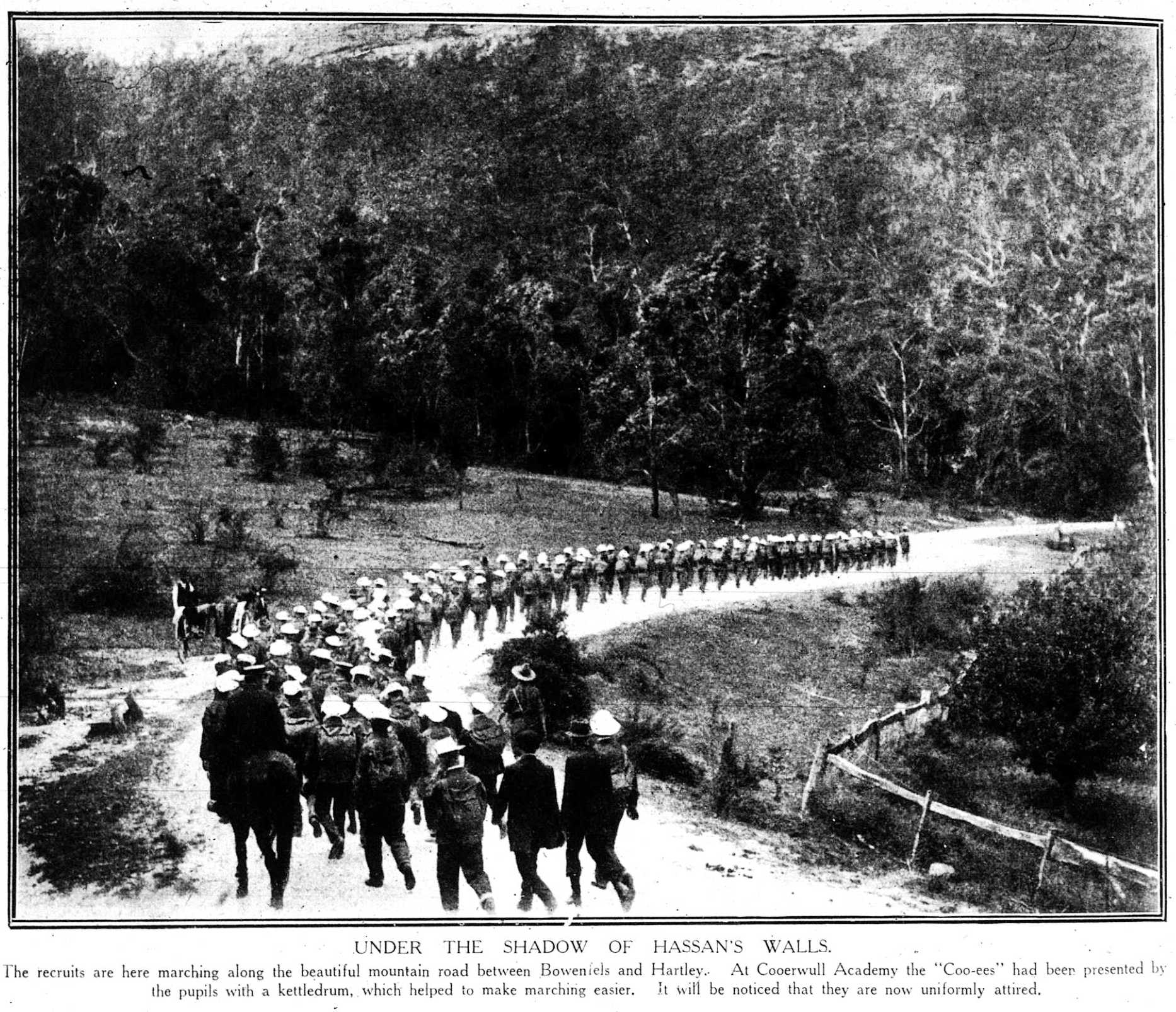
Under the shadow of Hassan's Walls (Sydney Mail 10/11/1915)

Under the shadow of Hassan’s Walls (Sydney Mail 10/11/1915)

Bowenfells.

Lithgow turned out in force to see the last of the “Coo-ees,” and each man was given a tri-color ribbon bearing the inscription, “Lithgow, 3/11/15. ‘Coo-ee!’ Good Luck!” as a souvenir of the occasion. Some ladies also attended with a bag of sweets for each man. The Lithgow camp  recruits marched out with the Gilgandra column as far as the Cooerwull Academy, where a brief halt was made. The boys of the academy had rigged flags across the road, and they met the march with cheers. The boys also presented the column with a kettledrum.

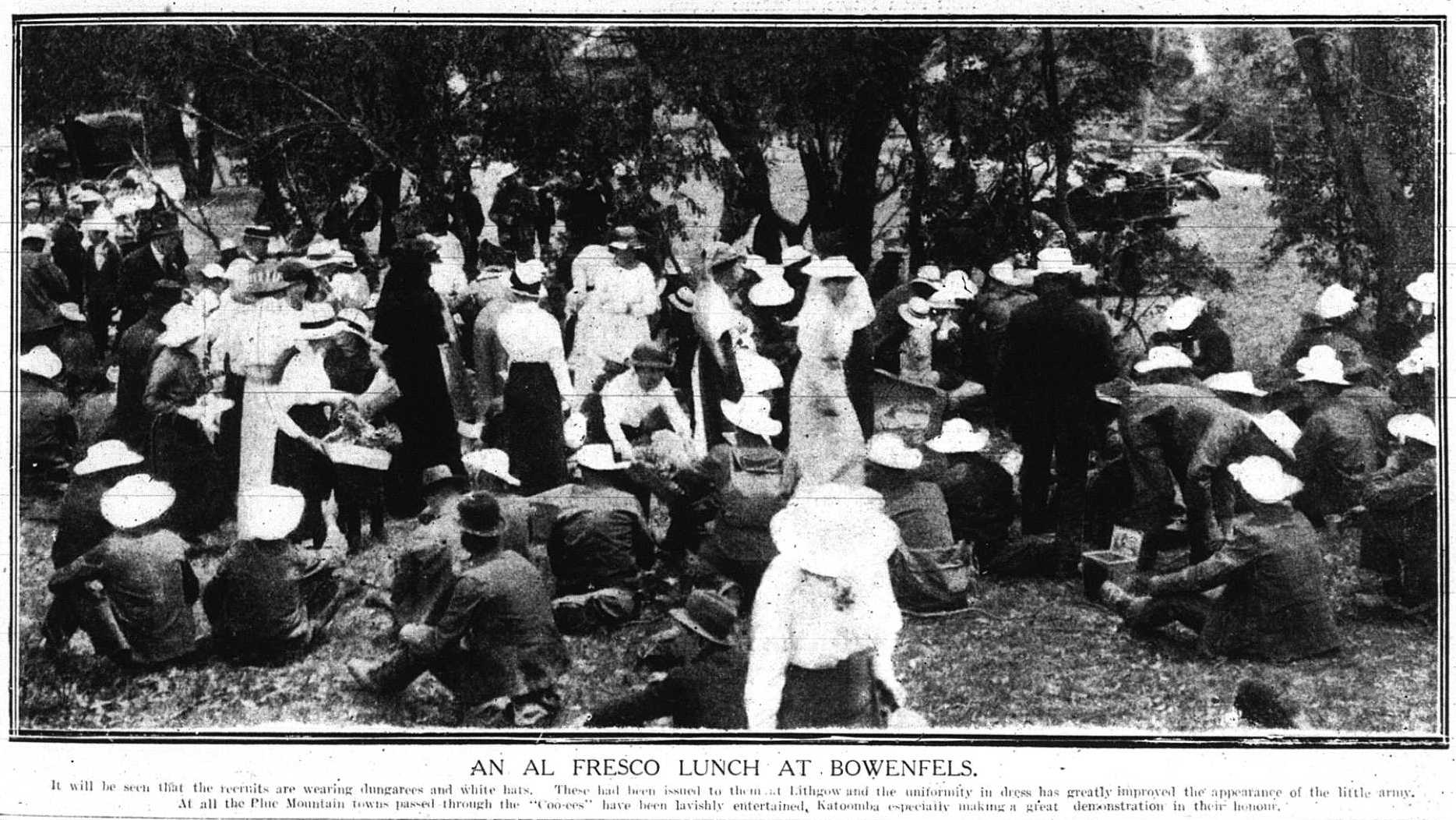
Al fresco lunch at Bowenfells (Sydney Mail 10/11/1915)

Al fresco lunch at Bowenfells (Sydney Mail 10/11/1915)

Lunch was laid at Bowenfells, under the trees opposite the oldest Methodist Church west of the Mountains, Nearby stand an old lock-up and hotel, both dating back to the earliest convict days. There was a surprisingly large assemblage of our friends from Lithgow and other towns further in the Mountains, together with chance tourists that had heard of the approach of the “Coo-ees,” and had come along to see them. Lunch was alfresco, with full and plenty, and it was speedily demolished by the hungry boys, for the walk had been warm and the way hilly.

Only five miles remained for the afternoon’s march, and as the country sloped downwards once more, an hour or two was spent in chatting with the visitors. A little diversion was caused by the discovery that one of the “Coo-ees” had   hitherto escaped the barber, and had a fine crop of curly hair. He was quickly captured by his mates, the camp barber was summoned, and the offending locks removed forthwith.

Reception at Hartley Vale (Sydney Mail 10/11/1915)

Reception at Hartley Vale (Sydney Mail 10/11/1915)

Hartley.

The column made its way into Hartley, headed by a battery of motor-cars, and the road was lined by school children, waving flags. It was strange to see the old courthouse, erected in the early thirties, with all its suggestions of the triangle and leg irons; It was strange to see this old building, the scene of many a convict tragedy, turned into a banquet hall in honor of the boys of the near west, who were going out to battle for the country.

The “Coo-ees” were warmly welcomed by the residents, and afterwards tea was accounted for, and blankets spread under the stars for the night’s bivouac.

Mr. J. McGarry, one of the most enthusiastic workers in entertaining the recruits, is the grandson of old John Mc-Garry, who had the Royal Hotel in the forties. The hotel has been in the hands of the family for three generations, and the place is an excellent example of the architecture of the old colonial days.’

Click here to access the article on Trove: http://nla.gov.au/nla.news-article116680017

Day 24, Tuesday, 2 November, 1915, Lithgow

Transcription of an extract from an article titled ‘The Route March : Through Lithgow District’ in The Farmer and Settler, 5 November, 1915, p. 3 [part 2 of 4]
… [Continued]

‘On Tuesday the “Coo-ees” spent the major portion of the day at squad drill, and in the afternoon a cricket match was played against the local camp boys, resulting in a win for the latter after a hard struggle. Dungaree overalls and   white hats were issued, and advantage was taken of the spare day to overhaul the foot gear of the contingent. A large quantity of new boots was purchased, and three repairers were kept at work all day. Meals were served at the camp, and the men began to think they had been living “high” on the march, when they had to sit down to stew for dinner and bread and marmalade for tea. The Lithgow camp is a drill hall, with an ample area of ground, and is in charge of Captain Eade, who is accompanying the Gilgandra men to Sydney. It is well equipped, and has all the essentials of   larger camps, everything being in good order.

A recruiting meeting was held after tea, the Mayor presiding. The usual appeal was made, but only five responded – a disappointing number from so large a district. But perhaps this should be considered very fair, when it is taken into consideration that Lithgow is an industrial town, where the majority of the men are employed in work that is of   vital importance to the nation in the present crisis. At the same time, when one or two of the “Coo-ees” were being shown over the Lithgow Small Arms Factory, they could not fail to note that much of the work at present being done, by able-bodied young men, could be satisfactorily performed by female labor, thus liberating a number of eligibles for service at the front.

During the evening, the headmaster of the district school, Major Reay, made a presentation to Captain Hitchens of a sum of money raised by the school children from the sale of roses.

Wednesday’s march is one of the most interesting of the whole journey from Gilgandra onward. The country along the route abounds in places of historic interest, and the route lay along one of   the beautiful mountain roads beloved of the tourist.’

Click here to access the article on Trove: http://nla.gov.au/nla.news-article116680017

Day 23, Monday, 1 November, 1915, Wallerawang to Lithgow

Transcription of an extract from an article titled ‘The Route March : Through Lithgow District’ in The Farmer and Settler, 5 November, 1915, p. 3 [part 1 of 4]

‘THE ROUTE MARCH
Through Lithgow District.
HITCHEN’S ARMY GROWING AS IT MARCHES.

Last Monday morning the Great Western Route March passed on from hospitable Wallerawang, a large number of the people assembling to wish the men “God-speed.” There were volleys of hurrahs in the place of votes of thanks and other expressions of goodwill, and the order “quick march,” and Wallerawang’s reception was over, and Lithgow’s almost begun.

Marrangarroo.

The first mile of the journey up the hill in the sunshine made warm going, but good time was made to Marrangarroo, where lunch was prepared on the banks of Middle River. A company of recruits from the Lithgow camp, numbering about 100 men, under their own officers, met their Gilgandra comrades here. They were on their mettle, and they presented a fine appearance as they marched. When the Coo-ees have been uniformed in the dungarees and hats that are ready for them in Lithgow, however, there will not be much to choose between them, notwithstanding the Lithgow lads’ longer training. The two contingents were paraded, and cheers exchanged.

Lithgow.

After dinner and a smoke-ho the road was taken once more, with the Lithgow boys in the lead. Dunn’s Comer was reached at 4 p.m.; where a large crowd had assembled to greet the column. The mayor, Ald. Pillans, in his brief welcome speech, said that it was a working man’s welcome to working men that were going to do the work of the Empire, he trusted, like men. Equipped with flags, the school children sang patriotic songs, and then, headed by the Lithgow Town Band, the town was entered, and the main street, lined by thousands of people, was paraded by the force.

The setting was like that of a play, the road winding down the valley to the town with the great blast furnaces silhouetting against the sky and covering the valley with a pall of smoke. The small arms factory guard turned out to the salute, and whistles from the factory and from the near-by railway yards cock-a-doodle-dooed like the ferry steamers on Sydney Harbor when a transport is sailing. All tho population of the country-side was here to welcome the growing army, and they cheered and cheered again.

The march, which included the town band, the local militia, and the boy scouts, concluded at the Trades Hall, where the men camped during their two nights’ stay in Lithgow, and after still more cheers the “dismiss” was given and the quarters were occupied.

Later the “Coo-ees” were the guests of the recruiting association at dinner in the Town Hall, and, general leave having been granted, a free picture show was provided in the Oddfellows’ Hall. During the intermission Captain Hitchens on behalf of the force was given £20, donated by the workmen of the Lithgow Small Arms Factory for the purpose of providing comforts.’

Click here to access the article on Trove: http://nla.gov.au/nla.news-article116680017

Day 22, Sunday, 31 October, 1915, Wallerawang

There is no account of this day in The Farmer and Settler reports, as it was a rest day on the march. 

 Following is an account which includes this day in a letter from Mr. H. T. Blackett, from Dubbo, to his wife, who accompanied the march in his Ford motor car. 

Note that there does not appear to be any surviving copies of the ‘moving picture’ film taken of the Coo-ees that is mentioned in it.

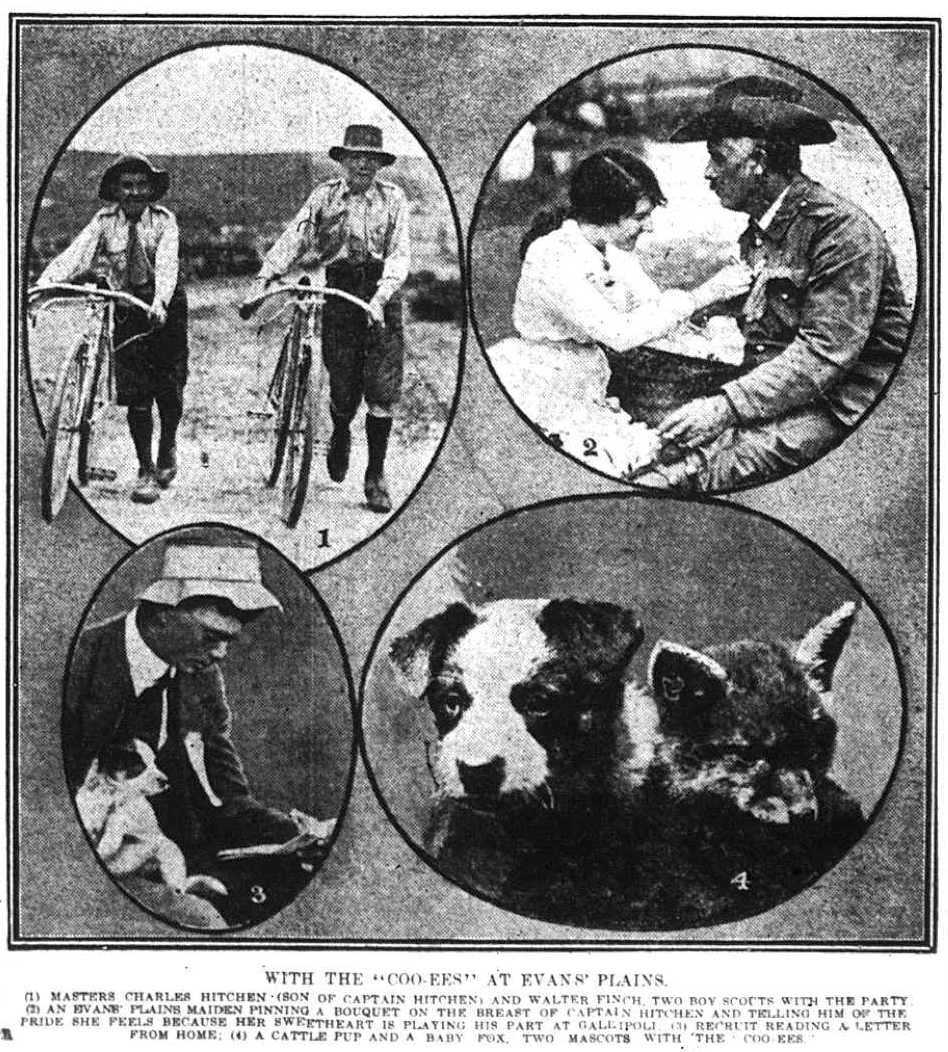
With the Coo-ees at Evans Plains (Daily Telegraph 30/10/1915)

With the Coo-ees at Evans’ Plains (Daily Telegraph 30/10/1915)

Transcription of an article titled ‘The “Coo-ees” : a day by day account’, from The Dubbo Liberal and Macquarie Advocate, 2 November 1915, p. 3.

‘Mr. H. T. Blacket, writing on 31st October from Wallerawang to Mrs. Blacket, gives some interesting particulars of the route march of the “Coo-ees.”

”After leaving Millthorpe,” he says, we made for Blayney, and when within two miles of that town we were met by Captain Eade, who took command of the men, and is still with us. He is a fine soldier, and is enforcing discipline very rigidly, especially in regard to drink. We had a great time at Blayney. I stayed with Mr. and Mrs. Arthur Heane, and enjoyed a good rest, feeling a bit tired, as I am going pretty solidly. What with transport, sick men, advance and rear work, I have covered over 700 miles. The Blayney people bought all our requirements. The night after leaving Blayney we camped at Bathampton wool-shed. Mr. Gilmour, the owner of the station (which is a pretty place, with lovely house and gardens), invited Major Wynne, Captain Eade and myself to stay with him for the night. He is a bachelor, but most hospitable and attentive. Next morning I went to Bathurst and brought the mails back to our midday camp at Evans’ Plains. I had a good load of stuff, besides sick men. The procession into Bathurst was one of the finest seen. Hundreds of children were in fancy dress, mounted police, Mayor and aldermen, wounded soldiers, cadets, and people by the thousands. The march to Bathurst was most imposing, and a moving picture was taken. If it is on at Dubbo you should see it. Ask the picture men to let you know if any of the “Coo-ee” pictures are to be shown. We left Bathurst, and had mid-day rest at Glanmire. After that we went to Yetholme, and camped at the school, having meals in the big dining room at “Brooklands,” and a camp-fire concert. Four recruits joined here. We left Yetholme yesterday morning, and did 20 miles to Wallerawang, where we arrived yesterday afternoon, after camping at Meadow Flat for lunch. The Wallerawang and Portland people met us by hundreds three miles from ‘Wang, and a band headed a very long procession all the way to the town. The people here are supplying all meals. Last night Mr. Carmichael addressed a meeting here, and we got seven recruits. We are now about 170 strong.

“We leave for Lithgow to-morrow, and will arrive there about 5 p.m. We understand there is to be a big reception at Lithgow-bands, soldiers from the camp (700), etc., are meeting us a mile out of town. Cigarettes are being excluded. We remain at Lithgow till the morning of the 3rd November, and then move on and camp at Hartley, at the foot of Victoria Pass. The people are very kind to us along the route. We have a cattle pup, a young fox, and a retriever. I hear that Mr. Fern, of Cobar, is bringing 100 recruits from Cobar to join us at Penrith, and from all we can hear Sydney is going balmy. It is a grand thing, and will be handed down in history as the first route march in the British Empire. A representative from Lithgow, and also from Mount Victoria, have just come to confer about arrangements there. We now have a member of the Army Medical Corps with the camp. Dungarees and white hats were issued to-day to the men, who are in the pink of condition, and marching strongly. All the talk about them being bootless and ill-clothed, etc., is a pack of lies. The men have but to ask for anything at all in the shape of boots, socks, clothing, braces, tobacco, haircuts and medicine, and they are obtained at the first opportunity. There have been no desertions. We now have a lorry, three waggonettes, a light spring cart, a sulky, and the car, and 10 horses and 170 men, as against the 28 men, one waggonette and two horses which left Gilgandra originally. The men are being well drilled by the Captain and Staff Sergeant-Major Scott, and the last three days have gone a long way towards making soldiers of them. Pay started from time of swearing-in. Amongst our men are a father and two sons.”’

Click here to access the article on Trove: http://nla.gov.au/nla.news-article77601738

Day 21, Saturday, 30 October, 1915, Yetholme to Wallerawang

Transcription of an article titled ‘The Great Route March : the tremendous Bathurst welcome’ from The Farmer and Settler, 2 November, 1915, p. 3, [part 3 of 3].
… [Continued]

 ‘Yetholme to Wallerawang.

The track from Yetholme to Wallerawang was mostly down hill, by the route, we took on Saturday, via Meadow Flat and Thompson’s Creek.

Sunny Corner again co-operated, this time with Meadow Flat, to provide luncheon for the recruits, the meal being laid out on the grass by tho school house. Bouquets and cigarettes were supplied to each man, and after an excellent “lunch,” which might well have been called a dinner, the remainder of the nineteen miles was tackled to “‘Wang,” as the local people prefer to call the junction town of Wallerawang.

Three miles from the day’s destination the school children at Thompson’s Creek presented bouquets to the “Coo-ees,” and a little further on, at the cross roads the entire population of Portland assembles  to greet the boys from the west.

Mr. Carmichael, M.L.A., who had arrived by the mid-day mail, was also there having travelled out in the Portland coach, together with a large number of Wallerawang townspeople. Speeches were made, and by request of the officers they were made short, as the men are finding “spruiking” the most tiresome part of the march. The Portland Town Band then took the lead, and the journey was resumed to Wallerawang, which town was entered about five o’clock.

Camp was pitched at once in the school grounds, and preparations made to attack the dinner that had been prepared by the good ladies, assisted by a contingent of enthusiasts from Portland.

As experience has shown that men can not march on cakes and trifles, the committee of management has taken upon it-self the responsibility of issuing directions as to what food shall be given the men. The ladies of the west seem to think that the only way to give the men a good time is to fill them up with pastry. No fault can be found with the cooking, as every “Coo-ee” can testify, but it is not marching food. On this occasion, however, the officer’s advice was followed, and the men “bogged into”‘ plates heaped with gold old corned beef and piled high with carrots in a manner that fully justified the demand for “plain food.”

Another matter in which official intervention has been found necessary was that of smoking materials. All along the route tobacco and cigarettes have been provided, generously, usually handed out at meal times by the ladies. As a number or the boys have colds hanging to them still, medical advice was sought, and they were told that the colds would never be shaken off while they continued to smoke such excessive quantities of cigarettes. Therefore only a limited quantity is now allowed, and any surplus is taken charge of by the quartermaster-sergeant and changed by obliging store-keepers for pipes and tobacco.

It is a tall order to ask a small place like Wallerawang to cater for a hundred and fifty men for five meals, and it takes three men nearly an hour to carve the meat. The ladies have gone to it with a will, and with the invaluable assistance of Mr. Sean (in whose hall the meals are prepared), together with other assistants, ‘Wang did well.’

Click here to access the article on Trove: http://nla.gov.au/nla.news-article116674770

Day 20, Friday, 29 October, 1915, Bathurst to Yetholme

Transcription of an article titled ‘The Great Route March : the tremendous Bathurst welcome’ from The Farmer and Settler, 2 November, 1915, p. 3, [part 2 of 3].
… [Continued]

Bathurst to Yetholme.
The district band played the column  out of town on Friday, leading the way from the showground along the beautiful willow avenue, over the bridge and out along the long, white road that leads Sydney-wards, over the mountains. The first portion of the day’s fifteen-mile journey to Yetholme was fairly good going, until Glanmire was reached at dinner time. Residents of Raglan co-operated with the Glanmire folk to provide lunch under the trees in Mr. Ivatt’s property at Glanmire. After being welcomed by Mr. J. Godfrey, the men “fell to” and soon evidenced their full appreciation of the good things provided by the ladies. The Rev. Crighton then addressed a few words of straight, manly advice to the men, and after the “Coo-ees” had cheered the ladies and others that had entertained them, they were themselves cheered along the road by the admiring throng.

Hilly ceased to be a suitable adjective with which to describe the road then entered upon, but the boys swung along the  mountain roads with a style about them that was a compliment to Captain Eade, and the non-commissioned officer that had joined forces at Bathurst for purposes of instruction and discipline.

A little after five in the evening Yetholme was discovered by the boys to be one or two tourist accommodation houses and a post office, nestling in the mountains, and one of the prettiest spots yet encountered. Small as was the population, arrangements had been made by the recruiting association for the proprietor of “Brooklands Park” to provide sustenance for the two full platoons of soldiers that had marched in that afternoon. Mr. W. H. Berry, president of the Turon Shire Council extended a warm welcome to the boys, and after quarters had been taken up in the school grounds, tea was served in the large dining hall. Two sittings is the order of the day now that a hundred and fifty men have to be provided for, only the larger towns boasting a structure capable of seating the whole army at once.

After tea it was proposed to hold a smoke concert in the dining room, but following a suggestion thrown out by the officers of the column, a camp fire concert was organised in the school grounds. A fair crowd assembled, and a very pleasant evening was spent, no fewer than three men coming forward to join, in response to the speeches of Messrs. C. W. Chiplin, Williams, Clark, Blackett, Lee, and Wynne. This addition to the ranks was all the more welcome because unexpected, nobody regarding such a small place as Yetholme in the light of a recruiting ground. One more man caught up on horseback from Glanmire. Mr. W. L. Garrad was a most energetic worker, as secretary of the local recruiting association; Mr. William represented Meadow Flat, and Mr. Chiplin spoke for Sunny Corner.

A shower of rain caused a little inconvenience to the open air sleepers during the night, hut all hands were cheery and ready for the march next morning after breakfast.’

Click here to access the article on Trove: http://nla.gov.au/nla.news-article116674770

Day 19, Thursday, 28 October, 1915, Bathampton to Bathurst

Transcription of an article titled ‘The Great Route March : the tremendous Bathurst welcome’ from The Farmer and Settler, 2 November, 1915, p. 3, [part 1 of 3].

‘The Great Route March
THE TREMENDOUS BATHURST WELCOME.

The recruiting march from Gilgandra to the sea has now reached the Blue Mountains, and is entering upon its fourth week. Captain Eade, of Lithgow, who has lately had disciplinary charge of the men, has done much towards making an army out of a mob, and by the time the column marches into Sydney it will be of a strength and of a character that the defence authorities will gladly approve.

After leaving Bathampton on Thursday morning dinner was provided for the marching column at Evans’ Plains, and the march then continued to Bathurst.

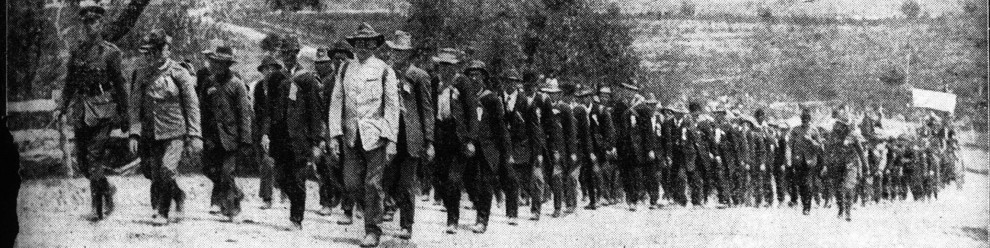
Coo-ees seven miles west of Bathurst (Daily Telegraph 30/10/1915)

Coo-ees seven miles west of Bathurst (Daily Telegraph 30/10/1915)

The pre-arranged time of arrival at the outskirts of the town was four o’clock, so, as good time had been made on the journey, an hour or more was put in at squad drill. The preparations of the Bathurst Recruiting Committee were elaborate and complete in every particular. All Bathurst was out to do honor to the men from the Castlereagh, and the children of all schools made a remarkable display, dressed in the costumes of the Allied nations. The cadets, under Col. Paul, and the school children lined the road, and then a procession was formed. Mounted police led, followed by the mayor and aldermen, and the Salvation Army and City Bands; a party of returned wounded soldiers, enjoying a holiday as guests of the Bathurst Red Cross Society, headed the “Coo-ees,” and the Bathurst unit fell in behind with their banner.

Hundreds of people lined the route, and the mile-long procession wound its way along the gaily decorated streets amid the cheers of the onlookers, and the ringing of church bells to King’s Parade, where an enclosure had been made in front of tho Soldiers’ Monument.

The wind had been rising all day, and at half-past four, just as the procession was turning into King’s Parade a “southerly buster” swirled the dust in clouds around the marching men. Alderman Beavis, Mayor of Bathurst, briefly welcomed Captain Hitchen and his coo-ees, for whom rousing cheers were given; then, as rain seemed imminent, the ladies dispensed afternoon tea and cigarettes in All Saints’ school-room, instead of outside as had been previously arranged.

The camp for the night was at the show ground, where also the ladies, marshalled by the Mayoress, served dinner to the hungry “Coo-ees.” Fortunately   the weather cleared, so that no more alterations to the programme were necessary. At 7.30 a continental was opened in Machattie Park, the selections by the District and City Bands being interspersed with recruiting speeches. A more beautiful setting could not have been found anywhere than in this park, with its well ordered paths, trim greenery, and the lights from the band rotunda glistening on the water playing from the fountain, about which the great crowd had assembled. Sweets and tobacco stalls were dotted about, at which purchases might be made by all except “Coo-ees,” who had been provided with badges that franked them to everything inside the park gates. Supper was served by another staff of ladies in a large tent specially erected for the occasion.

The Mayor, as chairman, introduced Dr. Machattie, Captain Eade, Sergeant Lee, and Private Fern, M.L.A., the member for Cobar, who was going to Cobar that night on final leave, and also to bring down a hundred men from the farthest west to join the column at Penrith.

These gentlemen addressed heart-to-heart, straight-from-the-shoulder recruiting arguments to the young men of Bathurst, not forgetting to point out to the women of Bathurst—Indeed, of all Australia—their duty in this awful war. Ten men had fallen into line with the recruits in tho procession as the Bathurst unit; eleven more men now came for- ward, so that the hundred and thirty odd that marched into the Queen City of the West formed a longer line by the addition of twenty-one “Bathurst Boomerangs.” Every recruit was presented with a trinket in the form of a boomerang, with Bathurst engraved on it, and the lo-cal unit was called “Bathurst Boomerangs” because “they go out to return.” While the heartiness of the welcome accorded the men of the column at Bathurst could not be any more sincere, or better demonstrated by the responsible citizens, than that of the other towns en- countered en route from Gilgandra, there can be no doubt that this was the big reception to date. Every man of the “Coo-ees” agrees that he had everything that could be desired at the hands of the   citizens of Bathurst.’

Click here to access the article on Trove: http://nla.gov.au/nla.news-article116674771
Day 18, Wednesday, 27 October, 1915, Blayney to Bathampton

Transcription of extract from an article titled ‘Gilgandra to the Coast : the “Snowball” growing as it rolls’ from The Farmer and Settler, 29 October, 1915, p. 3, [part 3 of 3 parts]:
… [Continued]

‘Blayney to Bathampton.
Blayney was bidden farewell on Wednesday morning, and a hilly journey entered upon to Bathampton. Six miles on this stage were traversed to King’s Plains, which name appeared on the face of is a misnomer, as the little cluster of houses was set on the top of a hill in the midst of hills. The local school teacher, Mr. Gardiner, was in charge of operations here, and the children marched out to meet the Coo-ees, each with a flag, together with the total population, about fifty persons. Luncheon was served in the school grounds, and the boys were welcomed by Mr. Gardiner, speaking on behalf of the residents.

Six more hilly miles were covered over a spur of the Blue Mountains to the home of Mr. Gilmour, who kindly offered the hospitality of the Bathampton estate to the recruits.

Bathampton lies in a pretty valley through which winds the Fitzgerald Valley Creek, and is one of the oldest Crown grants. The original homestead is nearly demolished, but some of the farm buildings remain.’

Click here to access the article on Trove: http://nla.gov.au/nla.news-article116671286

Day 17, Tuesday, 26 October, 1915, Millthorpe to Blayney

Transcription of extract from an article titled ‘Gilgandra to the Coast : the “Snowball” growing as it rolls’ from The Farmer and Settler, 29 October, 1915, p. 3, [part 2 of 3 parts]:
… [Continued]

‘Blayney Demonstration.
An early start was made on Tuesday, cloudy conditions, with cold winds, still prevailing. Blayney was entered at 12.45, the column being met at the town boundary by the Cowra town band, which had kindly come to the assistance of band-less Blayney. The Mayor (Alderman E. R. Clark). Mr. C. S. Fern (member for Cobar), shire councillors and aldermen were also present, and the procession was headed by a squad of thirty horsemen and horsewomen, and followed by a large number of cars and vehicles.

The show ground had been selected by the Recruiting Association for the recruits’ accommodation, and there the boys found a fine dinner prepared by the ladies of the local Red Cross Committee. To prevent any possible risk of the recruits succumbing to the misguided generosity of townspeople and others, all hotels were declared out of bounds, and the publicans warned by the police not to serve the recruits. It is a great pity that some of the persons that make a nuisance of themselves by insisting on “shouting” could not be made to go to the war themselves. They will not fight themselves, and they insist upon trying to make the real fighters unfit for their work.

The Cowra band gave selections during tho afternoon, and the public were present in force, chatting with the “Coo- ees.” After tea, also provided by the ladies, a continental was held in the pavilion, two thousand persons being present. Local artists contributed to a fine programme of vocal and instrumental tunes, interspersed with recruiting addresses by Mr. E. S. Carr (the local Federal member), Mr. E. R. Clark (the Mayor), Mr. C. S. Fern (the member for Cobar) and Q.M.S. Lee. Five local men answered the call, together with five other men from the district. Carcoar district also sent one man, and in addition presented the sum of £20, that had boon collected at the Carcoar show to tho marching fund of the column. Five more men arrived by the late train from Geurie and one from Gilgandra. The evening concluded with supper under the pavilion.

The Blayney Recruiting Association, the energetic secretary of which is Mr. K. F. Creaghe, was in charge of all arrangements. They supplied any and everything required from the stores, and also arranged for about eighty men to have their hair cut by two local barbers, who attended at the camp for that purpose. As cold weather is being experienced, six horse rugs were supplied at Blayney, and a vehicle will also be given, as the present transport facilities are proving inadequate.

The Blayney Freezing Works donated a supply of petrol for the motor, and as a large number of men have the “Coo-ee bark” (Syn. Liverpool cough), Mr. Matthews, the chemist, donated a quantity of cough tablets. A staff-sergeant-major from Lithgow will also shortly join the contingent to give instruction and for disciplinary purposes.’

Click here to access the article on Trove: http://nla.gov.au/nla.news-article116671286