Tag Archives: Wellington recruits

Percy Walter HOLPEN

Percy Walter HOLPEN

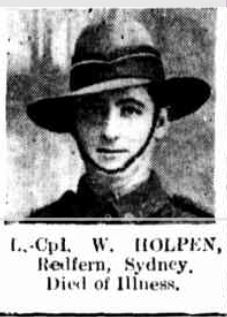
L. Cpl. W. Holpen, Redfern, Sydney. Died of Illness (Sydney Mail, 8/1/1919)

L. Cpl. W. Holpen, Redfern, Sydney. Died of Illness (Sydney Mail, 8/1/1919)

Per his military service record (regimental no. 2196), Percy Walter Holpen was born at Brisbane, Queensland. He gave his age as 21 years and 11 months, his marital status as single, and his occupation as carter. His description on his medical was height 5 feet 9 inches tall, weight 172 lbs., with a fair complexion, blue eyes, and light brown hair. His religious denomination was Church of England. He claimed that he had no previous military service. According to his Attestation paper in his service record he joined on 16th October 1915, when the Coo-ees were in Wellington. He did a preliminary medical at Wellington on 16th October 1915, and was provisionally accepted for enlistment at Dripstone by Captain Nicholas on the 19th October 1915. He completed his medical on the 11th December 1915 at Liverpool, and was attested at Liverpool on the same day, with his service dated from 16th October 1915.

After completing the march he went to Liverpool Camp and trained for the 15th reinforcements for the 1st Light Horse Regiment.

On his embarkation roll his address at time of enrolment was 84 Walker Street, Redfern, Sydney, N.S.W., and his next of kin is listed as father, Walter Holpen, 84 Walker Street, Redfern, Sydney, N.S.W.

On 21st March 1916 Trooper Holpen departed Sydney on the HMAT A26 Armadale, arriving in Egypt on the 24th April 1916. He was sent to the 1st Light Horse Training Regiment at Serapeum.

On the 1st May 1916 he was transferred to the 4th Pioneer Battalion.

On the 4th June 1916 Private Holpen left Alexandria aboard the Transport Scotian bound for France, arriving at Marseille on the 11th June 1916.

On the 10th July 1916 Private Holpen marched out of the 4th Pioneer Battalion whilst it was engaged in works in the vicinity of Fleurbaix, France, for transfer to the 46th Battalion. He marched into the 46th Battalion the next day whilst it was being relieved from the trenches in the vicinity of Sailly, France.

On the 25th August 1916 Private Holpen was admitted to the 13th Field Ambulance sick. On the 28th August 1916 he was moved to the 1st Australian Rest Station. On the 4th September 1916 he was discharged to return to duty. He rejoined the 46th Battalion the next day whilst it was resting at Rubempre, France, after coming out of the trenches in the vicinity of Poziers, France.

On the 1st December 1916 whilst the Battalion was engaged on road making at New Charlton Camp, Bazentin, France,  Private Holpen was charged with insolence to an officer and absenting himself without leave thereby missing a duty which devolved to another soldier. He was awarded 7 days Field Punishment no. 2 and fined one day’s pay.

On the 27th December 1916 Private Holpen was charged with being absent without leave from 2100 on the 20th December 1916 till 1330 on the 21st December 1916 whilst the Battalion was training at new Carlton Camp, Baxentin, France. He was fined a total of 16 days forfeiture of pay.

On the 18th January 1917 when the 46th Battalion was manning the front line trenches in front of Fricourt, France, Private Holpen was wounded in action, receiving a gun shot wound to his chest. Private Holpen was evacuated to a Casualty Clearing Station. On the 24th January 1917 he was admitted to the 3rd Stationary Hospital at Rouen, France. On the 28th January 1917 he was placed aboard the Hospital Ship Warilda at Le Harve, France, for transport to England. He arrived the next day and was admitted to the 1st London General Hospital.

Private Holpen was discharged from the 1st London General Hospital on the 24th March 1917, and granted Leave, to report to the Training Depot at Wareham, England, on the 4th April 1917. On the 10th May 1917 Private Holpen was transferred to the 65th Battalion that was training at Ludgershall, England.

On the 26th June 1917 Private Holpen was charged with being absent without leave from 1200 on the 24th June 1917 till 1530 on the 25th June 1917. He was awarded 6 days Field Punishment No. 2 and forfeiture of 8 days pay.

On the 19th September 1917 Private Holpen was transferred to the overseas Training Brigade for return to the 46th Battalion and France.

On the 20th September 1917 Private Holpen was charged with being absent without leave from 1700 on the 18th September 1917 till 2200 18th of September 1917. He was fined a total of 12 days pay.

On the 4th October 1917 Private Holpen was charged with being found beyond the limits Field by AIF Depots Orders without leave. He was awarded one day Field Punishment no. 2.

On the 14th October 1917 Private Holpen departed Southampton, England, for France, arriving at Le Harve the next day where he marched into the 4th Australian Division Base Depot. Private Holpen left the 4th Australian Division Base Depot on the 18th October 1917 to rejoin the 46th Battalion. He arrived at the 46th Battalion on the 19th October 1917 whilst it was in action around Ypres, Belgium. On the 12th November 1917 he was promoted to Lance Corporal while the Battalion was resting at Coyceques, France.

On the 25th January 1918 the 46th Battalion was conducting training at Perrone, France. Lance Corporal Holpen was charged with being absent without leave from 2100 on the 6th January 1917 till 1830 on the 7th January 1917. He was demoted to Private and fined 2 days pay.

On the 23rd April 1918 a Field General Court Martial was held where Private Holpen had been charged with Desertion being absent without leave from the 31st March 1918 to the 13th April 1918. He was found Guilty and sentenced to 5 years Penal Servitude.

On the 20th May 1918 the 5 year sentence was suspended. However, Private Holpen was soon in trouble again, being charged with escaping from confinement and being absent without leave from 27th May 1918 to 1st June 1918. On the 25th June 1918 another Field General Court Martial was held where Private Holpen was charged with this offence. He was found Guilty and sentenced to 2 years imprisonment with hard labour.

On the 27th July 1918 Private Holpen was admitted to the No.7 Military Prison to undergo his 5 year and 2 year sentences concurrently. On the 7th September 1918 the 5 years penal servitude was commuted to 2 years imprisonment with hard labour.

On the 19th November 1918 Private Holpen was admitted to the 30th General Hospital at Calais suffering from Influenza. On the 23rd November 1918 Private Holpen was listed as seriously ill, and on the 26th November 1918 he succumbed to the illness and died.

Private Holpen was buried at the Les Baraques Military Cemetery at Calais, France. Percy Walter Holpen has the rank of Lance Corporal inscribed on his headstone.
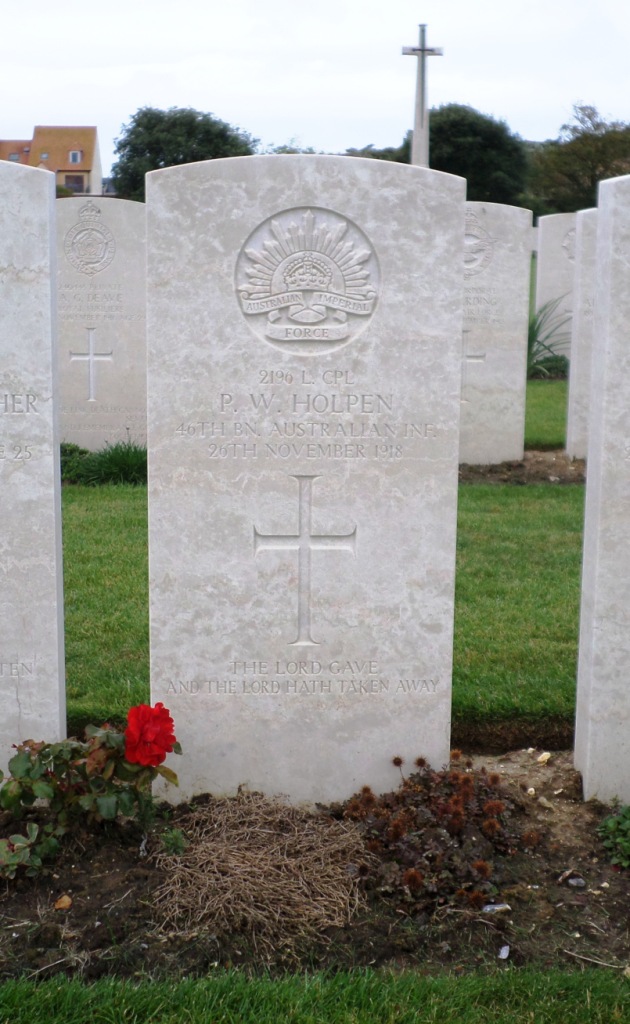
Percy Walter Holpen's headstone, Le Baraques Military Cemetery, France (Photograph: H. Thompson 28/8/2014)

Percy Walter Holpen’s headstone, Le Baraques Military Cemetery, France (Photograph: H. Thompson 28/8/2014)

Percy Walter Holpen gave incorrect details about his age when he joined the Coo-ees. His father Walter Holpen gave the particulars on his Circular for the Australian War Memorial Roll of Honour after the war, and said his son was only 20 years of age when he died.[1] He was born on the 9th January 1898, according to his Queensland birth registration under the name of Walter Percival Holpen, the son of Walter and Sarah (nee Jackson) Holpen.[2] He would therefore have only been 17 years and 9 months of age when he joined the Coo-ees in Wellington on 16th October 1915.

[1] ‘Percy Walter Holpen, AWM Roll of Honour, http://www.awm.gov.au/people/rolls/R1635220/

[2] ‘Walter Percival Holpen’, Australia Birth Index, 1788-1922, Ancestry.com
John Thomas SMITH

John Thomas SMITH

Per his military service record (regimental no. 4891), John Thomas Smith was born at Wigan, Lancashire, England. He gave his age as 30 years, his marital status as single, and his occupation as miner. His description on his medical was height 5 feet 7 inches tall, weight 10 stone 7 lbs., with a fair complexion, brown eyes, and brown hair. His religious denomination was Church of England. He completed his medical on the 16th October 1915 at Wellington, where he joined the Coo-ee March, and was attested by Captain Nicholas on the 19th October 1915 at Stuart Town. He claimed to have had no previous military service.

After completing the march he went to Liverpool Camp as reinforcement for the 13th Battalion.

On his embarkation roll his address at time of enrolment was Queen Street, Wellington, N.S.W., and his next of kin is listed as friend, L. A. Walters, Anhitn, 6 Fernbank Street, Marrickville, Sydney, N.S.W.

Private Smith departed Sydney on the HMAT Star of England on the 8th of March 1916. He arrived in Egypt on the 11th April 1916.

On the 25th April 1916 he was transferred from the 4th Training Battalion at Tel-el Kibir to the 4th Pioneer Battalion, where he was then taken on strength at Serapeum on the 29th April 1916.

On the 4th June 1916 Private Smith left Alexandria aboard the Transport Scotian bound for France, arriving at Marseille on the 11th June 1916.

Private Smith was one of four soldiers in his unit wounded in action on 10th January 1917, receiving a high explosive wound to his stomach, whilst the 4th Pioneer Battalion was undertaking work on the railway line near the village of Longueval, France. He was transferred to the 25th Ambulance Train on 11th January 1917 and admitted to the 12th General Hospital at Rouen on 12th January 1917 with a gun shot wound to the abdomen wall. He was transferred to the Convalescent Depot at Rouen on 24th January 1917, then to Base Depot “A” on 30th January 1917. He was transferred from the 4th Australian Division Base Depot back to his unit on 15th February 1917, rejoining from wounded on 17th January 1917.

He reported to hospital sick from the field on 29th June 1917, and was admitted to 39th General Hospital at Havre on 3rd July 1917. He marched into the 4th Australian Division Base Depot from hospital on 23rd July 1917. He then was readmitted to 39th General Hospital on 3rd August 1917, then on 31st August 1917 he was discharged, and returned to the 4th Australian Division Base Depot. On 7th September he marched out of the 4th Australian Division Base Depot, then returned to his unit in the field on 10th September 1917.

On the 25th October 1917 he was admitted to the 12th Canadian Field Ambulance with an accidentally dislocated right shoulder, then was transferred on the 26th October 1917 to the 13th Canadian Field Ambulance. On the 27th October he was transferred to 36th Ambulance Train, then admitted to 6th Convalescent Depot on 31st October 1917. He was discharged from the hospital at Etaples on the 8th November 1917, then marched in to the 4th Australian Division Base Depot at Havre on 10th November 1917. He returned to his unit in the field on 14th November 1917.

On 22nd February 1918 he reported to 13th Australian Field Ambulance sick, and was admitted to the 4th Australian Field Ambulance with Scabies. He returned to his unit on 28th February 1918.

Private Smith’s service record reports he was ‘wounded in action’ on the 5th April 1918, and was admitted to the 13th Australian Field Ambulance. According to the 4th Pioneer Battalion’s war diary, on 5th April 1918 the battalion was in camp near Henencourt Wood when it was shelled by German artillery. Private J. T. Smith is listed in the Casualties list as wounded by ‘H. E. Shell’. He was admitted to 22nd General Hospital at Camiers with a gun shot wound dislocated right shoulder on 6th April 1918. He was transferred to a hospital ship on 8th April 1918 and embarked for England, being admitted to Dorset County Hospital at Dorchester on 9th April 1918.

Private Smith died of his wounds on 23rd April, 1918, of gun shot wound dislocation of right shoulder (haemoptysis), at Dorset County Hospital, Dorset, England.

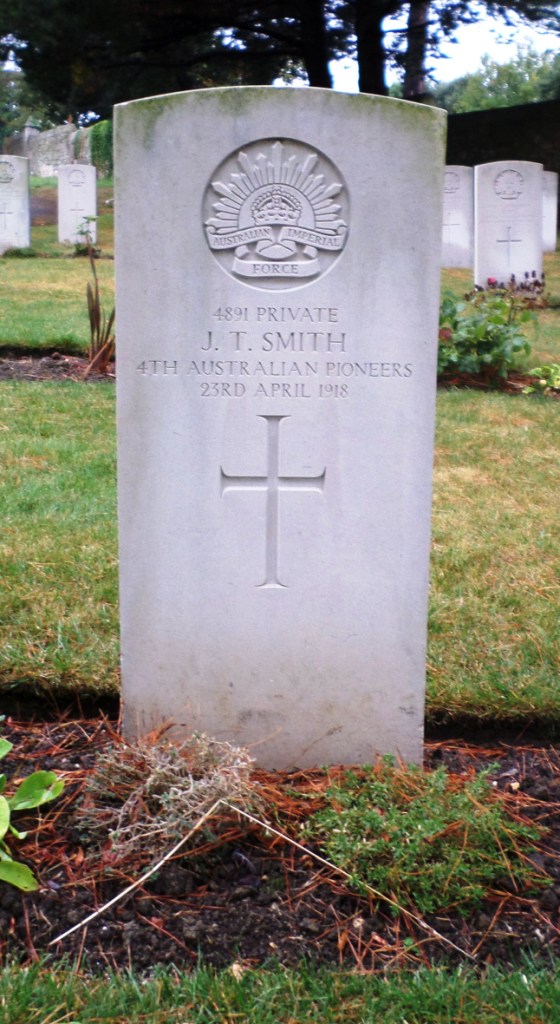
John Thomas Smith’s headstone at Melcombe Regis Cemetery, Weymouth, England (Photograph: H. Thompson 25/8/2014)

John Thomas Smith’s headstone at Melcombe Regis Cemetery, Weymouth, England (Photograph: H. Thompson 25/8/2014)

Private Smith was buried with full military honours on the 27th April, 1918 at Melcombe Regis Cemetery, Weymouth, Dorset, England.

Darcy KEATING

Darcy KEATING

Per his military service record (regimental no. 384), Darcy Keating was born at Warren, N.S.W. He gave his age as 21 years and 6 months, his marital status as single, and his occupation as laborer. His description on his medical was height 5 feet 8 inches tall, weight 11 stone 13 lbs., with a fair complexion, grey eyes, and fair hair. His religious denomination was Roman Catholic. He claimed that he had no previous military service. He completed his medical on the 16th October 1915 at Wellington (while the Coo-ees were in Wellington), and was attested at Mumbil on the 19th October 1915 by Captain Nicholas.

After completing the march he went to Liverpool Camp as reinforcement for the 1st Light Horse Regiment. Shortly after he was transferred to the Cyclist Training Battalion as reinforcement for the 1st Anzac Cyclist Battalion.

On his embarkation roll his address at time of enrolment was Chester Street, Warren, N.S.W., and his next of kin is listed as father, T. Keating, Chester Street, Warren, N.S.W.

On 3rd May 1916 Private Keating departed Sydney on the HMAT A46 Clan McGillivray, arriving in Egypt on the 13th June 1916. On the 5th July 1916 he was taken on strength of the 1st Division Base Depot at Tel El Kebir.

On the 1st August 1916 Private Keating departed Alexandria for England aboard the HMT Lake Manitoba. Private Keating marched into the Pioneer Training Battalion at Parkhouse, England, on the 19th August 1916. On the 7th September 1916 Private Keating was transferred to the 1st Training Battalion at Perham Downs, England.

On the 8th of October 1916 Private Keating departed England for France. Private Keating marched into the 1st Division Base Depot at Etaples on the 9th October 1916. On the 29th October 1916 Private Keating left Etaples to join the 4th Australian Infantry Battalion, marching in on the 5th November 1916 whilst the Battalion was in the trenches at Deville Wood, France.

On the 6th May 1917 when the Battalion was engaged in action at Bullecourt, France, Private Keating received a gun shot wound to his neck and left hand. He was evacuated to the 5th Field Ambulance, then on the 7th May he was sent to the 5th Casualty Clearing Station, and on the 8th May he was sent back to the 3rd General Hospital at Le Treport, France. On the 14th May 1916 he was transferred to the 3rd Convalescent Depot. On the 7th May 1916 Private Keating marched into the 1st Division Base Depot. On 21st June 1917 he marched out to rejoin his Battalion, arriving on the 26th June 1917 whilst the 4th Battalion was training at Buire, France.

On the 15th July 1917 Private Keating was promoted to Lance Corporal. On the 11th September 1917 Lance Corporal Keating was detached from the Battalion for duty with the C.R.E. He rejoined the Battalion on the 19th September 1917.

On the 4th October 1917 the Battalion was engaged in an attack at Broodseinde Ridge, Belgium. During this battle Lance Corporal Keating went missing in action. A Court of Enquiry later declared him killed in action, on 16th March 1918.

Lance Corporal Keating has no known grave and his name is remembered on the Menin Gate Memorial at Ieper (Ypres), Belgium.

KEATING D. on on 4th Battalion panel [near bottom of left row in Lance Corporal section] at the Menin Gate Memorial, Ieper (Ypres), Belgium (Photograph: H. Thompson 11/9/2012)

KEATING D. on on 4th Battalion panel [near bottom of left row in Lance Corporal section] at the Menin Gate Memorial, Ieper (Ypres), Belgium (Photograph: H. Thompson 11/9/2012)

Darcy Keating’s name is also listed on the Warren War Memorial.

Alan Chesher JOHNSON (Alan Cheshyre JANION)

Alan Chesher JOHNSON (Alan Cheshyre JANION)

Per his military service record (regimental no. 4817), Alan Chesher (or Chester) Johnson was born at Liverpool, England. He gave his age as 33 years, his marital status as single, and his occupation as laborer. His description on his medical was height 5 feet 6 ¾ inches tall, weight 151 lbs., with a fair complexion, grey eyes, and dark hair. His religious denomination was Church of England. He claimed that he had no previous military service. He completed his medical on the 16th October 1915 at Wellington (while the Coo-ees were in Wellington), and was attested at Dripstone on the 19th October 1915 by Captain Nicholas.

After completing the Coo-ee March he went to Liverpool Camp as reinforcement for the 13th Battalion.

On his embarkation roll his address at time of enrolment was 50A Young Street, Redfern, Sydney, N.S.W., and his next of kin is listed as friend, A. Hunter, 50A Young Street, Redfern, Sydney, N.S.W. (Miss A. Hunter was the sister and NOK of William Emmerton Hunter, who also joined the Coo-ees at Wellington, and embarked on the same ship).

Private Johnson departed Sydney on the HMAT Star of England along with many of the Coo-ees on the 8th March 1916. He arrived in Egypt on the 11th April 1916. On the 19th April 1916 he transferred to the 45th Battalion in Egypt.

On the 2nd June 1916 Private Johnson left Alexandria aboard the transport Kinfauns Castle bound for France, arriving at Marseille on the 8th June 1916.

On the 23rd July 1916 the Battalion was training in the vicinity of Berteacourt, France. Private Johnson was charged with being Absent From Parade at 9.00 am and 1.00 pm on the 22nd July and Being Absent from Church Parade on the 23rd July 1916. He was awarded 7 days Field Punishment number two.

On the 14th October 1916 the Battalion was resting at La Clyette, France, after being relieved from the front line. On this day Private Johnson was charged with being Absent Without Leave from 9.15 pm on the 10th October to 4.00 pm on the 11th October and of being Drunk and Urinating in Troop Quarters. He was awarded 7 days Field Punishment number two and forfeiture of eight days pay.

On the 30th December 1916 when the Battalion was training at Flesselles, France, Private Johnson was evacuated to the 8th Australian Field Ambulance with sore feet, possibly mild trench foot. He returned to the Battalion on the 18th January 1917 whilst it was at Mametz (near Pozieres), France.

On the 7th June 1917 the 45th Battalion was involved in an attack in the vicinity of the Messines Ridge, Belgium. Private Johnson was killed in action on the first day of the Battle of Messines.

Private Johnson has no known grave and is remembered on the Menin Gate at Ypres, Belgium.

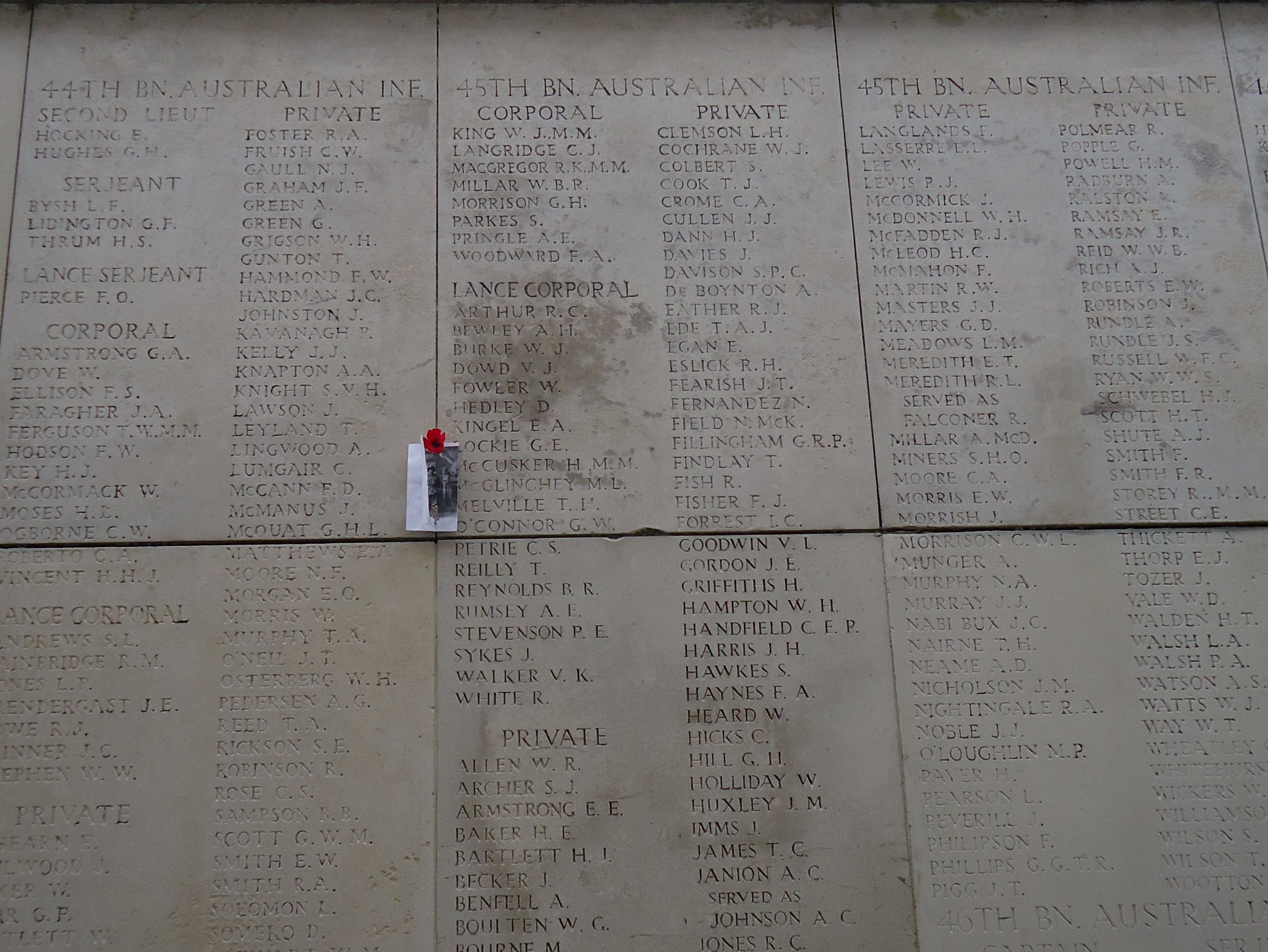
A. C. Janion served as A. C. Johnson on 45th Battalion panel at the Menin Gate Memorial, Belgium (Photograph: H. Thompson 11/9/2012)

Janion A. C. served as A. C. Johnson on 45th Battalion panel [bottom right row in centre] at the Menin Gate Memorial, Belgium (Photograph: H. Thompson 11/9/2012)

A letter in his service record dated 3rd December 1920 addressed to his mother Mrs. A. I. Janion, James Bay Hotel, Government Street, Victoria, B.C. in Canada acknowledges receipt of her statutory declaration (also in the file) advising his last name of Johnson which he enlisted under to be an assumed name, and states that the ‘records have been amended to read – “Stated to be JANION Alan Cheshyre.”

Donald Singleton STEWART

Donald Singleton STEWART

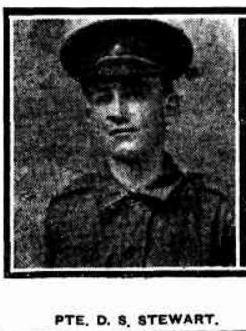
Donald Stewart (Sunday Times, 8/10/1916)

Donald Stewart (Sunday Times, 8/10/1916)

Per his military service record (regimental no. 4600), Donald Singleton Stewart was born at Wellington, N.S.W. He gave his age as 18 years (instead of his actual age of 16 years and 9 months), his marital status as single, and his occupation as grocer. His description on his medical was height 5 feet 8 inches tall, weight 9 stone 5 lbs., with a fair complexion, blue eyes, and fair hair. His religious denomination was Methodist.  He was known as one of the Wellington recruits, and joined the Coo-ees on the road after the Coo-ees had passed through Wellington. He was attested by Captain Nicholas “eight miles east” of Molong [at Boomey] on the 22nd October 1915, and completed his medical at Molong on 22nd October 1915. He claimed that he had previous military service with the Militia.

After completing the Coo-ee March he went to Liverpool Camp as reinforcement for the 13th Battalion.

On his embarkation roll his address at time of enrolment was Park Street, Wellington, N.S.W., and his next of kin is listed as his father, E. Stewart, Park Street, Wellington, N.S.W.

Private Stewart departed Sydney on the HMAT A70 Ballarat on the 16th February 1916 as 14th Reinforcement for the 13th Battalion. He arrived in Egypt on the 22nd March 1916. On the 1st April 1916 he was transferred to the 54th Battalion.

On the 19th June 1916 Private Stewart left Alexandria aboard HT Caledonian bound for France, arriving at Marseille on the 29th June 1916.

On the 20th July 1916 Private Stewart was reported missing in action after taking part in the Battle of Fromelles. On the 12th August 1916 Private Stewart was reported to be a prisoner of war in Germany. He was interned at Dulmen, Germany (a prison camp in Westphalia), then later detained at Schneidemuhl, Germany.

One of the youngest of the Coo-ees, he had his 17th birthday in Liverpool Camp, and his 18th and 19th birthdays as a prisoner of war in Germany (Wellington Times, 19/9/1918, p. 3).

After the end of the war, Private Stewart was repatriated to England on the 18th December 1918.

Private Stewart departed England on the 3rd May 1919 for return to Australia aboard the steamer Leicestershire, disembarking at Sydney on the 22nd June 1919. He was discharged on the 14th August 1919.