Tag Archives: Parramatta recruits

William FARTHING

William FARTHING

Per his military service record (regimental no. 4773), William Farthing was born at Moss Vale, N.S.W. He gave his age as 29 years and 10 months, his marital status as married, and his occupation as laborer. His description on his medical was height 5 feet 11 inches tall, weight 155 lbs., with a fair complexion, blue eyes, and sandy hair. His religious denomination was Church of England. He claimed that he had no previous military service.

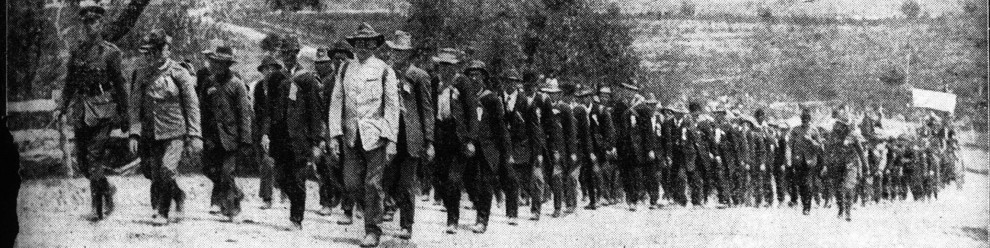
He completed his medical on the 10th November 1915 at Parramatta, and was attested at Parramatta on the 11th November 1915. The Coo-ees had held a recruiting meeting in the Park at Parramatta on the evening of the 10th November, where it was reported that 41 men had offered themselves as recruits.[1]

After completing the Coo-ee March he went to Liverpool Camp as reinforcement for the 13th Battalion.

On 21st January 1916 Private Farthing was charged with being absent from parade at the Liverpool Camp, and he was fined 5 shillings. On 3rd February 1916 he was charged with being absent without leave for 1 day, and he was fined 5 shillings. On 21st February 1916 he was charged with being absent without leave for 2 days, and he was fined 20 shillings.

On his embarkation roll his address at time of enrolment was Eglington Street, Lidcombe, N.S.W., and his next of kin is listed as his wife, Mrs A. M. [Ada May] Farthing, Eglington Street, Lidcombe, N.S.W.

On 8th March 1916 Private Farthing departed Sydney on the HMAT A15 Star of England, along with many of the other Coo-ees, as part of the 15th reinforcements for the 13th Battalion. On 27th March 1916 he was charged with breaking ship, and was fined 5 pounds.

He arrived in Egypt on the HMAT A15 Star of England on 11th April 1916.

On 18th April he was admitted to the 2nd Australian Stationary Hospital at Tel El Kebir, Egypt, suffering from mumps. He was discharged on 26th April 1916. On 30th April 1916 Private Farthing was again admitted to the 2nd Australian Stationary Hospital suffering mumps. He was discharged on 31st May 1916, and proceeded to England [date and ship unknown].

On 21st June 1916 Private Farthing was admitted to the 1st Australian Auxiliary Hospital at Harefield, England sick (on the same day that Bill Hitchen was also admitted to the same hospital).

He was discharged on 9th November 1916 and sent to the Number 1 Command Depot at Pernham Downs, England, arriving on 11th November 1916.

On 5th December 1916 Private Farthing was charged with being absent from 0900 on 2nd December until 1930 on 3rd December 1916. He was awarded 48 hours detention and fined 4 days pay.

On 16th January 1917 Private Farthing departed England on the ship Princess Victoria bound for France. He arrived at the 4th Australian Division Base Depot at Etaples on 17th January 1917.

On 21st January 1917 Private Farthing marched into the 13th Battalion when it was performing fatigue duties at Mametz, France.

On 15th August 1917 Private Farthing was detached to the 4th Australian Division Traffic Police. On 30th October 1917 he was charged with Neglecting to Obey a Lawful Order given by a Superior Officer. He was awarded forfeiture of 21 days pay. He was also sent back to the 13th Battalion.

On 8th September 1918 Private Farthing went on leave to England. He rejoined the 13th Battalion on 24th September 1918 when it was at Picquigny, France.

On 31st December 1918 Private Farthing went to Paris on leave. He returned on 7th January 1919 and was admitted to the Canadian General Hospital suffering Inguinal Adenitis. On 5th February 1919 he was transferred to the 3rd Stationary Hospital. On 17th February 1919 he was sent to England on board a hospital ship and admitted to the King George Hospital in London suffering from boils.

On 25th February 1919 Private Farthing was discharged from hospital and went on leave to report to the Number 1 Command Depot at Sutton Veny on 11th March 1919.

On 13th March 1919 Private Farthing marched into the Number 2 Command Depot at Weymouth, England.

On 5th April 1919 Private Farthing departed England aboard the transport Armagh bound for Australia. He arrived in Sydney on 20th May 1919 and was discharged Termination of Period of Enlistment on 4th July 1919.

[1] ‘The procession’, The Cumberland Argus and Fruitgrowers Advocate, 13 November 1915, p. 11, http://nla.gov.au/nla.news-article86101767
William Joseph MUNRO

William Joseph MUNRO

Per his military service record (regimental no. 4853), William Joseph Munro was born at Parramatta, N.S.W. He gave his age as 23 years, his marital status as single, and his occupation as station hand / laborer. His description on his medical was height 5 feet 6 ½ inches tall, weight 135 lbs., with a dark complexion, light hazel eyes, and black hair. His religious denomination was Roman Catholic. He claimed that he had no previous military service.

He completed his medical on the 10th November 1915 at Parramatta, and was attested at Parramatta on the 11th November 1915. The Coo-ees had held a recruiting meeting in the Park at Parramatta on the evening of the 10th November, where it was reported that 41 men had offered themselves as recruits.[1]

After completing the Coo-ee March he went to Liverpool Camp as reinforcement for the 13th Battalion.

On his embarkation roll his address at time of enrolment was Ox Hide, Cook Street, Lidcombe, N.S.W., and his next of kin is listed as his father, J. Munro, Ox Hide, Cook Street, Lidcombe, N.S.W.

On 8th March 1916 Private Munro departed Sydney on the HMAT A15 Star of England, along with many of the other Coo-ees, as part of the 15th reinforcements for the 13th Battalion. He arrived in Egypt on 11th April 1916.

On 7th June 1916 Private Munro left Alexandria aboard the Transport Ionian bound for France, arriving at Marseilles on 14th June 1916.

He was sent to the 4th Australian Division Base Depot at Etaples, France. On 21st July 1916 he joined the 13th Battalion whilst it was training at the Somme, France. He participated in the 13th Battalion’s first major offensive action in France at Pozieres in August 1916.

On 30th August 1916 Private Munro was with the 13th Battalion when it was in action at Pozieres, France. On this day Private Munro was reported Missing In Action.

On 27th September 1916 Private Munro was reported to be a Prisoner of War being held at Gefangenenlager at Dulmen in Westfalia, Germany. On the 16th of December 1916 he was reported to have been moved to Munster 1/W, Germany.

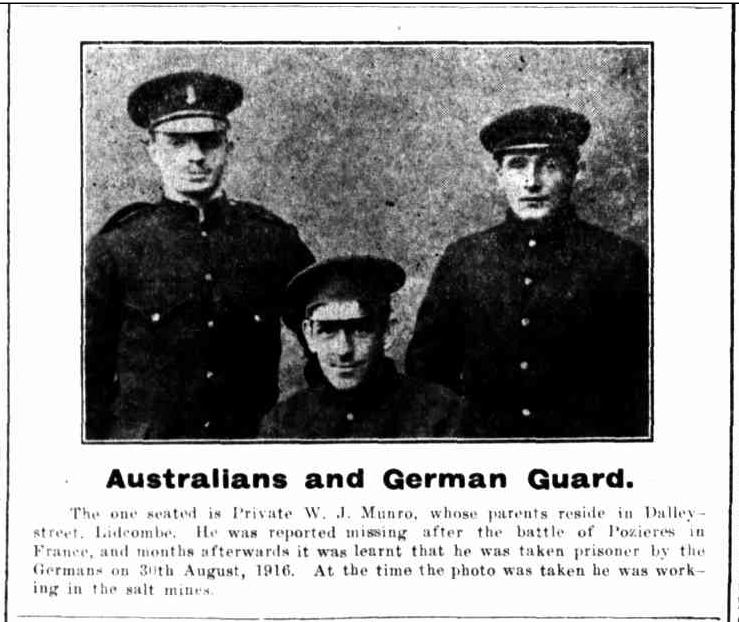
A photo of him appeared in the Cumberland Argus and Fruitgrowers Advocate on 8th June 1918 with another prisoner of war and a German prison guard, reporting that he was working in the salt mines.[2]


W. J. Munro (seated) with another prisoner of war and a German guard, 1918 (Cumberland Argus and Fruitgrowers Advocate, 8/6/1918)

W. J. Munro (seated) with another prisoner of war and a German guard, 1918 (Cumberland Argus and Fruitgrowers Advocate, 8/6/1918)

Private Munro remained a prisoner for the remainder of the war. In December 1918 he was repatriated to England, arriving at Hull on 7th December 1918, and in London on 9th December 1918.

On 28th January 1919 Private Munro was charged with Being Absent Without Leave from 10 am on 11th January 1919 until 9 am on 28th January 1919. He was fined a total of 34 days pay. On 29th January 1919 Private Munro marched into the Number One Command Depot at Sutton Veny, England.

On 2nd March 1919 Private Munro departed England aboard the Derbyshire bound for Australia. He arrived in Australia on 24th April 1919, and was discharged Termination of Period of Enlistment on 9th June 1919.

[1] ‘The procession’, The Cumberland Argus and Fruitgrowers Advocate, 13 November 1915, p. 11, http://nla.gov.au/nla.news-article86101767
[2] ‘Australians and German Guard’, The Cumberland Argus and Fruitgrowers Advocate, 8 June 1918, p. 10, http://nla.gov.au/nla.news-article86207336


Jack MORRIS

Jack MORRIS

Jack Morris (Photograph: Australian War Memorial)

Jack Morris (Photograph: Australian War Memorial)

Per his military service record (regimental no. 4849), Jack Morris was born at Pennant Hills, N.S.W. He gave his age as 18 years and 1 month, his marital status as single, and his occupation as rivetter. His description on his medical was height 5 feet 4 ½ inches tall, weight 134 lbs., with a fair complexion, grey eyes, and light hair. His religious denomination was Wesleyan. He claimed that he had 4 years previous V.T. experience. He completed his medical on the 11th November 1915 at Parramatta, and was attested at Parramatta on the 11th November 1915. A note in his service record from his mother Annie Morris gave permission for her son Jack Morris to enlist in the Australian Expeditionary Force, dated 11th November 1915.

After completing the Coo-ee March he went to Liverpool Camp as reinforcement for the 13th Battalion.

On his embarkation roll his address at time of enrolment was Sorrell Street, Parramatta, N.S.W., and his next of kin is listed as his widowed mother, Mrs. A. [Annie] Morris, Sorrell Street, Parramatta, N.S.W.

On 8th March 1916 Private Morris departed Sydney on the HMAT A15 Star of England, along with many of the other Coo-ees, arriving in Egypt on the 11th April 1916. On the 19th April 1916 he was transferred to the 45th Battalion at Serapeum. On the 23rd April 1916 he was sent to hospital sick. He rejoined the 45th Battalion on 1st May 1916.

On 2nd June 1916 Private Morris left Alexandria aboard the transport Kinfauns Castle bound for France, arriving at Marseilles on 8th June 1916.

Private Morris served with the 45th Battalion through its first action at Fleurbaix in France in July 1916, then as it moved to Pozieres in early August 1916. It was whist the 45th Battalion was in action in the vicinity of Pozieres, France, that Private Morris was killed in action on the night of the 5th/6thth of August 1916. His official date of death is the 6th August 1916. He has no known grave.

He died in the Battle of Pozieres on the same day as three Coo-ees in the 4th Pioneer Division – Oliver Harmon, another Coo-ee who joined at Parramatta, John Tarlington, who joined the Coo-ees at Blayney, and Karl Alex Frederick Neilson, who joined the Coo-ees at Springwood.

His death was reported in The Cumberland Argus and Fruitgrowers Advocate (9/9/1916 p. 4) as follows:

‘The Late Private Jack Morris.
The only son of a Parramatta widow.
One of the very sad cases of the losses of brave young soldiers was that when it was officially reported early this week to Mrs. Morris, widow, of Sorrell-street, Parramatta North, that her only son, a well-known Parramatta lad, Private Charles John (“Jack”) Morris, who enlisted at Parramatta with “the Coo-ees,” had been killed. Private Morris was born at Pennant Hills, and he would have been 19 years of age, had he lived, on the 28th of October. He was educated at the Brothers’ School, Parramatta North. His last letter was received three weeks ago, and was dated June 24. He had been to Egypt, and had then gone on to France, and was at the time of writing at the back of the fighting line, and within the sound of the guns. He left four sisters. He was reported to have been killed in action on the 5th or 6th of August.

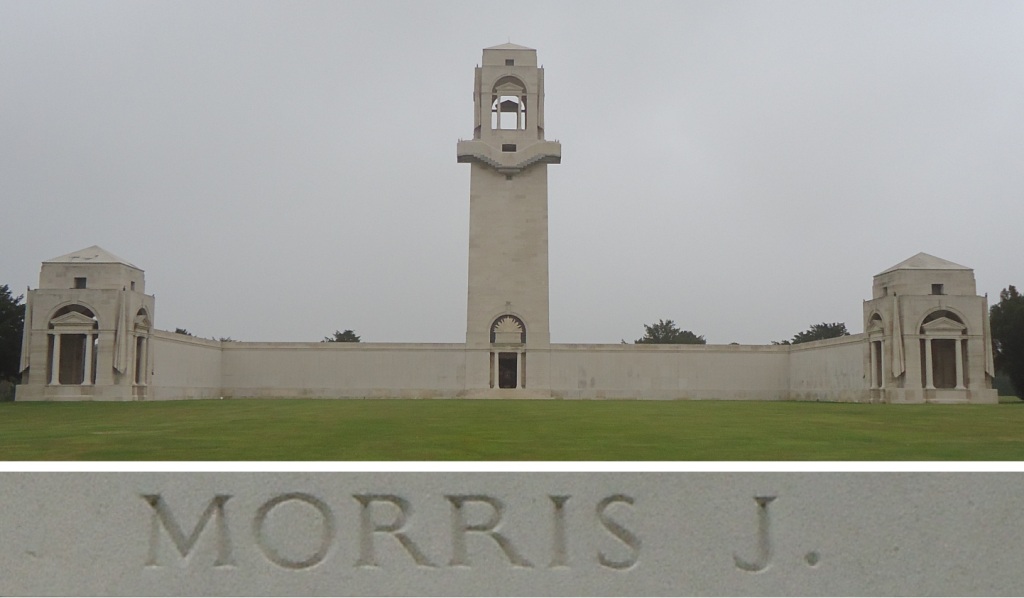
Private Morris is remembered on the Villers-Bretonneux Memorial, France.

Private Morris' name on the Villers-Bretonneux Memorial, France (Photograph: S. & H. Thompson 7/9/2014)

Private Morris’ name on the Villers-Bretonneux Memorial, France (Photograph: S. & H. Thompson 7/9/2014)

Private Morris’ name is commemorated on panel 140 on the Australian War Memorial First World War Roll of Honour.

Private Morris’ name is also listed on the Parramatta War Memorial (under C. J. Morris).

Oliver James HARMON

Oliver James HARMON

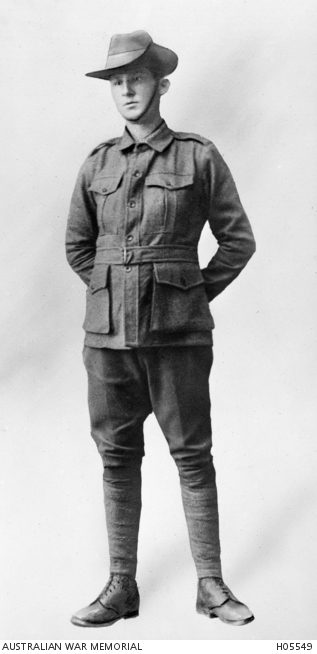
Private O. J. Harmon, ca. 1916 (Photograph: Australian War Memorial)

Private O. J. Harmon, ca. 1916 (Photograph: Australian War Memorial)

Per his military service record (regimental no. 4791), Oliver James Harmon was born at Redfern, N.S.W. He gave his age as 31 years and 11 months, his marital status as single, and his occupation as boiler makers’ assistant. His description on his medical was height 5 feet 10 ½ inches tall, weight 160 lbs., with blue eyes, and dark hair. His religious denomination was Church of England. He claimed that he had no previous military service. He completed his medical on the 10th November 1915 at Parramatta, and was attested at Ashfield on the 11th November 1915.

According to The Cumberland Argus and Fruitgrowers Advocate, he ‘had done a good deal of shearing in the West, and was personally known to many of the Gilgandra Coo-ees, whom he had joined when they passed through Parramatta’.[1]

After completing the Coo-ee March he went to Liverpool Camp as reinforcement for the 13th Battalion.

On his embarkation roll his address at time of enrolment was Alfred Street, Granville, N.S.W., and his next of kin is listed as his father, W. H. Harmon, Alfred Street, Granville, N.S.W.

On 8th March 1916 Private Harmon departed Sydney on the HMAT A15 Star of England along with many of the other Coo-ees, arriving in Egypt on the 11th April 1916.

On 16th April 1916 Private Harmon was transferred to the 4th Pioneer Battalion at Tel-El-Kebir, Egypt.

On 4th June 1916 Private Harmon left Alexandria aboard the Transport Scotian bound for France, arriving at Marseilles on 11th June 1916.

On 25th June 1916 the 4th Pioneer Battalion was at Armentieres, France, constructing defensive works. On this day Private Harmon was placed under arrest for Disobeying a Lawful Command Given By a Superior Officer (he did not accompany a Corporal to draw stores when ordered to do so) and Using Insubordinate Language To a Superior Officer (to the same Corporal). He was held in custody until a Field General Court Martial was held on the 8th of July 1916 at Fleurbaix, France. He was sentenced to 14 days Field Punishment Number 2.

On 6th August 1916 the 4th Pioneer Battalion was maintaining Tramway Trench in the ruins of the village of Pozieres which was under heavy German artillery fire during the Battle of Pozieres when Private Harmon was killed in action. Also killed with him in the 4th Pioneer Battalion on the same day were fellow Coo-ees John Tarlington (who joined the Coo-ees at Blayney), and Karl Alex Frederick Neilson (who joined the Coo-ees at Springwood).

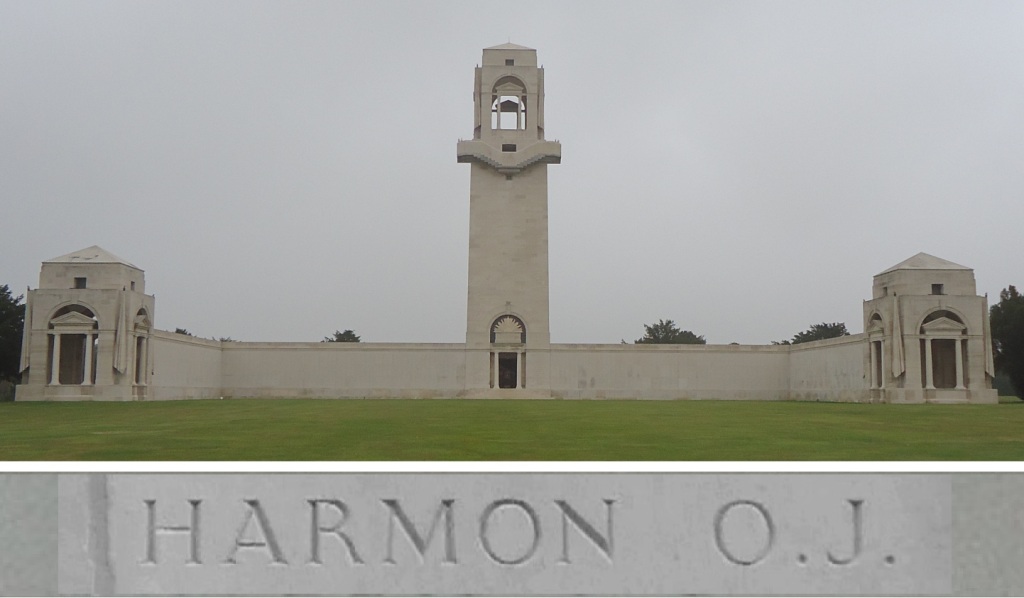
Private Harmon has no known grave, and is remembered on the Villers-Bretonneux Memorial in France.

Private Harmon's name on the Villers-Bretonneux Memorial, France (Photograph: S. & H. Thompson 7/9/2014)

Private Harmon’s name on the Villers-Bretonneux Memorial, France (Photograph: S. & H. Thompson 7/9/2014)

Private Harmon’s name is commemorated on panel 174 on the Australian War Memorial First World War Roll of Honour.

Private Harmon’s name is also remembered on the Granville War Memorial.

[1] ‘Killed in action’, The Cumberland Argus and Fruitgrowers Advocate, 9 September 1916, p. 10, http://nla.gov.au/nla.news-article86076476


Francis Charles FINLAYSON

Francis Charles FINLAYSON

Per his military service record (regimental no. 6251), Francis Charles Finlayson was born at Redfern, N.S.W. He gave his age as 28 years, his marital status as married, and his occupation as book keeper. His description on his medical was height 5 feet 11 inches tall, weight 140 lbs., with a fair complexion, grey eyes, and fair hair. His religious denomination was Roman Catholic. He claimed that he had no previous military service. He completed his medical on the 11th November 1915 at Parramatta, and was attested at Parramatta on 11th November 1915.

After completing the Coo-ee March he went to Liverpool Camp as reinforcement for the 13th Battalion.

On 3rd of February 1916 Private Finlayson was charged with being Absent Without Leave from the Liverpool Camp on the 1st and 2nd of February 1916. He was fined two days forfeiture of pay. On the 7th of March 1916 Private Finlayson was made an Acting Corporal.

After further training in Australia, Acting Corporal Finlayson departed Sydney on the HMAT A14 Euripides on 9th September 1916, as 20th reinforcement for the 13th Battalion. With him travelled fellow Coo-ees Acting Sergeant Thomas W. Dowd, and Acting Sergeant Stanley E. Stephens.

On his embarkation roll his address at time of enrolment was George Street, Parramatta, N.S.W., and his next of kin is listed as his wife, Mrs. M.[May] Finlayson, 5 Trafalgar Street, Armidale [sic] (Annandale), N.S.W.

He arrived at Plymouth, England, on 26th October 1916. On 4rd November 1916 Acting Corporal Finlayson marched into the 4th Training Battalion at Codford, England.

On 16th January 1917 Acting Corporal Finlayson left Folkestone aboard the SS Princess Victoria bound for France, marching into the 4th Division Base Depot at Etaples on 17th January 1917. Upon marching into the 4th Australian Division Base Depot he reverted to his substantive rank of Private.

On 21st January 1917 Private Finlayson was taken on strength of the 13th Battalion whilst it was at Mametz, France conducting fatigue duties.

On 4th February 1917 the 13th Battalion was taking part in an attack on the German trenches in the vicinity of Guedecourt, France. During this action Private Finlayson was killed in action.

According to a letter written home from Private Charlie C. Carr, another soldier from Parramatta, dated 12th February 1917, Frank Finlayson was killed at his side. He wrote: ‘He was in the same platoon, and had only just joined us up. It was his first time in the trenches. He had a great nerve and proved himself a splendid fighter. We had just attacked and taken the German position, when they opened up terribly heavy artillery fire. Frank bravely went out to carry in a wounded German, and got in quite safely, but it was only about five or ten minutes after that he was killed by a German high explosive shell’.[1]

This night was also fellow Coo-ee Stanley E. Stephens ‘first hop-over’ and ‘baptism of fire’ raid against the German trenches, in the same company. He wrote in a letter published in The Farmer and Settler on 17th August 1917 that on the night of 4th February Finlayson was on his left just before the hop-over, and their objective was a trench ‘known as Stormy trench, in which Fritz had a strong post’. He reported that ‘a mess-tin full of rum’ was passed along, and ‘everyone took a swig, and passed it on’, and that he ’gulped down a couple of mouthfuls and handed it to Fin’. After taking the trench and some German prisoners, they returned to their own trench. Stephens reported that ‘Finlayson was separated from us in the hop-over, and entered the trench some distance on our right’, and the Germans began a bombardment ‘putting them into us’. He continued that about midnight ‘Fin. Came along the trench looking for us’, and that ‘after yarning for a minute or two he went back to fetch his web gear and rifle, etc., up to our ‘possy’. Stephens wrote that ‘he and I had been mates for a long while, back in Kiama’, and he ‘had only been gone about ten minutes when another mate named Moss Paine came to tell me that Fin. was killed’, and that he ‘went back along the trench with Moss, but Fin. had been hit in the chest with a piece of shell that exploded in the trench, and had dropped without a word’.[2]

Private Finlayson has no known grave. He left a widow and three young children.

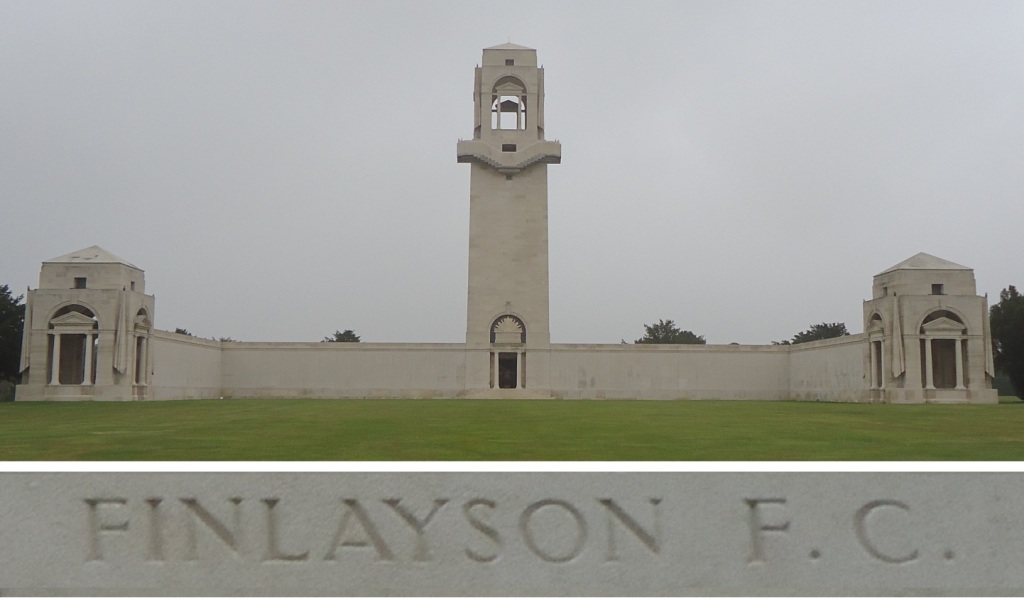
His name is remembered on the Villers-Bretonneux Memorial, France.

Private Finlayson's name on the Villers-Bretonneux Memorial, France (Photograph: S. & H. Thompson 7/9/2014)

Private Finlayson’s name on the Villers-Bretonneux Memorial, France (Photograph: S. & H. Thompson 7/9/2014)

Private Finlayson’s name is commemorated on panel 69 on the Australian War Memorial First World War Roll of Honour.

F. C. Finlayson’s name is also remembered on the Parramatta War Memorial.

[1] ‘Letters Home’, The Cumberland Argus and Fruitgrowers Advocate, 21 April 1917, p. 4. http://nla.gov.au/nla.news-article86090288

[2] ‘A baptism of fire’, The Farmer and Settler, 17 August 1917, p. 2, http://nla.gov.au/nla.news-article116642518