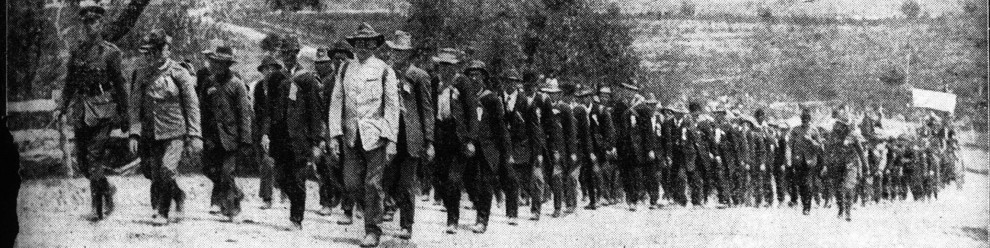
Tag Archives: HMAT A15 Star of England

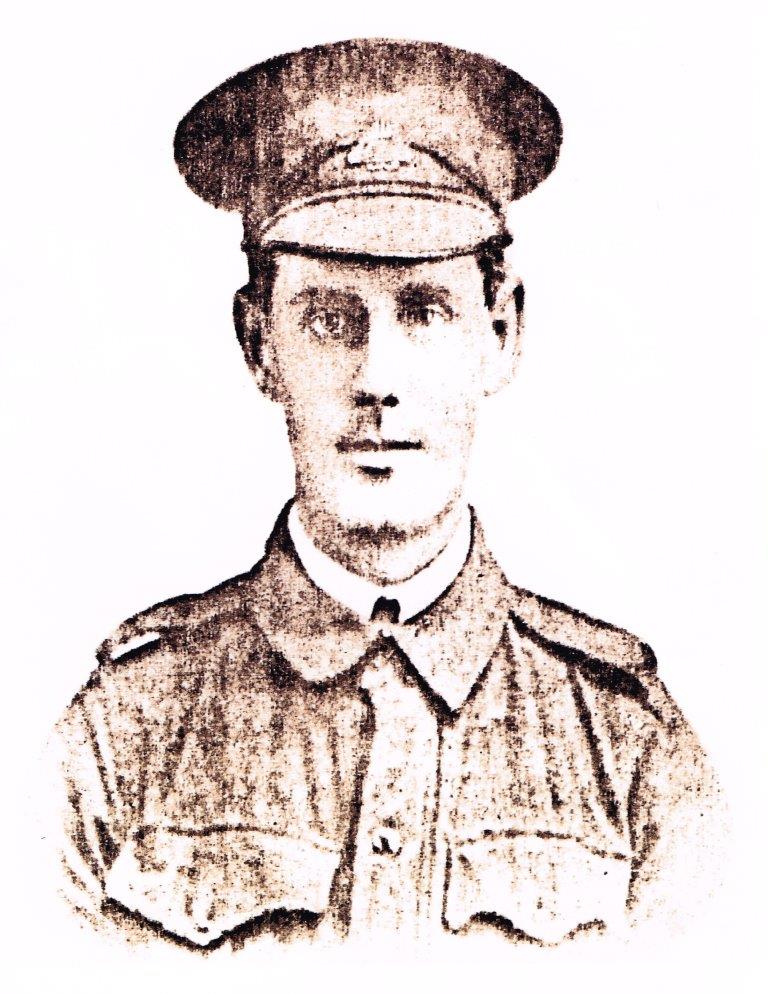
Joseph John WILLIAMS

Joseph John WILLIAMS

Per his military service record (regimental no. 4912), Joseph John Williams was born at Woollahra, N.S.W.[1]  He gave his age as 36 years and 11 months, his marital status as single, and his occupation as farrier.  His description on Certificate of Medical Examination was height 5 feet 5 ½ inches tall, weight 144 lbs., with a dark complexion, brown eyes, and grey hair.  His religious denomination was Roman Catholic.  He claimed that he had no previous military experience.  He completed his medical examination at Ashfield on 11th November 1915 (the day the Coo-ees marched from Parramatta to Ashfield), and was attested by Lieutenant F. Middenway at Ashfield on 11th November 1915.

It is not known exactly where Joseph John Williams joined (or first presented to join) the Coo-ee March, but it may possibly have been before the 11th November 1915.  The Oath on his Attestation Paper was dated ‘from 6th November 1915’.  The “Date of Joining” recorded for Private Williams on his embarkation roll was 7th November 1915.

After completing the Coo-ee March he went to Liverpool Camp as reinforcement for the 13th Battalion.

On 18th February 1916 Private Williams was charged with being absent without leave from the Liverpool Camp for 3 days.  He was fined 25 Shillings.

On his embarkation roll his address at time of enrolment was C/o T. Stephenson, 1 Ruffe [sic] Street, Leichhardt, Sydney, N.S.W., and his next of kin is listed as his mother, Mrs. E. M. [Esther Mary] Williams, at the same address.  The initial address recorded for his mother on his Attestation Paper was ‘Railway Parade Wentworth Falls N.S.W.’.

On 8th March 1916 Private Williams departed Sydney on the HMAT A15 Star of England, along with many of the other Coo-ees, and arrived in Egypt on 11th April 1916.

It is not recorded in his service record when Private Williams left Egypt, but after some training in Egypt, he was sent to the 4th Training Battalion at Rollestone, England.

Private Williams departed England bound for France on 30th July 1916.  He marched into the 4th Australian Division Base Depot at Etaples, France, on 1st August 1916.

He was taken on strength of the 13th Battalion on 26th August 1916 when it was at Albert, France, preparing to re-enter the fighting around Pozieres.

On the 1st of January 1917 Private Williams was sent to the 8th Australian Field Ambulance suffering from a sore ankle. On 4th January 1917 he was moved to the 1st General Hospital at Etretat, France. On 26th January 1917 he was transferred to the 2nd Stationary Hospital at Amiens, France, with ICT right ankle.  He was discharged and returned to the 13th Battalion on 8th February 1917.

On 2nd March 1917 Private Williams was sent to the 8th Australian Field Ambulance suffering from Scabies.  He was moved back to the 5th Rest station later that day with Influenza. On 7th March 1917 he was transferred to a Casualty Clearing Station with Trench Feet.  He was later moved to the 5th General Hospital at Rouen with Trench Fever.

On 12th March 1917 Private Williams was placed aboard the Hospital Ship Grantully Castle at Le Harve for evacuation to England.  He was admitted to the 2nd Southern General Hospital at Bristol, England, on the 13th of March 1917, with Trench Fever.

On 16th April 1917 Private Williams was transferred to the 3rd Australian Auxiliary Hospital at Dartford, England.  He was granted leave to report to the Number 3 Command Depot at Hurdcott, England, on 1st May 1917.

On 12th of May 1917 Private Williams was charged with being absent without leave in London from 3.30 p.m. on 1st May 1917 till 9.15 p.m. on 8th May 1917.  He was awarded 8 days Field Punishment Number 2 and fined 19 days pay.

On 4th August 1917 Private Williams was transferred to the Number 2 Command Depot at Weymouth, England.

On 27th September 1917 Private Williams departed England aboard the H.T. Suevic bound for Australia, with Debility.  He arrived in Australia on 20th November 1917, and was discharged medically unfit on 25th December 1917.

[1] NAA B2455, WILLIAMS J J
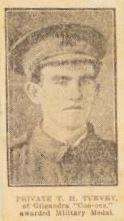
Thomas Henry TURVEY

Thomas Henry TURVEY

Private T. H. Turvey, of Gilgandra "Coo-ees", awarded Military Medal (Newspaper unknown, 1917)

Private T. H. Turvey, of Gilgandra “Coo-ees”, awarded Military Medal (Newspaper unknown, 1917)

Per his military service record (regimental no. 4902A), Thomas Henry Turvey was born at Gulgong, N.S.W. [1]  He gave his age as 22 years and 9 months, his marital status as single, and his occupation as laborer.  His description on his Certificate of Medical Examination was height 5 feet 8 ½ inches tall, weight 10 stone 10 lbs., with a dark complexion, light blue eyes, and dark hair.  His religious denomination was Roman Catholic.  He claimed that he had no previous military service.  He completed his medical examination on 4th October 1915 at Gilgandra, and was attested by Captain Eade at Lawson on the 7th October 1915.

Thomas Turvey stated that he had joined the Coo-ees at Katoomba in a court case in December 1915, in which he was a witness.[2]  The Coo-ees had stayed overnight at Katoomba on 5th November 1915.

After completing the Co-ee March he went to Liverpool Camp as reinforcement for the 13th Battalion.

On his embarkation roll his address at time of enrolment was Gilgandra, N.S.W., and his next of kin is listed as his father, T. [Thomas] Turvey, Gilgandra, N.S.W.

On 8th March 1916 Private Turvey, along with many of the other Coo-ees, departed Sydney on the HMAT A15 Star of England, and arrived in Egypt on 11th April 1916.

He was transferred to the 45th Battalion on 20th May 1916.

On 7th June 1916 Private Turvey left Alexandria aboard the transport Huntspill bound for France, arriving at Marseilles on 14th June 1916.

On 19th July 1916 Private Turvey was taken on strength of the 45th Battalion.

Private Turvey served with the 45th Battalion through its first action at Fleurbaix, France, in July 1916, then the Battle of the Somme around Pozieres, Mouquet Farm and Flers, without injury or illness.

His service record states that he was allocated the letter “A” to his regimental number on 22nd February 1917 on account of duplication of numbers.

Private Turvey was serving with the 45th Battalion when it was in action around Guedecourt, France, where on 27th February 1917 he was recommended for, and subsequently awarded, the Military Medal for bravery in the field, for his action on the 22nd/23rd February 1917.  This award was published in the London Gazette Supplement no. 30036 on 26th April 1917, and promulgated in the Commonwealth Gazette No. 133 on 21st August 1917.[3]

The citation for the Military Medal reads: “For his gallant conduct and devotion to duty during an attack on a enemy trench near Guedecourt on the night of 22/23rd Febry. 1917 when as a runner he maintained communication overland under artillery and machine gun fire between the front line and Headquarters. His work in this respect was quite consistent with his previous fine record established for coolness and determination in the face of all obstacles”.[4]

On 7th June 1917 the 45th Battalion was involved in an attack at Messines Ridge when Private Turvey received a gunshot wound to the abdomen.  He was one of 352 members of the 45th Battalion wounded during the attack.  Another 100 were killed and 50 missing.   He was evacuated to the 77th Field Ambulance, then to the 53rd Casualty Clearing Station.  On 9th June 1917 he was admitted to the 2nd Australian General Hospital at Wimereux.

On 11th June 1917 Private Turvey was placed aboard the Hospital Ship St Patrick for evacuation to England, and he was admitted to Royal Herbert Hospital at Woolwich with a gunshot wound to his right side on the same day.

On 22nd June 1917 Private Turvey was transferred to the 1st Australian Auxiliary Hospital at Harefield, England.

On 13th July 1917 he was discharged from hospital, and sent to the No. 2 Command Depot at Weymouth, England.

On 27th July 1917 Private Turvey commenced his return to Australia aboard the H.M.A.T. Demosthenes.

He arrived in Australia on 29th September 1917, and was discharged medically unfit on 1st November 1917.


[1] NAA: B2455, TURVEY THOMAS HENRY

[2] ‘Alleged Disloyal Conduct’, The Dubbo Liberal and Macquarie Advocate, 3 December 1915, p. 4. Retrieved February 26, 2017, from http://nla.gov.au/nla.news-article77602826

[3] The London Gazette, 26 April 1917, Supplement 30036, p. 3948, https://www.thegazette.co.uk/London/issue/30036/supplement/3948 ; Commonwealth Gazette, No. 133, 21st August 1917, p. 1786, https://www.legislation.gov.au/content/HistoricGazettes1917 (and copy in service record)

[4] Australian War Memorial. Recommendation for Military Medal, Thomas Henry Turvey, 27th February 1917, https://www.awm.gov.au/people/rolls/R1625170/


Thomas William EVANS

Thomas William EVANS

Per his military service record (regimental no. 4770), Thomas William Evans was born at Castlemaine, Victoria.[1]  He gave his age as 38 years, his marital status as single, and his occupation as Labourer.  His description on his Certificate of Medical Examination was height 5 feet 6inches tall, weight 149 lbs., with a fair complexion, blue eyes, and light brown hair.  His religious denomination was Church of England.  He completed his medical examination at Dubbo on 12th October 1915, and was attested at Dubbo on 14th October 1915 (the day the Coo-ees left Dubbo for Wongarbon).  He claimed to have had no previous military service.

His brother, Mr. J. Evans, later reported in the Mount Alexander Mail that he had ‘been engaged in farming’ in New South Wales for about three years before he enlisted, and that ‘he was one of those who made up the famous Gilgandra snowball’.[2]  A letter in his service record from a Mrs. S. H. Dunford, from a property near Parkes, enquiring as to his whereabouts after the war, stated that he had ‘enlisted with the Gilgandra Coo-ees’.[3]

After completing the Coo-ee March he went to Liverpool Camp as reinforcement for the 13th Battalion.

On his embarkation roll his address at time of enrolment was Parker Street, Castlemaine, Victoria, and his next of kin is listed as his mother, Mrs I. [Isabella] Evans, at the same address.

On 8th March 1916 Private Evans, along with many of the other Coo-ees, departed Sydney on the HMAT A15 Star of England, as 15th reinforcements for the 13th Battalion.  He arrived in Egypt on 11th April 1916.

He was transferred to the 45th Battalion on 19th April 1916.

On 2nd June 1916 Private Evans left Alexandria aboard the transport Kinfauns Castle, bound for France.  He arrived at Marseilles on 8th June 1916.

Private Evans served with the 45th Battalion through its first action at Fleurbaix, France in July 1916, then as it moved to Pozieres in early August 1916.

On 14th August 1916 the 45th Battalion was in the front line trenches between Pozieres and Martinpuich in France.  During this day 45th Battalion had casualties of 15 men wounded from artillery shelling.  Private Evans was one of the wounded.  He was evacuated to the 4th Field ambulance, then 44th Casualty Clearing Station, with a shrapnel wound to his back.  He was put on the Ambulance Train, and admitted to the 5th General Hospital at Rouen on 16th August 1916.

On 23rd August 1916 he was discharged, and sent to the 4th Australian Division Base Depot at Etaples, France.

He rejoined the 45th Battalion on 16th of September 1916 when it was conducting training at Victoria Camp near Rhenninghelst, Belgium.

On 19th November 1916 the 45th Battalion was moving into the front line at Grease Trench, just north of Gueducourt, France, when Private Evans was evacuated to the 38th Casualty Clearing Station sick with Influenza.

On 21st November 1916 he was placed aboard the 20th Ambulance Train, and conveyed to the 12th General Hospital at Rouen, France, where he was admitted on 22nd November 1916.

Private Evans was discharged from hospital on 2nd December 1916 and sent to the 4th Australian Division Base Depot at Etaples, France

Private Evans rejoined the 45th Battalion on 5th January 1917 when it was at Dernacourt, France, preparing to move to the front line.

On 20th February 1917 the 45th Battalion was in action near Guedecourt, France, when Private Evans was wounded in action for a second time, receiving a serious shrapnel wound to his right forehead that fractured his skull.  He was evacuated to a Casualty Clearing Station, then on 25st February 1917 placed aboard the 21st Ambulance Train.  He was conveyed to the 11th Stationary Hospital at Rouen, France , where he was admitted on 26th February 1917, suffering from gunshot wound head penetrating cranium, severe.

On 19th April 1917 Private Evans was evacuated to England by Hospital Ship.  He was admitted to the 3rd London General Hospital at Wandsworth.

On 21st July 1917 Private Evans was evacuated to the 1st Australian Auxiliary Hospital at Harefield, England.

On 25th July 1917 Private Evans was discharged from hospital, and granted leave to report to the Number 2 Command Depot at Weymouth, England.

Private Evans left England on 27th August 1917 for return to Australia aboard the H.M.A.T. Pakeha, arriving in Australia on 25th October 1917.

He was discharged medically unfit on 22nd November 1917, with gunshot wound to the head, fracture of skull.


[1]  NAA: B2455, EVANS T W

[2] ‘Items of News’, Mount Alexander Mail, 14 September 1916, p. 2. Retrieved February 7, 2017, from http://nla.gov.au/nla.news-article119637481

[3] NAA: B2455, EVANS T W, letter to Base Records, Melbourne, from Mrs S. H. Dunford, “Clear View”, Wongalia P.O., via Gunningbland, Parkes, 29th July 1920.

George Elsie EWENS

George Elsie EWENS

Pte. George Ewens, of Mandurama (Evening News, 20/9/1917)

Pte. George Ewens, of Mandurama (Evening News, 20/9/1917)

Per his military service record (regimental no. 4771), George Elsie Ewens was born at Mandurama, N.S.W.[1]  (His name is listed in some sections of his service record as George Leslie Ewens). He gave his age as 24 years and 3 months, his marital status as single, and his occupation as farmer.  His description on his Certificate of Medical Examination was height 5 feet 8 inches tall, weight 11 stone, with a medium complexion, grey eyes, and dark hair. His religious denomination was Presbyterian.  He claimed that he had no previous military service.

The Bathurst Times reported on 27th October 1915 that at Blayney (where the Coo-ees had stayed overnight the night before) ‘… as a result of a collection made amongst the people of Carcoar, Mandurama and Lyndhurst … the sum of £26 had been handed to Captain Hitchen as help to his men on their way to the front’, and that ‘They had also brought along a recruit in the person of Mr. George Ewins [sic], of Mandurama’.[2]

There is an irregularity in his service record, which perhaps indicates that some of his initial paperwork may have been lost.  His Statement of Service is recorded as having commenced on 28th October 1915 (when the Coo-ees were at Bathurst).  He completed his Certificate of Medical Examination at Liverpool on 23rd November 1915.  The Oath in his Attestation Paper was dated 28th October 1915, and recorded as ‘taken and subscribed at Bathurst’, but it was not signed by an Attesting Officer until 6th January 1916.

After completing the Coo-ee March he went to Liverpool Camp as reinforcement for the 13th Battalion.

On his embarkation roll his address at time of enrolment was Cathcart, Mandurama, N.S.W., and his next of kin was his father, J. B. [James Bell] Ewens, at the same address.  His date of joining on this document was 26th October 1915 (the day the Coo-ees stayed overnight at Blayney).

On 8th March 1916 Private Ewens, along with many of the other Coo-ees, departed Sydney on the HMAT A15 Star of England, as 15th reinforcements for the 13th Battalion, and arrived in Egypt on the 11th April 1916.

He was transferred to the 45th Battalion on 19th April 1916.

On 2nd June 1916 Private Ewens left Alexandria aboard the transport Kinfauns Castle, bound for France.  He arrived at Marseilles on 8th June 1916.

Private Ewens served with the 45th Battalion through its first action at Fleurbaix, France, in July 1916 then as it moved to Pozieres in early August 1916.  On 30th August 1916 the 45th Battalion was in the front line trenches between Pozieres and Mouquet Farm in France.  The Battalion had casualties of 1 man killed and 4 wounded.  Private Ewens was one of the wounded, suffering gunshot wounds to his back and leg.  (Fellow Coo-ee Private Healey was evacuated with shell shock on the same day).  Private Ewens was evacuated to the 44th Casualty Clearing Station, then admitted to the 13th General Hospital at Boulogne, France, the next day, on 31st August 1916.

On 2nd September 1916 Private Ewens was transferred to England aboard the Hospital Ship Newhaven, and admitted to the 2nd Eastern General Hospital in Brighton, England.

On 6th October 1916 he was discharged from hospital, and sent to the Number 1 Command Depot at Perham Downs, England.

On 8th October 1916 Private Ewens was granted leave, to report back on 25th October 1916.

On 27th October 1916 he marched out the Command Depot at Wareham.

On 11th November 1916 Private Ewens departed England to return to France.  He marched into the 4th Australian Division Base Depot at Etaples, France, on 13th November 1916.

He rejoined the 45th Battalion on 4th December 1916, when it was resting at Dernacourt, France.

On 23th February 1917 the 45th Battalion was in action near Guedecourt, France, when Private Ewens was wounded in action for the second time, receiving a gunshot wound to his left hand.  He was evacuated to a Casualty Clearing Station, then on 25th February 1917 he was placed aboard the 21st Ambulance Train.  He was moved to the 10th General Hospital at Rouen, France, where he was admitted on 26th February 1917.

On 3th March 1917 Private Ewens was transferred to the 2nd Convalescent Depot also at Rouen, France.

On 29th March 1917 he was transferred to the 4th Australian Division Base Depot at Etaples, France.

Private Ewens rejoined the 45th Battalion on 19th April 1917, when it was training at Bresle, France.

On 7th June 1917 the 45th Battalion was in action at Messines, Belgium, when Private Ewens was wounded in action for a third time, receiving a gunshot wound to his groin.  He was evacuated to the 77th Field Ambulance.  On 8th June 1917 he was sent to the 53rd Casualty Clearing Station.  On 9th June 1917 he was moved back to the 4th General Hospital.

On 18th of June 1917 Private Ewens was placed aboard the Hospital Ship Newhaven at Calais, France, for evacuation to England.  He was admitted to the 3rd London General Hospital at Wandsworth on the same day.

The Evening News reported on 20th September 1917 (with an accompanying photograph) that ‘Mr Ewens, a farmer, of Mandurama, has received word that his son, Private George Ewens, who enlisted with the Coo-ees, was wounded for the third time at Messines … Private Ewens is now in hospital in England’.[3]

On 8th October 1917 Private Ewens was transferred to the 3rd Australian Auxiliary Hospital at Dartford, England.  On 12th October 1917 he was discharged to Depot at Weymouth.

Private Ewens left England on 5th November 1917, for return to Australia aboard the H.M.A.T. Themistocles.

He arrived in Australia on 3rd January 1918, and was discharged medically unfit on 4th March 1918.


[1] NAA: B2455, EWENS G L – Ewens George Leslie : SERN 4771 : POB Mandurama NSW : POE Bathurst NSW : NOK F Ewens James Bell

[2] ‘Western News’, The Bathurst Times,  27 October 1917, p. 3. Retrieved February 10, 2017, from http://nla.gov.au/nla.news-article111244211

[3] ‘N.S.W. Honor Roll’, Evening News,  20 September 1917, p. 6. Retrieved October 17, 2016, from http://nla.gov.au/nla.news-article121247763


John Graham WATSON

John Graham WATSON

Per his military service record (regimental no. 4909), John Graham Watson was born at Katoomba, N.S.W.[1]  He gave his age as 25 years, his marital status as single, and his occupation as labourer.  His description on his medical was height 5 feet 9 ½ inches tall, weight 162 lbs., with a medium complexion, blue eyes, and medium hair. His religious denomination was Church of England.  He claimed that he had no previous military service.

He appears to have mistakenly been named as ‘W. Watson’ in The Blue Mountain Echo as one of ‘the lads who answered the call, and marched out with the Coo-ees’ at Katoomba.[2]

He was attested at Springwood by Lieutenant F. Middenway on 8th November 1915 (when the Coo-ees were at Springwood), but did not complete his medical examination until 15th November 1915 at Liverpool.

After completing the Co-ee March he went to Liverpool Camp as reinforcement for the 13th Battalion.

On his embarkation roll his address at time of enrolment was Bent Street, Katoomba, N.S.W., and his next of kin is listed as his sister, Miss E. [Elsie] A. Watson, at the same address.

On 8th March 1916 Private Watson, along with many of the other Coo-ees, departed Sydney on the HMAT A15 Star of England, and arrived in Egypt on 11th April 1916.

On 7th June 1916 Private Watson left Alexandria aboard the Transport Ionian bound for France, and he arrived at Marseilles on 14th June 1916.

Private Watson marched into the 13th Battalion on 19th August 1916 when it was resting and reorganising at Pernois, France.  (Fellow Coo-ee William Stirling Mason from Katoomba had joined the 13th Battalion in France on the same day).

A letter home from another Katoomba soldier, Reg. Duff, dated 15th September 1916, that was published in The Blue Mountain Echo, reported that ‘Snowy Mason and Jack Watson have joined the 13th Battalion’.[3]

On 10th October 1916 Private Watson was promoted to Lance Corporal in the field, in Belgium.

On 21st January 1917 he was promoted to Temporary Corporal.

On 4th February 1917 the 13th Battalion successfully attacked the German Front Line trenches near the village of Guedecourt, France.  During this attack T/Corporal Watson was wounded in action, receiving a gunshot wound to his right leg. (William Stirling Mason was also wounded in action with shrapnel wounds on the same day).  T/Corporal Watson was evacuated and admitted to the 10th General Hospital at Rouen, France, on 7th February 1917.  He also on this date reverted to the rank of Lance Corporal, on being wounded.

On 11th February 1917 Lance Corporal Watson was placed aboard the Hospital Ship Aberdonian for evacuation to England.  On 13th February 1917 he was admitted to the 3rd London General Hospital at Wandsworth.

On 2nd April 1917 he was transferred to the 3rd Australian Auxiliary Hospital at Dartford, England with a gunshot wound to his right foot.  He was discharged on 9th April 1917, and sent to the Number 2 Command Depot at Weymouth, England.

On 3rd May 1917 Lance Corporal Watson was admitted sick to the 1st Australian Dermatological Hospital at Bulford, England.  He was discharged on 21st June 1917, and returned to the Number 2 Command Depot.

On 29th of June 1917 Lance Corporal Watson was transferred to the Number 3 Command Depot at Hurdcott, England.  Soon after he was the sent to the Overseas Training Brigade at Perham Downs.

On 13th August 1917 he departed Southampton bound for France.  On 14th August 1917 he arrived at the 4th Australian Division Base Depot at Le Harve.

On 16th of August 1917 Lance Corporal Watson was admitted to the 39th General Hospital sick.  He was discharged and sent back to the 4th Australian Division Base Depot on 24th August 1917.

On 1st September 1917 he marched into the 13th Battalion when it was resting and reorganising at Verte Rue in France.

On 24th October 1917 Lance Corporal Watson was with the 13th Battalion when it was preparing to move from Ypres to Rheninghelst in Belgium, when he was sent to the 3rd Australian Field Ambulance with gas poisoning, then moved back to the 17th Casualty Clearing Station.  On 26th October 1917 he was admitted to the 9th General Hospital at Rouen, France.  On 6th November 1917 he was placed aboard a hospital ship for evacuation to England.  On 7thth November 1917 he was admitted to the Winchester Military Hospital with severe gas poisoning.

On 7th February 1918 he was transferred to the 1st Australian Auxiliary Hospital at Harefield, England.

On 16th March 1918 Lance Corporal Watson departed England aboard the Transport Kanowna bound for Australia.

He arrived in Australia on 25th May 1918, and was discharged Medically Unfit on 26th July 1918.

[1] NAA: B2455, WATSON J G

[2] ‘March over the Mountains’, The Blue Mountain Echo, 12 November 1915, p. 2. Retrieved September 21, 2015, from http://nla.gov.au/nla.news-article108042142

[3] ‘The Soldiers’ Mailbag’, The Blue Mountain Echo, 10 November 1916, p. 1. Retrieved February 22, 2017, from http://nla.gov.au/nla.news-article108042760


William Stirling MASON

William Stirling MASON

Per his military service record (regimental no. 4839), William Stirling Mason was born at ‘Eketahana’ [i.e. Eketahuna], New Zealand.[1]  His middle name of “Stirling” is spelt “Sterling”on some sections of his service record, but it is spelt as “Stirling” in his signature.  He gave his age as 21 years and 8 months, his marital status as single, and his occupation as labourer.  His description on his medical was height 5 feet 6 inches tall, weight 8 stone 12 lbs., with a fair complexion, blue eyes, and light brown hair. His religious denomination was Church of England.  He claimed that he had 12 months service in the Senior Cadets in New Zealand and he had been rejected for the AIF in the past for chest measurement.

The Blue Mountain Echo named ‘W. Mason’ as one of ‘the lads who answered the call, and marched out with the Coo-ees’ at Katoomba.[2]

He was attested at Springwood on 9th November 1915, and completed his medical examination on 9th November 1915 at Penrith, N.S.W.  (The Coo-ees had travelled from Springwood to Penrith on 9th November 1915).

After completing the Co-ee March he went to Liverpool Camp as reinforcement for the 13th Battalion.

On his embarkation roll his address at time of enrolment was Waratah Street, Katoomba, N.S.W., and his next of kin is listed as his father, W. [Walter] Mason, at the same address.

On 8th March 1916 Private Mason, along with many of the other Coo-ee,s departed Sydney on the HMAT A15 Star of England, and arrived in Egypt on 11th April 1916.

It is not recorded when Private Mason departed Egypt, but he ended up in the 4th Training battalion in England.

On 30th July 1916 Private Mason departed Rollerstone in England bound for France.  He marched into the 4th Australian Division Base Depot at Etaples on 1st August 1916.

He joined the 13th Battalion on 19th August 1916 when it was resting and reorganising at Pernois, France.

On 4th February 1917 the 13th Battalion successfully attacked the German Front Line trenches near the village of Guedecourt, France.  During this attack Private Mason was wounded in action. receiving multiple shrapnel wounds to his right arm.  He was evacuated and admitted to the 3rd Canadian Stationary Hospital at Boulogne, France on 7th February 1917.

On 9th of February 1917 Private Mason was placed aboard the Hospital Ship Princess Elizabeth in Boulogne Harbour for evacuation to England.

On 10th February 1917 he was admitted to the Norfolk War Hospital.

Private Mason was discharged on 5th March 1917, and granted leave to report to the Number 4 Command Depot at Wareham, England, on 21st March 1917.

On 3rd April 1917 Private Mason was admitted to the Military Hospital at Wareham with measles.

On 12th April 1917 he was moved to the 16th Field Ambulance at Woolwich, then was admitted to the Woolwich Military Hospital later that day.  He was discharged and sent back to the Number 4 Command Depot on 21st April 1917.

On 27th April 1917 Private Mason was transferred to the newly formed 63rd Battalion at Pernham Downs (which was later disbanded on 19th October 1917).

On 12th September 1917 Private Mason departed Southampton bound for France, to reinforce the 13th Battalion.  He arrived at the 4th Australian Division Base Depot at Le Harve on 13th September 1917.

On 21st September 1917 he departed the 4th Australian Division Base depot to rejoin the 13th Battalion.  On 30th September 1917 he marched into the 13th Battalion, when it was in the Steenvoorde area in northern France.

Two weeks later, on 16th October 1917, Private Mason was with the 13th Battalion manning the support line in the vicinity of Zonnebeke, Belgium, when he was wounded in action by Mustard Gas.  He was sent to the 11th Australian Field Ambulance with a blistered head, then moved back to the 3rd Australian Clearing Station.  He was placed aboard the 26th Ambulance Train and on 19th October 1917 he was admitted to the 3rd Stationary Hospital at Rouen, France.

On 22nd October 1917 he was placed aboard Hospital Ship Grantully Castle for evacuation to England.  On 24th October 1917 he was admitted to the Queen Mary Military Hospital at Whalley in Lancashire.

On 16th November 1917 Private Mason was discharged from hospital, and granted leave to report to the Number 1 Command Depot at Sutton Veny on 30th November 1917.

On 2nd January 1918 Private Mason marched into the Overseas Training Brigade at Longbridge, England from Number 1 Command Depot.

On 23rd January 1918 Private Mason departed Southampton bound for France.  He arrived at the 4th Australian Division Base Depot at Le Harve on  24th January 1918.

On 26th January 1918 Private Mason departed the 4th Australian Division Base depot to rejoin the 13th Battalion.  On 30th January 1918 he marched into the Battalion when it was manning the front line in the vicinity of Hollebeke, Belgium.

On the 1st of March 1918 Private Mason was with the 13th Battalion being relieved by the 10th Battalion from the support lines when the enemy launched a trench raid. Private Mason’s company was caught in the enemy barrage and 5 men were killed, and 5 wounded, including Private Mason, who sustained a shrapnel wound to his forehead and another to his right hand.  Both were minor. He was sent to the 1st Australian Field Ambulance.  He was treated and rejoined the Battalion the next day.

On 13th of November 1918 Private Mason was granted leave from France to England until 28th November 1918.

While on leave in England, on 17th November 1918 was admitted to the 1st Australian Auxiliary Hospital at Harefield, England, suffering Bronchitis.  This was reported as ‘Influenza seriously ill’ on 20th November 1918.

Private Mason was discharged on 6th of December 1918 and granted leave to report back to the Hospital at Harefield on  11th December 1918.  He was discharged on 14th December 1918, and sent to the Number 2 Command Depot at Weymouth, England.

On 18th January 1919 Private Mason departed England aboard the H.M.A.T. Ulysses bound for Australia.  He arrived in Australia on 15th March 1919.

The Blue Mountain Echo reported that Private ‘Will Mason’, along with other returning local soldiers, was presented with a smoker’s outfit at a welcome home function held at the Katoomba Town Hall on 31st March 1919.[3]

Private Mason was discharged Medically Unfit on 1st May 1919.

[1] NAA: B2455, MASON WILLIAM STIRLING

[2] ‘March over the Mountains’, The Blue Mountain Echo, 12 November 1915, p. 2. Retrieved September 21, 2015, from http://nla.gov.au/nla.news-article108042142  [on page 3]

[3] ‘A Royal Welcome. Katoomba’s Heroes Received. A Memorable Evening’, The Blue Mountain Echo, 4 April 1919, p. 1. Retrieved February 19, 2017, from http://nla.gov.au/nla.news-article108245995


Alfred WARDROP

Alfred WARDROP

Alfred Wardrop (Courtesy of Gary Wardrop)

Alfred Wardrop (Courtesy of Gary Wardrop)

Per his military service record (regimental no. 4908), Alfred Wardrop was born at Pyramul, N.S.W.[1]  He gave his age as 28 years and 6 months, his marital status as single, and his occupation as ‘no particular trade’. His description on his medical was height 5 feet 9 inches tall, weight 11 stone, with a fair complexion, blue eyes, and fair hair. His religious denomination was Anglican. He claimed that he had no previous military service. He completed his medical on 7th October 1915 at Gilgandra, and was attested by Captain Nicholas at Gilgandra on 9th October 1915.

After completing the Co-ee March he went to Liverpool Camp as reinforcement for the 13th Battalion.

The people of his home town of Pyramul gave him a farewell social and presentation when he was home on leave in February 1916.[2]

Along with fellow Coo-ees Privates W. Howard, J. Maher, C. Marchant, V. Quinton, L. L. Maguire, L. Greenleaf, T. Turvey, H. Baxter, and Signallers A. Lynne and J. Quinn, Private Wardrop was ‘entertained at a monster send-off’ in the Australian Hall on Friday, 3rd March 1916, when in Gilgandra on final leave.[3]

On his embarkation roll his address at time of enrolment was ‘Pyramel’ [sic], via Mudgee, N.S.W., and his next of kin is listed as his father, R. Wardrup, at the same address.  His trade or calling was recorded as labourer.

On 8th March 1916 Private Maguire along with many of the other Coo-ees departed Sydney on the HMAT A15 Star of England, and arrived in Egypt on the 11th April 1916.

After arriving in Egypt he was transferred to the 45th Battalion on the 19th April 1916.

On 2nd June 1916 Private Wardrop left Alexandria aboard the Transport Kinafauns Castle bound for France, and arrived at Marseilles on 8th June 1916.

Private Wardrop served with the 45th Battalion through its first action at Fleurbaix, France in July 1916, then as it moved to Pozieres in early August 1916.

On 16th August 1916 the 45th Battalion had just been relieved from the front line trenches between Pozieres and Martinpuich, France. Private Wardrop had suffered a gun shot wound to his right hand, and was evacuated to the 44th Casualty Clearing Station.  He was then moved by Ambulance Train, and admitted to the 9th General Hospital at Rouen, France on 17th August 1916.

On 21st August 1916 he was sent by the Hospital Ship Asturias to England. On 22nd August 1916 he was admitted to the 3rd London General Hospital at Wandsworth, London, England.

On 8th September 1916 Private Wardrop was discharged from Hospital, and granted leave.  On 27th  September 1916 he reported back from leave to the No. 1 Command Depot at Pernham Downs, England.

On 11th November 1916 Private Wardrop departed England for return to France.

On 13th November 1916 he marched into the 4th Australian Division Base Depot at Etaples, France.

On 4th of December 1916 Private Wardrop rejoined the 45th Battalion when it was resting at Dernacourt, France.

On 23rd February 1917 Private Wardrop was with the 45th Battalion when it was engaged in action in the vicinity of Stormy Trench, north east of Guedecourt, France, when he was wounded in action, receiving gunshot wounds to his left foot and left leg, and right thigh.  He was evacuated to the 14th Australian Field Ambulance, then back to the 45th Casualty Clearing Station.

On 26th February 1917 Private Wardrop was placed aboard the 31st Ambulance Train, and moved to the St Johns Ambulance Brigade Hospital at Etaples, France.

On 12th March 1917 his left foot was amputated three inches above the ankle.

On 13th March 1917 he was evacuated to hospital in England from Le Havre aboard the Hospital Ship Gloucester Castle.

On 14th March 1917 Private Wardrop was admitted to the 3rd London General Hospital at Wandsworth, England.

While he was recovering in this hospital, he wrote a letter home to his mother in Pyramul, which was published in the Mudgee Guardian and North-Western Representative, in which he wrote: “[Sending] a line to let you know that I am getting along well now. … I am in the same hospital now as I was when I was wounded before, but I cannot get [around] like I could before. I am wounded pretty badly this time, but am over the worst of it now  … I have no pain at all. I [had] my left foot off above the [ankle], a wound in the thigh on the … leg, and one under the knee on the right leg … I … go back to Australia after a few months. You have no need to worry about me in any way, as I am getting along fine, and am as happy as I ever I was. I will be able to get up in a chair in a few weeks. The same shell got [five] others, killing three – and wounding three of us. I was one of the lucky ones again, as I was between two of my mates who were killed”.[4]

On 15th September 1917 Private Wardrop was transferred to the 2nd Australian Auxiliary Hospital at Southall, England.

On 4th October 1917 Private Wardrop was granted leave to report back to the 2nd Australian Auxiliary Hospital on 18th October 1917.

He was granted leave again from 3rd January 1918 to 6th January 1918.

Private Wardrop commenced his return to Australia on 10th January 1918 aboard the H.T. Corinthic.

He arrived in Sydney on 7th March 1918.

He was discharged medically unfit on 6th September 1918.

[1] NAA: B2455, WARDROP ALFRED

[2] ‘Pyramul’, Mudgee Guardian and North-Western Representative, 21 February 1916, p. 2. Retrieved February 7, 2017, from http://nla.gov.au/nla.news-article156945383

[3] ‘District News’, Mudgee Guardian and North-Western Representative, 9 March 1916, p. 30. Retrieved February 7, 2017, from http://nla.gov.au/nla.news-article156951725

[4] ‘Wounded in France’, Mudgee Guardian and North-Western Representative, 28 May 1917, p. 4. Retrieved February 7, 2017, from http://nla.gov.au/nla.news-article157120908


William COLLYER

William COLLYER

Per his military service record (regimental no. 4752), William Collyer was born at Wongarbon, N.S.W.[1] He gave his age as 19 years and 3 months, his marital status as single, and his occupation as butcher. (He was the son of Thomas William Collyer and Flora Collyer). [2] His description on his medical was height 5 feet 8 ½ inches tall, weight 10 stone 10 lbs., with a fair complexion, blue eyes, and fair hair. His religious denomination was Church of England. He completed his certificate of medical examination on the 17th October 1915 at Wellington (while the Coo-ees were at Wellington). However he was not attested until 24th October 1915 by Captain Nicholas at Orange. A note at the top of his Attestation Paper reads ‘Presented himself 24/10/1915 with form signed by Metcalfe [the doctor at Wellington]. Sworn in 24/10/15’.

His Application to Enlist in the Australian Imperial Force form, addressed to the Recruiting Officer at Wellington, was signed by both his father Thomas Collyer and stepmother Ellen Collyer, so perhaps he had travelled back to Wongarbon to get the consent of his parents, before he caught up with the Coo-ees at Orange. He claimed that he had no previous military service.

‘William Colyer’ [sic] was listed in The Leader as one of the men who were recruited at Orange to join the Coo-ees.[3]

‘W. Collyer’ was listed as one of the ‘Wongarbon boys’ with the Coo-ees in The Dubbo Liberal and Macquarie Advocate.[4]

After completing the remainder of the march he went to Liverpool Camp as reinforcement for the 13th Battalion.

The Wellington Times reported that Privates W. Collyer and H. Saunders  were presented with wristlet watches by the residents of Wongarbon at a farewell social while they  were home on final leave on 3rd March 1916.[5]

On his embarkation roll his address at time of enrolment was Wongarbon, N.S.W., and his next of kin is listed as his father, T. Collyer, Wongarbon, N.S.W.

On 8th March 1916 Private Collyer, along with many of the other Coo-ees, departed Sydney on the HMAT A15 Star of England.  He arrived in Egypt on 11th April 1916.

On 16th April 1916 he transferred to the 4th Division Artillery at Tel-el-Kebir, and was taken on strength of the 10th Field Artillery Brigade.  He was also mustered as a Driver.

On 25th May 1916 he was transferred to the Artillery Training Depot at Tel-el-Kebir.

On 28th May 1916 Gunner Collyer left Alexandria on the HMT Corsican, bound for England.  He disembarked at Plymouth on 12th June 1916, for further training.

On 30th July 1916 Gunner Collyer departed England bound for France.

On 9th August 1916 Gunner Collyer was taken on strength of the 4th Division Ammunition Column in France, while it was training in the vicinity of the village of Acquin, 9 miles from St. Omer.

On 14th October 1916 his rank was changed to Driver.

On 7th March 1917 Driver Collyer’s rank was changed back to Gunner.

On 29th November 1917 Gunner Collyer was granted leave to England.

On 13th December 1917 whilst on leave in England, he was admitted to the 1st Australian Dermatological Hospital at Bulford, England, sick.  He was discharged from Hospital on 1st April 1918.

On 2nd April 1918 he marched into to No. 1 Command Depot at Sutton Veny in England.

On 24th May 1918 he marched out to the Overseas Training Brigade.

On 3rd July 1918 Gunner Collyer departed Southampton for return to Le Havre, France.

Gunner Collyer rejoined his unit on 14th July 1918, when the 4th Division Ammunition Column was at Frenchencourt, France.

On 9th March 1919 Gunner Collyer left his unit, and marched into the Base Depot at Le Harve to commence his return to Australia. He departed France on 31st March 1919.

He arrived at Weymouth, England, on 1st April 1919, where he marched into the No. 4 Command Depot.

On 12th May 1919 Gunner Collyer departed England for return to Australia aboard the HT Port Napier (along with Wongarbon Coo-ee Driver Saunders).

Gunner Collyer arrived in Sydney on 5th July 1919, and was discharged on the 19th of August 1919.


[1] NAA: B2455, COLLYER W

[2] NSW Birth Registration 35916/1896 William A Collyer.

[3] ‘The Recruits’, Leader, 25 October 1915, p. 4. Retrieved November 26, 2016, from http://nla.gov.au/nla.news-article117842599

[4] ‘Our Soldiers’, The Dubbo Liberal and Macquarie Advocate,  29 October 1915, p. 4. Retrieved January 26, 2017, from http://nla.gov.au/nla.news-article77601711

[5] ‘At Wongarbon’, Wellington Times,  9 March 1916, p. 6. Retrieved November 29, 2016, from http://nla.gov.au/nla.news-article143398796


Thomas SHAW

Thomas SHAW

Per his military service record (regimental no. 4896), Thomas Shaw was born at Draycott in the Clay, Staffordshire, England.[1] He gave his age as 36 years and 8 months, his marital status as single, and his occupation as farmer labourer. His description on his certificate of medical examination was height 5 feet 5 ½ inches tall, weight 11 stone 2 lbs., with a fair complexion, blue eyes, and fair hair. His religious denomination was Church of England. He claimed that he had no previous military service.

He completed his medical examination on the 16th October 1915 at Wellington (the day the Coo-ees arrived at Wellington), and was attested by Captain Nicholas at Stuart Town on the 19th October 1915. His “Joined on” date on his Attestation Paper was 18th October 1915, the day the Coo-ees left Wellington, and marched to Dripstone.

After completing the Coo-ee March he went to Liverpool Camp as reinforcement for the 13th Battalion.

On his embarkation roll his address at time of enrolment was not recorded, and his next of kin was listed as his sister, Mrs P. White, Bruce Bridge, Heath, Lincoln, England.

On 8th March 1916 Private Shaw along with many of the other Coo-ees departed Sydney on the HMAT A15 Star of England, and arrived in Egypt on the 11th April 1916.

On the 16th April 1916 Private Shaw was transferred to the 4th Pioneer Battalion at Tel-el-Kebir.

On 4th June 1916 Private Shaw left Alexandria aboard the Transport Scotian, bound for France.  He arrived at Marseilles on 11th June 1916.

Just two months later, on 7th August 1916 the 4th Pioneer Battalion was constructing communication trenches in Becourt Wood, France, when Private Shaw was wounded in action, receiving gunshot wounds to his left leg and neck. He was evacuated to the 4th General Hospital at Camiers, France, the next day.

On 20th August 1916 he was moved to Calais, France, and transferred to England aboard the Hospital Ship Newhaven.  He was admitted to the Carrington Military Hospital at Nottingham, England on 21st August 1916.

On 2nd September 1916 Private Shaw was transferred to the 1st Australian Auxiliary Hospital at Harefield, England.

On the 23rd of October 1916 Private Shaw was moved to the 3rd Auxiliary Hospital at Dartford with Myalgia.

On 14th January 1917 Private Shaw departed Southampton, England, on the Hospital Ship Kanowna, bound for Australia.

He arrived in Sydney on 11th March 1917, and was discharged Medically Unfit on 29th August 1917.

[1] NAA: B2455, SHAW THOMAS

Francis Albury HOLLAND

Francis Albury HOLLAND

Per his military service record (regimental no. 4800), Francis Albury Holland was born at Wyong, N.S.W.[1] He gave his age as 22 years, his marital status as single, and his occupation as laborer. His description on his medical was height 5 feet 4 ½ inches tall, weight 141 lbs., with a medium complexion, brown eyes, and dark hair. His religious denomination was Church of England. He claimed that he had 4 months previous military service with the Australian Rifles.

He completed his medical examination on the 2nd November 1915 at Lithgow, and was attested by Captain A. C. Eade at Lithgow on 2nd November 1915.

After completing the Coo-ee March he went to Liverpool Camp as reinforcement for the 13th Battalion.

On his embarkation roll his address at time of enrolment was Alison Road, Wyong, N.S.W., and his next of kin is listed as his mother, Mrs. L. [Louisa] Holland, at the same address.

On 8th March 1916 Private Holland departed Sydney on the HMAT A15 Star of England, along with many of the other Coo-ees, arriving in Egypt on 11th April 1916.

On 19th April 1916 he was transferred to the 45th Battalion.

On 2nd June 1916 Private Holland left Alexandria aboard the Transport Kinfauns Castle bound for France, arriving at Marseilles on 8th  June 1916.

Private Holland served with the 45th Battalion in France until 27th July 1916, when he was admitted to the 1st New Zealand Stationary Hospital at Amiens, France, suffering from Epilepsy.

On 31st July 1916 he was transferred to the 1st Australian General Hospital at Rouen, France.

On 4th August 1916 he was placed aboard the Hospital Ship Marama at Havre for evacuation to England.

He was admitted to the 2nd Birmingham War Hospital in England on 6th August 1916.

Private Holland was discharged on 13th September 1916, and sent to the No. 2 Command Depot at Weymouth, England.

On 17th October 1916 Private Holland departed Portland, England, aboard the H.M.A.T. Ajana, bound for Australia.

On 20th November 1916 he was charged with Breaking Hospital at sea on 17th November 1916. He was awarded 24 hours detention.

Private Holland arrived in Australia in early December 1916, and was discharged medically unfit on 20th January 1917.

[1] NAA: B2455, HOLLAND F A 4800