Tag Archives: Gilgandra recruits

Charles Edmond MARCHANT

Charles Edmond MARCHANT


Private Charles Marchant (Sunday Times, 8/10/1916)

Private Charles Marchant (Sunday Times, 8/10/1916)

Per his military service record (regimental no. 4848), Charles Edmond Marchant was born at Mundooran, N.S.W. He gave his age as 21 years and 9 months, his marital status as single, and his occupation as farmer. His description on his medical was height 5 feet 8 inches tall, weight 11 stone 4 lbs., with a dark complexion, grey or brown eyes, and dark hair. His religious denomination was Anglican. He claimed that he had no previous military service. He completed his medical on the 9th October 1915 at Gilgandra, and was attested at Gilgandra by Captain Nicholas on the 9th October 1915.

After completing the Coo-ee March he went to Liverpool Camp as reinforcement for the 13th Battalion.

On his embarkation roll his name is listed as Charles Edward Marchant. His address as time of enrolment was Warrenderi, Tooraweemah [Tooraweenah] Road, Gilgandra N.S.W., and his next of kin is listed as his father, E. Marchant, Warrenderi, Tooraweemah Road, Gilgandra, N.S.W.

On 8th March 1916 Private Marchant departed Sydney with many of the other Coo-ees on the HMAT Star of England, arriving in Egypt on the 11th April 1916.

On the 19th April 1916 he was taken on strength of the 45th Battalion.

Private Marchant received an accidental gun shot wound to the left elbow at Serapeum in Egypt on the 14th May 1916. According to an article in the Dubbo Liberal (29/8/1916, p. 2), While in Egypt he has the misfortune to meet with an accident two days before he was to have left for France. He was in the act of taking his rifle from the parapet, when it caught in a sand-bag and accidentally exploded, the bullet striking him on the left arm, splintering the bone.

He was hospitalized at No. 1 Australian Stationary Hospital at Ismailia on 15th May 1916, then sent to No. 3 Australian General Hospital at Abbassia on the 19th May 1916. He was then transferred to the Hospital Ship Karoola on the 5th July 1916 with a compound fracture of left humerus involving elbow joint, and returned to Australia.

He was medically discharged on the 13th September 1916.

Frank HUMPHREY

Frank HUMPHREY

Per his military service record (regimental no. 1887), Frank Humphrey was born at Hull, Yorkshire, England. He gave his age as 33 years and 3 months, his marital status as single, and his occupation as bricklayer. His description on his medical was height 5 feet 4 inches tall, weight 136 lbs., with a dark complexion, greenish eyes, and brown hair. His religious denomination was Church of England. He claimed that his previous military service consisted of seven months with Roystons Horse in South Africa during the Zulu rebellion. He completed his medical on the 9th October 1915 at Gilgandra, and was attested by Captain Nicholas at Gilgandra on the same day.

His address on his initial application to enlist paper was C/o Mrs McCrossen, Albert Street, Hornsby via Sydney, N.S.W.

After completing the Coo-ee March he went to Liverpool Camp as reinforcement for the 13th Battalion, however on the 4th January 1916 he was discharged with his services being no longer required, after a second period of being absent without leave.

Frank Humphrey attempted to enlist again on the 11th February 1916 at Wangaratta in Victoria. He was successful and allocated to the 3rd reinforcements for the 60th Infantry Battalion.

On his embarkation roll his address as time of enrolment was Railway Hotel, Wangaratta, and his next of kin is listed as mother, Mrs Matilda Johnstone, 31 Thorsley Street, Princess Avenue, Hull, England.

He embarked for Egypt aboard the HMAT A17 Port Lincoln at Melbourne on the 1st May 1916, arriving at Port Suez on the 10th June 1916. He was taken on strength at Tel-el-Kebir on 9th July 1916. He was admitted to No. 2 Australian General Hospital at Tel-el-Kebir on 23rd July 1916 with Adentitis. He was discharged back to duty on 28th July 1916.

On the 2nd August 1916 Private Humphrey left Alexandria aboard the Transport Francovia bound for France.

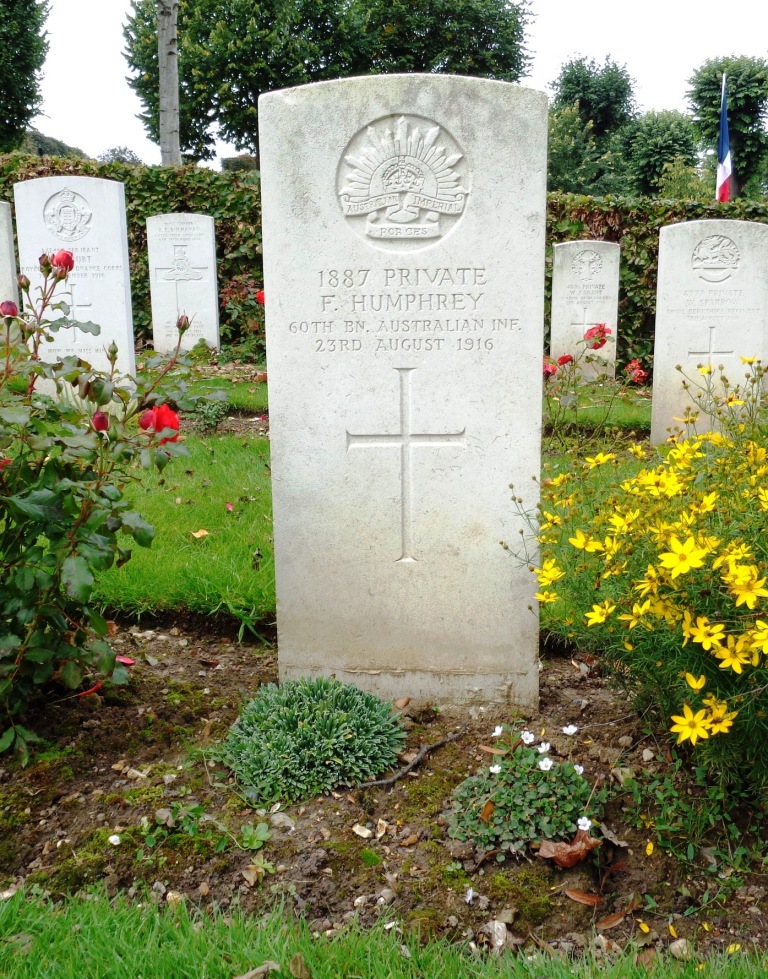
After arrival in France Private Humphrey was admitted to the No. 7 Canadian Stationary Hospital at Le Harve with Bacillary Dysentry on 19th August 1916. He died of his illness on the 23rd August 1916, and is buried at the Ste Marie Cemetery at Le Harve, France.

Frank Humphrey's headstone at Ste. Marie Cemetery, Le Havre, France (Photograph: H. Thompson 2/9/2014)

Frank Humphrey’s headstone at Ste. Marie Cemetery, Le Havre, France (Photograph: H. Thompson 2/9/2014)

His name is also remembered on the Cooee March Memorial Park Gateway (Gilgandra).

James MAHER

James MAHER

James Maher, 1915 (Photograph courtesy of L. Leo)

James Maher, 1915 (Photograph courtesy of L. Leo)

Per his military service record (regimental no. 4847), James Maher was born at Gilgandra, N.S.W.[1]  He gave his age as 18 years, his marital status as single, and his occupation as farm labourer.  His description on his medical was height 5 feet 7 inches, weight 136 lbs., with a medium complexion, grey eyes, and dark brown hair. His religious denomination was Roman Catholic.  He claimed to have 7 months previous experience with the Gilgandra Rifle Club. He completed his medical, and was attested, on the 14th October 1915 at Dubbo, which was the day the Co-ees left Dubbo on the Coo-ee March.

His official date of joining the A.I.F. on his Attestation Paper in his service record is the 14th October 1915, the day the Coo-ees marched from Dubbo to Wongarbon.  James “Jim” Maher is however known as one of the 35 recruits from Gilgandra – one of those who caught up along the way.

There is an intial Application to Enlist in the Australian Imperial Force document in his military service record, addressed to the Recruiting Officer at Dubbo,  dated 14th October 1915, which is signed by both his father John Maher, and his mother Georgina Ellen Maher, giving parental permission for him to join, as he was under the age of 21.

It is unclear whether he left Dubbo with the Coo-ees, or did not catch up with the Coo-ees until further down the march route, as per family stories he did not join the Coo-ee March until Wallerawang .[2]

After completing the march he went to Liverpool Camp as reinforcement for the 13th Battalion.

On his embarkation roll his address at time of enrolment was Springfield, Gilgandra, N.S.W., and his next of kin is listed as his father, J. Maher, Springfield, Gilgandra, N.S.W.

Along with many of the Coo-ees, Private Maher departed Sydney on the HMAT Star of England on the 8th March 1916. He arrived in Egypt on the 11th April 1916.

On 20th May 1916 he was transferred to the 45th Battalion.

On 2nd June 1916 Private Maher left Alexandria aboard the Transport Kinafanus Castle bound for France. He arrived at Marseilles on 8th June 1916.

Private Maher served with the 45th Battalion through its first action at Fleurbaix, France in July 1916, then through the battles around Pozieres and Mouquet Farm in August, September and October 1916.

On 4th January 1917 Private Maher was appointed Lance Corporal, when the Battalion was preparing to go into action at Dernacourt, France.

On 23rd February 1917 the 45th Battalion was in the front line near Guedecourt, France, when Lance Corporal Maher was wounded in action, receiving gunshot wounds to his right buttock and left ankle.[3]   He was moved to the 14th Australian Field Ambulance, then moved back to the 45th Casualty Clearing Station on 24th February 1917. On 26th February 1917 he was placed aboard the 31st Ambulance Train, and sent to the 26th General Hospital at Etaples, France.

On 1st May 1917 he was placed aboard the Hospital Ship Newhaven at Boulogne, and evacuated to England, He was admitted to the Chatham Military Hospital at Chatham, ,England, later that same day.

On 31st August 1917 he was transferred to the 1st Australian Auxiliary Hospital at Harefield, England. On 21st August 1917 he was discharged and sent to the No. 2 Command Depot at Weymouth, England.

On 16th December 1917 Lance Corporal Maher began his return to Australia, departing England on board the Hospital Ship Kanowa.

He arrived in Australia on 16th February 1917. He was discharged medically unfit on 10th July 1918.


[1] NAA: B2455, MAHER JAMES

[2] Leo, L., email correspondence, 31st July 2014.

[3] Australian Imperial Force unit war diaries, 1914-18 War – AWM4 Subclass 23/62 – 45th Infantry Battalion, February 1917.

William Thomas HITCHEN

William “Bill” Thomas HITCHEN

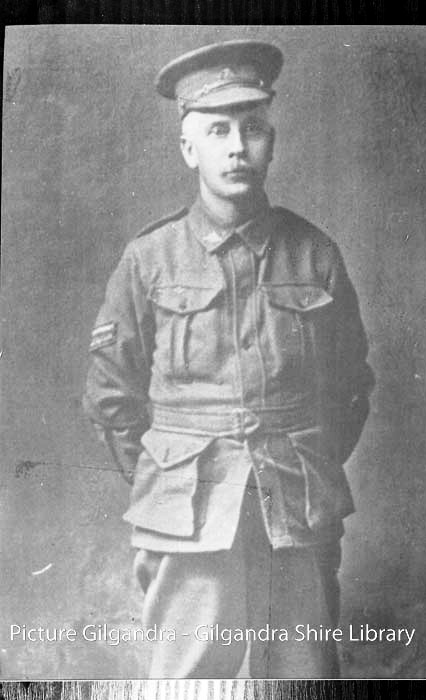
Bill Hitchen (Photograph courtesy of Gilgandra Shire Library)

Bill Hitchen (Photograph courtesy of Gilgandra Shire Library)

Per his military service record (regimental no. 1677), William “Bill” Thomas Hitchen was born at Mudgee, N.S.W. Lowering his actual age of 51 years by several years, he gave his age as 44 years and 2 months, and his address as Bridge Street, Gilgandra, N.S.W. He gave his occupation as plumber. His description on his medical was height 5 feet 7 ½ inches tall, weight 180 lbs., with a medium complexion, light brown eyes, and fair hair. His religious denomination was Roman Catholic.  He claimed to have no previous military experience.

He was known as Captain Bill Hitchen on the Coo-ee March as he was the Captain of the Gilgandra Rifle Club before enlisting.

Bill Hitchen was one of the main organisers of the Coo-ee March (along with his brother Richard G. Hitchen), and he joined the Coo-ees at Gilgandra at the beginning of the march. His official enlistment date is the 10th October 1915. However, per his service record he did not complete his medical and attestation until the 24th February 1916 at Bathurst, after he assisted in organising the Kookaburra March from Tooraweenah to Bathurst in early 1916.

After the Kookaburra March he was allocated to the 2nd reinforcements to the 45th Battalion as a Corporal.

Corporal Hitchen departed Sydney on the HMAT A40 Ceramic on the 14th April 1916. He embarked from Alexandria on 6th June 1916, and disembarked at Plymouth, England, on the 16th June 1916.

He was admitted to the 1st Australian Auxiliary Hospital at Harefield Park on 21st June 1916 sick with Melanotic Sarcoma.  He also had Diabetes.

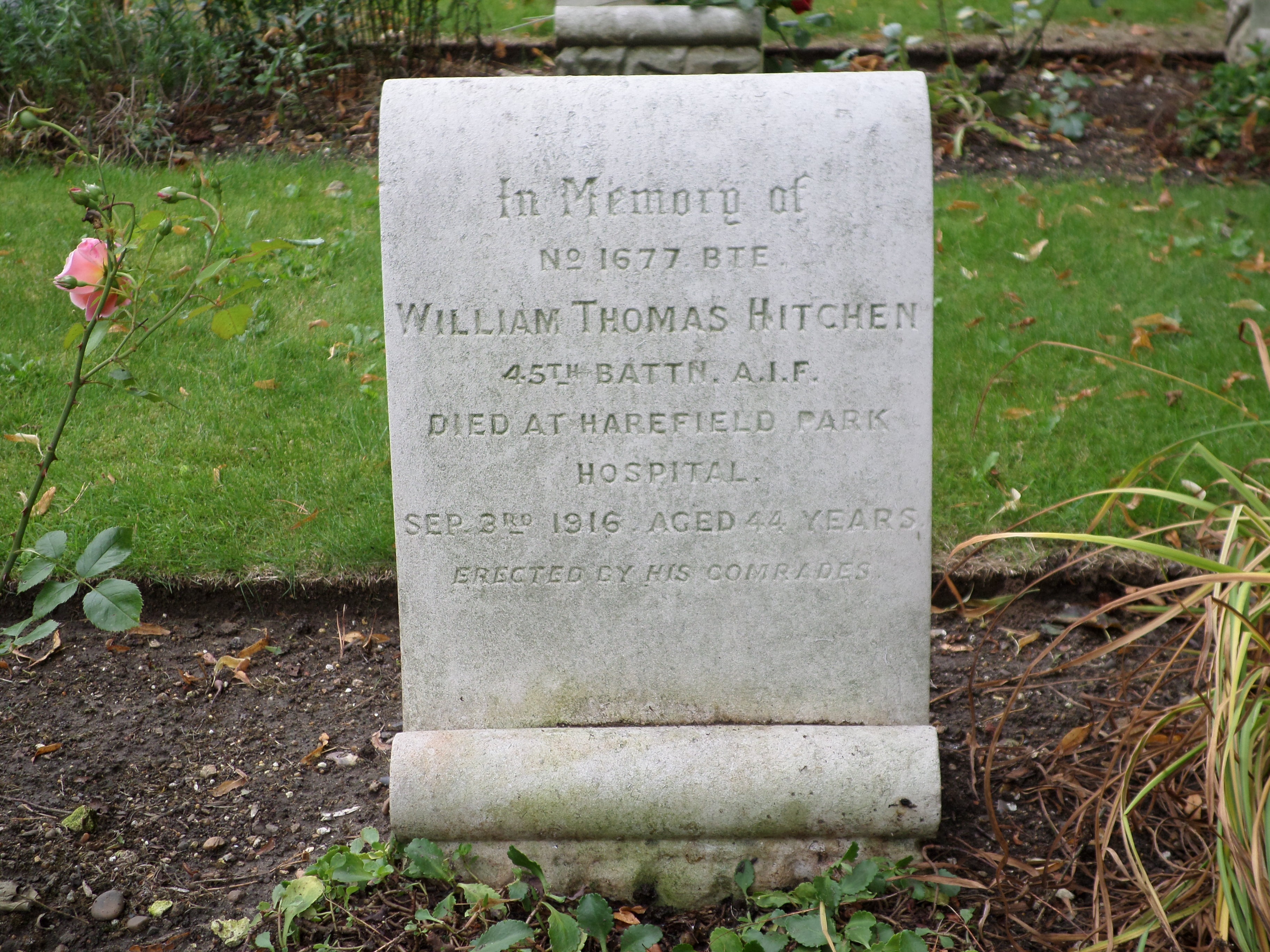
Corporal Hitchen died of his illness on the 3rd September 1916, and was buried at the nearby Saint Mary’s Churchyard at Harefield, England.

Bill Hitchen's headstone, Harefield (St. Mary) Churchyard (Photograph: S & H Thompson, 17/8/2014)

Bill Hitchen’s headstone, Harefield (St. Mary) Churchyard (Photograph: S & H Thompson, 17/8/2014)

His name is also listed on the Gilgandra War Memorial, Cooee March Memorial Park Gateway (Gilgandra), and the Gulargambone War Memorial.


William John Luther HOWARD

William John Luther HOWARD

Per his military service record (regimental no. 4802), William John Luther Howard was born at Crookwell, N.S.W. He gave his age as 24 years and 10 months, and his address as Mountain View, Biddon, Gilgandra, N.S.W. He gave his occupation as Farmer. His description on his medical was height 5 feet 9 ¾ inches tall, weight 11 stone 2 lbs., with a dark complexion, light blue eyes, and brown hair. His religious denomination was Methodist. He completed his medical on the 27th October 1915 at Gilgandra, (after the Coo-ee March had started), and was not attested until after the March had finished, at Liverpool on the 13th November 1915. He claimed to have had no previous military service.

Private Howard joined the Coo-ees at Bathurst. A telegram in the official correspondence of the March from A.H. Miller in Gilgandra to Major Wynne on the Coo-ee March dated 28th October 1915 advised that Howard had been sent to Bathurst the night before to meet them (presumably by train). His name was listed as one of the Bathurst recruits in The Bathurst Times (29/10/1915, p. 2).

After completing the march he went to Liverpool Camp as reinforcement for the 13th Battalion.

Private Howard departed Sydney on the HMAT Star of England on the 8th March 1916. He arrived in Egypt on the 11th of April 1916.

On the 7th June 1916 Private Howard left Alexandria aboard the Transport Huntspill bound for France, arriving at Marseille on the 14th June 1916.

After arriving in France Private Howard was sent to a Machine Gun Training School on 30th June 1916. After completing training he was posted to the 12th Machine Gun Company on the 12th August 1916, when it was engaged in heavy fighting around Pozieres.

Private Howard was admitted to hospital with influenza on 1st January 1917, returning to duty on 26th January 1917.

He was appointed Lance Corporal on the 9th October 1917 when his unit was resting out of the line at Ypres, Belgium.

On the 1st April 1918 his unit was redesignated the 4th Machine Gun Battalion.

He went on leave to the United Kingdom on 7th September 1918. He returned from leave on the 26th September 1918.

Lance Corporal Howard began his return to Australia aboard the Transport HMAT Commonwealth on the 17th April 1919. He arrived in Australia on the 19th May 1919.

He was discharged on the 12th June 1919.

John MCNAMARA

John MCNAMARA

Coo-ees on the road to Balladoran (Sydney Mail 20/10/1915)

Coo-ees on the road to Balladoran – John McNamara is in the front row second from the right, next to Captain Nicholas on far right (Sydney Mail 20/10/1915)

Per his military service record, John McNamara was born at Sydney, N.S.W. His WWI service record shows that he initially tried to enlist on 14th December 1914 at Traralgon in Victoria, where he gave his age as 47 years. (Based on his age given in his entry in the Sudan Nominal Roll on the Australian War Memorial website, it is likely he was even older). On his enlistment papers when he joined the Coo-ees at Gilgandra, he miraculously lost two years, giving his age as 45 years and 2 months. He listed his marital status as single, and his occupation as a butcher. His description on his medical was height 5 feet 11 inches tall, weight 160 ½ lbs., with a medium complexion, grey eyes, and light brown hair. His religious denomination was Roman Catholic. He completed his medical on the 9th October 1915 at Gilgandra, and was attested by Captain Nicholas on the 9th October 1915 at Gilgandra. He claimed to have 5 years in the Regular Forces of New South Wales throughout the Boer War, and a total of 15 years’ previous military service. He gave his address as c/- H. Burns, Exhibition Dairy, Botany Road, Sydney. He listed his next of kin as his nephew, Valentine McNamara, Exhibition Dairy, Botany Road, Sydney.

After completing the march he went to Liverpool Camp as reinforcement for the 13th Battalion.

After two periods of being absent without leave (17th to 24th January 1916, and 3rd to 11th February 1916), on the 16th February 1916 Private McNamara was discharged with his services no longer being required.

The veteran of the Coo-ees : John McNamara

Transcript of an article titled “The Veteran of the “Coo-ees” from The Dubbo Liberal and Macquarie Advocate, November 16, 1915, p. 2.

THE VETERAN OF THE “COO-EES.”

As long as ever he can remember, John McNamara, the grizzled old veteran, who marched in the front rank of the “Coo-ees” all the way down to the coast, has had a hankering after a military life. He first enlisted during the early eighties in the New South Wales Artillery, which was then under the control of the State Government. On the outbreak of the Soudan campaign he volunteered, for service, and secured a place in the field battery. At the conclusion of the campaign he was awarded the Soudan medal and clasp and the Khedive’s bronze star. His next experience of active service was under Major Forbes in the Matabele campaign, for which he holds the medal.

On the outbreak of hostilities in South Africa McNamara joined Brabant’s Horse, and went right through the war, gaining the Queen’s Medal and four clasps, the Kings Medal and two clasps, and also the Distinguished Conduct Medal. During the same campaign he also served in the Imperial Light Horse under Colonel Duncan McKenzie, and in the Western Province Mounted Rifles. At the conclusion of hostilities he enlisted in the Transvaal Mounted Police as a trooper, and during the Cape Colony rebellion a mounted patrol in which he was had a brush with the famous rebel leader Maritz at Toutlebosch Kop. Later as he resigned from the mounted police, and secured employment on the Cape-Cairo railway, being stationed at Wankas, a town 60 miles north of Buluwayo. Here he contracted black-water fever, and on his recovery he went to New Zealand. He remained there for some years, but the call of the bush was too strong, and six years ago he came over to New South Wales. He attempted to enlist at the beginning of the present war, but was rejected owing to the fact that he was over 35. Now things are changed. He is going to the front, and his heart’s desire being satisfied, there is no happier man in the “Coo-ees” than John McNamara.

Click here to view the article on Trove: http://nla.gov.au/nla.news-article77602239

Victor QUINTON

Victor QUINTON

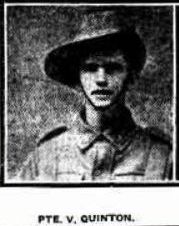
Private Victor Quinton (Sunday Times, 8/10/1916)

Private Victor Quinton (Sunday Times, 8/10/1916)

Per his military service record (regimental no. 4880), Victor Quinton was born at Gilgandra, N.S.W. He gave his age as 19 years and 6 months, his marital status as single, and his occupation as labourer. His description on his medical was height 5 feet 4 ½ inches tall, weight 8 stone 9 lbs., with a dark complexion, bluish green eyes, and dark hair. His religious denomination was Anglican. He completed his medical on the 9th October 1915 at Gilgandra, and was attested by Captain Nicholas on the 9th October 1915 at Gilgandra. He claimed to have had no previous military service.

After completing the march he went to Liverpool Camp as reinforcement for the 13th Battalion.

On his embarkation roll his address at time of enrolment was Miller Street, Gilgandra, N.S.W., and his next of kin is listed as mother, Mrs E. Lumley, Melrose Bidden, Gilgandra N.S.W.

Private Quinton departed Sydney on the HMAT Star of England on the 8th of March 1916. He arrived in Egypt on the 11th April 1916. On the 17th May 1916 he was transferred to the 4th Division Pioneer Training Battalion.

On the 6th June 1916 Private Quinton left Alexandria aboard the Transport Ionian bound for France, arriving at Marseille on the 15th June 1916. On the 22nd July 1916 Private Quinton was taken on strength in the field in the 4th Pioneer Battalion.

On the 5th August 1916 the Battalion was constructing communication trenches near Pozieres when Private Quinton was evacuated with shell shock. He returned to his unit on the 11th August 1916.

Private Quinton was evacuated with Influenza to the 5th Australian Field Ambulance, then the 36th Casualty Clearing Station, on 25th November 1916.  He was sent to hospital in Rouen on 29th November 1916.

On 14th December 1916, Private Quinton was evacuated to the 1st Southern General Hospital in England two weeks later.

He marched into Pernham Downs in England on 13th January 1917.

On the 24th January 1917 Private Quinton was transferred to the Australian Army Ordnance Corps. He served in England until the end of the war.

On the 22nd March 1919 Private Quinton left England on the Transport Nevasa bound for Australia. He arrived on the 26th April 1919, and was discharged on the 12th of June 1919.

Alfred Rupert Clyde LINGSTROM

Alfred Rupert Clyde LINGSTROM (aka Alf LYNNE)
Alfred Rupert Lynne "Pug" (Photograph courtesy of Gilgandra Shire Library)

Alfred Rupert Lynne “Pug”, 1915 (Photograph courtesy of Gilgandra Shire Library)

Per his military service record (regimental no. 4834), Alfred Rupert Clyde Lingstrom was born at Dubbo, N.S.W.[1]  He gave his age as 21 years, his marital status as single, and his occupation as Postal Assistant.  His description on his Certificate of Medical Examination was height 5 feet 6 ½ inches, weight 112 lbs., with a fair complexion, grey eyes, and light brown hair.  His religious denomination was Methodist.  He completed his medical examination on 13th October 1915 at Dubbo (the day the Coo-ees arrived in Dubbo), but was not attested until 26th October 1915 at Bathampton (after he had caught up with the Coo-ees).  He claimed to have had no previous military service. He stated that he was a member of the Geurie Rifle Club.

An article in the Wellington Times dated 28th October 1915 reported that ‘Mr. [W. W.] Smith and Mr. Lynne responded to the call for recruits when the Coo-ees from Gilgandra spent a night in Geurie’ [on Friday 15th October 1915], ‘but neither could join immediately, as the former had a big task in handing over all the shire books to his successor, and Mr. Lynne had to remain in his position at the local [Geurie] post-office till a relief man could be sent along’, and that ‘Mr. Lynne himself hails from the home of the Coo-ees (Gilgandra) so should find himself among friends when he joins them’.[2]

Alfred Lingstrom, reported as “A. Lynne” in The Dubbo Liberal and Macquarie Advocate, following a send off provided by the Geurie community, travelled by train from Geurie with fellow Geurie Coo-ee William Smith on Tuesday 26th October 1915, to catch up with the Coo-ees at Blayney.[3]

He was known as one of the Gilgandra Coo-ees.

After completing the remainder of the Coo-ee March, he went to Liverpool Camp as reinforcement for the 13th Battalion.

Private Lingstrom attended a Signal School at Liverpool from 25th December 1915 to 2nd February 1916.[4]

On his embarkation roll his address at time of enrolment was Warren Street, Gilgandra, N.S.W., and his next of kin is listed as his mother, Mrs. E. [Emily] Lingstrom, at the same address.

Private Lingstrom, along with many of the Coo-ees, departed Sydney on the HMAT A15 Star of England on 8th March 1916, as 15th reinforcement for the 13th Battalion.  He arrived in Egypt on 11th April 1916.

On the 16th May 1916 he was transferred to the Signal Section of the Engineers Training Depot at Tel-el Kebir.

On the 15th October 1916 Private Lingstrom was taken on strength of the ANZAC Mounted Division Signal Squadron at Romani.

On 1st February 1917 Private Lingstrom was sent to hospital sick. On 12th February 1917 he was admitted to the 14th Australian General Hospital at Abbassia, Egypt, suffering from Bronchitis.  He was transferred to a Convalescent Depot on 20th February 1917.

On 9th March 1917 Private Lingstrom was charged with (1) breaking out of barracks about 6 p.m. and remaining absent until apprehended by the Military Police about 7.30 p.m. on 8th March 1917, (2) being out of bounds by being in Wagh el Burka Street, and (3) neglecting to obey Garrison orders by not wearing identity discs.  He was awarded 3 days confined to barracks and fined 4 days pay.

On 12th March 1917 Private Lingstrom was sent to the 1st Light Horse Training Regiment at Moascar, Egypt.  On 20th March 1917 he was moved to the Base Signal Depot at Alexandria, Egypt.  On 27th of April 1917 he rejoined the ANZAC Mounted Division Signal Squadron.

On 9th May 1917 Private Lingstrom went to hospital sick. He was admitted to Citadel Military Hospital in Cairo, Egypt, on 12th May 1917, suffering from Debility.  He was discharged to a Convalescent Depot at Abbassia, Egypt, on 19th May 1917.

On 30th May 1917 Private Lingstrom was charged with overstaying his pass from 8 p.m. until apprehended by the Military Police about 9.40 p.m., and being out of bounds, on 28th May 1917.  He was fined 2 days pay.

On 2nd June 1917 Private Lingstrom was transferred to the British Red Cross Convalescent Depot at Montagah, Egypt.

On 14th June 1917 Private Lingstrom was discharged to the Base Signal Depot at Alexandria, Egypt.

On 28th July 1917 he rejoined the ANZAC Mounted Division Signal Squadron.

On 28th January 1918 Private Lingstrom was charged with whilst being on active service for failed to salute an officer on 25th January 1918.  He was awarded 5 days confined to camp.

On 2nd March 1918 Private Lingstrom was sent to the Base Signal Depot at Alexandria, Egypt.  On 28th March 1918 he rejoined the ANZAC Mounted Division Signal Squadron.

On 11th August 1918 Private Lingstrom was sent to a Rest Camp at Port Said, Egypt.

On 1st September 1918 he was sent to the Signals Training Unit at Moascar, Egypt.

On 12th February 1919 he rejoined the ANZAC Mounted Division Signal Squadron.

On 6th March 1919 Private Lingstrom was promoted to Temporary 2nd Corporal.  He was promoted to 2nd Corporal on 24th June 1919.

2nd Corporal Lingstrom began his return to Australia aboard the H.T. Malta at Kantara, Egypt, on 3rd July 1919.

He arrived in Australia on 10th August 1919, and was discharged on 3rd October 1919.


[1] NAA: B2455, LINGSTROM ALFRED RUPERT CLYDE

[2] ‘Round the Wellington District’, Wellington Times, 28 October 1915, p. 7. Retrieved February 27, 2017, from http://nla.gov.au/nla.news-article143392877

[3] ‘Geurie’, The Dubbo Liberal and Macquarie Advocate , 29 October 1915, p. 2. Retrieved February 27, 2017, from http://nla.gov.au/nla.news-article77601626

[4] ‘Gilgandra’, Dubbo Dispatch and Wellington Independent, 15 February 1916, p. 3. Retrieved February 27, 2017, from http://nla.gov.au/nla.news-article228635701
 

Leslie Webster GREENLEAF

Leslie Webster GREENLEAF (MM)

Per his military service record (regimental no. 4783), Leslie Webster Greenleaf was born in London, England.[1] He gave his age as 18 years, his marital status as single, and his occupation as butcher. His description on his medical was height 5 feet 7 inches tall, weight 126 lbs., with a fair complexion, grey eyes, and brown hair. His religious denomination was Church of England.  He completed his medical on the 9th October 1915 at Gilgandra and was attested by Captain Nicholas on the 9th October 1915 at Gilgandra. He claimed to have had no previous military service.

After completing the Coo-ee March he went to Liverpool Camp as reinforcement for the 13th Battalion.

On his embarkation roll his address at time of enrolment was Eumungerie Post Office, N.S.W., and his next of kin was his sister, Miss P. Greenleaf, 2 Woodside Road, Surrey, England.

Private Greenleaf departed Sydney on the HMAT A15 Star of England on the 8th March 1916 with the 15th reinforcements to the 13th Battalion. He arrived in Egypt on the 11th April 1916.

On the 7th June 1916 Private Greenleaf left Alexandria aboard the Transport Ionian bound for France, arriving at Marseille on the 14th June 1916.

On the 29th August 1916, during the Battle of the Somme, when the 13th Battalion was attacking Mouquet Farm, he received a gunshot wound to his right hand. Private Greenleaf was hospitalised then evacuated to England.

Private Greenleaf returned to France on the 29th December 1917.

On the 2nd May 1918 Private Greenleaf was with his Battalion defending Villers-Bretonneux when he undertook an action for which he was recommended for (and subsequently awarded with) the Military Medal.

The citation read: ‘East of Villers-Bretonneux on the morning of the 2nd May, 1918, when an officer was severely wounded by M.G. fire and lay within full view of the enemy, Privates Greenleaf and Smith went to his assistance and carried him in at great personal risk. With the assistance of two other men they improvised a stretcher squad, and, as the case was a serious one, carried through with it to the Regimental Aid Post. This was done in broad day light, and practically the whole route was under observation of enemy snipers who were very active.’

On the 20th May 1918, when the 13th Battalion was still defending Villers-Bretonneux, three members of the Battalion were wounded. Private Greenleaf received a bomb wound to his left arm, being wounded in action for the second time. He was admitted to the 13th Australian Field Ambulance, the taken to the 47th Casualty Clearing Station. On 23rd May 1918 Private Greenleaf admitted to the 47th General Hospital at Le Treport, France.

On 3rd  June 1918 Private Greenleaf was evacuated to England by Hospital Ship Panama (gun shot wound left arm). On 4th June 1918 Private Greenleaf was admitted to the Kitchener Military Hospital at Brighton, England. On 11th June 1918 Private Greenleaf was transferred to the 1st Australian Auxiliary Hospital at Harefield, England.

Private Greenleaf was discharged from hospital on leave from 13th June 1918, to report to No. 1 Command Depot at Sutton Veny on 27th June 1918.

Private Greenleaf began his return to Australia aboard the H.T.  City of Exeter on 15th January 1919.

He arrived in Australia on 2nd March 1919.

He was discharged on 11th May 1919.

[1] NAA: B2455, GREENLEAF L W