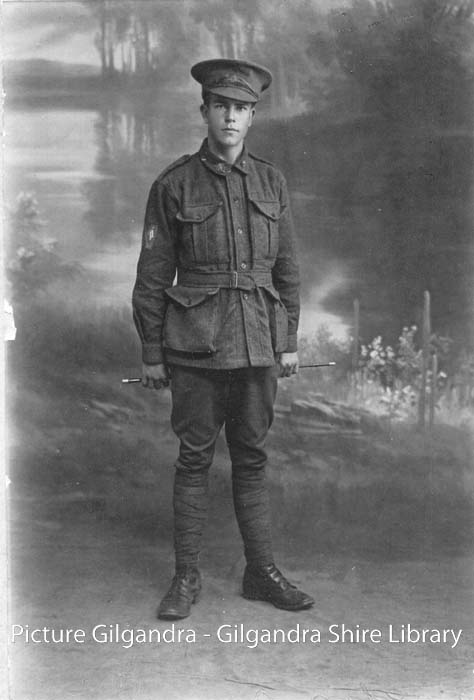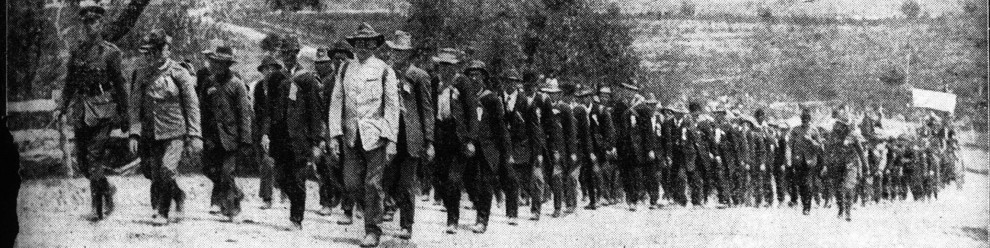
Tag Archives: Blayney recruits

Leo Ambrose STINSON

Leo Ambrose STINSON

Per his military service record (Depot), Leo Ambrose Stinson was born at Boomey, near the town of Wellington, N.S.W. He gave his age as 18 years and 11 months, his marital status as single, and his occupation as storeman. His description on his medical was height 6 feet and ½ inch tall, weight 9 stone 7 lbs., with a dark complexion, brown eyes, and dark hair. His religious denomination was Roman Catholic. He claimed that he had no previous military service. He completed his medical on the 22nd October 1915 at Gilgandra (12 days after the Coo-ees left), then caught up with the Coo-ees, and was attested at Blayney by Captain Eade on the 26th October 1915 (when the Coo-ees were at Blayney).

Leo Stinson was the recruit who joined the Coo-ees at Blayney from Gilgandra by train that was reported in the The Farmer and Settler, 29 October, 1915, p. 3.[1]

After completing the march he went to Liverpool Camp into D Coy 5th Battalion.

Following a further medical examination before the Medical Board on 17th November 1915 after arriving at Liverpool Camp with the Coo-ees, Private Stinson was discharged on the 29th of November 1915 as medically unfit, with deficient chest measurement.

On 18th March 1916 Leo Stinson re-enlisted at Dubbo, where he passed his medical and was attested. After some training he embarked from Sydney on 9th September 1916 as 15th reinforcement for the 20th Battalion on the HMAT A14 Euripides. He was given regimental no. 5644.

On his embarkation roll his address at time of enrolment was Miller Street, Gilgandra, N.S.W., and his next of kin is listed his father, John Nicholas Stinson, Rydal, N.S.W.

He arrived at Plymouth in England on 26th October 1916.

Private Stinson trained in England until 13th December 1916, when he was sent to Etaples in France. He joined the Battalion in France on 26th January 1917.

On the 15/16th of April 1917 a German attack broke through the front line near Lagnicourt in France and the guns of the 2nd Australian Field Artillery Brigade were captured. The 20th Battalion was involved in the counterattack that recaptured the guns and forced the Germans back to their lines. Over 200 Germans were captured by the Battalion in this operation. Six members of the Battalion were killed, and were 16 wounded, including Private Stinson, who received a gunshot wound to his back and another to his right arm. Private Stinson was evacuated to the 9th Casualty Clearing Station, then admitted to the 10th General Hospital in Rouen on 17th April 1917. He was then sent to England on 29th April 1917, and was admitted to the 5th Southern General Hospital on 30th April 1917.

On 7th July 1917 Private Simpson was discharged from the 5th Southern General Hospital to No. 1 Auxiliary Hospital at Harefield.

On 26th September 1917 Private Stinson left England on the HMAT Borda bound for Australia. He arrived in Melbourne on 25th November 1917, and was discharged as medically unfit on 4th January 1918.

On 22nd July 1919 Private Stinson re-enlisted in the Special Service AIF (regimental no. 86082), and on 12th August 1919 he departed Sydney bound for Europe as an escort for deportees being sent to Europe. He arrived at London on 12th October 1919. On 5th December 1919 Private Stinson commenced his return to Australia, arriving on 23rd January 1920. He was discharged on 7th February 1920.

Leo Stinson also enlisted in the AIF in the Second World War.

[1] ‘Great Route March. Gilgandra to the Coast’, ’, The Farmer and Settler, 29 October 1915, p. 3, http://nla.gov.au/n la.news-article116671286


John TARLINGTON

John TARLINGTON

Per his military service record (regimental no. 4605), John Tarlington was born at Glen Innes, N.S.W. He gave his age as 38 years and 7 months, his marital status as married, and his occupation as laborer. His description on his medical was height 5 feet 10 inches tall, weight 11 stone 5 lbs., with a fair complexion, blue eyes, and dark hair. His religious denomination was Roman Catholic.

On his attestation paper dated 26th October 1915, John Tarlington claimed previous service of 10 months in South Africa during the Boer War with the New South Wales Mounted Infantry, and 2 months previous service with the 18th Battalion.

John Tarlington had enlisted previously in the AIF on 20th May 1915 (with regimental no. 727) and completed two months training before being discharged at his wife’s request on 8th July 1915. Noted on this previous attestation paper dated 20th May 1915 was that at he had ‘Served 13th Battalion Discharged for breaking leave’. According to a statement in his service record that John Tarlington had made at the time of his 20th May 1915 enlistment, as he was unable to produce a discharge certificate for his previous service, he had enlisted about the ‘middle of November 1914 and was pooled’ to the 13th Battalion, from which he had been ‘discharged the day before embarkation on a charge of “Overstaying leave”’. He was ‘granted 24 hours leave, & returned to camp about 24 hours late, owing to severe illness’ of his wife, and on his return he was told his ‘place had been filled’ on account of his absence , and he was ‘then ordered off the ground by one of the Military Police’.

John Tarlington was in the process of applying to re-enlist in the AIF for the third time before he joined up with the Coo-ees at Blayney. On his initial Application to enlist form in his service record dated 11th October 1915 at Lithgow, John Tarlington gave his address as Coombing Park, Carcoar, N.S.W.  A letter in his service record stated that he would present himself on the 26th October after he had given two week’s notice to his employer. It appears he presented himself to the Coo-ee March at Blayney on the 26th October, instead of returning to Lithgow to enlist.

He completed his medical examination on the 26th October 1915 at Blayney, and was attested by Captain Eade at Blayney on 26th October 1915.

After completing the Coo-ee March he went to Liverpool Camp as reinforcement for the 13th Battalion.

On his embarkation roll his address at time of enrolment was Guildford Road, Guildford, N.S.W., and his next of kin is listed as his wife, Mrs. S. [Susan] Tarlington, Guildford Road, Guildford , N.S.W.

Private Tarlington departed Sydney on the HMAT Ballarat on 16th February 1916. He arrived in Egypt on 22nd March 1916. On 1st April 1916 he was transferred to the 54th Battalion at Ferry Post, Egypt.

On 14th April 1916 Private Tarlington reported to the 14th Field ambulance sick, and he was sent to the 2nd Casualty Clearing Station, then to the Number 1 Australian Stationary Hospital at Ismalia, Egypt. The next day 15th April 1916 Private Tarlington was admitted to the 1st Dermatological Hospital at Abassia, Egypt. He was discharged on 21st April 1916.

On 23rd May 1916 Private Tarilington was transferred to the 4th Pioneer Battalion.

Private Tarlington left Alexandria on 6th June 1916 aboard the Transport Ionian bound for France, arriving at Marseilles on 15th June 1916. He went to the 4th Australian Division Base Depot at Etaples, France. On 21st June 1916 he departed Etaples and joined the 4th Pioneer Battalion the next day on 22nd June 1916 when it was at Armentieres, France constructing defensive works.

On 6th August 1916 the 4th Pioneer Battalion was maintaining Tramway Trench in the ruins of the village of Pozieres which was under heavy German artillery fire during the Battle of Pozieres when Private Tarlington was killed in action. Also killed with him in the 4th Pioneer Battalion on the same day were fellow Coo-ees Oliver James Harmon (who joined the Coo-ees at Parramatta), and Karl Alex Frederick Neilson (who joined the Coo-ees at Springwood).

According to his Red Cross Wounded and Missing report, Private Tarlington was killed by a shell as ‘he got on the top of the trench at Pozieres to allow some wounded men to pass along the trench’, and he was buried ‘afterwards just over the parapet of the trench’, and ‘the grave was not marked’.[1]

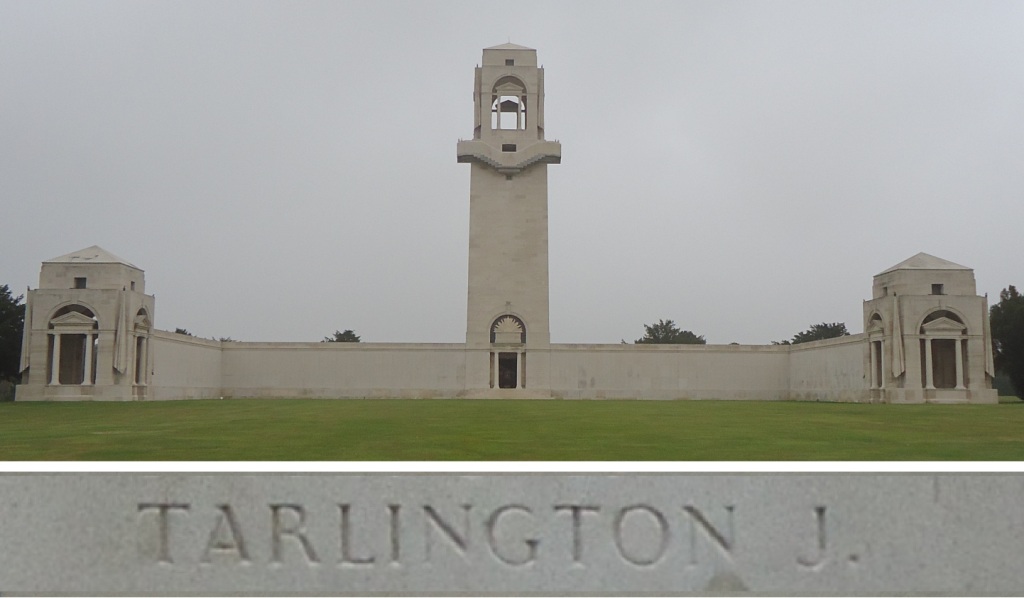
Private Tarlington has no known grave, and is remembered on the Villers-Bretonneux Memorial in France. He left a widow and a son.

Private Tarlington's name on the Villers-Bretonneux Memorial, France (Photograph: S. & H. Thompson 7/9/2014)

Private Tarlington’s name on the Villers-Bretonneux Memorial, France (Photograph: S. & H. Thompson 7/9/2014)

Private Tarlington’s name is commemorated on panel 174 on the Australian War Memorial First World War Roll of Honour.

Private Tarlington’s name is also remembered on the Guildford Soldiers Memorial at the Soldiers Memorial School of Arts Hall at Guildford.

[1] ‘4605 Private John Tarlington’, Red Cross Wounded and Missing Enquiry Bureau Files, 1914-1918 War 1DRL/0428, http://static.awm.gov.au/images/collection/pdf/RCDIG1059988–1-.pdf


Archibald MCINTYRE

Archibald MCINTYRE

Per his military service record (regimental no. 2708), Archibald McIntyre enlisted twice in the AIF. Archibald McIntyre was born at Glasgow, Scotland. On his first enlistment (during the Coo-ee March), he gave his age as 31 years and 6 months, his marital status as single, and his occupation as labourer. His description on his medical was height 5 feet 2 inches tall, weight 9 stone 10 lbs., with a dark complexion, brown eyes, and dark hair. His religious denomination was Church of England. He claimed that he had no previous military service. He completed his medical on the 26th October 1915 at Blayney, and was attested by Captain Eade at Blayney on the 26th October 1915.

After completing the Coo-ee March he went to Liverpool Camp as reinforcement for the 13th Battalion.

Whilst at Liverpool Camp Private McIntyre went before a medical board on 17th November 1915 where he was deemed unfit for military service due to defective vision. He was discharged on the 29th November 1915.

In a letter dated 16th April 1916 Archibald McIntyre wrote “I was rejected for eyesight but as they have reduced the test I intend to give it another try”.[1]

On the 19th May 1916 Archibald McIntyre applied again to join the AIF. He attended the Royal Agricultural Showground in Sydney, and stated in this application that he had 35 days previous military service in the AIF, and was rejected on grounds of eyesight. He underwent a medical on the 19th May 1916 which he passed. He was attested on the 20th May 1916 at the Royal Agricultural Showground.

Private McIntyre went into camp and began training at Cootamundra on the 23rd May 1916, then to Goulburn on the 22nd June 1916. He remained at Goulburn till the 4th September 1916 when he was transferred to the 56th Battalion and went to Sydney being taken on strength of the 6th reinforcements for the Battalion.

On his embarkation roll his address at time of enrolment was Portland N.S.W., and his next of kin is listed as father, William McIntyre, 161 Pollok Street, Glasgow, Scotland.

Private McIntyre departed Sydney on the HMAT A40 Ceramic on the 7th October 1916. He arrived in Plymouth, England, on the 21st November 1916. After further training in England he departed Folkestone, England, aboard the SS Princess Victoria for France on the 21st December 1916. He underwent further training in France at the 5th Australian Division Base Depot at Etaples. He joined the 56th Battalion on 1st February 1917 whilst it was in reserve and providing fatigue parties at Bernafay south of Pozieres, France.

On the 22nd March 1917 the 56th Battalion was in reserve in the vicinity of Bancourt, France, when Private McIntyre was evacuated to hospital sick. On the 24th March 1917 he was diagnosed to be suffering from Bronchitis. On the 25th March at the 2nd/1st South Midland Casualty Clearing Station Private McIntyre was diagnosed with Cerebro Spinal Meningitis. He died the next day.

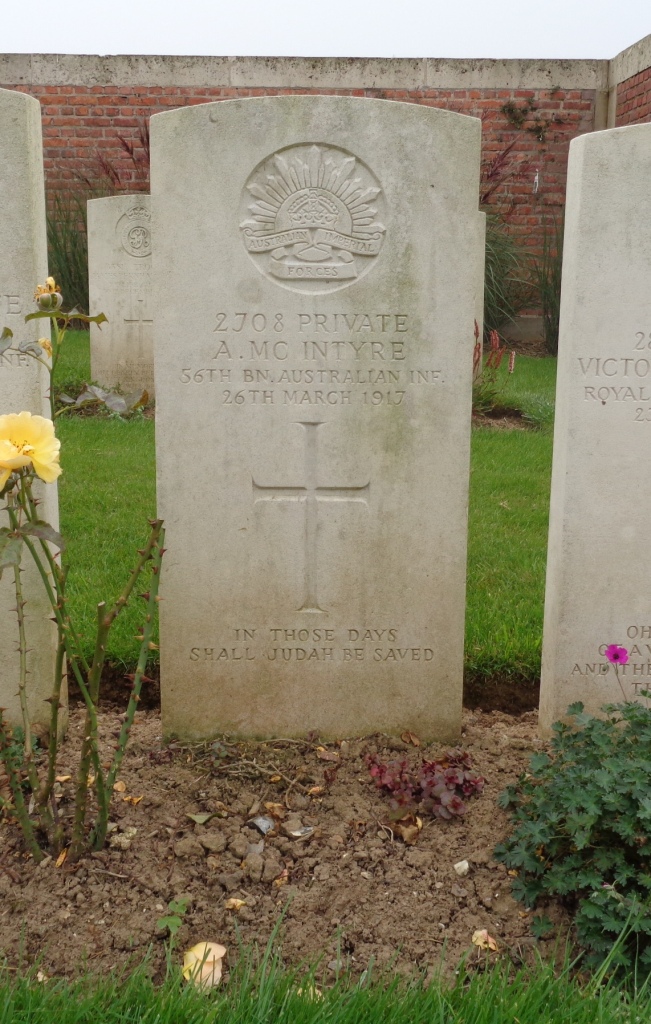
Private McIntyre was buried in the Puchevillers British Cemetery, France, on 26th March 1917.

Archibald McIntyre's headstone at Puchervillers British Cemetery, France (Photograph: S & H Thompson 5/9/2014)

Archibald McIntyre’s headstone at Puchevillers British Cemetery, France (Photograph: S & H Thompson 5/9/2014)

Private McIntyre’s name is commemorated on panel 162 on the Australian War Memorial First World War Roll of Honour.

Note: Archibald McIntyre’s father wrote on his Australian War Memorial Roll of Honour Circular that he came to Australia when he was 22, and that he ‘sailed round world once or twice as a sea apprentice in a sailing ship. Traded from Australia to New Zealand for a time. Joined in the Coo-ee March. Two brothers in British Army (one killed).’[2]

[1] McIntyre, Archibald. Letter to [A. H. Miller], 16th April 1916, Alex Halden (Joe) Miller papers mainly relating to the Gilgandra Coo-ee Recruitment March, New South Wales, 1912-1921, 1939, held at the Mitchell Library (State Library of N.S.W.)

[2] Archibald McIntyre 2708 Australian War Memorial Roll of Honour Circular, http://static.awm.gov.au/images/collection/pdf/RCDIG1068881–64-.PDF

Alfred Rupert Clyde LINGSTROM

Alfred Rupert Clyde LINGSTROM (aka Alf LYNNE)

Alfred Rupert Lynne "Pug" (Photograph courtesy of Gilgandra Shire Library)

Alfred Rupert Lynne “Pug”, 1915 (Photograph courtesy of Gilgandra Shire Library)

Per his military service record (regimental no. 4834), Alfred Rupert Clyde Lingstrom was born at Dubbo, N.S.W.[1]  He gave his age as 21 years, his marital status as single, and his occupation as Postal Assistant.  His description on his Certificate of Medical Examination was height 5 feet 6 ½ inches, weight 112 lbs., with a fair complexion, grey eyes, and light brown hair.  His religious denomination was Methodist.  He completed his medical examination on 13th October 1915 at Dubbo (the day the Coo-ees arrived in Dubbo), but was not attested until 26th October 1915 at Bathampton (after he had caught up with the Coo-ees).  He claimed to have had no previous military service. He stated that he was a member of the Geurie Rifle Club.

An article in the Wellington Times dated 28th October 1915 reported that ‘Mr. [W. W.] Smith and Mr. Lynne responded to the call for recruits when the Coo-ees from Gilgandra spent a night in Geurie’ [on Friday 15th October 1915], ‘but neither could join immediately, as the former had a big task in handing over all the shire books to his successor, and Mr. Lynne had to remain in his position at the local [Geurie] post-office till a relief man could be sent along’, and that ‘Mr. Lynne himself hails from the home of the Coo-ees (Gilgandra) so should find himself among friends when he joins them’.[2]

Alfred Lingstrom, reported as “A. Lynne” in The Dubbo Liberal and Macquarie Advocate, following a send off provided by the Geurie community, travelled by train from Geurie with fellow Geurie Coo-ee William Smith on Tuesday 26th October 1915, to catch up with the Coo-ees at Blayney.[3]

He was known as one of the Gilgandra Coo-ees.

After completing the remainder of the Coo-ee March, he went to Liverpool Camp as reinforcement for the 13th Battalion.

Private Lingstrom attended a Signal School at Liverpool from 25th December 1915 to 2nd February 1916.[4]

On his embarkation roll his address at time of enrolment was Warren Street, Gilgandra, N.S.W., and his next of kin is listed as his mother, Mrs. E. [Emily] Lingstrom, at the same address.

Private Lingstrom, along with many of the Coo-ees, departed Sydney on the HMAT A15 Star of England on 8th March 1916, as 15th reinforcement for the 13th Battalion.  He arrived in Egypt on 11th April 1916.

On the 16th May 1916 he was transferred to the Signal Section of the Engineers Training Depot at Tel-el Kebir.

On the 15th October 1916 Private Lingstrom was taken on strength of the ANZAC Mounted Division Signal Squadron at Romani.

On 1st February 1917 Private Lingstrom was sent to hospital sick. On 12th February 1917 he was admitted to the 14th Australian General Hospital at Abbassia, Egypt, suffering from Bronchitis.  He was transferred to a Convalescent Depot on 20th February 1917.

On 9th March 1917 Private Lingstrom was charged with (1) breaking out of barracks about 6 p.m. and remaining absent until apprehended by the Military Police about 7.30 p.m. on 8th March 1917, (2) being out of bounds by being in Wagh el Burka Street, and (3) neglecting to obey Garrison orders by not wearing identity discs.  He was awarded 3 days confined to barracks and fined 4 days pay.

On 12th March 1917 Private Lingstrom was sent to the 1st Light Horse Training Regiment at Moascar, Egypt.  On 20th March 1917 he was moved to the Base Signal Depot at Alexandria, Egypt.  On 27th of April 1917 he rejoined the ANZAC Mounted Division Signal Squadron.

On 9th May 1917 Private Lingstrom went to hospital sick. He was admitted to Citadel Military Hospital in Cairo, Egypt, on 12th May 1917, suffering from Debility.  He was discharged to a Convalescent Depot at Abbassia, Egypt, on 19th May 1917.

On 30th May 1917 Private Lingstrom was charged with overstaying his pass from 8 p.m. until apprehended by the Military Police about 9.40 p.m., and being out of bounds, on 28th May 1917.  He was fined 2 days pay.

On 2nd June 1917 Private Lingstrom was transferred to the British Red Cross Convalescent Depot at Montagah, Egypt.

On 14th June 1917 Private Lingstrom was discharged to the Base Signal Depot at Alexandria, Egypt.

On 28th July 1917 he rejoined the ANZAC Mounted Division Signal Squadron.

On 28th January 1918 Private Lingstrom was charged with whilst being on active service for failed to salute an officer on 25th January 1918.  He was awarded 5 days confined to camp.

On 2nd March 1918 Private Lingstrom was sent to the Base Signal Depot at Alexandria, Egypt.  On 28th March 1918 he rejoined the ANZAC Mounted Division Signal Squadron.

On 11th August 1918 Private Lingstrom was sent to a Rest Camp at Port Said, Egypt.

On 1st September 1918 he was sent to the Signals Training Unit at Moascar, Egypt.

On 12th February 1919 he rejoined the ANZAC Mounted Division Signal Squadron.

On 6th March 1919 Private Lingstrom was promoted to Temporary 2nd Corporal.  He was promoted to 2nd Corporal on 24th June 1919.

2nd Corporal Lingstrom began his return to Australia aboard the H.T. Malta at Kantara, Egypt, on 3rd July 1919.

He arrived in Australia on 10th August 1919, and was discharged on 3rd October 1919.


[1] NAA: B2455, LINGSTROM ALFRED RUPERT CLYDE

[2] ‘Round the Wellington District’, Wellington Times, 28 October 1915, p. 7. Retrieved February 27, 2017, from http://nla.gov.au/nla.news-article143392877

[3] ‘Geurie’, The Dubbo Liberal and Macquarie Advocate , 29 October 1915, p. 2. Retrieved February 27, 2017, from http://nla.gov.au/nla.news-article77601626

[4] ‘Gilgandra’, Dubbo Dispatch and Wellington Independent, 15 February 1916, p. 3. Retrieved February 27, 2017, from http://nla.gov.au/nla.news-article228635701