Category Archives: Recruits

John Hole SAUNDERS

John Hole SAUNDERS

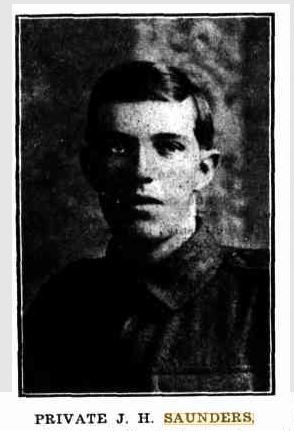
Private J. H. Saunders (Cumberland Argus and Fruitgrowers Advocate 27/5/1916)

Per his military service record (regimental no. 5766), John Hole Saunders was born at Parramatta, N.S.W.[1]  He gave his age as 18 years and 10 months, his marital status as single, and his occupation as shop assistant.  His description on his Certificate of Medical Examination form was height 5 feet 7 ½ inches tall, weight 123 lbs., with a fair complexion, blue eyes, and brown hair. His religious denomination was Methodist.  He claimed to have 4 years universal military training and was still serving.

He completed his medical examination on 10th November 1915 at Parramatta, and was attested by Lieutenant R. Howe at Parramatta on 11th November 1915, when the Coo-ees were recruiting at Parramatta.  He claimed that he had 4 years military service in the Cadets.

After completing the Coo-ee March he went to Liverpool Camp as reinforcement for the 13th Battalion.

The Cumberland Argus and Fruitgrowers Advocate reported that Private ‘Jack’ Saunders’ was presented with a silver-mounted pipe, fountain pen, and other articles, at a send-off held for him and fellow Parramatta recruit Private Roy McMillan, at Parramatta on Monday 14th February 1916. [2]

On his embarkation roll his address at time of enrolment was Dersmore, Crimea Street, Parramatta, N.S.W., and his next of kin is listed as his father, J. H. [John Hole] Saunders, at the same address.

On 3rd May 1916 Private Saunders departed Sydney on the HMAT A46 Clan McGillivray, as part of the 18th reinforcements for the 13th Battalion.

He arrived in Egypt in June 1916.

On Te-el-Kebir on 25th July 1916 Private Saunders was charged with conduct to the prejudice of good order and military discipline in that whilst on a route march disobeyed an order directly given by his superior officer.  He was awarded 2 days confined to barracks.

On 8th August 1916 Private Saunders departed Egypt bound for England aboard the Transport Megantic.

On 12th December 1916 Private Saunders departed Folkestone, England, aboard the SS Arundle bound for France.  He marched into the 4th Australian Division Base Depot at Etaples, France on 13th December 1916.

On 19th December 1916 Private Saunders marched into the 13th Battalion when it was training at Coisy, France.

On 13th January 1917 the 13th Battalion was conducting fatigue duties at Mametz, France, when Private Saunders was evacuated the 5th Australian Field Ambulance sick with Influenza.  On 15th January 1917 he was sent to the 38th Casualty Clearing Station, then placed aboard the 25th Ambulance Train for journey to No. 10 General Hospital at Rouen, France.

On 26th January 1917 he was released from hospital and sent to the 4th Australian Division Base Depot at Etaples, France.

He rejoined the 13th Battalion on 16th February 1917 whilst it was training and performing fatigue duties at Mametz, France.

On 11th April 1917 the 13th Battalion was involved in the attack on the Hindenburg line in the 1st Battle of Bullecourt, France, when Private Saunders was evacuated to the 8th Australian Field Ambulance suffering Asthma.  He was moved to the 4th Australian Field Ambulance, then sent to the 56th Casualty Clearing Station on the 20th April 1917.  On 23rd April 1917 he was transferred to the 11th Stationary Hospital at Rouen, France.

He was discharged from hospital on 26th April 1017 and sent to the 4th Australian Division Base Depot at Etaples, France.  Whilst at the 4th Australian Division Base Depot Private Saunders was classified as “PB” [Permanent Base duties].

On 29th May 1919 he departed France bound for England with the status “P.B.”

Private Saunders arrived in Weymouth on 30th May 1917 and marched into the No. 2 Command Depot.

On the 4th of June 1917 he was transferred to the No. 1 Command Depot at Perham Downs, England.

On 9th June 1917 Private Saunders was classified as “B1A4” [fit for overseas training camp when passed dentally fit].[3]

On 13th September 1917 Private Saunders was reclassified as “A3” [fit for overseas training camp, to which transferred for hardening, prior to rejoining unit overseas].[4]

On 14th September 1917 Private Saunders was sent to the Headquarters Depots at Tidworth, England, to perform guard duties.

On 25th October 1917 Private Saunders was temporarily detached for duty at the Administrative Headquarters in London.

On 4th December 1917 Private Saunders was sent to the No. 3 Command Depot at Hurdcott, England.  On 5th December 1917 he was reclassified as “B1A3” [fit for overseas training camp in two to three weeks].[5]

On 15th December 1917 Private Saunders was reclassified “A3” [fit for overseas training camp, to which transferred for hardening, prior to rejoining unit overseas].[6]

On 19th December 1917 Private Saunders was transferred to the Overseas Training Brigade at Longbridge Deverill, England.

On 10th January 1918 he departed Southampton, England, bound for France.  He marched into the 4th Australian Division Base Depot at Le Harve, France, on 11th January 1918.

On 18th January 1918 Private Saunders rejoined the 13th Battalion on 18th January 1918 when it was training at Locre, Belgium.

On 27th January 1918 the 13th Battalion was at White Chateau was manning the front line near Hollebeke in Belgium when Private Saunders was evacuated to the 13th Australian Field Ambulance suffering Balantitis.  He was moved back to the 2nd Australian Casualty Clearing Station.  On 29th January 1918 he was placed aboard the 39th Ambulance Train and transported to the 39th General Hospital at Le Havre France, where he was admitted on 1st February 1918. He was discharged on 3rd February 1918, and sent to the 4th Australian Division Base depot at Le Harve.

He rejoined the 13th Battalion on 12th of February 1918 when it was training at Locre, Belgium.

On 9th May 1918 the 13th Battalion was manning support lines near Villers Bretonneux, France, when Private Saunders was evacuated to the 13th Australian Field Ambulance sick.  He was moved back to the 61st Casualty Clearing Station then on 10th May 1918 he was placed aboard the 28th Ambulance Train for journey to the 39th General Hospital at Le Harve, France, where he was admitted on13th May 1918.

Private Saunders was discharged from hospital on 16th July 1918 and marched into the 4th Australian Division Base Depot at Le Harve that same day.

He rejoined the 13th Battalion on 3rd August 1918 when it was manning the front line south of Villers Bretonneux, France.

On 7th August 1918 the 13th Battalion was preparing to move forward to participate in an attack on the German lines  around Amiens when Private Saunders went absent without leave at 9.30 p.m.  He returned at 9.15 a.m. on 12th August 1918. On 22nd August 1918 he was charged with being absent without leave, and was awarded 28 days field punishment No. 2 and fined 33 days pay.

On 15th September 1918 the 13th Battalion was preparing to move forward to the front line when Private Saunders went absent without leave again.

He was located on 18th September 1918 and charged with desertion.  On 7th October 1918 a Field General Courts Martial was held where Private Saunders was charged with Desertion.  He pleaded Not Guilty.  He was found Guilty, and he was sentenced to serve 10 years Penal Servitude.

On 8th November 1918 Private Saunders marched into the No. 1 Military Prison at Rouen, France.

On 17th February 1919 he was transferred to England on SS Nirvana to serve the remainder of his sentence.  On 19th February 1919 Private Saunders marched into His Majesty’s Prison at Portland in England.

On 25th April 1919 Private Saunders’ prison sentence was suspended, and he was released and marched into the No. 4 Group at Hurdcott, England, on 26th April 1919.

On 2nd June 1919 Private Saunders departed Devonport, England, aboard the HT Beltana bound for Australia.

He arrived in Sydney on 20th July 1919, and was discharged Termination of Period of Enlistment on 4th September 1919.


[1] NAA B2455, SAUNDERS JOHN HOB

[2] ‘The Sheepskin Fund’, The Cumberland Argus and Fruitgrowers Advocate, 19 February 1916, p. 11. Retrieved March 12, 2017, from http://nla.gov.au/nla.news-article86072411

[3] Department of Veterans Affairs, ‘Army Medical Classifications – World War 1’ in Chapter 5 Abbreviations and Medical Classifications’, http://www.dva.gov.au/consultation-and-grants/advocacy-training/repatriation-handbooks

[4] Ibid.

[5] Ibid.

[6] Ibid.
Reginald Arthur COWELL

Reginald Arthur COWELL

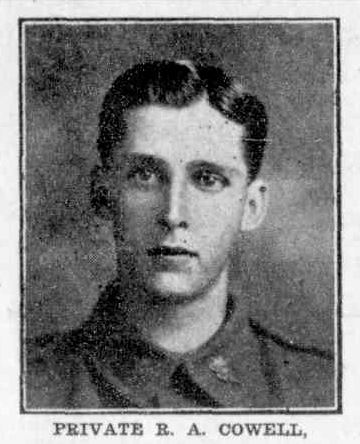
Private R. A. Cowell (Cumberland Argus and Fruitgrowers Advocate 19/1/1918)

Per his military service record (regimental no. 4751), Reginald Arthur Cowell was born at Ermington, N.S.W.[1]  He gave his age as 19 years 5 months, his marital status as single, and his occupation as nurseryman.  His description on his Certificate of Medical Examination form was height 5 feet 8 inches tall, weight 132 lbs., with a sallow complexion, brown eyes, and dark brown hair.  His religious denomination was Church of England.  He claimed that he had no previous military service.

Reginald Arthur Cowell joined the Coo-ees at Parramatta.[2]  The Coo-ees had held a recruiting meeting in the Park at Parramatta on the evening of the 10th November, where it was reported that 41 men had offered themselves as recruits.[3]

He completed his medical examination at Parramatta on 10th November 1915, and was attested by Lieutenant R. Howe at Parramatta on 11th November 1915.

After completing the Co-ee March he went to Liverpool Camp as reinforcement for the 13th Battalion.

The Cumberland Argus and Fruitgrowers Advocate reported on 11th March 1916 that a send-off had been given for Private Reginald Cowell the previous Friday ‘who is leaving with the Coo-ees this week for the front’, and that he was presented ‘with a silver-mounted pipe, tobacco pouch and silver pencil’.[4]

On his embarkation roll his address at time of enrolment was Excelsior Avenue, Castle Hill, N.S.W., and his next of kin is listed as his father, W. A. [William Arthur] Cowell, at the same address.

On 8th March 1916 Private Cowell, along with many of the other Coo-ees, departed Sydney on the HMAT A15 Star of England, and arrived in Egypt on 11th April 1916.

On 7th June 1916 Private Cowell left Alexandria aboard the Transport Ionian bound for France, and he arrived at Marseilles on 14th June 1916.

Private Cowell, (along with several other Coo-ees, including Privates Watson, Easterbrook, Healey, and Mason), marched into the 13th Battalion on 19th August 1916 when it was resting and reorganising at Pernois, France.

On 23rd September 1916 the 13th Battalion was manning the front line in the vicinity of Voormezeele, Belgium when Private Cowell was transferred to the 4th Division Light Trench Mortar Battery.

On 25th September he was taken on strength of the 4th Division Light Trench Mortar Battery in the vicinity of Voormezeele, Belgium.

On 11th April 1917 the 4th Division Light Trench Mortar Battery was involved in the attack on the Hindenburg Line in the vicinity of Bullecourt, France, when Private Cowell was wounded in action, receiving at shrapnel wound to his face.  He was evacuated to the 4th Australian Field Ambulance.  He was then moved back to the 9th Casualty Clearing Station.  On 12th April he was placed aboard the 11th Ambulance Train. He was admitted to the 1st General Hospital at Rouen on 13th April 1917.

On 28th April 1917 Private Cowell was discharged to Base details and sent to the 4th Australian Division Base Depot at Le Harve, France.

On 22nd June 1917 Private Cowell was charged with being absent without leave from Sick Parade.  He was awarded forfeiture of two days pay.

On 1st July 1917 Private Cowell departed the 4th Australian Division Base Depot to return to his unit.  He joined the 4th Division Light Trench Mortar Battery on 5th July 1917 when it was manning the front line in the vicinity of Ypres, Belgium.

On 19th October 1917 Private Cowell was with the 4th Division Light Trench Mortar Battery manning the front line in the vicinity of Passchendaele, Belgium, when he was wounded in action for the second time, receiving a shrapnel wound to his right eye.  He was evacuated to the 4th Australian Field Ambulance.  On 26th October 1917 he was discharged and returned to his unit in Belgium.

On 5th September 1918 Private Cowell was sent to England on leave.  He returned to his unit in France from leave on 23rd September 1918.

On 30th January 1919 Private Cowell was sent to the Australian Base Depot at Le Harve to begin his return to Australia.  He left Le Harve on 10th February 1919, and arrived at Weymouth in England on 11th February 1919.

On 15th February 1919 Private Cowell was admitted to the Fovant Military Hospital seriously ill with Broncho Pneumonia.  On 27th February 1919 he was transferred to the 1st Australian General Hospital at Sutton Veny, England.  He was discharged from hospital to the 3rd Training Brigade on 15th March 1919.

Private Cowell departed England aboard the H.T. Commonwealth bound for Australia on 13th April 1919.

He arrived in Australia on 12th June 1919, and was discharged on 17th October 1919.


[1] NAA: B2455, COWELL R A

[2] ‘Our Brave Boys on the Battle Fields’, The Cumberland Argus and Fruitgrowers Advocate, 19 January 1918, p. 4. Retrieved April 1, 2017, from http://nla.gov.au/nla.news-article86205203

[3] ‘The procession’, The Cumberland Argus and Fruitgrowers Advocate, 13 November 1915, p. 11, http://nla.gov.au/nla.news-article86101767

[4] ‘A Send-off’, The Cumberland Argus and Fruitgrowers Advocate, 11 March 1916, p. 11. Retrieved March 27, 2017, from http://nla.gov.au/nla.news-article86070741


Lewis Reginald DUFF

Lewis Reginald DUFF

Per his military service record (regimental no. 4766), Lewis Reginald Duff was born at Katoomba, N.S.W. [1]  He gave his age as 18 years and 6 months, his marital status as single, and his occupation as labourer.  His description on his Certificate of Medical Examination form was height 5 feet 5 ¾ inches tall, with a dark complexion, brown eyes, and brown hair.  His religious denomination was Presbyterian.  He claimed that he had no previous military service.

His father Lewis J. Duff gave his consent on his son’s Application to Enlist in the Australian Imperial Force form.  Lewis Reginald Duff completed his medical examination at Katoomba on 5th November 1915, and was attested by Lieutenant F. Middenway at Katoomba on the same day.

‘Lewis Duff’ was named in The Blue Mountain Echo as one of ‘the lads who answered the call, and marched out with the Coo-ees’ at Katoomba.[2]

After completing the Co-ee March he went to Liverpool Camp as reinforcement for the 13th Battalion.

On his embarkation roll his address at time of enrolment was Alma Cottage, Lurline Street, Katoomba, N.S.W., and his next of kin is listed as his father, L. Duff, at the same address.

On 8th March 1916 Private Duff, along with many of the other Coo-ees, departed Sydney on the HMAT A15 Star of England.  He arrived in Egypt on 11th April 1916.

On 19th April 1916 he was transferred to the 45th Battalion in Egypt.

On 2nd June 1916 Private Duff left Alexandria aboard the transport Kinfauns Castle bound for France.  He arrived at Marseilles on 8th June 1916.

Private Duff served with the 45th Battalion in France and Belgium for most of the remainder of the First World War.

Letters sent home to his parents which were published in The Blue Mountain Echo, in which he is usually referred to by his middle name, “Reg. Duff” (as both his father and grandfather were called Lewis Duff), tell us something of his experiences during the war.

A letter dated 15th September 1916 that Private Duff wrote to his parents at Katoomba was printed in The Blue Mountain Echo: “I have just come from the trenches, after a solid seven days without a spell. This is my third stretch out, and, so far, I’m altogether. Scratched in several places, but nothing serious. Our last experience was the worst, so far. It rained nearly all the time, and, in some places, we were up to our knees in mud and water. It was deadly, but we bogged through. We were relieved by the Canadians – fine fellows, fine fighters. I doubt if we will go back to the old lines. We are being re-fitted, and it is rumoured we are to the entrained and sent to another part of the front. All our old cloth go to the wash. It is commencing to get very cold here, and we are getting the misty rains, just like the Mountains… I forgot to mention our company received ‘special mention’ in army orders for the work done. Our officers are very proud- so that’s something”.[3]

His brother Cecil Duff wrote home to his parents from England in late 1916 that “I met an officer of the platoon young Reg. is in last Monday, and he gives a good account of him’’ and he said “Reg. was a game little fighter, very hardy, and was well liked…”.[4]

The next entry in Private Duff’s service record is not for nine months after he arrived in France, when it was recorded that on 5th March 1917 he was promoted to Lance Corporal.

Three months later, on 14th June 1917 he was promoted to Temporary Corporal.

His rank was made Corporal on 15th July 1917.

In a letter to his parents [not dated] that was published in The Blue Mountain Echo on 28th September 1917, Corporal Duff wrote: “Orders are out for another push on the Flanders front, and long ere you receive this we will be back and up to our neck in it again.  We are getting quite used to it now, as, although I have not mentioned much about it, I have been right in the thick of it all along. I have been in very push from the beginning of last year’s offensive at Pozieres. Our Battalion went through that. We were then recalled and sent up to Ypres, in Belgium, and then back down on the Somme again, landing there for the big start in November. We hung on there till April of this year, through all the fighting at Gueudecourt. We were instrumental in forcing Fritz to retreat from Bapaume, and we followed close on his wake right up to the Hindenburg line, at Bullecourt. We didn’t go over here, but, later, when our other Battalions broke through, we returned and aided in holding our gains for a couple of days. When we were relieved, the Huns drove out successors out again, but we doubled back and took them again. After that we were sent to Messines, where there was more rough work. On the completion of that stunt (“stunt,” by the way, is a soldierism for engagement or contract), we went further along the line, where they were hard at it when my squad got furlough. You will see by the foregoing that our boys have done their bit. There are not many left of the old Battalion – that is, of the boys who came with me from Egypt. One by one they drop out, and now men take their places, but so far I’ve been lucky, very lucky. I’ve had enough escapes to account for half a dozen good men, but I’m still all together, so that’s the main thing. Hope I pull through as well on my return, as there’s lots of work ahead”.[5]

On 27th February 1918 Corporal Duff was granted leave to England.  He rejoined the 45th Battalion on 15th March 1918.

On 15th July 1918 Corporal Duff was promoted to Sergeant.

On 31st August 1918 Sergeant Duff was detached for duty to the Permanent Cadre of the 3rd Training Brigade in England.

On 2nd September 1918 Sergeant Duff arrived at Folkstone, England from France.  On 3rd September 1918 Sergeant Duff marched in to the 3rd Training Brigade and to the Permanent Cadre at the Musketry School in Tidworth, England.

On 23rd September 1918 Sergeant Duff was detached to the Drill School at Chelsea, England.

On 20th October 1918 Sergeant Duff was taken on strength of the 12th Training Battalion at Hurdcott, England.

On 11th November 1918 Sergeant Duff was transferred to the No. 2 Camp at Park House, England.

On 14th December 1918 he returned to the 12th Training Battalion.

The Blue Mountains Echo on 28th March 1919 printed an extract from a letter sent by Sergeant Reg. Duff to his mother from Hurdcott, England, in which he stated that he “received three parcels last night (23.1.19)” and that” One was from home, with Xmas cake and sox…”, and that “I was expecting to be going home shortly ; but I had a disappointment yesterday, when they told me I would be going back to France on January 28… I am just back from my Xmas leave. I had a few days in Scotland, but spent most of my time in London, as I know some nice people there. I had only been back from my leave a few days when they gave me the Xmas leave. Well, I don’t want any more leave now ; I’ll wait until I get home”.[6]

On 29th January 1919 Sergeant Duff departed Southampton bound for France.  He arrived at the Australian Base Depot at Le Harve, France, on 30th January 1919.  He rejoined the 45th Battalion on 5th February 1919.

On 6th April 1919 Sergeant Duff arrived at the Australian Base Depot at Le Harve to commence his return to Australia.

On 15th April 1919 Sergeant Duff departed France bound for England.  On 16th April he marched into the No. 4 Group at Hurdcott, England.

On 2nd June 1919 Sergeant Duff departed Devonport, England, aboard the H.T. Beltana bound for Australia.

He arrived in Australia on 19th July 1919.  He was discharged Termination of Period of Enlistment on 12th September 1919.


[1] NAA: B2455, DUFF L R

[2] ‘March o’er the Mountains’, The Blue Mountain Echo, 12 November 1915, p. 3. Retrieved March 7, 2017, from http://nla.gov.au/nla.news-article108042142

[3] ‘The Soldiers’ Mailbag’, The Blue Mountain Echo (NSW : 1909 – 1928), 10 November 1916, p. 1. Retrieved March 7, 2017, from http://nla.gov.au/nla.news-article108042760

[4] ‘Fragments from France, The Blue Mountain Echo, 2 February 1917, p. 3. Retrieved March 7, 2017, from http://nla.gov.au/nla.news-article108248522

[5] ‘Right in the Thick of It’, The Blue Mountain Echo, 28 September 1917, p. 1. Retrieved March 7, 2017, from http://nla.gov.au/nla.news-article108249657

[6] ‘News of Our Boys’, The Blue Mountain Echo,  28 March 1919, p. 6. Retrieved March 7, 2017, from http://nla.gov.au/nla.news-article108246428

Cyril Roy MCMILLAN

Cyril Roy MCMILLAN

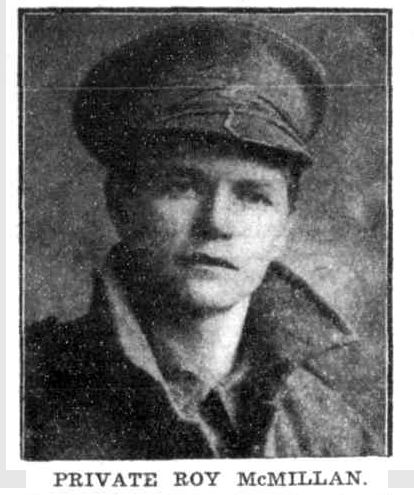
Private Roy McMillan (Cumberland Argus and Fruitgrowers Advocate, 11/5/1918)

Per his military service record (regimental no. 4861), Cyril Roy McMillan was born at Singleton, N.S.W.[1]  (This place of birth appears to have been recorded in error, as his birth was registered at Silverton, N.S.W., where his father was stationed as a Police Constable).[2]  He gave his age as 19 years and 2 months, his marital status as single, and his occupation as engineer.  His description on his Certificate of Medical Examination was 5 feet 7 inches tall, weight 123 ½ lbs., with a fair complexion, blue eyes, and brown hair.  His religious denomination was Church of England.  He claimed to have 4 years military service in the Cadets and was still serving.

He completed his medical examination at Parramatta on 10th November 1915.  His initial Application to Enlist in the Australian Imperial Force form was dated 11th November 1915, and his father’s signature giving his consent is on this form.  He was attested by Lieutenant R. Howe at Parramatta on 11th November 1915.

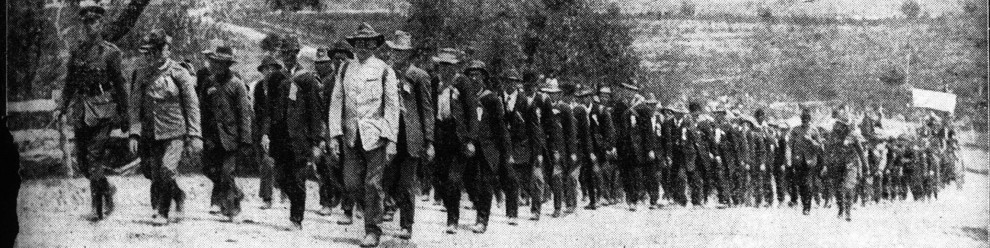
After a successful recruiting meeting the evening before, the Coo-ees left Parramatta on the morning of 11th November 1915, with an official count of 27 new recruits from that town.

After completing the Coo-ee March Cyril Roy McMillan went into Liverpool Camp as reinforcement for the 13th Battalion.

On 11th February 1916 Private McMillan was charged with being absent from fatigue duty.  He was fined 5 Shillings.

The Cumberland Argus and Fruitgrowers Advocate reported that Private ‘Roy McMillan’ was presented with a silver-mounted pipe, fountain pen, and other articles, at a send-off held for him and fellow Parramatta recruit Jack Saunders, at Parramatta on Monday 14th February 1916.[3] (He was named as Roy McMillan in several articles in The Cumberland Argus and Fruitgrowers Advocate).

On his embarkation roll Private McMillan’s address at time of enrolment was Marsden Street, Parramatta, N.S.W., and his next of kin is listed as his father, F. C. [Franklin Cutbush]. McMillan, at the same address.

On 8th March 1916 Private McMillan, along with many of the other Coo-ees, departed Sydney on the HMAT A15 Star of England, as15th reinforcements for the 13th Battalion.  He arrived in Egypt on 11th April 1916.

On 19th April 1916 Private McMillan was transferred to the 45th Battalion in Egypt.

On 2nd June 1916 Private McMillan left Alexandria aboard the transport Kinfauns Castle bound for France.  He arrived at Marseilles on 8th June 1916.

On 4th July 1916 the 45th Battalion was at Sailly-Sur-Lys preparing to move into the trenches for the first time, when Private McMillan was evacuated to the12th Australian Field Ambulance suffering from septic foot.  On 7th July 1916 he was sent to the 4th Division Rest Station.  He rejoined the 45th Battalion on the 12th of July 1916.

On 20th June 1916 Private McMillan was charged with being absent from billet without leave.  He was awarded 7 days confined to barracks.

On 6th September 1916 the 45th Battalion was refitting at Beauval, France, when Private McMillan was evacuated to  hospital. On 10th September 1916 he was admitted to the 2nd Canadian Stationary Hospital suffering myalgia.  On 19th September 1916 he was discharged from hospital to the 1st Convalescent Depot.  On 24th September 1916 he went to the 4th Australian Division Base Depot at Etaples, France.  He rejoined the 45th Battalion on 17th October 1916.

On 7th March 1917 the 45th Battalion was training at Bresle, France, when Private McMillan was evacuated to the 12th Australian Field Ambulance, then transferred to the 3rd Australian Field Ambulance with trench feet.  On 8th March 1917 he was moved back to the 45th Casualty Clearing Station.  On 11th March 1917 he was placed aboard the 9th Ambulance Train and admitted to the 3rd Stationary Hospital at Rouen, France.  On 13th March 1917 he was placed aboard the Hospital Ship Warilda at Le Havre for transfer to England with trench feet.  He was admitted to the Kitchener Military Hospital at Brighton, England, on 14th March 1916.

A letter dated 23rd March 1917 that he sent home to his father was reported on in the The Cumberland Argus and Fruitgrowers Advocate: ‘Sergeant McMillan, of the Parramatta police force, has received a letter from his son, Private Cyril Roy McMillan … in which he stated that he had then been in hospital in England suffering with trench feet’, and that ‘In describing the complaint, he says that the toes swell up, then wither away, and fall off in bad cases’.[4]

On 27th April 1917 Private McMillan was discharged from hospital and granted leave to report to the No. 1 Command Depot at Perham Downs on 12th May 1917.

On 20th July 1917 he was transferred to the No. 3 Command Depot at Hurdcott, England.

On 23rd November 1917 he marched in to the No. 1 Command Depot at Sutton Veny.

On 6th December 1917 he marched into the Overseas Training Brigade at Longbridge Deverill, England, near Sutton Veny.

On 3rd January 1918 Private McMillan departed Southampton bound for France.  He arrived at the 4th Australian Division Base Depot at Le Harve, France, on 4th January 1918.

On 22nd January 1918 Private McMillan rejoined the 45th Battalion when it was resting at La Clytte, Belgium.

On 5th and 6th April 1918 the 45th Battalion was in action around Dernacourt, France.  On 13th April 1918 it was recorded in Private McMillan’s service record that he was reported Missing In Action on 5th April 1918.  On 14th May 1918 he was reported to be a Prisoner of War in Germany.

After being released at the end of hostilities, Private McMillan was repatriated to England on 10th December 1918, and admitted to the 4th London General Hospital, suffering Dysentery.  On 18th December he was transferred to the 3rd Australian Auxiliary Hospital.

Private McMillan wrote the following letter to The Cumberland Argus and Fruitgrowers Advocate about his prisoner of war experience, which was published in the paper on 18th January 1919:

‘France, 30th Nov., 1918. The following letter reached ‘The Argus’ on Thursday: — “Dear Sir, — I am sending you a few lines, and would like you to publish them in the old paper.  I left Parramatta three years ago, with the Coo-ees, and I am sorry to say there are only two or three of us left to tell the tale.  I was taken prisoner in that big stunt last March and April.  One of my mates that I enlisted with was killed alongside me, just before we started to advance towards the Germans.  His name is Webber.[5]  Most of the boys will know him.  For the first five days I was captured I had nothing to eat.  All they would give us was a drop of water to drink. We were taken further back behind the lines, and there we were counted out into working parties, about 300 in a party, then again sent up behind the German lines, on munition dumps, and different kinds of work.  There we stayed until our people started to make the big advance, and we were gradually moved back to Germany. But never the whole journey did we have a lift in a train or motor lorry.  We had to foot it the whole way, right across Belgium, 20 and 30 miles a day, and hardly anything to eat. In passing through the Belgium towns the Belgians would do their best to help us.  They would give us bread and comforts, but the Germans would take all that off us and knock us down with their rifles. But we were never downhearted — we would scramble to our foot again and still have another go at it.  It was either that or starvation.  We were mostly living on potato peelings, turnip peelings, and cabbag[e] leaves, and it was an awful sight to see us having our dinner.  The poor lads were dying every day, and yet they would not give us any care.  When we wanted a smoke we had to pick up the ends of cigarettes and cigars which the Germans had dropped, and not every one of us could get that much.  You can’t imagine how happy we are to-day, now that we are released.  We were released about two weeks ago.  They just cast us adrift and told us to find our way back.  They never gave us any bread to start with, not even a bite.  Only for the Belgians we should have had hundreds of deaths along the road.  But the Belgians cared for us in every manner possible.  My mate and I were taken in by a Belgian lady, and there we stayed for five days, living on the best.  When we were leaving they packed our bags with sandwiches and cakes, also plenty of cigarettes and money.  We crossed the British lines on the 17th Nov., and we were heartily greeted by our own lads.  Several of us had to go to hospital through sickness.  I am in hospital at present, but will be across to England for Christmas, and hope to be home in Parramatta shortly afterwards.  I think I will close for the present, as it is getting beyond my time for sitting up. — I remain, your soldier friend, No. 4861, Pte. C. R. McMillan ’45th Batt.'” [Private McMillan is a son of Sergt. McMillan, till recently stationed at Parramatta police station.]’[6]

On 23rd December 1918 Private McMillan was discharged from hospital, and granted leave to report to the No. 1 Command Depot at Sutton Veny, England, on 23rd January 1919.

He was granted leave again from 7th June 1919 to 19th September 1919.  During this period of leave he attended a Motor Training Institute in London.

On 25th September 1919 Private McMillan departed Devonport, England, aboard the H.T. Port Denison, bound for Australia.

He arrived in Australia on 17th November 1919, and was discharged Termination of Period of Enlistment on 9th January 1920.


[1] NAA: B2455, MCMILLAN C R

[2] NSW Birth Registration, MCMILLAN CYRIL R 34803/1896 FRANKLIN C MARGARET A SILVERTON ;  ‘Local and General’, Western Grazier, 15 January 1896,  p. 2. Retrieved March 12, 2017, from http://nla.gov.au/nla.news-article13381118

[3] ‘The Sheepskin Fund’, The Cumberland Argus and Fruitgrowers Advocate, 19 February 1916, p. 11. Retrieved March 12, 2017, from http://nla.gov.au/nla.news-article86072411

[4] ‘Personal Pars’, The Cumberland Argus and Fruitgrowers Advocate, 26 May 1917, p. 6. Retrieved March 12, 2017, from http://nla.gov.au/nla.news-article86086965

[5] William WEBBER  was one of the Coo-ees attested at Ashfield.  He was killed in action on 6th April 1918.

[6] ‘German Atrocities. A Parramatta Prisoner’s Story’, .The Cumberland Argus and Fruitgrowers Advocate, 18 January 1919, p. 10. Retrieved March 12, 2017, from http://nla.gov.au/nla.news-article86118958


Bert KILDUFF

Bert KILDUFF

Per his military service record (regimental no. 4818), Bert Kilduff was born at Windsor, N.S.W.[1]  He gave his age as 23 years and 10 months, his marital status as single, and his occupation as butcher. His description on his Certificate of Medical Examination was height 5 feet 5 inches tall, weight 9 stone, with a fair complexion, blue eyes, and light brown hair.  His religious denomination was recorded as Church of England on his initial Attestation Paper (but was recorded as Roman Catholic on his second Attestation Paper).  He claimed that he had no previous military service.  He completed his medical examination on 12th November, 1915 at Ashfield, and was attested by Lieutenant S. Stirling at Ashfield on 12th November, 1915, along with two other Coo-ees, on the last day of the Coo-ee March, when the Coo-ees marched from Ashfield to Sydney.

After completing the Coee-ee March he went to Liverpool Camp as reinforcement for the 13th Battalion.  His initial period of service on his Statement of Service form is from 12th November 1915 until 15th January 1916.

A letter dated 22nd December 1915 in his service record, addressed to the C. O., 13th Battalion, stated that ‘This man was fined £5 at the Central Police Court for using obscene language’, and had ‘received a suit of plain clothes’.  Another letter dated 23rd December 1915 addressed to the C.O., 13th Battalion, from Lt. Colonel R. C. Simpson, A.A.G. A.I.F. Camp, stated that ‘This man’s clothes have been taken from him at Head Quarters’, and that ‘Attestation papers should be forwarded to me together with discharge papers made out in full, stating that he has been discharged as undesirable’.  On 15th January 1916 Private Kilduff was discharged Services no Longer Required.

Two days later, Bert Kilduff re-enlisted in the A.I.F.  He undertook another medical examination on 17th January 1916 at Sydney, and was attested at Liverpool on 18th January 1916.  He re-joined the Coo-ees at Liverpool Camp, as 15th reinforcement for the 13th Battalion.

While at Liverpool Camp, on 16th February 1916 Private Kilduff was charged with insubordination and fined.

On his embarkation roll his address at time of enrolment was Riverstone, N.S.W., and his next of kin is listed as his aunt, Mrs C. [Cecily] Viney, Riverstone, N.S.W.  His “Date of joining” on his embarkation roll was 11th November 1915 (the day the Coo-ees marched from Parramatta to Ashfield).

On 8th March 1916, Private Kilduff, along with many of the other Coo-ees, departed Sydney on the HMAT A15 Star of England.  He arrived in Egypt on the 11th April 1916.

On 16th April 1916 Private Kilduff was transferred to the 4th Pioneer Battalion at Tel El Kebir, Egypt.

On 27th April 1916 Private Kilduff was admitted to the 54th Casualty Clearing Station with Mumps.  He was discharged on 17th May 1916.

On 4th June 1916 Private Kilduff left Alexandria aboard the transport Scotian bound for France.  He arrived at Marseilles on 11th June 1916.

On 21st June 1916 the 4th Pioneer Battalion was at Strazeele, France, when Private Kilduff was admitted to the 13th Australian Field Ambulance with Tonsillitis.  He rejoined the 4th Pioneer Battalion on 25th June 1916 when it was working on constructing the Bois Grenier Line near Armentieres, France.

Private Kilduff served with the 4th Pioneer Battalion throughout its service on the Western Front, including Pozieres in August 1916, Mouquet Farm in September 1916, and Flers in October 1916.

On 4th November 1916 the 4th Pioneer Battalion was training at Breilly, France, when Private Kilduff was charged with being absent without leave from 2100 till 2130 on 3rd November 1016.  He was fined 14 days pay.

On 9th March 1917 the 4th Pioneer Battalion was constructing railways and training in the vicinity of Longueval, France, when Private Kilduff was admitted to the 8th Australian Field Ambulance for dental treatment.  He was discharged on 17th March 1917, but was admitted to the 8th Australian Field Ambulance sick suffering urethral stricture on the same day.  On 18th March 1917 he was moved to the 3rd Casualty Clearing Station.  He was transferred by ambulance train to the 1st Australian General Hospital at Rouen, France, arriving on 21st of March 1917.

On 30th March 1917 Private Kilduff was placed aboard the Hospital Ship Gloucester Castle at Le Harve, France, for transfer to England.  He was admitted to the 5th Southern General Hospital at Portsmouth, England, on 31st March 1917.

On 20th June 1917 Private Kilduff was transferred the 1st Australian Auxiliary Hospital at Harefield, England.

On 23rd June Private Kilduff was discharged from hospital to the No. 2 Command Depot at Weymouth, England.  On 29th June 1917 he was transferred to the No. 3 Command Depot at Hurdcott, England.

On 13th August 1917 Private Kilduff was admonished  with neglecting to obey Group Orders at Salisbury on 4th August 1917.

On 8th September 1917 Private Kilduff marched into the Overseas Training Brigade at Perham Downs, England.

On 11th October 1917 Private Kilduff departed Southampton bound for France.  On 13th October 1917 he marched into the 4th Australian Division Base Depot at Le Harve, France.

On 21st October 1917 Private Kilduff rejoined the 4th Pioneer Battalion when it was working on keeping the Zonnebeke Road in Belgium operational during the Third Battle of Ypres.

After serving with the 4th Pioneer Battalion on the Western Front for almost another year, on 9th October 1918 Private Kilduff was granted leave to England.  He rejoined the 4th Pioneer Battalion on 26th October 1918 whilst it was training at Ailly-sur-Somme, France.

On 10th February 1919 Private Kilduff was transferred to England for return to Australia.  He marched into the 3rd Training Brigade at Fovant, England, on 11th February 1919.

On 16th February 1919 Private Kilduff was admitted to the No. 2 Group Hospital with Influenza.  He was discharged on 26th February 1919.

On 13th April 1919 Private Kilduff commenced his return to Australia aboard the H.T. Commonwealth.  He arrived in Australia on 12th June 1919, and was discharged Termination of Period of Enlistment on 27th July 1919.

[1] NAA: B2455, KILDUFF BERT


Joseph John WILLIAMS

Joseph John WILLIAMS

Per his military service record (regimental no. 4912), Joseph John Williams was born at Woollahra, N.S.W.[1]  He gave his age as 36 years and 11 months, his marital status as single, and his occupation as farrier.  His description on Certificate of Medical Examination was height 5 feet 5 ½ inches tall, weight 144 lbs., with a dark complexion, brown eyes, and grey hair.  His religious denomination was Roman Catholic.  He claimed that he had no previous military experience.  He completed his medical examination at Ashfield on 11th November 1915 (the day the Coo-ees marched from Parramatta to Ashfield), and was attested by Lieutenant F. Middenway at Ashfield on 11th November 1915.

It is not known exactly where Joseph John Williams joined (or first presented to join) the Coo-ee March, but it may possibly have been before the 11th November 1915.  The Oath on his Attestation Paper was dated ‘from 6th November 1915’.  The “Date of Joining” recorded for Private Williams on his embarkation roll was 7th November 1915.

After completing the Coo-ee March he went to Liverpool Camp as reinforcement for the 13th Battalion.

On 18th February 1916 Private Williams was charged with being absent without leave from the Liverpool Camp for 3 days.  He was fined 25 Shillings.

On his embarkation roll his address at time of enrolment was C/o T. Stephenson, 1 Ruffe [sic] Street, Leichhardt, Sydney, N.S.W., and his next of kin is listed as his mother, Mrs. E. M. [Esther Mary] Williams, at the same address.  The initial address recorded for his mother on his Attestation Paper was ‘Railway Parade Wentworth Falls N.S.W.’.

On 8th March 1916 Private Williams departed Sydney on the HMAT A15 Star of England, along with many of the other Coo-ees, and arrived in Egypt on 11th April 1916.

It is not recorded in his service record when Private Williams left Egypt, but after some training in Egypt, he was sent to the 4th Training Battalion at Rollestone, England.

Private Williams departed England bound for France on 30th July 1916.  He marched into the 4th Australian Division Base Depot at Etaples, France, on 1st August 1916.

He was taken on strength of the 13th Battalion on 26th August 1916 when it was at Albert, France, preparing to re-enter the fighting around Pozieres.

On the 1st of January 1917 Private Williams was sent to the 8th Australian Field Ambulance suffering from a sore ankle. On 4th January 1917 he was moved to the 1st General Hospital at Etretat, France. On 26th January 1917 he was transferred to the 2nd Stationary Hospital at Amiens, France, with ICT right ankle.  He was discharged and returned to the 13th Battalion on 8th February 1917.

On 2nd March 1917 Private Williams was sent to the 8th Australian Field Ambulance suffering from Scabies.  He was moved back to the 5th Rest station later that day with Influenza. On 7th March 1917 he was transferred to a Casualty Clearing Station with Trench Feet.  He was later moved to the 5th General Hospital at Rouen with Trench Fever.

On 12th March 1917 Private Williams was placed aboard the Hospital Ship Grantully Castle at Le Harve for evacuation to England.  He was admitted to the 2nd Southern General Hospital at Bristol, England, on the 13th of March 1917, with Trench Fever.

On 16th April 1917 Private Williams was transferred to the 3rd Australian Auxiliary Hospital at Dartford, England.  He was granted leave to report to the Number 3 Command Depot at Hurdcott, England, on 1st May 1917.

On 12th of May 1917 Private Williams was charged with being absent without leave in London from 3.30 p.m. on 1st May 1917 till 9.15 p.m. on 8th May 1917.  He was awarded 8 days Field Punishment Number 2 and fined 19 days pay.

On 4th August 1917 Private Williams was transferred to the Number 2 Command Depot at Weymouth, England.

On 27th September 1917 Private Williams departed England aboard the H.T. Suevic bound for Australia, with Debility.  He arrived in Australia on 20th November 1917, and was discharged medically unfit on 25th December 1917.

[1] NAA B2455, WILLIAMS J J

William CAIRNS

William CAIRNS

Per his military service record (regimental no. 4748), William Cairns was born at Strawberry Hills, Sydney, N.S.W. [1] He gave his age as 26 years and 5 months, his marital status as married, and his occupation as laborer. His description on his Certificate of Medical Examination was height 5 feet 3 ¼ inches tall, weight 131 lbs., with a medium complexion, brown eyes, and black hair. His religious denomination was Church of England.  He claimed that he had no previous military service.

He completed his medical examination on 2nd November 1915 at Lithgow (when the Coo-ees were at Lithgow), and was attested by Captain A. C. Eade at Lithgow on 2nd November 1915.

After completing the Coo-ee March he went to Liverpool Camp as reinforcement for the 13th Battalion.

On 25th November 1915 Private Cairns was charged with being absent without leave.  He was fined one days pay.

On 22nd December 1915 Private Cairns was charged with being absent without leave for four days.  He was fined two shillings and forfeited four days pay.

On his embarkation roll his address at time of enrolment was Farr Street, Rockdale, N.S.W., and his next of kin is listed as his wife, Mrs. A. [Alice] Cairns, 31 Junction Road, North Sydney, N.S.W.

On 8th March 1916 Private Cairns departed Sydney on the HMAT A15 Star of England, along with many of the other Coo-ees, and arrived in Egypt on 11th April 1916.

On 24th May 1916 Private Cairns was admitted to the 2nd Australian Stationary Hospital at Tel-e-Kebir, suffering from Influenza.  On 26th of May 1916 he was sent to the Base Details Depot at Helopolis, Egypt.

On 2nd August 1916 Private Cairns was charged with being absent without leave from the 1700 Parade and absent from Piquet.  He was awarded seven days Field Punishment Number 2.

On 6th August 1916 Private Cairns left Alexandria aboard His Majesty’s Transport Megantic bound for England, arriving at Portsmouth later that month.  He then marched into the 4th Training Battalion.

On 22nd September 1916 Private Cairns left England bound for France.  On 24th September 1916 he marched into the 4th Australian Division Base Depot at Etaples, France.

He was taken on strength of the 13th Battalion on 6th October 1916 when it was manning the front line in the St Eloi sector in Belgium.

On 17th October 1916 Private Cairns was sent to the 13th Australian Field Ambulance sick.  On 18th October 1916 he was sent to the 4th Australian Field Ambulance, then to the Division Rest Station.  On 25th October he was moved to the 1st Convalescent Depot at Boulogne, France.  On 26th October 1916 he was admitted to the 18th General Hospital at Camiers, France.

On 23rd November 1916 he was transferred to the 51st General Hospital at Etaples, France.

On the 5th of December 1916 he was discharged and sent to the 4th Australian Division Base Depot also at Etaples, France.

On 8th December 1916 Private Cairns was charged with Drunkenness and being in possession of spirits on 6th December 1916. He was awarded 28 days Field Punishment Number One.

On 23rd December 1916 Private Cairns rejoined the 13th Battalion when it was training at Coisy, France.

On 28th January 1917 Private Cairns was admitted to the 13th Australian Field Ambulance with eye problems.  He was moved back to the Division Rest Station.

He rejoined the 13th Battalion on 2nd February 1917 when it was being relieved from the front line in the vicinity of Guedecourt, France.

On 26th February 1917 Private Cairns was charged with when on active service being in Amiens without a pass, and not complying with an order given by a Military Police officer.  He was fined seven days pay.

On 13th March 1917 Private Cairns was sent to the 13th Australian Field Ambulance suffering Influenza.  On 30th March 1917 he was transferred to the 5th General Hospital at Rouen, France, suffering Cystitis.

On 16th April 1917 Private Cairns was placed aboard the Hospital Ship St George at Rouen for evacuation to England.  On 17th April 1917 he was admitted to the Graylingwell War Hospital at Chichester, England, with Pyrexia.

On 4th May 1917 Private Cairns was transferred to the 3rd Australian Auxiliary Hospital at Dartford, England.  He was discharged on 14th May 1917, and granted leave to report to the Training Battalion at Hurdcott, England, on 29th May 1917.

On 30th May 1917 Private Cairns was moved to the 3rd Command Depot at Hurdcott, England.

On 30th June 1917 Private Cairns marched into the Overseas Training Brigade at Pernham Downs, England.

On 20th July 1917 Private Cairns was admitted sick to the 1st Australian Dermatological Hospital at Bulford, England.  He was discharged on 24th July 1917, and sent to the Convalescent Training Depot.

On 6th September 1917 Private Cairns was transferred to the Number 1 Command Depot at Perham Downs, England.

On 18th October 1917 Private Cairns was charged with being absent without leave from 1400 on 2nd October 1917 till being apprehended by the Military Police at 1100 on 15th October 1917, and losing by neglect his pass.  He was awarded Field Punishment Number Two and fined 28 days pay.

On 23rd October 1917 Private Cairns marched into the Overseas Training Brigade at Longbridge Deverell, England.

On 3rd November 1917 Private Cairns was admitted to the Sutton Veny Hospital suffering Trachoma.  A Medical Report of an Invalid form dated 3rd November 1917 in his file recorded that the disability dated from 4th February 1917 at Fleurs, France, where ‘phosphorus from shells caused irritation of eyes which gradually became worse’.

On 9th November 1917 he was transferred to the 1st Australian Auxiliary Hospital at Harefield, England.

On 6th December 1917 Private Cairns was charged with being absent without leave from the 1st Australian Auxiliary Hospital from 2045 on 4th December 1917 till 8.45pm on 5th December 1917.  He was fined three days pay.

On 14th December 1917 Private Cairns was discharged from hospital and sent to the Number 2 Command Depot at Weymouth, England.

Private Cairns left England on the H.M.A.T. Runic on 20th December 1917, for return to Australia, suffering TrachomaHe disembarked at Sydney on 14th February 1918.

Private Cairns was discharged Medically Unfit on 13th August 1918.

Note: William Cairns died the year after he returned to Australia, at the No 4 Australian General Hospital (Randwick Military Hospital), on 2nd April 1919.  He was buried at Gore Hill Cemetery at Gore Hill, Sydney.  His name is remembered on the Australian War Memorial Roll of Honour.[2]

[1]  NAA: B2455, CAIRNS W

[2] Australian War Memorial Roll of Honour, William Cairns, https://www.awm.gov.au/people/rolls/R1677339/


Daniel LYNCH

Daniel LYNCH

Per his military service record (regimental no. 5403), Daniel Lynch was born at Orange, N.S.W.[1]  He gave his age as 44 years and 3 months (although he appears to have been much older), his marital status as married, and his occupation as telegraph linesman.  His description on his Certificate of Medical Examination was height 6 feet 2 inches tall (so he was one of the tallest of the Coo-ees), weight 12 stone, with a fair complexion, blue eyes, and dark hair.  His religious denomination was Roman Catholic.  He claimed that he had no previous military service.  He completed his medical examination on 16th October 1915 at Wellington (while the Coo-ees were at Wellington), and was attested by Captain Nicholas at Stuart Town on 19th October 1915.

He was named (as “Lynch, D”) in the Wellington Times as one of the men who enlisted with the Coo-ees at Wellington.[2]

After completing the Coo-ee March he went to Liverpool Camp as 15th reinforcement for the 13th Battalion.

Whilst at the Liverpool Camp Private Lynch was charged with using obscene language to an NCO.  He was fined 1 Pound.  He was also absent without leave from the Liverpool Camp from the 18th to 31st January 1916, and from 1st to the 8th February 1916, a total of 22 days.

Private Lynch was involved in hearing at the Central Police Court on 25th January 1916, followed by a court case on 6th March 1916 at the Darlinghurst Quarter Sessions, in which another Coo-ee was charged with, and subsequently found guilty of, having assaulted him at Central Railway Station about midnight on January 16th 1916, and robbed him of two pounds.[3]

Private Lynch was transferred to 17th Reinforcement for the 13th Battalion in early 1916.

On his embarkation roll his address at time of enrolment was Percy Street, Wellington, N.S.W., and his next of kin is listed as his wife, Mrs M. E. [Mary Ellen] Lynch, at the same address.

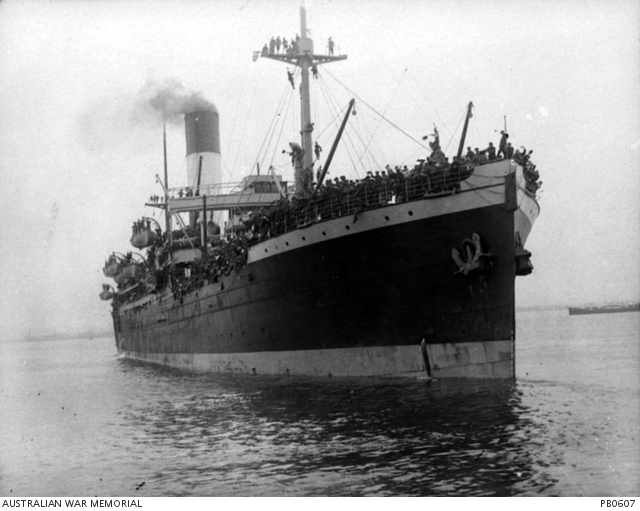
On 9th April 1916 Private Lynch departed Sydney on the HMAT Nestor A71 (along with several other Coo-ees), bound for Egypt.

Photograph of HMAT A71 Nestor loaded with troops on an earlier voyage, taken 11 October 1915.  Part of the Australian War Memorial Collection. PB0607.

Photograph of HMAT A71 Nestor loaded with troops on an earlier voyage, taken 11 October 1915. Part of the Australian War Memorial Collection. PB0607.

On the 5th of June 1916 he was admitted to the 3rd Australian General Hospital at Abbassia, Egypt with injured ribs.  He was discharged on 20th June 1916.

On 2nd August 1916 Private Lynch was charged with being absent without leave from 1700 parade at Tel-el-Kebir.  He was awarded 3 days field punishment number 2.

On 6th August 1916 Private Lynch departed Egypt bound for England aboard the Transport Megantic.

On 22nd September 1916 Private Lynch departed the 4th Training Battalion in England bound for France.

He marched into the 4th Australian Division Base Depot at Etaples, France, on 24th September 1916.

A few weeks later, on 15th October 1916 Private Lynch was admitted to the 26th General Hospital at Etaples, France, suffering Rheumatism.

On 23rd October 1916 Private Lynch was placed aboard the Hospital Ship Stad Antwerpen at Boulogne, for transfer to England.  He was admitted to the Western Heights Military Hospital at Dover later that day.

On 30th October 1916 Private Lynch was transferred to the 3rd Australian Auxiliary Hospital at Dartford, England, with Myalgia.  A Medical Report of an Invalid form dated 1st November 1916 at this hospital in his service record listed his ‘true age’ as 51 years. (If this was his correct age at that time, it means he would actually have been about 50 years of age when he enlisted with the Coo-ees).

On 12th November 1916 Private Lynch was discharged and marched into the Number 2 Command Depot at Weymouth, England.

On 12th March 1917 Private Lynch was charged with being absent without leave in London from 2nd March 1917 till apprehended by the Military Police on 8th March 1917.  He was awarded 7 days confined to barracks and fined 7 days pay.

On 17th March 1917 Private Lynch departed England from Plymouth aboard the H.T. Beltana bound for Australia, for discharge over age and debility.

He arrived in Sydney on 15th May 1917.  Private Lynch was discharged medically unfit on 11th June 1917.

[1] NAA: B2455, LYNCH DANIEL

[2] ‘Hitchen’s Coo-ees’, Wellington Times, 18 October 1915, p. 3. Retrieved March 1, 2017, from http://nla.gov.au/nla.news-article143388424

[3] ‘Soldier Charged’, The Sydney Morning Herald, 26 January 1916, p. 6. Retrieved March 1, 2017, from http://nla.gov.au/nla.news-article28782852  ;’Coo-ees in a Brawl’, The Sun, 6 March 1916, p. 5 (Final Extra). Retrieved March 1, 2017, from http://nla.gov.au/nla.news-article221356476

Thomas Henry TURVEY

Thomas Henry TURVEY

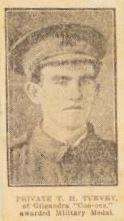
Private T. H. Turvey, of Gilgandra "Coo-ees", awarded Military Medal (Newspaper unknown, 1917)

Private T. H. Turvey, of Gilgandra “Coo-ees”, awarded Military Medal (Newspaper unknown, 1917)

Per his military service record (regimental no. 4902A), Thomas Henry Turvey was born at Gulgong, N.S.W. [1]  He gave his age as 22 years and 9 months, his marital status as single, and his occupation as laborer.  His description on his Certificate of Medical Examination was height 5 feet 8 ½ inches tall, weight 10 stone 10 lbs., with a dark complexion, light blue eyes, and dark hair.  His religious denomination was Roman Catholic.  He claimed that he had no previous military service.  He completed his medical examination on 4th October 1915 at Gilgandra, and was attested by Captain Eade at Lawson on the 7th October 1915.

Thomas Turvey stated that he had joined the Coo-ees at Katoomba in a court case in December 1915, in which he was a witness.[2]  The Coo-ees had stayed overnight at Katoomba on 5th November 1915.

After completing the Co-ee March he went to Liverpool Camp as reinforcement for the 13th Battalion.

On his embarkation roll his address at time of enrolment was Gilgandra, N.S.W., and his next of kin is listed as his father, T. [Thomas] Turvey, Gilgandra, N.S.W.

On 8th March 1916 Private Turvey, along with many of the other Coo-ees, departed Sydney on the HMAT A15 Star of England, and arrived in Egypt on 11th April 1916.

He was transferred to the 45th Battalion on 20th May 1916.

On 7th June 1916 Private Turvey left Alexandria aboard the transport Huntspill bound for France, arriving at Marseilles on 14th June 1916.

On 19th July 1916 Private Turvey was taken on strength of the 45th Battalion.

Private Turvey served with the 45th Battalion through its first action at Fleurbaix, France, in July 1916, then the Battle of the Somme around Pozieres, Mouquet Farm and Flers, without injury or illness.

His service record states that he was allocated the letter “A” to his regimental number on 22nd February 1917 on account of duplication of numbers.

Private Turvey was serving with the 45th Battalion when it was in action around Guedecourt, France, where on 27th February 1917 he was recommended for, and subsequently awarded, the Military Medal for bravery in the field, for his action on the 22nd/23rd February 1917.  This award was published in the London Gazette Supplement no. 30036 on 26th April 1917, and promulgated in the Commonwealth Gazette No. 133 on 21st August 1917.[3]

The citation for the Military Medal reads: “For his gallant conduct and devotion to duty during an attack on a enemy trench near Guedecourt on the night of 22/23rd Febry. 1917 when as a runner he maintained communication overland under artillery and machine gun fire between the front line and Headquarters. His work in this respect was quite consistent with his previous fine record established for coolness and determination in the face of all obstacles”.[4]

On 7th June 1917 the 45th Battalion was involved in an attack at Messines Ridge when Private Turvey received a gunshot wound to the abdomen.  He was one of 352 members of the 45th Battalion wounded during the attack.  Another 100 were killed and 50 missing.   He was evacuated to the 77th Field Ambulance, then to the 53rd Casualty Clearing Station.  On 9th June 1917 he was admitted to the 2nd Australian General Hospital at Wimereux.

On 11th June 1917 Private Turvey was placed aboard the Hospital Ship St Patrick for evacuation to England, and he was admitted to Royal Herbert Hospital at Woolwich with a gunshot wound to his right side on the same day.

On 22nd June 1917 Private Turvey was transferred to the 1st Australian Auxiliary Hospital at Harefield, England.

On 13th July 1917 he was discharged from hospital, and sent to the No. 2 Command Depot at Weymouth, England.

On 27th July 1917 Private Turvey commenced his return to Australia aboard the H.M.A.T. Demosthenes.

He arrived in Australia on 29th September 1917, and was discharged medically unfit on 1st November 1917.


[1] NAA: B2455, TURVEY THOMAS HENRY

[2] ‘Alleged Disloyal Conduct’, The Dubbo Liberal and Macquarie Advocate, 3 December 1915, p. 4. Retrieved February 26, 2017, from http://nla.gov.au/nla.news-article77602826

[3] The London Gazette, 26 April 1917, Supplement 30036, p. 3948, https://www.thegazette.co.uk/London/issue/30036/supplement/3948 ; Commonwealth Gazette, No. 133, 21st August 1917, p. 1786, https://www.legislation.gov.au/content/HistoricGazettes1917 (and copy in service record)

[4] Australian War Memorial. Recommendation for Military Medal, Thomas Henry Turvey, 27th February 1917, https://www.awm.gov.au/people/rolls/R1625170/


Thomas William EVANS

Thomas William EVANS

Per his military service record (regimental no. 4770), Thomas William Evans was born at Castlemaine, Victoria.[1]  He gave his age as 38 years, his marital status as single, and his occupation as Labourer.  His description on his Certificate of Medical Examination was height 5 feet 6inches tall, weight 149 lbs., with a fair complexion, blue eyes, and light brown hair.  His religious denomination was Church of England.  He completed his medical examination at Dubbo on 12th October 1915, and was attested at Dubbo on 14th October 1915 (the day the Coo-ees left Dubbo for Wongarbon).  He claimed to have had no previous military service.

His brother, Mr. J. Evans, later reported in the Mount Alexander Mail that he had ‘been engaged in farming’ in New South Wales for about three years before he enlisted, and that ‘he was one of those who made up the famous Gilgandra snowball’.[2]  A letter in his service record from a Mrs. S. H. Dunford, from a property near Parkes, enquiring as to his whereabouts after the war, stated that he had ‘enlisted with the Gilgandra Coo-ees’.[3]

After completing the Coo-ee March he went to Liverpool Camp as reinforcement for the 13th Battalion.

On his embarkation roll his address at time of enrolment was Parker Street, Castlemaine, Victoria, and his next of kin is listed as his mother, Mrs I. [Isabella] Evans, at the same address.

On 8th March 1916 Private Evans, along with many of the other Coo-ees, departed Sydney on the HMAT A15 Star of England, as 15th reinforcements for the 13th Battalion.  He arrived in Egypt on 11th April 1916.

He was transferred to the 45th Battalion on 19th April 1916.

On 2nd June 1916 Private Evans left Alexandria aboard the transport Kinfauns Castle, bound for France.  He arrived at Marseilles on 8th June 1916.

Private Evans served with the 45th Battalion through its first action at Fleurbaix, France in July 1916, then as it moved to Pozieres in early August 1916.

On 14th August 1916 the 45th Battalion was in the front line trenches between Pozieres and Martinpuich in France.  During this day 45th Battalion had casualties of 15 men wounded from artillery shelling.  Private Evans was one of the wounded.  He was evacuated to the 4th Field ambulance, then 44th Casualty Clearing Station, with a shrapnel wound to his back.  He was put on the Ambulance Train, and admitted to the 5th General Hospital at Rouen on 16th August 1916.

On 23rd August 1916 he was discharged, and sent to the 4th Australian Division Base Depot at Etaples, France.

He rejoined the 45th Battalion on 16th of September 1916 when it was conducting training at Victoria Camp near Rhenninghelst, Belgium.

On 19th November 1916 the 45th Battalion was moving into the front line at Grease Trench, just north of Gueducourt, France, when Private Evans was evacuated to the 38th Casualty Clearing Station sick with Influenza.

On 21st November 1916 he was placed aboard the 20th Ambulance Train, and conveyed to the 12th General Hospital at Rouen, France, where he was admitted on 22nd November 1916.

Private Evans was discharged from hospital on 2nd December 1916 and sent to the 4th Australian Division Base Depot at Etaples, France

Private Evans rejoined the 45th Battalion on 5th January 1917 when it was at Dernacourt, France, preparing to move to the front line.

On 20th February 1917 the 45th Battalion was in action near Guedecourt, France, when Private Evans was wounded in action for a second time, receiving a serious shrapnel wound to his right forehead that fractured his skull.  He was evacuated to a Casualty Clearing Station, then on 25st February 1917 placed aboard the 21st Ambulance Train.  He was conveyed to the 11th Stationary Hospital at Rouen, France , where he was admitted on 26th February 1917, suffering from gunshot wound head penetrating cranium, severe.

On 19th April 1917 Private Evans was evacuated to England by Hospital Ship.  He was admitted to the 3rd London General Hospital at Wandsworth.

On 21st July 1917 Private Evans was evacuated to the 1st Australian Auxiliary Hospital at Harefield, England.

On 25th July 1917 Private Evans was discharged from hospital, and granted leave to report to the Number 2 Command Depot at Weymouth, England.

Private Evans left England on 27th August 1917 for return to Australia aboard the H.M.A.T. Pakeha, arriving in Australia on 25th October 1917.

He was discharged medically unfit on 22nd November 1917, with gunshot wound to the head, fracture of skull.


[1]  NAA: B2455, EVANS T W

[2] ‘Items of News’, Mount Alexander Mail, 14 September 1916, p. 2. Retrieved February 7, 2017, from http://nla.gov.au/nla.news-article119637481

[3] NAA: B2455, EVANS T W, letter to Base Records, Melbourne, from Mrs S. H. Dunford, “Clear View”, Wongalia P.O., via Gunningbland, Parkes, 29th July 1920.