Letter from W. H. Saunders about HMAT Star of England voyage and arrival in Egypt 1916

Letter from W. H. Saunders about his voyage on HMAT A15 Star of England ,and arrival in Egypt, 1916

Most of the Coo-ees were transported from Sydney to Egypt on the troopship HMAT A15 Star of England, which embarked from Sydney on the 8th March 1916.  A photograph of the ship from an earlier voyage is pictured below.

Details about this voyage were included in a letter William Hilton Saunders (a Coo-ee from Wongarbon) wrote to his parents, which has been transcribed below. The undated letter was published in an article titled ‘Australians in Action. Letters from the Front’ in the Wellington Times, 29 June 1916, p. 3.

Troopship, HMAT A15 Star of England at the docks, 1914 [on an earlier voyage]. Photo courtesy of: John Oxley Library, State Library of Queensland, Image number: APE-039-01-0009

 ‘Australians in Action.
Letters from the Front.
… Driver Hilton Saunders, son of Mr. and Mrs. E. J. Saunders, of Wongarbon, writes as follows to his parents:—
I am still O.K., and still enjoying the happy-go-lucky life of an Australian soldier. I have now settled down to camp life after having had a most enjoyable trip over the water from Sydney. There is no doubt it was a lovely trip from the very day we left Sydney till we landed in Port Said. I will try and give you a brief description of some of some of our experiences and the sight we saw.

To begin with I will give you an idea of how calm the sea is in the tropics at times. Well at times it has the appearance of a very calm lake with not even a ripple on the surface except those made by the troopship. I was simply entranced when I first noticed it, and I began to imagine I was once again out on one of the Great Western Plains with a mirage dancing before my eyes; for such it resembled. You have not the slightest idea of what it looks like. The whole spectacle was a revelation to me, because I did not think the restless ocean could be so calm and placid. Then towards evening one sees more grandeur presented by nature in the form of sunset. One sunset in particular presented a very fine spectacle. Viewed from the troopship it looked like a vast work of art featuring an undulating landscape dotted with spreading trees, vegetation, lakes, and rivers. At first the whole scene was of a greyish tinge, but gradually changed to a reddish glow; giving the appearance of a bush fire raging amongst the timber in its midst. Certainly one of the most picturesque sights that has come my way since leaving Sydney. Well, mother dear, I will not weary you with descriptions of tropical sunsets, etc., but will tell you a few of the happenings on the way to Ceylon. Well, after leaving Sydney, we hugged the coast for a few days, and then lost sight of land till we hit the West Australian coast, somewhere about Cape Leeuwin. We only got a glimpse of the hazy coast line, and many were the speculations regarding our chances of landing at Fremantle. However, we were doomed to disappointment, for when we looked out next morning (Thursday 16th), all that met our gaze was an endless waste of water. Nothing very eventful happened on the way to Colombo, not even when crossing the “line” because the Colonel, for certain reasons, would not allow any celebrations to take place. On Saturday, 25th, at about 8 a.m., we sighted the coast of Ceylon. Everyone was happy and excited, because it meant, to most of us, our first glimpse of foreign land. We hugged the coast all day and dropped anchor inside the breakwater at sundown. All along the coast are to be seen hundreds of natives out in their little boats catching fish. These boats are very comical little structures cut out of a log of wood. They are about as long as one of our rowing boats at home, and just wide enough for the natives to sit in, which means about 14 or 15 inches. They have another piece of wood the same length as the boat itself, and this is lashed to the side with two pieces of bamboo and some rope. They are said to be very safe even in very heavy weather. Nearly all of them carry from two to eleven natives. Colombo has not a natural harbour, so three breakwaters had to be built at a total expenditure of £1,000, 000, and no doubt it is a wonderful piece of engineering. We were hardly stationary before the native coolies were swarming round the boat on barges loaded with coal. Of course, they don’t load coal in Columbo with the assistance of machinery the same as they do in Newcastle, but everything has to be done by black labor. These follows are a very dirty low-bred class of men, very small and thin, but very wiry. They bring 50 tons of coal in each barge, and it is all packed in bags, just the same as onion bags. The barges are brought up along-side the ship by a tug and made fast then after a lot of jabbering the loading begins. A kind of staging or scaffolding is rigged on the ship’s side in tiers, two men standing on each tier.
Each bag is lifted separately from the barge to the men on the lower stage, and so on till it reaches the deck, then two more men place it on the shoulders of a native, who carries it to the bunker hatch, and drops it in. Simple enough on paper, but in practice very hard work, and I, for one, would not care about taking it on for twenty times as much as the nigger gets (about 1s. per day). This coaling was carried on all day and all night for two nights and a day from either side of the ship, so you can guess what a state everything was in from coal dust. It seemed to penetrate everything on board, and we were continually washing ourselves, but were always dirty; in fact, it was with difficulty that our officers picked us out from the Cin- galese. On Sunday morning we all had an early breakfast, and half the boys went ashore in lighters towed by a tug at 7.30 a.m. The remainder including the Coo-ees, went off at 10 a.m., when the others came back. We were marched round the town through the main streets, and down past the military barracks along the promenade to the Grand Hotel. Then we turned round and marched back again to the barracks, were we broke off for about three-quarters of an hour, and were treated to cool drinks. We were not allowed to leave the grounds, but there were dozens of natives selling fruits, silks, postcards, curios, etc. Fruit is very cheap, and bananas can be bought about ten dozen on a bunch for 1s., cocoanuts and pineapples 1d. each. Needless to say we all speculated to a great extent in fruit, which was a welcome luxury to us after being so long without it. Nearly all the Ceylon goods are fairly cheap, but anything of English manufacture is dear. The natives have their own way of doing business, and deal very much the same as the Arabs of Egypt. They will ask 8s. for an article which can be bought after a little barnying for about 1s. 6d.   Cigars can be bought in Columbo from ls. 6d. to 5s. per box of 50, and they are real good one’s too. Everybody has something to sell from the oldest man down to the smallest boy. They are also the greatest “hums” under the sun, and I think they are taught to beg before they are out of their cradles, and thieves is no name for them; why they would steal the milk out of your tea while you were looking on. Well, when we had had a rest and eaten nearly all the fruit about the town, we were marched back to the wharf and taken back to our ship (2.30 p.m.). Everybody was disappointed at not be-ing given a free hand to see the town, and a lot of them managed to get back to shore the same night in coal barges, although a strict watch was kept by officers, guards, and native harbour police. I myself was down in the middle of a dirty old coal barge once or twice, but was always shrewd enough to get caught and hunted back on the beat. Next morning I went for a swim alongside the troopship, and among others got very sunburnt on the shoulders and arms. After lunch Mac, Ernie, Will Collyer, and a lot more of us got down a rope (very much against the rules) on to a water barge which was just about to leave for the shore for another supply of water. Once on shore again we began to look about and enjoy ourselves. First of all we had a look around the Customs Offices and wharves; everything here is done by the natives; office work and every-thing. Then we made our way down to the markets, which are a series of shops ranging in size from a small room about 4 by 4 feet to larger and better kept places. The streets leading through the markets are only about 14 or 15 feet wide, and are lined from one end to the other with carts or drays drawn by oxen which are very different to the cattle of our climes; they are only about the size of an 18-months’ old steer, and have a small hump on the top of their shoulders, very much resembling a buffalo in miniature. They are capable of pulling a fairly large load, and if there is one of these oxen-drawn carts in Columbo, well there must be two or three hundred. Everything imaginable is sold in these markets, fruit, vegetables, nuts, flowers, curios, drinks, clothing, birds, monkeys, etc. We did not speculate in the wares because the shops are absolutely filthy in general; so filthy that we had to hold our noses while walking past some of the shops. Of course, there are some as fine shops as I have seen anywhere. One, for instance, Cargills, Ltd., which is situated on a corner just up about 100 yards from the wharf is just as up-to-date as Anthony Hordern’s, only, of course, it is not as big. Almost anything can be bought at Cargills, including all the goods and luxuries specially manufactured for the tropics. The labor employed is mostly white, and there are hundreds of large electric fans running all day to keep the building cool. Then there is the Bristol Hotel, which was built about 200 years ago by the Spaniards, and is a beautiful big building and very comfortable inside. There is also the Grand Hotel, which is situated about 60 yards from the beach, and overlooking the Indian ocean; no doubt a beautiful hotel, and equal in comforts and cuisine to any hotel in Sydney. After seeing a few more of the principal buildings such as the post office, Mosque, Town Hall, etc., we went to the railway station and saw a train go out. From there we went and had a ride in one of the electric trams, which are very much the same as our own with the exception that they are driven by niggers (instead of whites), who are dressed in a kind of light khaki uniform. Charlie Gardiner and I then hired a rickshaw each and went for a ride all over the town again. The day being very hot, my nag began to perspire very freely, but nothing daunted kept up his steady trot, and when he happened to slacken down a little I would break a banana off the bunch I had with me, and hit him in the middle of the back. Off he’d dart again as if stung by a hornet or some other equally venomous insect. To see these fellows trotting down the street they look for all the world like emus, and many were the memories recalled to mind of the Western Plains, when I saw them for the first time. Most of the niggers who pull a rickshaw are very fine indeed, and it is almost possible to hear your pal change his mind on the opposite side of one of them. On our arrival back at the wharf we were making preparations to go aboard when lo and behold! and much to our dismay, the Star of England was just clearing the breakwater. The niggers absolutely refused to take us outside the breakwater to her, so we did not know what to do. We could see the boat outside the harbour steaming slowly, but did not know whether she was going to wait for us, or go straight on, so after a bit of consultation among ourselves we came to the conclusion that she would not wait because a troopship before us had gone off leaving over a hundred men behind to be taken on by another steamer following in a few days. Damp were our spirits, but “ne use for to cry,” so we decided to make the best of a bad thing, and contented ourselves by eating bananas and dried-figs, and discussing the future. However, after going out about a mile our ship “hove to” and dropped anchor (much to our joy), and we were taken out to her in a pilot launch. Our names were taken, but nothing happened to any of our company, although a few of another company were carpeted and fined £5 or 28 days’ detention for breaking ship. After everything turned out alright I was, in a way, glad that we missed the boat, because it gave us a bit of a lesson in punctuality. We left Columbo about 1 a.m. on Tuesday, and passed Aden about lunch time on April 4th, but did not call. The sun was very hot on April 4th, 5th, 6th, and 7th, just as we were entering the Red Sea. I think the passage is called “Hell’s Gates,” and it is well named. After passing well into the Red Sea the weather began to get very much cooler. On Sunday morning, the 9th, we arrived at Suez at about 5.30 a.m., and left the same afternoon at sundown for Port Said, where we arrived early on the morning of the 10th, on Dorrie’s birthday. We had the bad luck to go through the Suez Canal at night time, and, of course, could not see very much of the scenery if there is any, but I think all that is to be seen is sand, and, of course, the bitter lakes. As soon as we dropped anchor the niggers commenced coaling, but they work very differently to the Cingalese. The coal is brought to the ship’s side in barges, and two long planks are laid from the barge to the ship; the coal is shovelled into baskets which are just the same as a carpenter’s tool carrier, and then these baskets are carried up one plank on the shoulders of coolies, who tip the coal down into the bunker hatch, and race back as quickly as possible down the other plank for another load, which is already waiting for them. They are yelling the whole time this is going on, and it is hard to hear yourself speak where they are working. They remind one of black ants, as they rush backwards and forwards with their grimy loads, but they are great workers, and do twice as much work as the Cingalese. Port Said is said to be the fastest coaling port in the world, and I don’t doubt it the way these niggers work. We were taken ashore on Tuesday morning, and taken straight to camp at Tel-el-Kebir, where we were quartered for a week only. While there I met Corporal Jack Clements when he arrived from Australia, also met Jack Hives in the Light Horse Camp. He looks well, and seems quite contented. We had a long yarn. Since coming here I have met several Dubbo chaps. There is one chap in our tent named Arthur Kidby from ‘Wait-a-While,’ just out of Dubbo, also another chap who was out on Condon’s place when Mr. Condon first came to Wongarbon. He brought his horses over for him. Aubrey Field is also in the 46th battery. I saw Len Butcher here to-day. He brought some horses from Luna Park at Heliopolis to our battery. Roy Stanbridge, who used to be with Dick Skuthorpe, was with Len, and they both look well. Roy is breaking in horses and mules in the remount unit. A couple of days ago somo artillery chaps came here from Cairo, and amongst them was Arthur Roche, who after being wounded, was sent to England, where he has been for the last eight months, and only came back about three weeks ago. He is in one of the batteries, and wishes to be re-membered to Uncle J. Dunn, etc. On Sunday afternoon I walked into the coffee canteen, and who should be there but Alf. McLean, of Orange. He went down to Sydney with us, and afterwards joined the 1st A.L.H. He came over since we did, and was up here visiting his brother. I have not struck Roy Bowling or Uel Armstrong, Lou Lassers, or the Spencer boys yet, but I know where Lou and Norman Levett are, and may get a chance to see them later. They are about twelve miles from here, and Norman has a commission in the 54th battalion. Len Butcher says he saw Jim Olsen about five or six days ago in Cairo. Try and send me the full address of Roy, Uel, and the Spencer boys next time you write, and I will try and look them up. You would not know Wil and I now, we both have moustaches, and I weigh 70 kilogrammes, which is equivalent to about 11 stone, so you see I have put on a considerable amount of flesh already since leaving Australia. I have not received any papers from home yet, but got two letters from you.

We are now camped away out in the desert, surrounded by sand and myriads of flies, but we don’t do much work, and I am perfectly satisfied with the camp and quite contented. There is nothing here to worry about except news, and we don’t get much of that. We had about 100 mules to look after for about a week, and it was great sport watching some of the lads trying to stick them. There were a good many of them who did not have much of a grip of how to ride, but usually had a better grip of the sand. We have not many horses now, and no mules, and I am glad they are gone, for although they are wonderful pullers I have no time for them; they seem silly animals, and they can kick a fellow from any angle of the compass. Why I’ve seen mules kick mosquitoes off their ears without ducking their heads. “I love those mules and donkeys, but give me a horse.” There are any amount of camels about here, and the other day about a thousand went past the camp; it took the “train” about an hour to pass. The railway trains over here have three classes. The lst is very comfortable and more elaborate than the 1st class of the western line. The carriages have no breaks on them; the engines are the only parts with breaks, and the trucks are all red the same as the carriages. One of our cooks is a brother of a J. Macnamara, of Dubbo. Remember me to all Wongarbon friends.

Click here to view this article on Trove: http://nla.gov.au/nla.news-article137412087
 

Letters home

Letters sent home to Australia from soldiers to family and friends were sometimes published in local newspapers during the First World War, so that their news could be shared with their local communities.  As was the case at the time, these letters give an insight into the individual war experiences of these soldiers.

In the course of my research I have found some letters written by several Coo-ees which were published in local newspapers during the First World War, including The Wellington TimesThe Dubbo Liberal and Macquarie AdvocateThe Nepean Times, and The Farmer and Settler. A selection of these letters will be included in this blog, which cover:

  •  the voyage on the Star of England troopship from Sydney to Egypt (which took the majority of the Coo-ees overseas),
  • the first experiences of some of them “over the top” in the trenches,
  • the loss of some of the Coo-ees in battle,
  • the experience of one as a prisoner of war in Germany,
  • how much the Coo-ees valued letters they received from home, and
  • the importance of the socks and other comforts sent overseas to the soldiers.

Coo-ee recruits: previous military service – “Old soldiers”

The military service records of the Coo-ee recruits show that some had previous military service before joining the Coo-ee March.

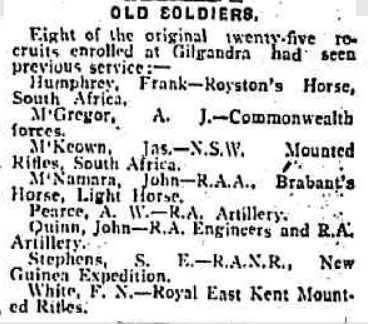
The following article, transcribed from The Farmer and Settler (15 October 1915, p. 3) lists the previous military service of the original 25 Gilgandra recruits:

‘OLD SOLDIERS.
Eight of the original twenty-five recruits enrolled at Gilgandra had seen previous service:–
Humphrey, Frank—Royston’s Horse, South Africa.
McGregor, A. J.—Commonwealth forces.
McKeown, Jas.—N.S.W. Mounted Rifles, South Africa.
McNamara, John—R.A.A. Brabant’s Horse, Light Horse.
Pearce, A. W.—R.A. Artillery.
Quinn, John—R.A. Engineers and R.A. Artillery.
Stephens, S. E.—R.A.N.R., New Guinea Expedition.
White, F.N.—Royal East Kent Mounted Rifles.’

Gilgandra recruits with previous military service (Farmer & Settler 15/10/1915)

Old soldiers (Farmer & Settler, 15/10/1915)

Click here to view the article on Trove: http://nla.gov.au/nla.news-article116673888

The Coo-ees: moving pictures of the march

Moving pictures were taken of the 1915 Coo-ee March, and shown in many NSW picture theatres soon after the march finished.

The Dubbo Liberal and Macquarie Advocate (29 October 1915, p. 4) reported the following about the moving pictures taken of the march:
‘Poets may sing, their songs may survive through generations; their burning words may cause posterity to thrill with pride; statesmen may find fame, and Australian soldiers win their wreaths of glory. But Bill Hitchen, his name and his memory, will survive unto the end of time, and 500 years hence, let us hope, the moving pictures will show the people of that futurity Bill Hitchen and his “Coo-ees” on their magnetic march to the front. We hope the idea will not be forgotten.’[1]

Mr. H. T. Blacket from Dubbo (who accompanied the Coo-ees in his motor car) wrote about the film taken in a letter to his wife written on 31st October 1915 while the Coo-ees were in Wallerawang, which was published in The Dubbo Liberal and Macquarie Advocate (2 November 1915, p. 3):
“… The march to Bathurst was most imposing, and a moving picture was taken. If it is on at Dubbo you should see it. Ask the picture men to let you know if any of the “Coo-ee” pictures are to be shown.”[2]

The contents of the film was described in the Orange newspaper The Leader (24 November 1915, p. 2) as follows:
‘THE COO-EES AT THE MONARCHS
To-morrow night all Orange should pack the Monarchs’ Picture palace to view the screening of Hitchen’s Gilgandra Coo-ees’ entry into Orange. There will be 1100 feet of film shown depicting the crowd lining the route of march down Byng Street, the reception at the Town Hall, and incidents connected with the contingent. It is safe to say that every person who came into the scope of the camera will wish to see how he or she looks on the screen, and there fore we predict a big house. There will also be shown the entry into Wellington, Lithgow, Katoomba, etc till the final grand entry into Martin Place, Sydney. A chance is offered to the public of Orange to visit the Monarchs to-morrow night to pick out their friends and themselves. We understand that the pictures are exceedingly clear, and a triumph in local motion photography.’[3]

Another advertisement in The Leader (12 November 1915, p. 7) lists the film appearing at Monarch Pictures as ‘Australian Gazette … Gilgandra Coo-ees’, with the description ‘Showing from Wellington to their arrival in Sydney. See the Coo-ees and yourself while they were in Orange’.[4]

An advertisement in the Sunday Times (14 November, 1915, p. 16) describes footage of the Coo-ees marching through Enmore and Newton in Sydney:
‘ENMORE THEATRE
… WE WILL SCREEN ALL NEXT WEEK,
A MOVING PICTURE
OF THE
“GILGANDRA COO-EES” WELCOME
That took place at Enmore Theatre, on Friday, Showing
MARCH THROUGH ENMORE AND NEWTON,
And the Crowds outside the
ENMORE THEATRE.
See Yourself in this Great Australian Event.’[5]

I found a reference to a film titled ‘Australian Gazette, c1915. WW1 Recruitment Drive’ on the National Film and Sound Archive catalogue, and purchased a copy of the film a few months ago. The film is of the Coo-ee March, but is so badly deteriorated that of the approximately 6.5 minutes of film, only about 20-30 seconds remains visible, and this was of very poor quality. The film’s title cards ‘Arrival at Wellington’, ‘The reception at Orange’, ‘Calling for recruits at the Town Hall’ , ‘Crossing the Blue Mountains near Lawson’, ‘The arrival at Sydney on Friday 12th November’, and ‘A cheer from the wounded soldiers’ are still visible on the deteriorated film. From the content of this film, it appears it may be the same film as the Australian Gazette ‘Gilgandra Coo-ees’ film that was widely screened soon after the Coo-ee March finished in late 1915.

Unfortunately it appears that the film taken of the Coo-ee March, which apparently was made into numerous copies, and shown in many picture theatres, has not survived even 100 years.

I do not know if the NFSA has the only copy of this film that survives to the current day, but it is a great shame that of all the copies that were circulated and shown in late 1915, not a single one appears to have survived in a viewable format.

If anyone knows of any surviving film footage of the 1915 Coo-ee March please contact me.

[1] ‘Our Soldiers, The Dubbo Liberal and Macquarie Advocate, 29 October 1915, p. 4, http://nla.gov.au/nla.news-article77601711

[2] ‘The “Coo-ees” : a day by day account’, The Dubbo Liberal and Macquarie Advocate, 2 November 1915, p. 3, http://nla.gov.au/nla.news-article77601738

[3] ‘The Coo-ees at the Monarchs’, Leader, 24 November 1915, p. 2, http://nla.gov.au/nla.news-article117844056

[4] ‘Advertising … Monarch Pictures, to-morrow night’, The Leader, 12 November 1915, p. 7, http://nla.gov.au/nla.news-article117843475

[5] Advertising… Enmore Theatre’, Sunday Times, 14 November 1915, p. 16, http://nla.gov.au/nla.news-article120806468

The Coo-ees grow tired of talkers : an open letter to the Mayor of Blayney

Transcription of an article titled “The Coo-ees “ from The Bathurst Times, 26 October, 1915, p. 3.

‘“THE COO-EES.”
GROW TIRED OF TALKERS.
AN OPEN LETTER TO THE MAYOR OF BLAYNEY.

Dear Mr. Mayor, — It is said that the brave Coo-ees from Gilgandra are growing tired of listening to addresses. In the hope that Blayney will use the good sense for which it is noted, these lines are respectfully penned to its chief citizen.

When we reach the town of Blayney
you can give us of your cheer,
You can spread a meal before us with
perhaps a glass of beer;
You can give us pipes and matches, and
a pair or two of socks,
But don’t allow the fellow near who
only talks and talks!

They talked at us in Dubbo, and they
talked in Wellington,
They chin-chined too, at Geurie, and
we thought it only fun;
At Stuart Town and Orange they dished
up the same old stuff
So now we’re getting sick of it, we
feel we’ve had enough!

We ‘ve got to visit Bathurst and a dozen
other towns,
And want to show a smiling face, and
not a face of frowns;
But when they fire speeches at a bloke
from morn till dark
He’s bound to cut up rusty; it would
make an angel nark!

Unless a change is brought about I’ll
give the game a break,
Because, you see, they’ll kill us with
the speeches that they make!
Why don’t they bottle up their gab,
just let ’em get to work
They ought to leave our chaps alone
and try it on a Turk!

When we left old Gilgandra we were fit
for anything,
Because we love our Empire, and be-
cause we love our King,
But since we’ve got along the road that
leads to Coogee Beach,
We’ve grown to hate the thoughts of
men who want to make a speech.

So Mister Mayor, if you please, don’t
take us in and talk,
Just mind that we are tired, for
we’ve had a weary walk,
Just give us each a hand grip; there
is not a bettor way
To let a fellow understand the words
you’d like to say.

Yours truly, DOUBLE O SIX.
Gilgandra Troop,
On the Wallaby,
Millthorpe, Monday.’

Click here to view the article on Trove: http://nla.gov.au/nla.news-article111234721


Mr. G. J. Gilmour: sheepskin vests, and ‘records of the march’

Mr George John Gilmour, of Rose Street, Chatswood, was a former resident of the Gilgandra district, and a director of The Land newspaper.  Following a visit to meet the Coo-ees when they were in Lawson, he arranged for funds to be raised to purchase sheepskin vests for the Coo-ees, which were presented to them on Friday 14th January 1916 at Her Majesty’s Theatre.[1]

According to an article in The Land newspaper (31 March 1916), Mr Gilmour also proposed to collect ‘records of the march’, for ‘purposes of record in the Mitchell Library’, which would include ‘the photograph, signature, place of enlistment, and country addresses of each member of this, the first of the route marches, together with the relevant original correspondence’ in ‘consultation with Mr. Hugh Wright, the Librarian, Mr. H. P. Williams, Managing Editor of “The Land”, and Mr. Palmer of the Immigration and Tourist Bureau’.  The article also stated that ‘Mr. Palmer, who as a member of Headquarters Staff, was closely associated with the Gilgandra march, already has in his possession a card containing the autographs of the officers and men, obtained when the “Coo-ees” were the guests of Katoomba, and this will be incorporated with the record of the march.’[2]

I contacted the State Library of New South Wales regarding these records a few months ago, but unfortunately it appears that they were not collected and given to the Mitchell Library, which has no record of receiving them.

It was a commendable proposal, but the majority of the Coo-ees by this time had already left for Egypt in February and early March 1916.


[1] “Presentations to the “Coo-ees”, The Land,  21 January 1916, p.12, http://nla.gov.au/nla.news-article102926246

[2] “The Answering Coo-ees”, The Land, 31 March, 1916, p. 12, http://nla.gov.au/nla.news-article102928312

Final Parade and Inspection

Transcription of an article titled ‘The “Coo-ees” to Parade’ in The Farmer and Settler, 7 March, 1916, p. 3.

‘THE “COO-EES” TO PARADE
The “15th of the 13th.”

The Gilgandra “Coo-ees,” who made history last year by marching “from the sunset to the sea,” have nearly finished their period of training at Liverpool, and will soon be on the troopship en route for the seat of war. Some have already sailed as a part of the 14th reinforcements for the 13th Battalion, some are in the Light Horse, and in the Artillery, others, again, have entered the non-coms. school ; but the bulk of the original “Coo-ees” are still in the infantry. Of the 270 men that marched in to Liverpool camp, 220 are still with the force — a good percentage.

The “Coo-ees” are known in official circles as the 15th Reinforcements to the 13th Battalion, and they will parade for inspection in Sydney today as a part of a battalion that has become famous on account of its glorious deeds at the front. The “Coo-ees” arc proud to belong to it, and are determined to add to its good name.’

Click here to access the article on Trove: http://nla.gov.au/nla.news-article116666873

Transcription of an article titled ‘Reinforcements’ in The Sydney Morning Herald, 8 March, 1916, p. 13.

‘REINFORCEMENTS.
INSPECTED BY THE STATE GOVERNOR.
A SPLENDID SHOWING.

The heavy rain of the morning made it appear as if the inspection of reinforcements arranged for yesterday afternoon would not take place, and that the men would be merely marched from the Central Railway Station to the Royal Agricultural Show Ground, and for this contingency all arrangements had been made by Headquarters’ Staff. By midday, however, the sun came out; the black clouds disappeared, and when the men arrived from Liverpool the sky was brilliantly blue, flecked here and there only by masses of white cloud. To music supplied by the Liverpool Depot Band and the Casula Band, the reinforcements marched from the railway station, via Eddy-avenue, Elizabeth-street, Wentworth-avenue, and College-street to the outer Domain, entering by the St. Mary’s gates.

By the time the troops had assembled there was a large concourse of people to welcome them, and the parade ground presented an animated spectacle with the long, unbroken lines of khaki in tho centre, and the variegated colours of the ladies’ dresses, banked up on the four sides of the square. Shortly before 4 o’clock the various reinforcements arrived, and took up their positions, with their flags fluttering in the breeze, and the bands playing martial airs. Military and civil police kept the square free of spectators, and as the hour for the inspection struck, Brigadier-General Ramaciotti, accompanied by his orderly officer, Lieut. Frank Smith, of the 13th   Battalion, Major Sadler (General Staff Officer), and Captain Stokes (of the General Staff) arrived at the ground, and were ac- corded the general salute.

Tho Commandant made an inspection of all ranks, which included the 15th Reinforcements of the 1st Battalion; reinforcements for the 2nd, 3rd, 13th, 17th, and l8th Battalions; 2nd Divisional Train; 1st and 2nd Light Horse Brigade Trains; 7th Australian Army Service Corps; 1st Light Horse Field Ambulance; 5th and 8th Field Ambulance; the 1st and 2nd Reinforcements of the Mobile Veterinary Sections, and the 2nd Australian Remount Units, comprising the 5th, 6th, 7th, and 8th squadrons.

Major C. V. Watson was in command of the whole parade, and the men stretched in a deep, unbroken line from the path in front of Richmond-terrace to the eastern side of the parade ground.

As the general salute was sounded and the Commandant, accompanied by his staff, set out on his tour of inspection, the sight was an inspiring one. Under a typical Australian sky the men stood rank on rank, making a fine showing, and the brilliant costumes of the ladies only made a fitting setting for the sombre khaki, backed as they were by the foliage of a hundred dark green shade trees.

On the conclusion of his inspection the general returned to the saluting base, and was joined by his Excellency Sir Gerald Strickland, the Governor, and his A.D.C., Captain Firth. This was the moment for the march-past, and the various reinforcements swung along with their regimental colours in quick time.

Major Watson, having passed the base, wheeled, and joined his Excellency and General Ramaciotti at the saluting base, and watched the men whom he has trained swing by. They were a fine level lot, hard as nails, and brown as the proverbial berry, and looked fit enough to give a good account of themselves against any enemy on whom they might be flung. Conspicuous among the colours carried was that of the 15th Reinforcements of the 1st Battalion, recently presented to the men by Miss Dorothy Brunton.

At the conclusion of the march-past, Brigadier-General Ramaciotti stated that his Excellency was very pleased with the showing of the men, and the fine way in which they had marched past.

Before leaving the ground Sir Gerald Strickland, accompanied by the District Commandant and their staffs, inspected the Garrison Military Police on duty, under Sergeant-Major Harber, and congratulated him on the fine physique of his men.’

Click here to access the article on Trove: http://nla.gov.au/nla.news-article15662163

Photograph and caption with heading ‘The State Commandant inspecting the Gilgandra “Coo-ees” in Sydney’ in The Sydney Mail, 15 March 1916, p. 8.

The State Commandant inspecting the "Coo-ees" in Sydney (Sydney Mail 15/3/1916)

The State Commandant inspecting the “Coo-ees” in Sydney (Sydney Mail 15/3/1916)

‘The State Commandant Inspecting the Gilgandra “Coo-ees” in Sydney.
The inspection was made the day before the troops sailed for the front. The “Coo-ees,” it will be remembered, originated the route marches which have done much to stimulate the recruiting movement.

After several months training they have developed into excellent soldiers, and their delight knew no bounds when they learned definitely that at last their time had come to board a troopship, and sail off to strengthen then ranks of their comrades at the front. Their example should be followed by every man fit and free to go. The call for volunteers is now more insistent than ever.’

The Coo-ees in Liverpool Camp

Transcription of an article titled ‘Route Marches : Gathering of the Clans : The “Cooees” winning praise in camp’  in The Farmer and Settler, 5 January, 1916, p. 3.

‘ROUTE MARCHES.
Gathering of the Clans
THE “COOEES” WINNING PRAISE IN CAMP.

The lying rumors that have been spread — maliciously by enemy sympathisers, without a doubt — concerning the men that took part in the Gilgandra route march render it expedient that a few definite facts should be published to nail the lies like vermin on a barn door.

When the Inspector-General (General McCay) reviewed the troops in training at Liverpool camp the other day, he did the job thoroughly, taking them battalion by battalion, and company by company, criticising severely when the facts called for it, and giving a little carefully measured praise where it was due. When he had seen E company of the 13th Battalion he complimented the commanding officer on the appearance of his men, and said that they were “the steadiest on parade that day.” He did not know until later that E company was the present regimental name of our old friends, the “Coo-ees.” These men from the west had been in camp little more than a month, and the companies they were so flatteringly compared with consisted in some cases of men that had been drilling for three months or more; so the compliment was something for the “Coo-ees” to be proud of.

Another fact suggesting that the time spent in marching to the seaboard is not wasted: On the day of the great “round up” in Sydney, when every man in uniform outside the camps was called upon “to show cause,” the whole force at Liverpool was taken for a fourteen miles forced march over rough roads, on a stifling day under a broiling sun. “The Coo-ees did it smiling, while nearly all the rest were nearer tears” is the way in which an observer illustrates the contrast in condition between the men that had marched over the Blue Mountains and the others. So route marches not only bring the young men of the rural settlements face to face with their duty, but they have some definite value also in fitting men for soldiering.

Now for some statistics: The Coo-ees marched into camp 273 strong, and seven men were added from other units, because of technical knowledge or for other reasons. Of this number, unfortunately, twenty-one failed to pass the severe Liverpool medical test, and sixteen, for medical or disciplinary reasons, have since been transferred to the home defence forces, or have been discharged — not a large proportion to lose in comparison with the camp experience of other units. And although thirty men, at their own request, have been transferred to the Light Horse, it will be seen that the “Coo-ees” column is still substantially intact, an assertion that is further supported by the fact that every non-com. but one in the present E company marched with the column from the west. The company sergeant-major is S. E. Stephens, who, since his service with the first expeditionary force in New Guinea, has been on the “Farmer and Settler” editorial staff; he went to Gilgandra to report the route march for this journal, re-enlisted there, and marched into camp with the column. The platoon sergeants are: H. Davenport, of Wongarbon; L. R. Anlezark, of Orange; T. W. Dowd. of Wongarbon; and E. S. Taylour, of Wentworthville. Corporals: C. H. Maidens, of Molong; W. W. Smith, of Geurie; J. E. L. Hourigan of Parramatta; J. G. Cameron, of Gilgandra; J. McKeown, of Gilgandra; and Pay Corporal J. C. Gilmour, of Coonamble. Others of the men gathered in on that first route march are qualifying for the non-com. class; but unfortunately, as the “Coo-ees” are reinforcements for a battalion already at the front, and not part of a new battalion, these ranks may be only temporary. How well, on the whole, the “Coo-ees” are behaving, and how quickly they are assimilating the lessons to be learned at Liverpool is evidenced by the fact, that although they only marched into camp on November 14th, a fairly big draft has already been made upon E company to make up the 14th reinforcements for the battalion at the front.

The next time that the story is whispered that the “Coo-ees” proved to be a bad lot, the readers of the “Farmer and Settler” will be able to say that they know better; that the “Coo-ees” are the pride of their company officers, have been complimented by General McCay, came smiling out of a forced march, have lost very few men through misbehavior, and are getting fit so rapidly that they will very shortly all be in Europe putting fresh battle names on the proud colors of the “Fighting Thirteenth.”’

Click here to access the article on Trove: http://nla.gov.au/nla.news-article116676486

Day 34, Friday, 12 November, 1915, Ashfield to Sydney

Transcription of an extract from an article titled ‘The Route March : End of the Long Trek’ in The Farmer and Settler, 16 November, 1915, p. 3 [2 of 2 parts]
… [Continued]

‘Friday saw the end of the long journey. This last day of the march, through the crowded high-ways and by-ways of a populous city, was full of sensations to the men of the column.

The sturdy, hard, muscular appearance of the men from the west proved a revelation to the city dwellers, and no one could wonder at the feeling that stirred in the deep-throated acclaims of the multitude as the bronzed and burly lads swung down the crowded thoroughfares that led citywards. Through the traffic worn streets, by Dulwich Hill to Marrickville and into Newtown, they came, each street corner calling a welcome, each defined centre cheering them vociferously, and better than all of this, each centre sending in its little band of recruits to augment the cohort of country men. The civic fathers and the prominent business men of each suburb held levees of welcome and local bands blared and citizens cheered, which welcome the men gravely acknowledged.

At Newtown, a halt was made for a brief period to regale the men with refreshments, and in one of the local picture shows, Mr. D. R. Hall, the Attorney-General, delivered a brief oration of welcome. The entry to the city followed, and just as the long procession turned into George Street, Lady Helen Munro Ferguson, in the absence of the Governor-General, met the men and congratulated them upon having achieved a march that would live in the annals of Australian history.

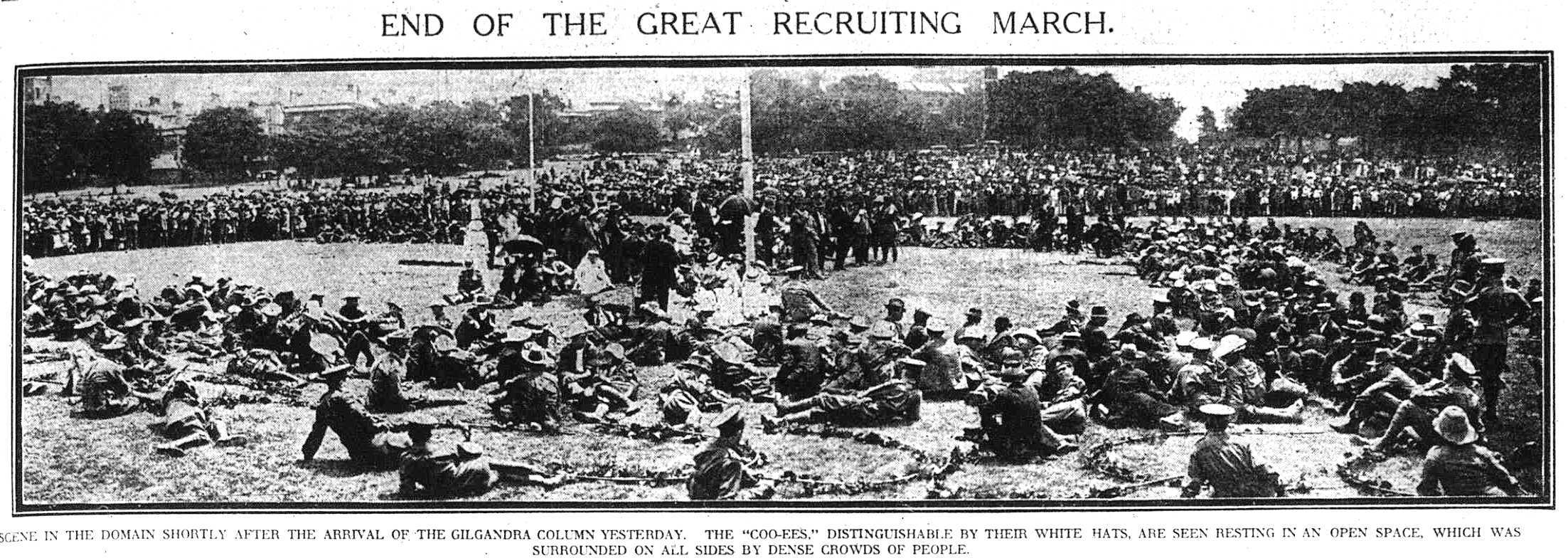
Coo-ees resting at the Domain (Daily Telegraph 13/11/1915)

Coo-ees resting at the Domain (Daily Telegraph 13/11/1915)

From this point, through the city, and into the Domain, the streets were densely packed with wildly-cheering crowds, and the great cordiality of the welcomes showered upon the western heroes was noteworthy. At the Domain, at midday, the men rested while addresses were delivered by prominent public men, and an hour later an official reception was held at Martin Place. Capt. Hitchens, the leader of the band, was accorded a most gratifying reception, and the men were overwhelmed with congratulations and good wishes.

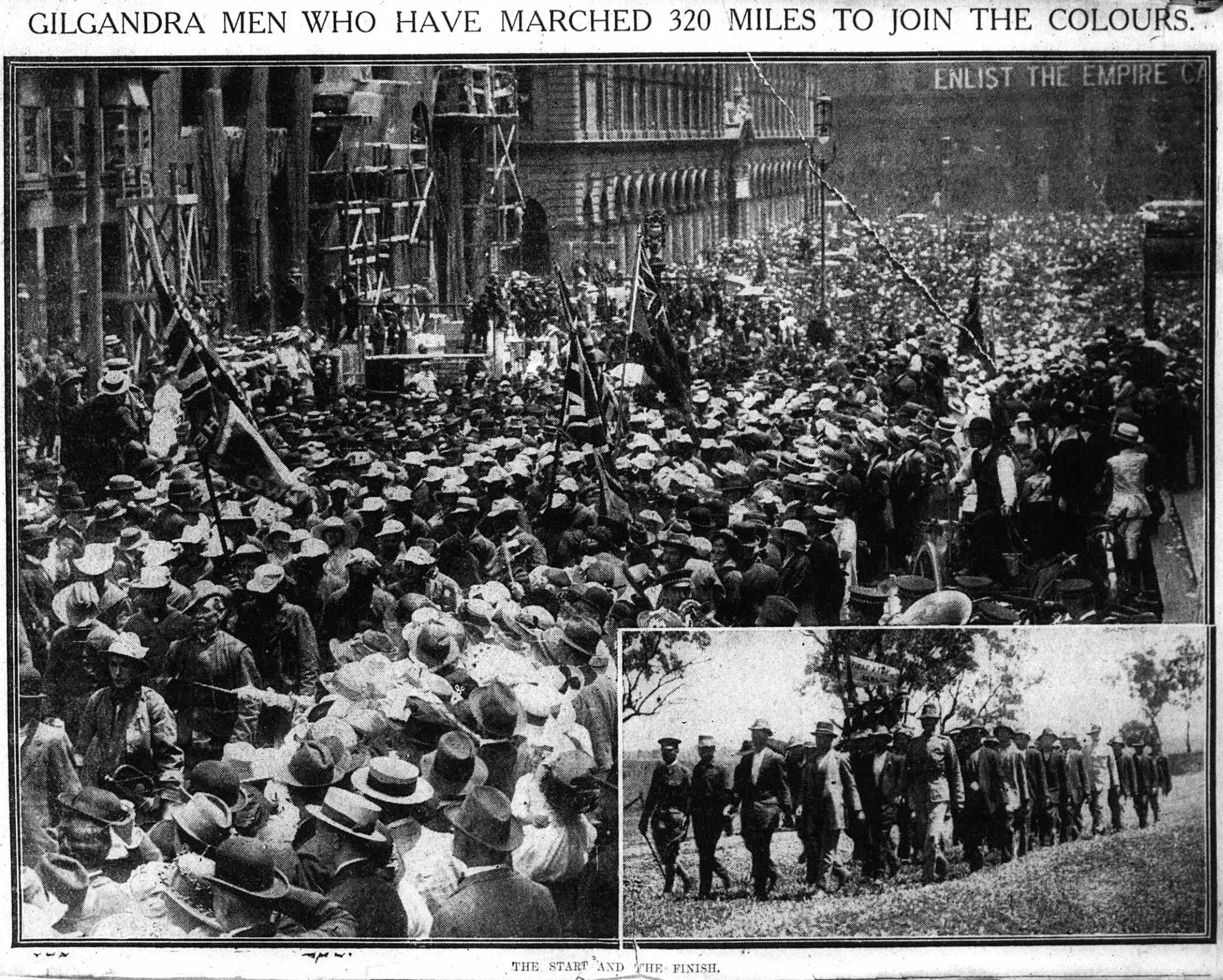
The start and the finish (Sydney Morning Herald 13/11/1915)

The start and the finish (Sydney Morning Herald 13/11/1915)

After the celebrations were over, the two hundred and sixty-three men that comprised the band of “Coo-ees,” were entrained to Liverpool, the first great stage of their journey to the battle-front ended.

The Force at the Finish.
Following is the official statement of men that actually signed on (after medical examination), between Gilgandra and Sydney: Gilgandra 35, Dubbo 13, Wongarbon 12, Geurie 6, Wellington 31, Stuart Town 1, Euchareena 1, Molong 4, Parkes 5, Orange 19, Millthorpe 2, Blayney 11, Bathurst 17, Glanmire 1, Yetholme 1, Wallerawang 3, Lithgow 19, Blackheath 2, Katoomba 11, Leura 1, Lawson 10, Springwood 5, Penrith 4, Parramatta 27, Ashfield 22, total 263.’

Click here to access the article on Trove: http://nla.gov.au/nla.news-article116671136

Day 33, Thursday, 11 November, 1915, Parramatta to Ashfield

Transcription of an extract from an article titled ‘The Route March : End of the Long Trek’ in The Farmer and Settler, 16 November, 1915, p. 3 [1 of 2 parts]

‘THE ROUTE MARCH
End of the Long Trek
DUST-STAINED WARRIORS IN CAMP.

Australia, to-day, realises that her best and bravest must gird on the harness of war to fill the gaps in the ranks of the Empire’s fighting forces; and the insistent “Coo-ee” from the firing line found a striking response when the great three- hundred-mile march of the West o’ Sun- set men reached the finishing post in the heart of the city of Sydney on Friday last at noon. Readers of the “Farmer and Settler” have followed, issue by issue, the fortunes of the recruits from Gilgandra, to the outskirts of the city, and each and every man of the contingent claims that more could be related of the last twenty miles than of the hundreds of the earlier part of the journey. If the “Coo-ees” were inspirited by the hospitality and enthusiasm of the folk, on the long stretches where the road reached straight and bare across the drought-red plains, or wound its way around shoulders of mist-capped ranges, the clamorous welcomes of the people of the foot-hills and the coastal belt was even more soul stirring.

During the march from Parramatta to Ashfield, the men experienced the most trying period of their journey. The dust dried in their throats, and they were jostled and jolted by the thousands of eager, excited loyalists that thronged the route, before, behind, and on all sides disorganising the military machine with their misdirected enthusiasm.

At Harris Park, the community bestowed the best of its viands on the eager soldiers. At Pittrow public school, a flag was presented amid martial ceremonies. Outside Granville, the Westmead Boys’ Band (still going strong) and the local cadets fought a passage for the recruits. After this they tramped through Auburn, dim with the soot of a hundred factories; Homebush reminiscent of the bush, the boys had left with its mobs of sheep, and wild-eyed, bellowing cattle ; then through the crowded suburban streets, packed with curious, excited spectators and choking with dust, to Ashfield.’

… [Cont.]

Click here to access the article on Trove: http://nla.gov.au/nla.news-article116671136