Edward Joseph MCGARRY

Edward Joseph MCGARRY

Per his military service record (regimental no. 4920), Edward Joseph McGarry was born at Kelso, N.S.W. He gave his age as 35 years and 8 months, his marital status as married, and his occupation as fuelman. His description on his medical was height 5 feet 9 ¼ inches tall, weight 12 stone, with a dark complexion, brown eyes, and black hair. His religious denomination was Roman Catholic. He claimed that he had no previous military service. He joined the Coo-ee March at Bathurst. He was attested at Bathurst on the 28th October 1915, but did not complete his medical until the 13th November October 1915 at Liverpool.

After completing the Coo-ee March he went to Liverpool Camp as reinforcement for the 13th Battalion.

On 7th February 1916 he was charged with being absent without leave for 5 days,

On his embarkation roll his address at time of enrolment was 7 Lord Street, Bathurst, N.S.W., and his next of kin is listed as wife, Mrs S. McGarry, 7 Lord Street, Bathurst, N.S.W.

On 8th March 1916 Private McGarry departed Sydney along with many other Coo-ees on the HMAT A15 Star of England, arriving in Egypt on the 11th April 1916.

On the 16th April 1916 he was transferred to the 4th Pioneer Battalion.

On the 4th June 1916 Private McGarry left Alexandria aboard the Transport Scotian bound for France, disembarking at Marseille on the 11th June 1916.

On the 28th September 1916 Private McGarry was admitted to the 4th Field Ambulance sick. He was admitted with Influenza, and transferred to the Division Rest Staton on the 29th September 1916. He was then admitted to the 13th Australian Field Ambulance with Influenza.

On the 4th October 1916 Private McGarry was discharged to duty.

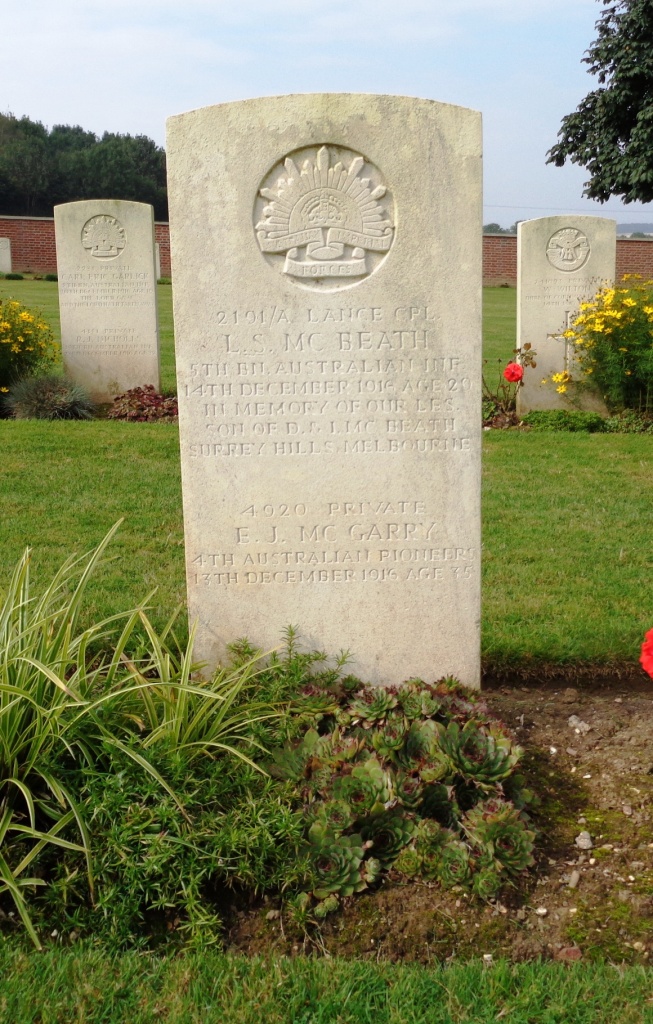
On the 12th December 1916 Private McGarry was wounded in action with a gun shot wound to the chest. He died at No. 38 Casualty Clearing Station at Heilly on 13th December 1916, and was buried on the same day in Heilly Station Cemetery, which was adjacent to the Clearing Station.

Edward Joseph McGarry's headstone at Heilly Station Cemetery, France. His name is on the bottom of the headstone (Photograph: H. Thompson, 4/9/2014)

Edward Joseph McGarry’s headstone at Heilly Station Cemetery, France. His name is on the bottom of the headstone (Photograph: H. Thompson, 4/9/2014)

An article titled ‘Died on service Private E. J. McGarry A “Coo-ee’s” sacrifice’ in the National Advocate (29/12/1916, p. 1) noted that before enlisting, he was ‘employed in the locomotive department on the Bathurst railway’, and that he left a wife and two children.

Heilly Station Cemetery – France

HEILLY STATION CEMETERY

On 4th September 2014 Stephen and I drove to Heilly Station Cemetery, which is located approximately 2 km south west of the village of Mericourt-l’Abbe, which is about 19 km north east of Amiens and 10 km south west of Albert in France.

According to the Commonwealth War Graves Commission website http://www.cwgc.org/, Heilly Station Cemetery was begun by the 36th Casualty Clearing Station at Heilly in May 1916, and was used for Commonwealth burials up until the last burial in May 1919.

The 36th Casualty Clearing Station at Heilly Station was close to the Somme battlefields, and was on the route taken by ambulance trains taking casualties back to hospital behind the lines.

There are 2,890 First World War Commonwealth servicemen buried or commemorated in this cemetery. The Cemetery also contains 83 German graves. Due to the large number of burials being carried out, many of the headstones have more than one name on them, as many of the graves were too close together to be marked individually.

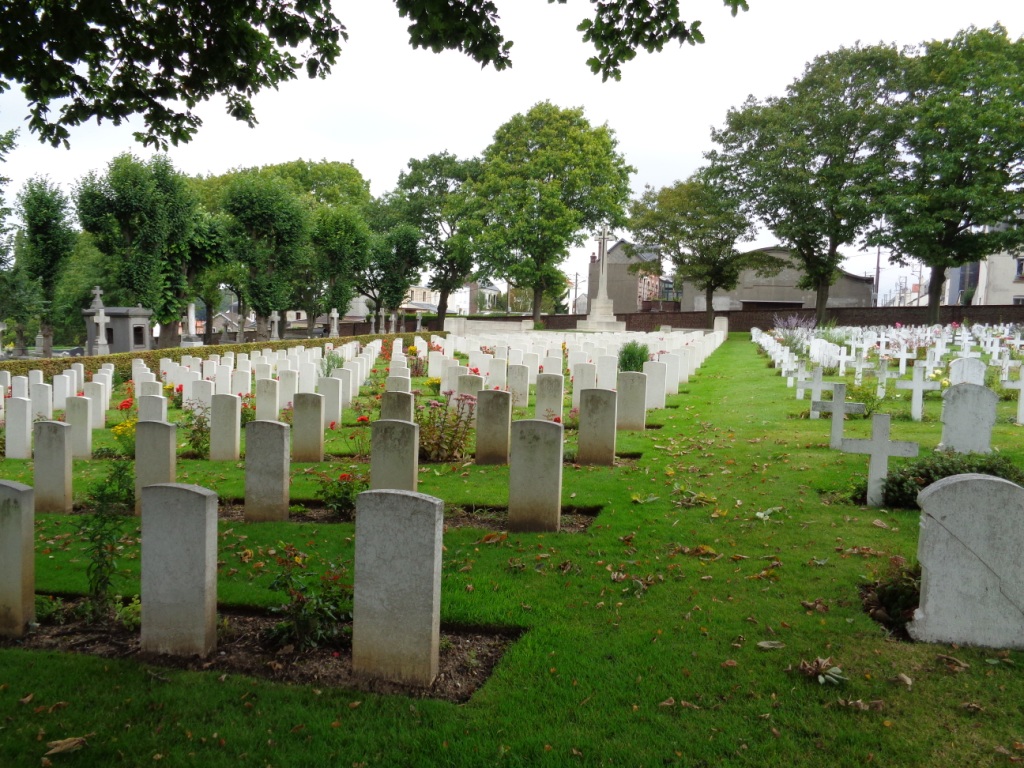
Edward Joseph McGarry, a fuelman on enlistment per his service record, who joined the Coo-ees at Bathurst, is the only Coo-ee buried in this cemetery. He died of wounds on 13th December 1916. He shares a headstone with another Australian soldier.

A photograph of the headstone on Edward Joseph McGarry’s grave will be placed on his individual blog entry, and form part of a Roll of Honour for the fallen Coo-ees on this blog.

The photograph below shows Heilly Station Cemetery on the left, and in the distance, Heilly Station at Heilly. The green crop on the right is potatoes.

Heilly Station Cemetery and Heilly Station (Photograph: S. Thompson 4/9/2014)

Heilly Station Cemetery and Heilly Station (Photograph: S. Thompson 4/9/2014)


Percy Walter HOLPEN

Percy Walter HOLPEN

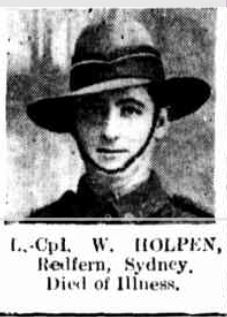
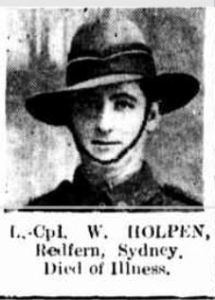
L. Cpl. W. Holpen, Redfern, Sydney. Died of Illness (Sydney Mail, 8/1/1919)

L. Cpl. W. Holpen, Redfern, Sydney. Died of Illness (Sydney Mail, 8/1/1919)

Per his military service record (regimental no. 2196), Percy Walter Holpen was born at Brisbane, Queensland. He gave his age as 21 years and 11 months, his marital status as single, and his occupation as carter. His description on his medical was height 5 feet 9 inches tall, weight 172 lbs., with a fair complexion, blue eyes, and light brown hair. His religious denomination was Church of England. He claimed that he had no previous military service. According to his Attestation paper in his service record he joined on 16th October 1915, when the Coo-ees were in Wellington. He did a preliminary medical at Wellington on 16th October 1915, and was provisionally accepted for enlistment at Dripstone by Captain Nicholas on the 19th October 1915. He completed his medical on the 11th December 1915 at Liverpool, and was attested at Liverpool on the same day, with his service dated from 16th October 1915.

After completing the march he went to Liverpool Camp and trained for the 15th reinforcements for the 1st Light Horse Regiment.

On his embarkation roll his address at time of enrolment was 84 Walker Street, Redfern, Sydney, N.S.W., and his next of kin is listed as father, Walter Holpen, 84 Walker Street, Redfern, Sydney, N.S.W.

On 21st March 1916 Trooper Holpen departed Sydney on the HMAT A26 Armadale, arriving in Egypt on the 24th April 1916. He was sent to the 1st Light Horse Training Regiment at Serapeum.

On the 1st May 1916 he was transferred to the 4th Pioneer Battalion.

On the 4th June 1916 Private Holpen left Alexandria aboard the Transport Scotian bound for France, arriving at Marseille on the 11th June 1916.

On the 10th July 1916 Private Holpen marched out of the 4th Pioneer Battalion whilst it was engaged in works in the vicinity of Fleurbaix, France, for transfer to the 46th Battalion. He marched into the 46th Battalion the next day whilst it was being relieved from the trenches in the vicinity of Sailly, France.

On the 25th August 1916 Private Holpen was admitted to the 13th Field Ambulance sick. On the 28th August 1916 he was moved to the 1st Australian Rest Station. On the 4th September 1916 he was discharged to return to duty. He rejoined the 46th Battalion the next day whilst it was resting at Rubempre, France, after coming out of the trenches in the vicinity of Poziers, France.

On the 1st December 1916 whilst the Battalion was engaged on road making at New Charlton Camp, Bazentin, France,  Private Holpen was charged with insolence to an officer and absenting himself without leave thereby missing a duty which devolved to another soldier. He was awarded 7 days Field Punishment no. 2 and fined one day’s pay.

On the 27th December 1916 Private Holpen was charged with being absent without leave from 2100 on the 20th December 1916 till 1330 on the 21st December 1916 whilst the Battalion was training at new Carlton Camp, Baxentin, France. He was fined a total of 16 days forfeiture of pay.

On the 18th January 1917 when the 46th Battalion was manning the front line trenches in front of Fricourt, France, Private Holpen was wounded in action, receiving a gun shot wound to his chest. Private Holpen was evacuated to a Casualty Clearing Station. On the 24th January 1917 he was admitted to the 3rd Stationary Hospital at Rouen, France. On the 28th January 1917 he was placed aboard the Hospital Ship Warilda at Le Harve, France, for transport to England. He arrived the next day and was admitted to the 1st London General Hospital.

Private Holpen was discharged from the 1st London General Hospital on the 24th March 1917, and granted Leave, to report to the Training Depot at Wareham, England, on the 4th April 1917. On the 10th May 1917 Private Holpen was transferred to the 65th Battalion that was training at Ludgershall, England.

On the 26th June 1917 Private Holpen was charged with being absent without leave from 1200 on the 24th June 1917 till 1530 on the 25th June 1917. He was awarded 6 days Field Punishment No. 2 and forfeiture of 8 days pay.

On the 19th September 1917 Private Holpen was transferred to the overseas Training Brigade for return to the 46th Battalion and France.

On the 20th September 1917 Private Holpen was charged with being absent without leave from 1700 on the 18th September 1917 till 2200 18th of September 1917. He was fined a total of 12 days pay.

On the 4th October 1917 Private Holpen was charged with being found beyond the limits Field by AIF Depots Orders without leave. He was awarded one day Field Punishment no. 2.

On the 14th October 1917 Private Holpen departed Southampton, England, for France, arriving at Le Harve the next day where he marched into the 4th Australian Division Base Depot. Private Holpen left the 4th Australian Division Base Depot on the 18th October 1917 to rejoin the 46th Battalion. He arrived at the 46th Battalion on the 19th October 1917 whilst it was in action around Ypres, Belgium. On the 12th November 1917 he was promoted to Lance Corporal while the Battalion was resting at Coyceques, France.

On the 25th January 1918 the 46th Battalion was conducting training at Perrone, France. Lance Corporal Holpen was charged with being absent without leave from 2100 on the 6th January 1917 till 1830 on the 7th January 1917. He was demoted to Private and fined 2 days pay.

On the 23rd April 1918 a Field General Court Martial was held where Private Holpen had been charged with Desertion being absent without leave from the 31st March 1918 to the 13th April 1918. He was found Guilty and sentenced to 5 years Penal Servitude.

On the 20th May 1918 the 5 year sentence was suspended. However, Private Holpen was soon in trouble again, being charged with escaping from confinement and being absent without leave from 27th May 1918 to 1st June 1918. On the 25th June 1918 another Field General Court Martial was held where Private Holpen was charged with this offence. He was found Guilty and sentenced to 2 years imprisonment with hard labour.

On the 27th July 1918 Private Holpen was admitted to the No.7 Military Prison to undergo his 5 year and 2 year sentences concurrently. On the 7th September 1918 the 5 years penal servitude was commuted to 2 years imprisonment with hard labour.

On the 19th November 1918 Private Holpen was admitted to the 30th General Hospital at Calais suffering from Influenza. On the 23rd November 1918 Private Holpen was listed as seriously ill, and on the 26th November 1918 he succumbed to the illness and died.

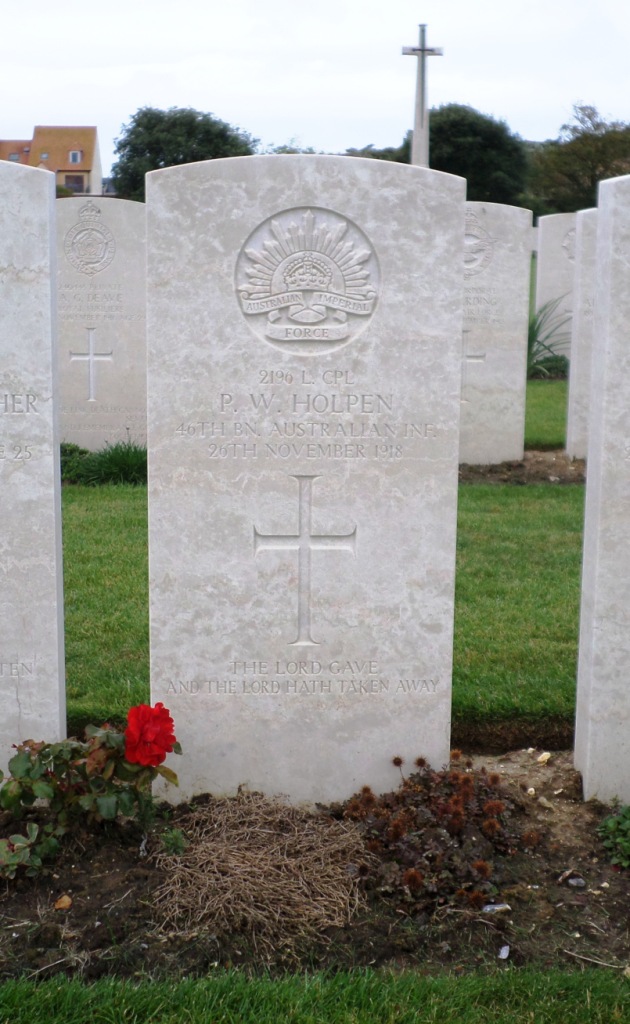
Private Holpen was buried at the Les Baraques Military Cemetery at Calais, France. Percy Walter Holpen has the rank of Lance Corporal inscribed on his headstone.
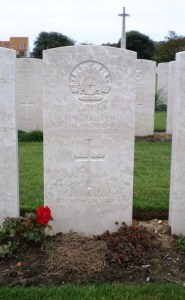
Percy Walter Holpen's headstone, Le Baraques Military Cemetery, France (Photograph: H. Thompson 28/8/2014)

Percy Walter Holpen’s headstone, Le Baraques Military Cemetery, France (Photograph: H. Thompson 28/8/2014)

Percy Walter Holpen gave incorrect details about his age when he joined the Coo-ees. His father Walter Holpen gave the particulars on his Circular for the Australian War Memorial Roll of Honour after the war, and said his son was only 20 years of age when he died.[1] He was born on the 9th January 1898, according to his Queensland birth registration under the name of Walter Percival Holpen, the son of Walter and Sarah (nee Jackson) Holpen.[2] He would therefore have only been 17 years and 9 months of age when he joined the Coo-ees in Wellington on 16th October 1915.

[1] ‘Percy Walter Holpen, AWM Roll of Honour, http://www.awm.gov.au/people/rolls/R1635220/

[2] ‘Walter Percival Holpen’, Australia Birth Index, 1788-1922, Ancestry.com
John QUINN

John QUINN

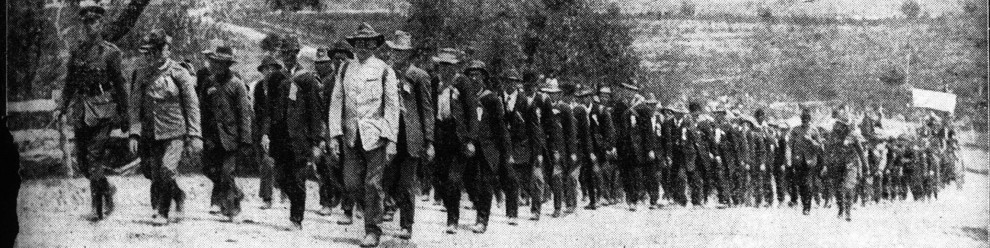
Per his military service record (regimental no. 4881), John Quinn was born at Moana, N.S.W. He gave his age as 29 years and 11 months, his marital status as single, and his occupation as fitter. His description on his medical was height 5 feet 9 inches tall, weight 165 lbs., with a fair complexion, grey eyes, and brown hair. His religious denomination was Roman Catholic. He claimed to have had previous military service of 2 years in the Royal Australian Engineers and 3 years in the Royal Australian Artillery. He completed his medical on the 9th October 1915 at Gilgandra, and was attested by Captain Nicholas at Gilgandra on the 9th October 1915.

After completing the Coo-ee March he went to Liverpool Camp as reinforcement for the 13th Battalion.

On his embarkation roll his address at time of enrolment was C/o Shire Council, Gilgandra, N.S.W., and his next of kin is listed as father, W. Quinn, Tocum Wall Post Office, N.S.W.

On 8th March 1916 Private Quinn departed Sydney along with many other Coo-ees on the HMAT Star of England, arriving in Egypt on the 11th April 1916.

On the 16th April 1916 he was transferred to the 4th Pioneer Battalion.

On the 4th June 1916 Private Quinn left Alexandria aboard the Transport Scotian bound for France, arriving at Marseille on the 11th June 1916.

On the 10th July 1916 he was transferred to the 46th Battalion.

On 23rd July 1916 Private Quinn was admitted to 1 Canadian General Hospital in Etaples with an old injury to the right leg. On 24th August 1916 he was transferred to 6 Convalescent Depot, Etaples. He was transferred to 5 Convalescent Depot in Boulogne on 10th September 1916. He was transferred to base details, and marched into Etaples on 16th October 1916. He was employed in the Sanitary Squad, Etaples.

He was handed to area command for duty on 10th July 1917, then was transferred from the field to 1st Anzac Rfts. Camp on 18th August 1917.

On 11th November 1917 when he was transferred the Australian Employment Company in France.

On 15th September 1918 he went on leave to the United Kingdom. On 29th September 1918 he rejoined his unit in France from leave.

He marched out to the Australian General Base Depot at Rouelles on 5th December 1918. He was transferred to England on 12th December 1918. He marched into No. 2 Command Depot at Weymouth on 13th December 1918.

Private Quinn began his return to Australia on the 5th March 1919 aboard the Transport Nevasa, arriving at Sydney on the 23rd April 1919. He was discharged as medically unfit on the 3rd October 1919 with ‘disability – right lower limb crushed by shell’.

James MCKEOWN

James MCKEOWN

Per his military service record (regimental no. 4862), James McKeown was born at Mudgee, N.S.W. He gave his age as 37 years, his marital status as married, and his occupation as dealer & skin buyer. His description on his medical was height 5 feet 8 ¼ inches tall, weight 11 stone 4 lbs., with a dark complexion, brown eyes, and brown hair. His religious denomination was Roman Catholic. He claimed that he had 15 months active service in South Africa. He completed his medical on the 8th October 1915 at Gilgandra, and was attested by Captain Nicholas at Gilgandra on the 9th October 1915.

After completing the Coo-ee March he went to Liverpool Camp as reinforcement for the 13th Battalion.

In his service record the rank of Acting Corporal was assigned on the 9th October 1915. He was referred to as ‘Corporal McKeown’ in an article about some of the Coo-ees being home on leave in the The Gilgandra Weekly (7/1/1916, p. 3), and again as one of the corporals in an article listing the Coo-ees’ platoon sergeants and corporals at Liverpool Camp in the Leader (14/2/1916, p. 6).

On his embarkation roll his address at time of enrolment was Lower Miller Street, Gilgandra, N.S.W., and his next of kin is listed as wife, Mrs R. McKeown, Lower Miller Street, Gilganda, N.S.W.

On 8th March 1916 with the rank of Acting Corporal, McKeown along with many of the other Coo-ees departed Sydney on the HMAT Star of England, arriving in Egypt on the 11th April 1916.

On the 20th of May 1916 he was transferred to the 45th Battalion.

On the 7th June 1916 Private McKeown was made Acting Corporal, and left Alexandria aboard the Transport Huntspill bound for France, arriving at Marseille on the 14th June 1916.

Acting Corporal McKeown served with the 45th Battalion while it was undertaking training, and relieving on the front line, on the Somme battlefields in France. On the 12th October 1916 he reverted to the rank of Private.

On 22nd November 1916 Private McKeown went to hospital from the field, then rejoined his Battalion in the field on 4th December 1916.

On 26th December 1916 he was sent to hospital, and admitted to No. 1 Australian General Hospital in Rouen on 31st December 1916 with Myocardis.

On 1st January 1917 Private McKeown was evacuated to England sick with Bronchitis, and was admitted to the Lewisham Military Hospital on 2nd January 1917. On 29th January 1917 he was transferred to the 3rd Australian Auxiliary Hospital at Dartford.

He was returned to Australia with Cardiac Insufficiency on the 4th May 1917 aboard the Hospital Ship Themistocles. He arrived in Australia on the 5th July 1917, and was discharged as medically unfit on the 31st July 1917.

Charles Edmond MARCHANT

Charles Edmond MARCHANT


Private Charles Marchant (Sunday Times, 8/10/1916)

Private Charles Marchant (Sunday Times, 8/10/1916)

Per his military service record (regimental no. 4848), Charles Edmond Marchant was born at Mundooran, N.S.W. He gave his age as 21 years and 9 months, his marital status as single, and his occupation as farmer. His description on his medical was height 5 feet 8 inches tall, weight 11 stone 4 lbs., with a dark complexion, grey or brown eyes, and dark hair. His religious denomination was Anglican. He claimed that he had no previous military service. He completed his medical on the 9th October 1915 at Gilgandra, and was attested at Gilgandra by Captain Nicholas on the 9th October 1915.

After completing the Coo-ee March he went to Liverpool Camp as reinforcement for the 13th Battalion.

On his embarkation roll his name is listed as Charles Edward Marchant. His address as time of enrolment was Warrenderi, Tooraweemah [Tooraweenah] Road, Gilgandra N.S.W., and his next of kin is listed as his father, E. Marchant, Warrenderi, Tooraweemah Road, Gilgandra, N.S.W.

On 8th March 1916 Private Marchant departed Sydney with many of the other Coo-ees on the HMAT Star of England, arriving in Egypt on the 11th April 1916.

On the 19th April 1916 he was taken on strength of the 45th Battalion.

Private Marchant received an accidental gun shot wound to the left elbow at Serapeum in Egypt on the 14th May 1916. According to an article in the Dubbo Liberal (29/8/1916, p. 2), While in Egypt he has the misfortune to meet with an accident two days before he was to have left for France. He was in the act of taking his rifle from the parapet, when it caught in a sand-bag and accidentally exploded, the bullet striking him on the left arm, splintering the bone.

He was hospitalized at No. 1 Australian Stationary Hospital at Ismailia on 15th May 1916, then sent to No. 3 Australian General Hospital at Abbassia on the 19th May 1916. He was then transferred to the Hospital Ship Karoola on the 5th July 1916 with a compound fracture of left humerus involving elbow joint, and returned to Australia.

He was medically discharged on the 13th September 1916.

Frank HUMPHREY

Frank HUMPHREY

Per his military service record (regimental no. 1887), Frank Humphrey was born at Hull, Yorkshire, England. He gave his age as 33 years and 3 months, his marital status as single, and his occupation as bricklayer. His description on his medical was height 5 feet 4 inches tall, weight 136 lbs., with a dark complexion, greenish eyes, and brown hair. His religious denomination was Church of England. He claimed that his previous military service consisted of seven months with Roystons Horse in South Africa during the Zulu rebellion. He completed his medical on the 9th October 1915 at Gilgandra, and was attested by Captain Nicholas at Gilgandra on the same day.

His address on his initial application to enlist paper was C/o Mrs McCrossen, Albert Street, Hornsby via Sydney, N.S.W.

After completing the Coo-ee March he went to Liverpool Camp as reinforcement for the 13th Battalion, however on the 4th January 1916 he was discharged with his services being no longer required, after a second period of being absent without leave.

Frank Humphrey attempted to enlist again on the 11th February 1916 at Wangaratta in Victoria. He was successful and allocated to the 3rd reinforcements for the 60th Infantry Battalion.

On his embarkation roll his address as time of enrolment was Railway Hotel, Wangaratta, and his next of kin is listed as mother, Mrs Matilda Johnstone, 31 Thorsley Street, Princess Avenue, Hull, England.

He embarked for Egypt aboard the HMAT A17 Port Lincoln at Melbourne on the 1st May 1916, arriving at Port Suez on the 10th June 1916. He was taken on strength at Tel-el-Kebir on 9th July 1916. He was admitted to No. 2 Australian General Hospital at Tel-el-Kebir on 23rd July 1916 with Adentitis. He was discharged back to duty on 28th July 1916.

On the 2nd August 1916 Private Humphrey left Alexandria aboard the Transport Francovia bound for France.

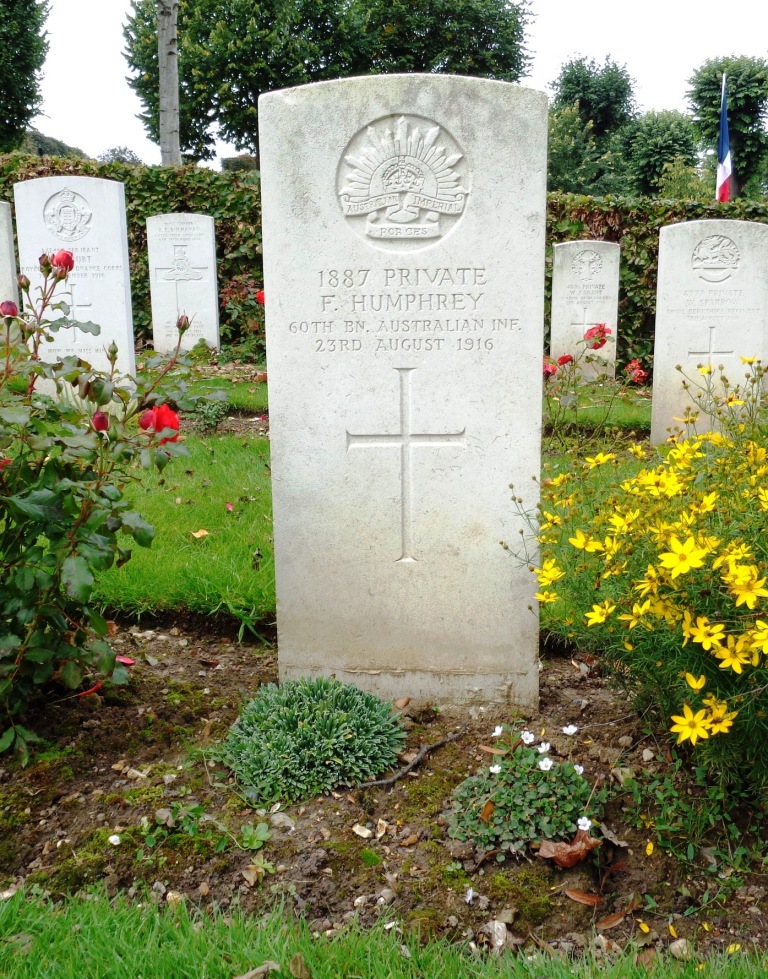
After arrival in France Private Humphrey was admitted to the No. 7 Canadian Stationary Hospital at Le Harve with Bacillary Dysentry on 19th August 1916. He died of his illness on the 23rd August 1916, and is buried at the Ste Marie Cemetery at Le Harve, France.

Frank Humphrey's headstone at Ste. Marie Cemetery, Le Havre, France (Photograph: H. Thompson 2/9/2014)

Frank Humphrey’s headstone at Ste. Marie Cemetery, Le Havre, France (Photograph: H. Thompson 2/9/2014)

His name is also remembered on the Cooee March Memorial Park Gateway (Gilgandra).

Ste. Marie Cemetery – France

STE. MARIE CEMETERY

On Tuesday 2nd September 2014 Stephen and I visited Ste. Marie Cemetery, which is located in Le Havre, Seine-Maritime, France. It is a large general cemetery, and it would have been very difficult to find the grave we were looking for without the Cimetiere Sainte Marie map that was given to us by a very helpful man in the office at the West Entrance gate.

According to the Commonwealth War Graves Commission website http://www.cwgc.org, Le Havre was one of the ports that was used to disembark British and other Allied troops from August 1914, and housed 3 general and 2 stationery hospitals, and 4 convalescent depots by May 1917. Ste. Marie contains 1690 First World War Commonwealth burials. It also contains 364 Second World War burials.

Frank Humphrey, a bricklayer on enlistment per his service record, who joined the Coo-ees at Gilgandra (and was later discharged, and re-enlisted in February 1916), is the only Coo-ee buried in this cemetery. He died of illness at No. 7 Canadian Stationary Hospital at Le Harve on 23rd August 1916.

The photograph below shows part of the First World War Commonwealth military graves at St. Marie Cemetery. Frank Humphrey’s grave is third from the left in the third row on the left (just in view).

Ste. Marie Cemetery, Le Havre, France (Photograph: H. Thompson 2/9/2014)

Ste. Marie Cemetery, Le Havre, France (Photograph: H. Thompson 2/9/2014)

A photograph of the headstone on Frank Humphrey’s grave will be placed on his individual blog entry, and form part of a Roll of Honour for the fallen Coo-ees on this blog.

John Thomas SMITH

John Thomas SMITH

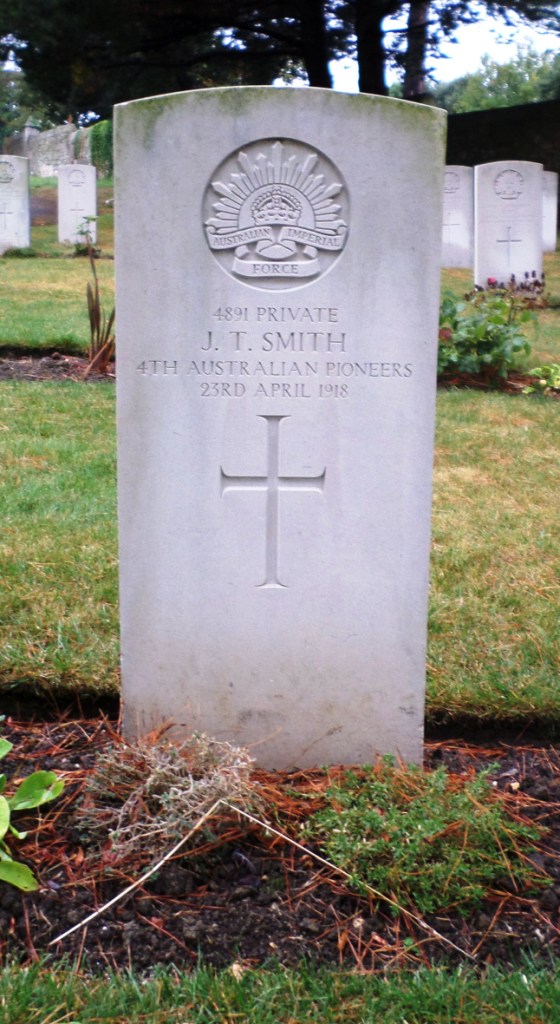
Per his military service record (regimental no. 4891), John Thomas Smith was born at Wigan, Lancashire, England. He gave his age as 30 years, his marital status as single, and his occupation as miner. His description on his medical was height 5 feet 7 inches tall, weight 10 stone 7 lbs., with a fair complexion, brown eyes, and brown hair. His religious denomination was Church of England. He completed his medical on the 16th October 1915 at Wellington, where he joined the Coo-ee March, and was attested by Captain Nicholas on the 19th October 1915 at Stuart Town. He claimed to have had no previous military service.

After completing the march he went to Liverpool Camp as reinforcement for the 13th Battalion.

On his embarkation roll his address at time of enrolment was Queen Street, Wellington, N.S.W., and his next of kin is listed as friend, L. A. Walters, Anhitn, 6 Fernbank Street, Marrickville, Sydney, N.S.W.

Private Smith departed Sydney on the HMAT Star of England on the 8th of March 1916. He arrived in Egypt on the 11th April 1916.

On the 25th April 1916 he was transferred from the 4th Training Battalion at Tel-el Kibir to the 4th Pioneer Battalion, where he was then taken on strength at Serapeum on the 29th April 1916.

On the 4th June 1916 Private Smith left Alexandria aboard the Transport Scotian bound for France, arriving at Marseille on the 11th June 1916.

Private Smith was one of four soldiers in his unit wounded in action on 10th January 1917, receiving a high explosive wound to his stomach, whilst the 4th Pioneer Battalion was undertaking work on the railway line near the village of Longueval, France. He was transferred to the 25th Ambulance Train on 11th January 1917 and admitted to the 12th General Hospital at Rouen on 12th January 1917 with a gun shot wound to the abdomen wall. He was transferred to the Convalescent Depot at Rouen on 24th January 1917, then to Base Depot “A” on 30th January 1917. He was transferred from the 4th Australian Division Base Depot back to his unit on 15th February 1917, rejoining from wounded on 17th January 1917.

He reported to hospital sick from the field on 29th June 1917, and was admitted to 39th General Hospital at Havre on 3rd July 1917. He marched into the 4th Australian Division Base Depot from hospital on 23rd July 1917. He then was readmitted to 39th General Hospital on 3rd August 1917, then on 31st August 1917 he was discharged, and returned to the 4th Australian Division Base Depot. On 7th September he marched out of the 4th Australian Division Base Depot, then returned to his unit in the field on 10th September 1917.

On the 25th October 1917 he was admitted to the 12th Canadian Field Ambulance with an accidentally dislocated right shoulder, then was transferred on the 26th October 1917 to the 13th Canadian Field Ambulance. On the 27th October he was transferred to 36th Ambulance Train, then admitted to 6th Convalescent Depot on 31st October 1917. He was discharged from the hospital at Etaples on the 8th November 1917, then marched in to the 4th Australian Division Base Depot at Havre on 10th November 1917. He returned to his unit in the field on 14th November 1917.

On 22nd February 1918 he reported to 13th Australian Field Ambulance sick, and was admitted to the 4th Australian Field Ambulance with Scabies. He returned to his unit on 28th February 1918.

Private Smith’s service record reports he was ‘wounded in action’ on the 5th April 1918, and was admitted to the 13th Australian Field Ambulance. According to the 4th Pioneer Battalion’s war diary, on 5th April 1918 the battalion was in camp near Henencourt Wood when it was shelled by German artillery. Private J. T. Smith is listed in the Casualties list as wounded by ‘H. E. Shell’. He was admitted to 22nd General Hospital at Camiers with a gun shot wound dislocated right shoulder on 6th April 1918. He was transferred to a hospital ship on 8th April 1918 and embarked for England, being admitted to Dorset County Hospital at Dorchester on 9th April 1918.

Private Smith died of his wounds on 23rd April, 1918, of gun shot wound dislocation of right shoulder (haemoptysis), at Dorset County Hospital, Dorset, England.

John Thomas Smith’s headstone at Melcombe Regis Cemetery, Weymouth, England (Photograph: H. Thompson 25/8/2014)

John Thomas Smith’s headstone at Melcombe Regis Cemetery, Weymouth, England (Photograph: H. Thompson 25/8/2014)

Private Smith was buried with full military honours on the 27th April, 1918 at Melcombe Regis Cemetery, Weymouth, Dorset, England.

Thomas THORNE

Thomas THORNE

Mrs Thorne with her son Thomas Thorne who joined at Lawson (Mirror of Australia 13/11/1915)

Mrs Thorne with her son Thomas Thorne who joined at Lawson (Mirror of Australia 13/11/1915)

Per his military service record (regimental no. 4903), Thomas Thorne was born at Hay, N.S.W. He gave his age as 22 years and 2 months, his marital status as married, and his occupation as motor driver. His description on his medical was height 5 feet 6 inches tall, weight 140 lbs., with a dark complexion, brown eyes, and brown hair. His religious denomination was Church of England. He claimed to have 6 months experience with the Lawson Rifle Club. He joined the Coo-ee March at Lawson, and was attested at Lawson on the 7th November 1915.

After completing the march he went to Liverpool Camp as reinforcement for the 13th Battalion.  He completed his medical at Liverpool on the 13th November 1915.

On Private Thorne’s embarkation roll his address at time of enrolment was Christabell Street, Lawson, N.S.W., and his next of kin is listed as wife, Mrs. M. A. Thorne, C/o Mrs Page, Casino, Carr-Street, Coogee, N.S.W.

Along with many of the Coo-ees, Private Thorne departed Sydney on the HMAT Star of England on the 8th March 1916, and arrived in Egypt on the 11th April 1916.

Following being admitted ill on the 11th April 1916 to the 31st General Hospital in Port Said, Egypt, he marched in to 4th Training Battalion, Egypt on 21st May 1916.

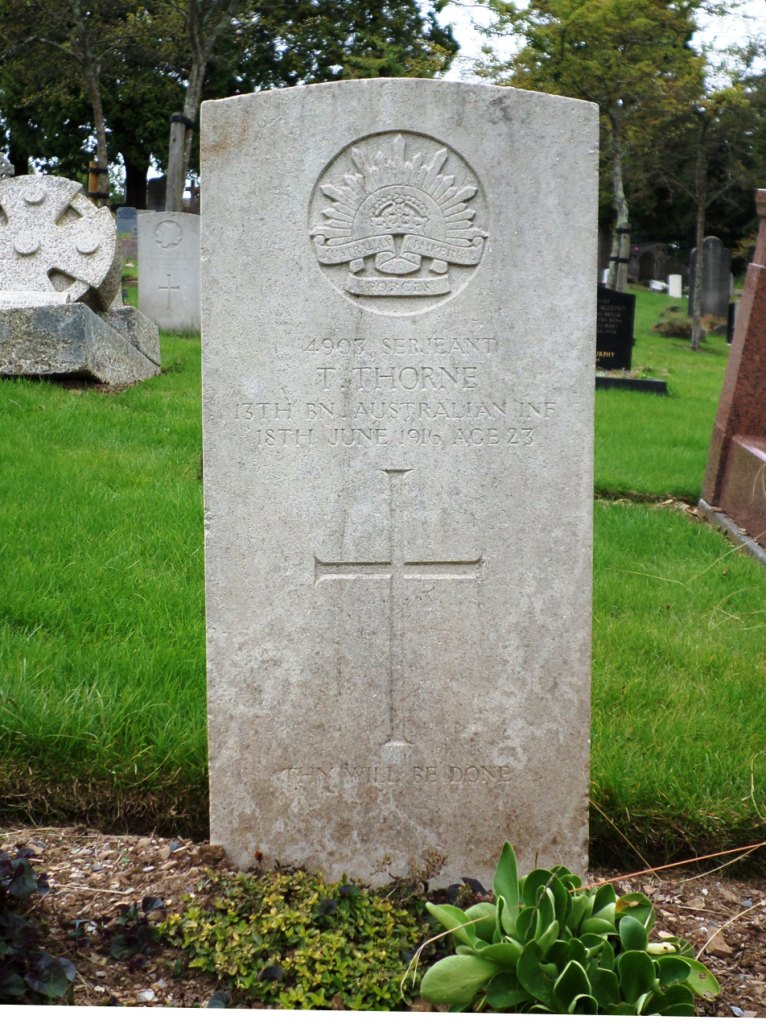
The name and embarkation date of the transport ship that took Thomas Thorne to England from Egypt is not recorded in his service record. The next entry in his service record notes Acting Sergeant Thorne admitted to Devonport Military Hospital on 16th June 1916, and then his death two days later of Pneumonia on 18th June 1916.

According to a letter from the Matron at the hospital in the Australian Red Cross Society Wounded and Missing Enquiry Bureau files, 1914-18 War 1DRL/0428  on the Australian War Memorial website, ‘Thorne was admitted to this hospital from the transport upon which he arrived in England on the 17-6-16. He was very ill with Broncho Pneumonia & the Doctors gave no hope of his recovery. He lived until the following day the 18-6-16 when passed peacefully away at 4.30 p.m.’

Thomas Thorne’s headstone at Plymouth (Efford) Cemetery, England (Photograph: H. Thompson 24/8/2014)

Thomas Thorne’s headstone at Plymouth (Efford) Cemetery, England (Photograph: H. Thompson 24/8/2014)

Sergeant Thorne was buried at Plymouth (Efford) Cemetery in Plymouth, Devon, England, on the 21st June 1916 with full military honours.

Thomas Thorne’s name is also listed on the Lawson War Memorial.