Yearly Archives: 2014

James CRAWFORD

James CRAWFORD

Per his military service record (regimental no. 4753), James Crawford was born in Glasgow, Scotland. He gave his age as 38 years, his marital status as single, and his occupation as farmer. His description on his medical was height 5 feet 5 ½ inches tall, weight 11 stone 7 lbs., with a fair complexion, bluish grey eyes, and fair hair. His religious denomination was Anglican. He completed his medical on the 8th October 1915 at Gilgandra and was attested by Captain Nicholas on the 9th October 1915 at Gilgandra. He claimed to have had no previous military service. His surname looks like “Crowford” in his signature.

After completing the march he went to Liverpool Camp as reinforcement for the 13th Battalion.

On his embarkation roll his address at time of enrolment was Gilgandra, N.S.W., and his next of kin is listed as mother, Mrs E. Crawford, Hull Head, Castle Fern, Donegal, Ireland.

Private Crawford departed Sydney on the HMAT Star of England on the 8th March 1916. He arrived in Egypt on the 11th of April 1916.

On the 7th of June 1916 Private Crawford left Alexandria aboard the Transport Ionian bound for France, arriving at Marseille on the 14th of June 1916.

On the 31st August 1916 during the Battle of the Somme the 13th Battalion was being relieved from the vicinity of Mouquet Farm, France when he received a gunshot wound to his back. Private Crawford was evacuated to the 49th Casualty Clearing Station, where he died of his wounds on the 3rd September 1916.

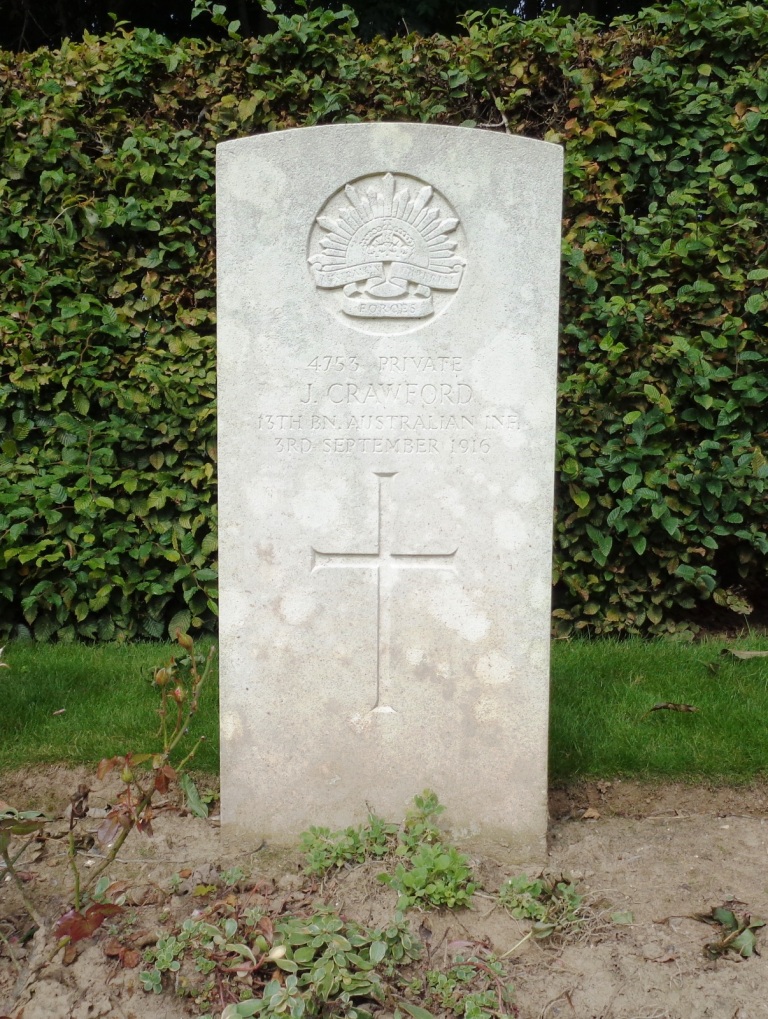
He is buried in the Contay British Cemetery, France.

James Crawford's headstone, Contay British Cemetery, France (Photograph: H. Thompson 4/9/2014)

James Crawford’s headstone, Contay British Cemetery, France (Photograph: H. Thompson 4/9/2014)

Private Crawford’s name is commemorated on panel 68 on the Australian War Memorial First World War Roll of Honour.

His name is also listed on the Cooee March Memorial Park Gateway (Gilgandra).

Ernest SIMPSON (aka C. A. SIMPSON)

Ernest Simpson (aka C. A. Simpson)

One of the men who lined up to join the Coo-ee March at Gilgandra has been listed as “C. A. Simpson” on the Cooee March Memorial Park gateway in Gilgandra, and in the book The Coo-ee March by John Meredith (1981).

Simpson was incorrectly named as “C. Simpson” in a photo published in the Daily Telegraph (pictured on left below), which possibly lead to the incorrect initials being assigned to him.

C_Simpson_C_Finn_C_Marchant_JR_Lee_DailyTelegraph_11Oct1915_p9

Paraded for medical inspection … (left to right): Messrs. C. Simpson, C. Finn, C. Marchant, and J. R. Lee (Daily Telegraph, 11/10/1915)

An article in The Farmer and Settler (19 October 1915, p. 3) reported that ‘In addition to the men sworn in at Gilgandra and at towns en route, the great march column numbers: … Simpson, temporarily unfit, but hoping to pass the doctor in Sydney’.[1]  Further down the same page is reported: ‘One of the men marching to Sydney has failed to pass the doctor. He waited for three weeks in Gilgandra, paying his own hotel expenses, and then when he stripped off for the medical inspection he was “turned down” for hernia. He is physically the strongest man that has offered, and, is otherwise “as sound as a bell”. He intends to march to Sydney, undergo an operation upon arrival, and submit himself again’.[2]

A chance review last week of a document held in the official correspondence from the march held in the Mitchell Library, which lists an “E. Simpson” with a period of enlistment from “9/10 to 11/11/15” with other Coo-ees still waiting for payment for their period of service who had been rejected as medically unfit on arrival at Liverpool Camp,  has enabled his identity to be established.[3]

Knowing the correct initial for his first name, and that he had actually enlisted,  allowed for his service record to be located on the National Archives of Australia website. He is listed under the name Ernest Simpson, joining on 9th October 1915, at Gilgandra. He was born in Horsham, Victoria, and gave his age as 33 years, and his occupation as labourer. There are no details entered for his description on his medical certificate form in his service record papers.  His next of kin is listed as his father, Duncan Simpson, Renmark, South Australia.

On the ‘Detailed medical history of an invalid’ form in his service record dated 17th November 1915 at Liverpool, he was found by the medical board to have a double inguinal hernia, and to be unfit for military service.  He was medically discharged on 29th November 1915.

[1] ‘Route March notes’, The Farmer and Settler, 19 October, 1915, p. 3, http://nla.gov.au/nla.news-article116648915

[2] ‘Failed to pass the doctor’, The Farmer and Settler, 19 October, 1915, p. 3, http://nla.gov.au/nla.news-article116648912

[3] The Alex Halden (Joe) Miller papers mainly relating to the Gilgandra Coo-ee Recruitment March, New South Wales, 1912-1921, 1939, MLMSS 5081


Robert Clyde CAMPBELL

Robert Clyde CAMPBELL

Per his military service record (regimental no. 5996), Robert Clyde Campbell was born in Sydney, N.S.W. He gave his age as 25 years, his marital status as single, and his occupation as farmer. His date of joining on the attestation paper at the front of his service record is listed as 9th October 1915, however further pages record that he completed his medical on the 13th July 1916 at Kiama N.S.W., and also signed his service oath at Kiama on the 13th July 1916. His description on his medical was height 5 feet 7 inches tall, weight 11 stone 6 lbs., with a fair complexion, blue eyes, and fair hair. His religious denomination was Church of England. He claimed to have had no previous military service.

“R. C. Campbell” was named in several newspaper articles published at the time as one of the original 25 recruits who signed up for the march in Gilgandra on Saturday 9th October 1915.

Further investigation has found that he did not complete the Coo-ee March. Per a telegram sent to A. H. Miller dated 17th November 1915 in the official correspondence from the march which is held at the State Library of New South Wales, R. C. Campbell was admitted to Lithgow Hospital with Typhoid Fever when the Coo-ees were in Lithgow, where he remained until after the march was completed. He then went to Liverpool Camp as reinforcement for the 13th Battalion.

On his embarkation roll his address at time of enrolment was 286 Harris Street, Sydney, N.S.W., and his next of kin is listed as mother, Mrs C. Campbell, 286 Harris Street, Sydney, N.S.W.

Private Campbell departed Sydney on the HMAT Wiltshire A18 on the 22nd August 1916, arriving at Plymouth on the 13th October 1916. He marched into the 13th Battalion on the 6th March 1917 when it was out of the line at Ribemont, France.

On the 11th April 1917 Private Campbell was with the Battalion when it launched an attack on the Hindenberg Line in the vicinity of Reincourt. During this attack he was wounded receiving a gun shot wound to his left arm. He was one of 118 members of the Battalion wounded. Another 25 were killed and 367 were missing.

Private Campbell was hospitalised and evacuated to England on the 18th July 1917. He developed oedema to his left leg, and on the 31st October 1917 he commenced his return to Australia on the HMAT Berrima, arriving in Australia on the 3oth December 1917. He was discharged as medically unfit on the 30th January 1918.

James Gerald CAMERON

James Gerald CAMERON (DCM)

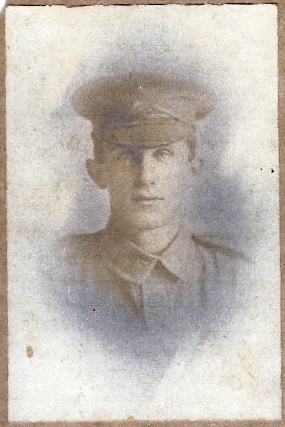
James Gerald Cameron (Photograph courtesy of his grandson Dennis Richards)

Per his military service record (regimental no. 4747), James Gerald Cameron was born at Mundooran, N.S.W.[1]  [Mundooran was later renamed Mendooran]. He gave his age as 23 years and 9 months, his marital status as single, and his occupation as farmer.  His description on his medical was height 5 feet 8 inches tall, weight 12 stone 11 lbs., with a fair complexion, blue eyes, and fair hair. His religious denomination was Presbyterian.  He completed his medical on the 9th October 1915 at Gilgandra, but was not attested by Captain Nicholas until the 12th October 1915 at Mogriguy. He claimed to have had no previous military service.

On his embarkation roll his address as time of enrolment was Mundooran, N.S.W., and his next of kin is listed as father, J. A. Cameron, Mundooran, N.S.W.

James Cameron’s experience in joining the march at Gilgandra was reported in The Farmer and Settler :

‘One of the men in the big march – Cameron – happened to attend the meeting at Gilgandra on the Friday night before starting day. Moved by Private Lee’s eloquence, he handed in his name. He then rode home forty miles to tell his people of the step he had taken, and, after riding forty miles back, was ready to take his place with his new comrades on the Sunday morning’.[2]

After completing the march he went to Liverpool Camp as reinforcement for the 13th Battalion.

Private Cameron departed Sydney on the HMAT A15 Star of England on the 8th March 1916 bound for Egypt.

On 12th April 1916 he was admitted to the 2nd Australian Stationary Hospital at Tel El Kebir, Egypt suffering from Mumps.

On  18th May 1916 he transferred to the 4th Division Cyclist Training Corps.

Private Cameron left Alexandria on the Huntspill on 8th June 1916, arriving in Marseilles on the 14th June 1916.

On the 9th July 1916 he transferred to the 1st ANZAC Cyclist Battalion, then on the 26th August 1916 he was transferred to the 45th Battalion, missing the battles on the Somme, and joining the Battalion at the time they were moving to Belgium. On the 5th September 1916 he was appointed Lance Corporal.

On 10th October 1916 Lance Corporal Cameron was accidentally injured suffering a dislodged cartilage to his right knee. He was sent to the 12th Australian Field Ambulance, then on 11th October 1916 he was transferred to the 10th Casualty Clearing Station, then to the 3rd Casualty Clearing Station. On 12th October 1916 he was placed aboard the 1st Ambulance Train and sent to the 8th Stationary Hospital at Wimereux, France. He was discharged and rejoined the Battalion on 19th October 1916.

He was promoted to Temporary Corporal on 11th December 1916.

On 27th March 1917 Temporary Corporal Cameron was again accidentally injured suffering a laceration to his right hand. He was sent to the 12th Australian Casualty Clearing Station, then on 31st March he was transferred to the 1st/1st Casualty Clearing Station.  He reverted to the rank of Lance Corporal while he was in hospital.

On 4th April 1917 he was admitted to the 3rd Canadian General Hospital at Boulogne, France.

On 6th April 1917 he was promoted to Corporal.

On 7th April 1917 he was placed aboard the Hospital Ship Princess Elizabeth for evacuation to England. He was admitted to the Kitchener Military Hospital at Brighton in England later that day.

He was discharged from hospital on 21st April 1917 and granted leave to report to the No. 1 Command Depot at Perham Downs in England on 7th May 1917.

On 25th June 1917 Corporal Cameron departed Southampton, England, bound for France. He marched into the 4th Australian Division Base Depot at Le Harve on 26th June 1917.

He rejoined the 45th Battalion on 14th July 1917 when it was resting and reorganising at Kortepyp Camp, Belgium after being in action around Messines.

On the 25th August 1917 he was promoted to Sergeant.

On 21st March 1918 he was granted leave to England. He rejoined the 45th Battalion in France on 6th April 1918.

On 2nd May 1918 Sergeant Cameron received a gunshot wound to his left shoulder during fighting around Villers Bretonneux. He was sent to the 12th Australian Field Ambulance. On 3rd of May 1918 he was evacuated to the 61st Casualty Clearing Station. On 4th May 1918 he was admitted to the 1st Canadian General Hospital. On 6th May 1918 he was placed aboard the hospital Ship Ville De Liege and evacuated to England. He was admitted to the High Barnet Military Hospital in London later that day.

On 21st May 1918 he was transferred to the 1st Australian Auxiliary Hospital at Harefield, England.

On 23rd May 1918 he was granted leave to report to the No. 1 Command Depot at Perham Downs, England, on 6th June 1918.

On  5th June 1918 Sergeant Cameron  was admitted to the 1st Australian Dermatological Hospital at Bulford, England sick. He was discharged on 13th July 1918.

On 6th September 1918 Sergeant Cameron departed Folkestone, England, bound for France. He marched into the 4th Australian Division Base Depot at Le Harve, France on  9th September 1918.

He rejoined his Battalion on 13th September 1918 when it was Poeuilly, France.

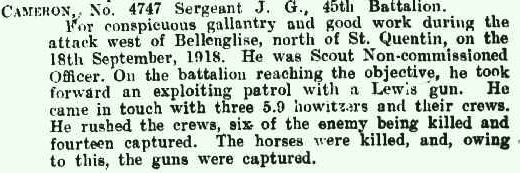
For his actions on the 18th September 1918 during an attack near Bellenglise, France, Sergeant Cameron recommended for, and subsequently awarded, a Distinguished Conduct Medal. The recommendation dated 25th September 1918 in his military service record reads: ‘For conspicuous bravery and devotion to duty during the attack west of Bellenglise on the 18th September 1918. He was scout N.C.O. On the Battalion reaching the objective he took forward an exploiting patrol with a Lewis gun. He came in touch with three 5.9. Howitzers and their crew. He rushed the crews, six of the enemy being killed and 14 captured. The horses were killed and owing to this the guns were captured.

Notification of his award was announced in Supplement No. 31225 to The London Gazette, 12th March 1919 (page 3392), and was also promulgated in the Commonwealth of Australia Gazette, 17th June 1919 (page 1012).

The citation below for his Distinguished Conduct Medal was published in Supplement No. 31668 to The London Gazette, 2nd December 1919 (page 14907), and also in The Commonwealth of Australia Gazette No. 20, 19th February 1920 (page 191).

‘Awarded the Distinguished Conduct Medal … Cameron, No. 4747 Sergeant J. G., 45th Battalion’ (The Commonwealth of Australia Gazette, 19th February 1920, p 191)

On 23th October 1918 he was appointed Temporary Company Sergeant Major. He was promoted to Company Sergeant Major (Warrant Officer Class 2) on 8th November 1918.

On 3rd February 1919 Company Sergeant Major Cameron was granted leave to England.  He rejoined the 45th Battalion on 25th March 1919.

On 10th April 1919 Company Sergeant Major Cameron departed Le Harve bound for England, to commence his return to Australia. He landed at Southampton on 11th April 1919 and marched into the No. 6 Camp at Sutton Veny, England.

Company Sergeant Major Cameron departed England aboard the HT Devanha on 8th May 1919 bound for Australia.

He arrived at Sydney on 26th June 1919. He was discharged Termination of Period of Enlistment on  10th August 1919.


[1] NAA: B2455, CAMERON J G

[2] ‘Eighty miles to enlist’, The Farmer and Settler, 19 October, 1915, p. 3, http://nla.gov.au/nla.news-article116648908


Sidney BENNETT

Sidney BENNETT

Sidney Bennett (Photograph courtesy of his of his grand-daughters D. Ayers and J. Pemberton)

Sidney Bennett (Photograph courtesy of his of his grand-daughters D. Ayers and J. Pemberton)

Per his military service record (regimental no. 4732), Sidney Bennett was born at Paddington, Sydney. He gave his age as 24 years and 10 months, his marital status as single, and his occupation as labourer.  His description on his medical was height 5 feet 9 ½ inches tall, weight 11 stone 5 lbs., with a dark complexion, blue eyes, and dark hair. His religious denomination was Roman Catholic. He completed his medical on the 8th October 1915 at Gilgandra and was attested by Captain Nicholas on the 9th October 1915 at Gilgandra. He claimed to have had no previous military service.

On his embarkation roll his address as time of enrolment was Hornsey, David Street, North Sydney, N.S.W., and his next of kin is listed as father, Mr H. Bennett, Hornsey, David Street, North Sydney, N.S.W.

After completing the march he went to Liverpool Camp as reinforcement for the 13th Battalion.

Private Bennett departed Sydney on the HMAT A15 Star of England on the 8th March 1916. On the 19th of April 1916 he transferred to the 45th Battalion in Egypt.

On the 2nd June 1916 Private Bennett left Alexandria aboard the Kinfauns Castle bound for France, arriving at Marseilles on the 8th June 1916.

On the 22nd September 1916 he received a gunshot wound to his left forearm whilst conducting a working party near Vierstraat, Belgium. He was hospitalised and evacuated to England.

On the 13th September 1918 he was transferred to the 54th Battalion, and on the 11th October 1918 to the 56th Battalion.

Private Bennett commenced his return to Australia on the HT Devanha on 8th May 1919, arriving in Australia on the 19th June 1919. He was discharged on the 10th August 1919.

Harold BAXTER

Harold BAXTER

Per his military service record (regimental no. 4730), Harold Baxter was born at Illford, Essex, England.[1]  He gave his age as 22 years and 4 months [although he was several years younger], his marital status as single, and his occupation as a farm labourer.  His description on his medical was height 5 feet 9 inches tall, weight 11 stone, with a medium dark complexion, blue eyes, and dark hair. His religious denomination was Methodist.

He completed his medical examination on the 10th October 1915 at Gilgandra and was attested by Captain Nicholas on the 9th October 1915 at Gilgandra. He claimed to have had no previous military service.

After completing the Coo-ee March he went to Liverpool Camp as reinforcement for the 13th Battalion.

On his embarkation roll his address as time of enrolment was Euronga, Gilgandra, N.S.W., and his next of kin is listed as father, [Mr J.] Baxter, 727 Romford Road, Manor Park, Essex, England.

Private Baxter departed Sydney on the HMAT A15 Star of England, along with many of the other Coo-ees, on the 8th March 1916. On the 19th April 1916 he transferred to the 45th Battalion in Egypt.

On the 2nd June 1916 Private Baxter left Alexandria aboard the Kinfauns Castle bound for France, arriving at Marseilles on the 8th June 1916.

Private Baxter survived the fighting on the Somme unscathed, however on the 22nd November 1916, near Guedecourt, France, he was one of 3 members of the Battalion killed during a intercompany relief by a heavy German artillery barrage that also wounded 7 other members of the Battalion.

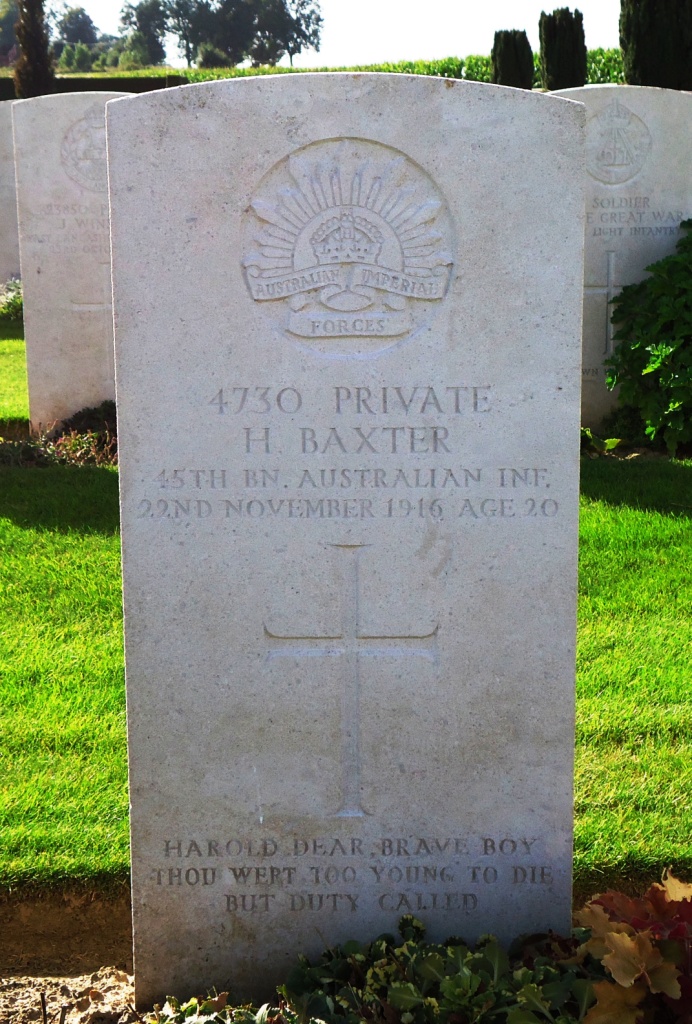
He is buried at Bancourt British Cemetery, at Bancourt, France.  His age at death was listed as only being 20 years of age on his headstone.

Harold Baxter headstone, Bancourt British Cemetery (Photograph: S & H Thompson 2012)

Harold Baxter headstone, Bancourt British Cemetery (Photograph: S & H Thompson 2012)

His name is also listed on the Cooee March Memorial Park Gateway (Gilgandra).

Research note:  His Birth Certificate lists his date of birth as 14th May 1897, so he was only 18 years and 4 months when he enlisted on the Coo-ee March.  He was only 19 years and 6 months old when he died.[2]

[1] NAA: B2455, BAXTER H

[2] General Register Office Birth Certificate, Harold Jubilee Baxter, Ilford, County of Essex, 14 May 1897, son of James Aram Baxter and Rhoda Baxter formerly Kilner.

William ALSTON

William ALSTON

William Alston on the occasion of his marriage to Miss. I. Quinton, sister of Coo-ee Victor Quinton, at Gilgandra, 1923 (Photograph courtesy of Dell Tschanter)

William Alston on the occasion of his marriage to Miss. I. Quinton, sister of Coo-ee Victor Quinton, at Gilgandra, 1923 (Photograph courtesy of  Dell Tschanter)

Per his military service record (regimental no. 1086), William Alston was born at Walgett, N.S.W. He gave his age as 23 years and 4 months, his marital status as single, and his occupation as general labourer.  His description on his medical was height 6 feet tall, weight 168 lbs., with a dark complexion, brown eyes, and black hair. His religious denomination was Anglican.  He completed his medical on the 7th October 1915 at Gilgandra and was attested by Captain Nicholas on the 9th October 1915 at Gilgandra. He claimed to have had no previous military service.

On his embarkation roll his address as time of enrolment was Narrabri West, N.S.W., and his next of kin is listed as sister, Miss Jane Alston, Narrabri West, N.S.W.

A letter from William Alston which was printed in The Dubbo Liberal and Macquarie Advocate reports his impression of the early stages of the Coo-ee March:

‘Private W. Alston, who is a member of the Coo-ees, writing to a friend from Wellington said:- “We are having the time of our lives everywhere along the track. The people had most magnificent spreads and a most places a banquet at night. I reckon the men who gave in their names and never came up are missing the time of their lives, but you can’t call them men, they are only shirkers. I myself have had good times in Gil., but nothing to compare with this. If they keep on treating us like this I will have to get a new suit of clothes, as these will be too small. The crops from Dubbo to here look splendid. We Gil. boys have our lips nearly kissed off by the girls. We have got so used to it that we kiss married women and all. It shows they think something of us.”’[1]

After completing the march he went into camp at Menangle Park as reinforcement for the Camel Corps.

Trooper Alston departed Sydney on the RMS Mongolia on the 8th July 1916. After his arrival in Egypt, on the 19th August 1916 he was taken on strength of the 1st Light Horse Training Regiment. On the 7th September 1916 he was taken on strength of the Imperial Camel Corps. On the 25th January 1917 he was taken on strength of the 1st ANZAC Battalion of the Imperial Camel Brigade.

On the 19th April 1917 Trooper Alston was with the 1st Battalion when it attacked a Turkish position outside Gaza in Palestine. Trooper Alston was one of 164 members of the Battalion wounded in the attack receiving a gunshot wound to his left arm and the side of his foot. Another 32 members of the Battalion were killed in the attack.

Trooper Alston was hospitalised for his wounds and re-joined his unit on the 17th July 1917.

On the 7th July 1918 he was transferred to the 14th Light Horse Regiment.

Trooper Alston departed Port Said, Egypt, aboard the HT Dorset on 29th April 1919, commencing his return to Australia. He arrived in Australia on the 11th June 1919, and was discharged on the 26th July 1919.

[1]‘Coo-ees and kisses’, The Dubbo Liberal and Macquarie Advocate, 5 November, 1915, p 6, http://nla.gov.au/nla.news-article77601844


Letter from W. H. Saunders about HMAT Star of England voyage and arrival in Egypt 1916

Letter from W. H. Saunders about his voyage on HMAT A15 Star of England ,and arrival in Egypt, 1916

Most of the Coo-ees were transported from Sydney to Egypt on the troopship HMAT A15 Star of England, which embarked from Sydney on the 8th March 1916.  A photograph of the ship from an earlier voyage is pictured below.

Details about this voyage were included in a letter William Hilton Saunders (a Coo-ee from Wongarbon) wrote to his parents, which has been transcribed below. The undated letter was published in an article titled ‘Australians in Action. Letters from the Front’ in the Wellington Times, 29 June 1916, p. 3.

Troopship, HMAT A15 Star of England at the docks, 1914 [on an earlier voyage]. Photo courtesy of: John Oxley Library, State Library of Queensland, Image number: APE-039-01-0009

 ‘Australians in Action.
Letters from the Front.
… Driver Hilton Saunders, son of Mr. and Mrs. E. J. Saunders, of Wongarbon, writes as follows to his parents:—
I am still O.K., and still enjoying the happy-go-lucky life of an Australian soldier. I have now settled down to camp life after having had a most enjoyable trip over the water from Sydney. There is no doubt it was a lovely trip from the very day we left Sydney till we landed in Port Said. I will try and give you a brief description of some of some of our experiences and the sight we saw.

To begin with I will give you an idea of how calm the sea is in the tropics at times. Well at times it has the appearance of a very calm lake with not even a ripple on the surface except those made by the troopship. I was simply entranced when I first noticed it, and I began to imagine I was once again out on one of the Great Western Plains with a mirage dancing before my eyes; for such it resembled. You have not the slightest idea of what it looks like. The whole spectacle was a revelation to me, because I did not think the restless ocean could be so calm and placid. Then towards evening one sees more grandeur presented by nature in the form of sunset. One sunset in particular presented a very fine spectacle. Viewed from the troopship it looked like a vast work of art featuring an undulating landscape dotted with spreading trees, vegetation, lakes, and rivers. At first the whole scene was of a greyish tinge, but gradually changed to a reddish glow; giving the appearance of a bush fire raging amongst the timber in its midst. Certainly one of the most picturesque sights that has come my way since leaving Sydney. Well, mother dear, I will not weary you with descriptions of tropical sunsets, etc., but will tell you a few of the happenings on the way to Ceylon. Well, after leaving Sydney, we hugged the coast for a few days, and then lost sight of land till we hit the West Australian coast, somewhere about Cape Leeuwin. We only got a glimpse of the hazy coast line, and many were the speculations regarding our chances of landing at Fremantle. However, we were doomed to disappointment, for when we looked out next morning (Thursday 16th), all that met our gaze was an endless waste of water. Nothing very eventful happened on the way to Colombo, not even when crossing the “line” because the Colonel, for certain reasons, would not allow any celebrations to take place. On Saturday, 25th, at about 8 a.m., we sighted the coast of Ceylon. Everyone was happy and excited, because it meant, to most of us, our first glimpse of foreign land. We hugged the coast all day and dropped anchor inside the breakwater at sundown. All along the coast are to be seen hundreds of natives out in their little boats catching fish. These boats are very comical little structures cut out of a log of wood. They are about as long as one of our rowing boats at home, and just wide enough for the natives to sit in, which means about 14 or 15 inches. They have another piece of wood the same length as the boat itself, and this is lashed to the side with two pieces of bamboo and some rope. They are said to be very safe even in very heavy weather. Nearly all of them carry from two to eleven natives. Colombo has not a natural harbour, so three breakwaters had to be built at a total expenditure of £1,000, 000, and no doubt it is a wonderful piece of engineering. We were hardly stationary before the native coolies were swarming round the boat on barges loaded with coal. Of course, they don’t load coal in Columbo with the assistance of machinery the same as they do in Newcastle, but everything has to be done by black labor. These follows are a very dirty low-bred class of men, very small and thin, but very wiry. They bring 50 tons of coal in each barge, and it is all packed in bags, just the same as onion bags. The barges are brought up along-side the ship by a tug and made fast then after a lot of jabbering the loading begins. A kind of staging or scaffolding is rigged on the ship’s side in tiers, two men standing on each tier.
Each bag is lifted separately from the barge to the men on the lower stage, and so on till it reaches the deck, then two more men place it on the shoulders of a native, who carries it to the bunker hatch, and drops it in. Simple enough on paper, but in practice very hard work, and I, for one, would not care about taking it on for twenty times as much as the nigger gets (about 1s. per day). This coaling was carried on all day and all night for two nights and a day from either side of the ship, so you can guess what a state everything was in from coal dust. It seemed to penetrate everything on board, and we were continually washing ourselves, but were always dirty; in fact, it was with difficulty that our officers picked us out from the Cin- galese. On Sunday morning we all had an early breakfast, and half the boys went ashore in lighters towed by a tug at 7.30 a.m. The remainder including the Coo-ees, went off at 10 a.m., when the others came back. We were marched round the town through the main streets, and down past the military barracks along the promenade to the Grand Hotel. Then we turned round and marched back again to the barracks, were we broke off for about three-quarters of an hour, and were treated to cool drinks. We were not allowed to leave the grounds, but there were dozens of natives selling fruits, silks, postcards, curios, etc. Fruit is very cheap, and bananas can be bought about ten dozen on a bunch for 1s., cocoanuts and pineapples 1d. each. Needless to say we all speculated to a great extent in fruit, which was a welcome luxury to us after being so long without it. Nearly all the Ceylon goods are fairly cheap, but anything of English manufacture is dear. The natives have their own way of doing business, and deal very much the same as the Arabs of Egypt. They will ask 8s. for an article which can be bought after a little barnying for about 1s. 6d.   Cigars can be bought in Columbo from ls. 6d. to 5s. per box of 50, and they are real good one’s too. Everybody has something to sell from the oldest man down to the smallest boy. They are also the greatest “hums” under the sun, and I think they are taught to beg before they are out of their cradles, and thieves is no name for them; why they would steal the milk out of your tea while you were looking on. Well, when we had had a rest and eaten nearly all the fruit about the town, we were marched back to the wharf and taken back to our ship (2.30 p.m.). Everybody was disappointed at not be-ing given a free hand to see the town, and a lot of them managed to get back to shore the same night in coal barges, although a strict watch was kept by officers, guards, and native harbour police. I myself was down in the middle of a dirty old coal barge once or twice, but was always shrewd enough to get caught and hunted back on the beat. Next morning I went for a swim alongside the troopship, and among others got very sunburnt on the shoulders and arms. After lunch Mac, Ernie, Will Collyer, and a lot more of us got down a rope (very much against the rules) on to a water barge which was just about to leave for the shore for another supply of water. Once on shore again we began to look about and enjoy ourselves. First of all we had a look around the Customs Offices and wharves; everything here is done by the natives; office work and every-thing. Then we made our way down to the markets, which are a series of shops ranging in size from a small room about 4 by 4 feet to larger and better kept places. The streets leading through the markets are only about 14 or 15 feet wide, and are lined from one end to the other with carts or drays drawn by oxen which are very different to the cattle of our climes; they are only about the size of an 18-months’ old steer, and have a small hump on the top of their shoulders, very much resembling a buffalo in miniature. They are capable of pulling a fairly large load, and if there is one of these oxen-drawn carts in Columbo, well there must be two or three hundred. Everything imaginable is sold in these markets, fruit, vegetables, nuts, flowers, curios, drinks, clothing, birds, monkeys, etc. We did not speculate in the wares because the shops are absolutely filthy in general; so filthy that we had to hold our noses while walking past some of the shops. Of course, there are some as fine shops as I have seen anywhere. One, for instance, Cargills, Ltd., which is situated on a corner just up about 100 yards from the wharf is just as up-to-date as Anthony Hordern’s, only, of course, it is not as big. Almost anything can be bought at Cargills, including all the goods and luxuries specially manufactured for the tropics. The labor employed is mostly white, and there are hundreds of large electric fans running all day to keep the building cool. Then there is the Bristol Hotel, which was built about 200 years ago by the Spaniards, and is a beautiful big building and very comfortable inside. There is also the Grand Hotel, which is situated about 60 yards from the beach, and overlooking the Indian ocean; no doubt a beautiful hotel, and equal in comforts and cuisine to any hotel in Sydney. After seeing a few more of the principal buildings such as the post office, Mosque, Town Hall, etc., we went to the railway station and saw a train go out. From there we went and had a ride in one of the electric trams, which are very much the same as our own with the exception that they are driven by niggers (instead of whites), who are dressed in a kind of light khaki uniform. Charlie Gardiner and I then hired a rickshaw each and went for a ride all over the town again. The day being very hot, my nag began to perspire very freely, but nothing daunted kept up his steady trot, and when he happened to slacken down a little I would break a banana off the bunch I had with me, and hit him in the middle of the back. Off he’d dart again as if stung by a hornet or some other equally venomous insect. To see these fellows trotting down the street they look for all the world like emus, and many were the memories recalled to mind of the Western Plains, when I saw them for the first time. Most of the niggers who pull a rickshaw are very fine indeed, and it is almost possible to hear your pal change his mind on the opposite side of one of them. On our arrival back at the wharf we were making preparations to go aboard when lo and behold! and much to our dismay, the Star of England was just clearing the breakwater. The niggers absolutely refused to take us outside the breakwater to her, so we did not know what to do. We could see the boat outside the harbour steaming slowly, but did not know whether she was going to wait for us, or go straight on, so after a bit of consultation among ourselves we came to the conclusion that she would not wait because a troopship before us had gone off leaving over a hundred men behind to be taken on by another steamer following in a few days. Damp were our spirits, but “ne use for to cry,” so we decided to make the best of a bad thing, and contented ourselves by eating bananas and dried-figs, and discussing the future. However, after going out about a mile our ship “hove to” and dropped anchor (much to our joy), and we were taken out to her in a pilot launch. Our names were taken, but nothing happened to any of our company, although a few of another company were carpeted and fined £5 or 28 days’ detention for breaking ship. After everything turned out alright I was, in a way, glad that we missed the boat, because it gave us a bit of a lesson in punctuality. We left Columbo about 1 a.m. on Tuesday, and passed Aden about lunch time on April 4th, but did not call. The sun was very hot on April 4th, 5th, 6th, and 7th, just as we were entering the Red Sea. I think the passage is called “Hell’s Gates,” and it is well named. After passing well into the Red Sea the weather began to get very much cooler. On Sunday morning, the 9th, we arrived at Suez at about 5.30 a.m., and left the same afternoon at sundown for Port Said, where we arrived early on the morning of the 10th, on Dorrie’s birthday. We had the bad luck to go through the Suez Canal at night time, and, of course, could not see very much of the scenery if there is any, but I think all that is to be seen is sand, and, of course, the bitter lakes. As soon as we dropped anchor the niggers commenced coaling, but they work very differently to the Cingalese. The coal is brought to the ship’s side in barges, and two long planks are laid from the barge to the ship; the coal is shovelled into baskets which are just the same as a carpenter’s tool carrier, and then these baskets are carried up one plank on the shoulders of coolies, who tip the coal down into the bunker hatch, and race back as quickly as possible down the other plank for another load, which is already waiting for them. They are yelling the whole time this is going on, and it is hard to hear yourself speak where they are working. They remind one of black ants, as they rush backwards and forwards with their grimy loads, but they are great workers, and do twice as much work as the Cingalese. Port Said is said to be the fastest coaling port in the world, and I don’t doubt it the way these niggers work. We were taken ashore on Tuesday morning, and taken straight to camp at Tel-el-Kebir, where we were quartered for a week only. While there I met Corporal Jack Clements when he arrived from Australia, also met Jack Hives in the Light Horse Camp. He looks well, and seems quite contented. We had a long yarn. Since coming here I have met several Dubbo chaps. There is one chap in our tent named Arthur Kidby from ‘Wait-a-While,’ just out of Dubbo, also another chap who was out on Condon’s place when Mr. Condon first came to Wongarbon. He brought his horses over for him. Aubrey Field is also in the 46th battery. I saw Len Butcher here to-day. He brought some horses from Luna Park at Heliopolis to our battery. Roy Stanbridge, who used to be with Dick Skuthorpe, was with Len, and they both look well. Roy is breaking in horses and mules in the remount unit. A couple of days ago somo artillery chaps came here from Cairo, and amongst them was Arthur Roche, who after being wounded, was sent to England, where he has been for the last eight months, and only came back about three weeks ago. He is in one of the batteries, and wishes to be re-membered to Uncle J. Dunn, etc. On Sunday afternoon I walked into the coffee canteen, and who should be there but Alf. McLean, of Orange. He went down to Sydney with us, and afterwards joined the 1st A.L.H. He came over since we did, and was up here visiting his brother. I have not struck Roy Bowling or Uel Armstrong, Lou Lassers, or the Spencer boys yet, but I know where Lou and Norman Levett are, and may get a chance to see them later. They are about twelve miles from here, and Norman has a commission in the 54th battalion. Len Butcher says he saw Jim Olsen about five or six days ago in Cairo. Try and send me the full address of Roy, Uel, and the Spencer boys next time you write, and I will try and look them up. You would not know Wil and I now, we both have moustaches, and I weigh 70 kilogrammes, which is equivalent to about 11 stone, so you see I have put on a considerable amount of flesh already since leaving Australia. I have not received any papers from home yet, but got two letters from you.

We are now camped away out in the desert, surrounded by sand and myriads of flies, but we don’t do much work, and I am perfectly satisfied with the camp and quite contented. There is nothing here to worry about except news, and we don’t get much of that. We had about 100 mules to look after for about a week, and it was great sport watching some of the lads trying to stick them. There were a good many of them who did not have much of a grip of how to ride, but usually had a better grip of the sand. We have not many horses now, and no mules, and I am glad they are gone, for although they are wonderful pullers I have no time for them; they seem silly animals, and they can kick a fellow from any angle of the compass. Why I’ve seen mules kick mosquitoes off their ears without ducking their heads. “I love those mules and donkeys, but give me a horse.” There are any amount of camels about here, and the other day about a thousand went past the camp; it took the “train” about an hour to pass. The railway trains over here have three classes. The lst is very comfortable and more elaborate than the 1st class of the western line. The carriages have no breaks on them; the engines are the only parts with breaks, and the trucks are all red the same as the carriages. One of our cooks is a brother of a J. Macnamara, of Dubbo. Remember me to all Wongarbon friends.

Click here to view this article on Trove: http://nla.gov.au/nla.news-article137412087
 

Letters home

Letters sent home to Australia from soldiers to family and friends were sometimes published in local newspapers during the First World War, so that their news could be shared with their local communities.  As was the case at the time, these letters give an insight into the individual war experiences of these soldiers.

In the course of my research I have found some letters written by several Coo-ees which were published in local newspapers during the First World War, including The Wellington TimesThe Dubbo Liberal and Macquarie AdvocateThe Nepean Times, and The Farmer and Settler. A selection of these letters will be included in this blog, which cover:

  •  the voyage on the Star of England troopship from Sydney to Egypt (which took the majority of the Coo-ees overseas),
  • the first experiences of some of them “over the top” in the trenches,
  • the loss of some of the Coo-ees in battle,
  • the experience of one as a prisoner of war in Germany,
  • how much the Coo-ees valued letters they received from home, and
  • the importance of the socks and other comforts sent overseas to the soldiers.

Coo-ee recruits: previous military service – “Old soldiers”

The military service records of the Coo-ee recruits show that some had previous military service before joining the Coo-ee March.

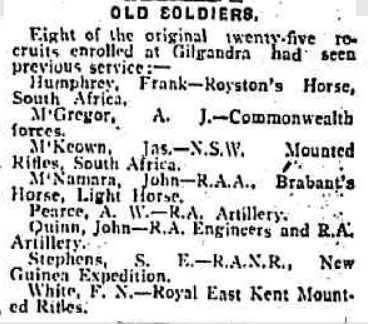
The following article, transcribed from The Farmer and Settler (15 October 1915, p. 3) lists the previous military service of the original 25 Gilgandra recruits:

‘OLD SOLDIERS.
Eight of the original twenty-five recruits enrolled at Gilgandra had seen previous service:–
Humphrey, Frank—Royston’s Horse, South Africa.
McGregor, A. J.—Commonwealth forces.
McKeown, Jas.—N.S.W. Mounted Rifles, South Africa.
McNamara, John—R.A.A. Brabant’s Horse, Light Horse.
Pearce, A. W.—R.A. Artillery.
Quinn, John—R.A. Engineers and R.A. Artillery.
Stephens, S. E.—R.A.N.R., New Guinea Expedition.
White, F.N.—Royal East Kent Mounted Rifles.’

Gilgandra recruits with previous military service (Farmer & Settler 15/10/1915)

Old soldiers (Farmer & Settler, 15/10/1915)

Click here to view the article on Trove: http://nla.gov.au/nla.news-article116673888