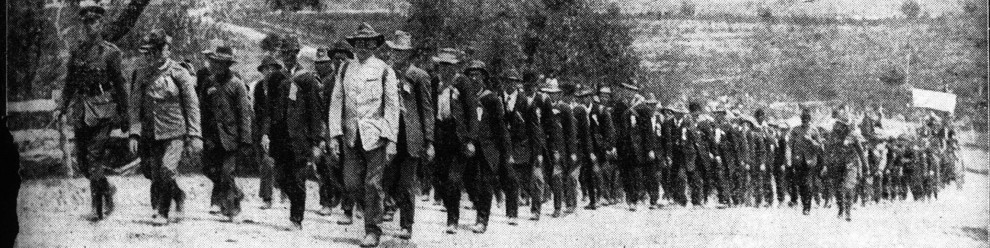
Moving pictures were taken of the 1915 Coo-ee March, and shown in many NSW picture theatres soon after the march finished.
The Dubbo Liberal and Macquarie Advocate (29 October 1915, p. 4) reported the following about the moving pictures taken of the march:
‘Poets may sing, their songs may survive through generations; their burning words may cause posterity to thrill with pride; statesmen may find fame, and Australian soldiers win their wreaths of glory. But Bill Hitchen, his name and his memory, will survive unto the end of time, and 500 years hence, let us hope, the moving pictures will show the people of that futurity Bill Hitchen and his “Coo-ees” on their magnetic march to the front. We hope the idea will not be forgotten.’[1]
Mr. H. T. Blacket from Dubbo (who accompanied the Coo-ees in his motor car) wrote about the film taken in a letter to his wife written on 31st October 1915 while the Coo-ees were in Wallerawang, which was published in The Dubbo Liberal and Macquarie Advocate (2 November 1915, p. 3):
“… The march to Bathurst was most imposing, and a moving picture was taken. If it is on at Dubbo you should see it. Ask the picture men to let you know if any of the “Coo-ee” pictures are to be shown.”[2]
The contents of the film was described in the Orange newspaper The Leader (24 November 1915, p. 2) as follows:
‘THE COO-EES AT THE MONARCHS
To-morrow night all Orange should pack the Monarchs’ Picture palace to view the screening of Hitchen’s Gilgandra Coo-ees’ entry into Orange. There will be 1100 feet of film shown depicting the crowd lining the route of march down Byng Street, the reception at the Town Hall, and incidents connected with the contingent. It is safe to say that every person who came into the scope of the camera will wish to see how he or she looks on the screen, and there fore we predict a big house. There will also be shown the entry into Wellington, Lithgow, Katoomba, etc till the final grand entry into Martin Place, Sydney. A chance is offered to the public of Orange to visit the Monarchs to-morrow night to pick out their friends and themselves. We understand that the pictures are exceedingly clear, and a triumph in local motion photography.’[3]
Another advertisement in The Leader (12 November 1915, p. 7) lists the film appearing at Monarch Pictures as ‘Australian Gazette … Gilgandra Coo-ees’, with the description ‘Showing from Wellington to their arrival in Sydney. See the Coo-ees and yourself while they were in Orange’.[4]
An advertisement in the Sunday Times (14 November, 1915, p. 16) describes footage of the Coo-ees marching through Enmore and Newton in Sydney:
‘ENMORE THEATRE
… WE WILL SCREEN ALL NEXT WEEK,
A MOVING PICTURE
OF THE
“GILGANDRA COO-EES” WELCOME
That took place at Enmore Theatre, on Friday, Showing
MARCH THROUGH ENMORE AND NEWTON,
And the Crowds outside the
ENMORE THEATRE.
See Yourself in this Great Australian Event.’[5]
I found a reference to a film titled ‘Australian Gazette, c1915. WW1 Recruitment Drive’ on the National Film and Sound Archive catalogue, and purchased a copy of the film a few months ago. The film is of the Coo-ee March, but is so badly deteriorated that of the approximately 6.5 minutes of film, only about 20-30 seconds remains visible, and this was of very poor quality. The film’s title cards ‘Arrival at Wellington’, ‘The reception at Orange’, ‘Calling for recruits at the Town Hall’ , ‘Crossing the Blue Mountains near Lawson’, ‘The arrival at Sydney on Friday 12th November’, and ‘A cheer from the wounded soldiers’ are still visible on the deteriorated film. From the content of this film, it appears it may be the same film as the Australian Gazette ‘Gilgandra Coo-ees’ film that was widely screened soon after the Coo-ee March finished in late 1915.
Unfortunately it appears that the film taken of the Coo-ee March, which apparently was made into numerous copies, and shown in many picture theatres, has not survived even 100 years.
I do not know if the NFSA has the only copy of this film that survives to the current day, but it is a great shame that of all the copies that were circulated and shown in late 1915, not a single one appears to have survived in a viewable format.
If anyone knows of any surviving film footage of the 1915 Coo-ee March please contact me.
[1] ‘Our Soldiers, The Dubbo Liberal and Macquarie Advocate, 29 October 1915, p. 4, http://nla.gov.au/nla.news-article77601711
[2] ‘The “Coo-ees” : a day by day account’, The Dubbo Liberal and Macquarie Advocate, 2 November 1915, p. 3, http://nla.gov.au/nla.news-article77601738
[3] ‘The Coo-ees at the Monarchs’, Leader, 24 November 1915, p. 2, http://nla.gov.au/nla.news-article117844056
[4] ‘Advertising … Monarch Pictures, to-morrow night’, The Leader, 12 November 1915, p. 7, http://nla.gov.au/nla.news-article117843475
[5] Advertising… Enmore Theatre’, Sunday Times, 14 November 1915, p. 16, http://nla.gov.au/nla.news-article120806468


 1915 Coo-ee March