Category Archives: Recruits

Albert BROWN

Albert BROWN

Per his military service record (regimental no. 4734), Albert Brown was born at Bellabay, Ireland.[1]  He gave his age as 18 years and 2 months, his marital status as single, and his occupation as baker.  His description on his Certificate of Medical Examination was height 5 feet 6 inches tall, weight 8 stone 10 lbs., with a fair complexion, grey eyes, and dark hair.  His religious denomination was recorded as Presbyterian. He claimed that he had 3 years and 4 months previous military service  undertaking compulsory training [cadets].

A letter dated 11th November 1915 from his father T. Brown in his service record gave consent for him to enlist.

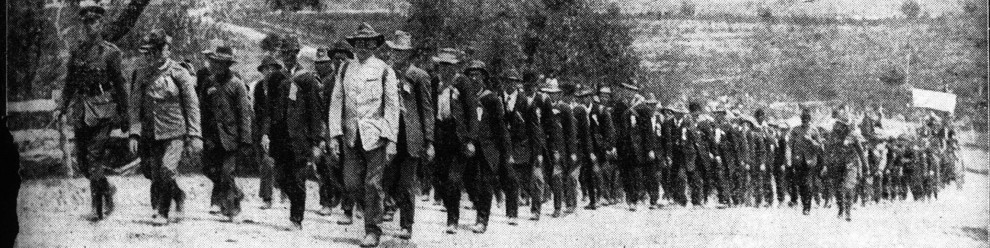
He completed his medical examination on 11th November 1915 at Parramatta, and was attested by Lieutenant R. Howe at Parramatta on 11th November 1915 (the day the Coo-ees marched from Parramatta to Ashfield).

After completing the Coo-ee March he went to Liverpool Camp as reinforcement for the 13th Battalion.

On his embarkation roll his address at time of enrolment was Miller Road, Old Guildford N.S.W., and his next of kin is listed as his father, T. Brown, at the same address.[2]

He was one of the soldiers given a farewell at the Elite Hall in Guildford on Thursday 9th December 1915 by the Guildford Patriotic Committee (along with fellow Coo-ee Allan Colquhoun), where they were each presented with a sheepskin vest and money belt.[3]

Troopship HMAT A15 Star of England. Australian War Memorial Collection AWM H17014.

On 8th March 1916, Private Brown, along with many of the other Coo-ees, departed Sydney on the HMAT A15 Star of England, with the 15th reinforcements for the 13th Battalion.  He arrived in Egypt on the 11th April 1916.

On 16th April 1916 Private Brown was transferred to the 5th Division Cyclist Company at Tel-el-Kebir in Egypt (along with fellow Coo-ees Private Richardson, Private Megarrity, Private Lloyd and Private Spicer).

On 17th June 1916 Private Brown left Alexandria aboard a transport bound for France.  He arrived at Marseilles on 25th June 1916.

On 21st April 1917 Private Brown was seconded to the 2nd Cooking School in France.

He re-joined 2nd ANZAC Corps Cyclist Battalion on 5th May 1917. (The 5th Division Cyclist Company had been moved into the Battalion upon its formation in July 1916).

On 22nd July 1917 Private Brown went on leave. He re-joined to the 2nd ANZAC Cyclist Battalion on 6th August 1917.

On 3rd December 1917 Private Brown was detached to the 2nd ANZAC Anti-Aircraft unit. He re-joined the 2nd ANZAC Cyclist Battalion on 9th December 1917.

On 16th January 1918 Private Brown was taken on strength of the Australian Corps Cyclist Battalion.

On 5th June 1918 Private Brown was detached to the Corps Prisoner of War Compound.

On 29th August 1918 he was granted leave to England.

Private Brown re-joined the Australian Corps Cyclist Battalion in France on 15th September 1918.

A Certified Extract of a Marriage Certificate in his service record states that 21 year of Albert Brown, soldier, married 18 year old Regina Anne Joseph Mahien on 23rd April 1919 at Andeslues, Belgium.

On 6th May 1919 Private Brown departed France bound for England, to begin his return to Australia. Private Brown arrived at Southampton on 7th June 1919, and marched into the No. 2 Group the same day.

On 12th July 1919 Private Brown departed England aboard the H.T. Indarra bound for Australia.

He arrived in Sydney on 9th September 1919.

He was discharged medically unfit on 27th December 1919 ‘Disability Not Stated’.

Note: After returning to N.S.W. after the First World War, Albert Brown returned to Belgium to live with his Belgian wife.[4] He became a Prisoner of War in the Second World War, after Germany invaded Poland. He returned to Belgium after the end of that war.


[1] NAA B2455, BROWN A

[2] Australia War Memorial. First World War Embarkation Rolls, Albert Brown, HMAT Star of England A15, 8th March 1916.

[3] FAREWELLING. (1915, December 11). The Cumberland Argus and Fruitgrowers Advocate (Parramatta, NSW : 1888 – 1950), p. 5. Retrieved March 26, 2018, from http://nla.gov.au/nla.news-article86106306

[4] OBITUARY (1941, June 26). The Biz (Fairfield, NSW : 1928 – 1972), p. 2. Retrieved March 26, 2018, from http://nla.gov.au/nla.news-article76309000


Norman Hamond FRANCISCO

Norman Hamond FRANCISCO

Per his military service record (regimental no. 4775),  Norman Hamond Francisco was born at Cobar, N.S.W.[1]  He gave his age as 24 years and 9 months, his marital status as single, and his occupation as baker.  His description on his Certificate of Medical Examination was height 5 feet 1 ½ inches tall, weight 162 lbs., with a fair complexion, grey eyes, and light brown hair.  His religious denomination was Roman Catholic. He claimed to have had no previous military service.

A send-off was held on Thursday 28th October 1915 at the Court House Hotel in Cobar for Norman Francisco, brothers Walter and Robert Mitchell, and Andrew Lennox, and they were then cheered by many friends when they left Cobar by train on Saturday 30th October 1915 to join the A.I.F.[2]

All four of them completed their medical examinations, and were attested, at Dubbo on Monday 2nd November 1915, (the day the Coo-ees were at Lithgow).

Norman Francisco then traveled by train with these three other Cobar men to catch up with the Coo-ees.  They were waiting to join the Coo-ee March when the Coo-ees arrived at Mt. Victoria three days later, on Thursday 4th November 1915.[3]

After completing the Coo-ee March Private Francisco went to Liverpool Camp as reinforcement for the 13th Battalion.

On 20th December 1915 Private Francisco was charged with being absent without leave from the Liverpool Camp from 3rd to 19th December 1915. He was fined 17 days pay.

Private Francisco and fellow Coo-ee Private Lennox while home on leave were given a farewell at the Star Hotel in Cobar on Saturday, 1st January 1916.[4]

On 4th February 1916 Private Francisco was charged with being absent without leave from the Liverpool Camp on 1st February 1916. He was fined 1 days pay.

On 16th February 1916 he was charged with being absent from night piquet. He was fined 2 days pay.

On his embarkation roll his address at time of enrolment was Becker Street, Cobar, N.S.W., and his next of kin was listed as his father, A. [Alfred] Francisco, at the same address.[5]

On 8th March 1916 Private Francisco, along with many of the other Coo-ees, departed Sydney on the HMAT A15 Star of England, with the 15th reinforcements for the 13th Battalion.

Troopship HMAT A15 Star of England. Australian War Memorial Collection AWM H17014.

He arrived in Egypt on 11th April 1916.

On the 16th of April 1916 he transferred to the 4th Pioneer Battalion at Tel El Kebir, Egypt.

On the 4th of June 1916 Private Francisco left Alexandria aboard the Transport Scotian bound for France.  He arrived  at Marseilles on 11th June 1916.

On 31st October 1916 Private Francisco was charged with being absent without leave from 0830 on 29th October 1916 till 0900 on 29th October 1916. He was fined 4 days pay.

On 5th November 1916 Private Francisco was injured playing in a football match. He was sent to the 4th Australian Field Ambulance. On 7th November 1916 he was admitted to the 1st New Zealand Stationary Hospital at Amiens, France, with a sprained ankle. On 9th November 1916 he was placed aboard the 9th Ambulance Train and sent to the 11th Stationary Hospital at Rouen, France, where he was admitted on 10th November 1916 with a fracture to the 5th metarasal bone in his right foot.

On 12th November 1916 Private Francisco was placed aboard the Hospital Ship Formosa bound for England. He was admitted to the 1st Southern General Hospital at Birmingham, England, on 13th November 1916, with a fractured toe.

Private Francisco was discharged from hospital on 19th February 1917, and granted leave to report to the No. 1 Command Depot at Perham Downs, England on 6th March 1917.

On 24th March 1917 Private Francisco was charged with being absent without leave from 3.30 pm on 6th March 1917 till 8.45 am on 23rd March 1917. He was awarded 10 days Field Punishment No. 2 and fined 28 days pay.

On 21st June 1917 Private Francisco was charged with neglecting to obey routine orders by being in Tidworth after hours on 19th June 1917 without a pass, using obscene language, and drunkenness. He was awarded 14 days detention.

On 21st August 1917 Private Francisco marched into the Overseas Training Brigade.

On 23rd September 1917 he was appointed Acting Lance Corporal at Fovant, England, while attending school.

On 20th October 1917 Private Francisco was sent to the Sutton Veny Military Hospital sick with Influenza.  He revered to the rank of Private on being admitted to hospital.  He was discharged on 30th October 1917.

On 22nd February 1918 Private Francisco was charged with being absent without leave from midnight on 19th February 1918 till apprehended by the Military Police at 1815 on 20th February 1918. He was awarded 1 days Field Punishment No. 2 and fined 3 days pay.

On 7th April 1918 Private Francisco departed Southampton, England, bound for France.  He marched into the Australian Infantry Base Depot at Le Havre on 8th April 1918.

On 19th April 1918 he rejoined the 4th Pioneer Battalion in France.

On 22nd May 1918 the 4th Pioneer Battalion was resting  in billets around the village of Bussy, France, when it was bombed by enemy aircraft.[6]  One man was killed and 6 were wounded. Private Francisco was one of those wounded, receiving a bomb wound to his right leg. He was sent to the 4th Australian Field Ambulance. On 23rd May 1918 he was moved back to the 5th Casualty Clearing Station. On 27th May 1918 he was placed aboard the 10th Ambulance Train, being admitted to the 47th General Hospital later that day. He was discharged on 5th June 1918, and sent to the Australian General Base Depot at Le Harve, France.

He rejoined the 4th Pioneer Battalion on the 19th of June 1918.

On 13th March 1919 Private Francisco departed France bound for England to commence his return to Australia. He arrived at Weymouth, England, on 14th March 1919 and marched into the No. 4 Command Depot at Hurdcott, England.

On 1st May 1919 Private Francisco commenced his return to Australia aboard the Transport China.

He arrived in Australia on 11th June 1919.

Private Francisco was discharged Termination of Period of Enlistment on 26th July 1919.


[1] NAA: B2455, FRANCISCO N H

[2] ‘Summary’, Western Age, 30 October 1915, p. 2. Retrieved August 5, 2017, from http://nla.gov.au/nla.news-article136723099

[3] ‘Summary’, Western Age, 6 November 1915, p. 2. Retrieved April 4, 2017, from http://nla.gov.au/nla.news-article136724708

[4] Valedictory. (1916, January 4). Western Age (Dubbo, NSW : 1914 – 1932), p. 2. Retrieved February 18, 2018, from http://nla.gov.au/nla.news-article136725949

[5] Australia War Memorial. First World War Embarkation Rolls, Norman Hammond [sic] Francisco, HMAT Star of England A15, 8th March 1916.

[6] Australian Imperial Force unit war diaries, 1914-18 War – AWM4 Subclass 14/16 – 4th Australian Pioneer Battalion, May 1918.

William JENKINS

William JENKINS

Per his military service record (Depot), William Jenkins was born at Bendigo, Victoria. [1]   He gave his age as 25 years and 7 months, his marital status as single, and his occupation as labourer. His description on his Certificate of Medical Examination was height 5 feet 3 inches tall, weight 119 lbs.,  with a dark complexion, grey eyes, and dark hair. His religious denomination was Church of England. He claimed that he had no previous military service.

His next of kin was listed on his Attestation Paper as his mother, Mrs H. Jenkins, Bendigo, Victoria.

‘Jenkins, W.’ was listed in the Wellington Times as one of the men who joined the Coo-ees at Wellington.[2]

He completed his medical examination on 16th October 1915 at Wellington, and was attested by Captain T. A. Nicholas when the Coo-ees were at Mumbil on 19th October 1915.

After completing the Coo-ee March he went to Liverpool Camp as reinforcement for the 13th Battalion.

On 17th November 1915 Private Jenkins went before a medical board at Liverpool Camp, where he was diagnosed to have ‘insufficient chest measurement’, and unfit for active service.

On 21st November 1915 Private Jenkins was charged with being absent without leave. He was fined 1 days pay.

Private Jenkins was discharged  from the A.I.F. medically unfit on 29th November 1915.

William Jenkins re-enlisted in the A.I.F. at Wagga Wagga N.S.W. on 28th October 1918, where he was attested, and completed a medical examination.  He stated he had two weeks previous military experience at Liverpool Camp Sydney on this new Attestation Paper.[3]

However, when he went before a medical board held at Victoria Barracks in Sydney the next day on 29th October 1918, he was again found unfit for active service, and discharged due to ‘deficient chest expansion’.


[1] NAA: B2455, JENKINS WILLIAM

[2] HITCHEN’S COO-EES. (1915, October 18). Wellington Times (NSW : 1899 – 1954), p. 3. Retrieved March 11, 2018, from http://nla.gov.au/nla.news-article143388424

[3] NAA: B2455, JENKINS WILLIAM

William GRAHAM

William GRAHAM

Per his military service record (Depot), Graham William was born at Dumfries, Scotland.[1]  He gave his age as 30 years, his marital status as single, and his occupation as miner (coal). His description on his Certificate of Medical Examination was height 5 feet 7 ¾ inches tall, [weight not recorded], with a sallow dark complexion, brown eyes, and brown hair. His religious denomination was Church of England. He claimed that he had 5 years previous military service with the Royal Garrison Artillery.

He listed his next of kin as ‘None’ on his Attestation Paper.

His postal address on his initial Application to Enlist in the Australian Imperial Force form was Grey Street, Lithgow.

He completed his medical examination on the 5th November 1915 at Katoomba, and was attested at Katoomba by Lieutenant F. Middenway on the same day.

‘W. Graham’ was named in The Blue Mountain Echo as one of the recruits who joined the Coo-ees at Katoomba.[2]

After completing the Coo-ee March he went to Liverpool Camp as reinforcement for the 13th Battalion.

On 17th November 1915 Private Graham went before a medical board at Liverpool Camp, where he was diagnosed to be suffering from Nystagmus, and unfit for active service.

Private Graham was discharged medically unfit on 29th November 1915.


[1] NAA: B2455, GRAHAM W

[2] ‘March o’er the Mountains’, The Blue Mountain Echo, 12 November 1915, pp. 2-3, http://nla.gov.au/nla.news-article108042142


James GORDON

James GORDON

Per his military service record (Depot), James Gordon was born at Parramatta, N.S.W.[1]  He gave his age as 23 years and 5 months, his marital status as single, and his occupation as labourer.  His description on his Certificate of medical examination was height 5 feet 8 inches tall, weight 140 lbs, with a fair complexion, blue eyes, and brown hair.  His religious denomination was Church of England.  He claimed that he had no previous military experience.

His next of kin on his Attestation paper was listed his father, Stephen Gordon, Lennox Street, Parramatta, Sydney.

He completed his medical examination, and was attested by Lieutenant R. Howe, at Parramatta on 11th November 1915 (the day the Coo-ees marched from Parramatta to Ashfield).

After completing the Coo-ee March he went to Liverpool Camp as reinforcement for the 13th Battalion.

On 12th December 1915 Private Gordon went absent without leave till he was apprehended on 31st January 1916. As a result he was charged for being absent without leave amounting to desertion.

He was discharged for being a deserter on 20th July 1916.

[1] NAA: B2455, GORDON J

Michael GLEESON

Michael GLEESON

Per his military service record (Depot), Michael Gleeson was born at South Melbourne, Victoria.[1] He gave his age as 42 years and 4 months, his marital status as single, and his occupation as labourer. His description on his Certificate of Medical Examination was height 5 feet 7 inches tall, weight 151 lbs., with a medium complexion, blue eyes, and brown hair. His religious denomination was Roman Catholic. He claimed that he had no previous military service.

His next of kin on his Attestation paper was listed as his sister, Mrs Julia Kreiger, 38 Mountain Street, South Melbourne.

Michael Gleeson was named in an article titled ‘Blayney recruits’ in The Leader as one of six men who have joined ‘as a result of the visit of the Coo-ees to Blayney’.[2]

He completed his medical examination at Blayney on 26th October 1915, and was attested by Captain A. C. Eade that same day at Blayney. The Coo-ees had held a recruiting meeting, and stayed overnight at Blayney on 26th October 1915.

After completing the Coo-ee March he went to Liverpool Camp as reinforcement for the 13th Battalion.

On 2nd December 1915 Private Gleeson was charged for being absent from parade without leave.

On 3rd December 1915 he was charged with being under the influence of liquor in company lines.

He then went absent without leave until 9 a.m. on 13th December 1915. He was recommended to be discharged.

On 14th December 1915 he was discharged from the A.I.F. not likely to become an efficient soldier.

[1] NAA: B2455, GLEESON M

[2] BLAYNEY RECRUITS (1915, October 29). Leader (Orange, NSW : 1912 – 1922), p. 8. Retrieved April 1, 2016, from http://nla.gov.au/nla.news-article117842821

Arthur GILCHRIST

Arthur GILCHRIST

Per his initial military service record (Depot), Arthur Gilchrist was born at Millthorpe, N.S.W.[1]  He gave his age as 38 years and 2 months, his marital status as single, and his occupation as labourer. His description on his Certificate of medical examination was height 5 feet 9 1/8 inches tall, weight 9 stone, with a fair complexion, blue eyes, and brown hair.  His religious denomination was Roman Catholic.  He claimed that he had no previous military service, and had been rejected in the past at Gilgandra and Orange for his eyesight and chest measurement.

His next of kin on his Attestation paper was listed as his mother, Mrs Mary Gilchrist, McLachlan Street, Orange N.S.W.  His older Brother Robert Gilchrist had joined the Coo-ees at Euchareena on 20th October 1915.

Arthur Gilchrist was listed in The Leader as one of the men who were recruited at Orange to join the Coo-ees.[2]

He completed his medical examination at Orange on 24th October 1915, and was attested by Captain Nicholas at Orange the same day (the day the Coo-ees rested at Orange).

After completing the Coo-ee March he went to Liverpool Camp as reinforcement for the 13th Battalion.

On 17th of November 1915 Private Gilchrist went before a medical board at Liverpool Camp where he was found to have rheumatism. He was recommended to be discharged.

On 29th November 1915 he was discharged from the A.I.F.  medically unfit.

A separate military service record (regimental no. N18113) shows that on 1st April 1916 he re-enlisted in the A.I.F. under the name Arthur Joseph Gilchrist at Gulargambone, N.S.W.[3]

He was sent to the Dubbo Military Camp on 3rd April 1916.

On 3rd May 1916 he was sent to the 54th Depot Battalion at Bathurst Camp.

On 23rd May 1916 Private Gilchrist went before a medical board at Bathurst where he was found to have chronic rheumatism. He was recommended to be discharged.

On 6th June 1916 Private Gilchrist was discharged from the A.I.F. for the second time medically unfit.

It appears that he attempted to re-enlist in the A.I.F. on yet another occasion. According to an article in The Leader, Arthur J. Gilchrist was recorded as one of 22 men rejected as unfit who had tried to enlist in the A.I.F. at the Orange Drill Hall in early 1917.[4]

[1] NAA: B2455, GILCHRIST A

[2] THE RECRUITS. (1915, October 25). Leader (Orange, NSW : 1912 – 1922), p. 4. Retrieved November 26, 2016, from http://nla.gov.au/nla.news-article117842599

[3] NAA: B2455, GILCHRIST A J

[4] RECRUITING. (1917, March 26). Leader (Orange, NSW : 1912 – 1922), p. 6. Retrieved February 25, 2018, from http://nla.gov.au/nla.news-article117824292


Denis Justin DWYER

Denis Justin DWYER

Per his military service record (Depot), Denis Justin Dwyer [spelt also as Dennis Justin Dwyer] was born in Grenfell, N.S.W.[1]  He gave his age as 22 years and 6 months, his marital status as single, and his occupation as labourer.  His description on his Certificate of Medical Examination was height 5 feet 7 inches tall, weight 10 stone, with a fair complexion, grey eyes, and brown hair.  His religious denomination was Roman Catholic.  He claimed he had no previous military service.

He completed his medical examination at Molong on 22nd October 1915, and was attested by Captain T. A. Nicholas at ‘Molong (8 miles east)’, along with several other Coo-ees, on 22nd October 1915.

His next of kin was recorded on his Australian Imperial Force Attestation Paper of Persons Enlisted for Service Abroad form as his mother, Mrs R. Dwyer, 1 Yule Street, Dulwich Hill, Sydney N.S.W.

After completing the Coo-ee March he went to Liverpool Camp as reinforcement for the 13th Battalion.

On 5th December 1915 Private Dwyer was charged with being absent without leave from 2nd December to 14th December 1915.  He was recommended to be discharged.

His Statement of Service records that on 16th December 1915 Private Dwyer was discharged from the A.I.F. unlikely to become an efficient soldier.

[1] NAA: B2455, DWYER D J


Joseph Thomas BRUCE

Joseph Thomas BRUCE

Per his military service record (Depot), Joseph Thomas Bruce was born at Corowa, N.S.W.[1] He gave his age as 23 years and 2 months, his marital status as single, and his occupation as shearer. His description on his Certificate of Medical Examination was 5 feet 8 inches tall, weight 158 lbs., with a fair complexion, brown eyes, and brown hair. His religious denomination was Church of England. He claimed that he had no previous military service.

He completed his medical examination at Wellington on 22nd October 1915.  He then caught up with the Coo-ees, and was attested by Captain T. A. Nicholas at Orange on 24th October 1915.

His next of kin was recorded on his Australian Imperial Force Attestation Paper of Persons Enlisted for Service Abroad form as his mother, Mrs E. Bruce, Harris Street, Sydney.

On 6th November 1915 at Katoomba (the day the Coo-ees marched from Katoomba to Lawson), Private Bruce was charged by Captain A. C. Eade with drunkenness and using offensive language. Captain Hitchen was the witness to the offences. Private Bruce was fined 70 shillings.

After completing the Coo-ee March he went into Liverpool Camp as reinforcement for the 13th Battalion.

On 3rd December 1915 Private Bruce was charged with being absent without leave and drunkenness, and was discharged from the A.I.F. not likely to become an efficient soldier.

[1] NAA: B2455, BRUCE J T

Frederick Graham HARVEY

Frederick Graham HARVEY (MM)

Per his military service record (regimental no. 4792), Frederick Graham Harvey was born at Wagga Wagga, N.S.W.[1]  He gave his age as 19 years and 5 months, his marital status as single, and his occupation as farmer.  His description on his Certificate of Medical Examination was 5 feet 9 inches tall, weight 10 stone, with a fair complexion, grey eyes, and fair hair.  His religious denomination was Presbyterian.   He claimed that he had no previous military service.

The National Advocate reported on 22nd October 1915 that  ‘Fred Graham Harvey’ of the ‘Cosmopolitan Hotel, Bathurst’, was one of the 16 ‘Bathurst Burrs’  recruited by the Bathurst Recruiting Association  who had ‘been enlisted and passed by the medical officer ‘ to join the Coo-ees when they reached Bathurst.[2]

The National Advocate reported that ‘a dozen men actually left Bathurst with the Coo-ees, and that ’the remainder of the Bathurst unit will follow on and catch up with the Coo-ees probably at Wallerawang and Lithgow’.[3]

His ‘Date of Joining’ per his embarkation roll was 22nd October 1915.[4]  Per a Statutory Declaration in his service record, Frederick Graham Harvey stated he was attested at Bathurst. A letter from his mother dated 23rd October 1915 from West Maitland, giving permission for him to enlist, is in his file.

However, there appears to be an anomaly with his enlistment papers, as his initial enlistment paperwork from Bathurst appears to be missing from his file.  The ‘Oath to the Taken by Person Being Enlisted’ section of his Attestation Paper has the initial details of ‘taken and subscribed at Bathurst’  on ‘28th October 1915’ crossed out (the day the Coo-ees arrived in Bathurst), and changed to 13th November 1915 at Liverpool.  He was attested at Liverpool my Lieutenant E. Shaw on 13th November 1915 (the day after the Coo-ee March finished in Sydney), and he completed a medical examination at Liverpool on the same day.

So it appears he presented to enlist with the Coo-ees in Bathurst, but it is unclear if he marched out of Bathurst with the Coo-ees, or caught up with them along the way.

After the Coo-ee March he went into Liverpool Camp with the Coo-ees as reinforcement for the 13th Battalion.

An entry in his service record dated 22nd November 1915 at Liverpool stated that he had been absent from guard duty [date not recorded], and he was warned.

On his embarkation roll his address at time of enrolment was 58 Keppel Street, Bathurst, N.S.W. His next of kin is listed as his mother, Mrs S. Harvey, 23 Wolfe Street, West Maitland, N.S.W.[5]

On 8th March 1916 Private Harvey, along with many of the other Coo-ees, departed Sydney on the HMAT A15 Star of England with the 15th reinforcements for the 13th Battalion, and arrived in Egypt on  11th April 1916.

On 16th April 1916 Private Harvey was transferred to the 4th Pioneer Battalion.

On 4th June 1916 Private Harvey left Alexandria aboard the Transport Scotian, bound for France. He arrived at Marseilles on 11th June 1916.

On 16th April 1916 Private Harvey was transferred to the 4th Pioneer Battalion at Tel-el-Kebir.

On 2nd December 1916 the 4th Pioneer Battalion was constructing tramways near Longueval, France when Private Harvey suffered a sprained back.[6] He was sent to the 15th Australian Field Ambulance. On 3rd December 1916 he was sent to a Rest Station. On 13th December 1916 he re-joined the 4th Pioneer Battalion, when it was still constructing tramways near Longueval, France.

He went to hospital sick on 14th March 1917.  He re-joined the 4th Pioneer Battalion from hospital the next day.

On 14th October 1917 Private Harvey was awarded the Military Medal for action he performed on 26th September 1917 when the 4th Pioneer Battalion was engaged on the Ypres Sector in the vicinity of Westhoek, Belgium.

The citation reads:

For gallant conduct and devotion to duty in the YPRES Sector. This man assisted his Officer in carrying out a very daring daylight reconnaissance immediately following the attack on 26th September. Under very heavy hostile shell fire a location for an important Communication Trench and taped and laid out. After this was completed he returned to a rendezvous to guide the Company up to dig the Trench. He went forward reconnoitering for the safest routes possible and by his initiative, enabled the digging party to reach, and successfully completed the job. By his coolness and courage he set a fine example to all.[7]

Notification of Private Harvey’s  award was gazetted in Third Supplement No. 30431 to The London Gazette, 14th December 1917 (page 13198), and was also published in the Commonwealth of Australia Gazette, 2nd May 1918 (page 1036).[8]

On 24th December 1917 Private Harvey was sent to the 4th Australian Field Ambulance suffering Pyrexia.

He was discharged and returned to the 4th Pioneer Battalion on 2nd January 1918, when it was digging trenches near Guyencourt, France.[9]

On 21st March 1918 Private Harvey was promoted to Lance Corporal.

On 6th May 1918 Lance Corporal Harvey was sent to the 12th Australian Field Ambulance suffering from Bronchitis. He was moved to the 61st Casualty Clearing Station later that day.  On 7th May 1918 he was placed aboard the 27th Ambulance Train. On 8th May 1918 he was admitted to the 6th General Hospital at Rouen, France.

On 12th May 1918 Lance Corporal Harvey was placed aboard the Hospital Ship Grantully Castle for evacuation to England. On 13th May 1918 he was admitted to the Winchester General Military Hospital.

On 8th June 1918 he was transferred to the 1st Australian Auxiliary Hospital at Harefield, England.

On1st July 1918 he was discharged and granted leave to report to the No. 1 Command Depot at Sutton Veny, England.

On 5th September 1918 Lance Corporal Harvey marched into the Overseas Training Brigade at Longbridge Deverill, England.

On 20th September 1918 Lance Corporal Harvey was transferred to the 1st Training Brigade.

On 13th January 1919 Lance Corporal Harvey marched into a concentration camp at Codford, England, awaiting his return to Australia.

On 21st March 1919 Lance Corporal Harvey left England on the H.M.T. Kildonian Castle, bound for Australia.

He arrived in Australia on 9th May 1919.

He was discharged Termination of Period of Enlistment on 23rd June 1919.


[1] NAA B2455, HARVEY F G

[2] Bathurst Route Marchers. (1915, October 22). National Advocate (Bathurst, NSW : 1889 – 1954), p. 3. Retrieved December 3, 2017, from http://nla.gov.au/nla.news-article158147800

[3] To the Sea (1915, October 30). National Advocate (Bathurst, NSW : 1889 – 1954), p. 3. Retrieved January 27, 2018, from http://nla.gov.au/nla.news-article158152730

[4] Australian War Memorial. First World War Embarkation Roll, Frederick Graham Harvey,  4792. HMAT Star of England A15, 8 March 1916.

[5] Australian War Memorial. First World War Embarkation Roll, Frederick Graham Harvey,  4792. HMAT Star of England A15, 8 March 1916.

[6] Australian Imperial Force unit war diaries, 1914-18 War – AWM4 Subclass 14/16 – 4th Australian Pioneer Battalion, December 1916.

[7] Australian War Memorial. Honours and Awards (Recommendation), Francis [sic] Graham Harvey, Private, 4792, 4th Australian Pioneer Battalion, https://www.awm.gov.au/collection/R1586601

[8] Government Gazette Proclamations and Legislation (1918, May 2). Commonwealth of Australia Gazette (National : 1901 – 1973), p. 1036. Retrieved January 29, 2018, from http://nla.gov.au/nla.news-article232464380

[9] Australian Imperial Force unit war diaries, 1914-18 War – AWM4 Subclass 14/16 – 4th Australian Pioneer Battalion, January 1918.