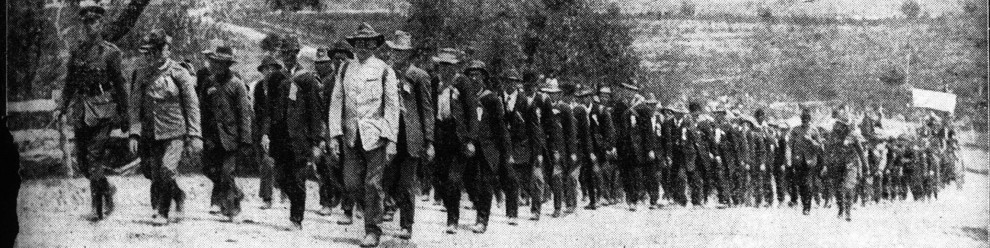
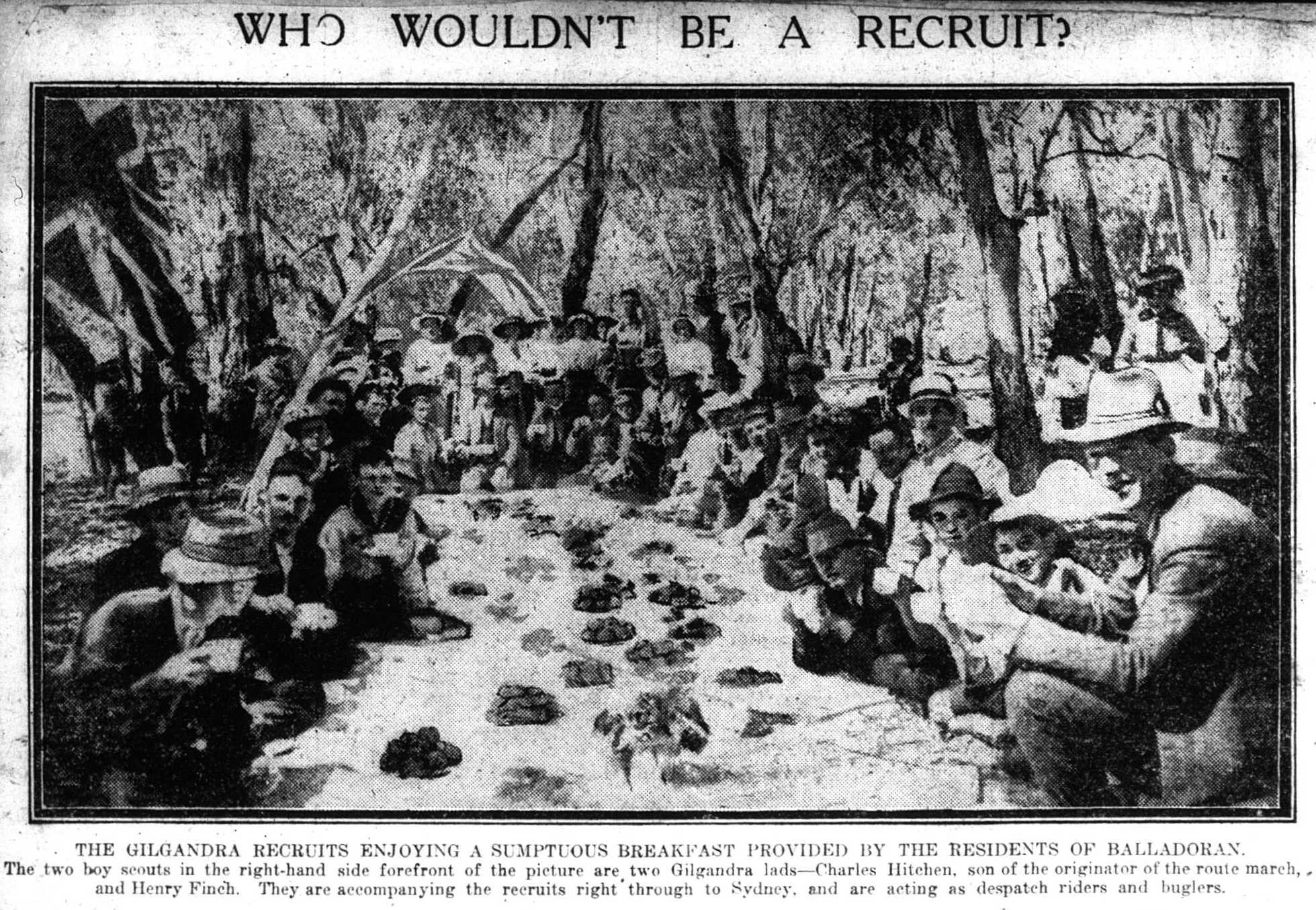
Day 2, Monday, 11 October, 1915, Balladoran to Eumungerie

Breakfast at Balladoran (Daily Telegraph 14/10/1915)

Breakfast at Balladoran (Daily Telegraph 14/10/1915)

Transcription of extract from an article titled ‘Coo-ees Column’ in The Farmer and Settler, 15 October, 1915, p. 3, [part 1 of 3 parts]:

‘COO-EE’S’ COLUMN’
The March from Gilgandra, A GREAT CHARGE AGAINST THE TURKEYS.

The ‘Coo-ees’ moved out of Balladoran at half-past ten on Monday morning on the second day’s march, the Union Jack and the Australian flag leading and a company of school children acting as a guard of honor.

At the town boundary a halt was made, and a short address was delivered by Mr. Berriman on behalf of the townspeople.  He spoke of the great deeds performed by the Australians at the Dardanelles, and expressed a confident belief that in years to come hearts would glow and pulses thrill at the story of the achievements of ‘Hitchen’s Coo-ees.’

Captain Nicholas, O.C., and Q.M.S. Lee responded, expressing the ‘Coo-ees’ ” gratitude to the Balladoran residents for their liberal hospitality. The men gave three cheers for the towns-people, then the schoolmaster led the children in singing the National Anthem, and cheers for the soldiers were lustily given to finish.

The march was then resumed under unpleasant conditions. The weather was very warm, and the dust and flies were particularly objectionable. By easy stages Mr. Wheaton’s homestead, two miles from Eumungerie, was reached. The transport waggons and cook had preceded the party, so lunch was ready, prepared from the stores carried, and was thoroughly enjoyed, as the good people of Gilgandra and Balladoran had given liberally of the best.’

Arrival at Eumungerie.

After a good rest, some instruction in the elements of drill was given by the officer commanding, and a move was then made to Eumungerie, which was the location of the second night’s camp. This town was reached a little after five o’clock, and the boys were delighted to find   that arrangements had been made for them to have a shower bath. They appreciated the thoughtfulness that put the ablutions earlier on the programme than the speech-making; and they enjoyed the speeches all the more for having clean skins. The dinner provided by the ladies of Eumungerie was an excellent one, and the boys, fresh from their bath, did full justice to it. Mr. J. Wheaton, chairman of the Eumungerie Recruiting Association, Mr. McLennan, vice-chairman, and Mr. McKeown, secretary, voiced the townspeople’s welcome, and Q.M.S. Lee, the ‘Coo-ees” official speechmaker, responded on behalf of his comrades.

After dinner there was music and dancing, then when the crowd was at its biggest, Mr. Wheaton introduced Mr. McLachlan, the school inspector from Dubbo, and Mr. Blackett, who had driven from forty miles the other side of Dubbo, to meet the Gilgandra recruits. These gentlemen and Mr. Lee delivered rousing recruiting speeches, and two young men, S. Walker, of Balladoran, and H. Sharpe, of Eumungerie, announced their intention of being in the January contingent after harvest. When these men stepped up on the platform they were given a hearty cheer that must have strengthened their resolution to do their duty for King and country.

An appeal for the Sheepskin Vest Fund found ready givers, and one local lady, Mrs. H. Griffith, gave £1 to the ‘Coo-ees” marching fund.

Advantage was taken of the occasion by the townspeople to present one of the   ‘Coo-ees’ that joined from Eumungerie with a wristlet watch to show their appreciation of his manliness and sense of duty in thus enlisting to take up his share of the burden. [This was Leslie Greenleaf].

The evening concluded with more dancing and the singing of several songs, but the majority of the ‘Coo-ees’ were glad to ‘sneak’ away to their blankets.

During the stay at Eumungerie, Mr. J. Wheaton showed a fine spirit of patriotic generosity in giving the recruits carte-blanche at his store; attempts to thank him were good naturedly brushed aside. A noticeable feature of all the good treatment is that the people absolutely refuse to be thanked, and, indeed, declare that they cannot do enough for the boys from the Castlereagh that are going forth at the call of duty.’

Click here to view the article on Trovehttp://nla.gov.au/nla.news-article116673914
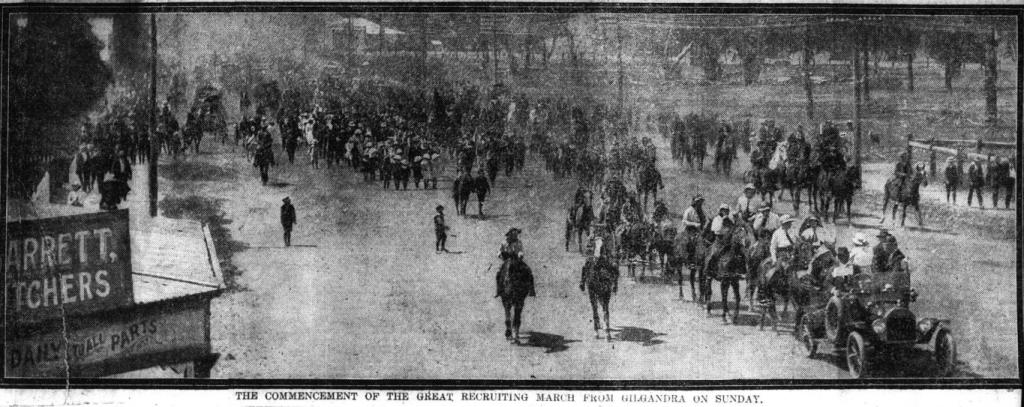
Day 1, Sunday, 10th October, 1915, Gilgandra to Balladoran

The start at Gilgandra (Daily Telegraph 12/10/1915)

The start at Gilgandra (Daily Telegraph 12/10/1915)

Transcribed from The Farmer and Settler, 12 October, 1915, p. 3.

‘THE ROUTE MARCH. Gilgandra to the Coast TRIUMPHANT SEND-OFF BY THE PEOPLE.

Gilgandra’s greatest of all events, the start of the route march, became a fact of history on Sunday last, when the contingent after a simple religious ceremony stepped out on its long march to the coast.

On Saturday, when the ‘Farmer and Settler’ special reporter, who will march to Sydney, arrived at Gilgandra, he found Captain Nicholas and Drs. Burkitt and Cooper, of Dubbo, on the ground. Captain Nicholas has been appointed to take charge of the contingent, and be will be their leader and instructor all the way through to Sydney.

On Saturday afternoon twenty-five recruits were sworn in. Two failed to pass the doctor, but they will march through to the coast nevertheless. The number of recruits would have been double if the recruiting association had not been compelled to wait so long for the permission of the military authorities, the result being that many men grew tired of waiting, and went into camp. The doctor said that the Gilgandra men were as fine a body of recruits as he had seen, with good feet and sound constitutions. On Saturday night a torchlight procession paraded the town, headed by the band. The recruits were followed by the rifle club and the boy scouts. In the interval of a picture show, Major Winn, of Sydney, and Private Lee, the ex-clergyman recruit, made special appeals to the young men to volunteer.

There were fully three thousand persons, almost the whole population of the district, at the open-air consecration service on Sunday morning, when the Rev. W. Jenkins commended the men to their Creator.

The shire president, Mr. Barden, said he was sure that the twenty-five starting out would be five hundred at the end of the long march. Almost the whole of the people, the largest gathering ever seen at Gilgandra, accompanied the march to Boberah, where a general programme of hand-shaking took place. A guard of honor of young horsewomen   rode at the head of the procession, and the local recruiting association and shire councillors took part. Captain Nicholas formed up his little force — grown already to thirty-one men; and Mr. W. T. Hitchens had the honor of giving the first words of command–‘Quick march.’ Amid resounding cheers the route march had begun, and it was followed for several miles of its long journey, by a great cavalcade of horses and vehicles. Then there was a halt, with more good-byes, more cheers, and the rifle club fired a parting volley.

The heat was intense, and the dust hung over the troops like a pillar of cloud — a fiery cloud, so that when the first stop, Marthaguy, was reached, all were grateful for the lunch spread by the residents, and not less for the facilities provided for a wash and a freshen up. At Marthaguy one new recruit fell in. Many of the Gilgandra folk still followed the column. The young daughter of a prominent citizen left her car and marched alongside the men for some distance; she announced her intention of being present in Martin Place at the finish, and declared that if she had been a boy she would have marched all the way, and gone to the front with the contingent. It is a pity that some of the boys have not the spirit of the girls.

Patriotic sons of the West. A 320 mile march (Sydney Mail 20/10/1915)

‘Patriotic sons of the West. A 320 mile march’ – Coo-ees on the road to Balladoran (Sydney Mail 20/10/1915)

At Balladoran the townspeople met the column a mile out of town and escorted them to their camp with banners, and gave them a hearty welcome. The camp was reached at five o’clock, and here another recruit joined the column.

Following are the names of the first twenty-five to enlist:–

John Quinn, John Macnamara, Stanley E. Stephens, Jack Hunt, William L. Hunt, Albert W. Pearce, Leslie W. Greenleaf, Arthur C. Finn, Francis N. White, Alfred Wardroffe, Victor Quinton, William Alston, Sidney Bennett, John R. Lee, Harold Baxter, Charles R. Wheeler, E. T. Hitchen, James McKeown, James Crowford, Charles E. Marchant, Andrew J. MacGregor, Lawrence L. McGuire, Robert C. Campbell, Peter Wilson, and Frank Humphrey.’

Click here to view the article on Trove: http://nla.gov.au/nla.news-article116668904


Coo-ee March: Introduction

Gilgandra Route March (Daily Telegraph, 16 Oct. 1915)

Route of the March (Daily Telegraph 16/10/1915)

The  320 miles (515 km) “Coo-ee” recruitment march left Gilgandra with 25 marchers on Sunday, 10th October, 1915, stopping in each town and village along the route to be welcomed by local officials and members of each community, and to hold recruiting speeches to increase their ranks, and arrived in Sydney on Friday, 12th November, 1915 with its numbers increased to 263 marchers.  This march started a snowball of other similar recruitment marches in late 1915 and early 1916.

The Sydney Morning Herald  (13 November 1915, p. 20) reported the following official figures ‘of the men who actually signed on (after medical examination), between Gilgandra and Sydney:- Gilgandra, 35; Dubbo, 13; Wongarbon, 12; Geurie, 6; Wellington, 31; Stuart Town, 1; Euchareena, 1; Molong, 4; Parkes, 5; Orange, 19; Millthorpe, 2; Blayney, 11; Bathurst, 17; Glanmire, 1; Yetholme, 1; Wallerawang, 3; Lithgow, 19; Blackheath, 2; Katoomba, 11; Leura, 1; Lawson, 10; Springwood, 5; Penrith, 4; Parramatta, 27; Ashfield, 22; total, 263’.

Following is the route and timetable of the march: Sunday, Oct. 10,  Balladoran ; Monday, Oct. 11,  Eumungerie ; Tuesday, Oct. 12,  Mogriguy ; Wednesday, Oct. 13,  Dubbo ; Thursday, Oct. 14,  Wongarbon ; Friday, Oct. 15,  Geurie ; Saturday, Oct. 16-Sunday, Oct. 17,  Wellington ; Monday, Oct. 18,  Dripstone ; Tuesday, Oct. 19,  Stuart Town ; Wednesday, Oct. 20,  Euchareena ; Thursday, Oct. 21,  Boomey ; Friday, Oct. 22,  Molong ; Saturday, Oct. 23-Sunday, Oct. 24,  Orange ; Monday, Oct. 25,  Milthorpe ; Tuesday, Oct. 26,  Blayney ; Wednesday, Oct. 27,  Bathampton ; Thursday, Oct. 28,  Bathurst ; Friday, Oct. 29,  Yetholme ; Saturday, Oct. 30-Sunday, Oct. 31, Wallerawang ; Monday, Nov. 1-Tuesday, Nov. 2,  Lithgow ; Wednesday Nov. 3, Little Hartley ; Thursday, Nov. 4,  Mt. Victoria ; Friday, Nov. 5,  Katoomba ; Saturday, Nov. 6-Sunday, Nov. 7,  Lawson, Monday, Nov. 8,  Springwood ; Tuesday, Nov. 9,   Penrith ; Wednesday, Nov. 10, Parramatta ; Thursday, Nov. 11, Ashfield ; Friday, Nov. 12, Sydney.

An account of the march on a day by day basis will follow initially in this blog.  It will be based mostly on articles from The Farmer and Settler, which were provided by Stanley E. Stephens, who was the son of the editor of this newspaper sent to be the official correspondent to cover the march, and who also joined the Coo-ees as a recruit at Gilgandra.