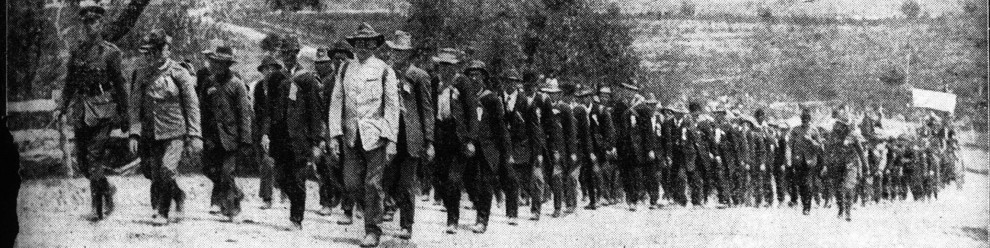
Day 32, Wednesday, 10 November, 1915, Penrith to Parramatta

Transcription of an extract from an article titled ‘The Route March : In the Suburbs of Sydney’ in The Farmer and Settler, 12 November, 1915, p. 3 [3 of 3 parts]
… [Continued]

‘St. Mary’s.
The marching conditions were better on Wednesday morning, as the column set out for Parramatta, “via ports.” The four miles to St. Mary’s was soon covered, and the troops marched in briskly, headed by the local band. The Mayor (Ald. Brett) with other members of the council, and Mr. J. C. Hunt, M.L.A., gave the army its official welcome, and breakfast was eaten under the shade of the trees in Victoria Park, where the men fraternised with the local residents, and good heart-to-heart recruiting work was done.

Colyton and Eastern Creek.
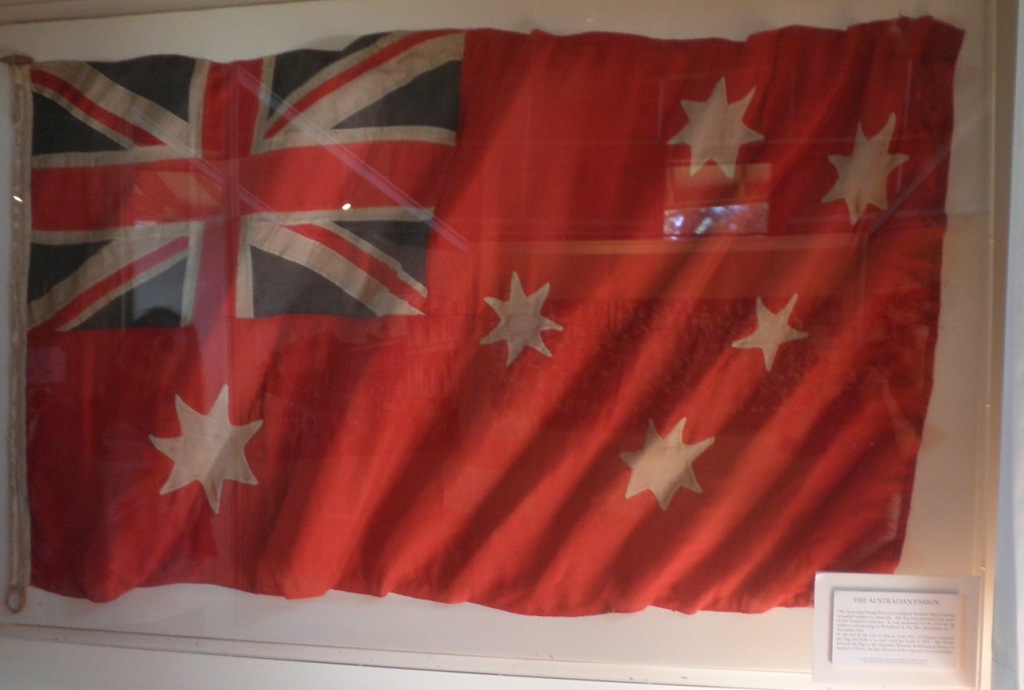
At ten o’clock the men were “following the flag” again, along the road to the village of Colyton, where the school children presented Captain Hitchen, for the “Coo-ees,” with a “purse of sovereigns” and an Australian ensign. A recruit that joined there was one of the family of McGregors that has already given five sons to the Empire. As the family said their brave but tearful farewells to the sixth McGregor, all that witnessed the incident realised the fine loyalty of the McGregors, and also the suffering that the Hun fiends have brought upon the world.

At Eastern Creek the army was met by Col. Pringle, president of the Blacktown Shire Council, and Cr. James Angus, president of the recruiting committee. Luncheon was provided in the Walgrove school grounds by the ladies of Rooty Hill and Eastern Creek.

Prospect to Westmead.
At Prospect there were more welcomes and another meal; and there was an acceptable distribution of oranges, provided by the growers of Castle Hill, twenty miles away. Father Bernard and the band of the Boys’ Home met the troops soon after they left Prospect, and played them all the way to Parramatta.

At Wentworthville there was yet another distribution of cordials, and there the Parramatta welcome really began, for the Mayor (Ald. Graham) and Mr. W. F. Jago came out to meet the recruits.
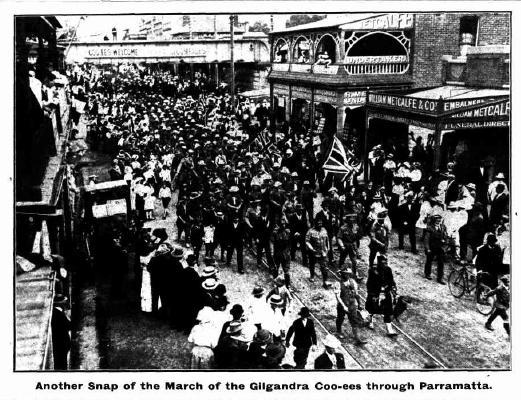
Coo-ees marching through Parramatta (The Cumberland Argus and Fruitgrowers Advocate 20/11/1915)

Coo-ees marching through Parramatta (The Cumberland Argus and Fruitgrowers Advocate 20/11/1915)

Parramatta.
The last few miles of the journey through a semi-suburban residential district was a triumphal procession. Vehicles lined the roads, and hundreds of persons were gathered at every coign of vantage to see and to cheer the heroes of the west.
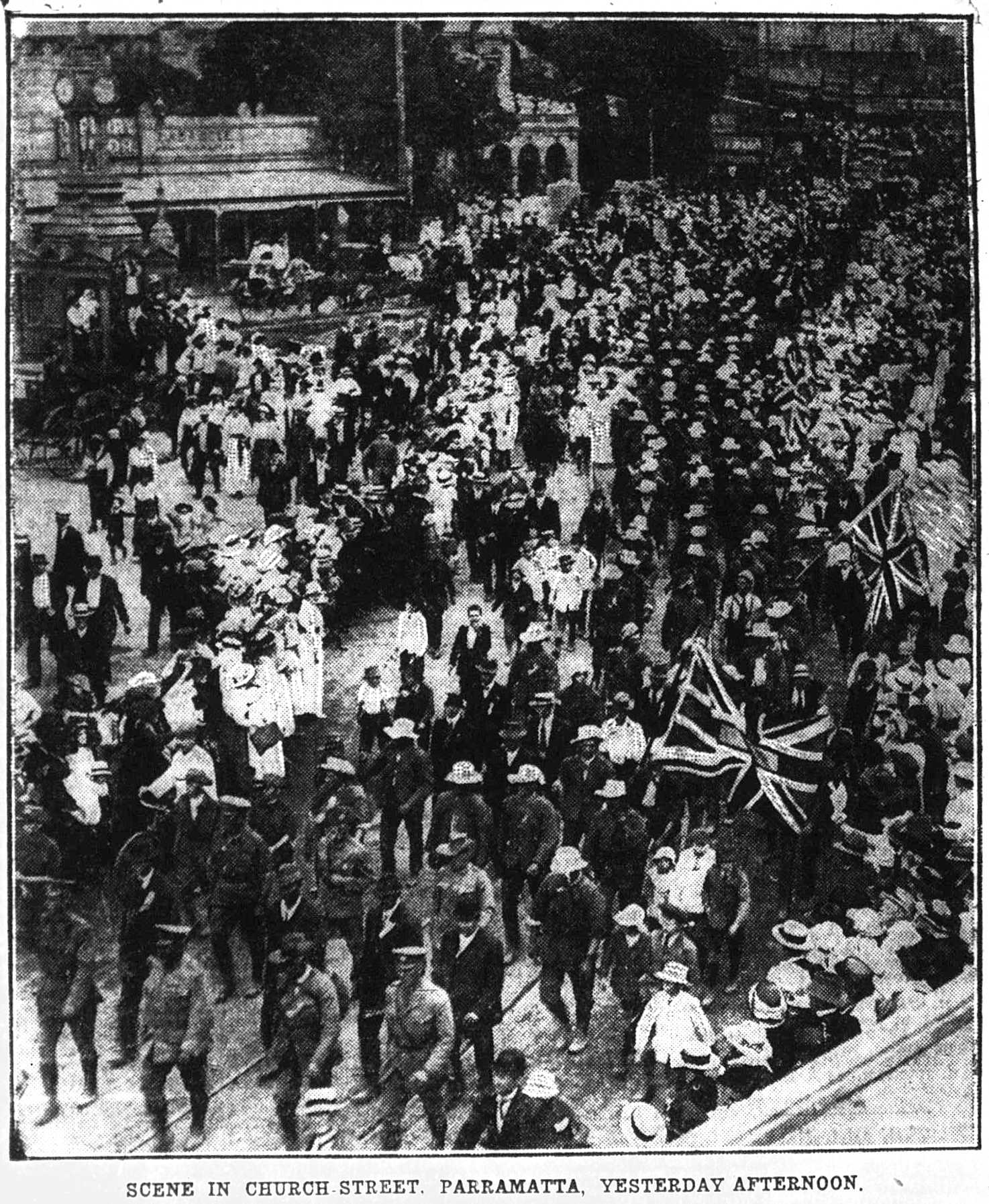
Coo-ees in crowded Church Street, Parramatta (Evening News 11/11/1915)

Coo-ees in crowded Church Street, Parramatta (Evening News 11/11/1915)

The column marched into the old town escorted by the Mounted Police, Fire Brigade, Light Horse, Cadets, Boy Scouts, returned soldiers, Parramatta Citizens’ Band, Westmead Boys’ Band, Burnside Homes Boys’ Pipers Band, and the Kings School boys. Alderman Graham welcomed the westerners and then the whole force made an imposing entry into the town, the streets of which were gaily decorated, and the population of which had turned out en masse. The school children of the district were assembled at the Town Hall, and their demonstration was the most striking of all.
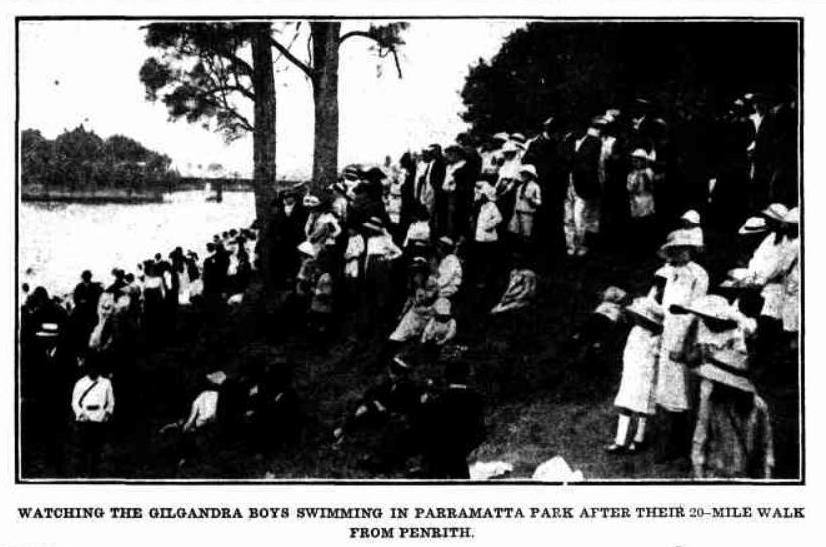
Crowd watching the Coo-ees swimming in Parramatta Park (The Cumberland Argus and Fruitgrowers Advocate 20/11/1915)

Crowd watching the Coo-ees swimming in Parramatta Park (The Cumberland Argus and Fruitgrowers Advocate 20/11/1915)

The camp was pitched in a pleasant corner of Parramatta Park, and the men had the opportunity of a refreshing swim in the river, and a general clean up and cool off before the evening meal.

After being entertained at dinner in the Town Hall by the mayoress and the ladies of Parramatta, the men attended a recruiting meeting when speeches were delivered by the Rev. P. S. Waddy, head-master of the King’s School, and Rev. S. M. Johnston, Sergeant Coates and Sergeant-major Lee. The result of the meeting was that forty-one recruits were obtained.

Yesterday’s suburban junketings and “speechifications” may be passed over, the one pleasant fact being recorded that the “Coo-ees” made a fine recruiting impression upon the young manhood of the western suburbs, and it is certain that at tod-day’s finish in Martin Place, Sydney, there will be over three hundred sworn recruits answering the roll-call of “Hitchen ‘s Own.”

Click here to access the article on Trove: http://nla.gov.au/nla.news-article116652489
Day 31, Tuesday, 9 November, 1915, Springwood to Penrith

Transcription of an extract from an article titled ‘The Route March : In the Suburbs of Sydney’ in The Farmer and Settler, 12 November, 1915, p. 3 [2 of 3 parts]

… [Continued]

‘Valley Heights to Emu Plains.
On Tuesday morning Springwood waved its farewell, and the column passed onward and downward along the picturesque mountain roads through Valley Heights, Blaxland and Glenbrook, and down Lapstone Hill to the bridge, where the noon day meal was taken. Senators McDougall and Grant came to see the army of the West at Emu Plains.

Penrith.
At four o clock Penrith was “stormed,” the “Coo-ees” swinging into town like a corps of veterans. They were met at the Nepean bridge by a squadron of Light Horse, a company of infantry, a detachment of Boy Scouts, and a squad of smart-looking recruits. Headed by the Penrith band the town was paraded, and the whole population of the district appeared to be present. At the town hall the mayor, Ald. Walker, made a brief speech of welcome, and the men were afterwards entertained at dinner, and later took part in the usual recruiting rally.

… [Cont.]

Click here to access the article on Trove: http://nla.gov.au/nla.news-article116652489
Day 30, Monday, 8 November, 1915, Lawson to Springwood

Transcription of an extract from an article titled ‘The Route March : In the Suburbs of Sydney’ in The Farmer and Settler, 12 November, 1915, p. 3 [1 of 3 parts]

‘THE ROUTE MARCH
In the Suburbs of Sydney
OVER THREE HUNDRED MEN NOW MARCHING.

Before this issue of the “Farmer and Settler” reaches the great majority of its readers, the Great Western Route March will have ended, the “Coo-ees” will have been welcomed in the heart of Sydney by assembled thousands of the people, and will have gone into camp to complete their training.

In many respects the last week on the road was the roughest of the whole thirty two days’ march, and the greatest test of the physical stamina and the temper of the men.

When the column left Lawson on Monday morning, the mountains were swathed in the smoke of bush fires, and as the miles brought them nearer the capital the men found the roads growing rougher and dustier, the humid heat more oppressive, and the flies and the smoke twin plagues to complete their discomfort. The other side of the picture was the cheery courage of the men themselves, and the enthusiasm and generosity of the people at every wayside town and hamlet.

Hazelbrook.
As the army approached Hazelbrook it was met by the school children and practically the whole population. Gifts of cigarettes and other comforts were made, the children sang the National Anthem, and the troops marched through, cheered by the “motto” that had been stretched across the road: “God-speed, and a safe return — Hazelbrook to the Coo-ees.”

One of the interesting episodes of the Hazelbrook welcome was the presence of an Afghanistan and South African veteran, Lieut. E. G. Facey, who could not resist the impulse to step it out to the martial music of the Leura band.

Woodford.  
A warm welcome awaited the column at Woodford. Under the trees a cold luncheon had been spread, and while the men refreshed themselves, Captain Dakin and Mr. G. J. Waterhouse voiced the good wishes of the people.

Australian Ensign flag donated to the Coo-ees at Woodford, now on display at the Coo-ee Heritage Centre, Gilgandra (Photograph: H. Thompson)

Australian Ensign flag given to the Coo-ees by wounded soldiers at Woodford, now on display at the Coo-ee Heritage Centre, Gilgandra. Donated by the family of Ernie May, a Coo-ee from Wongarbon who kept the flag after the Coo-ee March (Photograph: H. Thompson)

A ceremony that touched the boys was the presentation of an Australian flag by Private Nutting, on behalf of his comrades of the local military convalescent home, Professor David’s house, lent to the Government for the use of the returned soldiers. A contingent of the wounded soldiers assembled and cheered the “Coo-ees,” and this was a compliment that went to the hearts of all; they carried that Anzac-Australian flag in the place of honor through townships passed through later.

Linden and Faulconbridge.
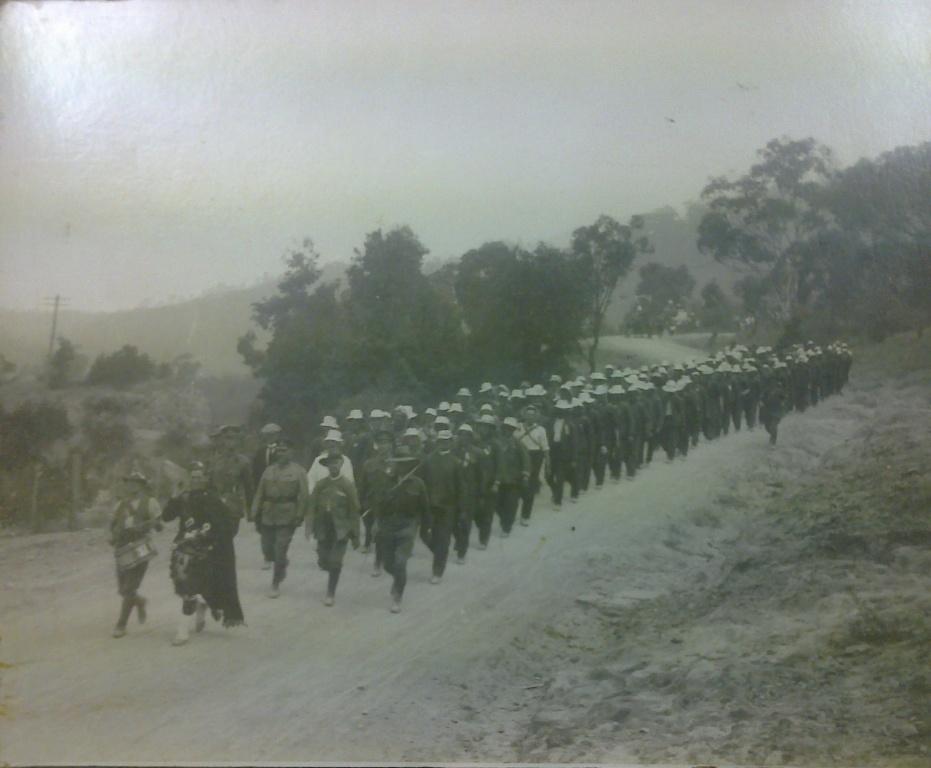
From Woodford to Linden was down hill, on a road that twisted between blackened patches of recently burned timber. Linden was a non-stop station, so, helped along by the cheers of the residents, the column forged ahead.

Soon after noon the hamlet of Faulconbridge, the last resting place of Sir Henry Parkes, came into view. An escort of mounted troopers joined the column here, but there was no halt until Springwood was reached.

Coo-ees nearing Springwood (Photograph courtesy of Gilgandra Historical Society)

Coo-ees nearing Springwood (Photograph courtesy of Gilgandra Historical Society)

Springwood.
The procession that entered Springwood consisted of the “Coo-ees,” Leura band, mounted troopers, a squad of local riflemen and a piper specially sent by the Highland Society. Springwood was en fete, flags flew everywhere, and banners of welcome hung across the road. A charming tableau was presented by the school children, the boys dressed in khaki as soldiers and tho girls garbed as nurses. After a parade of the township the army camped at Homedale estate, dined and rested — all except a squad ordered out at the double to take a bridge head of the enemy, an advancing tongue of bush fire.

At night a thousand persons attended a promenade concert and listened to fine recruiting speeches by Mr. H. Blackett and the local clergy.’

… [Cont.]

Click here to access the article on Trove: http://nla.gov.au/nla.news-article116652489
Day 29, Sunday, 7 November, 1915, Lawson

Transcription of an article titled ‘”Coo-ees” at Lawson’ in The Blue Mountain Echo, 12 November, 1915, p. 6.

“COO-EES” AT LAWSON.

“Give the boys a good time”‘ was the keynote of Lawson’s welcome to the “Coo-ees,” and that note was sustained from their first approach to the town on Saturday afternoon until they were farewelled, about half way to Hazelbrook. Half a dozen gaily-decorated motor cars, with a full compliment of fair passengers, tho Public School children, and half the population of Lawson; the President of the Shire Council (Cr. J. T. Wall), with Councillors Geggie and Staples and the members of the Recruiting Association, met the little army on Vickery’s Hill, and were formally welcomed by President Wall to the Blue Mountains Shire, after which a procession was formed, headed by the Recruiting Association and the Leura Brass Band, with the motor cars bringing up the rear. On their arrival at Bellevue Hill Park, each was presented with a packet of cigarettes from the students of Stratford School for Girls. Cr. Geggie, as the oldest resident, extended a welcome to Major Wynne, Capt. Eade, other officers and men. The formal reception over, the men at once availed themselves of the opportunity for a swim, and it did one good to see the evident enjoyment of a swim in one of the finest swimming baths on the Mountains. The ladies of Lawson and Hazelbrook, in the meantime, had all preparations made for a rush on the tea tables, but there was enough and to spare, and both officers and men expressed themselves as delighted with the meal provided.

In the evening a recruiting meeting was held in front of the post office; and, in view of the fact that so many men have already enlisted from this town, it was a surprise to find six more who were ready to serve their King and Country.

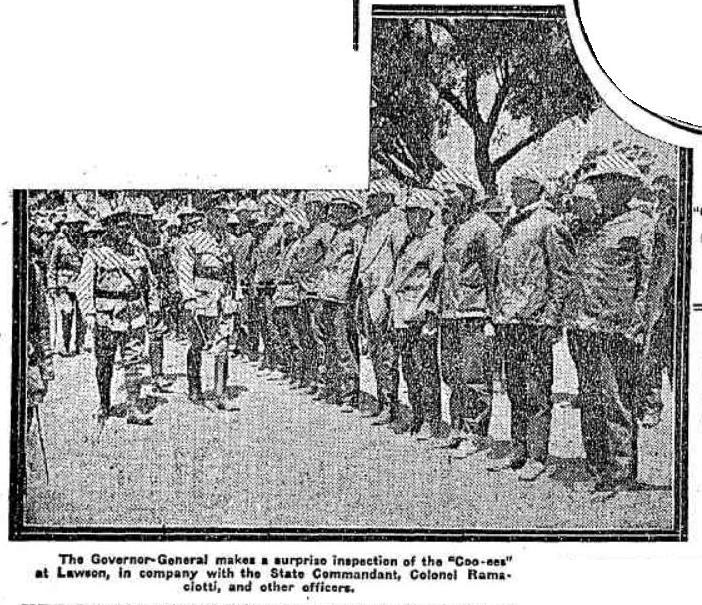
Governor-General inspects the Coo-ees at Lawson (Mirror of Australia 13/11/1915)

Governor-General inspects the Coo-ees at Lawson (Mirror of Australia 13/11/1915)

Sunday morning was a surprise packet. It was known that Colonel Ramacciotti would probably be up to inspect the troops. The Colonel arrived about 11 o’clock, and soon after the Governor-General arrived, accompanied by Capt.  Hosketh-Smith, of the naval establishment at Garden Island. His Excellency has evinced the keenest interest in the march, and inspected the contingent when it was much smaller, at Geurie and Dripstone. The men were drawn up in preparation of an inspection by the State   Commandant, Colonel Ramacciotti, who, accompanied by Major Edwards, of the Headquarters Staff, arrived about noon by motor from Sydney. It wan announced by the Commandant that the Governor-General was coming, and was on the road. On arrival his Excellency was met by the State Commandant, Major Edwards, Major Wynne and Capt. Eade. His Excellency, addressing the men, referred to the pleasure he had already had in meeting those who had first joined, but expressed regret that he would not be able to meet them on their arrival in Sydney. Her Excellency would be there, however, and she would give him a good description of it. They had not only shown endurance but military virtues on the march. They had shown their initiative in being able to provide for themselves. Self-help was the greatest of all military virtues on the battlefield. He hoped that when in camp they would show the same high standard of excellence. The movement had created a great interest throughout Australia and the Empire. He would have pleasure in reporting it to his Majesty.

Colonel Ramacciotti said they had put up a record of which they all might be proud. They had to live up to it, and let nothing tarnish it. He intended to put them into a battalion formed of country men — and the men in it had to be the best.

On Sunday afternoon a united religious service was held in the Bellevue Hill Park. There was a great muster of residents and visitors from all the towns, from Katoomba to Springwood. Addresses were delivered by the. local clergymen. In the evening, a song service was held in the Institute hall. A united choir from all the churches occupied the stage, and rendered the anthem, “King of Kings,” and members of the choir rendered quartettes, duets and solos. The hall was packed with men of tho “Coo-ees” and residents. Cr. W. G. Staples presided, and, in his opening remarks, stated that the service had been arranged for the men of the “Coo-ees,” and that doubtless many of them had often gathered round the piano in the old home and had a “sing-song,” and he wanted the men to realise that the meeting was for them. Right heartily they followed the conductor, Mr. T. Savage, who had the men and tho audience singing the old Gospel hymns and choruses as they had never sung them before.

A big gathering assembled to bid fare well to the boys on Monday morning. Prior to their departure, Mr. W. Lowden expressed the satisfaction of the residents on the excellent conduct of the men during Sunday. Cheers were given for the people of Lawson, for the “Coo-ees,” and the Lawson recruits.

The officers were entertained by Miss Barlow, of the Grand Hotel, to dinner on Sunday, a hospitality which was much appreciated.’

Click here to access the article on Trove: http://nla.gov.au/nla.news-article108042178

Day 28, Saturday, 6 November, 1915, Katoomba to Lawson

Transcription of an extract from an article titled ‘The Route March : Through the Mountains’ in The Farmer and Settler, 9 November, 1915, p. 3 [2 of 3]
… [Continued]

‘Leura.  
Katoomba’s send-off on Saturday morning will not readily be forgotten by the men of the column. Mr A. J. Craig gave the Katoomba recruits a flag, the presentation being made by Ald. J. F. Tabrett. Then amid great cheering the column took the road for Leura, at which pretty town it was met by the president of the local recruiting association (Mr. J. H. Bloome) and the Leura Band. A halt of only fifteen minutes was made at Leura, but two recruits joined, and Captain-chaplain Fielding made a vigorous speech that cheered the men on.

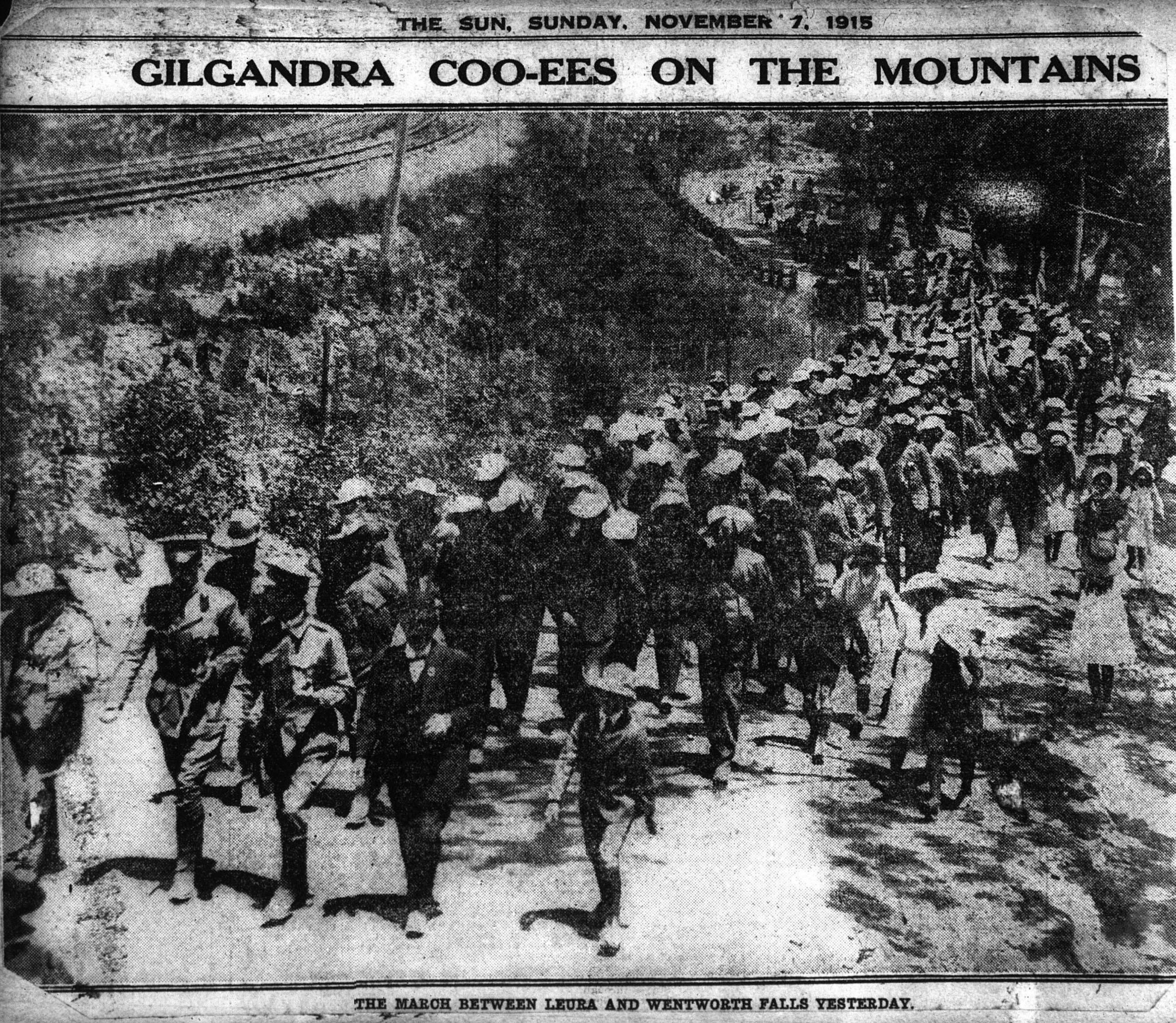
Coo-ees marching between Leura and Wentworth Falls (The Sun 7/11/1915)

Coo-ees marching between Leura and Wentworth Falls (The Sun 7/11/1915)

Wentworth Falls.
Leura Band played the column into Wentworth Falls, where there was more enthusiastic welcoming, and yet more wholesale feeding. Mr. H. A. Hickman, at the School of Arts, voiced the citizens’ welcome. A contingent of wounded soldiers paraded here, and were warmly welcomed by the “Coo-ees.” One of them, Private O’Connor, said he was glad to see them hurrying along to the front. “Not only you boys are wanted,” he said, “but all the lads in the country should come along, I am now on the way to recovery, but I hope to have another go. I have had two already.”

Mrs Thorne with her son Thomas Thorne who joined at Lawson (Mirror of Australia 13/11/1915)

Mrs Thorne with her son Thomas Thorne who joined at Lawson (Mirror of Australia 13/11/1915)

Lawson.
With the Leura Band still giving the step, the “Coo-ees” stepped out briskly toward Lawson, where the week-end was to be spent. The president of the Blue Mountains Shire, Cr. J. T. Wall, came out some distance to meet the column, and further along a line of decorated motor cars came into sight, and a corps of boy scouts, with a welcome banner. It was a long procession that found its way to Lawson Park, where Cr. Geggie, made the men welcome on behalf of the townspeople of Lawson and Hazelbrook. The men were entertained at dinner at the School of Arts, and at night a recruiting meeting was held, at which five recruits joined the force.’

[N.B. remainder of this article is not included in blog].

Click here to access the article on Trove: http://nla.gov.au/nla.news-article116669569

Day 27, Friday, 5 November, 1915, Mount Victoria to Katoomba

Transcription of an extract from an article titled ‘The Route March : Through the Mountains’ in The Farmer and Settler, 9 November, 1915, p. 3 [1 of 3]

[N.B. Includes a further description of Day 26, Thursday, 4 November, 1915, at Katoomba]

‘THE ROUTE MARCH
Through the Mountains
THE COLUMN REVIEWED BY THE GOVERNOR-GENERAL.

The Great Western Route march has crossed the range, and is now swinging down the slopes towards the foothills   and the city — whose lights can be seen glowing at night like the haze above a furnace.

Mount Victoria.
The first of the chain of Blue Mountain towns, Mount Victoria, welcomed the “Coo-ees” right royally on Thursday, and for the men it must be said that they looked worthy of their reception, as hard and wiry a force of soldiers in the raw as any officer could desire to com- mand; and feeling as well as looking more soldierly than they had done, with their new uniform- dungarees and white hats — the recruits’ dress of the training camps. The march into town was followed by the official welcome at the flag- staff — where a special flag was unfurled; then in the afternoon Captain Eade put the men through a stiff two hours’ course of drill; and at night there was a camp concert, with recruiting speeches.

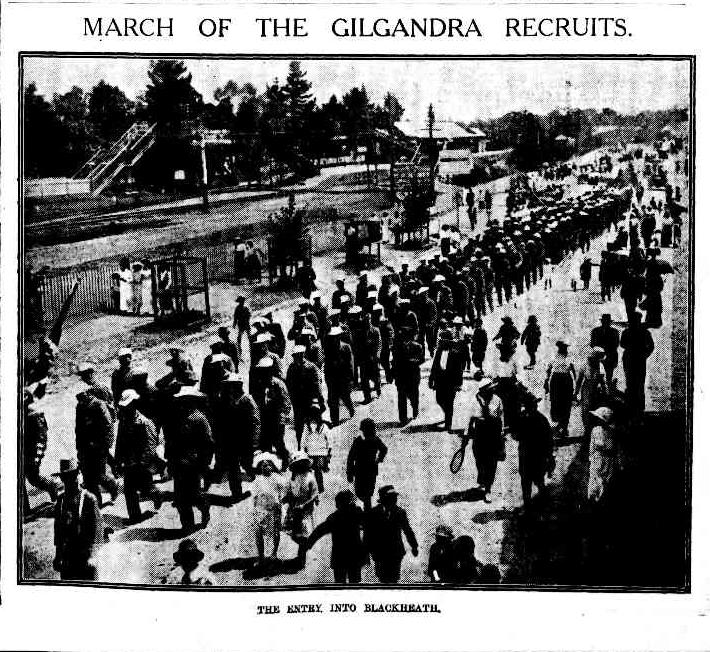
The entry into Blackheath (Sydney Morning Herald 8/11/1915)

The entry into Blackheath (Sydney Morning Herald 8/11/1915)

Blackheath.
The column marched out of Mount Victoria at nine o’clock on Friday morning, and covered the four miles to Blackheath in less than an hour. Half a mile out the Metropolitan Schools’ Military Band met the contingent, and played it into the town, where a triumphal arch had been erected in honor of the occasion. The best feature of the Blackheath welcome was the presence of a guard of honor of returned soldiers from Anzac and Rabaul, under Col. Paton.

After the president of the local progress association had formally welcomed the troops, Captain Hitchen performed the ceremony of “breaking the flag” at the home of Mr. W. R. Tully. Then the procession; headed, by the school children, moved on to the Blackheath Hall, where a substantial meal, prepared by the district ladies, was enjoyed to the full. Here two recruits joined amid the cheers of the public, and the still lustier cheers of the “Coo-ees.”

Medlow Baths.
Next stop, Medlow! But a very short stop it was, as the time was limited. Cool drinks were served, cheers were given, and the column passed on. The march to Katoomba was a rather trying one, as bush fires were raging and the road was overhung with a pall of dense smoke.

 Katoomba.
Arrived at the Explorers’ Tree, the contingent found a detachment of the 41st Regiment drawn up to meet them, also the members of the rifle clubs, the cadets, boy scouts, and school children, with scores of motor cars and other vehicles, and a striking tableau representing the Allies. A speech of welcome was made by Ald. Brierley, Mayor of Katoomba, and then the procession, a mile long, traversed the principal thoroughfare to the skating rink, the route being thronged with thousands of cheering citizens. Katoomba gave the lads great entertainment, three solid meals, free baths, free picture shows, free socks, and free everything else to add to their comfort. At the Katoomba theatre in the afternoon, the mayor presented a local recruit. Pte. Perkins, with a wristlet watch, subscribed by the Boys’ Association. At night the public reception was turned as usual into a recruiting meeting, and five men signed on.’

… [Cont.]

Click here to access the article on Trove: http://nla.gov.au/nla.news-article116669569

Day 26, Thursday, 4 November, 1915, Hartley to Mount Victoria

Transcription of an extract from an article titled ‘The Route March : Through Lithgow District’ in The Farmer and Settler, 5 November, 1915, p. 3 [part 4 of 4]
… [Continued]

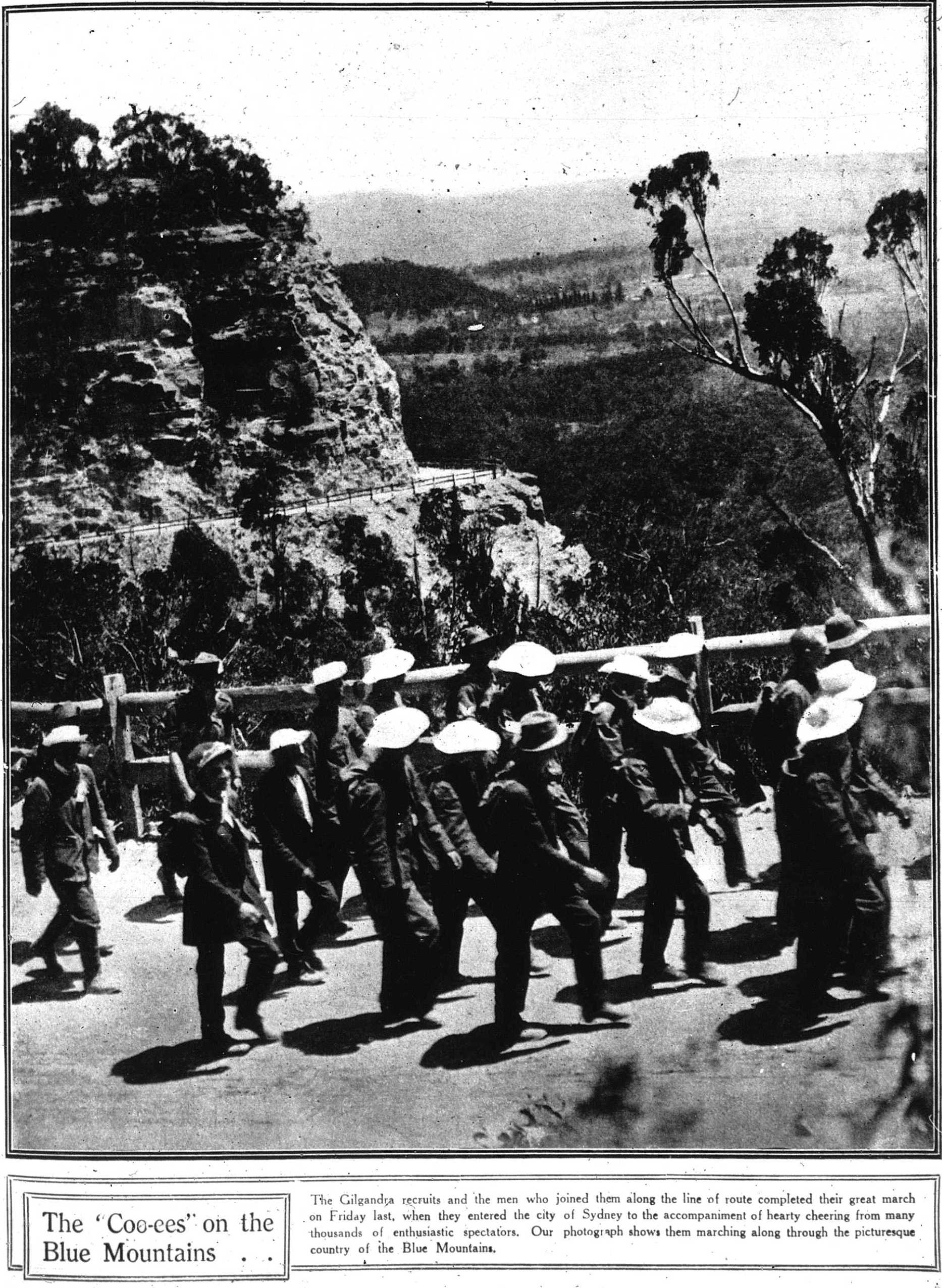
Coo-ees climbing Berghofers Pass on Mt. Victoria (Sydney Mail 17/11/1915)

Coo-ees climbing Berghofers Pass on Mt. Victoria (Sydney Mail 17/11/1915)

Mount Victoria.    
New Victoria Pass was negotiated on Thursday, and the grade tried the transport horses severely. The men appreciated the scenery, but were glad when Mt. Victoria was reached, as it was a dry stage, and the day was warm as it ever could be in the mountains. About a mile out of town the column was met by the Rev. P. J. Hefferman and a party of school children and townspeople. Seven recruits were there also, lined up at the roadside waiting to join the “Coo-ees,” a sight that gladdened the hearts of all. The time of arrival had been fixed so that the marching recruits would be present at the unfurling of a flag on the new staff erected in honor of the arrival of the “Coo-ees.” This ceremony was performed with all due impressiveness, after which the boys adjourned to dinner. Another afternoon’s good hard drill was then given the troops. It is rumored that Colonel Ramacciotti, the State Commandant, intends to make an inspection, but when and where is known only to himself. Staff Captain Eade and Staff Sergeant-Major Scott are accompanying the men to Sydney, also Lieut. Middlemay, of the local camp, and a sergeant of the A.M.C., so the Gilgandra route march is now getting full staff recognition. An open air camp fire concert was held last night, in the Mount Victoria Park, with an excellent programme of harmony and recruiting speeches. Two more recruits caught up by train last night, and the strength of the column is now one hundred and eighty.’

Click here to access the article on Trove: http://nla.gov.au/nla.news-article116680017

Day 25, Wednesday, 3 November, 1915, Lithgow to Hartley

Transcription of an extract from an article titled ‘The Route March : Through Lithgow District’ in The Farmer and Settler, 5 November, 1915, p. 3 [part 3 of 4]
… [Continued]

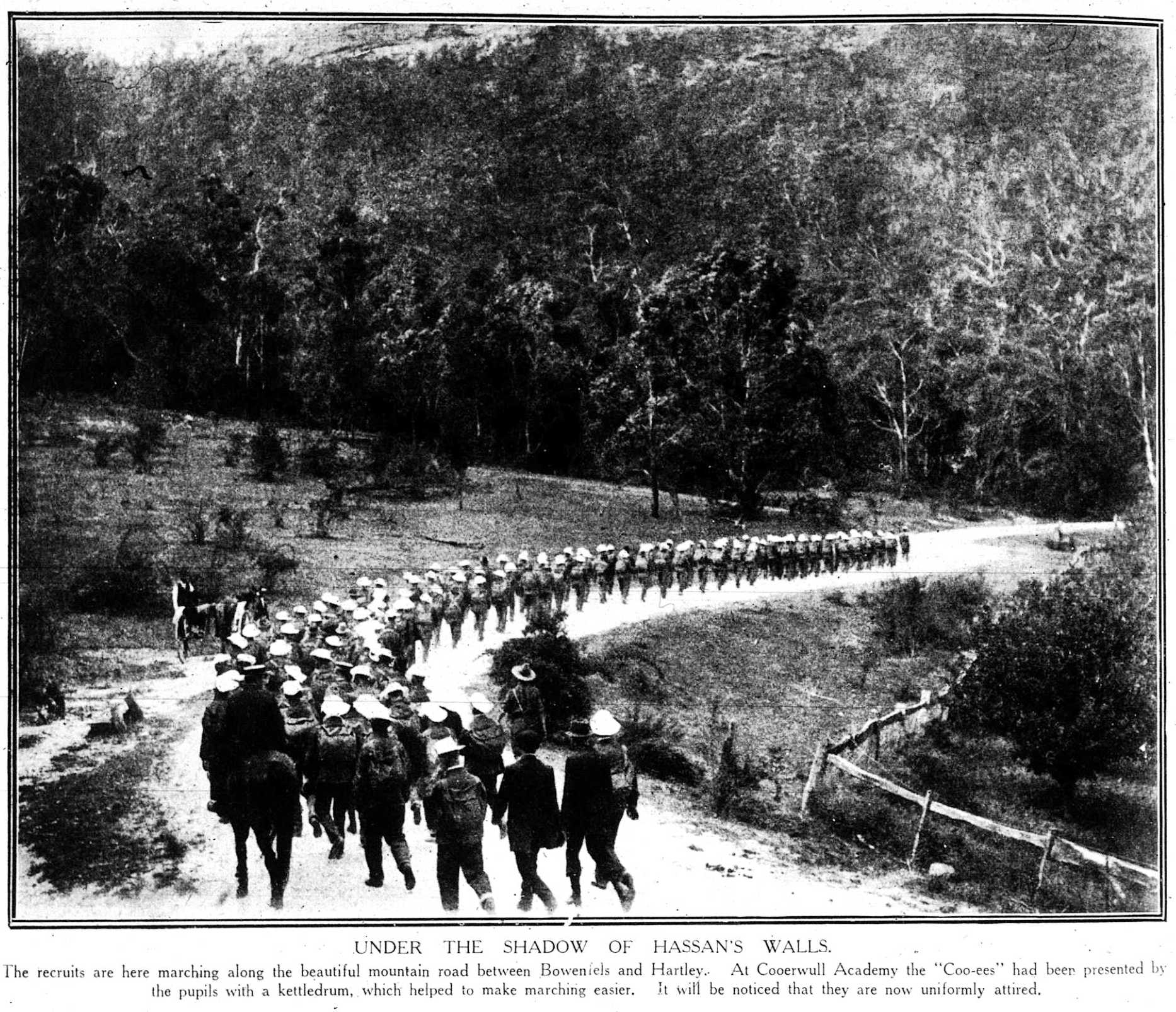
Under the shadow of Hassan's Walls (Sydney Mail 10/11/1915)

Under the shadow of Hassan’s Walls (Sydney Mail 10/11/1915)

Bowenfells.

Lithgow turned out in force to see the last of the “Coo-ees,” and each man was given a tri-color ribbon bearing the inscription, “Lithgow, 3/11/15. ‘Coo-ee!’ Good Luck!” as a souvenir of the occasion. Some ladies also attended with a bag of sweets for each man. The Lithgow camp  recruits marched out with the Gilgandra column as far as the Cooerwull Academy, where a brief halt was made. The boys of the academy had rigged flags across the road, and they met the march with cheers. The boys also presented the column with a kettledrum.

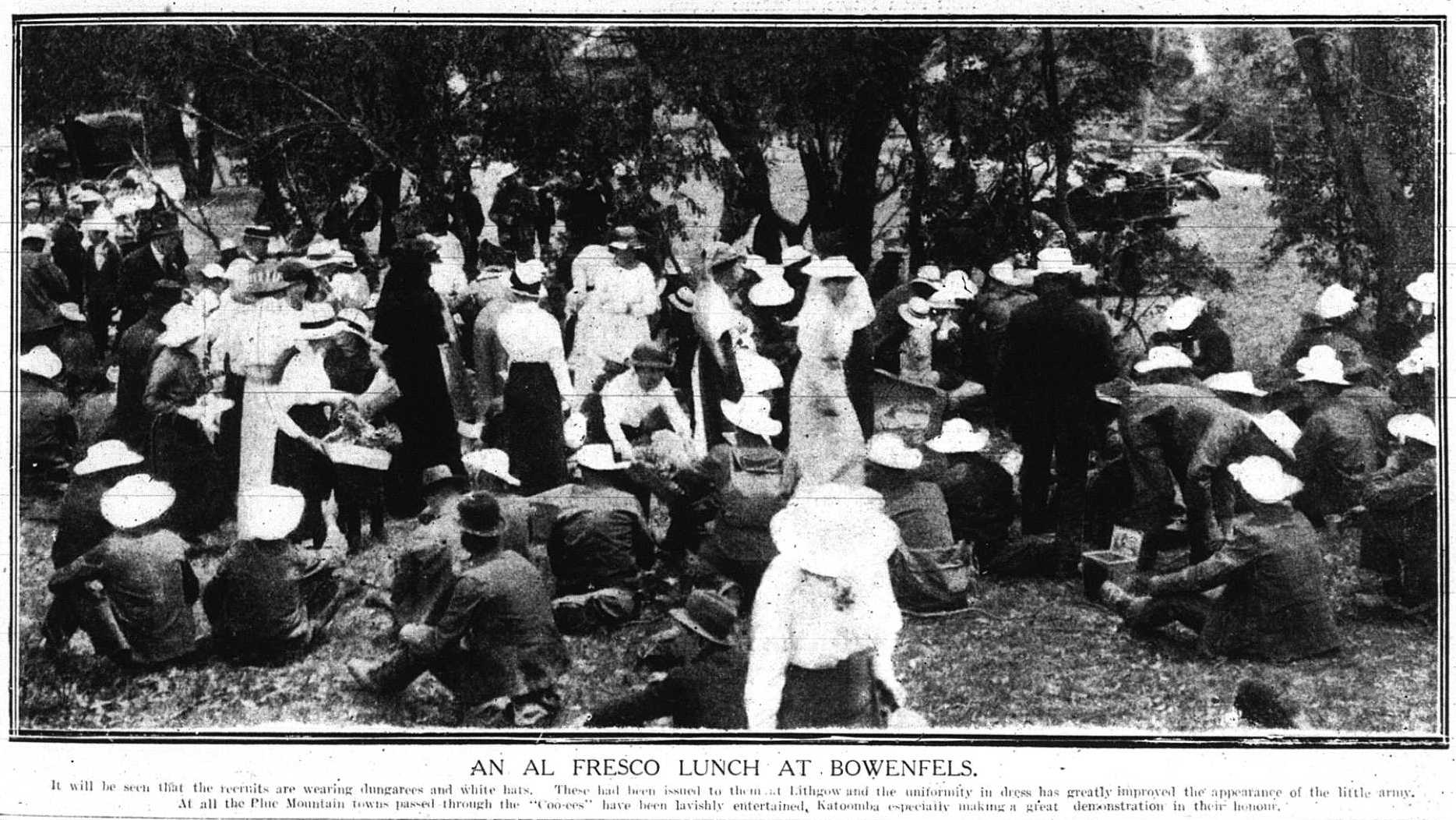
Al fresco lunch at Bowenfells (Sydney Mail 10/11/1915)

Al fresco lunch at Bowenfells (Sydney Mail 10/11/1915)

Lunch was laid at Bowenfells, under the trees opposite the oldest Methodist Church west of the Mountains, Nearby stand an old lock-up and hotel, both dating back to the earliest convict days. There was a surprisingly large assemblage of our friends from Lithgow and other towns further in the Mountains, together with chance tourists that had heard of the approach of the “Coo-ees,” and had come along to see them. Lunch was alfresco, with full and plenty, and it was speedily demolished by the hungry boys, for the walk had been warm and the way hilly.

Only five miles remained for the afternoon’s march, and as the country sloped downwards once more, an hour or two was spent in chatting with the visitors. A little diversion was caused by the discovery that one of the “Coo-ees” had   hitherto escaped the barber, and had a fine crop of curly hair. He was quickly captured by his mates, the camp barber was summoned, and the offending locks removed forthwith.

Reception at Hartley Vale (Sydney Mail 10/11/1915)

Reception at Hartley Vale (Sydney Mail 10/11/1915)

Hartley.

The column made its way into Hartley, headed by a battery of motor-cars, and the road was lined by school children, waving flags. It was strange to see the old courthouse, erected in the early thirties, with all its suggestions of the triangle and leg irons; It was strange to see this old building, the scene of many a convict tragedy, turned into a banquet hall in honor of the boys of the near west, who were going out to battle for the country.

The “Coo-ees” were warmly welcomed by the residents, and afterwards tea was accounted for, and blankets spread under the stars for the night’s bivouac.

Mr. J. McGarry, one of the most enthusiastic workers in entertaining the recruits, is the grandson of old John Mc-Garry, who had the Royal Hotel in the forties. The hotel has been in the hands of the family for three generations, and the place is an excellent example of the architecture of the old colonial days.’

Click here to access the article on Trove: http://nla.gov.au/nla.news-article116680017

Day 24, Tuesday, 2 November, 1915, Lithgow

Transcription of an extract from an article titled ‘The Route March : Through Lithgow District’ in The Farmer and Settler, 5 November, 1915, p. 3 [part 2 of 4]
… [Continued]

‘On Tuesday the “Coo-ees” spent the major portion of the day at squad drill, and in the afternoon a cricket match was played against the local camp boys, resulting in a win for the latter after a hard struggle. Dungaree overalls and   white hats were issued, and advantage was taken of the spare day to overhaul the foot gear of the contingent. A large quantity of new boots was purchased, and three repairers were kept at work all day. Meals were served at the camp, and the men began to think they had been living “high” on the march, when they had to sit down to stew for dinner and bread and marmalade for tea. The Lithgow camp is a drill hall, with an ample area of ground, and is in charge of Captain Eade, who is accompanying the Gilgandra men to Sydney. It is well equipped, and has all the essentials of   larger camps, everything being in good order.

A recruiting meeting was held after tea, the Mayor presiding. The usual appeal was made, but only five responded – a disappointing number from so large a district. But perhaps this should be considered very fair, when it is taken into consideration that Lithgow is an industrial town, where the majority of the men are employed in work that is of   vital importance to the nation in the present crisis. At the same time, when one or two of the “Coo-ees” were being shown over the Lithgow Small Arms Factory, they could not fail to note that much of the work at present being done, by able-bodied young men, could be satisfactorily performed by female labor, thus liberating a number of eligibles for service at the front.

During the evening, the headmaster of the district school, Major Reay, made a presentation to Captain Hitchens of a sum of money raised by the school children from the sale of roses.

Wednesday’s march is one of the most interesting of the whole journey from Gilgandra onward. The country along the route abounds in places of historic interest, and the route lay along one of   the beautiful mountain roads beloved of the tourist.’

Click here to access the article on Trove: http://nla.gov.au/nla.news-article116680017

Day 23, Monday, 1 November, 1915, Wallerawang to Lithgow

Transcription of an extract from an article titled ‘The Route March : Through Lithgow District’ in The Farmer and Settler, 5 November, 1915, p. 3 [part 1 of 4]

‘THE ROUTE MARCH
Through Lithgow District.
HITCHEN’S ARMY GROWING AS IT MARCHES.

Last Monday morning the Great Western Route March passed on from hospitable Wallerawang, a large number of the people assembling to wish the men “God-speed.” There were volleys of hurrahs in the place of votes of thanks and other expressions of goodwill, and the order “quick march,” and Wallerawang’s reception was over, and Lithgow’s almost begun.

Marrangarroo.

The first mile of the journey up the hill in the sunshine made warm going, but good time was made to Marrangarroo, where lunch was prepared on the banks of Middle River. A company of recruits from the Lithgow camp, numbering about 100 men, under their own officers, met their Gilgandra comrades here. They were on their mettle, and they presented a fine appearance as they marched. When the Coo-ees have been uniformed in the dungarees and hats that are ready for them in Lithgow, however, there will not be much to choose between them, notwithstanding the Lithgow lads’ longer training. The two contingents were paraded, and cheers exchanged.

Lithgow.

After dinner and a smoke-ho the road was taken once more, with the Lithgow boys in the lead. Dunn’s Comer was reached at 4 p.m.; where a large crowd had assembled to greet the column. The mayor, Ald. Pillans, in his brief welcome speech, said that it was a working man’s welcome to working men that were going to do the work of the Empire, he trusted, like men. Equipped with flags, the school children sang patriotic songs, and then, headed by the Lithgow Town Band, the town was entered, and the main street, lined by thousands of people, was paraded by the force.

The setting was like that of a play, the road winding down the valley to the town with the great blast furnaces silhouetting against the sky and covering the valley with a pall of smoke. The small arms factory guard turned out to the salute, and whistles from the factory and from the near-by railway yards cock-a-doodle-dooed like the ferry steamers on Sydney Harbor when a transport is sailing. All tho population of the country-side was here to welcome the growing army, and they cheered and cheered again.

The march, which included the town band, the local militia, and the boy scouts, concluded at the Trades Hall, where the men camped during their two nights’ stay in Lithgow, and after still more cheers the “dismiss” was given and the quarters were occupied.

Later the “Coo-ees” were the guests of the recruiting association at dinner in the Town Hall, and, general leave having been granted, a free picture show was provided in the Oddfellows’ Hall. During the intermission Captain Hitchens on behalf of the force was given £20, donated by the workmen of the Lithgow Small Arms Factory for the purpose of providing comforts.’

Click here to access the article on Trove: http://nla.gov.au/nla.news-article116680017