Harry DAVENPORT (aka Harry SWENDSON)

Harry DAVENPORT (Harry SWENDSON)
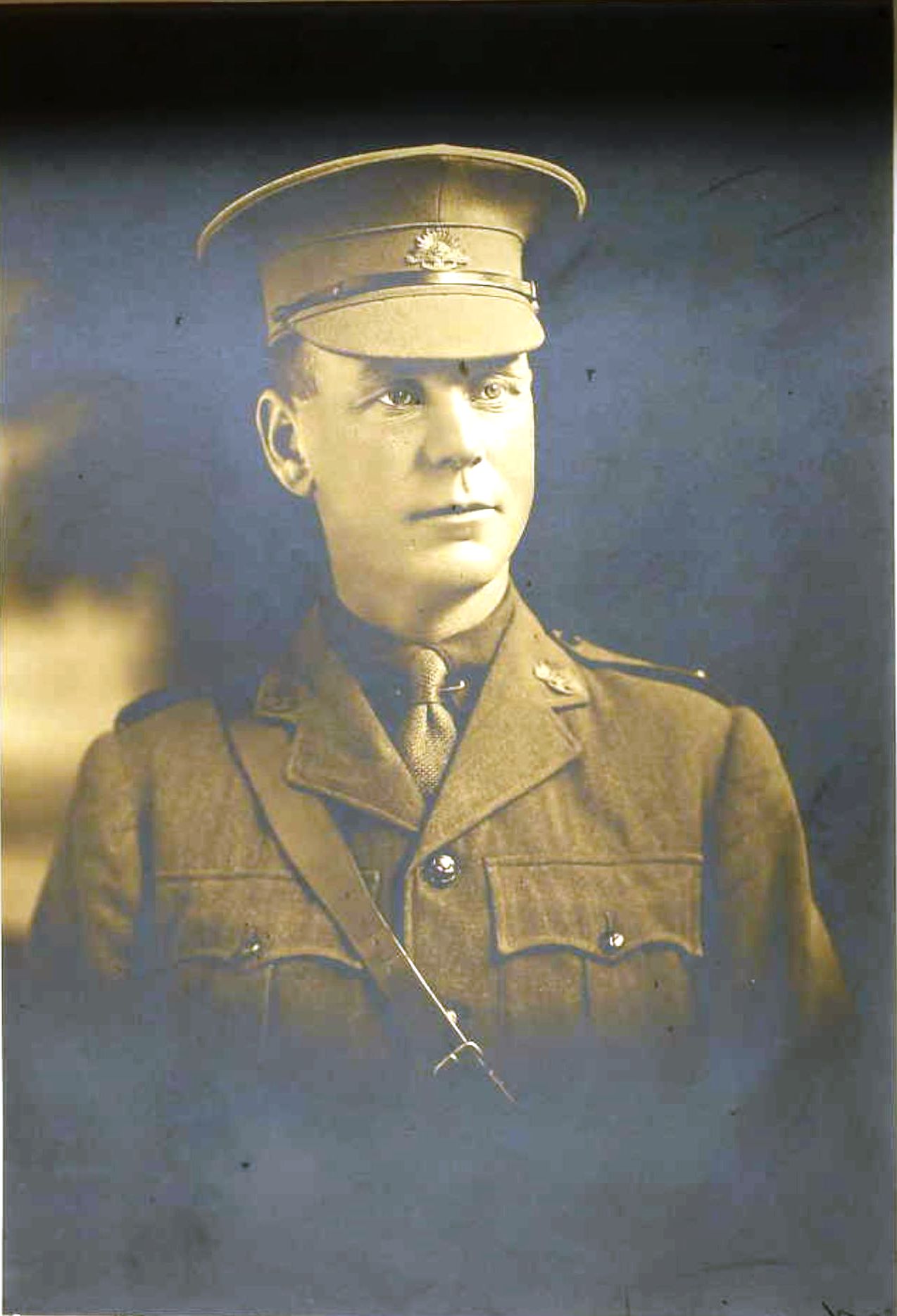
Harry Davenport (Photograph courtesy of Dave Murray)

Harry Davenport (Photograph courtesy of Dave Murray)

Per his Attestation paper on military service record (Lieutenant), Harry Davenport, with a note ‘true name Harry Swendson’, was born at Toronto, Canada. He gave his age as 41 years, his marital status as widower, and his occupation as Billiard Table Proprietor. His description on his medical was height 5 feet 10 5/8 inches tall, weight 168 lbs., with a fair complexion, grey eyes, and brown hair. His religious denomination was written as ‘none’. He claimed that he had no previous military service. He stated that he was a member of the Wongarbon Rifle Club.

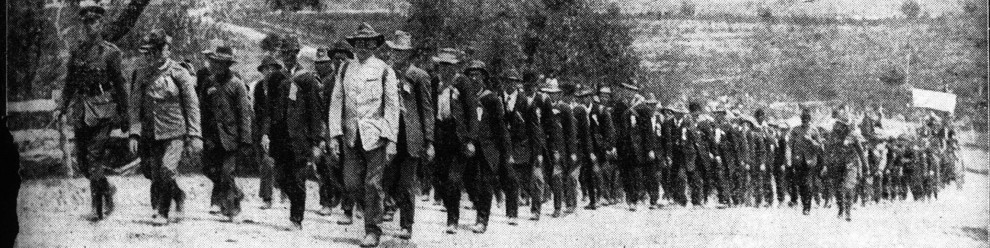
The Dubbo Liberal and Macquarie Advocate reported on 29th October 1915 (p. 4) that ‘H. Davenport’ was one of the Wongarbon boys who had joined the Coo-ees.

According to an article in The Farmer and Settler on 19th October 1915 (p. 3), thirteen men stepped forward and gave their name, ‘either to march under Captain Nicholas, or to come after harvest’, when the Coo-ees recruited in Wongarbon on 14th October 1915.

It appears Harry Davenport was one of these men, but he needed time to get his affairs in order, as he did not join the Coo-ees until the 24th October 1915 at Orange, where he undertook his medical examination, and was attested by Captain T. A. Nicholas. A note on the top of his Attestation paper in his service record said he ‘presented at Orange 24/10/15’.  His original Application to enlist in the Australian Imperial Force form, addressed to the Recruiting Officer at Orange, gave his postal address as ‘Wongarbon’.

After completing the march he went to Liverpool Camp as reinforcement for the 13th Battalion. During this time he was reported in The Farmer and Settler on 5th January 1916 (p. 3) as being a platoon sergeant in E Company, which consisted of many of the Coo-ees.

On his Application for a commission in the Australian Imperial Forces form dated 10th July 1916 in his service record he stated previous military experience of 7 years with the Vancouver Rifle Club in Canada, and being with the Wongarbon Rifle Club since July 1914. For education qualifications he stated he attended Central High School Toronto, Ont., Canada, and Wentworth Military Academy in Missouri U.S.A. Also recorded is “Sergt. “C” Coy 13th Battalion Kiama”. He gave his date of birth on this form as 31st March 1874, and his age as 42 years and 3 months. He gave his next of kin as daughter, Vieve Gwen Davenport, 324 Michigan Ave., Chicago, U.S.A. His religion is noted as Church of England on this form.

Private Davenport was sent to the A.I.F. Officers Training School at Duntroon where he trained to be an officer. On the 25th July 1916 he was appointed a Second Lieutenant.

On his embarkation roll his address at time of enrolment was 493 Dowling Street, Moore Park, Sydney, N.S.W., and his next of kin is listed as a friend, Miss F. Pole-Hore, 493 Dowling Street, Moore Park, Sydney, N.S.W.

On the 8th November 1916 Second Lieutenant Davenport departed Sydney as part of the 22nd reinforcement for the 4th Infantry Battalion aboard the SS Port Nicholson. 

He arrived at Devonport in England on 10th January 1917. He marched into the 1st Training Battalion at Durrington the same day.

On the 18th June 1917 Second Lieutenant Davenport departed England for France, arriving at the 1st Division Base Depot at Le Harve on 20th June 1917.

On 11th July 1917 Second Lieutenant Davenport left Le Harve to join the 4th Battalion. He marched in on 15th July 1917 whilst the Battalion was conducting training in the Bray Sur Somme area of France.

On the 16th July 1917 he was promoted to Lieutenant.

Less than three months after his arrival in France, on 4th October 1917 Lieutenant Davenport was wounded in action, being shot in the chest, while the 4th Battalion was engaged in an attack at Broodseinde Ridge, Belgium.  He was evacuated to an Aid Post, but died of his wounds prior to arrival.

He was buried on Broodenside Ridge, however his grave marker was destroyed in further fighting.

Lieutenant Davenport has no known grave, and is remembered on the Menin Gate Memorial at Ieper (Ypres), Belgium.

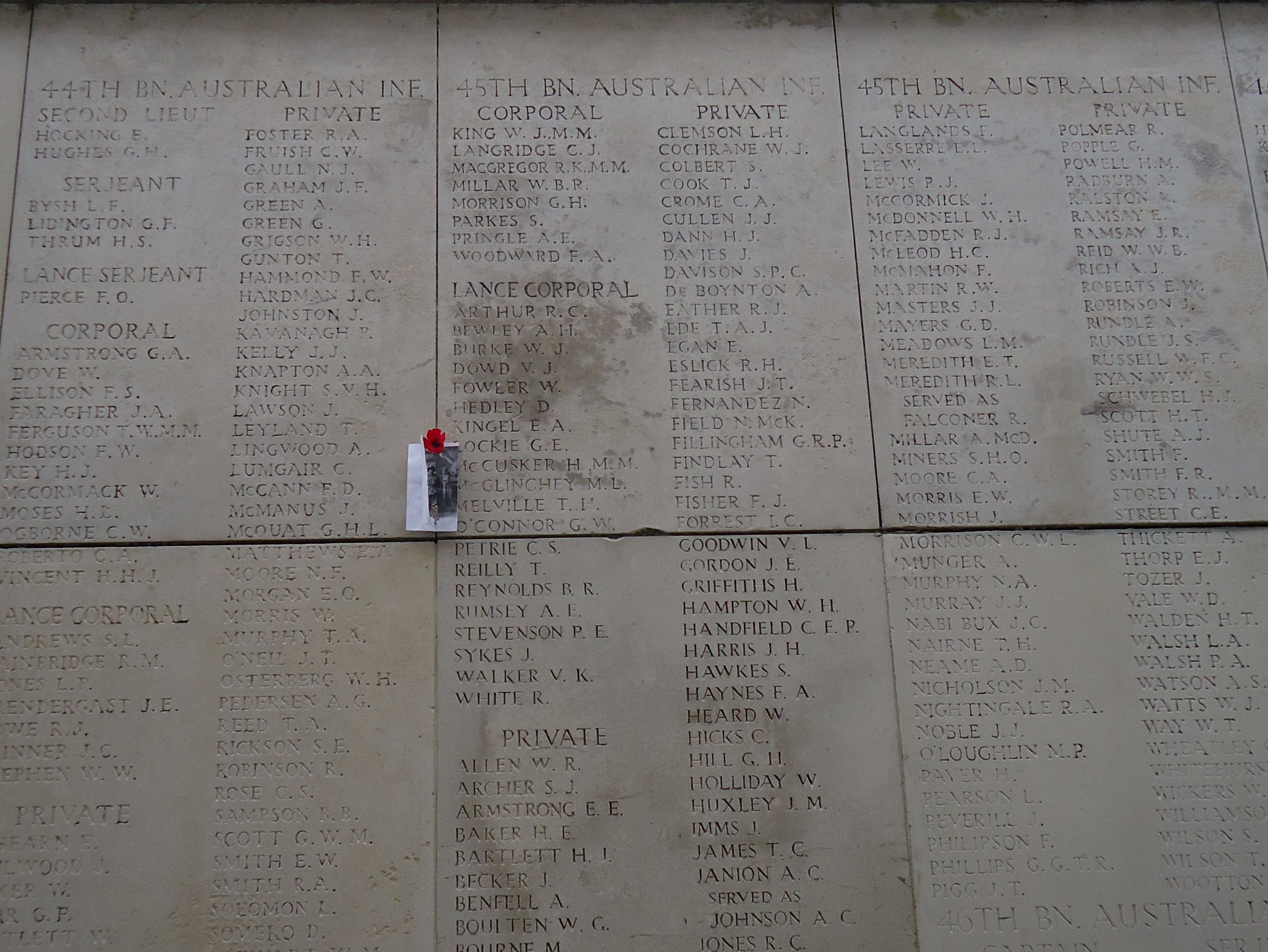
Swendson H. (served as Davenport H.) name in Lieutenant section on 4th Bn. Australian Infantry Battalion panel at the Menin Gate Memorial, Ieper (Ypres), Belgium (Photograph: H. Thompson 11/9/2012)

Swendson H. (served as Davenport H.) name in Lieutenant section on 4th Bn. Australian Infantry Battalion panel at the Menin Gate Memorial, Ieper (Ypres), Belgium (Photograph: H. Thompson 11/9/2012)

His name is also listed on the Wongarbon Soldiers Memorial, and the Atchison County WWI Memorial Honor Roll at Atchison, Kansas.

Harry Davenport appears to have had a few mysteries in his past. It is not known exactly when he arrived in Australia, but he is reported in an article in The Dubbo Liberal and Macquarie Advocate on 12th February 1915 (p. 2) as having purchased a billiard room, fruit and tobacconist’s shop in Wongarbon.

According to correspondence from Harry Augustus Swendson’s family in Harry Davenport’s service record, his family had no knowledge of Harry Davenport marrying, or having a daughter. His family had received letters (addressed from H. Davenport) and a photograph from him in his AIF uniform while he was overseas on active service before he was killed.

According to an article titled ‘Lt. Harry Swendson’ on the Shawnee County Casualties in WWI web page http://www.shawneeww1.info/stories/storiesSwendson.html, his actual date of birth was 31st March 1880, not 31st March 1874 as he claimed in his AIF service record, which would have made him only 35 years of age when he joined the Coo-ee March, not 41 years as he claimed. He was also actually born at Hawthorn, Atchison County, Kansas, not Toronto, Canada, as he had claimed on his application papers.

He is noted on the Commonwealth War Graves Commission site as being the son of S. and Sarah A. Swendson, a native of Hawthorn, Kansas, U.S.A., and being aged 35 years when he died.

James MAHER

James MAHER

James Maher, 1915 (Photograph courtesy of L. Leo)

James Maher, 1915 (Photograph courtesy of L. Leo)

Per his military service record (regimental no. 4847), James Maher was born at Gilgandra, N.S.W.[1]  He gave his age as 18 years, his marital status as single, and his occupation as farm labourer.  His description on his medical was height 5 feet 7 inches, weight 136 lbs., with a medium complexion, grey eyes, and dark brown hair. His religious denomination was Roman Catholic.  He claimed to have 7 months previous experience with the Gilgandra Rifle Club. He completed his medical, and was attested, on the 14th October 1915 at Dubbo, which was the day the Co-ees left Dubbo on the Coo-ee March.

His official date of joining the A.I.F. on his Attestation Paper in his service record is the 14th October 1915, the day the Coo-ees marched from Dubbo to Wongarbon.  James “Jim” Maher is however known as one of the 35 recruits from Gilgandra – one of those who caught up along the way.

There is an intial Application to Enlist in the Australian Imperial Force document in his military service record, addressed to the Recruiting Officer at Dubbo,  dated 14th October 1915, which is signed by both his father John Maher, and his mother Georgina Ellen Maher, giving parental permission for him to join, as he was under the age of 21.

It is unclear whether he left Dubbo with the Coo-ees, or did not catch up with the Coo-ees until further down the march route, as per family stories he did not join the Coo-ee March until Wallerawang .[2]

After completing the march he went to Liverpool Camp as reinforcement for the 13th Battalion.

On his embarkation roll his address at time of enrolment was Springfield, Gilgandra, N.S.W., and his next of kin is listed as his father, J. Maher, Springfield, Gilgandra, N.S.W.

Along with many of the Coo-ees, Private Maher departed Sydney on the HMAT Star of England on the 8th March 1916. He arrived in Egypt on the 11th April 1916.

On 20th May 1916 he was transferred to the 45th Battalion.

On 2nd June 1916 Private Maher left Alexandria aboard the Transport Kinafanus Castle bound for France. He arrived at Marseilles on 8th June 1916.

Private Maher served with the 45th Battalion through its first action at Fleurbaix, France in July 1916, then through the battles around Pozieres and Mouquet Farm in August, September and October 1916.

On 4th January 1917 Private Maher was appointed Lance Corporal, when the Battalion was preparing to go into action at Dernacourt, France.

On 23rd February 1917 the 45th Battalion was in the front line near Guedecourt, France, when Lance Corporal Maher was wounded in action, receiving gunshot wounds to his right buttock and left ankle.[3]   He was moved to the 14th Australian Field Ambulance, then moved back to the 45th Casualty Clearing Station on 24th February 1917. On 26th February 1917 he was placed aboard the 31st Ambulance Train, and sent to the 26th General Hospital at Etaples, France.

On 1st May 1917 he was placed aboard the Hospital Ship Newhaven at Boulogne, and evacuated to England, He was admitted to the Chatham Military Hospital at Chatham, ,England, later that same day.

On 31st August 1917 he was transferred to the 1st Australian Auxiliary Hospital at Harefield, England. On 21st August 1917 he was discharged and sent to the No. 2 Command Depot at Weymouth, England.

On 16th December 1917 Lance Corporal Maher began his return to Australia, departing England on board the Hospital Ship Kanowa.

He arrived in Australia on 16th February 1917. He was discharged medically unfit on 10th July 1918.


[1] NAA: B2455, MAHER JAMES

[2] Leo, L., email correspondence, 31st July 2014.

[3] Australian Imperial Force unit war diaries, 1914-18 War – AWM4 Subclass 23/62 – 45th Infantry Battalion, February 1917.

Updating blog entries for individual Coo-ees

I am working through the blogs I have posted for individual Coo-ees to date, adding details about their description from their medical in their service records –  height, weight, complexion, colour of eyes, and hair, and also their religious denomination.

I am also adding details for any local war memorials that list the name of fallen Coo-ees.

I will also update previous blog entries when I obtain more photographs, or find out more information from newspaper articles and other sources.

If you are following this blog by email, please note that these updated blog entries will not be re-posted, so please check this website from time to time to see what changes have been made to the records.

Darcy KEATING

Darcy KEATING

Per his military service record (regimental no. 384), Darcy Keating was born at Warren, N.S.W. He gave his age as 21 years and 6 months, his marital status as single, and his occupation as laborer. His description on his medical was height 5 feet 8 inches tall, weight 11 stone 13 lbs., with a fair complexion, grey eyes, and fair hair. His religious denomination was Roman Catholic. He claimed that he had no previous military service. He completed his medical on the 16th October 1915 at Wellington (while the Coo-ees were in Wellington), and was attested at Mumbil on the 19th October 1915 by Captain Nicholas.

After completing the march he went to Liverpool Camp as reinforcement for the 1st Light Horse Regiment. Shortly after he was transferred to the Cyclist Training Battalion as reinforcement for the 1st Anzac Cyclist Battalion.

On his embarkation roll his address at time of enrolment was Chester Street, Warren, N.S.W., and his next of kin is listed as father, T. Keating, Chester Street, Warren, N.S.W.

On 3rd May 1916 Private Keating departed Sydney on the HMAT A46 Clan McGillivray, arriving in Egypt on the 13th June 1916. On the 5th July 1916 he was taken on strength of the 1st Division Base Depot at Tel El Kebir.

On the 1st August 1916 Private Keating departed Alexandria for England aboard the HMT Lake Manitoba. Private Keating marched into the Pioneer Training Battalion at Parkhouse, England, on the 19th August 1916. On the 7th September 1916 Private Keating was transferred to the 1st Training Battalion at Perham Downs, England.

On the 8th of October 1916 Private Keating departed England for France. Private Keating marched into the 1st Division Base Depot at Etaples on the 9th October 1916. On the 29th October 1916 Private Keating left Etaples to join the 4th Australian Infantry Battalion, marching in on the 5th November 1916 whilst the Battalion was in the trenches at Deville Wood, France.

On the 6th May 1917 when the Battalion was engaged in action at Bullecourt, France, Private Keating received a gun shot wound to his neck and left hand. He was evacuated to the 5th Field Ambulance, then on the 7th May he was sent to the 5th Casualty Clearing Station, and on the 8th May he was sent back to the 3rd General Hospital at Le Treport, France. On the 14th May 1916 he was transferred to the 3rd Convalescent Depot. On the 7th May 1916 Private Keating marched into the 1st Division Base Depot. On 21st June 1917 he marched out to rejoin his Battalion, arriving on the 26th June 1917 whilst the 4th Battalion was training at Buire, France.

On the 15th July 1917 Private Keating was promoted to Lance Corporal. On the 11th September 1917 Lance Corporal Keating was detached from the Battalion for duty with the C.R.E. He rejoined the Battalion on the 19th September 1917.

On the 4th October 1917 the Battalion was engaged in an attack at Broodseinde Ridge, Belgium. During this battle Lance Corporal Keating went missing in action. A Court of Enquiry later declared him killed in action, on 16th March 1918.

Lance Corporal Keating has no known grave and his name is remembered on the Menin Gate Memorial at Ieper (Ypres), Belgium.

KEATING D. on on 4th Battalion panel [near bottom of left row in Lance Corporal section] at the Menin Gate Memorial, Ieper (Ypres), Belgium (Photograph: H. Thompson 11/9/2012)

KEATING D. on on 4th Battalion panel [near bottom of left row in Lance Corporal section] at the Menin Gate Memorial, Ieper (Ypres), Belgium (Photograph: H. Thompson 11/9/2012)

Darcy Keating’s name is also listed on the Warren War Memorial.

Patrick Joseph O’LOUGHLIN (O’LOUGHLEN)

Patrick Joseph O’LOUGHLIN (O’LOUGHLEN)

Per his initial military service record (Depot), Patrick O’Loughlin was born at Ballyvaugan, County Clare, Ireland. He gave his age as 27 years and 8 months, his marital status as single, and his occupation as laborer. His description on his medical was height 6 feet tall, weight 13 stone, with a medium complexion, light brown eyes, and black hair. His religious denomination was Roman Catholic. He completed his medical at Molong on 22nd October 1915, and was attested by Captain Nicholas at Molong (8 miles east) on the 22nd October 1915. He claimed to have no previous military experience.

The postal address he gave on his initial Application to enlist in the Australian Imperial Force form at Molong on 22nd October 1915 was Tattersalls Hotel, Gilgandra N.S.W.

It was reported in The Western Champion (21/10/1915, p. 19) that the Parkes Recruiting Association had held a recruiting meeting ‘for the purpose of enrolling recruits who were willing to join the volunteers now on the way, by road, from Gilgandra to Sydney’, and that ‘five men had mounted the lorry in response to the appeal’, and that ‘one of them went on to Dubbo’, with the remaining four planning to proceed to Molong to join the contingent. Patrick O’Loughlin was one of the four recruits sent by the Parkes Recruiting Association to join the Coo-ees at Molong.

The Gilgandra Weekly newspaper reported on 3 December 1915 (p. 10) that O’Loughlin had enlisted at Parkes, and joined the Coo-ee March at Molong, and had said that “a mate of mine told me that the Mayor of Parkes was offering £5 to every man who would join the Coo-ees’ march. I went in search of the Mayor and found him at the Parkes railway station. I asked him if what I had been told was true, and he said Yes, I am giving five pounds to every man who joins the Coo-ees from Parkes, and passes the medical man with the route march. He then paid my train fare to Molong, and I caught the train and joined the Coo-ees at Molong.”

After completing the Coo-ee March he went to Liverpool Camp as reinforcement for the 13th Battalion. However on the 17th November 1915 Private O’Loughlin went before a Medical Board where they recommended his discharge due to Varicose Veins. On the 29th November 1915 Private O’Loughlin was discharged as medically unfit.

In the official correspondence of the march held in the Mitchell Library collection, there is a receipt for £5 made out to P. O’Loughlin dated 16th November 1915 with note ‘Parkes townspeoples honorarium’, and an undated letter from O’Loughlin addressed to Mr A. H.Miller, Secretary of the Gilgandra Recruitment Association, about his non-payment after he was discharged, which had his address at the time listed as being Millthorpe Grand Western Hotel.

A year after his initial enlistment in the Coo-ee March, he re-enlisted at Dubbo Military Camp under the name of Patrick Joseph O’Loughlin, with regimental no. 7048, on the 27th October 1916. He completed (and passed) his medical, and was attested, that same day. He gave his age as 28 years and 8 months, his marital status as single, and his occupation as laborer. His description on his medical this time was a height of 6 feet 0 ¾ inches, weight 172 lbs, with a fair complexion, brown eyes, and black hair.

On the 3rd November 1916 Private O’Loughlin was transferred from Dubbo Depot Batalion to Liverpool Camp as reinforcement for the 3rd Battalion.

On his embarkation roll his address at time of enrolment was P.O., Dubbo, N.S.W, and his next of kin is listed as mother, Mrs M. O’Brien, Corkscrew Hill, Bally Vaughan, Clare, Ireland.

On the 9th November 1916 Private O’Loughlin departed Sydney on the HMAT A24 Benalla, arriving at Devonport, England, on the 9th January 1917, marching into the 1st Training Battalion at Durrington.

On the 16th May 1917 Private O’Loughlin was charged with being Absent Without Leave from reville on the 30th April, till apprehended by the Military Police at Waterford at 8.30 pm on the 7th May 1917. He was also charged with attempting to escape from escort by jumping from a train whilst in motion. He was awarded 14 days Field Punishment number two and forfeiture of 30 days pay and spent eight days in custody awaiting trial.

On the 14th June 1917 Private O’Loughlin marched out of the 1st Training Battalion and departed for France from Southampton. On the 15th June 1917 Private O’Loughlin marched into the 1st Division Base Depot at Le Havre. On the 28th June 1917 he departed the 1st Division Base Depot and marched into the 3rd Battalion on the 3rd July 1917 whilst it was conducting training in the vicinity of Mesnil, France.

On the 18th September 1917 the 3rd Battalion was at Dickebusch, near Ypres, in Belgium, when Private O’Loughlin was killed in action, only three months after arriving at the Western Front.

Private O’Loughlin has no known grave, and is remembered on the Menin Gate Memorial at Ieper (Ypres), Belgium, under the name O’LOUGHLEN P. J.


O’Loughen J P on 3rd Battalion Australian Infantry panel [third row in centre on right] at the Menin Gate Memorial, Ieper, Belgium (Photograph: H. Thompson 11/9/2012)

O’Loughlen P. J. on 3rd Battalion Australian Infantry panel [name in centre of the row on the right] at the Menin Gate Memorial, Ieper, Belgium (Photograph: H. Thompson 11/9/2012)

His name is recorded as Patrick Joseph O’LOUGHLEN on the Australian War Memorial Roll of Honour database.

Patrick O’Loughlin’s name is also recorded on the Coo-ee March Memorial Gateway at Molong as one of the five men from Molong who joined the Coo-ee March on 22nd October 1915.

Alan Chesher JOHNSON (Alan Cheshyre JANION)

Alan Chesher JOHNSON (Alan Cheshyre JANION)

Per his military service record (regimental no. 4817), Alan Chesher (or Chester) Johnson was born at Liverpool, England. He gave his age as 33 years, his marital status as single, and his occupation as laborer. His description on his medical was height 5 feet 6 ¾ inches tall, weight 151 lbs., with a fair complexion, grey eyes, and dark hair. His religious denomination was Church of England. He claimed that he had no previous military service. He completed his medical on the 16th October 1915 at Wellington (while the Coo-ees were in Wellington), and was attested at Dripstone on the 19th October 1915 by Captain Nicholas.

After completing the Coo-ee March he went to Liverpool Camp as reinforcement for the 13th Battalion.

On his embarkation roll his address at time of enrolment was 50A Young Street, Redfern, Sydney, N.S.W., and his next of kin is listed as friend, A. Hunter, 50A Young Street, Redfern, Sydney, N.S.W. (Miss A. Hunter was the sister and NOK of William Emmerton Hunter, who also joined the Coo-ees at Wellington, and embarked on the same ship).

Private Johnson departed Sydney on the HMAT Star of England along with many of the Coo-ees on the 8th March 1916. He arrived in Egypt on the 11th April 1916. On the 19th April 1916 he transferred to the 45th Battalion in Egypt.

On the 2nd June 1916 Private Johnson left Alexandria aboard the transport Kinfauns Castle bound for France, arriving at Marseille on the 8th June 1916.

On the 23rd July 1916 the Battalion was training in the vicinity of Berteacourt, France. Private Johnson was charged with being Absent From Parade at 9.00 am and 1.00 pm on the 22nd July and Being Absent from Church Parade on the 23rd July 1916. He was awarded 7 days Field Punishment number two.

On the 14th October 1916 the Battalion was resting at La Clyette, France, after being relieved from the front line. On this day Private Johnson was charged with being Absent Without Leave from 9.15 pm on the 10th October to 4.00 pm on the 11th October and of being Drunk and Urinating in Troop Quarters. He was awarded 7 days Field Punishment number two and forfeiture of eight days pay.

On the 30th December 1916 when the Battalion was training at Flesselles, France, Private Johnson was evacuated to the 8th Australian Field Ambulance with sore feet, possibly mild trench foot. He returned to the Battalion on the 18th January 1917 whilst it was at Mametz (near Pozieres), France.

On the 7th June 1917 the 45th Battalion was involved in an attack in the vicinity of the Messines Ridge, Belgium. Private Johnson was killed in action on the first day of the Battle of Messines.

Private Johnson has no known grave and is remembered on the Menin Gate at Ypres, Belgium.

A. C. Janion served as A. C. Johnson on 45th Battalion panel at the Menin Gate Memorial, Belgium (Photograph: H. Thompson 11/9/2012)

Janion A. C. served as A. C. Johnson on 45th Battalion panel [bottom right row in centre] at the Menin Gate Memorial, Belgium (Photograph: H. Thompson 11/9/2012)

A letter in his service record dated 3rd December 1920 addressed to his mother Mrs. A. I. Janion, James Bay Hotel, Government Street, Victoria, B.C. in Canada acknowledges receipt of her statutory declaration (also in the file) advising his last name of Johnson which he enlisted under to be an assumed name, and states that the ‘records have been amended to read – “Stated to be JANION Alan Cheshyre.”

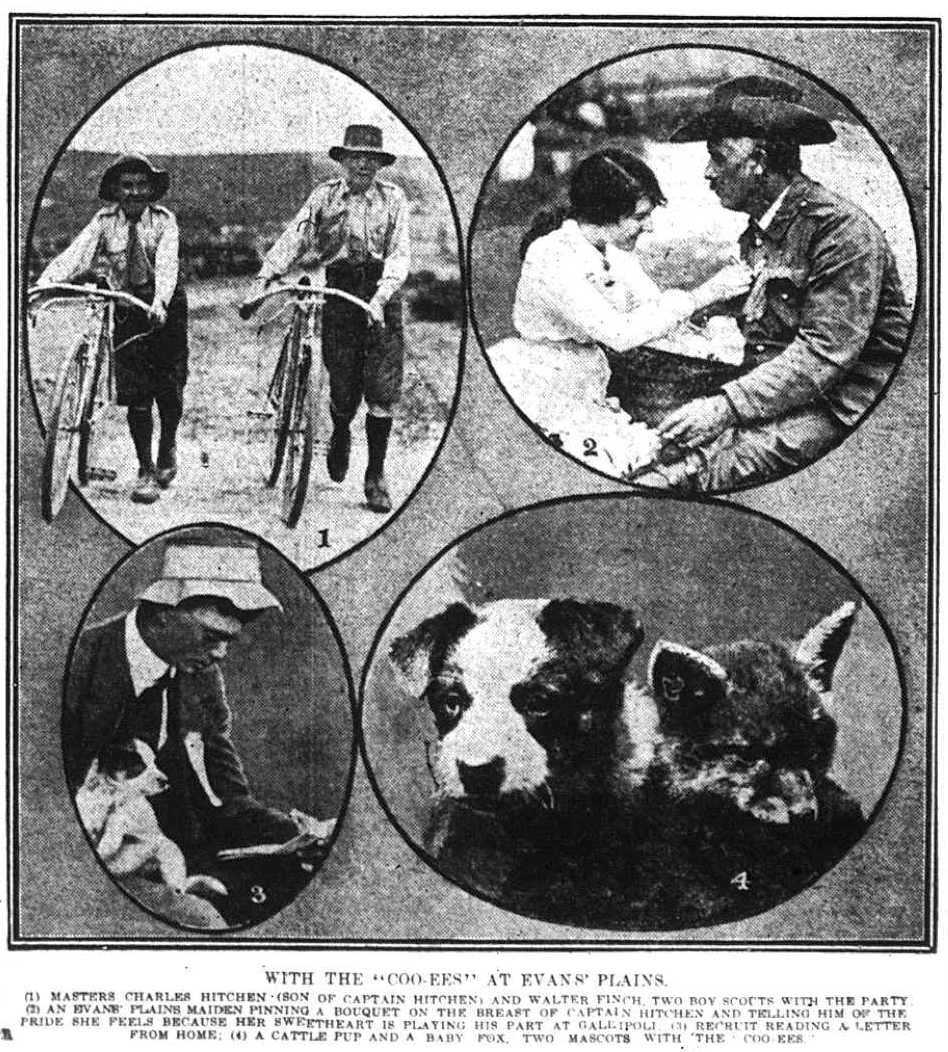
Fox mascot presented to the Coo-ees at Evans Plains

With the Coo-ees at Evans Plains (Daily Telegraph 30/10/1915)

With the Coo-ees at Evans Plains (Daily Telegraph 30/10/1915)

I have often wondered how the Coo-ees ended up with a fox cub as a mascot on the Coo-ee March. This is described in the following article, along with the ‘patriotic songs’ sung by the school children at Evan’s Plains. School children often took part in welcoming and entertaining the Coo-ees at each town and village visited on the march. It is interesting to note that the Coo-ees were expecting to reinforce the Australian men fighting at Gallipoli when they signed up on the Coo-ee March, not the Western Front.

Transcript of an article titled ‘At Evans Plains” published in the Bathurst newspaper National Advocate on 30 October 1915, p. 3.

‘AT EVAN’S-PLAINS.
YOUNG FOX AS MASCOT

The residents of Evan’s Plains extended a hearty welcome to the Gilgandra Coo-ees.   The Cooe-ees arrived about noon on Thursday, escorted by two local horsemen, Messrs. Cecil Colley and Morris Windsor who rode out some distance along the road to meet them. An energetic ladies committee, under the charge of Mrs. J. Dwyer and Miss Ivy Maher, worked hard to make the short stay of the men as pleasant as possible. Mr. Hugh McKay also rendered valuable assistance. Refreshments were served under the poplars on the property of Mr. J. Wardman. Several patriotic songs were rendered by the school children, whilst the good wishes for a safe return were expressed by several of the residents. The Coo-ees were presented by Mr. Frank Windsor with a young fox as a token from the Plains, which they intend to take along with them to Gallipoli.’

Click here to view the article on Trove: http://nla.gov.au/nla.news-article158152710

Arthur Charles REID

Arthur Charles REID (READ)

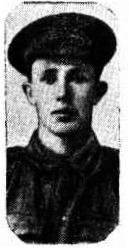
  ‘Gunner A. C. Reed’, (Forbes Advocate 8/12/1916)


‘Gunner A. C. Reed’, (Forbes Advocate 8/12/1916)

Per his military service record (regimental no. 4886), Arthur Charles Reid [or Arthur Charles Reed per his signature or Arthur Charles Read per his 1890 N.S.W. BDM Index birth registration] was born at Forbes, N.S.W. He gave his age as 25 years, his marital status as single, and his occupation as Shearing Machine Expert. His description on his medical was height 5 feet 10 inches tall, weight 13 stone 1 lbs., with a medium complexion, blue eyes, and brown hair. His religious denomination was Church of England. He claimed to have no previous military experience. He was attested on the 5th November at Katoomba, and completed his medical on the 6th November 1915 at Lawson, on the same days that the Coo-ees were in these towns.

He went to Liverpool Camp as reinforcement for the 13th Battalion.

On his embarkation roll his address at time of enrolment was Waitohe Condobolin, N.S.W., and his next of kin is listed as his father, F. H. Reid [Reed or Read], Coerrie [written elsewhere as Colarie or Calarie] Forbes, N.S.W.

Along with many of the Coo-ees, Private Reid departed Sydney on the HMAT Star of England on the 8th March 1916. He arrived in Egypt on the 11th April 1916.

On the 16th April 1916 Private Reid transferred to the 4th Division Artillery and his rank designation changed to Gunner. He was taken of strength of the 10th Field Artillery Brigade in Egypt. On the 27th May 1916 he was taken on strength of the 4th Division Ammunition Column.

On the 6th June 1916 Gunner Reid left Alexandria aboard the Oriana bound for France, arriving at Marseille on the 13th June 1916. On the 25th June 1916 he was taken on strength of the 4th Division Medium Trench Mortar Battery.

On the 8th September 1916 after seeing action on the Somme Gunner Reid had just arrived at the front in the vicinity of Vierssraat, Belgium, when he received a gunshot wound to his head. Private Reid was evacuated to the 11th Canadian Field Ambulance where he died of his wounds the next day.

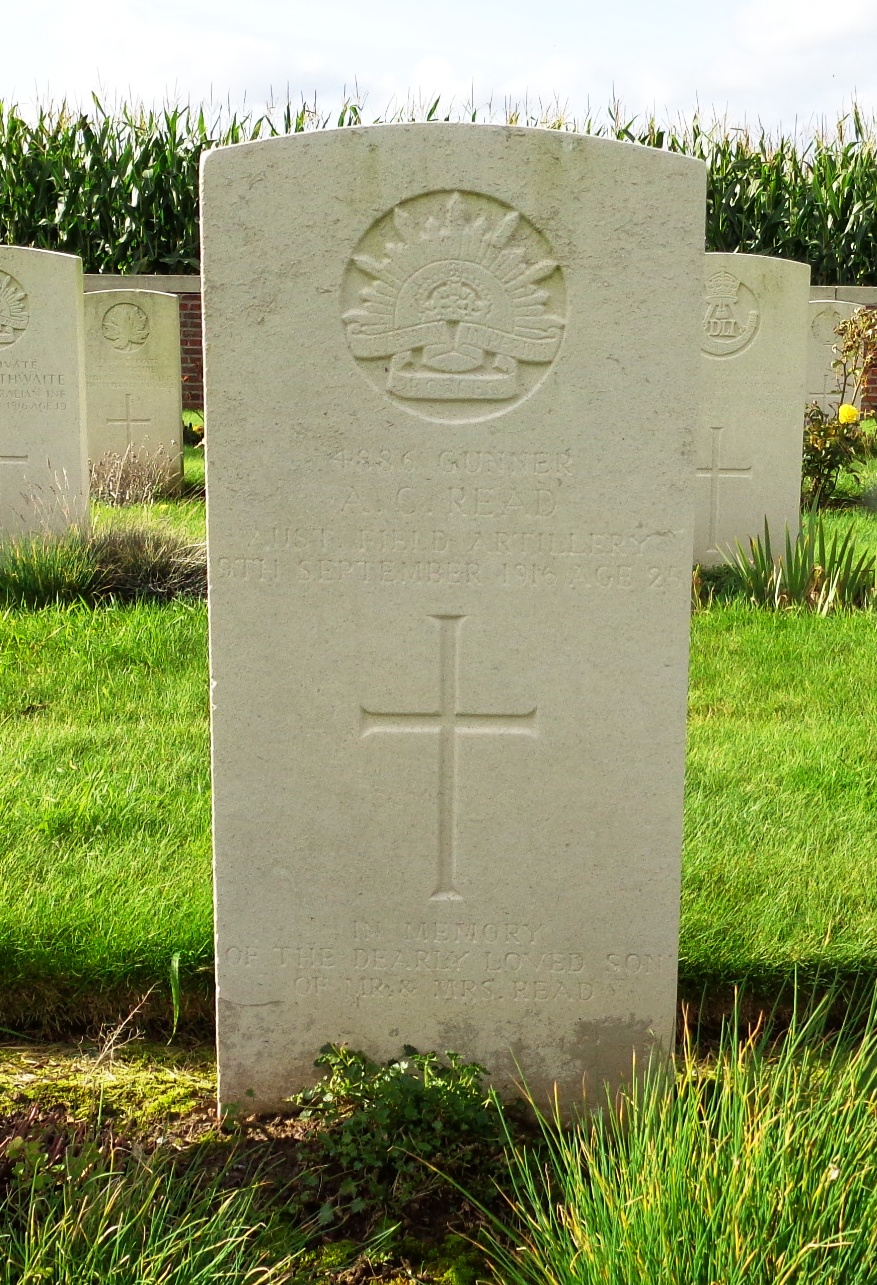
Gunner Reid is buried at the La Clytte Military Cemetery, De Klijte, Flanders, Belgium.

Arthur Charles Reid’s headstone at La Clytte Military Cemetery, Belgium (Photograph: H. Thompson 28/8/2014)


Arthur Charles Reid’s surname is spelt as READ on the headstone. The writing on the headstone is very worn. It reads:

4886 Gunner
A. C. Read
Aust. Field Artillery
9th September 1916 Age 25
In memory
of the dearly loved son
of Mr. & Mrs. Read

Letters home and family photographs

A daughter of Donald Stewart (who joined the Coo-ees at Wellington) contacted me recently via the blog, so I have posted transcriptions of some of the letters he wrote home to his family while he was a prisoner of war in a German prison camp during the First World War, which were published in the family’s local newspaper The Wellington Times.

We are discovering through our research on the Coo-ees that several of them were held as prisoners of war during the First World War, including Donald Stewart from Wellington, Joseph Armstrong who joined the Coo-ees at Dubbo, and Allan Collquhoun and Cecil Roy McMillan, who both joined the Coo-ees at Parramatta.

Letters sent home to family and friends by the Coo-ees – whether they were training in camp, on a troopship, prisoners of war, fighting on the front, or behind the lines – provided information about their experiences during the war, and their thoughts and feelings at the time.  It is great that some of these letters were published in local newspapers during the First World War, so that we can read about their experiences today.

Some family members have also sent me a photograph of their Coo-ee relative, with permission to include it on the individual blog entry for their Coo-ee, and it is fantastic to be able to be able to put a face to the name of individual Coo-ees.

Newspapers also published individual photographs of some of the Coo-ees during the war years, which I have been collecting, but I may not have found all of these yet.  If more photographs become available, I will add these to each individual Coo-ees blog entry.

If anyone has personal letters, diaries, or photographs of the Coo-ees, I would very much like to hear from you. Please email me at cooeemarch1915@gmail.com.

Another letter from Donald Stewart, a Wellington Coo-ee, from inside a German prisoner of war camp

Transcription of an article titled ‘Two years a prisoner of war : letter from Private Don Stewart’ published in the Wellington Times, 19 September, 1918, p. 3.

‘TWO YEARS A PRISONER OF WAR.
LETTER FROM PRIVATE DON STEWART.

Mr. and Mrs. Stewart, of Park Street, Wellington, have received a letter from their son, Private Don Stewart, who for over two years has been a prisoner of war in Germany. The letter is dated from Schneidemuhl, June 10, 1918, and reads:— “Just a few lines, hoping to   find you all well at home. As for me, well, I am feeling pretty fit lately, as we have plenty of fresh air and exercise, which keeps a fellow in good health. I feel a bit tired so I will have a smoke and go to bed and finish writing tomorrow.

Next morning he resumed his letter as follows: “I feel a bit like writing now, so will have a try to finish this letter. I received fourteen letters during last week, on May 30, and two on June 2, from home, also one from Mrs. Mostyn. Two days later I had one from father, and one from mother. I wish they would come every week, although I cannot answer them. Well, dad, it is nearly two years since I was taken prisoner, and how I do wish I were back again at home. I do not think I will want to leave home again in a hurry. The experiences I have had since I left home would do a lot of good to the young chaps who want to leave home at the age I did. Fancy, I had my 17th birthday at Liverpool (England), and my 18th and 19th here in Germany, and in six months I will be 20. I will soon be able to have the key to my door. I am sending you two of my photographs by this letter. (The British censor encloses a slip stating the photos were missing from the letter when it reached England. Evidently they had been taken out by the German censor). I will have my photo taken again soon and will send you some. I saw Private Long a few days ago, and up till then he had not heard about his brother having been killed. I may see him again next week, and see if he has heard anything further. I cannot say much, so will close, hoping you will remember me to all my friends and give my best love to all at home.”

Click here to view the article on Trove: http://nla.gov.au/nla.news-article143228060

To read more about Donald Stewart, click on the Donald S. Stewart tag at the bottom of this blog entry.