Monthly Archives: April 2017

Sydney Raymond CARVER

Sydney Raymond CARVER

Per his military service record (regimental no. 4745), Sydney Raymond Carver was born at Hill End, N.S.W.[1]  He gave his age as 30 years and 6 months, his marital status as single, and his occupation as fettler.  His description on his Certificate of Medical Examination form was height 5 feet 6 inches tall, with a dark complexion, brown eyes, and black hair.  His religious denomination was Methodist.  He claimed that he had served for 5 years in the Hill End Rifle Club.

He was attested by Captain A. C. Eade at Katoomba on 5th November 1915 (the day the Coo-ees marched from Mount Victoria to Katoomba).  He did not complete his medical examination until 13th November 1915 at Liverpool.

After completing the Co-ee March he went to Liverpool Camp as reinforcement for the 13th Battalion.

Sydney Raymond Carver was also known as “Tom” Carver.[2]  He was referred to as ‘Private Tom Carver, of the Coo-ees … home on final leave’, in the Lithgow Mercury on 29th December 1915.[3]

The National Advocate reported that Private S. Carver was given a send-off on Thursday night 30th December 1915 in the Royal Hall at Hill End, where he was presented with a wristlet watch.[4]

On his embarkation roll his address at time of enrolment was Hill End, N.S.W., and his next of kin is listed as his father, B. [Benjamin] Carver, Hill End, N.S.W.

On 8th March 1916 Private Carver, along with many of the other Coo-ees, departed Sydney on the HMAT A15 Star of England.  He arrived in Egypt on 11th April 1916.

On 19th April 1916 he was transferred to the 45th Battalion in Egypt.

On 2nd June 1916 Private Carver left Alexandria aboard the transport Kinfauns Castle bound for France arriving at Marseilles on 8th June 1916.

On 4th July 1916 Private Carver was sent to the 4th Australian Field Ambulance suffering from Influenza.  On 7th July 1916 he was sent to the 4th Division Rest Station.  He rejoined the 45th Battalion on 9th July 1916.

On 30th July 1916 Private Carver was promoted to Lance Corporal.

On 24th August 1916 he was promoted to Corporal.

On 6th April 1917 he was promoted to Sergeant.

On 11th April 1917 the 45th Battalion was moving into the front line in the vicinity of Noreuil, France when Sergeant Carver was wounded in action, receiving a shrapnel wound to his left leg.  He was sent to the 4th Australian Field Ambulance, then moved back to the 9th Casualty Clearing Station, then the 56th Casualty Clearing Station.  On 12th April 1917 he was placed aboard the 11th Ambulance Train.  On 13th April 1917 he was admitted to the 1st General Hospital at Entretat, France.

On 25th April 1917 Sergeant Carver was placed aboard a hospital ship for evacuation to England.  On 26th April 1917 he was admitted to the 2nd Southern General Hospital at Bristol, England.

He was discharged from hospital on 21st May 1917, and granted leave to report to the No. 1 Command Depot at Perham Downs on 5th June 1917.

On 26th June 1917 he was transferred to the Overseas Training Brigade.

On 9th December 1917 Sergeant Carver departed Southampton bound for France.  He arrived at the 4th Australian Division Base Depot at Le Harve, France, on 10th December 1917.

He rejoined the 45th Battalion when it was training at Haut Allaines, France, on 16th December 1917.

On 5th April 1918 the 45th Battalion was in action around Dernacourt, France, when Sergeant Carver was wounded in action for the second time, receiving a gunshot wound to his abdomen.  He was sent to the 13th Australian Field Ambulance, then back to the 29th Casualty Clearing Station.  On 6th April 1918 he was placed aboard the 27th Ambulance Train being admitted to the 7th Canadian General Hospital on the 7th of April 1918 at Etaples, France.

On 25th April 1918 he was placed aboard the Hospital Ship Princess Elizabeth for evacuation to England.  On 26th April 1918 he was admitted to the County of Middlesex War Hospital at Napsbury  in England.

On 3rd June 1918 he was transferred to the 1st Australian Auxiliary Hospital at Harefield, England.  He was discharged on 18th June 1918 and sent to the No. 3 Command Depot at Hurdcott, England.

On 3rd July 1918 Sergeant Carver was admitted to the Fovant Military Hospital sick.  He was discharged on 31st July 1918.

On 11th September 1918 Sergeant Carver was transferred to the No. 1 Command Depot at Sutton Veny, England.

On 21st October 1918 Sergeant Carver was sent to the Overseas Training Brigade.

He departed Southampton on 21st November 1918 bound for France.  He arrived at the 4th Australian Division Base Depot at Le Harve, France, on 22nd November 1918.

He rejoined the 45th Battalion in France on 1st December 1918.

On 19th March 1919 Sergeant Carver was sent to the 12th Australian Field Ambulance sick with old abdomen wound.  He was discharged, and rejoined the 45th Battalion, on 25th March 1919.

On 6th April 1919 Sergeant Carver was sent to the Australian Base Depot at Le Harve.

On 11th April 1919 Sergeant Carver was admitted to the 39th General Hospital sick at Le Havre.

On 18th April 1918 he was placed aboard a hospital ship for evacuation to England.  He was admitted to the 1st Australian Dermatological Hospital at Bulford, England, on 19th April 1919.

He was discharged on 4th July 1919 and sent to the No. 2 Depot at Sutton Veny, England.

On 23rd July 1919 Sergeant Carver departed England aboard the H.T. Suevic bound for Australia.

He arrived in Australia 10th September 1919, and was discharged medically unfit on 10th November 1919.

The Mudgee Guardian and North-Western Representative reported that Sergeant Carver was one of the soldiers who were given a welcome home at a large gathering held at the Royal Hall in Hill End on Friday 3rd October 1919.  Each soldier was given an inscribed gold medal, and a ‘useful bundle of clothing from the ladies’ knitting circle’.[5]

Research note: Sydney Raymond ‘Tom’ Carver was not named in The Blue Mountain Echo as one of ‘the lads who answered the call, and marched out with the Coo-ees’ at Katoomba.[6]  His “Joined on” date on his Attestation Paper is 5th November 1915, so it appears possible that he may have joined the Coo-ees somewhere on that day before they reached Katoomba. The Coo-ees picked up two recruits in Blackheath on route from Mount Victoria to Katoomba.[7]  One of these men was Thomas Walsh.  ‘T. Carver’ and ‘T. Walsh’ are listed together on the Blackheath Roll of Honor published in The Blue Mountain Echo on 13th April 1917.[8]  It appears a possibility that ‘Tom’ Carver may have been the other recruit who joined the Coo-ees at Blackheath.  

[1] NAA: B2455, CARVER S R

[2] ‘CARVER, Sydney Raymond (Tom) : Service Number – 4745’’, Hill End War Memorial, http://www.heatgg.org.au/resources/databases/hill-end-war-memorial/

[3] ‘Hill End’, Lithgow Mercury, 29 December 1915, p. 4. Retrieved March 27, 2017, from http://nla.gov.au/nla.news-article218453720

[4] ‘’Hill End Recruits’, National Advocate, 6 January 1916, p. 3. Retrieved March 27, 2017, from http://nla.gov.au/nla.news-article158046862

[5] ‘Soldiers’ Welcome Home’, Mudgee Guardian and North-Western Representative, 9 October 1919, p. 12. Retrieved March 27, 2017, from http://nla.gov.au/nla.news-article157039404

[6] ‘March o’er the Mountains’, The Blue Mountain Echo, 12 November 1915, p. 2. Retrieved September 21, 2015, from http://nla.gov.au/nla.news-article108042142  [on page 3]

[7] ‘The Route March’, The Farmer and Settler,  9 November 1915, p. 3. Retrieved March 27, 2017, from http://nla.gov.au/nla.news-article116669569

[8] ‘Eastertide at Blackheath’, The Blue Mountain Echo, 13 April 1917, p. 3. Retrieved March 29, 2017, from http://nla.gov.au/nla.news-article108244227
Thomas WALSH

Thomas WALSH

Per his military service record (Depot), Thomas Walsh was born in Melbourne, Victoria.[1]  He gave his age as 43 years and 4 months, his marital status as single, and his occupation as labourer.  His description on his Certificate of Medical Examination was height 5 feet 6 inches tall, weight 9 stone 7 lbs., with a dark complexion, grey eyes, and brown hair.  His religious denomination was Church of England.  He claimed he had no previous military experience. Marked against his next of kin on his Attestation Paper was “No Relatives”.

He was attested at Katoomba by Captain A. C. Eade on 5th November 1915 (the day the Coo-ees marched from Mount Victoria to Katoomba).  He did not complete his medical examination until 13th November 1915 at Liverpool.

He appears to have been one of the two recruits that joined the Coo-ees at Blackheath during their march from Mount Victoria to Katoomba on 5th November 1915.  His initial Application to enlist in the Australian Imperial Force form dated 5th November 1915 was addressed to the Recruiting officer at Blackheath, and his postal address was left blank.  The Preliminary Medical Examination section was signed by a medical officer at Blackheath on 5th November 1915.  The Certificate of Recruiting Officer section at the bottom of this form was signed by Captain Eade at Lawson on 7th November 1915.

After completing the Coo-ee March he went to Liverpool Camp as reinforcement for the 13th Battalion.

However, it appears that his service in the Australian Imperial Force was short.

On 15th January 1916 Private Walsh was posted as a deserter. A warrant for his arrest was issued the on 19th February 1916. The warrant was withdrawn on the 13th of January 1920.

Research note: It may just be a coincidence, but the signature of this Thomas Walsh is very similar to that of another Thomas Walsh aged 43 years and 5 months, who was attested at Liverpool on 20th January 1916, who was also born at Melbourne, and was assigned to the same company that the Coo-ees were initially assigned to in the 13th Battalion.  The “Joined on” date of this Thomas Walsh was 4th November 1915, but there is nothing in his service record to indicate where this occurred.  This Thomas Walsh was sent overseas in May 1916, served on the Western Front, and returned to Australia in 1917.  However his next of kin was listed as his mother, who had a different surname, and there were some small differences with his appearance, and a different occupation was listed.

[1] NAA: B2455, WALSH THOMAS

John Hole SAUNDERS

John Hole SAUNDERS

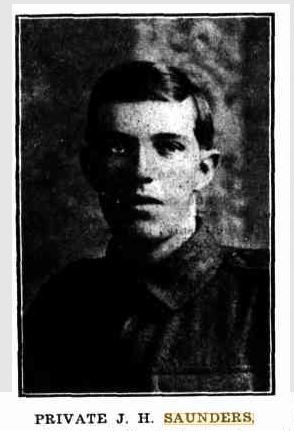
Private J. H. Saunders (Cumberland Argus and Fruitgrowers Advocate 27/5/1916)

Per his military service record (regimental no. 5766), John Hole Saunders was born at Parramatta, N.S.W.[1]  He gave his age as 18 years and 10 months, his marital status as single, and his occupation as shop assistant.  His description on his Certificate of Medical Examination form was height 5 feet 7 ½ inches tall, weight 123 lbs., with a fair complexion, blue eyes, and brown hair. His religious denomination was Methodist.  He claimed to have 4 years universal military training and was still serving.

He completed his medical examination on 10th November 1915 at Parramatta, and was attested by Lieutenant R. Howe at Parramatta on 11th November 1915, when the Coo-ees were recruiting at Parramatta.  He claimed that he had 4 years military service in the Cadets.

After completing the Coo-ee March he went to Liverpool Camp as reinforcement for the 13th Battalion.

The Cumberland Argus and Fruitgrowers Advocate reported that Private ‘Jack’ Saunders’ was presented with a silver-mounted pipe, fountain pen, and other articles, at a send-off held for him and fellow Parramatta recruit Private Roy McMillan, at Parramatta on Monday 14th February 1916. [2]

On his embarkation roll his address at time of enrolment was Dersmore, Crimea Street, Parramatta, N.S.W., and his next of kin is listed as his father, J. H. [John Hole] Saunders, at the same address.

On 3rd May 1916 Private Saunders departed Sydney on the HMAT A46 Clan McGillivray, as part of the 18th reinforcements for the 13th Battalion.

He arrived in Egypt in June 1916.

On Te-el-Kebir on 25th July 1916 Private Saunders was charged with conduct to the prejudice of good order and military discipline in that whilst on a route march disobeyed an order directly given by his superior officer.  He was awarded 2 days confined to barracks.

On 8th August 1916 Private Saunders departed Egypt bound for England aboard the Transport Megantic.

On 12th December 1916 Private Saunders departed Folkestone, England, aboard the SS Arundle bound for France.  He marched into the 4th Australian Division Base Depot at Etaples, France on 13th December 1916.

On 19th December 1916 Private Saunders marched into the 13th Battalion when it was training at Coisy, France.

On 13th January 1917 the 13th Battalion was conducting fatigue duties at Mametz, France, when Private Saunders was evacuated the 5th Australian Field Ambulance sick with Influenza.  On 15th January 1917 he was sent to the 38th Casualty Clearing Station, then placed aboard the 25th Ambulance Train for journey to No. 10 General Hospital at Rouen, France.

On 26th January 1917 he was released from hospital and sent to the 4th Australian Division Base Depot at Etaples, France.

He rejoined the 13th Battalion on 16th February 1917 whilst it was training and performing fatigue duties at Mametz, France.

On 11th April 1917 the 13th Battalion was involved in the attack on the Hindenburg line in the 1st Battle of Bullecourt, France, when Private Saunders was evacuated to the 8th Australian Field Ambulance suffering Asthma.  He was moved to the 4th Australian Field Ambulance, then sent to the 56th Casualty Clearing Station on the 20th April 1917.  On 23rd April 1917 he was transferred to the 11th Stationary Hospital at Rouen, France.

He was discharged from hospital on 26th April 1017 and sent to the 4th Australian Division Base Depot at Etaples, France.  Whilst at the 4th Australian Division Base Depot Private Saunders was classified as “PB” [Permanent Base duties].

On 29th May 1919 he departed France bound for England with the status “P.B.”

Private Saunders arrived in Weymouth on 30th May 1917 and marched into the No. 2 Command Depot.

On the 4th of June 1917 he was transferred to the No. 1 Command Depot at Perham Downs, England.

On 9th June 1917 Private Saunders was classified as “B1A4” [fit for overseas training camp when passed dentally fit].[3]

On 13th September 1917 Private Saunders was reclassified as “A3” [fit for overseas training camp, to which transferred for hardening, prior to rejoining unit overseas].[4]

On 14th September 1917 Private Saunders was sent to the Headquarters Depots at Tidworth, England, to perform guard duties.

On 25th October 1917 Private Saunders was temporarily detached for duty at the Administrative Headquarters in London.

On 4th December 1917 Private Saunders was sent to the No. 3 Command Depot at Hurdcott, England.  On 5th December 1917 he was reclassified as “B1A3” [fit for overseas training camp in two to three weeks].[5]

On 15th December 1917 Private Saunders was reclassified “A3” [fit for overseas training camp, to which transferred for hardening, prior to rejoining unit overseas].[6]

On 19th December 1917 Private Saunders was transferred to the Overseas Training Brigade at Longbridge Deverill, England.

On 10th January 1918 he departed Southampton, England, bound for France.  He marched into the 4th Australian Division Base Depot at Le Harve, France, on 11th January 1918.

On 18th January 1918 Private Saunders rejoined the 13th Battalion on 18th January 1918 when it was training at Locre, Belgium.

On 27th January 1918 the 13th Battalion was at White Chateau was manning the front line near Hollebeke in Belgium when Private Saunders was evacuated to the 13th Australian Field Ambulance suffering Balantitis.  He was moved back to the 2nd Australian Casualty Clearing Station.  On 29th January 1918 he was placed aboard the 39th Ambulance Train and transported to the 39th General Hospital at Le Havre France, where he was admitted on 1st February 1918. He was discharged on 3rd February 1918, and sent to the 4th Australian Division Base depot at Le Harve.

He rejoined the 13th Battalion on 12th of February 1918 when it was training at Locre, Belgium.

On 9th May 1918 the 13th Battalion was manning support lines near Villers Bretonneux, France, when Private Saunders was evacuated to the 13th Australian Field Ambulance sick.  He was moved back to the 61st Casualty Clearing Station then on 10th May 1918 he was placed aboard the 28th Ambulance Train for journey to the 39th General Hospital at Le Harve, France, where he was admitted on13th May 1918.

Private Saunders was discharged from hospital on 16th July 1918 and marched into the 4th Australian Division Base Depot at Le Harve that same day.

He rejoined the 13th Battalion on 3rd August 1918 when it was manning the front line south of Villers Bretonneux, France.

On 7th August 1918 the 13th Battalion was preparing to move forward to participate in an attack on the German lines  around Amiens when Private Saunders went absent without leave at 9.30 p.m.  He returned at 9.15 a.m. on 12th August 1918. On 22nd August 1918 he was charged with being absent without leave, and was awarded 28 days field punishment No. 2 and fined 33 days pay.

On 15th September 1918 the 13th Battalion was preparing to move forward to the front line when Private Saunders went absent without leave again.

He was located on 18th September 1918 and charged with desertion.  On 7th October 1918 a Field General Courts Martial was held where Private Saunders was charged with Desertion.  He pleaded Not Guilty.  He was found Guilty, and he was sentenced to serve 10 years Penal Servitude.

On 8th November 1918 Private Saunders marched into the No. 1 Military Prison at Rouen, France.

On 17th February 1919 he was transferred to England on SS Nirvana to serve the remainder of his sentence.  On 19th February 1919 Private Saunders marched into His Majesty’s Prison at Portland in England.

On 25th April 1919 Private Saunders’ prison sentence was suspended, and he was released and marched into the No. 4 Group at Hurdcott, England, on 26th April 1919.

On 2nd June 1919 Private Saunders departed Devonport, England, aboard the HT Beltana bound for Australia.

He arrived in Sydney on 20th July 1919, and was discharged Termination of Period of Enlistment on 4th September 1919.


[1] NAA B2455, SAUNDERS JOHN HOB

[2] ‘The Sheepskin Fund’, The Cumberland Argus and Fruitgrowers Advocate, 19 February 1916, p. 11. Retrieved March 12, 2017, from http://nla.gov.au/nla.news-article86072411

[3] Department of Veterans Affairs, ‘Army Medical Classifications – World War 1’ in Chapter 5 Abbreviations and Medical Classifications’, http://www.dva.gov.au/consultation-and-grants/advocacy-training/repatriation-handbooks

[4] Ibid.

[5] Ibid.

[6] Ibid.

Reginald Arthur COWELL

Reginald Arthur COWELL

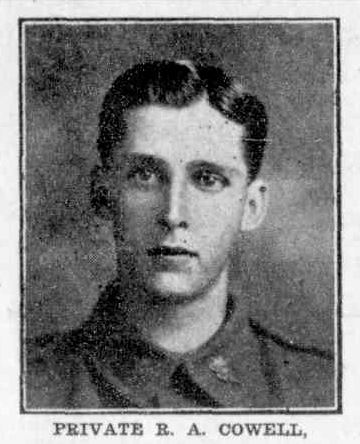
Private R. A. Cowell (Cumberland Argus and Fruitgrowers Advocate 19/1/1918)

Per his military service record (regimental no. 4751), Reginald Arthur Cowell was born at Ermington, N.S.W.[1]  He gave his age as 19 years 5 months, his marital status as single, and his occupation as nurseryman.  His description on his Certificate of Medical Examination form was height 5 feet 8 inches tall, weight 132 lbs., with a sallow complexion, brown eyes, and dark brown hair.  His religious denomination was Church of England.  He claimed that he had no previous military service.

Reginald Arthur Cowell joined the Coo-ees at Parramatta.[2]  The Coo-ees had held a recruiting meeting in the Park at Parramatta on the evening of the 10th November, where it was reported that 41 men had offered themselves as recruits.[3]

He completed his medical examination at Parramatta on 10th November 1915, and was attested by Lieutenant R. Howe at Parramatta on 11th November 1915.

After completing the Co-ee March he went to Liverpool Camp as reinforcement for the 13th Battalion.

The Cumberland Argus and Fruitgrowers Advocate reported on 11th March 1916 that a send-off had been given for Private Reginald Cowell the previous Friday ‘who is leaving with the Coo-ees this week for the front’, and that he was presented ‘with a silver-mounted pipe, tobacco pouch and silver pencil’.[4]

On his embarkation roll his address at time of enrolment was Excelsior Avenue, Castle Hill, N.S.W., and his next of kin is listed as his father, W. A. [William Arthur] Cowell, at the same address.

On 8th March 1916 Private Cowell, along with many of the other Coo-ees, departed Sydney on the HMAT A15 Star of England, and arrived in Egypt on 11th April 1916.

On 7th June 1916 Private Cowell left Alexandria aboard the Transport Ionian bound for France, and he arrived at Marseilles on 14th June 1916.

Private Cowell, (along with several other Coo-ees, including Privates Watson, Easterbrook, Healey, and Mason), marched into the 13th Battalion on 19th August 1916 when it was resting and reorganising at Pernois, France.

On 23rd September 1916 the 13th Battalion was manning the front line in the vicinity of Voormezeele, Belgium when Private Cowell was transferred to the 4th Division Light Trench Mortar Battery.

On 25th September he was taken on strength of the 4th Division Light Trench Mortar Battery in the vicinity of Voormezeele, Belgium.

On 11th April 1917 the 4th Division Light Trench Mortar Battery was involved in the attack on the Hindenburg Line in the vicinity of Bullecourt, France, when Private Cowell was wounded in action, receiving at shrapnel wound to his face.  He was evacuated to the 4th Australian Field Ambulance.  He was then moved back to the 9th Casualty Clearing Station.  On 12th April he was placed aboard the 11th Ambulance Train. He was admitted to the 1st General Hospital at Rouen on 13th April 1917.

On 28th April 1917 Private Cowell was discharged to Base details and sent to the 4th Australian Division Base Depot at Le Harve, France.

On 22nd June 1917 Private Cowell was charged with being absent without leave from Sick Parade.  He was awarded forfeiture of two days pay.

On 1st July 1917 Private Cowell departed the 4th Australian Division Base Depot to return to his unit.  He joined the 4th Division Light Trench Mortar Battery on 5th July 1917 when it was manning the front line in the vicinity of Ypres, Belgium.

On 19th October 1917 Private Cowell was with the 4th Division Light Trench Mortar Battery manning the front line in the vicinity of Passchendaele, Belgium, when he was wounded in action for the second time, receiving a shrapnel wound to his right eye.  He was evacuated to the 4th Australian Field Ambulance.  On 26th October 1917 he was discharged and returned to his unit in Belgium.

On 5th September 1918 Private Cowell was sent to England on leave.  He returned to his unit in France from leave on 23rd September 1918.

On 30th January 1919 Private Cowell was sent to the Australian Base Depot at Le Harve to begin his return to Australia.  He left Le Harve on 10th February 1919, and arrived at Weymouth in England on 11th February 1919.

On 15th February 1919 Private Cowell was admitted to the Fovant Military Hospital seriously ill with Broncho Pneumonia.  On 27th February 1919 he was transferred to the 1st Australian General Hospital at Sutton Veny, England.  He was discharged from hospital to the 3rd Training Brigade on 15th March 1919.

Private Cowell departed England aboard the H.T. Commonwealth bound for Australia on 13th April 1919.

He arrived in Australia on 12th June 1919, and was discharged on 17th October 1919.


[1] NAA: B2455, COWELL R A

[2] ‘Our Brave Boys on the Battle Fields’, The Cumberland Argus and Fruitgrowers Advocate, 19 January 1918, p. 4. Retrieved April 1, 2017, from http://nla.gov.au/nla.news-article86205203

[3] ‘The procession’, The Cumberland Argus and Fruitgrowers Advocate, 13 November 1915, p. 11, http://nla.gov.au/nla.news-article86101767

[4] ‘A Send-off’, The Cumberland Argus and Fruitgrowers Advocate, 11 March 1916, p. 11. Retrieved March 27, 2017, from http://nla.gov.au/nla.news-article86070741