Yearly Archives: 2014

The Coo-ees: moving pictures of the march

Moving pictures were taken of the 1915 Coo-ee March, and shown in many NSW picture theatres soon after the march finished.

The Dubbo Liberal and Macquarie Advocate (29 October 1915, p. 4) reported the following about the moving pictures taken of the march:
‘Poets may sing, their songs may survive through generations; their burning words may cause posterity to thrill with pride; statesmen may find fame, and Australian soldiers win their wreaths of glory. But Bill Hitchen, his name and his memory, will survive unto the end of time, and 500 years hence, let us hope, the moving pictures will show the people of that futurity Bill Hitchen and his “Coo-ees” on their magnetic march to the front. We hope the idea will not be forgotten.’[1]

Mr. H. T. Blacket from Dubbo (who accompanied the Coo-ees in his motor car) wrote about the film taken in a letter to his wife written on 31st October 1915 while the Coo-ees were in Wallerawang, which was published in The Dubbo Liberal and Macquarie Advocate (2 November 1915, p. 3):
“… The march to Bathurst was most imposing, and a moving picture was taken. If it is on at Dubbo you should see it. Ask the picture men to let you know if any of the “Coo-ee” pictures are to be shown.”[2]

The contents of the film was described in the Orange newspaper The Leader (24 November 1915, p. 2) as follows:
‘THE COO-EES AT THE MONARCHS
To-morrow night all Orange should pack the Monarchs’ Picture palace to view the screening of Hitchen’s Gilgandra Coo-ees’ entry into Orange. There will be 1100 feet of film shown depicting the crowd lining the route of march down Byng Street, the reception at the Town Hall, and incidents connected with the contingent. It is safe to say that every person who came into the scope of the camera will wish to see how he or she looks on the screen, and there fore we predict a big house. There will also be shown the entry into Wellington, Lithgow, Katoomba, etc till the final grand entry into Martin Place, Sydney. A chance is offered to the public of Orange to visit the Monarchs to-morrow night to pick out their friends and themselves. We understand that the pictures are exceedingly clear, and a triumph in local motion photography.’[3]

Another advertisement in The Leader (12 November 1915, p. 7) lists the film appearing at Monarch Pictures as ‘Australian Gazette … Gilgandra Coo-ees’, with the description ‘Showing from Wellington to their arrival in Sydney. See the Coo-ees and yourself while they were in Orange’.[4]

An advertisement in the Sunday Times (14 November, 1915, p. 16) describes footage of the Coo-ees marching through Enmore and Newton in Sydney:
‘ENMORE THEATRE
… WE WILL SCREEN ALL NEXT WEEK,
A MOVING PICTURE
OF THE
“GILGANDRA COO-EES” WELCOME
That took place at Enmore Theatre, on Friday, Showing
MARCH THROUGH ENMORE AND NEWTON,
And the Crowds outside the
ENMORE THEATRE.
See Yourself in this Great Australian Event.’[5]

I found a reference to a film titled ‘Australian Gazette, c1915. WW1 Recruitment Drive’ on the National Film and Sound Archive catalogue, and purchased a copy of the film a few months ago. The film is of the Coo-ee March, but is so badly deteriorated that of the approximately 6.5 minutes of film, only about 20-30 seconds remains visible, and this was of very poor quality. The film’s title cards ‘Arrival at Wellington’, ‘The reception at Orange’, ‘Calling for recruits at the Town Hall’ , ‘Crossing the Blue Mountains near Lawson’, ‘The arrival at Sydney on Friday 12th November’, and ‘A cheer from the wounded soldiers’ are still visible on the deteriorated film. From the content of this film, it appears it may be the same film as the Australian Gazette ‘Gilgandra Coo-ees’ film that was widely screened soon after the Coo-ee March finished in late 1915.

Unfortunately it appears that the film taken of the Coo-ee March, which apparently was made into numerous copies, and shown in many picture theatres, has not survived even 100 years.

I do not know if the NFSA has the only copy of this film that survives to the current day, but it is a great shame that of all the copies that were circulated and shown in late 1915, not a single one appears to have survived in a viewable format.

If anyone knows of any surviving film footage of the 1915 Coo-ee March please contact me.

[1] ‘Our Soldiers, The Dubbo Liberal and Macquarie Advocate, 29 October 1915, p. 4, http://nla.gov.au/nla.news-article77601711

[2] ‘The “Coo-ees” : a day by day account’, The Dubbo Liberal and Macquarie Advocate, 2 November 1915, p. 3, http://nla.gov.au/nla.news-article77601738

[3] ‘The Coo-ees at the Monarchs’, Leader, 24 November 1915, p. 2, http://nla.gov.au/nla.news-article117844056

[4] ‘Advertising … Monarch Pictures, to-morrow night’, The Leader, 12 November 1915, p. 7, http://nla.gov.au/nla.news-article117843475

[5] Advertising… Enmore Theatre’, Sunday Times, 14 November 1915, p. 16, http://nla.gov.au/nla.news-article120806468

The Coo-ees grow tired of talkers : an open letter to the Mayor of Blayney

Transcription of an article titled “The Coo-ees “ from The Bathurst Times, 26 October, 1915, p. 3.

‘“THE COO-EES.”
GROW TIRED OF TALKERS.
AN OPEN LETTER TO THE MAYOR OF BLAYNEY.

Dear Mr. Mayor, — It is said that the brave Coo-ees from Gilgandra are growing tired of listening to addresses. In the hope that Blayney will use the good sense for which it is noted, these lines are respectfully penned to its chief citizen.

When we reach the town of Blayney
you can give us of your cheer,
You can spread a meal before us with
perhaps a glass of beer;
You can give us pipes and matches, and
a pair or two of socks,
But don’t allow the fellow near who
only talks and talks!

They talked at us in Dubbo, and they
talked in Wellington,
They chin-chined too, at Geurie, and
we thought it only fun;
At Stuart Town and Orange they dished
up the same old stuff
So now we’re getting sick of it, we
feel we’ve had enough!

We ‘ve got to visit Bathurst and a dozen
other towns,
And want to show a smiling face, and
not a face of frowns;
But when they fire speeches at a bloke
from morn till dark
He’s bound to cut up rusty; it would
make an angel nark!

Unless a change is brought about I’ll
give the game a break,
Because, you see, they’ll kill us with
the speeches that they make!
Why don’t they bottle up their gab,
just let ’em get to work
They ought to leave our chaps alone
and try it on a Turk!

When we left old Gilgandra we were fit
for anything,
Because we love our Empire, and be-
cause we love our King,
But since we’ve got along the road that
leads to Coogee Beach,
We’ve grown to hate the thoughts of
men who want to make a speech.

So Mister Mayor, if you please, don’t
take us in and talk,
Just mind that we are tired, for
we’ve had a weary walk,
Just give us each a hand grip; there
is not a bettor way
To let a fellow understand the words
you’d like to say.

Yours truly, DOUBLE O SIX.
Gilgandra Troop,
On the Wallaby,
Millthorpe, Monday.’

Click here to view the article on Trove: http://nla.gov.au/nla.news-article111234721


Mr. G. J. Gilmour: sheepskin vests, and ‘records of the march’

Mr George John Gilmour, of Rose Street, Chatswood, was a former resident of the Gilgandra district, and a director of The Land newspaper.  Following a visit to meet the Coo-ees when they were in Lawson, he arranged for funds to be raised to purchase sheepskin vests for the Coo-ees, which were presented to them on Friday 14th January 1916 at Her Majesty’s Theatre.[1]

According to an article in The Land newspaper (31 March 1916), Mr Gilmour also proposed to collect ‘records of the march’, for ‘purposes of record in the Mitchell Library’, which would include ‘the photograph, signature, place of enlistment, and country addresses of each member of this, the first of the route marches, together with the relevant original correspondence’ in ‘consultation with Mr. Hugh Wright, the Librarian, Mr. H. P. Williams, Managing Editor of “The Land”, and Mr. Palmer of the Immigration and Tourist Bureau’.  The article also stated that ‘Mr. Palmer, who as a member of Headquarters Staff, was closely associated with the Gilgandra march, already has in his possession a card containing the autographs of the officers and men, obtained when the “Coo-ees” were the guests of Katoomba, and this will be incorporated with the record of the march.’[2]

I contacted the State Library of New South Wales regarding these records a few months ago, but unfortunately it appears that they were not collected and given to the Mitchell Library, which has no record of receiving them.

It was a commendable proposal, but the majority of the Coo-ees by this time had already left for Egypt in February and early March 1916.


[1] “Presentations to the “Coo-ees”, The Land,  21 January 1916, p.12, http://nla.gov.au/nla.news-article102926246

[2] “The Answering Coo-ees”, The Land, 31 March, 1916, p. 12, http://nla.gov.au/nla.news-article102928312

Final Parade and Inspection

Transcription of an article titled ‘The “Coo-ees” to Parade’ in The Farmer and Settler, 7 March, 1916, p. 3.

‘THE “COO-EES” TO PARADE
The “15th of the 13th.”

The Gilgandra “Coo-ees,” who made history last year by marching “from the sunset to the sea,” have nearly finished their period of training at Liverpool, and will soon be on the troopship en route for the seat of war. Some have already sailed as a part of the 14th reinforcements for the 13th Battalion, some are in the Light Horse, and in the Artillery, others, again, have entered the non-coms. school ; but the bulk of the original “Coo-ees” are still in the infantry. Of the 270 men that marched in to Liverpool camp, 220 are still with the force — a good percentage.

The “Coo-ees” are known in official circles as the 15th Reinforcements to the 13th Battalion, and they will parade for inspection in Sydney today as a part of a battalion that has become famous on account of its glorious deeds at the front. The “Coo-ees” arc proud to belong to it, and are determined to add to its good name.’

Click here to access the article on Trove: http://nla.gov.au/nla.news-article116666873

Transcription of an article titled ‘Reinforcements’ in The Sydney Morning Herald, 8 March, 1916, p. 13.

‘REINFORCEMENTS.
INSPECTED BY THE STATE GOVERNOR.
A SPLENDID SHOWING.

The heavy rain of the morning made it appear as if the inspection of reinforcements arranged for yesterday afternoon would not take place, and that the men would be merely marched from the Central Railway Station to the Royal Agricultural Show Ground, and for this contingency all arrangements had been made by Headquarters’ Staff. By midday, however, the sun came out; the black clouds disappeared, and when the men arrived from Liverpool the sky was brilliantly blue, flecked here and there only by masses of white cloud. To music supplied by the Liverpool Depot Band and the Casula Band, the reinforcements marched from the railway station, via Eddy-avenue, Elizabeth-street, Wentworth-avenue, and College-street to the outer Domain, entering by the St. Mary’s gates.

By the time the troops had assembled there was a large concourse of people to welcome them, and the parade ground presented an animated spectacle with the long, unbroken lines of khaki in tho centre, and the variegated colours of the ladies’ dresses, banked up on the four sides of the square. Shortly before 4 o’clock the various reinforcements arrived, and took up their positions, with their flags fluttering in the breeze, and the bands playing martial airs. Military and civil police kept the square free of spectators, and as the hour for the inspection struck, Brigadier-General Ramaciotti, accompanied by his orderly officer, Lieut. Frank Smith, of the 13th   Battalion, Major Sadler (General Staff Officer), and Captain Stokes (of the General Staff) arrived at the ground, and were ac- corded the general salute.

Tho Commandant made an inspection of all ranks, which included the 15th Reinforcements of the 1st Battalion; reinforcements for the 2nd, 3rd, 13th, 17th, and l8th Battalions; 2nd Divisional Train; 1st and 2nd Light Horse Brigade Trains; 7th Australian Army Service Corps; 1st Light Horse Field Ambulance; 5th and 8th Field Ambulance; the 1st and 2nd Reinforcements of the Mobile Veterinary Sections, and the 2nd Australian Remount Units, comprising the 5th, 6th, 7th, and 8th squadrons.

Major C. V. Watson was in command of the whole parade, and the men stretched in a deep, unbroken line from the path in front of Richmond-terrace to the eastern side of the parade ground.

As the general salute was sounded and the Commandant, accompanied by his staff, set out on his tour of inspection, the sight was an inspiring one. Under a typical Australian sky the men stood rank on rank, making a fine showing, and the brilliant costumes of the ladies only made a fitting setting for the sombre khaki, backed as they were by the foliage of a hundred dark green shade trees.

On the conclusion of his inspection the general returned to the saluting base, and was joined by his Excellency Sir Gerald Strickland, the Governor, and his A.D.C., Captain Firth. This was the moment for the march-past, and the various reinforcements swung along with their regimental colours in quick time.

Major Watson, having passed the base, wheeled, and joined his Excellency and General Ramaciotti at the saluting base, and watched the men whom he has trained swing by. They were a fine level lot, hard as nails, and brown as the proverbial berry, and looked fit enough to give a good account of themselves against any enemy on whom they might be flung. Conspicuous among the colours carried was that of the 15th Reinforcements of the 1st Battalion, recently presented to the men by Miss Dorothy Brunton.

At the conclusion of the march-past, Brigadier-General Ramaciotti stated that his Excellency was very pleased with the showing of the men, and the fine way in which they had marched past.

Before leaving the ground Sir Gerald Strickland, accompanied by the District Commandant and their staffs, inspected the Garrison Military Police on duty, under Sergeant-Major Harber, and congratulated him on the fine physique of his men.’

Click here to access the article on Trove: http://nla.gov.au/nla.news-article15662163

Photograph and caption with heading ‘The State Commandant inspecting the Gilgandra “Coo-ees” in Sydney’ in The Sydney Mail, 15 March 1916, p. 8.

The State Commandant inspecting the "Coo-ees" in Sydney (Sydney Mail 15/3/1916)

The State Commandant inspecting the “Coo-ees” in Sydney (Sydney Mail 15/3/1916)

‘The State Commandant Inspecting the Gilgandra “Coo-ees” in Sydney.
The inspection was made the day before the troops sailed for the front. The “Coo-ees,” it will be remembered, originated the route marches which have done much to stimulate the recruiting movement.

After several months training they have developed into excellent soldiers, and their delight knew no bounds when they learned definitely that at last their time had come to board a troopship, and sail off to strengthen then ranks of their comrades at the front. Their example should be followed by every man fit and free to go. The call for volunteers is now more insistent than ever.’

The Coo-ees in Liverpool Camp

Transcription of an article titled ‘Route Marches : Gathering of the Clans : The “Cooees” winning praise in camp’  in The Farmer and Settler, 5 January, 1916, p. 3.

‘ROUTE MARCHES.
Gathering of the Clans
THE “COOEES” WINNING PRAISE IN CAMP.

The lying rumors that have been spread — maliciously by enemy sympathisers, without a doubt — concerning the men that took part in the Gilgandra route march render it expedient that a few definite facts should be published to nail the lies like vermin on a barn door.

When the Inspector-General (General McCay) reviewed the troops in training at Liverpool camp the other day, he did the job thoroughly, taking them battalion by battalion, and company by company, criticising severely when the facts called for it, and giving a little carefully measured praise where it was due. When he had seen E company of the 13th Battalion he complimented the commanding officer on the appearance of his men, and said that they were “the steadiest on parade that day.” He did not know until later that E company was the present regimental name of our old friends, the “Coo-ees.” These men from the west had been in camp little more than a month, and the companies they were so flatteringly compared with consisted in some cases of men that had been drilling for three months or more; so the compliment was something for the “Coo-ees” to be proud of.

Another fact suggesting that the time spent in marching to the seaboard is not wasted: On the day of the great “round up” in Sydney, when every man in uniform outside the camps was called upon “to show cause,” the whole force at Liverpool was taken for a fourteen miles forced march over rough roads, on a stifling day under a broiling sun. “The Coo-ees did it smiling, while nearly all the rest were nearer tears” is the way in which an observer illustrates the contrast in condition between the men that had marched over the Blue Mountains and the others. So route marches not only bring the young men of the rural settlements face to face with their duty, but they have some definite value also in fitting men for soldiering.

Now for some statistics: The Coo-ees marched into camp 273 strong, and seven men were added from other units, because of technical knowledge or for other reasons. Of this number, unfortunately, twenty-one failed to pass the severe Liverpool medical test, and sixteen, for medical or disciplinary reasons, have since been transferred to the home defence forces, or have been discharged — not a large proportion to lose in comparison with the camp experience of other units. And although thirty men, at their own request, have been transferred to the Light Horse, it will be seen that the “Coo-ees” column is still substantially intact, an assertion that is further supported by the fact that every non-com. but one in the present E company marched with the column from the west. The company sergeant-major is S. E. Stephens, who, since his service with the first expeditionary force in New Guinea, has been on the “Farmer and Settler” editorial staff; he went to Gilgandra to report the route march for this journal, re-enlisted there, and marched into camp with the column. The platoon sergeants are: H. Davenport, of Wongarbon; L. R. Anlezark, of Orange; T. W. Dowd. of Wongarbon; and E. S. Taylour, of Wentworthville. Corporals: C. H. Maidens, of Molong; W. W. Smith, of Geurie; J. E. L. Hourigan of Parramatta; J. G. Cameron, of Gilgandra; J. McKeown, of Gilgandra; and Pay Corporal J. C. Gilmour, of Coonamble. Others of the men gathered in on that first route march are qualifying for the non-com. class; but unfortunately, as the “Coo-ees” are reinforcements for a battalion already at the front, and not part of a new battalion, these ranks may be only temporary. How well, on the whole, the “Coo-ees” are behaving, and how quickly they are assimilating the lessons to be learned at Liverpool is evidenced by the fact, that although they only marched into camp on November 14th, a fairly big draft has already been made upon E company to make up the 14th reinforcements for the battalion at the front.

The next time that the story is whispered that the “Coo-ees” proved to be a bad lot, the readers of the “Farmer and Settler” will be able to say that they know better; that the “Coo-ees” are the pride of their company officers, have been complimented by General McCay, came smiling out of a forced march, have lost very few men through misbehavior, and are getting fit so rapidly that they will very shortly all be in Europe putting fresh battle names on the proud colors of the “Fighting Thirteenth.”’

Click here to access the article on Trove: http://nla.gov.au/nla.news-article116676486

Day 34, Friday, 12 November, 1915, Ashfield to Sydney

Transcription of an extract from an article titled ‘The Route March : End of the Long Trek’ in The Farmer and Settler, 16 November, 1915, p. 3 [2 of 2 parts]
… [Continued]

‘Friday saw the end of the long journey. This last day of the march, through the crowded high-ways and by-ways of a populous city, was full of sensations to the men of the column.

The sturdy, hard, muscular appearance of the men from the west proved a revelation to the city dwellers, and no one could wonder at the feeling that stirred in the deep-throated acclaims of the multitude as the bronzed and burly lads swung down the crowded thoroughfares that led citywards. Through the traffic worn streets, by Dulwich Hill to Marrickville and into Newtown, they came, each street corner calling a welcome, each defined centre cheering them vociferously, and better than all of this, each centre sending in its little band of recruits to augment the cohort of country men. The civic fathers and the prominent business men of each suburb held levees of welcome and local bands blared and citizens cheered, which welcome the men gravely acknowledged.

At Newtown, a halt was made for a brief period to regale the men with refreshments, and in one of the local picture shows, Mr. D. R. Hall, the Attorney-General, delivered a brief oration of welcome. The entry to the city followed, and just as the long procession turned into George Street, Lady Helen Munro Ferguson, in the absence of the Governor-General, met the men and congratulated them upon having achieved a march that would live in the annals of Australian history.

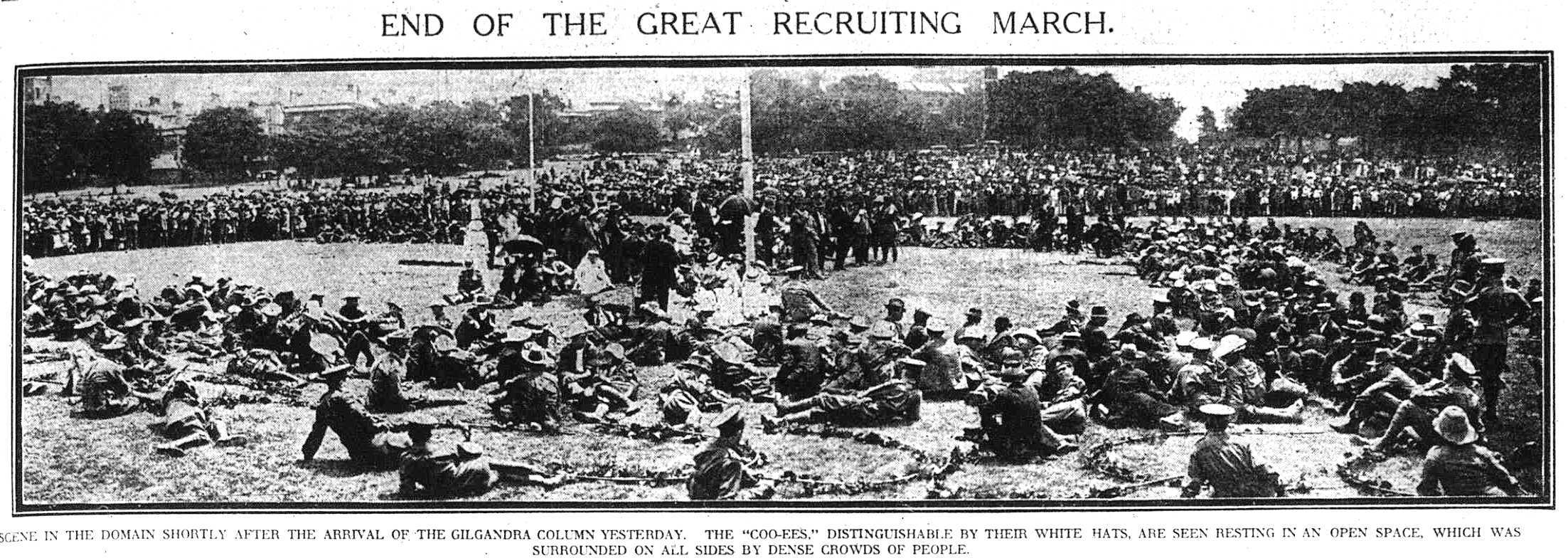
Coo-ees resting at the Domain (Daily Telegraph 13/11/1915)

Coo-ees resting at the Domain (Daily Telegraph 13/11/1915)

From this point, through the city, and into the Domain, the streets were densely packed with wildly-cheering crowds, and the great cordiality of the welcomes showered upon the western heroes was noteworthy. At the Domain, at midday, the men rested while addresses were delivered by prominent public men, and an hour later an official reception was held at Martin Place. Capt. Hitchens, the leader of the band, was accorded a most gratifying reception, and the men were overwhelmed with congratulations and good wishes.

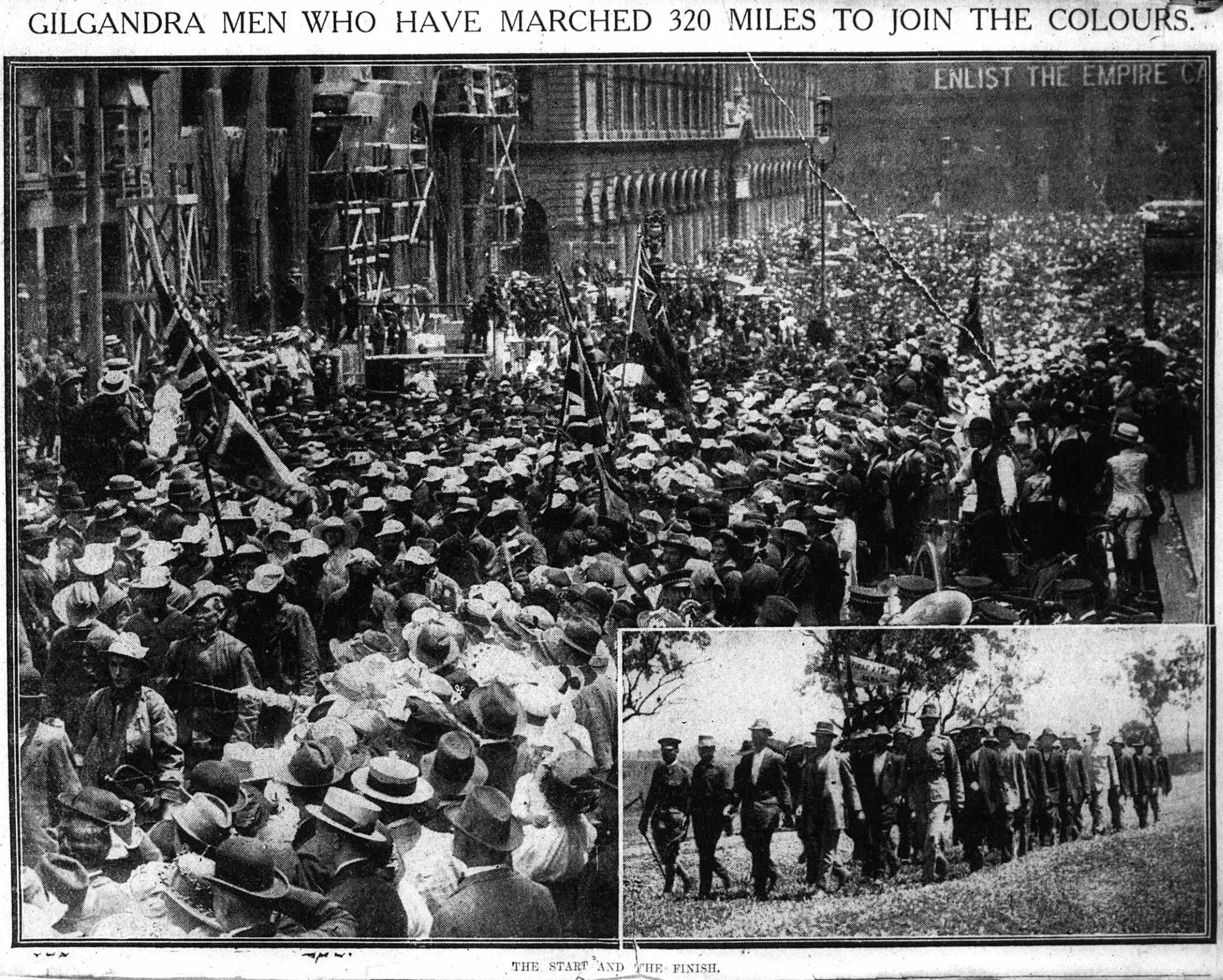
The start and the finish (Sydney Morning Herald 13/11/1915)

The start and the finish (Sydney Morning Herald 13/11/1915)

After the celebrations were over, the two hundred and sixty-three men that comprised the band of “Coo-ees,” were entrained to Liverpool, the first great stage of their journey to the battle-front ended.

The Force at the Finish.
Following is the official statement of men that actually signed on (after medical examination), between Gilgandra and Sydney: Gilgandra 35, Dubbo 13, Wongarbon 12, Geurie 6, Wellington 31, Stuart Town 1, Euchareena 1, Molong 4, Parkes 5, Orange 19, Millthorpe 2, Blayney 11, Bathurst 17, Glanmire 1, Yetholme 1, Wallerawang 3, Lithgow 19, Blackheath 2, Katoomba 11, Leura 1, Lawson 10, Springwood 5, Penrith 4, Parramatta 27, Ashfield 22, total 263.’

Click here to access the article on Trove: http://nla.gov.au/nla.news-article116671136

Day 33, Thursday, 11 November, 1915, Parramatta to Ashfield

Transcription of an extract from an article titled ‘The Route March : End of the Long Trek’ in The Farmer and Settler, 16 November, 1915, p. 3 [1 of 2 parts]

‘THE ROUTE MARCH
End of the Long Trek
DUST-STAINED WARRIORS IN CAMP.

Australia, to-day, realises that her best and bravest must gird on the harness of war to fill the gaps in the ranks of the Empire’s fighting forces; and the insistent “Coo-ee” from the firing line found a striking response when the great three- hundred-mile march of the West o’ Sun- set men reached the finishing post in the heart of the city of Sydney on Friday last at noon. Readers of the “Farmer and Settler” have followed, issue by issue, the fortunes of the recruits from Gilgandra, to the outskirts of the city, and each and every man of the contingent claims that more could be related of the last twenty miles than of the hundreds of the earlier part of the journey. If the “Coo-ees” were inspirited by the hospitality and enthusiasm of the folk, on the long stretches where the road reached straight and bare across the drought-red plains, or wound its way around shoulders of mist-capped ranges, the clamorous welcomes of the people of the foot-hills and the coastal belt was even more soul stirring.

During the march from Parramatta to Ashfield, the men experienced the most trying period of their journey. The dust dried in their throats, and they were jostled and jolted by the thousands of eager, excited loyalists that thronged the route, before, behind, and on all sides disorganising the military machine with their misdirected enthusiasm.

At Harris Park, the community bestowed the best of its viands on the eager soldiers. At Pittrow public school, a flag was presented amid martial ceremonies. Outside Granville, the Westmead Boys’ Band (still going strong) and the local cadets fought a passage for the recruits. After this they tramped through Auburn, dim with the soot of a hundred factories; Homebush reminiscent of the bush, the boys had left with its mobs of sheep, and wild-eyed, bellowing cattle ; then through the crowded suburban streets, packed with curious, excited spectators and choking with dust, to Ashfield.’

… [Cont.]

Click here to access the article on Trove: http://nla.gov.au/nla.news-article116671136

Day 32, Wednesday, 10 November, 1915, Penrith to Parramatta

Transcription of an extract from an article titled ‘The Route March : In the Suburbs of Sydney’ in The Farmer and Settler, 12 November, 1915, p. 3 [3 of 3 parts]
… [Continued]

‘St. Mary’s.
The marching conditions were better on Wednesday morning, as the column set out for Parramatta, “via ports.” The four miles to St. Mary’s was soon covered, and the troops marched in briskly, headed by the local band. The Mayor (Ald. Brett) with other members of the council, and Mr. J. C. Hunt, M.L.A., gave the army its official welcome, and breakfast was eaten under the shade of the trees in Victoria Park, where the men fraternised with the local residents, and good heart-to-heart recruiting work was done.

Colyton and Eastern Creek.
At ten o’clock the men were “following the flag” again, along the road to the village of Colyton, where the school children presented Captain Hitchen, for the “Coo-ees,” with a “purse of sovereigns” and an Australian ensign. A recruit that joined there was one of the family of McGregors that has already given five sons to the Empire. As the family said their brave but tearful farewells to the sixth McGregor, all that witnessed the incident realised the fine loyalty of the McGregors, and also the suffering that the Hun fiends have brought upon the world.

At Eastern Creek the army was met by Col. Pringle, president of the Blacktown Shire Council, and Cr. James Angus, president of the recruiting committee. Luncheon was provided in the Walgrove school grounds by the ladies of Rooty Hill and Eastern Creek.

Prospect to Westmead.
At Prospect there were more welcomes and another meal; and there was an acceptable distribution of oranges, provided by the growers of Castle Hill, twenty miles away. Father Bernard and the band of the Boys’ Home met the troops soon after they left Prospect, and played them all the way to Parramatta.

At Wentworthville there was yet another distribution of cordials, and there the Parramatta welcome really began, for the Mayor (Ald. Graham) and Mr. W. F. Jago came out to meet the recruits.

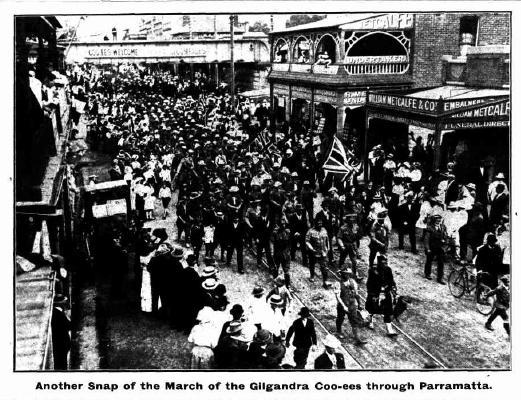
Coo-ees marching through Parramatta (The Cumberland Argus and Fruitgrowers Advocate 20/11/1915)

Coo-ees marching through Parramatta (The Cumberland Argus and Fruitgrowers Advocate 20/11/1915)

Parramatta.
The last few miles of the journey through a semi-suburban residential district was a triumphal procession. Vehicles lined the roads, and hundreds of persons were gathered at every coign of vantage to see and to cheer the heroes of the west.

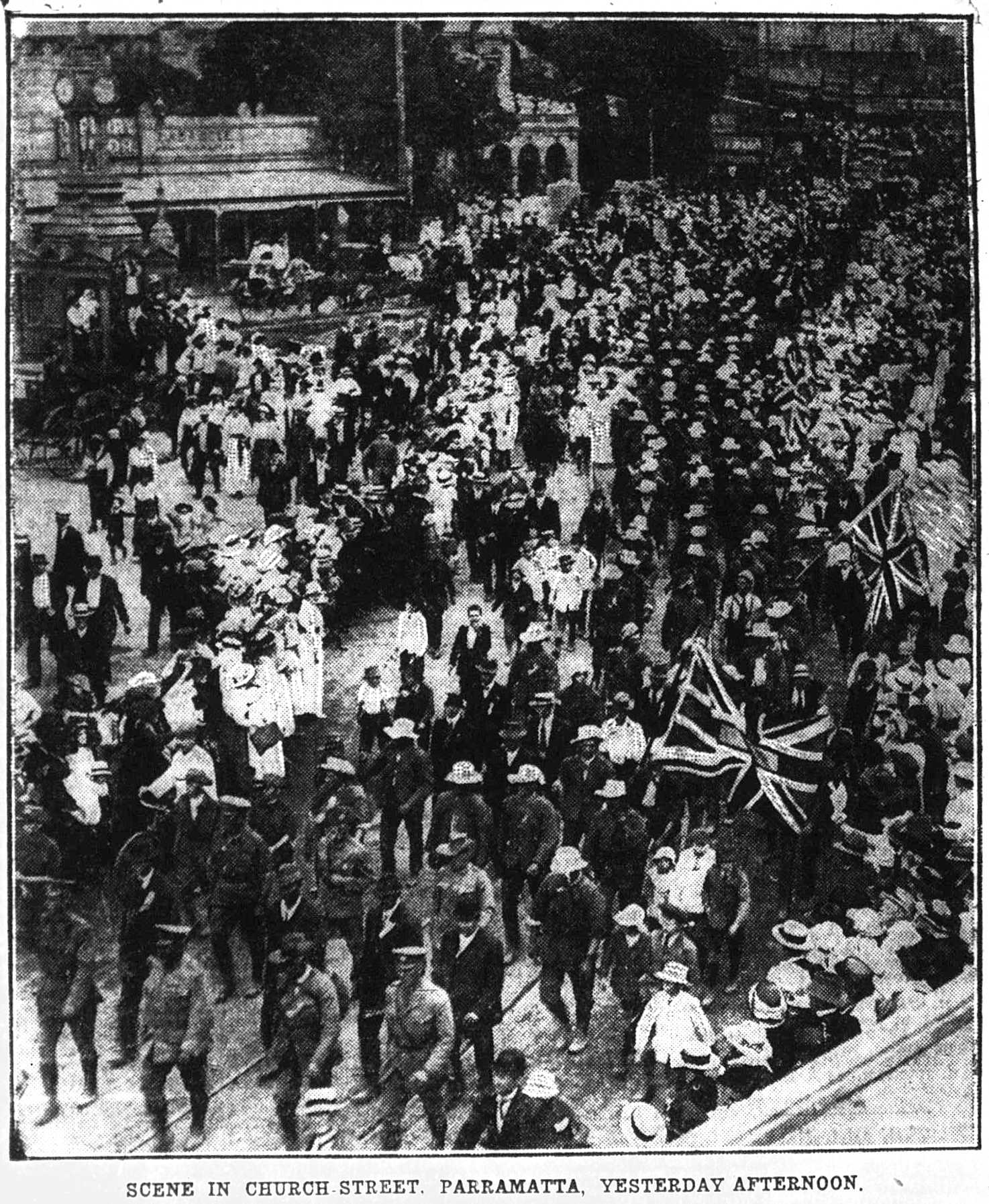
Coo-ees in crowded Church Street, Parramatta (Evening News 11/11/1915)

Coo-ees in crowded Church Street, Parramatta (Evening News 11/11/1915)

The column marched into the old town escorted by the Mounted Police, Fire Brigade, Light Horse, Cadets, Boy Scouts, returned soldiers, Parramatta Citizens’ Band, Westmead Boys’ Band, Burnside Homes Boys’ Pipers Band, and the Kings School boys. Alderman Graham welcomed the westerners and then the whole force made an imposing entry into the town, the streets of which were gaily decorated, and the population of which had turned out en masse. The school children of the district were assembled at the Town Hall, and their demonstration was the most striking of all.

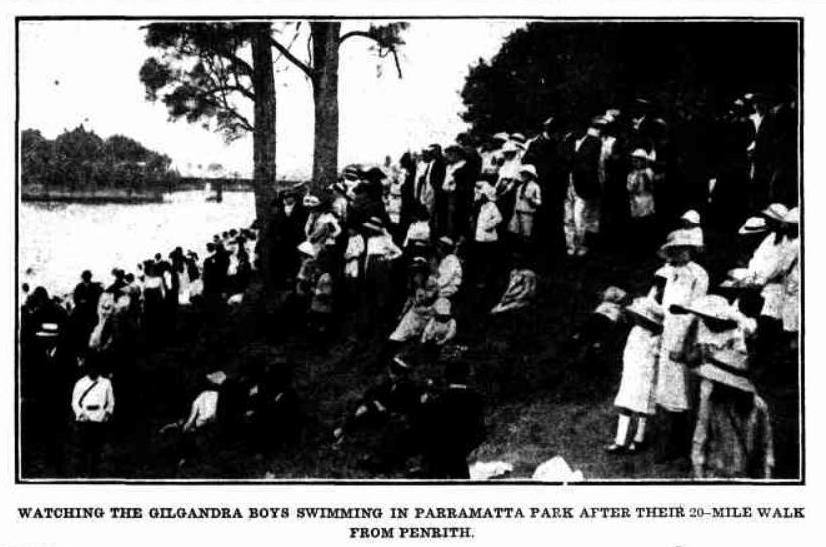
Crowd watching the Coo-ees swimming in Parramatta Park (The Cumberland Argus and Fruitgrowers Advocate 20/11/1915)

Crowd watching the Coo-ees swimming in Parramatta Park (The Cumberland Argus and Fruitgrowers Advocate 20/11/1915)

The camp was pitched in a pleasant corner of Parramatta Park, and the men had the opportunity of a refreshing swim in the river, and a general clean up and cool off before the evening meal.

After being entertained at dinner in the Town Hall by the mayoress and the ladies of Parramatta, the men attended a recruiting meeting when speeches were delivered by the Rev. P. S. Waddy, head-master of the King’s School, and Rev. S. M. Johnston, Sergeant Coates and Sergeant-major Lee. The result of the meeting was that forty-one recruits were obtained.

Yesterday’s suburban junketings and “speechifications” may be passed over, the one pleasant fact being recorded that the “Coo-ees” made a fine recruiting impression upon the young manhood of the western suburbs, and it is certain that at tod-day’s finish in Martin Place, Sydney, there will be over three hundred sworn recruits answering the roll-call of “Hitchen ‘s Own.”

Click here to access the article on Trove: http://nla.gov.au/nla.news-article116652489

Day 31, Tuesday, 9 November, 1915, Springwood to Penrith

Transcription of an extract from an article titled ‘The Route March : In the Suburbs of Sydney’ in The Farmer and Settler, 12 November, 1915, p. 3 [2 of 3 parts]

… [Continued]

‘Valley Heights to Emu Plains.
On Tuesday morning Springwood waved its farewell, and the column passed onward and downward along the picturesque mountain roads through Valley Heights, Blaxland and Glenbrook, and down Lapstone Hill to the bridge, where the noon day meal was taken. Senators McDougall and Grant came to see the army of the West at Emu Plains.

Penrith.
At four o clock Penrith was “stormed,” the “Coo-ees” swinging into town like a corps of veterans. They were met at the Nepean bridge by a squadron of Light Horse, a company of infantry, a detachment of Boy Scouts, and a squad of smart-looking recruits. Headed by the Penrith band the town was paraded, and the whole population of the district appeared to be present. At the town hall the mayor, Ald. Walker, made a brief speech of welcome, and the men were afterwards entertained at dinner, and later took part in the usual recruiting rally.

… [Cont.]

Click here to access the article on Trove: http://nla.gov.au/nla.news-article116652489

Day 30, Monday, 8 November, 1915, Lawson to Springwood

Transcription of an extract from an article titled ‘The Route March : In the Suburbs of Sydney’ in The Farmer and Settler, 12 November, 1915, p. 3 [1 of 3 parts]

‘THE ROUTE MARCH
In the Suburbs of Sydney
OVER THREE HUNDRED MEN NOW MARCHING.

Before this issue of the “Farmer and Settler” reaches the great majority of its readers, the Great Western Route March will have ended, the “Coo-ees” will have been welcomed in the heart of Sydney by assembled thousands of the people, and will have gone into camp to complete their training.

In many respects the last week on the road was the roughest of the whole thirty two days’ march, and the greatest test of the physical stamina and the temper of the men.

When the column left Lawson on Monday morning, the mountains were swathed in the smoke of bush fires, and as the miles brought them nearer the capital the men found the roads growing rougher and dustier, the humid heat more oppressive, and the flies and the smoke twin plagues to complete their discomfort. The other side of the picture was the cheery courage of the men themselves, and the enthusiasm and generosity of the people at every wayside town and hamlet.

Hazelbrook.
As the army approached Hazelbrook it was met by the school children and practically the whole population. Gifts of cigarettes and other comforts were made, the children sang the National Anthem, and the troops marched through, cheered by the “motto” that had been stretched across the road: “God-speed, and a safe return — Hazelbrook to the Coo-ees.”

One of the interesting episodes of the Hazelbrook welcome was the presence of an Afghanistan and South African veteran, Lieut. E. G. Facey, who could not resist the impulse to step it out to the martial music of the Leura band.

Woodford.  
A warm welcome awaited the column at Woodford. Under the trees a cold luncheon had been spread, and while the men refreshed themselves, Captain Dakin and Mr. G. J. Waterhouse voiced the good wishes of the people.

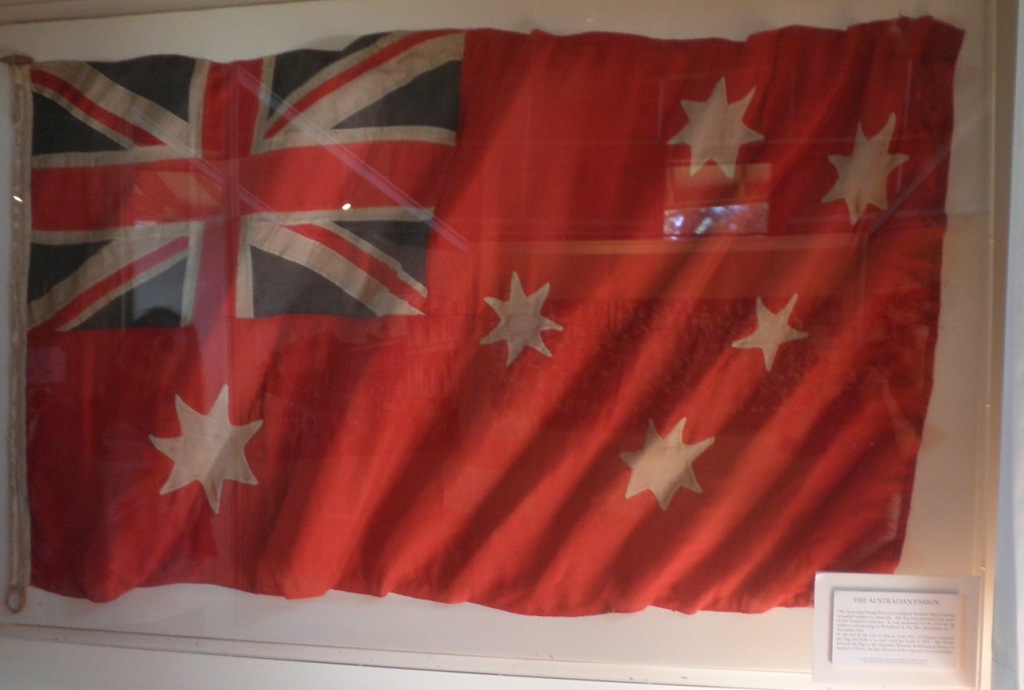
Australian Ensign flag donated to the Coo-ees at Woodford, now on display at the Coo-ee Heritage Centre, Gilgandra (Photograph: H. Thompson)

Australian Ensign flag given to the Coo-ees by wounded soldiers at Woodford, now on display at the Coo-ee Heritage Centre, Gilgandra. Donated by the family of Ernie May, a Coo-ee from Wongarbon who kept the flag after the Coo-ee March (Photograph: H. Thompson)

A ceremony that touched the boys was the presentation of an Australian flag by Private Nutting, on behalf of his comrades of the local military convalescent home, Professor David’s house, lent to the Government for the use of the returned soldiers. A contingent of the wounded soldiers assembled and cheered the “Coo-ees,” and this was a compliment that went to the hearts of all; they carried that Anzac-Australian flag in the place of honor through townships passed through later.

Linden and Faulconbridge.
From Woodford to Linden was down hill, on a road that twisted between blackened patches of recently burned timber. Linden was a non-stop station, so, helped along by the cheers of the residents, the column forged ahead.

Soon after noon the hamlet of Faulconbridge, the last resting place of Sir Henry Parkes, came into view. An escort of mounted troopers joined the column here, but there was no halt until Springwood was reached.

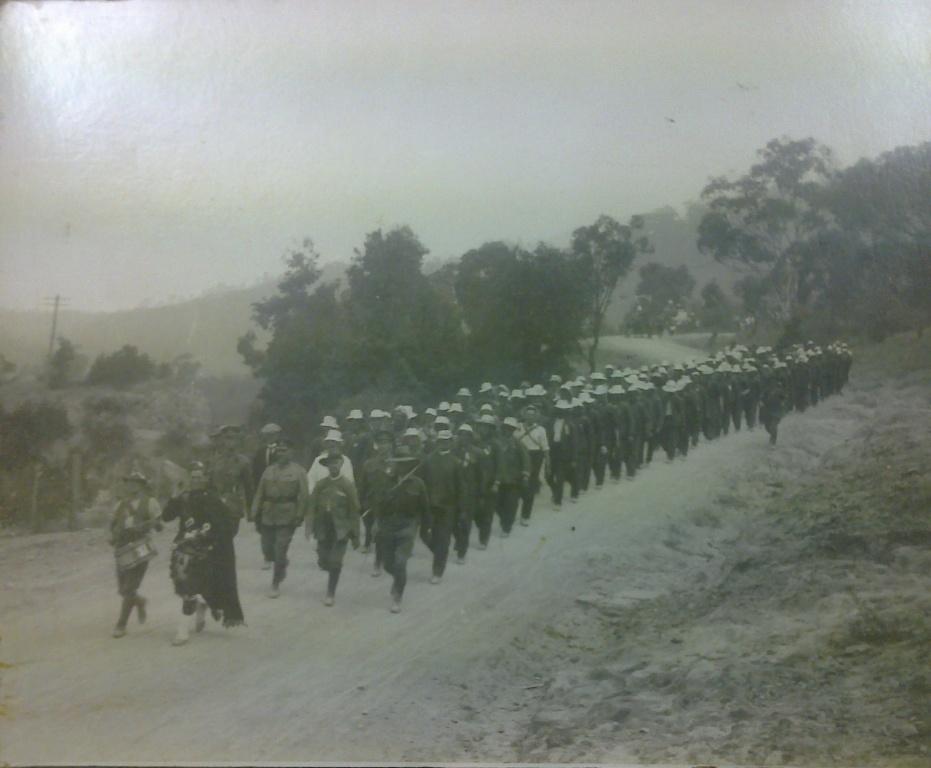
Coo-ees nearing Springwood (Photograph courtesy of Gilgandra Historical Society)

Coo-ees nearing Springwood (Photograph courtesy of Gilgandra Historical Society)

Springwood.
The procession that entered Springwood consisted of the “Coo-ees,” Leura band, mounted troopers, a squad of local riflemen and a piper specially sent by the Highland Society. Springwood was en fete, flags flew everywhere, and banners of welcome hung across the road. A charming tableau was presented by the school children, the boys dressed in khaki as soldiers and tho girls garbed as nurses. After a parade of the township the army camped at Homedale estate, dined and rested — all except a squad ordered out at the double to take a bridge head of the enemy, an advancing tongue of bush fire.

At night a thousand persons attended a promenade concert and listened to fine recruiting speeches by Mr. H. Blackett and the local clergy.’

… [Cont.]

Click here to access the article on Trove: http://nla.gov.au/nla.news-article116652489