Yearly Archives: 2014

Denis Roy GREEN

Denis Roy GREEN

Per his military service record (regimental no. 4782), Denis Roy Green was born at Bathurst, N.S.W. He gave his age as 18 years, his marital status as single, and his occupation as Flour mill hand. His description on his medical was height 5 feet 8 ½ inches tall, weight 135 lbs., with a fair complexion, blue eyes, and fair hair. His religious denomination was Church of England.  He joined the Coo-ee March at Dubbo. He completed his medical on the 14th October 1915 at Dubbo, and was attested on the 14th October 1915 at Dubbo. He claimed to have had 10 months previous military service in Cadets B Coy.

After completing the remainder of the march he went to Liverpool Camp as reinforcement for the 13th Battalion.

On his embarkation roll his address at time of enrolment was 49 Carlingford Street, Bathurst, N.S.W., and his next of kin is listed as his mother [recorded incorrectly as his wife], Mrs. A. Robinson, 49 Carlingford Street, Bathurst, N.S.W.

Private Green departed Sydney on the HMAT A15 Star of England on the 8th March 1916. He arrived in Egypt on the 11th April 1916.

On the 16th April 1916 he was transferred to the 4th Division Artillery at Telelkebir.

He proceeded to join the British Expeditionary Force in France, embarking at Alexandria on 6th June 1916 on the HT Ionian, and disembarking at Marseilles on 15th June 1916. On 21st July 1916 he marched out to join the unit.

On the 22nd July 1916 he joined the 4th Pioneer Battalion in the field from the 2nd reinforcement of the 4th Pioneer Battalion.

On 2nd June 1917 he was detached for duty with Divisional Mule Transport. On 13th June 1917 he rejoined 4th Pioneer Battalion from detachment.

On 30th July 1917 he was appointed Driver.

On 21st September 1918 he went on leave in England.

Driver Green returned to Australia on 22nd July 1919 on the HT Ulysses, disembarking in Sydney on 5th September, 1919.

He was discharged on 20th February 1921 as medically unfit.

Anniversary of their start

Transcript of an article from The Sunday Times, October 8, 1916, p. 9.

THE COO-EES
EN ROUTE FOR BERLIN
ANNIVERSARY OF THEIR START
It’s 12 months all but two days since the Coo-ees started on their long march from Gilgandra to Berlin, and thought they’re not there yet, most of them are still on the way. One is well beyond the borders of Germany – he is a prisoner of war, and is reported to be in a prison camp in Westphalia – several have been wounded, and two, including their famous leader, “Captain Bill” Hitchen, are dead.
The Coo-ees started on the first stage of their march, the 330 miles trip from Gilgandra to Sydney, on Tuesday, Oct 10. There were 25 of them then ; but before they had covered half the distance the home town had sent another ten hotfoot to join them. These 35 Gilgandra men were good recruiting agents, for before they reached Sydney they had gathered in seven more men for every one of the original troop. They arrived just about 270 strong. Their example was followed all over the country, and recruiting marches were conducted from several points. None of them, however, captured such interest as that of the Coo-ees , and although public memory is always short, it is probable that Captain Bill Hitchen and his men will always be remembered when Australia’s part in the war is talked of. Certainly they will never be forgotten in Gilgandra and the other country towns they passed through.

SACRIFICES THEY MADE
Every town and township on the line turned out to meet them as they approached, and they were feted and fed until their leaders began to fear they would be killed by kindness. The enthusiasm of the volunteers, too, was infectious. All along the road men dropped their work and joined the ranks. From Gilgandra alone there were three men with families. There was Captain Hitchen (officially he was only a Corporal ; but he will always be remembered as Captain Bill), who had a family of three sons and two daughters ; there was Signaller A. J. McGregor, who left behind him a wife and five young children ; and there was Corporal J. McKeown, who left a wife and four small McKeowns. Wee McGregor, as he was known all along the march, sold out a flourishing bakery business in Gilgandra to join the Coo-ees. He had three brothers at the front, and he wanted to follow them. On the way to Sydney another brother jumped into the ranks – five from one family. McKeown had fought in the South African war, and had soldiering in his blood. At Coonamble two young brothers named Hunt joined the ranks. Their father saw them start ; but the thought of the parting was too much for him. A few days later he hurried after the boys, and at Bathurst he, too, joint the march.

MEN OF ALL AGES
The Coo-ees were men of all ages. Captain Bill himself was 52, and though the rest all said they were under 45 the authorities in many cases had their suspicions about them. On the other hand there were three lads under the age of 18.
When they reached Sydney on March 8 [sic] a number of them were rejected as medically unfit ; but 220 eventually sailed for Europe. They didn’t all go together. Some were taken into the Light Horse and others into the Engineers and Artillery ; but about 180 went away as the 15th Reinforcements of the 13th Battalion. In Egypt they were again split up ; but the majority went into the 45th Battalion. Those who stayed in Egypt were under fire three weeks after their landing, and the men who went to France were in the trenches in June. It used to be a military axiom that it took three years to train a soldier. In the case of the Coo-ees, the time spent in training was a little over three months.
A record of their doings is being kept by Mr. A. H. Miller, of Gilgandra, who took part a leading part in organising the march. He is still collecting details, keeping a list of those who have fallen, and the experiences the men have met with. He also communicates with their relatives, whenever news of any of the men arrives.
The people of Gilgandra are keeping up the anniversary of the start of the march on Tuesday by a social. They originally intended to devote the proceeds to purchasing Christmas hampers for the men ; but the State War Council refused permission for this, and the money will now be devoted to the Repatriation Fund. Numbers of private parcels are being made up, however, for Christmas gifts, for the men. So far there have been but nine casualties among the Coo-ees.

COO-EES WHO HAVE FALLEN
Corporal Hitchen died of diabetes in Harefield Hospital, in England, a few weeks ago. He was ill when he arrived in England and went straight into hospital. He died two months later. When news of his death was received in Gilgandra, all the business houses closed their doors for two hours.
Private Victor Quinton, of Gilgandra, is wounded, though he was at first reported missing. He is a son of Mrs. A. Lumsey, of Gilgandra.
Private Sid Heuston, wounded, is a son of Mr. and Mrs. Geo. Heuston, of Wellington. He joined the Coo-ees there when he was only 17 years and three months of age.
Private Dave Wagner, wounded, is a son of Mr. and Mrs. J. Wagner, of Valley Heights. He was only 16 years and 10 months old when he enlisted.
Private J. Wiggins, wounded, is a son of Mr. E. Wiggins, of Springwood. He and his mate, Dave Wagner, both enlisted from Springwood, the only recruits in the march from the township.
Private C. Crease, wounded, joined the Coo-ees in the mountains. He is a brother of Mrs. P. Letham, of Simmons-street, Enmore.
Sgt. T. Thorne, who died of illness in England, was 23 years of age. He was the only son of Mrs. and the late Mr. G. Thorne, of Thorneycroft, Lawson. His father died suddenly from heart failure a month after the boy left for the front.
Private D. S. Stewart was at first reported missing, but has since been traced to a prison camp in Westphalia, where he is a prisoner of war. He is the second son of Mr. and Mrs. A Stewart, of Parkes-street, East Wellington, and was only 16 years and 9 months old when he enlisted. He was the youngest recruit with the Coo-ees. Another brother, who enlisted at 18, is in the trenches.
Private Oliver James Harmon, of Granville, killed in action, was a son of Mr. and Mrs. W. H. Harmon, of Alfred-street, Granville. He joined the Coo-ees, many of whom he had known out West, at Parramatta. His younger brother, Percy, is on H.M.S. Phantom, and another is in camp at Liverpool.
Private C. Marchant, accidentally wounded in Egypt and invalided home, is a son of Mr. and Mrs. E. Marchant, of Gilgandra, at which township he joined the Coo-ees. He was prominent in boxing circles in the West, and also a member of the Gilgandra Waratah Football Club and the League of Wheelmen.
Private Albert Nelson, wounded (second occasion), is the son of Mr. and Mrs. R. Nelson, of Gilgandra. He joined the Coo-ees at Liverpool Camp, and sailed for the front with them on March 8. When he was wounded on the first occasion he remained on duty. This time he was wounded in three places – knee, back and foot.
Private Borton, Lawson (wounded).
Private R. Uhr (invalided home).
Private J. Morris, Parramatta (killed in action).
Private G. Seaman, Bathurst (wounded).
Private W. E. Hunter, Redfern (wounded), enlisted at Geurie, and when the Coo-ees were in Orange he received a letter from his mother stating that his two brothers had been killed at the Dardanelles.
Cpl. W. Smith, who enlisted with the Coo-ees at Geurie, where he was employed as Shire Clerk, was taken from France to England to undergo an operation. From advices received by the last mail he was improving fast. He was a widower with a number of young children, whom he placed in boarding-school before going to the front.’


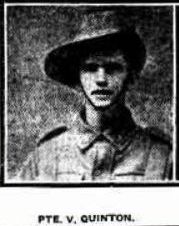
Victor QUINTON

Victor QUINTON

Private Victor Quinton (Sunday Times, 8/10/1916)

Private Victor Quinton (Sunday Times, 8/10/1916)

Per his military service record (regimental no. 4880), Victor Quinton was born at Gilgandra, N.S.W. He gave his age as 19 years and 6 months, his marital status as single, and his occupation as labourer. His description on his medical was height 5 feet 4 ½ inches tall, weight 8 stone 9 lbs., with a dark complexion, bluish green eyes, and dark hair. His religious denomination was Anglican. He completed his medical on the 9th October 1915 at Gilgandra, and was attested by Captain Nicholas on the 9th October 1915 at Gilgandra. He claimed to have had no previous military service.

After completing the march he went to Liverpool Camp as reinforcement for the 13th Battalion.

On his embarkation roll his address at time of enrolment was Miller Street, Gilgandra, N.S.W., and his next of kin is listed as mother, Mrs E. Lumley, Melrose Bidden, Gilgandra N.S.W.

Private Quinton departed Sydney on the HMAT Star of England on the 8th of March 1916. He arrived in Egypt on the 11th April 1916. On the 17th May 1916 he was transferred to the 4th Division Pioneer Training Battalion.

On the 6th June 1916 Private Quinton left Alexandria aboard the Transport Ionian bound for France, arriving at Marseille on the 15th June 1916. On the 22nd July 1916 Private Quinton was taken on strength in the field in the 4th Pioneer Battalion.

On the 5th August 1916 the Battalion was constructing communication trenches near Pozieres when Private Quinton was evacuated with shell shock. He returned to his unit on the 11th August 1916.

Private Quinton was evacuated with Influenza to the 5th Australian Field Ambulance, then the 36th Casualty Clearing Station, on 25th November 1916.  He was sent to hospital in Rouen on 29th November 1916.

On 14th December 1916, Private Quinton was evacuated to the 1st Southern General Hospital in England two weeks later.

He marched into Pernham Downs in England on 13th January 1917.

On the 24th January 1917 Private Quinton was transferred to the Australian Army Ordnance Corps. He served in England until the end of the war.

On the 22nd March 1919 Private Quinton left England on the Transport Nevasa bound for Australia. He arrived on the 26th April 1919, and was discharged on the 12th of June 1919.

Reginald Henry CHAMBERLAIN

Reginald Henry CHAMBERLAIN

Reginald Henry Chamberlain enlisted four times during the First World War.

Per his military service record (regimental no. 3021), Reginald Henry Chamberlain was born at Sydney, N.S.W. He gave his age as 24 years and 5 months (at the time of his 1917 application), his marital status as single, and his occupation as motor mechanic.

He first joined on 5th November 1914, completing his medical at Liverpool on 6th November 1914, and his attestation at Liverpool on 9th November 1914. He stated he had no previous military experience on this application form. However, he was discharged as “unlikely to become an efficient soldier” on 20th November 1914.

He joined again on 7th December 1914, completing his medical and attestation at Liverpool on 9th December 1914. He was discharged on 29th December 1914 with varicocele.

Reginald Henry Chamberlain joined again on 29th July 1915, completing his medical at Sydney on 29th July 1915, and his attestation at Liverpool on 5th August 1915. The date of discharge is not shown for this enlistment period in his service record.

However, he joined again at Parkes, undertaking his medical and attestation at Parkes on 11th October 1915. His description on his medical was height 5 feet 5 ¾ inches tall, weight 123 lbs., with a medium complexion, blue/grey eyes, and brown hair. His religious denomination was Church of England.  He gave his age on this application to enlist form as 22 years and 11 months. Private Chamberlain was one of two recruits (along with Joseph Armstrong who joined at Parkes on the 11th October 1915), who travelled to Dubbo on the morning on Wednesday 13th October 1915, along with three others who entered Dubbo Military Camp (Western Champion, 14/10/1915, p. 18).

It was reported in The Western Champion (21/10/1915, p. 17) that the Parkes Recruiting Association had held a recruiting meeting ‘for the purpose of enrolling recruits who were willing to join the volunteers now on the way, by road, from Gilgandra to Sydney’, and that ‘five men had mounted the lorry in response to the appeal’, and that ‘one of them went on to Dubbo’, with the remaining four planning to proceed to Molong to join the continent.

However, the recruit who was sent to Dubbo by Parkes Recruiting Association to join the Coo-ees is not named anywhere in newspaper reports or in the official correspondence of the march held in the Mitchell Library. It appears one of them (Chamberlain or Armstrong) had a change of heart and decided to join the Coo-ees on their march to Sydney, instead of entering Dubbo Military Camp.

After completing the Coo-ee March Private Armstrong went to Liverpool Camp as reinforcement for the 13th Battalion. However, he was discharged again as being medically unfit on 29th November 1915 before a medical board at Liverpool with varicocele.

On his fourth attempt at enlistment, he successfully completed his medical and attestation on 22nd January 1917 in Sydney. On his embarkation roll his address at time of enrolment was Sydney, N.S.W., and his next of kin is listed (as on his earlier applications to enlist) as his brother William Thomas Chamberlain, 19 Clevedon Road, Parnell, Auckland, N.Z.

Private Chamberlain departed Sydney on the HMAT A24 Benalla on 10th May 1917 as 7th Reinforcement for the 36th Battalion. He disembarked at Plymouth, England on the 19th July 1917. On 20th July he marched into 9th Training Battalion in England.

He proceeded to France on the 27th December 1917 from Southampton.

He marched out to the Front on 30th December 1917. On the 3rd January 1918 he was taken on strength in the 36th Battalion, and re-allocated regimental number 3021A.

He was appointed Lance Corporal on 20th February 1918.

On 30th April 1918 L/Corporal Chamberlain was transferred to the 35th Battalion. He was also wounded in action, being gassed, on the same day, and admitted to the 9th Australian Field Ambulance. He was transferred to the 12th Casualty Clearing Station on 2nd May, then to the 3rd Australian General Hospital in Abbeville on the 6th May 1918.

He embarked for England on 1lth May 1918, and was admitted to Whipps Cross Military Hospital in Leytonstone for shell gas.

He was transferred to the 1st Auxiliary Hospital, Harefield, on 27th May 1918.

He was discharged from hospital on 29th May 1918, then after being granted furlough, marched into No. 4 Command Depot, Hurdcott on 12th June 1918.

On 16th January 1919 he reverted to the rank of Private on being taken on strength of A.M.T.S. (Australian Motor Transport Section) and was mustered as Driver M.T.

He was discharged from the A.I.F. in London on being demobilized on 5th October 1919, but following his request for reinstatement, was then reinstated in the A.I.F. on 27th October 1919.

Private Reginald Henry Chamberlain returned to Australia on 18th December 1919 on the HT Konigin Luise, disembarking in Sydney on 7th February 1919.

He was discharged on 21st March 1920.

Joseph ARMSTRONG

Joseph ARMSTRONG

Per his military service record (regimental no. 4430), Joseph Armstrong was born at Bally-Bofey, Ireland. He gave his age as 43 years and 5 months, his marital status as single, and his occupation as labourer. He did a preliminary medical examination at Condobolin on 8th October 1915, then completed his medical, and attestation, at Parkes on 12th October, 1915. His description on his medical was height 5 feet 7 ½ inches tall, weight 162 lbs., with a fresh complexion, blue grey eyes, and light brown hair. His religious denomination was Church of England. He claimed to have served in the 3rd N.S.W. Imperial Bushmen for 2 ½ years in the Boer War.

Private Armstrong was one of two recruits (along with Reginald Henry Chamberlain who joined at Parkes on the 11th October 1915), who travelled to Dubbo on the morning on Wednesday 13th October 1915, along with three others who entered Dubbo Military Camp (Western Champion, 14/10/1915, p. 18).

It was reported in The Western Champion (21/10/1915, p. 17) that the Parkes Recruiting Association had held a recruiting meeting ‘for the purpose of enrolling recruits who were willing to join the volunteers now on the way, by road, from Gilgandra to Sydney’, and that ‘five men had mounted the lorry in response to the appeal’, and that ‘one of them went on to Dubbo’, with the remaining four planning to proceed to Molong to join the contingent.

However, the recruit who was sent to Dubbo by Parkes Recruiting Association to join the Coo-ees is not named anywhere in newspaper reports or in the official correspondence of the march held in the Mitchell Library. It appears one of them (Armstrong or Chamberlain) had a change of heart and decided to join the Coo-ees on their march to Sydney, instead of entering Dubbo Military Camp.

After completing the Coo-ee March Private Armstrong went to Liverpool Camp as reinforcement for the 13th Battalion.

On his embarkation roll his address at time of enrolment was 125 Flinders Street, Sydney, N.S.W., and his next of kin is listed as his cousin, Mrs E. Phillips, 125 Flinders Street, Sydney, N.S.W.

Private Armstrong departed Sydney on the HMAT A70 Ballarat on 16th February 1916 as 14th Reinforcement for the 13th Battalion. He arrived in Egypt on the 22nd March 1916. On the 1st April 1916 he was transferred to the 54th Battalion.

He embarked on the HT Caledonian at Alexandria on 19th June 1916, and disembarked at Marseilles, France, on 29th June 1916.

He was initially reported killed in action on 19th July 1916 at the Battle of Fromelles in France.  However he had been wounded with a bullet wound to the buttock and thigh during this battle, and taken a prisoner by the Germans. On 19th October 1916  he was officially reported as a Prisoner of War, at Wurzburg, Germany.

After the end of the war he was repatriated, arriving in England on 30th December 1918. He then returned to Australia leaving Weymouth on the transport Karoa on 28th March 1919, arriving in Australia on 10th May 1919.  He was medically discharged on 24th June 1919.

Joseph Patrick WALLIS

 Joseph Patrick WALLIS (aka Joseph Patrick WAILES)

Per his military service record (regimental no. 4617), Joseph Patrick Wallis was born at Darlinghurst, N.S.W.[1]  He gave his age as 18 years and 4 months (though he was younger), his marital status as single, and his occupation as seaman. He undertook a preliminary medical examination at Trangie on 6th October 1915 (where he gave his occupation as stableboy, and address as 9 George Street, Burwood). His description on his medical was height 5 feet 6 ¼ inches tall, weight 112 lbs., with a fair complexion, grey eyes, and light brown hair. His religious denomination was Roman Catholic.

He joined the Coo-ee March at Dubbo. He completed his medical on the 13th October 1915 at Dubbo, and was attested on 13th October 1915 at Dubbo. He claimed to have had no previous military service.

After completing the Coo-ee March he went to Liverpool Camp as reinforcement for the 13th Battalion.

On his embarkation roll his address at time of enrolment was Wollara Wollar, via Mudgee, N.S.W., and his next of kin is listed as his aunt, Mrs Sarah Doyle, Wollara Wollar, via Mudgee, N.S.W. (This was later changed in his service record to his mother Mrs Jane Wailes at various Sydney addresses).

Private Wallis departed Sydney on the HMAT A70 Ballarat on the 16th February 1916 as 14th Reinforcement for the 13th Battalion. He arrived in Egypt on the 22nd March 1916. On the 1st April 1916 he was transferred to the 54th Battalion.

He embarked on the HT Caledonian at Alexandria on 19th June 1916, and disembarked at Marseilles, France, on 29th June 1916.

He was killed during the Battle of Fromelles in France on 19/20th July 1916. He was originally listed with “No known grave”, and commemorated at V. C. Corner Australian Cemetery and Memorial at Fromelles.

His body was identified in 2010, and was buried in the Fromelles (Pheasant Wood) Military Cemetery, France.

Joseph Patrick Wallis headstone at Fromelles (Pheseant Wood) Military Cemetery, France (Photograph S & H Thompson 2012)

Joseph Patrick Wallis headstone at Fromelles (Pheseant Wood) Military Cemetery, France (Photograph S & H Thompson 2012)

Private Wailes’ name is also commemorated on panel 160 on the Australian War Memorial First World War Roll of Honour.

Research note: The NSW Birth Certificate for Joseph Wailes shows he was born on 28th August 1898, so he was actually only 17 years and 1 month when he enlisted with the Coo-ees, and 17 years and 10 months when he died.


[1] NAA: B2455, WALLIS JOSEPH PATRICK

[2] NSW Birth Certificate WAILES JOSEPH  27421/1898 FREDERICK C  JANE SYDNEY

Alfred Rupert Clyde LINGSTROM

Alfred Rupert Clyde LINGSTROM (aka Alf LYNNE)
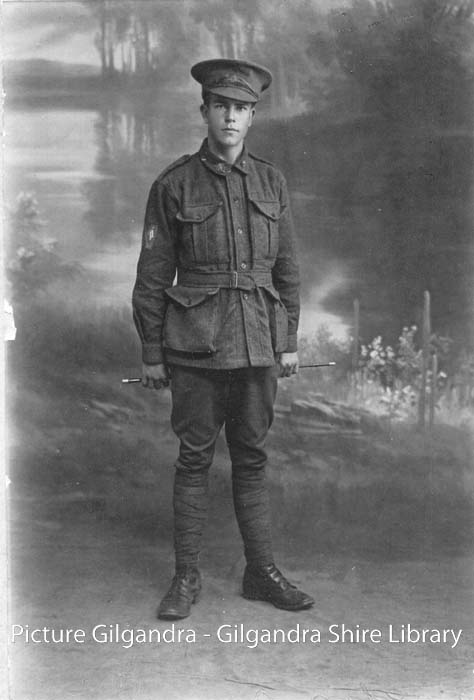
Alfred Rupert Lynne "Pug" (Photograph courtesy of Gilgandra Shire Library)

Alfred Rupert Lynne “Pug”, 1915 (Photograph courtesy of Gilgandra Shire Library)

Per his military service record (regimental no. 4834), Alfred Rupert Clyde Lingstrom was born at Dubbo, N.S.W.[1]  He gave his age as 21 years, his marital status as single, and his occupation as Postal Assistant.  His description on his Certificate of Medical Examination was height 5 feet 6 ½ inches, weight 112 lbs., with a fair complexion, grey eyes, and light brown hair.  His religious denomination was Methodist.  He completed his medical examination on 13th October 1915 at Dubbo (the day the Coo-ees arrived in Dubbo), but was not attested until 26th October 1915 at Bathampton (after he had caught up with the Coo-ees).  He claimed to have had no previous military service. He stated that he was a member of the Geurie Rifle Club.

An article in the Wellington Times dated 28th October 1915 reported that ‘Mr. [W. W.] Smith and Mr. Lynne responded to the call for recruits when the Coo-ees from Gilgandra spent a night in Geurie’ [on Friday 15th October 1915], ‘but neither could join immediately, as the former had a big task in handing over all the shire books to his successor, and Mr. Lynne had to remain in his position at the local [Geurie] post-office till a relief man could be sent along’, and that ‘Mr. Lynne himself hails from the home of the Coo-ees (Gilgandra) so should find himself among friends when he joins them’.[2]

Alfred Lingstrom, reported as “A. Lynne” in The Dubbo Liberal and Macquarie Advocate, following a send off provided by the Geurie community, travelled by train from Geurie with fellow Geurie Coo-ee William Smith on Tuesday 26th October 1915, to catch up with the Coo-ees at Blayney.[3]

He was known as one of the Gilgandra Coo-ees.

After completing the remainder of the Coo-ee March, he went to Liverpool Camp as reinforcement for the 13th Battalion.

Private Lingstrom attended a Signal School at Liverpool from 25th December 1915 to 2nd February 1916.[4]

On his embarkation roll his address at time of enrolment was Warren Street, Gilgandra, N.S.W., and his next of kin is listed as his mother, Mrs. E. [Emily] Lingstrom, at the same address.

Private Lingstrom, along with many of the Coo-ees, departed Sydney on the HMAT A15 Star of England on 8th March 1916, as 15th reinforcement for the 13th Battalion.  He arrived in Egypt on 11th April 1916.

On the 16th May 1916 he was transferred to the Signal Section of the Engineers Training Depot at Tel-el Kebir.

On the 15th October 1916 Private Lingstrom was taken on strength of the ANZAC Mounted Division Signal Squadron at Romani.

On 1st February 1917 Private Lingstrom was sent to hospital sick. On 12th February 1917 he was admitted to the 14th Australian General Hospital at Abbassia, Egypt, suffering from Bronchitis.  He was transferred to a Convalescent Depot on 20th February 1917.

On 9th March 1917 Private Lingstrom was charged with (1) breaking out of barracks about 6 p.m. and remaining absent until apprehended by the Military Police about 7.30 p.m. on 8th March 1917, (2) being out of bounds by being in Wagh el Burka Street, and (3) neglecting to obey Garrison orders by not wearing identity discs.  He was awarded 3 days confined to barracks and fined 4 days pay.

On 12th March 1917 Private Lingstrom was sent to the 1st Light Horse Training Regiment at Moascar, Egypt.  On 20th March 1917 he was moved to the Base Signal Depot at Alexandria, Egypt.  On 27th of April 1917 he rejoined the ANZAC Mounted Division Signal Squadron.

On 9th May 1917 Private Lingstrom went to hospital sick. He was admitted to Citadel Military Hospital in Cairo, Egypt, on 12th May 1917, suffering from Debility.  He was discharged to a Convalescent Depot at Abbassia, Egypt, on 19th May 1917.

On 30th May 1917 Private Lingstrom was charged with overstaying his pass from 8 p.m. until apprehended by the Military Police about 9.40 p.m., and being out of bounds, on 28th May 1917.  He was fined 2 days pay.

On 2nd June 1917 Private Lingstrom was transferred to the British Red Cross Convalescent Depot at Montagah, Egypt.

On 14th June 1917 Private Lingstrom was discharged to the Base Signal Depot at Alexandria, Egypt.

On 28th July 1917 he rejoined the ANZAC Mounted Division Signal Squadron.

On 28th January 1918 Private Lingstrom was charged with whilst being on active service for failed to salute an officer on 25th January 1918.  He was awarded 5 days confined to camp.

On 2nd March 1918 Private Lingstrom was sent to the Base Signal Depot at Alexandria, Egypt.  On 28th March 1918 he rejoined the ANZAC Mounted Division Signal Squadron.

On 11th August 1918 Private Lingstrom was sent to a Rest Camp at Port Said, Egypt.

On 1st September 1918 he was sent to the Signals Training Unit at Moascar, Egypt.

On 12th February 1919 he rejoined the ANZAC Mounted Division Signal Squadron.

On 6th March 1919 Private Lingstrom was promoted to Temporary 2nd Corporal.  He was promoted to 2nd Corporal on 24th June 1919.

2nd Corporal Lingstrom began his return to Australia aboard the H.T. Malta at Kantara, Egypt, on 3rd July 1919.

He arrived in Australia on 10th August 1919, and was discharged on 3rd October 1919.


[1] NAA: B2455, LINGSTROM ALFRED RUPERT CLYDE

[2] ‘Round the Wellington District’, Wellington Times, 28 October 1915, p. 7. Retrieved February 27, 2017, from http://nla.gov.au/nla.news-article143392877

[3] ‘Geurie’, The Dubbo Liberal and Macquarie Advocate , 29 October 1915, p. 2. Retrieved February 27, 2017, from http://nla.gov.au/nla.news-article77601626

[4] ‘Gilgandra’, Dubbo Dispatch and Wellington Independent, 15 February 1916, p. 3. Retrieved February 27, 2017, from http://nla.gov.au/nla.news-article228635701
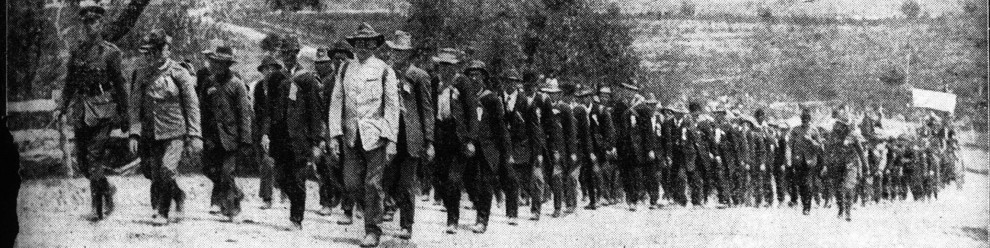
 

Oral recording by Leslie Greenleaf about the Coo-ee March

Oral recording of Leslie Webster Greenleaf’s recollection of the Coo-ee March

An oral recording is held in the Australian War Memorial sound collection (ID number S00329), which has the title: : ‘Leslie Webster Greenleaf, MM, as a private, 13th Battalion, discusses his part in the Gilgandra “Cooee March” in October 1915 in an interview with Kaye Mallison’.

This recording covers Leslie Webster Greenleaf’s recollection of joining at Gilgandra, the march to Sydney, training in Liverpool, the trip on the troopship ‘Star of England’, final parade in Egypt, and subsequent break-up of the Coo-ees, which he described as “that was the end of the era for the Coo-ees”, and his subsequent troopship journey to France.

This oral recording can be listened to online at http://www.awm.gov.au/collection/S00329/

To listen to this recording, click on the “Sound” link next to the file name.

Leslie Webster GREENLEAF

Leslie Webster GREENLEAF (MM)

Per his military service record (regimental no. 4783), Leslie Webster Greenleaf was born in London, England.[1] He gave his age as 18 years, his marital status as single, and his occupation as butcher. His description on his medical was height 5 feet 7 inches tall, weight 126 lbs., with a fair complexion, grey eyes, and brown hair. His religious denomination was Church of England.  He completed his medical on the 9th October 1915 at Gilgandra and was attested by Captain Nicholas on the 9th October 1915 at Gilgandra. He claimed to have had no previous military service.

After completing the Coo-ee March he went to Liverpool Camp as reinforcement for the 13th Battalion.

On his embarkation roll his address at time of enrolment was Eumungerie Post Office, N.S.W., and his next of kin was his sister, Miss P. Greenleaf, 2 Woodside Road, Surrey, England.

Private Greenleaf departed Sydney on the HMAT A15 Star of England on the 8th March 1916 with the 15th reinforcements to the 13th Battalion. He arrived in Egypt on the 11th April 1916.

On the 7th June 1916 Private Greenleaf left Alexandria aboard the Transport Ionian bound for France, arriving at Marseille on the 14th June 1916.

On the 29th August 1916, during the Battle of the Somme, when the 13th Battalion was attacking Mouquet Farm, he received a gunshot wound to his right hand. Private Greenleaf was hospitalised then evacuated to England.

Private Greenleaf returned to France on the 29th December 1917.

On the 2nd May 1918 Private Greenleaf was with his Battalion defending Villers-Bretonneux when he undertook an action for which he was recommended for (and subsequently awarded with) the Military Medal.

The citation read: ‘East of Villers-Bretonneux on the morning of the 2nd May, 1918, when an officer was severely wounded by M.G. fire and lay within full view of the enemy, Privates Greenleaf and Smith went to his assistance and carried him in at great personal risk. With the assistance of two other men they improvised a stretcher squad, and, as the case was a serious one, carried through with it to the Regimental Aid Post. This was done in broad day light, and practically the whole route was under observation of enemy snipers who were very active.’

On the 20th May 1918, when the 13th Battalion was still defending Villers-Bretonneux, three members of the Battalion were wounded. Private Greenleaf received a bomb wound to his left arm, being wounded in action for the second time. He was admitted to the 13th Australian Field Ambulance, the taken to the 47th Casualty Clearing Station. On 23rd May 1918 Private Greenleaf admitted to the 47th General Hospital at Le Treport, France.

On 3rd  June 1918 Private Greenleaf was evacuated to England by Hospital Ship Panama (gun shot wound left arm). On 4th June 1918 Private Greenleaf was admitted to the Kitchener Military Hospital at Brighton, England. On 11th June 1918 Private Greenleaf was transferred to the 1st Australian Auxiliary Hospital at Harefield, England.

Private Greenleaf was discharged from hospital on leave from 13th June 1918, to report to No. 1 Command Depot at Sutton Veny on 27th June 1918.

Private Greenleaf began his return to Australia aboard the H.T.  City of Exeter on 15th January 1919.

He arrived in Australia on 2nd March 1919.

He was discharged on 11th May 1919.

[1] NAA: B2455, GREENLEAF L W

Charles Arthur FINN

Charles Arthur FINN

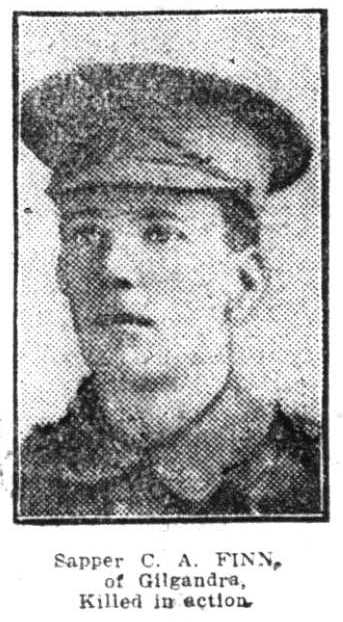
Sapper C. A. Finn, of Gilgandra killed in action (Newspaper unknown, ca. 1917)

Sapper C. A. Finn, of Gilgandra killed in action (Newspaper unknown, ca. 1917)

Per his military service record (regimental no. 6289), Charles Arthur Finn was born at Mt McDonald, N.S.W.[1] He gave his age as 27 years and 3 months, his marital status as single, and his occupation as Blacksmith. He completed his medical on 7th October 1915 at Gilgandra and was attested by Captain Nicholas on 9th October 1915 at Gilgandra. He claimed to have had no previous military service.

After completing the Coo-ee March he went to Liverpool Camp as reinforcement for the Engineers.

On his embarkation roll his address at time of enrolment was Gilgandra, N.S.W., and his next of kin is listed as mother, Mrs Eliza Finn, ‘Rosevale’, Everdon, Gilgandra N.S.W.

Sapper Finn departed Sydney on the HMAT A26 Armidale on 21st March 1916 with the 15th reinforcements for the 1st Field Company Engineers. He arrived in Egypt on 24th April 1916.

On the 28th May 1916 Sapper Finn left Alexandria aboard the SS Briton bound for England where he trained before being sent to France on 18th August 1916.

He marched into the 4th Division Base Depot at Etaples on 18th August 1916.

Sapper Finn was transferred to the 13th Field Company Engineers, and was one of 15 reinforcements who marched into the 13th Field Company Engineers on  27th August 1916, whilst it was resting at Pernois, France.

On the 29th November 1916 he was evacuated sick whilst the Company was conducting works in the forward area in the vicinity of Delville Wood, France

On the 1st December 1916 he was admitted to the 14th General Hospital at Boulogne, France, with Influenza. On the 9th of December 1916 he was transferred to the 1st Convalescent Depot at Boulogne. On the 16th of December 1916 he was sent to the 25th General Hospital suffering from piles. On the 3rd of January 1917 he was transferred to the 7th Convalescent Depot.

On the 14th February 1917 Sapper Finn was sent to the No.3 Large Rest Camp. On the 18th February 1917 whilst at the Number 3 Large Rest Camp Sapper Finn was charged with Whilst Being On Active Service Being in Bed One Hour after Reveille. He was awarded Five Days Confined to Barracks.

On the 26th February 1917 Sapper Finn marched into the Australian Engineers Base Depot at Etaples. On the 15th March 1917 he rejoined the 13th Field Company whilst it was in Reserve at Baizieux, France.

On the 7th April 1917 the 13th Field Company was conducting road maintenance, and locating and repairing wells and looking for mines, in the vicinity of Bapaume, France when he and another member of the Company were killed by a high explosive shell. According to his Red Cross Wounded and Missing report, Sapper Finn and another soldier ‘were taking detonators out of a German unexploded mine when a shell came over and killed them both’, and they were ‘both buried at Noreuil, where they were at the time’. [2]

His body was exhumed from this grave after the war, and he was then buried at the H.A.C. Cemetery, Ecoust-St. Mein, Arras, Nord Pas de Calais, France.


Charles Alfred Finn's headstone at H.A.C. Cemetery, France (Photograph: S. & H. Thompson, 6/9/2014)

Charles Arthur Finn’s headstone at H.A.C. Cemetery, France (Photograph: S. & H. Thompson, 6/9/2014)

Sapper Finn’s name is commemorated on panel 23 on the Australian War Memorial First World War Roll of Honour.

His name is also listed on the Gilgandra War Memorial, and the Cooee March Memorial Park Gateway at Gilgandra.


[1] NAA: B2455, FINN C A

[2] ‘6289 Sapper Charles Arthur Finn, 13th Field Company Engineers’, Red Cross Wounded and Missing Enquiry Bureau Files, 1914-1918 War 1DRL/0428, https://www.awm.gov.au/people/rolls/R1486776/